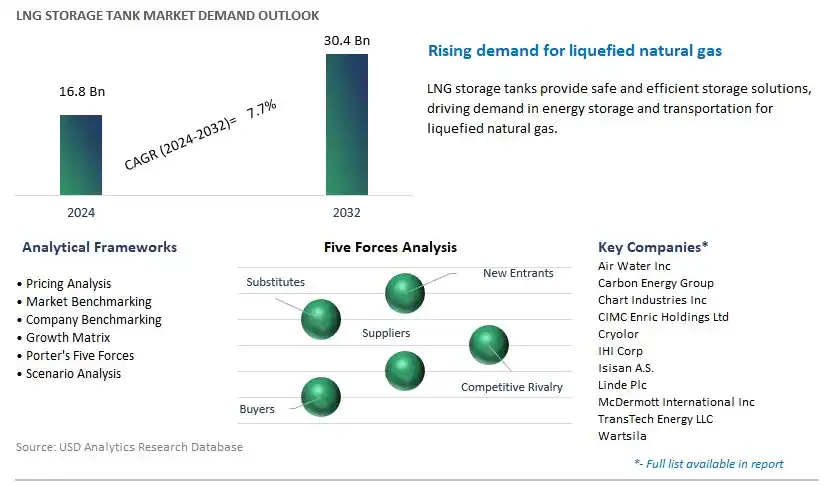
According to USD Analytics the Global LNG Storage Tank Market is projected to grow from $16.8 Billion in 2024 to $30.4 Billion by 2032, at a CAGR of 7.7%. From 2024 to 2032.
The global LNG Storage Tank Market Study analyzes and forecasts the market size across 6 regions and 24 countries for diverse segments -By Type (Self-Supportive, Non-Self-Supportive), By Material (Steel, 9% Nickel Steel, Aluminum Alloy, Others).
An Introduction to LNG Storage Tank Market in 2025
Liquefied natural gas (LNG) storage tanks play a vital role in the transportation and storage of natural gas in its liquid form, enabling efficient distribution and utilization of natural gas resources worldwide. In 2025, the demand for LNG storage tanks s to rise as countries seek to diversify their energy sources and reduce greenhouse gas emissions. LNG storage tanks are typically constructed using materials such as stainless steel, carbon steel, or concrete, and they employ various insulation techniques to maintain the cryogenic temperatures required to keep natural gas in its liquid state. With advancements in tank design, construction methods, and safety features, modern LNG storage tanks offer enhanced reliability, durability, and safety performance. Additionally, the adoption of advanced materials and construction techniques has led to the development of innovative tank designs that minimize heat leakage and reduce environmental impact. As the global demand for natural gas s to grow, driven by factors such as urbanization, industrialization, and environmental regulations, the market for LNG storage tanks is expected to witness steady growth, fueled by investments in infrastructure development and LNG export facilities.
LNG Storage Tank Market Competitive Landscape
The market report analyses the leading companies in the industry including Air Water Inc, Carbon Energy Group, Chart Industries Inc, CIMC Enric Holdings Ltd, Cryolor, IHI Corp, Isisan A.S., Linde Plc, McDermott International Inc, TransTech Energy LLC, Wartsila, and others.
LNG Storage Tank Market Dynamics
Market Trend: Increasing Demand for LNG as a Cleaner Fuel Alternative
The most prominent market trend in LNG storage tanks is the increasing demand for liquefied natural gas (LNG) as a cleaner fuel alternative. With growing environmental concerns and stricter emissions regulations, there is a global shift towards cleaner energy sources, including LNG, for power generation, transportation, and industrial applications. LNG offers significant environmental benefits compared to traditional fossil fuels, including lower carbon emissions and reduced air pollution. As a result, there is a rising need for LNG storage infrastructure, including LNG storage tanks, to support the growing demand for LNG as a cleaner and more sustainable fuel option. This trend is driving investments in LNG infrastructure development and the expansion of LNG storage capacity worldwide.
Market Driver: Expansion of LNG Infrastructure and Export Facilities
A key market driver for LNG storage tanks is the expansion of LNG infrastructure and export facilities. As countries seek to diversify their energy sources and reduce reliance on coal and oil, there is increasing investment in LNG liquefaction plants and export terminals to monetize natural gas reserves and meet growing energy demand in international markets. LNG storage tanks play a crucial role in the LNG supply chain, providing storage capacity for liquefied natural gas before it is loaded onto LNG carriers for transport to import terminals or end-user markets. The expansion of LNG infrastructure, particularly in regions with abundant natural gas reserves such as the United States, Australia, and Qatar, is driving the demand for LNG storage tanks and creating opportunities for tank manufacturers, engineering firms, and construction contractors.
Market Opportunity: Adoption of Innovative Tank Technologies and Safety Measures
An emerging opportunity within the LNG storage tank market lies in the adoption of innovative tank technologies and safety measures. LNG storage tanks are subject to stringent safety regulations and engineering standards to ensure the safe handling and storage of liquefied natural gas. As LNG infrastructure expands and new LNG projects come online, there is a need for advanced tank designs and safety systems to enhance operational efficiency, reliability, and safety performance. Opportunities exist for the development and implementation of technologies such as double containment systems, full containment tanks, and cryogenic insulation materials to minimize the risk of LNG spills, leaks, and accidents. Additionally, there is potential for incorporating digitalization and remote monitoring capabilities into LNG storage tank systems to enable real-time monitoring of tank conditions and early detection of potential hazards. By embracing innovative tank technologies and safety measures, stakeholders in the LNG storage tank market can enhance safety standards, mitigate operational risks, and capitalize on the growing demand for LNG storage infrastructure worldwide.
LNG Storage Tank Market Share Analysis: Self-Supportive Tanks segment generated the highest revenue in 2024
The Self-Supportive Tanks segment is the largest segment within the LNG storage tank market. Self-supportive tanks, also known as full containment tanks, are designed with a reinforced concrete outer wall that provides structural support to the tank, allowing it to withstand the high pressures and low temperatures associated with storing liquefied natural gas (LNG). These tanks are widely preferred for LNG storage applications due to their superior safety features and robust construction, which minimizes the risk of leaks or failures. Additionally, self-supportive tanks offer higher storage capacities compared to non-self-supportive tanks, making them suitable for large-scale LNG storage facilities and terminals. Moreover, advancements in tank design and construction technologies further enhance the efficiency and reliability of self-supportive tanks, driving their adoption in LNG storage projects worldwide. With their proven track record of safety and performance, the Self-Supportive Tanks segment maintains its position as the largest and most significant market segment within the LNG storage tank market.
LNG Storage Tank Market Share Analysis: Aluminum Alloy is poised to register the fastest CAGR over the forecast period
The Aluminum Alloy segment is the fastest-growing segment within the LNG storage tank market. Aluminum alloy has gained traction as a preferred material for LNG storage tanks due to its unique combination of properties, including high strength-to-weight ratio, corrosion resistance, and durability. These attributes make aluminum alloy tanks particularly suitable for applications requiring lightweight and portable storage solutions, such as small-scale LNG terminals and marine bunkering facilities. Additionally, advancements in aluminum alloy manufacturing processes and technologies have led to the development of innovative tank designs that offer improved performance and efficiency while meeting stringent safety standards. Moreover, the increasing focus on sustainability and environmental stewardship in the LNG industry drives the demand for aluminum alloy tanks, as they offer recyclability and lower carbon footprint compared to traditional steel tanks. With its versatility, performance benefits, and growing adoption in various LNG storage applications, the Aluminum Alloy segment is poised for continued rapid growth within the LNG storage tank market.
LNG Storage Tank Market
By Type
Self-Supportive
Non-Self-Supportive
By Material
Steel
9% Nickel Steel
Aluminum Alloy
Others
Countries Analyzed
North America (US, Canada, Mexico)
Europe (Germany, UK, France, Spain, Italy, Russia, Rest of Europe)
Asia Pacific (China, India, Japan, South Korea, Australia, South East Asia, Rest of Asia)
South America (Brazil, Argentina, Rest of South America)
Middle East and Africa (Saudi Arabia, UAE, Rest of Middle East, South Africa, Egypt, Rest of Africa)
LNG Storage Tank Companies Profiled in the Study
Air Water Inc
Carbon Energy Group
Chart Industries Inc
CIMC Enric Holdings Ltd
Cryolor
IHI Corp
Isisan A.S.
Linde Plc
McDermott International Inc
TransTech Energy LLC
Wartsila
*- List Not Exhaustive
TABLE OF CONTENTS
1 Introduction to 2025 LNG Storage Tank Market
1.1 Market Overview
1.2 Quick Facts
1.3 Scope/Objective of the Study
1.4 Market Definition
1.5 Countries and Regions Covered
1.6 Units, Currency, and Conversions
1.7 Industry Value Chain
2 Research Methodology
2.1 Market Size Estimation
2.2 Sources and Research Methodology
2.3 Data Triangulation
2.4 Assumptions and Limitations
3 Executive Summary
3.1 Global LNG Storage Tank Market Size Outlook, $ Million, 2021 to 2034
3.2 LNG Storage Tank Market Outlook by Type, $ Million, 2021 to 2034
3.3 LNG Storage Tank Market Outlook by Product, $ Million, 2021 to 2034
3.4 LNG Storage Tank Market Outlook by Application, $ Million, 2021 to 2034
3.5 LNG Storage Tank Market Outlook by Key Countries, $ Million, 2021 to 2034
4 Market Dynamics
4.1 Key Driving Forces of LNG Storage Tank Industry
4.2 Key Market Trends in LNG Storage Tank Industry
4.3 Potential Opportunities in LNG Storage Tank Industry
4.4 Key Challenges in LNG Storage Tank Industry
5 Market Factor Analysis
5.1 Value Chain Analysis
5.2 Competitive Landscape
5.2.1 Global LNG Storage Tank Market Share by Company (%), 2025
5.2.2 Product Offerings by Company
5.3 Porter’s Five Forces Analysis
5.4 Pricing Analysis and Outlook
6 Growth Outlook Across Scenarios
6.1 Growth Analysis-Case Scenario Definitions
6.2 Low Growth Scenario Forecasts
6.3 Reference Growth Scenario Forecasts
6.4 High Growth Scenario Forecasts
7 Global LNG Storage Tank Market Outlook by Segments
7.1 LNG Storage Tank Market Outlook by Segments, $ Million, 2021- 2034
By Type
Self-Supportive
Non-Self-Supportive
By Material
Steel
9% Nickel Steel
Aluminum Alloy
Others
8 North America LNG Storage Tank Market Analysis and Outlook To 2032
8.1 Introduction to North America LNG Storage Tank Markets in 2024
8.2 North America LNG Storage Tank Market Size Outlook by Country, 2021-2034
8.2.1 United States
8.2.2 Canada
8.2.3 Mexico
8.3 North America LNG Storage Tank Market size Outlook by Segments, 2021-2034
By Type
Self-Supportive
Non-Self-Supportive
By Material
Steel
9% Nickel Steel
Aluminum Alloy
Others
9 Europe LNG Storage Tank Market Analysis and Outlook To 2032
9.1 Introduction to Europe LNG Storage Tank Markets in 2024
9.2 Europe LNG Storage Tank Market Size Outlook by Country, 2021-2034
9.2.1 Germany
9.2.2 France
9.2.3 Spain
9.2.4 United Kingdom
9.2.4 Italy
9.2.5 Russia
9.2.6 Norway
9.2.7 Rest of Europe
9.3 Europe LNG Storage Tank Market Size Outlook by Segments, 2021-2034
By Type
Self-Supportive
Non-Self-Supportive
By Material
Steel
9% Nickel Steel
Aluminum Alloy
Others
10 Asia Pacific LNG Storage Tank Market Analysis and Outlook To 2032
10.1 Introduction to Asia Pacific LNG Storage Tank Markets in 2024
10.2 Asia Pacific LNG Storage Tank Market Size Outlook by Country, 2021-2034
10.2.1 China
10.2.2 India
10.2.3 Japan
10.2.4 South Korea
10.2.5 Indonesia
10.2.6 Malaysia
10.2.7 Australia
10.2.8 Rest of Asia Pacific
10.3 Asia Pacific LNG Storage Tank Market size Outlook by Segments, 2021-2034
By Type
Self-Supportive
Non-Self-Supportive
By Material
Steel
9% Nickel Steel
Aluminum Alloy
Others
11 South America LNG Storage Tank Market Analysis and Outlook To 2032
11.1 Introduction to South America LNG Storage Tank Markets in 2024
11.2 South America LNG Storage Tank Market Size Outlook by Country, 2021-2034
11.2.1 Brazil
11.2.2 Argentina
11.2.3 Rest of South America
11.3 South America LNG Storage Tank Market size Outlook by Segments, 2021-2034
By Type
Self-Supportive
Non-Self-Supportive
By Material
Steel
9% Nickel Steel
Aluminum Alloy
Others
12 Middle East and Africa LNG Storage Tank Market Analysis and Outlook To 2032
12.1 Introduction to Middle East and Africa LNG Storage Tank Markets in 2024
12.2 Middle East and Africa LNG Storage Tank Market Size Outlook by Country, 2021-2034
12.2.1 Saudi Arabia
12.2.2 UAE
12.2.3 Oman
12.2.4 Rest of Middle East
12.2.5 Egypt
12.2.6 Nigeria
12.2.7 South Africa
12.2.8 Rest of Africa
12.3 Middle East and Africa LNG Storage Tank Market size Outlook by Segments, 2021-2034
By Type
Self-Supportive
Non-Self-Supportive
By Material
Steel
9% Nickel Steel
Aluminum Alloy
Others
13 Company Profiles
13.1 Company Snapshot
13.2 SWOT Profiles
13.3 Products and Services
13.4 Recent Developments
13.5 Financial Profile
Air Water Inc
Carbon Energy Group
Chart Industries Inc
CIMC Enric Holdings Ltd
Cryolor
IHI Corp
Isisan A.S.
Linde Plc
McDermott International Inc
TransTech Energy LLC
Wartsila
14 Appendix
14.1 Customization Offerings
14.2 Subscription Services
14.3 Related Reports
14.4 Publisher Expertise
By Type
Self-Supportive
Non-Self-Supportive
By Material
Steel
9% Nickel Steel
Aluminum Alloy
Others
Countries Analyzed
North America (US, Canada, Mexico)
Europe (Germany, UK, France, Spain, Italy, Russia, Rest of Europe)
Asia Pacific (China, India, Japan, South Korea, Australia, South East Asia, Rest of Asia)
South America (Brazil, Argentina, Rest of South America)
Middle East and Africa (Saudi Arabia, UAE, Rest of Middle East, South Africa, Egypt, Rest of Africa)
