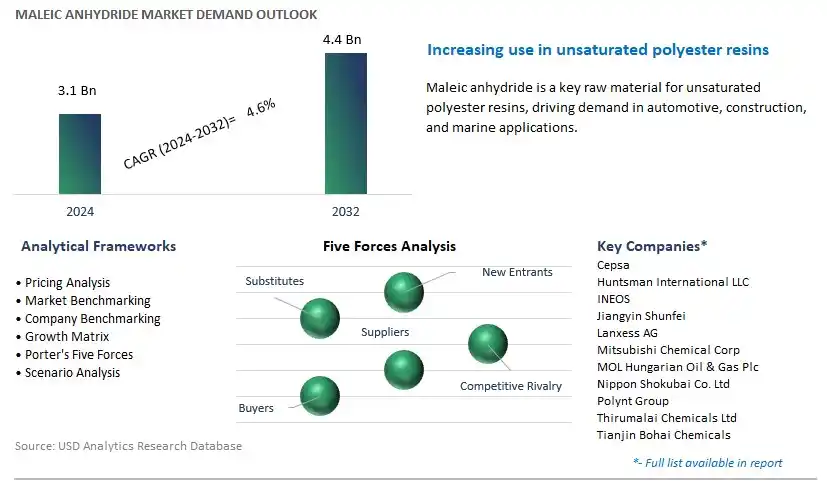
Global Maleic Anhydride Market Size is valued at $3.1 Billion in 2024 and is forecast to register a growth rate (CAGR) of 4.6% to reach $4.4 Billion by 2032.
The global Maleic Anhydride Market Study analyzes and forecasts the market size across 6 regions and 24 countries for diverse segments -By Raw Material (n-butane, Benzene), By Application (Unsaturated polyester resins (UPR), 1,4-butanediol (BDO), Additives, Copolymers, Others).
An Introduction to Maleic Anhydride Market in 2024
Maleic anhydride is a versatile chemical intermediate used in the production of various products such as resins, coatings, adhesives, and plastics. In 2024, the demand for maleic anhydride s to grow as industries rely on its unique chemical properties for diverse applications. Maleic anhydride is produced by the oxidation of butane or benzene and serves as a precursor to maleic acid, fumaric acid, and various maleic esters. It undergoes reactions such as esterification, hydrolysis, and Diels-Alder reactions to form a wide range of derivatives with applications in industries such as construction, automotive, packaging, and textiles. Maleic anhydride-based resins are used in the production of fiberglass-reinforced plastics (FRP), architectural coatings, and water-based adhesives, offering excellent adhesion, chemical resistance, and weatherability. Further, maleic anhydride derivatives find applications in pharmaceuticals, agriculture, and personal care products due to their antifungal, gelling, and crosslinking properties. With ongoing research into sustainable production methods and applications, as well as regulatory initiatives promoting environmentally friendly chemicals, the market for maleic anhydride is expected to witness steady growth, driven by its versatility and indispensable role in various industrial sectors.
Maleic Anhydride Market Competitive Landscape
The market report analyses the leading companies in the industry including Cepsa, Huntsman International LLC, INEOS, Jiangyin Shunfei, Lanxess AG, Mitsubishi Chemical Corp, MOL Hungarian Oil & Gas Plc, Nippon Shokubai Co. Ltd, Polynt Group, Thirumalai Chemicals Ltd, Tianjin Bohai Chemicals, and others.
Maleic Anhydride Market Dynamics
Market Trend: Growing Demand in Construction and Automotive Sectors
A prominent market trend for maleic anhydride is the increasing demand driven by the growth of the construction and automotive sectors. Maleic anhydride is a versatile chemical used in the production of various products, including unsaturated polyester resins, which find wide applications in construction materials, automotive parts, and coatings. With ongoing urbanization and infrastructure development projects worldwide, as well as the rising demand for lightweight and durable materials in the automotive industry, there's a steady increase in the consumption of maleic anhydride. This trend is expected to continue as these sectors expand and evolve.
Market Driver: Rising Demand for Unsaturated Polyester Resins
A key market driver for maleic anhydride is the rising demand for unsaturated polyester resins (UPRs). UPRs are vital components in the manufacturing of fiberglass reinforced plastics (FRP), composites, and coatings, which find extensive applications in construction, automotive, marine, and aerospace industries. Maleic anhydride serves as a feedstock in the production of UPRs, and the growing demand for these resins is fueling the consumption of maleic anhydride. Factors such as increasing construction activities, infrastructure development, and demand for lightweight materials in automotive manufacturing are driving the growth of UPRs and, consequently, the demand for maleic anhydride.
Market Opportunity: Expansion into Renewable Chemicals and Sustainable Solutions
A potential opportunity for maleic anhydride lies in expanding its application into renewable chemicals and sustainable solutions. With growing concerns about environmental sustainability and the shift towards bio-based and eco-friendly products, there's an opportunity to explore the production of maleic anhydride from renewable feedstocks or through greener manufacturing processes. Additionally, maleic anhydride derivatives, such as maleic acid and fumaric acid, have applications in various industries, including food, pharmaceuticals, and personal care. By investing in research and development to develop sustainable production methods and exploring new applications for maleic anhydride derivatives, manufacturers can capitalize on the increasing demand for renewable chemicals and sustainable solutions, thereby enhancing their market competitiveness and contributing to a greener future.
Maleic Anhydride Market Share Analysis: n-Butane segment generated the highest revenue in 2024
The n-Butane segment is the largest segment within the maleic anhydride market. Maleic anhydride is primarily produced through the oxidation of n-butane, a hydrocarbon compound derived from natural gas processing and petroleum refining. The n-Butane segment benefits from the abundant availability and relatively low cost of n-butane compared to benzene, making it the preferred raw material for maleic anhydride production. Additionally, the production process for maleic anhydride from n-butane involves catalytic oxidation, which is a well-established and cost-effective method utilized by many manufacturers globally. Moreover, n-butane-based maleic anhydride production facilities are often integrated with refineries or petrochemical complexes, allowing for economies of scale, logistical efficiencies, and synergies in raw material sourcing and process optimization. Furthermore, the n-Butane segment benefits from the versatility of maleic anhydride as a key intermediate in the production of various downstream products, including unsaturated polyester resins, alkyd resins, lubricant additives, and agricultural chemicals. With its cost advantages, established production infrastructure, and versatile applications, the n-Butane segment maintains its position as the largest and most significant segment within the maleic anhydride market.
Maleic Anhydride Market Share Analysis: 1,4-Butanediol (BDO) is poised to register the fastest CAGR over the forecast period
The 1,4-Butanediol (BDO) segment is the fastest-growing segment within the maleic anhydride market. 1,4-Butanediol is a versatile chemical compound used as a precursor in the production of various high-value downstream products, including tetrahydrofuran (THF), polybutylene terephthalate (PBT), polyurethanes, and synthetic fibers. Maleic anhydride serves as a key intermediate in the production of BDO through the catalytic hydrogenation of maleic anhydride to succinic anhydride, followed by hydrogenation to produce BDO. The BDO segment experiences significant growth due to the increasing demand for BDO-based products in applications such as engineering plastics, automotive components, textiles, pharmaceuticals, and personal care products. Additionally, BDO is favored for its excellent properties such as high chemical and thermal stability, solubility, and versatility in polymerization reactions. Furthermore, the BDO segment benefits from the expansion of end-use industries such as automotive, construction, and consumer goods, which drive the demand for BDO-derived materials and products. Moreover, advancements in production technologies, including bio-based routes for BDO synthesis, further enhance the growth prospects of the segment by addressing sustainability concerns and expanding market opportunities. With its wide-ranging applications, favorable properties, and increasing demand in key industries, the 1,4-Butanediol (BDO) segment is expected to continue its rapid growth trajectory within the maleic anhydride market.
Maleic Anhydride Market
By Raw Material
n-butane
Benzene
By Application
Unsaturated polyester resins (UPR)
1,4-butanediol (BDO)
Additives
Copolymers
Others
Countries Analyzed
North America (US, Canada, Mexico)
Europe (Germany, UK, France, Spain, Italy, Russia, Rest of Europe)
Asia Pacific (China, India, Japan, South Korea, Australia, South East Asia, Rest of Asia)
South America (Brazil, Argentina, Rest of South America)
Middle East and Africa (Saudi Arabia, UAE, Rest of Middle East, South Africa, Egypt, Rest of Africa)
Maleic Anhydride Companies Profiled in the Study
Cepsa
Huntsman International LLC
INEOS
Jiangyin Shunfei
Lanxess AG
Mitsubishi Chemical Corp
MOL Hungarian Oil & Gas Plc
Nippon Shokubai Co. Ltd
Polynt Group
Thirumalai Chemicals Ltd
Tianjin Bohai Chemicals
*- List Not Exhaustive
TABLE OF CONTENTS
1 Introduction to 2024 Maleic Anhydride Market
1.1 Market Overview
1.2 Quick Facts
1.3 Scope/Objective of the Study
1.4 Market Definition
1.5 Countries and Regions Covered
1.6 Units, Currency, and Conversions
1.7 Industry Value Chain
2 Research Methodology
2.1 Market Size Estimation
2.2 Sources and Research Methodology
2.3 Data Triangulation
2.4 Assumptions and Limitations
3 Executive Summary
3.1 Global Maleic Anhydride Market Size Outlook, $ Million, 2021 to 2032
3.2 Maleic Anhydride Market Outlook by Type, $ Million, 2021 to 2032
3.3 Maleic Anhydride Market Outlook by Product, $ Million, 2021 to 2032
3.4 Maleic Anhydride Market Outlook by Application, $ Million, 2021 to 2032
3.5 Maleic Anhydride Market Outlook by Key Countries, $ Million, 2021 to 2032
4 Market Dynamics
4.1 Key Driving Forces of Maleic Anhydride Industry
4.2 Key Market Trends in Maleic Anhydride Industry
4.3 Potential Opportunities in Maleic Anhydride Industry
4.4 Key Challenges in Maleic Anhydride Industry
5 Market Factor Analysis
5.1 Value Chain Analysis
5.2 Competitive Landscape
5.2.1 Global Maleic Anhydride Market Share by Company (%), 2023
5.2.2 Product Offerings by Company
5.3 Porter’s Five Forces Analysis
5.4 Pricing Analysis and Outlook
6 Growth Outlook Across Scenarios
6.1 Growth Analysis-Case Scenario Definitions
6.2 Low Growth Scenario Forecasts
6.3 Reference Growth Scenario Forecasts
6.4 High Growth Scenario Forecasts
7 Global Maleic Anhydride Market Outlook by Segments
7.1 Maleic Anhydride Market Outlook by Segments, $ Million, 2021- 2032
By Raw Material
n-butane
Benzene
By Application
Unsaturated polyester resins (UPR)
1,4-butanediol (BDO)
Additives
Copolymers
Others
8 North America Maleic Anhydride Market Analysis and Outlook To 2032
8.1 Introduction to North America Maleic Anhydride Markets in 2024
8.2 North America Maleic Anhydride Market Size Outlook by Country, 2021-2032
8.2.1 United States
8.2.2 Canada
8.2.3 Mexico
8.3 North America Maleic Anhydride Market size Outlook by Segments, 2021-2032
By Raw Material
n-butane
Benzene
By Application
Unsaturated polyester resins (UPR)
1,4-butanediol (BDO)
Additives
Copolymers
Others
9 Europe Maleic Anhydride Market Analysis and Outlook To 2032
9.1 Introduction to Europe Maleic Anhydride Markets in 2024
9.2 Europe Maleic Anhydride Market Size Outlook by Country, 2021-2032
9.2.1 Germany
9.2.2 France
9.2.3 Spain
9.2.4 United Kingdom
9.2.4 Italy
9.2.5 Russia
9.2.6 Norway
9.2.7 Rest of Europe
9.3 Europe Maleic Anhydride Market Size Outlook by Segments, 2021-2032
By Raw Material
n-butane
Benzene
By Application
Unsaturated polyester resins (UPR)
1,4-butanediol (BDO)
Additives
Copolymers
Others
10 Asia Pacific Maleic Anhydride Market Analysis and Outlook To 2032
10.1 Introduction to Asia Pacific Maleic Anhydride Markets in 2024
10.2 Asia Pacific Maleic Anhydride Market Size Outlook by Country, 2021-2032
10.2.1 China
10.2.2 India
10.2.3 Japan
10.2.4 South Korea
10.2.5 Indonesia
10.2.6 Malaysia
10.2.7 Australia
10.2.8 Rest of Asia Pacific
10.3 Asia Pacific Maleic Anhydride Market size Outlook by Segments, 2021-2032
By Raw Material
n-butane
Benzene
By Application
Unsaturated polyester resins (UPR)
1,4-butanediol (BDO)
Additives
Copolymers
Others
11 South America Maleic Anhydride Market Analysis and Outlook To 2032
11.1 Introduction to South America Maleic Anhydride Markets in 2024
11.2 South America Maleic Anhydride Market Size Outlook by Country, 2021-2032
11.2.1 Brazil
11.2.2 Argentina
11.2.3 Rest of South America
11.3 South America Maleic Anhydride Market size Outlook by Segments, 2021-2032
By Raw Material
n-butane
Benzene
By Application
Unsaturated polyester resins (UPR)
1,4-butanediol (BDO)
Additives
Copolymers
Others
12 Middle East and Africa Maleic Anhydride Market Analysis and Outlook To 2032
12.1 Introduction to Middle East and Africa Maleic Anhydride Markets in 2024
12.2 Middle East and Africa Maleic Anhydride Market Size Outlook by Country, 2021-2032
12.2.1 Saudi Arabia
12.2.2 UAE
12.2.3 Oman
12.2.4 Rest of Middle East
12.2.5 Egypt
12.2.6 Nigeria
12.2.7 South Africa
12.2.8 Rest of Africa
12.3 Middle East and Africa Maleic Anhydride Market size Outlook by Segments, 2021-2032
By Raw Material
n-butane
Benzene
By Application
Unsaturated polyester resins (UPR)
1,4-butanediol (BDO)
Additives
Copolymers
Others
13 Company Profiles
13.1 Company Snapshot
13.2 SWOT Profiles
13.3 Products and Services
13.4 Recent Developments
13.5 Financial Profile
Cepsa
Huntsman International LLC
INEOS
Jiangyin Shunfei
Lanxess AG
Mitsubishi Chemical Corp
MOL Hungarian Oil & Gas Plc
Nippon Shokubai Co. Ltd
Polynt Group
Thirumalai Chemicals Ltd
Tianjin Bohai Chemicals
14 Appendix
14.1 Customization Offerings
14.2 Subscription Services
14.3 Related Reports
14.4 Publisher Expertise
By Raw Material
n-butane
Benzene
By Application
Unsaturated polyester resins (UPR)
1,4-butanediol (BDO)
Additives
Copolymers
Others
Countries Analyzed
North America (US, Canada, Mexico)
Europe (Germany, UK, France, Spain, Italy, Russia, Rest of Europe)
Asia Pacific (China, India, Japan, South Korea, Australia, South East Asia, Rest of Asia)
South America (Brazil, Argentina, Rest of South America)
Middle East and Africa (Saudi Arabia, UAE, Rest of Middle East, South Africa, Egypt, Rest of Africa)
