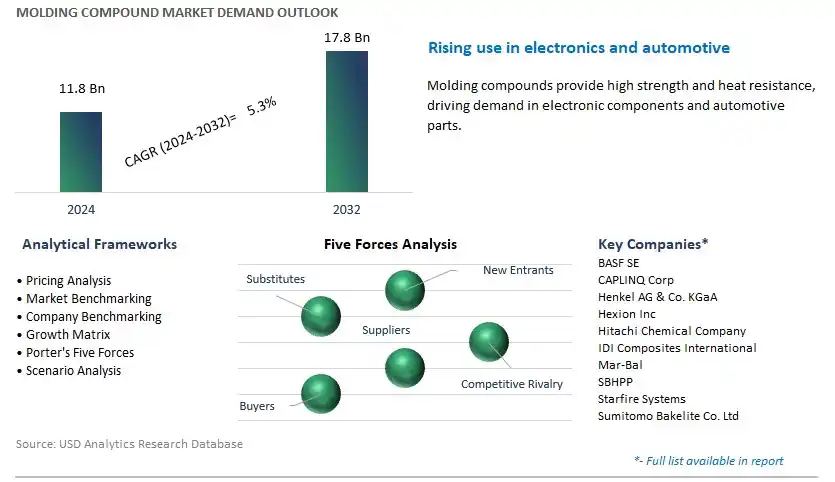
Global Molding Compound Market Size is valued at $11.8 Billion in 2024 and is forecast to register a growth rate (CAGR) of 5.3% to reach $17.8 Billion by 2032.
The global Molding Compound Market Study analyzes and forecasts the market size across 6 regions and 24 countries for diverse segments -By Resin (Phenolic, Epoxy, Polyester, Others), By Application (Electrical, Automotive, Aerospace, Others).
An Introduction to Molding Compound Market in 2024
Molding compounds play a critical role in the manufacturing of composite materials, offering a versatile solution for producing components with superior mechanical properties and dimensional stability. In 2024, the market for molding compounds s to evolve, driven by advancements in resin formulations, reinforcement materials, and manufacturing processes. These compounds, typically composed of thermosetting or thermoplastic resins reinforced with fibers such as glass, carbon, or aramid, are used in diverse applications including automotive parts, aerospace components, sporting goods, and electrical insulation. The market trend towards lightweighting and sustainability has led to the development of bio-based resins and recycled reinforcement materials, catering to the growing demand for environmentally friendly solutions. Further, ongoing research focuses on enhancing the processability, performance, and recyclability of molding compounds to meet the evolving needs of modern manufacturing industries.
Molding Compound Market Competitive Landscape
The market report analyses the leading companies in the industry including BASF SE, CAPLINQ Corp, Henkel AG & Co. KGaA, Hexion Inc, Hitachi Chemical Company, IDI Composites International, Mar-Bal, SBHPP, Starfire Systems, Sumitomo Bakelite Co. Ltd, and others.
Molding Compound Market Dynamics
Market Trend: Shift Towards Lightweight and High-Performance Materials
A prominent market trend for molding compounds is the shift towards lightweight and high-performance materials in various industries such as automotive, aerospace, electronics, and consumer goods. As manufacturers strive to meet stringent performance requirements while reducing vehicle weight, improving fuel efficiency, and enhancing product durability, there's a growing demand for advanced molding compounds that offer superior mechanical properties, thermal stability, and electrical insulation. Molding compounds reinforced with fibers, fillers, and additives enable the production of lightweight components with excellent strength-to-weight ratios, dimensional stability, and resistance to harsh operating conditions. This trend is driven by the need for innovative materials that can replace traditional metals, ceramics, and thermoset plastics in critical applications, leading to increased adoption of molding compounds as preferred materials for lightweighting and performance optimization.
Market Driver: Technological Advancements in Material Science and Manufacturing Processes
A key market driver for molding compounds is the continuous technological advancements in material science, formulation techniques, and manufacturing processes that enable the development of tailored solutions for specific application requirements. With ongoing research and innovation, manufacturers are able to engineer molding compounds with customized properties such as stiffness, impact resistance, flame retardancy, and chemical resistance to meet the diverse needs of different industries and end-users. Advanced compounding technologies, including reactive extrusion, compaction molding, and additive manufacturing, allow for precise control over material composition, morphology, and microstructure, resulting in optimized performance and cost-effective production of molded components. The drive for material innovation, process optimization, and product differentiation fuels the demand for molding compounds as versatile and customizable materials that enable manufacturers to push the boundaries of design and engineering.
Market Opportunity: Expansion into Emerging Applications and Markets
A potential opportunity for molding compound manufacturers lies in the expansion into emerging applications and markets that require specialized materials with unique performance characteristics. Opportunities exist for developing molding compounds tailored to niche sectors such as renewable energy, medical devices, sporting goods, and telecommunications, where there's a demand for lightweight, durable, and environmentally friendly materials. By collaborating with industry partners, conducting market research, and investing in product development, manufacturers can identify unmet needs and niche opportunities for molding compounds in emerging industries and applications. Additionally, there's an opportunity to offer value-added services such as material testing, application engineering support, and supply chain optimization to facilitate the adoption of molding compounds and accelerate market penetration. By diversifying product offerings and targeting new markets, molding compound manufacturers can capitalize on emerging trends, expand their customer base, and drive sustainable growth in the competitive global marketplace.
Molding Compound Market Share Analysis: Phenolic Resin segment generated the highest revenue in 2024
The Phenolic Resin Segment is the largest segment in the Molding Compound Market. Phenolic resins are widely used in molding compounds due to their exceptional heat resistance, mechanical strength, and flame-retardant properties. These resins find extensive application in industries such as automotive, aerospace, electrical, and construction, where high-performance materials are required. Phenolic molding compounds exhibit excellent dimensional stability and resistance to chemicals, making them suitable for manufacturing components subjected to harsh operating conditions. Moreover, phenolic resins offer cost-effectiveness and versatility in processing, allowing for the production of intricate and complex parts through various molding techniques such as compression molding, transfer molding, and injection molding. With the increasing demand for lightweight, durable, and high-temperature-resistant materials in critical applications, the Phenolic Resin Segment maintains its leadership position in the Molding Compound Market as the preferred choice for a broad spectrum of industrial applications.
Molding Compound Market Share Analysis: Aerospace is poised to register the fastest CAGR over the forecast period
The Aerospace Application Segment is the fastest-growing segment in the Molding Compound Market. In the aerospace industry, molding compounds play a critical role in the manufacturing of lightweight and high-performance components used in aircraft and spacecraft. These components include interior panels, structural components, aerodynamic fairings, and insulation materials. The aerospace sector demands materials that offer exceptional strength-to-weight ratio, heat resistance, flame retardancy, and dimensional stability to withstand the extreme conditions experienced during flight. Molding compounds tailored for aerospace applications, such as epoxy and phenolic resins reinforced with fibers like carbon or glass, meet these stringent requirements. Additionally, advancements in composite materials and manufacturing processes have further accelerated the adoption of molding compounds in aerospace applications. With the aerospace industry experiencing sustained growth driven by increasing air travel demand, space exploration initiatives, and technological advancements in aircraft design, the Aerospace Application Segment presents significant growth opportunities for suppliers and manufacturers in the Molding Compound Market as the demand for lightweight and high-performance materials continues to rise in the aerospace sector.
Molding Compound Market
By Resin
Phenolic
Epoxy
Polyester
Others
By Application
Electrical
Automotive
Aerospace
Others
Countries Analyzed
North America (US, Canada, Mexico)
Europe (Germany, UK, France, Spain, Italy, Russia, Rest of Europe)
Asia Pacific (China, India, Japan, South Korea, Australia, South East Asia, Rest of Asia)
South America (Brazil, Argentina, Rest of South America)
Middle East and Africa (Saudi Arabia, UAE, Rest of Middle East, South Africa, Egypt, Rest of Africa)
Molding Compound Companies Profiled in the Study
BASF SE
CAPLINQ Corp
Henkel AG & Co. KGaA
Hexion Inc
Hitachi Chemical Company
IDI Composites International
Mar-Bal
SBHPP
Starfire Systems
Sumitomo Bakelite Co. Ltd
*- List Not Exhaustive
TABLE OF CONTENTS
1 Introduction to 2024 Molding Compound Market
1.1 Market Overview
1.2 Quick Facts
1.3 Scope/Objective of the Study
1.4 Market Definition
1.5 Countries and Regions Covered
1.6 Units, Currency, and Conversions
1.7 Industry Value Chain
2 Research Methodology
2.1 Market Size Estimation
2.2 Sources and Research Methodology
2.3 Data Triangulation
2.4 Assumptions and Limitations
3 Executive Summary
3.1 Global Molding Compound Market Size Outlook, $ Million, 2021 to 2032
3.2 Molding Compound Market Outlook by Type, $ Million, 2021 to 2032
3.3 Molding Compound Market Outlook by Product, $ Million, 2021 to 2032
3.4 Molding Compound Market Outlook by Application, $ Million, 2021 to 2032
3.5 Molding Compound Market Outlook by Key Countries, $ Million, 2021 to 2032
4 Market Dynamics
4.1 Key Driving Forces of Molding Compound Industry
4.2 Key Market Trends in Molding Compound Industry
4.3 Potential Opportunities in Molding Compound Industry
4.4 Key Challenges in Molding Compound Industry
5 Market Factor Analysis
5.1 Value Chain Analysis
5.2 Competitive Landscape
5.2.1 Global Molding Compound Market Share by Company (%), 2023
5.2.2 Product Offerings by Company
5.3 Porter’s Five Forces Analysis
5.4 Pricing Analysis and Outlook
6 Growth Outlook Across Scenarios
6.1 Growth Analysis-Case Scenario Definitions
6.2 Low Growth Scenario Forecasts
6.3 Reference Growth Scenario Forecasts
6.4 High Growth Scenario Forecasts
7 Global Molding Compound Market Outlook by Segments
7.1 Molding Compound Market Outlook by Segments, $ Million, 2021- 2032
By Resin
Phenolic
Epoxy
Polyester
Others
By Application
Electrical
Automotive
Aerospace
Others
8 North America Molding Compound Market Analysis and Outlook To 2032
8.1 Introduction to North America Molding Compound Markets in 2024
8.2 North America Molding Compound Market Size Outlook by Country, 2021-2032
8.2.1 United States
8.2.2 Canada
8.2.3 Mexico
8.3 North America Molding Compound Market size Outlook by Segments, 2021-2032
By Resin
Phenolic
Epoxy
Polyester
Others
By Application
Electrical
Automotive
Aerospace
Others
9 Europe Molding Compound Market Analysis and Outlook To 2032
9.1 Introduction to Europe Molding Compound Markets in 2024
9.2 Europe Molding Compound Market Size Outlook by Country, 2021-2032
9.2.1 Germany
9.2.2 France
9.2.3 Spain
9.2.4 United Kingdom
9.2.4 Italy
9.2.5 Russia
9.2.6 Norway
9.2.7 Rest of Europe
9.3 Europe Molding Compound Market Size Outlook by Segments, 2021-2032
By Resin
Phenolic
Epoxy
Polyester
Others
By Application
Electrical
Automotive
Aerospace
Others
10 Asia Pacific Molding Compound Market Analysis and Outlook To 2032
10.1 Introduction to Asia Pacific Molding Compound Markets in 2024
10.2 Asia Pacific Molding Compound Market Size Outlook by Country, 2021-2032
10.2.1 China
10.2.2 India
10.2.3 Japan
10.2.4 South Korea
10.2.5 Indonesia
10.2.6 Malaysia
10.2.7 Australia
10.2.8 Rest of Asia Pacific
10.3 Asia Pacific Molding Compound Market size Outlook by Segments, 2021-2032
By Resin
Phenolic
Epoxy
Polyester
Others
By Application
Electrical
Automotive
Aerospace
Others
11 South America Molding Compound Market Analysis and Outlook To 2032
11.1 Introduction to South America Molding Compound Markets in 2024
11.2 South America Molding Compound Market Size Outlook by Country, 2021-2032
11.2.1 Brazil
11.2.2 Argentina
11.2.3 Rest of South America
11.3 South America Molding Compound Market size Outlook by Segments, 2021-2032
By Resin
Phenolic
Epoxy
Polyester
Others
By Application
Electrical
Automotive
Aerospace
Others
12 Middle East and Africa Molding Compound Market Analysis and Outlook To 2032
12.1 Introduction to Middle East and Africa Molding Compound Markets in 2024
12.2 Middle East and Africa Molding Compound Market Size Outlook by Country, 2021-2032
12.2.1 Saudi Arabia
12.2.2 UAE
12.2.3 Oman
12.2.4 Rest of Middle East
12.2.5 Egypt
12.2.6 Nigeria
12.2.7 South Africa
12.2.8 Rest of Africa
12.3 Middle East and Africa Molding Compound Market size Outlook by Segments, 2021-2032
By Resin
Phenolic
Epoxy
Polyester
Others
By Application
Electrical
Automotive
Aerospace
Others
13 Company Profiles
13.1 Company Snapshot
13.2 SWOT Profiles
13.3 Products and Services
13.4 Recent Developments
13.5 Financial Profile
BASF SE
CAPLINQ Corp
Henkel AG & Co. KGaA
Hexion Inc
Hitachi Chemical Company
IDI Composites International
Mar-Bal
SBHPP
Starfire Systems
Sumitomo Bakelite Co. Ltd
14 Appendix
14.1 Customization Offerings
14.2 Subscription Services
14.3 Related Reports
14.4 Publisher Expertise
By Resin
Phenolic
Epoxy
Polyester
Others
By Application
Electrical
Automotive
Aerospace
Others
Countries Analyzed
North America (US, Canada, Mexico)
Europe (Germany, UK, France, Spain, Italy, Russia, Rest of Europe)
Asia Pacific (China, India, Japan, South Korea, Australia, South East Asia, Rest of Asia)
South America (Brazil, Argentina, Rest of South America)
Middle East and Africa (Saudi Arabia, UAE, Rest of Middle East, South Africa, Egypt, Rest of Africa)
