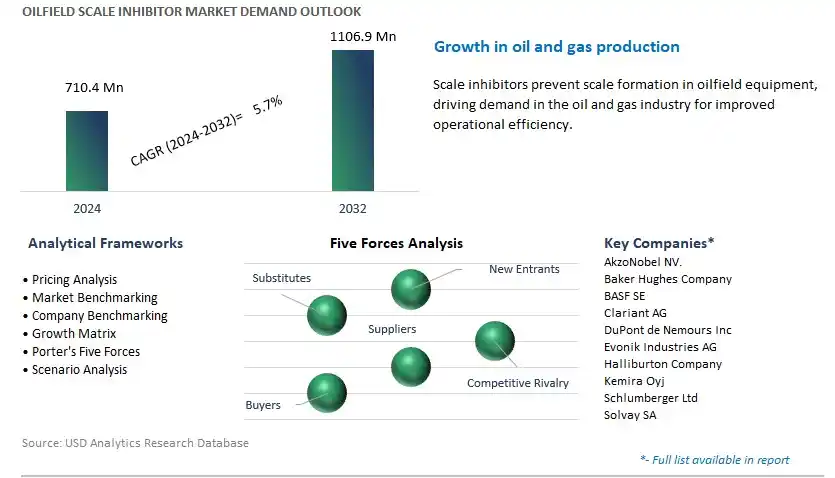
Global Oilfield Scale Inhibitor Market Size is valued at $710.4 Million in 2024 and is forecast to register a growth rate (CAGR) of 5.7% to reach $1106.9 Million by 2032.
The global Oilfield Scale Inhibitor Market Study analyzes and forecasts the market size across 6 regions and 24 countries for diverse segments -By Type (Phosphonates, Carboxylate/Acrylate, Sulfonates, Others).
An Introduction to Oilfield Scale Inhibitor Market in 2024
Oilfield scale inhibitors are specialty chemicals used in the oil and gas industry to prevent the formation and deposition of scale-forming minerals such as calcium carbonate, calcium sulfate, and barium sulfate in production equipment and reservoirs. In 2024, the market for oilfield scale inhibitors remains crucial for ensuring the efficient and safe operation of oil and gas production facilities worldwide. Scale formation can lead to reduced flow rates, equipment damage, and costly shutdowns, making scale inhibition a critical aspect of production optimization and asset integrity management. Oilfield scale inhibitors function by interfering with the nucleation and crystal growth of scale-forming minerals, preventing their precipitation and adhesion to surfaces. These inhibitors are injected into production fluids at specified dosages, where they inhibit scale formation under a wide range of temperature, pressure, and salinity conditions. The demand for oilfield scale inhibitors is driven by factors such as increasing production from challenging reservoirs, the need to extend the operational life of aging wells, and the growing adoption of advanced chemical treatments for reservoir management. Market trends include the development of environmentally friendly inhibitors with reduced toxicity and environmental impact, the optimization of inhibitor formulations for compatibility with different production fluids, and the use of predictive modeling and monitoring technologies for proactive scale management in oilfield operations.
Oilfield Scale Inhibitor Market Competitive Landscape
The market report analyses the leading companies in the industry including AkzoNobel NV., Baker Hughes Company, BASF SE, Clariant AG, DuPont de Nemours Inc, Evonik Industries AG, Halliburton Company, Kemira Oyj, Schlumberger Ltd, Solvay SA, and others.
Oilfield Scale Inhibitor Market Dynamics
Market Trend: Increasing Focus on Cost Reduction and Operational Efficiency
A prominent market trend in oilfield scale inhibitors is the increasing focus on cost reduction and operational efficiency in the oil and gas industry. With fluctuating oil prices, growing competition, and tightening budgets, oilfield operators are seeking ways to optimize production processes and minimize operational expenses. Scale formation in oilfield equipment and pipelines can lead to reduced production rates, increased downtime, and costly maintenance interventions. Therefore, there is a growing demand for effective scale inhibitor solutions that can prevent scale deposition and maintain production efficiency, thereby reducing operational costs and improving overall profitability. This trend towards cost reduction and operational efficiency is driving the adoption of advanced scale inhibitor technologies and integrated chemical management strategies in oilfield operations.
Market Driver: Growth in Oil and Gas Exploration and Production Activities
A key driver for the oilfield scale inhibitor market is the growth in oil and gas exploration and production activities worldwide. Despite fluctuations in oil prices, the demand for energy continues to rise, driving investments in upstream oil and gas projects, including drilling, well stimulation, and production enhancement. As oil and gas reservoirs age, the risk of scale formation increases due to changes in reservoir fluid chemistry, temperature, and pressure conditions. This necessitates the use of scale inhibitor chemicals to prevent scale deposition and maintain production rates. The expansion of oilfield operations, particularly in offshore and unconventional reservoirs, creates opportunities for scale inhibitor suppliers to provide innovative solutions tailored to the specific challenges and requirements of different production environments and reservoir types.
Market Opportunity: Adoption of Environmentally Friendly and Biodegradable Scale Inhibitors
A significant market opportunity for oilfield scale inhibitors lies in the adoption of environmentally friendly and biodegradable scale inhibitor formulations. With growing environmental concerns and regulatory pressure to reduce chemical discharge into the environment, there is an increasing demand for scale inhibitor chemicals that are non-toxic, biodegradable, and environmentally sustainable. Oilfield operators are increasingly seeking alternatives to traditional scale inhibitor chemistries, such as phosphonates and polyacrylates, which may pose risks to aquatic ecosystems and human health. The development and commercialization of eco-friendly scale inhibitor formulations offer opportunities for manufacturers to differentiate their products, meet regulatory requirements, and enhance their corporate sustainability profiles. By leveraging the opportunity presented by environmentally friendly scale inhibitors, suppliers can capture market share, build customer trust, and contribute to sustainable practices in the oil and gas industry.
Oilfield Scale Inhibitor Market Share Analysis: Phosphonates segment generated the highest revenue in 2024
Among the types in the Oilfield Scale Inhibitor Market, the Phosphonates segment is the largest. The large revenue share is driven by the preference for phosphonates as scale inhibitors in the oil and gas industry. Phosphonates exhibit excellent scale inhibition properties and are highly effective in preventing the formation of various types of scales, including calcium carbonate, calcium sulfate, and barium sulfate, which are common in oilfield operations. Additionally, phosphonates offer superior thermal stability and compatibility with other chemicals used in oilfield processes, making them versatile and reliable additives for scale control. Moreover, phosphonates are environmentally friendly and exhibit low toxicity, making them suitable for use in environmentally sensitive areas. As oil and gas exploration and production activities continue to expand globally, the demand for efficient scale inhibition solutions remains high, driving the adoption of phosphonates in oilfield operations. Furthermore, ongoing advancements in phosphonate-based formulations, such as improved performance and cost-effectiveness, further contribute to their widespread use in the oilfield scale inhibitor market. Over the forecast period, the Phosphonates segment is expected to maintain its leadership position in the oilfield scale inhibitor market due to its proven effectiveness, versatility, and environmental compatibility.
Oilfield Scale Inhibitor Market
By Type
Phosphonates
Carboxylate/Acrylate
Sulfonates
Others
Countries Analyzed
North America (US, Canada, Mexico)
Europe (Germany, UK, France, Spain, Italy, Russia, Rest of Europe)
Asia Pacific (China, India, Japan, South Korea, Australia, South East Asia, Rest of Asia)
South America (Brazil, Argentina, Rest of South America)
Middle East and Africa (Saudi Arabia, UAE, Rest of Middle East, South Africa, Egypt, Rest of Africa)
Oilfield Scale Inhibitor Companies Profiled in the Study
AkzoNobel NV.
Baker Hughes Company
BASF SE
Clariant AG
DuPont de Nemours Inc
Evonik Industries AG
Halliburton Company
Kemira Oyj
Schlumberger Ltd
Solvay SA
*- List Not Exhaustive
TABLE OF CONTENTS
1 Introduction to 2024 Oilfield Scale Inhibitor Market
1.1 Market Overview
1.2 Quick Facts
1.3 Scope/Objective of the Study
1.4 Market Definition
1.5 Countries and Regions Covered
1.6 Units, Currency, and Conversions
1.7 Industry Value Chain
2 Research Methodology
2.1 Market Size Estimation
2.2 Sources and Research Methodology
2.3 Data Triangulation
2.4 Assumptions and Limitations
3 Executive Summary
3.1 Global Oilfield Scale Inhibitor Market Size Outlook, $ Million, 2021 to 2032
3.2 Oilfield Scale Inhibitor Market Outlook by Type, $ Million, 2021 to 2032
3.3 Oilfield Scale Inhibitor Market Outlook by Product, $ Million, 2021 to 2032
3.4 Oilfield Scale Inhibitor Market Outlook by Application, $ Million, 2021 to 2032
3.5 Oilfield Scale Inhibitor Market Outlook by Key Countries, $ Million, 2021 to 2032
4 Market Dynamics
4.1 Key Driving Forces of Oilfield Scale Inhibitor Industry
4.2 Key Market Trends in Oilfield Scale Inhibitor Industry
4.3 Potential Opportunities in Oilfield Scale Inhibitor Industry
4.4 Key Challenges in Oilfield Scale Inhibitor Industry
5 Market Factor Analysis
5.1 Value Chain Analysis
5.2 Competitive Landscape
5.2.1 Global Oilfield Scale Inhibitor Market Share by Company (%), 2023
5.2.2 Product Offerings by Company
5.3 Porter’s Five Forces Analysis
5.4 Pricing Analysis and Outlook
6 Growth Outlook Across Scenarios
6.1 Growth Analysis-Case Scenario Definitions
6.2 Low Growth Scenario Forecasts
6.3 Reference Growth Scenario Forecasts
6.4 High Growth Scenario Forecasts
7 Global Oilfield Scale Inhibitor Market Outlook by Segments
7.1 Oilfield Scale Inhibitor Market Outlook by Segments, $ Million, 2021- 2032
By Type
Phosphonates
Carboxylate/Acrylate
Sulfonates
Others
8 North America Oilfield Scale Inhibitor Market Analysis and Outlook To 2032
8.1 Introduction to North America Oilfield Scale Inhibitor Markets in 2024
8.2 North America Oilfield Scale Inhibitor Market Size Outlook by Country, 2021-2032
8.2.1 United States
8.2.2 Canada
8.2.3 Mexico
8.3 North America Oilfield Scale Inhibitor Market size Outlook by Segments, 2021-2032
By Type
Phosphonates
Carboxylate/Acrylate
Sulfonates
Others
9 Europe Oilfield Scale Inhibitor Market Analysis and Outlook To 2032
9.1 Introduction to Europe Oilfield Scale Inhibitor Markets in 2024
9.2 Europe Oilfield Scale Inhibitor Market Size Outlook by Country, 2021-2032
9.2.1 Germany
9.2.2 France
9.2.3 Spain
9.2.4 United Kingdom
9.2.4 Italy
9.2.5 Russia
9.2.6 Norway
9.2.7 Rest of Europe
9.3 Europe Oilfield Scale Inhibitor Market Size Outlook by Segments, 2021-2032
By Type
Phosphonates
Carboxylate/Acrylate
Sulfonates
Others
10 Asia Pacific Oilfield Scale Inhibitor Market Analysis and Outlook To 2032
10.1 Introduction to Asia Pacific Oilfield Scale Inhibitor Markets in 2024
10.2 Asia Pacific Oilfield Scale Inhibitor Market Size Outlook by Country, 2021-2032
10.2.1 China
10.2.2 India
10.2.3 Japan
10.2.4 South Korea
10.2.5 Indonesia
10.2.6 Malaysia
10.2.7 Australia
10.2.8 Rest of Asia Pacific
10.3 Asia Pacific Oilfield Scale Inhibitor Market size Outlook by Segments, 2021-2032
By Type
Phosphonates
Carboxylate/Acrylate
Sulfonates
Others
11 South America Oilfield Scale Inhibitor Market Analysis and Outlook To 2032
11.1 Introduction to South America Oilfield Scale Inhibitor Markets in 2024
11.2 South America Oilfield Scale Inhibitor Market Size Outlook by Country, 2021-2032
11.2.1 Brazil
11.2.2 Argentina
11.2.3 Rest of South America
11.3 South America Oilfield Scale Inhibitor Market size Outlook by Segments, 2021-2032
By Type
Phosphonates
Carboxylate/Acrylate
Sulfonates
Others
12 Middle East and Africa Oilfield Scale Inhibitor Market Analysis and Outlook To 2032
12.1 Introduction to Middle East and Africa Oilfield Scale Inhibitor Markets in 2024
12.2 Middle East and Africa Oilfield Scale Inhibitor Market Size Outlook by Country, 2021-2032
12.2.1 Saudi Arabia
12.2.2 UAE
12.2.3 Oman
12.2.4 Rest of Middle East
12.2.5 Egypt
12.2.6 Nigeria
12.2.7 South Africa
12.2.8 Rest of Africa
12.3 Middle East and Africa Oilfield Scale Inhibitor Market size Outlook by Segments, 2021-2032
By Type
Phosphonates
Carboxylate/Acrylate
Sulfonates
Others
13 Company Profiles
13.1 Company Snapshot
13.2 SWOT Profiles
13.3 Products and Services
13.4 Recent Developments
13.5 Financial Profile
AkzoNobel NV.
Baker Hughes Company
BASF SE
Clariant AG
DuPont de Nemours Inc
Evonik Industries AG
Halliburton Company
Kemira Oyj
Schlumberger Ltd
Solvay SA
14 Appendix
14.1 Customization Offerings
14.2 Subscription Services
14.3 Related Reports
14.4 Publisher Expertise
By Type
Phosphonates
Carboxylate/Acrylate
Sulfonates
Others
Countries Analyzed
North America (US, Canada, Mexico)
Europe (Germany, UK, France, Spain, Italy, Russia, Rest of Europe)
Asia Pacific (China, India, Japan, South Korea, Australia, South East Asia, Rest of Asia)
South America (Brazil, Argentina, Rest of South America)
Middle East and Africa (Saudi Arabia, UAE, Rest of Middle East, South Africa, Egypt, Rest of Africa)
