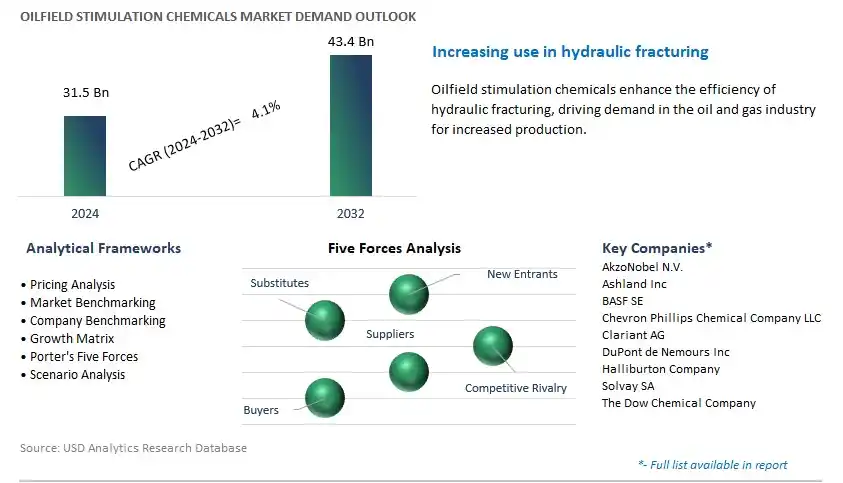
Global Oilfield Stimulation Chemicals Market Size is valued at $31.5 Billion in 2024 and is forecast to register a growth rate (CAGR) of 4.1% to reach $43.4 Billion by 2032.
The global Oilfield Stimulation Chemicals Market Study analyzes and forecasts the market size across 6 regions and 24 countries for diverse segments -By Product (Gelling Agents, Corrosion Inhibitors, Acids and Biocides, Friction Reducers, Others), By Application (Hydraulic Fracturing, Matrix Acidization, Acid Fracking, Others).
An Introduction to Oilfield Stimulation Chemicals Market in 2024
Oilfield stimulation chemicals are specialized additives used in hydraulic fracturing (fracking) and acidizing operations to enhance the productivity of oil and gas reservoirs by improving fluid flow and reservoir permeability. In 2024, the market for oilfield stimulation chemicals s to evolve as the oil and gas industry seeks to maximize recovery from unconventional and mature reservoirs. These chemicals include friction reducers, biocides, scale inhibitors, corrosion inhibitors, and proppants, each playing a specific role in the stimulation process. Hydraulic fracturing involves injecting a mixture of water, chemicals, and proppants into the reservoir at high pressure to create fractures and enhance hydrocarbon production, while acidizing treatments involve the injection of acids to dissolve rock formations and improve fluid flow paths. The demand for oilfield stimulation chemicals is driven by factors such as the growth of unconventional oil and gas production, technological advancements in stimulation techniques, and the need to overcome production challenges such as low permeability and reservoir heterogeneity. Market trends include the development of environmentally friendly and biodegradable stimulation chemicals, the optimization of chemical formulations for specific reservoir conditions, and the integration of digital technologies for real-time monitoring and control of stimulation operations to maximize efficiency and
Oilfield Stimulation Chemicals Market Competitive Landscape
The market report analyses the leading companies in the industry including AkzoNobel N.V., Ashland Inc, BASF SE, Chevron Phillips Chemical Company LLC, Clariant AG, DuPont de Nemours Inc, Halliburton Company, Solvay SA, The Dow Chemical Company, and others.
Oilfield Stimulation Chemicals Market Dynamics
Market Trend: Shift Towards Enhanced Oil Recovery Techniques
A prominent market trend in oilfield stimulation chemicals is the shift towards enhanced oil recovery (EOR) techniques to maximize production from mature oilfields. As conventional oil reserves deplete, oilfield operators are turning to advanced stimulation techniques such as hydraulic fracturing, acidizing, and water flooding to enhance oil production rates and extend the economic life of reservoirs. Oilfield stimulation chemicals play a crucial role in these processes by optimizing fluid viscosity, controlling formation damage, and improving reservoir sweep efficiency. With the increasing adoption of EOR methods to unlock unconventional resources and revitalize mature fields, there is a growing demand for specialized stimulation chemicals that can enhance oil recovery rates and maximize reservoir performance.
Market Driver: Growing Exploration and Development of Unconventional Oil and Gas Resources
A key driver for the oilfield stimulation chemicals market is the growing exploration and development of unconventional oil and gas resources, such as shale oil and tight gas reservoirs. Technological advancements in horizontal drilling and hydraulic fracturing have enabled the extraction of hydrocarbons from previously inaccessible formations, leading to a surge in unconventional oil and gas production worldwide. Oilfield stimulation chemicals are essential components of hydraulic fracturing fluids, which are injected into reservoirs under high pressure to create fractures and enhance hydrocarbon flow. The increasing development of unconventional resources drives the demand for stimulation chemicals that can optimize fracturing fluid performance, improve well productivity, and maximize hydrocarbon recovery.
Market Opportunity: Development of Environmentally Friendly and Sustainable Stimulation Chemicals
A significant market opportunity for oilfield stimulation chemicals lies in the development of environmentally friendly and sustainable formulations. With growing concerns about environmental impact and public scrutiny of hydraulic fracturing operations, there is a demand for stimulation chemicals that minimize environmental footprint, reduce water usage, and mitigate risks to air and water quality. Manufacturers have the opportunity to innovate and formulate stimulation chemicals using biodegradable, non-toxic, and eco-friendly ingredients that meet regulatory requirements and address stakeholder concerns. By leveraging the opportunity presented by environmentally friendly stimulation chemicals, suppliers can differentiate their products, gain market share, and align with the sustainability goals of oilfield operators and regulatory authorities. This can lead to the development of new product lines, partnerships, and market segments, driving growth and differentiation in the oilfield stimulation chemicals market.
Oilfield Stimulation Chemicals Market Share Analysis: Gelling Agents segment generated the highest revenue in 2024
Within the Oilfield Stimulation Chemicals Market, the Gelling Agents segment is experiencing rapid growth, surpassing other segments. This surge in demand is driven by adoption of gelling agents in oilfield stimulation operations. Gelling agents play a crucial role in hydraulic fracturing, also known as fracking, where they are used to thicken the fracturing fluid, creating a viscous gel that efficiently carries proppants into the formation and helps prop open the fractures. As hydraulic fracturing activities continue to rise globally, particularly in unconventional oil and gas reservoirs such as shale formations, the demand for gelling agents escalates accordingly. Additionally, advancements in gelling agent formulations, such as improved viscosity control, thermal stability, and compatibility with other stimulation chemicals, enhance their effectiveness and versatility in various reservoir conditions. Furthermore, the increasing focus on maximizing well productivity and optimizing production rates drives the demand for high-performance gelling agents that can ensure successful reservoir stimulation and enhance hydrocarbon recovery. Over the forecast period, the Gelling Agents segment is poised for significant growth in the oilfield stimulation chemicals market due to its vital role in enabling efficient hydraulic fracturing operations and maximizing the production potential of oil and gas reservoirs.
Oilfield Stimulation Chemicals Market Share Analysis: Hydraulic Fracturing is poised to register the fastest CAGR over the forecast period
Among the applications in the Oilfield Stimulation Chemicals Market, the Hydraulic Fracturing segment stands out as the fastest-growing. The market growth is driven by demand for stimulation chemicals specifically tailored for hydraulic fracturing operations. Hydraulic fracturing, or fracking, has revolutionized the oil and gas industry by enabling the extraction of hydrocarbons from unconventional reservoirs such as shale formations. This technique involves injecting a mixture of water, sand, and stimulation chemicals into the reservoir under high pressure to create fractures in the rock formation, allowing trapped oil and gas to flow more freely to the wellbore. As the global demand for energy continues to rise and conventional reserves dwindle, hydraulic fracturing plays an increasingly crucial role in unlocking vast reserves of unconventional hydrocarbons. Consequently, the demand for stimulation chemicals used in hydraulic fracturing, including gelling agents, corrosion inhibitors, biocides, and friction reducers, is witnessing significant growth. Furthermore, ongoing advancements in hydraulic fracturing technologies and the development of more efficient and environmentally friendly stimulation chemicals contribute to the accelerated growth of the Hydraulic Fracturing segment in the oilfield stimulation chemicals market. Over the forecast period, the Hydraulic Fracturing segment is expected to continue its rapid expansion as the oil and gas industry increasingly relies on hydraulic fracturing techniques to maximize production from unconventional reservoirs.
Oilfield Stimulation Chemicals Market
By Product
Gelling Agents
Corrosion Inhibitors
Acids and Biocides
Friction Reducers
Others
By Application
Hydraulic Fracturing
Matrix Acidization
Acid Fracking
Others
Countries Analyzed
North America (US, Canada, Mexico)
Europe (Germany, UK, France, Spain, Italy, Russia, Rest of Europe)
Asia Pacific (China, India, Japan, South Korea, Australia, South East Asia, Rest of Asia)
South America (Brazil, Argentina, Rest of South America)
Middle East and Africa (Saudi Arabia, UAE, Rest of Middle East, South Africa, Egypt, Rest of Africa)
Oilfield Stimulation Chemicals Companies Profiled in the Study
AkzoNobel N.V.
Ashland Inc
BASF SE
Chevron Phillips Chemical Company LLC
Clariant AG
DuPont de Nemours Inc
Halliburton Company
Solvay SA
The Dow Chemical Company
*- List Not Exhaustive
TABLE OF CONTENTS
1 Introduction to 2024 Oilfield Stimulation Chemicals Market
1.1 Market Overview
1.2 Quick Facts
1.3 Scope/Objective of the Study
1.4 Market Definition
1.5 Countries and Regions Covered
1.6 Units, Currency, and Conversions
1.7 Industry Value Chain
2 Research Methodology
2.1 Market Size Estimation
2.2 Sources and Research Methodology
2.3 Data Triangulation
2.4 Assumptions and Limitations
3 Executive Summary
3.1 Global Oilfield Stimulation Chemicals Market Size Outlook, $ Million, 2021 to 2032
3.2 Oilfield Stimulation Chemicals Market Outlook by Type, $ Million, 2021 to 2032
3.3 Oilfield Stimulation Chemicals Market Outlook by Product, $ Million, 2021 to 2032
3.4 Oilfield Stimulation Chemicals Market Outlook by Application, $ Million, 2021 to 2032
3.5 Oilfield Stimulation Chemicals Market Outlook by Key Countries, $ Million, 2021 to 2032
4 Market Dynamics
4.1 Key Driving Forces of Oilfield Stimulation Chemicals Industry
4.2 Key Market Trends in Oilfield Stimulation Chemicals Industry
4.3 Potential Opportunities in Oilfield Stimulation Chemicals Industry
4.4 Key Challenges in Oilfield Stimulation Chemicals Industry
5 Market Factor Analysis
5.1 Value Chain Analysis
5.2 Competitive Landscape
5.2.1 Global Oilfield Stimulation Chemicals Market Share by Company (%), 2023
5.2.2 Product Offerings by Company
5.3 Porter’s Five Forces Analysis
5.4 Pricing Analysis and Outlook
6 Growth Outlook Across Scenarios
6.1 Growth Analysis-Case Scenario Definitions
6.2 Low Growth Scenario Forecasts
6.3 Reference Growth Scenario Forecasts
6.4 High Growth Scenario Forecasts
7 Global Oilfield Stimulation Chemicals Market Outlook by Segments
7.1 Oilfield Stimulation Chemicals Market Outlook by Segments, $ Million, 2021- 2032
By Product
Gelling Agents
Corrosion Inhibitors
Acids and Biocides
Friction Reducers
Others
By Application
Hydraulic Fracturing
Matrix Acidization
Acid Fracking
Others
8 North America Oilfield Stimulation Chemicals Market Analysis and Outlook To 2032
8.1 Introduction to North America Oilfield Stimulation Chemicals Markets in 2024
8.2 North America Oilfield Stimulation Chemicals Market Size Outlook by Country, 2021-2032
8.2.1 United States
8.2.2 Canada
8.2.3 Mexico
8.3 North America Oilfield Stimulation Chemicals Market size Outlook by Segments, 2021-2032
By Product
Gelling Agents
Corrosion Inhibitors
Acids and Biocides
Friction Reducers
Others
By Application
Hydraulic Fracturing
Matrix Acidization
Acid Fracking
Others
9 Europe Oilfield Stimulation Chemicals Market Analysis and Outlook To 2032
9.1 Introduction to Europe Oilfield Stimulation Chemicals Markets in 2024
9.2 Europe Oilfield Stimulation Chemicals Market Size Outlook by Country, 2021-2032
9.2.1 Germany
9.2.2 France
9.2.3 Spain
9.2.4 United Kingdom
9.2.4 Italy
9.2.5 Russia
9.2.6 Norway
9.2.7 Rest of Europe
9.3 Europe Oilfield Stimulation Chemicals Market Size Outlook by Segments, 2021-2032
By Product
Gelling Agents
Corrosion Inhibitors
Acids and Biocides
Friction Reducers
Others
By Application
Hydraulic Fracturing
Matrix Acidization
Acid Fracking
Others
10 Asia Pacific Oilfield Stimulation Chemicals Market Analysis and Outlook To 2032
10.1 Introduction to Asia Pacific Oilfield Stimulation Chemicals Markets in 2024
10.2 Asia Pacific Oilfield Stimulation Chemicals Market Size Outlook by Country, 2021-2032
10.2.1 China
10.2.2 India
10.2.3 Japan
10.2.4 South Korea
10.2.5 Indonesia
10.2.6 Malaysia
10.2.7 Australia
10.2.8 Rest of Asia Pacific
10.3 Asia Pacific Oilfield Stimulation Chemicals Market size Outlook by Segments, 2021-2032
By Product
Gelling Agents
Corrosion Inhibitors
Acids and Biocides
Friction Reducers
Others
By Application
Hydraulic Fracturing
Matrix Acidization
Acid Fracking
Others
11 South America Oilfield Stimulation Chemicals Market Analysis and Outlook To 2032
11.1 Introduction to South America Oilfield Stimulation Chemicals Markets in 2024
11.2 South America Oilfield Stimulation Chemicals Market Size Outlook by Country, 2021-2032
11.2.1 Brazil
11.2.2 Argentina
11.2.3 Rest of South America
11.3 South America Oilfield Stimulation Chemicals Market size Outlook by Segments, 2021-2032
By Product
Gelling Agents
Corrosion Inhibitors
Acids and Biocides
Friction Reducers
Others
By Application
Hydraulic Fracturing
Matrix Acidization
Acid Fracking
Others
12 Middle East and Africa Oilfield Stimulation Chemicals Market Analysis and Outlook To 2032
12.1 Introduction to Middle East and Africa Oilfield Stimulation Chemicals Markets in 2024
12.2 Middle East and Africa Oilfield Stimulation Chemicals Market Size Outlook by Country, 2021-2032
12.2.1 Saudi Arabia
12.2.2 UAE
12.2.3 Oman
12.2.4 Rest of Middle East
12.2.5 Egypt
12.2.6 Nigeria
12.2.7 South Africa
12.2.8 Rest of Africa
12.3 Middle East and Africa Oilfield Stimulation Chemicals Market size Outlook by Segments, 2021-2032
By Product
Gelling Agents
Corrosion Inhibitors
Acids and Biocides
Friction Reducers
Others
By Application
Hydraulic Fracturing
Matrix Acidization
Acid Fracking
Others
13 Company Profiles
13.1 Company Snapshot
13.2 SWOT Profiles
13.3 Products and Services
13.4 Recent Developments
13.5 Financial Profile
AkzoNobel N.V.
Ashland Inc
BASF SE
Chevron Phillips Chemical Company LLC
Clariant AG
DuPont de Nemours Inc
Halliburton Company
Solvay SA
The Dow Chemical Company
14 Appendix
14.1 Customization Offerings
14.2 Subscription Services
14.3 Related Reports
14.4 Publisher Expertise
By Product
Gelling Agents
Corrosion Inhibitors
Acids and Biocides
Friction Reducers
Others
By Application
Hydraulic Fracturing
Matrix Acidization
Acid Fracking
Others
Countries Analyzed
North America (US, Canada, Mexico)
Europe (Germany, UK, France, Spain, Italy, Russia, Rest of Europe)
Asia Pacific (China, India, Japan, South Korea, Australia, South East Asia, Rest of Asia)
South America (Brazil, Argentina, Rest of South America)
Middle East and Africa (Saudi Arabia, UAE, Rest of Middle East, South Africa, Egypt, Rest of Africa)
