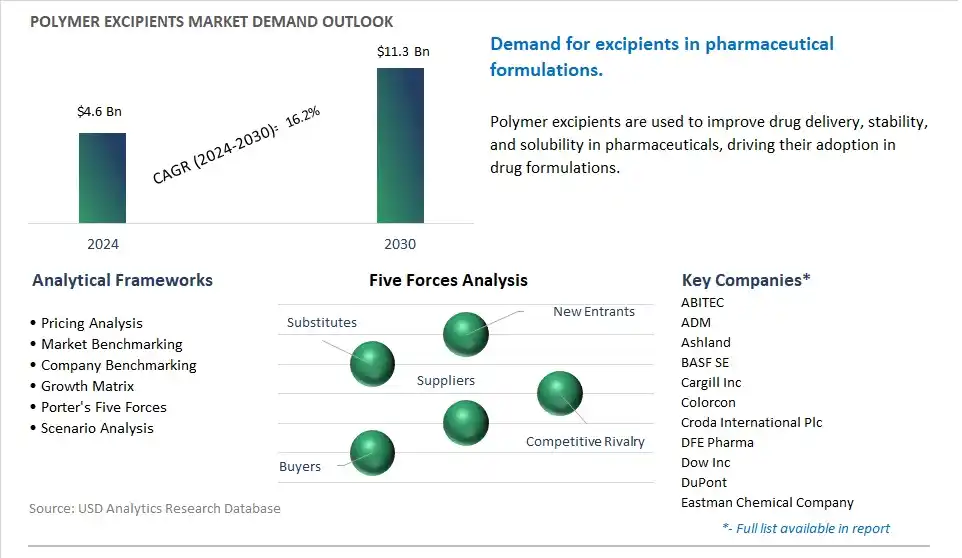
The global Polymer Excipients Market is poised to register a 16.2% CAGR from $4.6 Billion in 2024 to $11.3 Billion in 2030.
The global Polymer Excipients Market Study analyzes and forecasts the market size across 6 regions and 24 countries for diverse segments -By Product (Polyvinylpyrrolidone, Polyethylene Glycol, Starch, Micro Crystalline Cellulose (MCC), Ethyl and Methyl Cellulose, Hydroxypropyl Methylcellulose (HPMC), Others), By Application (Binders, Viscosity Modifiers, Coatings, Flavors, Preservatives, Colorants, Sweeteners, Others).
An Introduction to Global Polymer Excipients Market in 2024
The pharmaceutical industry's continuous quest for safer and more effective drug delivery systems is driving the demand for polymer excipients. Key trends shaping this market include the development of novel excipients with enhanced functionalities, such as controlled release, solubility enhancement, and taste masking, to overcome formulation challenges and improve patient compliance. Moreover, the shift towards personalized medicine and biopharmaceuticals is fueling the demand for biocompatible and biodegradable polymer excipients. Regulatory approvals for innovative excipients and increasing investments in research and development are expected to further accelerate the growth of the polymer excipients market in the coming years.
Polymer Excipients Market Competitive Landscape
The market report analyses the leading companies in the industry including ABITEC, ADM, Ashland, BASF SE, Cargill Inc, Colorcon, Croda International Plc, DFE Pharma, Dow Inc, DuPont, Eastman Chemical Company, Evonik Industries AG, FINAR LTD, JRS PHARMA, Kerry Inc, Roquette Frères, The Lubrizol Corp.
Polymer Excipients Market Dynamics
Polymer Excipients Market Trend: Growing Demand for Biodegradable and Sustainable Excipients
A prominent trend in the polymer excipients market is the increasing demand for biodegradable and sustainable excipients in pharmaceutical formulations. With growing concerns about environmental sustainability and regulatory pressures to reduce plastic waste, there is a shift towards the use of biodegradable polymers as excipients in drug delivery systems and pharmaceutical formulations. Polymer excipients derived from renewable resources offer advantages such as biocompatibility, controlled release properties, and reduced environmental impact compared to traditional synthetic excipients. The concerns about plastic pollution is driving the adoption of biodegradable polymer excipients in drug development and formulation.
Polymer Excipients Market Driver: Advancements in Drug Delivery Technologies
The market for polymer excipients is driven by advancements in drug delivery technologies and formulation techniques. As pharmaceutical companies strive to develop innovative drug formulations with improved efficacy, safety, and patient compliance, there is a growing demand for excipients that can enhance drug solubility, stability, and bioavailability. Polymers offer unique properties that enable controlled release, targeted delivery, and modulation of drug release kinetics, making them valuable components in various drug delivery systems such as nanoparticles, microparticles, and implants. With the increasing complexity of drug formulations and the need for customized delivery solutions, the demand for versatile polymer excipients is on the rise, driving market growth in the pharmaceutical industry.
Polymer Excipients Market Opportunity: Expansion into Nutraceuticals and Cosmeceuticals
A potential opportunity in the polymer excipients market lies in expanding into nutraceuticals and cosmeceuticals sectors. Polymer excipients offer functional benefits such as encapsulation, stabilization, and controlled release in nutraceutical and cosmeceutical formulations, providing opportunities for enhancing product performance and consumer acceptance. With the growing demand for functional foods, dietary supplements, and cosmetic products with improved efficacy and bioavailability, there is a need for excipients that can enhance the delivery and absorption of bioactive ingredients. By leveraging their expertise in polymer science and formulation technologies, manufacturers can develop innovative excipients tailored to the specific requirements of nutraceutical and cosmeceutical applications, tapping into new market segments and driving growth in these industries.
Polymer Excipients Market Share Analysis: Micro Crystalline Cellulose (MCC) product generated the highest revenue in 2024
The largest segment in the Polymer Excipients Market is the Micro Crystalline Cellulose (MCC) product category. MCC is widely used as a filler and binder in pharmaceutical and nutraceutical formulations due to its excellent compressibility, flow properties, and binding capabilities. MCC serves as an essential excipient in the manufacturing of tablets, capsules, and granules, where it helps improve drug delivery, stability, and dissolution characteristics of active pharmaceutical ingredients (APIs). Additionally, MCC is chemically inert, biocompatible, and insoluble in water, making it suitable for use in oral dosage forms that require controlled release, sustained release, or immediate release profiles. Further, MCC offers versatility in formulation development, as it can be modified to achieve specific particle sizes, surface areas, and porosities to meet the requirements of different drug products and manufacturing processes. Furthermore, MCC is generally recognized as safe (GRAS) by regulatory authorities and complies with pharmacopeial standards, ensuring its acceptance and use in pharmaceutical formulations worldwide. Additionally, the growing pharmaceutical industry, increasing prevalence of chronic diseases, and rising demand for generic drugs drive the demand for MCC as a key excipient in drug formulations. Over the forecast period, the unique combination of functional properties, regulatory compliance, and widespread acceptance in pharmaceutical applications positions MCC as the largest segment in the Polymer Excipients Market.
Polymer Excipients Market Share Analysis: Binders application segment is poised to register the fastest growth rate (CAGR) over the forecast period to 2030
The fastest-growing segment in the Polymer Excipients Market is the Binders application category. Binders play a crucial role in pharmaceutical and nutraceutical formulations as they are responsible for holding the active pharmaceutical ingredients (APIs) together and providing cohesion to the dosage form, such as tablets and capsules. With the increasing demand for oral solid dosage forms, including tablets and capsules, there is a corresponding rise in the need for effective binders to ensure the integrity, stability, and uniformity of the final dosage form. Polymer excipients used as binders, such as hydroxypropyl methylcellulose (HPMC), microcrystalline cellulose (MCC), and polyvinylpyrrolidone (PVP), offer advantages such as good binding properties, compressibility, and compatibility with a wide range of APIs. Additionally, binders can influence the drug release profile, disintegration time, and bioavailability of the dosage form, making them essential components in formulation development. Further, the growing pharmaceutical industry, increasing prevalence of chronic diseases, and rising demand for novel drug delivery systems drive the demand for binders in pharmaceutical formulations. Furthermore, advancements in polymer chemistry, manufacturing technologies, and formulation techniques contribute to the development of innovative binder materials with improved performance and functionality, further propelling the growth of the Binders application segment in the Polymer Excipients Market. Over the forecast period, the critical role of binders in ensuring the quality and efficacy of pharmaceutical products, coupled with the ongoing advancements in formulation science, fuels the rapid expansion of the Binders segment in the Polymer Excipients Market.
Polymer Excipients Market Report Segmentation
By Product
Polyvinylpyrrolidone
Polyethylene Glycol
Starch
Micro Crystalline Cellulose (MCC)
Ethyl and Methyl Cellulose
Hydroxypropyl Methylcellulose (HPMC)
Others
By Application
Binders
Viscosity Modifiers
Coatings
Flavors
Preservatives
Colorants
Sweeteners
Others
Regions Included
North America (US, Canada, Mexico)
Europe (Germany, UK, France, Spain, Italy, Russia, Rest of Europe)
Asia Pacific (China, India, Japan, South Korea, Australia, South East Asia, Rest of Asia)
South America (Brazil, Argentina, Rest of South America)
Middle East and Africa (Saudi Arabia, UAE, Rest of Middle East, South Africa, Egypt, Rest of Africa)
Polymer Excipients Companies Profiled in the Market Study
ABITEC
ADM
Ashland
BASF SE
Cargill Inc
Colorcon
Croda International Plc
DFE Pharma
Dow Inc
DuPont
Eastman Chemical Company
Evonik Industries AG
FINAR LTD
JRS PHARMA
Kerry Inc
Roquette Frères
The Lubrizol Corp
*- List Not Exhaustive
TABLE OF CONTENTS
1 Introduction to 2024 Polymer Excipients Market
1.1 Market Overview
1.2 Quick Facts
1.3 Scope/Objective of the Study
1.4 Market Definition
1.5 Countries and Regions Covered
1.6 Units, Currency, and Conversions
1.7 Industry Value Chain
2 Research Methodology
2.1 Market Size Estimation
2.2 Sources and Research Methodology
2.3 Data Triangulation
2.4 Assumptions and Limitations
3 Executive Summary
3.1 Global Polymer Excipients Market Size Outlook, $ Million, 2021 to 2030
3.2 Polymer Excipients Market Outlook by Type, $ Million, 2021 to 2030
3.3 Polymer Excipients Market Outlook by Product, $ Million, 2021 to 2030
3.4 Polymer Excipients Market Outlook by Application, $ Million, 2021 to 2030
3.5 Polymer Excipients Market Outlook by Key Countries, $ Million, 2021 to 2030
4 Market Dynamics
4.1 Key Driving Forces of Polymer Excipients Industry
4.2 Key Market Trends in Polymer Excipients Industry
4.3 Potential Opportunities in Polymer Excipients Industry
4.4 Key Challenges in Polymer Excipients Industry
5 Market Factor Analysis
5.1 Value Chain Analysis
5.2 Competitive Landscape
5.2.1 Global Polymer Excipients Market Share by Company (%), 2023
5.2.2 Product Offerings by Company
5.3 Porter’s Five Forces Analysis
5.4 Pricing Analysis and Outlook
6 Growth Outlook Across Scenarios
6.1 Growth Analysis-Case Scenario Definitions
6.2 Low Growth Scenario Forecasts
6.3 Reference Growth Scenario Forecasts
6.4 High Growth Scenario Forecasts
7 Global Polymer Excipients Market Outlook by Segments
7.1 Polymer Excipients Market Outlook by Segments, $ Million, 2021- 2030
By Product
Polyvinylpyrrolidone
Polyethylene Glycol
Starch
Micro Crystalline Cellulose (MCC)
Ethyl and Methyl Cellulose
Hydroxypropyl Methylcellulose (HPMC)
Others
By Application
Binders
Viscosity Modifiers
Coatings
Flavors
Preservatives
Colorants
Sweeteners
Others
8 North America Polymer Excipients Market Analysis and Outlook To 2030
8.1 Introduction to North America Polymer Excipients Markets in 2024
8.2 North America Polymer Excipients Market Size Outlook by Country, 2021-2030
8.2.1 United States
8.2.2 Canada
8.2.3 Mexico
8.3 North America Polymer Excipients Market size Outlook by Segments, 2021-2030
By Product
Polyvinylpyrrolidone
Polyethylene Glycol
Starch
Micro Crystalline Cellulose (MCC)
Ethyl and Methyl Cellulose
Hydroxypropyl Methylcellulose (HPMC)
Others
By Application
Binders
Viscosity Modifiers
Coatings
Flavors
Preservatives
Colorants
Sweeteners
Others
9 Europe Polymer Excipients Market Analysis and Outlook To 2030
9.1 Introduction to Europe Polymer Excipients Markets in 2024
9.2 Europe Polymer Excipients Market Size Outlook by Country, 2021-2030
9.2.1 Germany
9.2.2 France
9.2.3 Spain
9.2.4 United Kingdom
9.2.4 Italy
9.2.5 Russia
9.2.6 Norway
9.2.7 Rest of Europe
9.3 Europe Polymer Excipients Market Size Outlook by Segments, 2021-2030
By Product
Polyvinylpyrrolidone
Polyethylene Glycol
Starch
Micro Crystalline Cellulose (MCC)
Ethyl and Methyl Cellulose
Hydroxypropyl Methylcellulose (HPMC)
Others
By Application
Binders
Viscosity Modifiers
Coatings
Flavors
Preservatives
Colorants
Sweeteners
Others
10 Asia Pacific Polymer Excipients Market Analysis and Outlook To 2030
10.1 Introduction to Asia Pacific Polymer Excipients Markets in 2024
10.2 Asia Pacific Polymer Excipients Market Size Outlook by Country, 2021-2030
10.2.1 China
10.2.2 India
10.2.3 Japan
10.2.4 South Korea
10.2.5 Indonesia
10.2.6 Malaysia
10.2.7 Australia
10.2.8 Rest of Asia Pacific
10.3 Asia Pacific Polymer Excipients Market size Outlook by Segments, 2021-2030
By Product
Polyvinylpyrrolidone
Polyethylene Glycol
Starch
Micro Crystalline Cellulose (MCC)
Ethyl and Methyl Cellulose
Hydroxypropyl Methylcellulose (HPMC)
Others
By Application
Binders
Viscosity Modifiers
Coatings
Flavors
Preservatives
Colorants
Sweeteners
Others
11 South America Polymer Excipients Market Analysis and Outlook To 2030
11.1 Introduction to South America Polymer Excipients Markets in 2024
11.2 South America Polymer Excipients Market Size Outlook by Country, 2021-2030
11.2.1 Brazil
11.2.2 Argentina
11.2.3 Rest of South America
11.3 South America Polymer Excipients Market size Outlook by Segments, 2021-2030
By Product
Polyvinylpyrrolidone
Polyethylene Glycol
Starch
Micro Crystalline Cellulose (MCC)
Ethyl and Methyl Cellulose
Hydroxypropyl Methylcellulose (HPMC)
Others
By Application
Binders
Viscosity Modifiers
Coatings
Flavors
Preservatives
Colorants
Sweeteners
Others
12 Middle East and Africa Polymer Excipients Market Analysis and Outlook To 2030
12.1 Introduction to Middle East and Africa Polymer Excipients Markets in 2024
12.2 Middle East and Africa Polymer Excipients Market Size Outlook by Country, 2021-2030
12.2.1 Saudi Arabia
12.2.2 UAE
12.2.3 Oman
12.2.4 Rest of Middle East
12.2.5 Egypt
12.2.6 Nigeria
12.2.7 South Africa
12.2.8 Rest of Africa
12.3 Middle East and Africa Polymer Excipients Market size Outlook by Segments, 2021-2030
By Product
Polyvinylpyrrolidone
Polyethylene Glycol
Starch
Micro Crystalline Cellulose (MCC)
Ethyl and Methyl Cellulose
Hydroxypropyl Methylcellulose (HPMC)
Others
By Application
Binders
Viscosity Modifiers
Coatings
Flavors
Preservatives
Colorants
Sweeteners
Others
13 Company Profiles
13.1 Company Snapshot
13.2 SWOT Profiles
13.3 Products and Services
13.4 Recent Developments
13.5 Financial Profile
ABITEC
ADM
Ashland
BASF SE
Cargill Inc
Colorcon
Croda International Plc
DFE Pharma
Dow Inc
DuPont
Eastman Chemical Company
Evonik Industries AG
FINAR LTD
JRS PHARMA
Kerry Inc
Roquette Frères
The Lubrizol Corp
14 Appendix
14.1 Customization Offerings
14.2 Subscription Services
14.3 Related Reports
14.4 Publisher Expertise
By Product
Polyvinylpyrrolidone
Polyethylene Glycol
Starch
Micro Crystalline Cellulose (MCC)
Ethyl and Methyl Cellulose
Hydroxypropyl Methylcellulose (HPMC)
Others
By Application
Binders
Viscosity Modifiers
Coatings
Flavors
Preservatives
Colorants
Sweeteners
Others
Countries Analyzed
North America (US, Canada, Mexico)
Europe (Germany, UK, France, Spain, Italy, Russia, Rest of Europe)
Asia Pacific (China, India, Japan, South Korea, Australia, South East Asia, Rest of Asia)
South America (Brazil, Argentina, Rest of South America)
Middle East and Africa (Saudi Arabia, UAE, Rest of Middle East, South Africa, Egypt, Rest of Africa)
