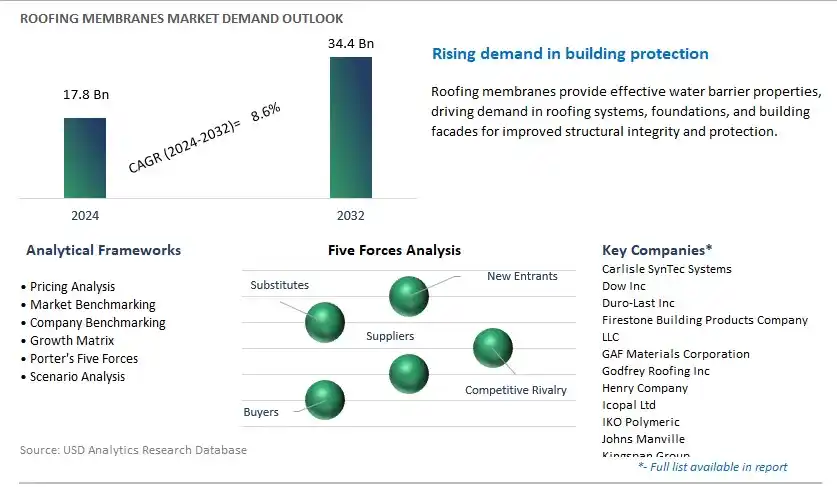
Global Roofing Membranes Market Size is valued at $17.8 Billion in 2024 and is forecast to register a growth rate (CAGR) of 8.6% to reach $34.4 Billion by 2032.
The global Roofing Membranes Market Study analyzes and forecasts the market size across 6 regions and 24 countries for diverse segments -By Product (Thermoplastic Polyolefin (TPO), Ethylene Propylene Diene Monomer (EPDM), Poly Vinyl Chloride (PVC), Modified Bitumen (Mod-Bit), Others), By Installation (Mechanically Attached, Fully Adhered, Ballasted, Others), By Application (Residential, Commercial, Institutional, Infrastructural).
An Introduction to Roofing Membranes Market in 2024
Roofing membranes are essential components of modern roofing systems, providing waterproofing, weatherproofing, and thermal insulation for buildings and structures. In 2024, the market for roofing membranes is experiencing steady growth, driven by the increasing demand for durable, energy-efficient, and sustainable roofing solutions. Roofing membranes are available in various materials, including bitumen, thermoplastics, and elastomers, each offering specific advantages in terms of installation, performance, and longevity. With advancements in membrane technology, manufacturers are developing innovative products such as self-adhering membranes, reflective membranes, and green roofing systems to meet evolving building codes, energy efficiency standards, and environmental regulations. Additionally, the growing emphasis on resilience and disaster preparedness is driving demand for roofing membranes with enhanced wind resistance, impact resistance, and fire retardancy. As building owners and contractors prioritize long-term performance and cost-effectiveness, the roofing membrane market is poised for sustained growth, supporting the construction and renovation of commercial, residential, and institutional buildings worldwide.
Roofing Membranes Market Competitive Landscape
The market report analyses the leading companies in the industry including Carlisle SynTec Systems, Dow Inc, Duro-Last Inc, Firestone Building Products Company LLC, GAF Materials Corporation, Godfrey Roofing Inc, Henry Company, Icopal Ltd, IKO Polymeric, Johns Manville, Kingspan Group, Owens Corning, pH plastics, Sika AG, Siplast, and others.
Roofing Membranes Market Dynamics
Market Trend: Shift towards Sustainable and Energy-Efficient Solutions
A prevailing trend in the roofing membranes market is the shift towards sustainable and energy-efficient solutions. With increasing awareness of climate change and environmental sustainability, there's a growing demand for roofing materials that offer enhanced energy performance and minimize environmental impact. This trend is driving the adoption of eco-friendly roofing membranes, such as those made from recycled materials or incorporating reflective coatings to reduce heat absorption. Additionally, innovations in manufacturing processes are enabling the production of membranes with improved durability and longevity, further contributing to sustainable roofing practices.
Market Driver: Urbanization and Infrastructure Development
A key driver fueling the growth of the roofing membranes market is urbanization and infrastructure development. Rapid urbanization, particularly in emerging economies, is leading to the construction of new buildings and infrastructure projects, driving demand for roofing membranes for both residential and commercial applications. Additionally, renovation and retrofitting activities in existing structures to improve energy efficiency and durability further boost market demand. As governments continue to invest in infrastructure projects and promote sustainable building practices, the demand for roofing membranes is expected to surge, providing significant opportunities for manufacturers and suppliers in the market.
Market Opportunity: Integration of Smart Technologies and IoT
An opportunity for the roofing membranes market lies in the integration of smart technologies and the Internet of Things (IoT) into roofing systems. By incorporating sensors, actuators, and communication devices into roofing membranes, building owners and facility managers can monitor various parameters such as temperature, moisture levels, and structural integrity in real-time. This enables proactive maintenance, early detection of leaks or damage, and optimization of energy usage. Moreover, smart roofing systems can contribute to building automation and energy management strategies, enhancing overall building performance and occupant comfort. Embracing smart technologies presents a promising opportunity for roofing membrane manufacturers to differentiate their products and provide added value to customers in an increasingly digitalized construction industry.
Roofing Membranes Market Share Analysis: Thermoplastic Polyolefin (TPO) segment generated the highest revenue in 2024
Within the Roofing Membranes Market, thermoplastic Polyolefin (TPO) segment is the largest. TPO roofing membranes offer a combination of performance, durability, and cost-effectiveness, making them a popular choice for various commercial and residential roofing applications. TPO membranes are highly resistant to UV radiation, ozone, chemicals, and punctures, ensuring long-term protection for buildings in diverse weather conditions. Additionally, TPO roofing systems are lightweight, flexible, and easy to install, reducing labor costs and installation time compared to other roofing materials. The growing demand for energy-efficient and environmentally friendly roofing solutions has further propelled the adoption of TPO membranes, as they offer excellent thermal insulation properties and can be recycled at the end of their service life, contributing to sustainability goals. With its superior performance characteristics and widespread applicability in roofing projects, the TPO segment maintains its position as the largest in the roofing membranes market.
Roofing Membranes Market Share Analysis: Fully Adhered is poised to register the fastest CAGR over the forecast period
Within the Roofing Membranes Market, the Fully Adhered segment is the fastest-growing. Fully adhered roofing systems involve bonding the membrane directly to the substrate using adhesive or hot asphalt, providing a strong and seamless waterproofing barrier. Fully adhered membranes offer superior wind uplift resistance, making them suitable for buildings located in high-wind regions or hurricane-prone areas. Additionally, fully adhered systems exhibit excellent resistance to membrane flutter and tenting, reducing the risk of membrane damage during extreme weather events. The increasing demand for resilient and durable roofing solutions, coupled with the need for enhanced building performance and energy efficiency, has driven the adoption of fully adhered roofing membranes. Moreover, advancements in adhesive technology and installation techniques have improved the ease and efficiency of installing fully adhered roofing systems, further fuelling their growth in the roofing membranes market. With their superior performance attributes and increasing popularity among architects, contractors, and building owners, the Fully Adhered segment is experiencing significant growth in the roofing membranes market.
Roofing Membranes Market Share Analysis: Commercial segment generated the highest revenue in 2024
Within the Roofing Membranes Market, the Commercial segment is the largest. Commercial buildings, including offices, retail spaces, industrial facilities, and warehouses, often require large roofing surfaces with specific performance requirements to protect valuable assets and occupants. Roofing membranes play a crucial role in providing waterproofing, insulation, and weather protection for commercial structures, ensuring the longevity and functionality of the roofing system. Additionally, commercial buildings often have flat or low-slope roofs, which are well-suited for membrane roofing systems due to their ease of installation and maintenance. The increasing construction activities in the commercial sector, driven by urbanization, economic growth, and infrastructure development, contribute to the high demand for roofing membranes in commercial applications. Moreover, stringent building codes and regulations governing commercial construction require durable and high-performance roofing solutions, further driving the adoption of roofing membranes in this segment. With the growing emphasis on energy efficiency, sustainability, and building resilience in commercial construction projects, the Commercial segment maintains its position as the largest in the roofing membranes market.
Roofing Membranes Market
By Product
Thermoplastic Polyolefin (TPO)
Ethylene Propylene Diene Monomer (EPDM)
Poly Vinyl Chloride (PVC)
Modified Bitumen (Mod-Bit)
Others
By Installation
Mechanically Attached
Fully Adhered
Ballasted
Others
By Application
Residential
Commercial
Institutional
InfrastructuralCountries Analyzed
North America (US, Canada, Mexico)
Europe (Germany, UK, France, Spain, Italy, Russia, Rest of Europe)
Asia Pacific (China, India, Japan, South Korea, Australia, South East Asia, Rest of Asia)
South America (Brazil, Argentina, Rest of South America)
Middle East and Africa (Saudi Arabia, UAE, Rest of Middle East, South Africa, Egypt, Rest of Africa)
Roofing Membranes Companies Profiled in the Study
Carlisle SynTec Systems
Dow Inc
Duro-Last Inc
Firestone Building Products Company LLC
GAF Materials Corporation
Godfrey Roofing Inc
Henry Company
Icopal Ltd
IKO Polymeric
Johns Manville
Kingspan Group
Owens Corning
pH plastics
Sika AG
Siplast
*- List Not Exhaustive
TABLE OF CONTENTS
1 Introduction to 2024 Roofing Membranes Market
1.1 Market Overview
1.2 Quick Facts
1.3 Scope/Objective of the Study
1.4 Market Definition
1.5 Countries and Regions Covered
1.6 Units, Currency, and Conversions
1.7 Industry Value Chain
2 Research Methodology
2.1 Market Size Estimation
2.2 Sources and Research Methodology
2.3 Data Triangulation
2.4 Assumptions and Limitations
3 Executive Summary
3.1 Global Roofing Membranes Market Size Outlook, $ Million, 2021 to 2032
3.2 Roofing Membranes Market Outlook by Type, $ Million, 2021 to 2032
3.3 Roofing Membranes Market Outlook by Product, $ Million, 2021 to 2032
3.4 Roofing Membranes Market Outlook by Application, $ Million, 2021 to 2032
3.5 Roofing Membranes Market Outlook by Key Countries, $ Million, 2021 to 2032
4 Market Dynamics
4.1 Key Driving Forces of Roofing Membranes Industry
4.2 Key Market Trends in Roofing Membranes Industry
4.3 Potential Opportunities in Roofing Membranes Industry
4.4 Key Challenges in Roofing Membranes Industry
5 Market Factor Analysis
5.1 Value Chain Analysis
5.2 Competitive Landscape
5.2.1 Global Roofing Membranes Market Share by Company (%), 2023
5.2.2 Product Offerings by Company
5.3 Porter’s Five Forces Analysis
5.4 Pricing Analysis and Outlook
6 Growth Outlook Across Scenarios
6.1 Growth Analysis-Case Scenario Definitions
6.2 Low Growth Scenario Forecasts
6.3 Reference Growth Scenario Forecasts
6.4 High Growth Scenario Forecasts
7 Global Roofing Membranes Market Outlook by Segments
7.1 Roofing Membranes Market Outlook by Segments, $ Million, 2021- 2032
By Product
Thermoplastic Polyolefin (TPO)
Ethylene Propylene Diene Monomer (EPDM)
Poly Vinyl Chloride (PVC)
Modified Bitumen (Mod-Bit)
Others
By Installation
Mechanically Attached
Fully Adhered
Ballasted
Others
By Application
Residential
Commercial
Institutional
Infrastructural
8 North America Roofing Membranes Market Analysis and Outlook To 2032
8.1 Introduction to North America Roofing Membranes Markets in 2024
8.2 North America Roofing Membranes Market Size Outlook by Country, 2021-2032
8.2.1 United States
8.2.2 Canada
8.2.3 Mexico
8.3 North America Roofing Membranes Market size Outlook by Segments, 2021-2032
By Product
Thermoplastic Polyolefin (TPO)
Ethylene Propylene Diene Monomer (EPDM)
Poly Vinyl Chloride (PVC)
Modified Bitumen (Mod-Bit)
Others
By Installation
Mechanically Attached
Fully Adhered
Ballasted
Others
By Application
Residential
Commercial
Institutional
Infrastructural
9 Europe Roofing Membranes Market Analysis and Outlook To 2032
9.1 Introduction to Europe Roofing Membranes Markets in 2024
9.2 Europe Roofing Membranes Market Size Outlook by Country, 2021-2032
9.2.1 Germany
9.2.2 France
9.2.3 Spain
9.2.4 United Kingdom
9.2.4 Italy
9.2.5 Russia
9.2.6 Norway
9.2.7 Rest of Europe
9.3 Europe Roofing Membranes Market Size Outlook by Segments, 2021-2032
By Product
Thermoplastic Polyolefin (TPO)
Ethylene Propylene Diene Monomer (EPDM)
Poly Vinyl Chloride (PVC)
Modified Bitumen (Mod-Bit)
Others
By Installation
Mechanically Attached
Fully Adhered
Ballasted
Others
By Application
Residential
Commercial
Institutional
Infrastructural
10 Asia Pacific Roofing Membranes Market Analysis and Outlook To 2032
10.1 Introduction to Asia Pacific Roofing Membranes Markets in 2024
10.2 Asia Pacific Roofing Membranes Market Size Outlook by Country, 2021-2032
10.2.1 China
10.2.2 India
10.2.3 Japan
10.2.4 South Korea
10.2.5 Indonesia
10.2.6 Malaysia
10.2.7 Australia
10.2.8 Rest of Asia Pacific
10.3 Asia Pacific Roofing Membranes Market size Outlook by Segments, 2021-2032
By Product
Thermoplastic Polyolefin (TPO)
Ethylene Propylene Diene Monomer (EPDM)
Poly Vinyl Chloride (PVC)
Modified Bitumen (Mod-Bit)
Others
By Installation
Mechanically Attached
Fully Adhered
Ballasted
Others
By Application
Residential
Commercial
Institutional
Infrastructural
11 South America Roofing Membranes Market Analysis and Outlook To 2032
11.1 Introduction to South America Roofing Membranes Markets in 2024
11.2 South America Roofing Membranes Market Size Outlook by Country, 2021-2032
11.2.1 Brazil
11.2.2 Argentina
11.2.3 Rest of South America
11.3 South America Roofing Membranes Market size Outlook by Segments, 2021-2032
By Product
Thermoplastic Polyolefin (TPO)
Ethylene Propylene Diene Monomer (EPDM)
Poly Vinyl Chloride (PVC)
Modified Bitumen (Mod-Bit)
Others
By Installation
Mechanically Attached
Fully Adhered
Ballasted
Others
By Application
Residential
Commercial
Institutional
Infrastructural
12 Middle East and Africa Roofing Membranes Market Analysis and Outlook To 2032
12.1 Introduction to Middle East and Africa Roofing Membranes Markets in 2024
12.2 Middle East and Africa Roofing Membranes Market Size Outlook by Country, 2021-2032
12.2.1 Saudi Arabia
12.2.2 UAE
12.2.3 Oman
12.2.4 Rest of Middle East
12.2.5 Egypt
12.2.6 Nigeria
12.2.7 South Africa
12.2.8 Rest of Africa
12.3 Middle East and Africa Roofing Membranes Market size Outlook by Segments, 2021-2032
By Product
Thermoplastic Polyolefin (TPO)
Ethylene Propylene Diene Monomer (EPDM)
Poly Vinyl Chloride (PVC)
Modified Bitumen (Mod-Bit)
Others
By Installation
Mechanically Attached
Fully Adhered
Ballasted
Others
By Application
Residential
Commercial
Institutional
Infrastructural
13 Company Profiles
13.1 Company Snapshot
13.2 SWOT Profiles
13.3 Products and Services
13.4 Recent Developments
13.5 Financial Profile
Carlisle SynTec Systems
Dow Inc
Duro-Last Inc
Firestone Building Products Company LLC
GAF Materials Corporation
Godfrey Roofing Inc
Henry Company
Icopal Ltd
IKO Polymeric
Johns Manville
Kingspan Group
Owens Corning
pH plastics
Sika AG
Siplast
14 Appendix
14.1 Customization Offerings
14.2 Subscription Services
14.3 Related Reports
14.4 Publisher Expertise
By Product
Thermoplastic Polyolefin (TPO)
Ethylene Propylene Diene Monomer (EPDM)
Poly Vinyl Chloride (PVC)
Modified Bitumen (Mod-Bit)
Others
By Installation
Mechanically Attached
Fully Adhered
Ballasted
Others
By Application
Residential
Commercial
Institutional
Infrastructural
Countries Analyzed
North America (US, Canada, Mexico)
Europe (Germany, UK, France, Spain, Italy, Russia, Rest of Europe)
Asia Pacific (China, India, Japan, South Korea, Australia, South East Asia, Rest of Asia)
South America (Brazil, Argentina, Rest of South America)
Middle East and Africa (Saudi Arabia, UAE, Rest of Middle East, South Africa, Egypt, Rest of Africa)
