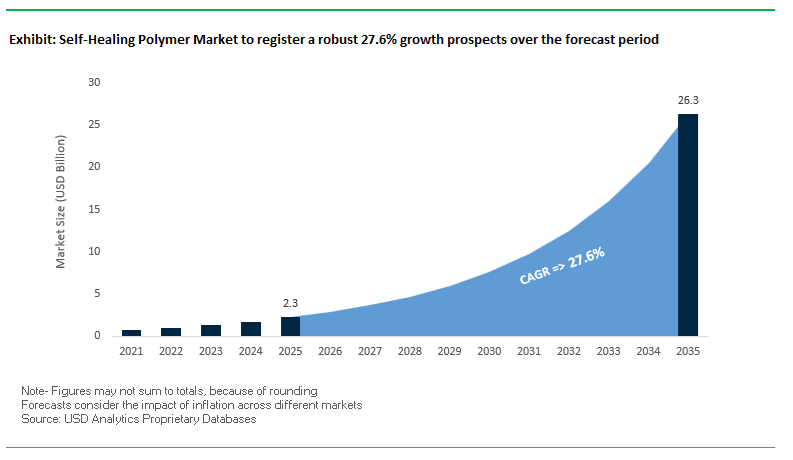
The Self-Healing Polymer Market is on a steep growth trajectory, rising from USD 2.3 billion in 2025 to USD 26.3 billion by 2035, achieving an exceptional CAGR of 27.6%. Demand is accelerating across aerospace composites, automotive coatings, consumer electronics, infrastructure, and soft robotics, driven by the shift toward durable, repairable, and low-maintenance material systems. Manufacturers are increasingly prioritizing healing efficiency, repeatable cyclability, material toughness, and nanoparticle-enhanced microcapsule integration, as these engineering parameters directly influence adoption in critical structural and functional applications.
Extrinsic self-healing epoxy systems—primarily used in composite aerospace structures—now achieve up to 98% fracture toughness recovery within 24 hours, a performance threshold essential for mission-critical applications. Intrinsic self-healing polymers using Diels–Alder dynamic covalent chemistry maintain >95% healing efficiency over seven repair cycles, enabling their use in flexible electronics, reconfigurable circuits, and adaptive packaging systems. Automotive OEMs are aggressively adopting self-healing transparent topcoats capable of solar-activated reflow repair, reducing paint shop maintenance frequency by ~50% over a vehicle’s lifetime. Meanwhile, nanocomposite SMPs demonstrate optimal strength and healing balance with 2 wt% nanofiller/microcapsule integration, a key design guideline for high-performance coatings and structural systems.
Key insights for manufacturers and vendors
Extrinsic epoxy systems achieving 98% toughness recovery are becoming the aerospace standard for damage-tolerant composites.
Intrinsic Diels–Alder polymers with >95% multi-cycle repeatability enable reliable deployment in consumer electronics and flexible circuits.
Self-healing automotive coatings can reduce lifecycle maintenance costs by 50%, reshaping OEM sustainability and refurbishment strategies.
Nanoparticle- or microcapsule-enhanced composites at 2 wt% offer optimal mechanical–healing synergy for industrial applications.
Growing adoption in infrastructure and aviation maintenance signals strong future demand for large-surface-area healing solutions.
Market Analysis: R&D Breakthroughs, Aerospace Adoption, and Regulatory Advancements Reshaping Global Self-Healing Polymer Demand
The global Self-Healing Polymer industry is advancing rapidly through scientific breakthroughs, strategic investments, and large-scale adoption across aerospace, automotive, and electronics sectors. The momentum is strongly reinforced by hybrid self-healing architectures. In August 2025, researchers at Carnegie Mellon University developed hybrid polymer systems that combine intrinsic and extrinsic healing mechanisms, enabling the creation of high-modulus, high-stiffness polymers suited for advanced electronics and packaging applications. Similarly, in April 2025, Texas A&M unveiled a Diels–Alder Polymer capable of rapidly liquefying and resolidifying after projectile impact, a revolutionary material innovation designed for space vehicle windows, where micro-debris impacts pose significant operational risk.
Industrial investment is also rising. In November 2025, AkzoNobel committed over USD 30 million to upgrade its North American infrastructure with advanced thermoplastic powder coating technologies, a move expected to indirectly accelerate the adoption of self-healing powder coatings across architectural, automotive, and industrial sectors. Likewise, Covestro’s acquisition of Pontacol in August 2025 reinforced its strategic expansion into specialty films and protective coatings engineered with reflow-based self-healing performance, widely applicable in electronics and automotive exterior surfaces.
Downstream industries—especially aerospace—continue to drive notable market expansion. Reports from Q4 2024 highlight escalating deployment of self-healing erosion-control films in wide-body aircraft maintenance facilities in the UAE, expected to reduce aircraft paint shop cycles by up to 50% by 2030. China’s aviation program is also accelerating adoption: February 2024 reports confirmed that C919 and CR929 prototypes now integrate capsule-based self-healing composites into radomes and cabin structures, driven by government-backed materials innovation.
The healthcare and robotics sectors are also emerging as major adopters. In April 2025, researchers successfully 3D printed supramolecular hydrogels with sub-60-second healing, supporting biomimetic soft robotics and next-generation medical systems. Meanwhile, the European Union’s SHINE Project (Q1 2025) validated new ambient-temperature self-healing elastomers capable of recovering 60% of initial properties, demonstrating their viability for large-scale use in road infrastructure, structural surfaces, and civil engineering applications.
Market Trend 1: Engineering-Grade Microvascular and Capsule-Based Healing Systems for High-Performance Composite Structures
The Self-Healing Polymer Market is being significantly transformed by the integration of capsule-based and microvascular healing systems into aerospace, automotive, and defense composites—fields where structural reliability and lifecycle cost reduction are paramount. Capsule-based systems show strong performance for large-scale crack remediation; epoxy composites embedded with microcapsules can restore 80%–97% of their original fracture toughness (KIC) following mechanical damage. This restoration is critical for high-load components where small cracks can propagate rapidly under cyclic fatigue.
In fiber-reinforced systems, a primary performance requirement is the restoration of the fiber–matrix interface. Experimental systems demonstrated 91% recovery of Interfacial Shear Strength (IFSS), confirming that crack bridging and load transfer mechanisms can be nearly fully re-established post-healing. Importantly, capsule systems exhibit autonomic activation, rupturing immediately upon crack formation and releasing healing agents without requiring thermal, electrical, or chemical triggers—critical for remote or inaccessible environments.
However, traditional capsule systems are limited in multi-cycle healing efficiency, with efficiency declining by 20%–30% after repeated damage events. This limitation is accelerating the transition toward microvascular networks capable of delivering healing agents repeatedly throughout the lifetime of the composite structure. As aerospace OEMs and advanced material producers seek longer design life, higher safety margins, and lighter structures, microvascular and capsule-integrated self-healing polymers are emerging as a strategic differentiator in composite materials engineering.
Market Trend 2: Rapid Advancement of Intrinsically Self-Healing Elastomers for Stretchable Electronics and Wearable Devices
A second major trend reshaping the Self-Healing Polymer Market is the rise of intrinsically self-healing elastomers engineered for electrical functionality in soft robotics, bio-integrated sensors, and wearable electronics. These polymers leverage reversible dynamic bonding, conductive fillers, and supramolecular chemistry to autonomously restore electrical and mechanical performance after damage.
State-of-the-art conductive elastomers have demonstrated 90%–100% restoration of pristine electrical conductivity after complete severing and self-healing, confirming their readiness for high-resolution strain sensors, flexible circuits, and wearable signal-transmission interfaces. Mechanical self-recovery is equally advanced: elastomers utilizing hydrogen bonds or disulfide exchanges recover 86% of tensile strength after only 1.5 hours at 60°C, while some disulfide-based polymers exhibit full strength recovery in just 60 seconds at 70°C.
Intrinsic self-healing does not compromise strength. Advanced polyurethane elastomers now achieve tensile strengths up to 41 MPa while remaining capable of reversible healing, positioning them as replacements for both silicones and thermoplastic elastomers in demanding flexible-hardware applications. These developments are aligning with market demand for rugged, repairable, lightweight, and durable electronics, significantly boosting the commercialization trajectory of self-healing elastomeric materials.
Market Opportunity 1: Self-Healing Polymer Concretes and Coatings Offering Breakthrough Durability for Civil Infrastructure
One of the largest commercial opportunities lies in deploying self-healing polymer systems within civil infrastructure materials, especially concrete, protective coatings, and repair mortars. Traditional autogenous healing only seals microcracks <0.2 mm, but engineered biological and polymer-embedded healing systems extend this dramatically. Bacteria-based self-healing concrete can autonomously repair cracks up to 0.4 mm, and advanced formulations demonstrate healing of 0.8 mm cracks—critical thresholds for preventing corrosion in reinforcing steel and extending structural service life.
Water permeability reduction is a major performance metric. The enhanced healing mechanisms restore near-original impermeability, significantly improving durability in marine, transportation, and wastewater infrastructure. The opportunity is strengthened by the long-term viability of healing agents: encapsulated bacterial spores can remain dormant for several decades, providing multi-decade autonomous repair capability without external maintenance.
As governments and operators face rising costs of structural degradation, climate-induced damage, and corrosion-related failures, self-healing polymer concretes and coatings offer a compelling lifecycle cost advantage, positioning them to become a mainstream component of next-generation sustainable infrastructure materials.
A technologically transformative opportunity is emerging with self-healing solid-state polymer electrolytes (SPEs) designed to enhance stability, safety, and cycle life in next-generation lithium metal and lithium-sulfur batteries. Cracks within solid electrolytes are a primary cause of dendrite formation and interfacial resistance buildup. Self-healing disulfide-bonded SPEs have demonstrated remarkable cycling stability, with Li|Li symmetric cells operating for more than 6,000 hours without short circuiting.
These systems enable dramatic improvements in commercial battery metrics. A Li–S cell integrating a self-healing SPE achieved 93% capacity retention after 700 cycles, signaling major advancements in long-term durability. To maintain strong ionic performance, SPEs must achieve conductivities of ≥10⁻³ S/cm at 60°C, a benchmark met by PEO-based systems enhanced with self-healing additives that prevent interfacial cracking and preserve ion transport pathways.
A critical benefit is the sealing of microscopic gaps at the electrode–electrolyte interface, improving interfacial contact and preventing performance decay. As automakers, consumer electronics manufacturers, and grid-storage developers intensify the push toward safer solid-state platforms, self-healing polymer electrolytes represent a breakthrough pathway toward commercial-scale reliability and extended battery lifetime.
Self healing Polymer Market Share Analysis
Market Share by Healing Mechanism: Extrinsic Self-Healing Dominates Due to High Repair Efficiency and Commercial Maturity
Extrinsic Self-Healing polymers hold the largest market share—approximately 65%—because they represent the most commercially mature, scalable, and industrially validated technology for autonomous material repair. Their mechanism, which relies on microcapsules or vascular networks embedded within the polymer matrix, delivers exceptionally high healing efficiency—often exceeding 90% restoration of mechanical strength after initial damage. This high level of performance makes extrinsic systems the preferred choice for applications where structural integrity, coating durability, and failure prevention are mission-critical. Manufacturers favor extrinsic solutions because they integrate seamlessly into existing production lines without requiring major formulation overhauls. Microencapsulation technology, in particular, enables controlled release of healing agents upon crack formation, providing reliable, repeatable self-repair in sectors such as anti-corrosion coatings, structural adhesives, automotive topcoats, and aerospace composites. The widespread use of extrinsic mechanisms in self-healing protective coatings—one of the largest and fastest-growing SMP submarkets—further strengthens this segment’s dominance. Its commercial readiness, validation across multiple industries, and ability to deliver immediate, autonomous healing continue to position extrinsic self-healing as the foundational technology driving the global self-healing polymer market.
Market Share By End-Use Industry: Construction & Infrastructure Leads Due to Demand for Autonomous Durability Enhancement
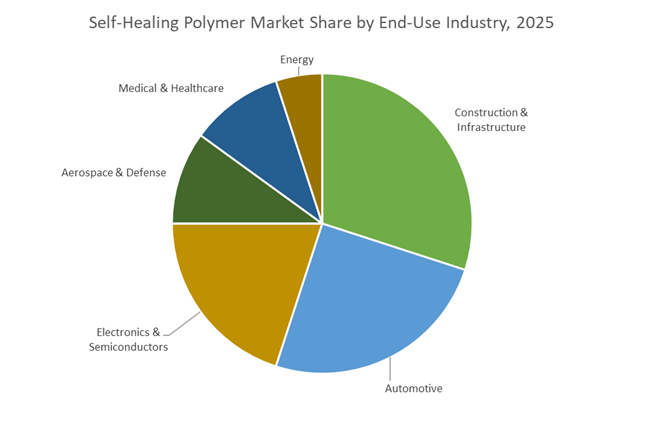
The Construction & Infrastructure sector, accounting for nearly 30% of global demand, is the largest end-use segment for Self-Healing Polymers due to the enormous economic and structural implications of material degradation in civil assets. Bridges, tunnels, highways, and large buildings face constant stress from thermal cycling, mechanical loading, and environmental exposure, leading to microcracking that initiates long-term deterioration. Self-healing polymers—particularly extrinsic systems integrated into concrete, sealants, and protective coatings—provide a transformative solution by autonomously repairing these early-stage defects, thus preventing corrosion, water ingress, and crack propagation. The sector’s leadership is also driven by the escalating global emphasis on asset longevity, reduced maintenance costs, and infrastructure resilience, especially as governments allocate substantial budgets to modernize aging structures and reduce life-cycle emissions. Self-healing concrete and coatings significantly lower the frequency of repairs and extend the operational lifespan of large-scale assets, aligning with sustainability-focused construction codes and long-term urban development goals. Because construction projects consume materials at enormous volume and require long-term performance with minimal downtime, this sector continues to be the highest-value adopter of self-healing polymers, anchoring the segment’s market share leadership and shaping innovation priorities across the industry.
Country Analysis: Global Adoption Patterns and Innovation Trajectories in Self-Healing Polymers
United States: Breakthrough Intrinsic Hybrid Materials and High-End Aerospace Integration
The United States leads global innovation in self-healing polymers, supported by powerful academic R&D pipelines, defense-driven materials science, and rapid commercialization across automotive and aerospace sectors. A landmark milestone came in August 2025, when researchers at Carnegie Mellon University unveiled a novel hybrid self-healing polymer capable of merging intrinsic and extrinsic repair mechanisms. By embedding rigid brush particles within a flexible linear copolymer chain, the material achieves exceptional stiffness while retaining autonomous healing—marking a major leap for electronics, structural health monitoring, and smart coatings.
Aerospace and defense programs in the U.S. have accelerated real-world adoption, with leading manufacturers integrating nano-engineered self-healing coatings into aircraft components starting May 2025. These adaptive coatings mitigate UV degradation, moisture ingress, and surface micro-cracking—critical for improving fatigue life in composite aircraft structures. Additional breakthroughs at Texas A&M University highlight the U.S. leadership in extreme-environment materials: a Diels–Alder Polymer (DAP) capable of autonomously re-forming covalent bonds after projectile impact is now being evaluated for space vehicle windows and micrometeoroid protection. The automotive sector is responding equally aggressively, with OEMs deploying microcapsule-based self-healing coatings in late 2025 to enhance scratch resistance and surface longevity in premium EV models.
China: Biomedical Hydrogel Leadership and Rapid Industrialization of Structural Self-Healing Systems
China’s self-healing polymer market is expanding at record pace, driven by world-class biomedical materials R&D and industrial rollouts for infrastructure, coatings, and mobility applications. Chinese researchers’ development of a graphene–melatonin–fiber reinforced hydrogel scaffold for muscle tissue regeneration demonstrates China’s unmatched capability in bio-nanomaterial engineering. This hybrid structure, using a hyaluronic-acid–based self-healing matrix, positions China at the forefront of regenerative medicine and implantable hydrogel technology.
China also dominates in clinical and consumer healthcare applications, particularly with injectable self-healing hydrogels designed for high-mobility joints like elbows and knees. These formulations offer superior elastic recovery and autonomous repair—ideal for chronic wound care and dynamic tissue environments. Beyond healthcare, China is rapidly deploying polymer-based self-healing coatings and admixtures in mega infrastructure projects. Bridges, tunnels, steel structures, and coastal installations increasingly rely on polymeric self-repair technologies to lower lifecycle maintenance costs, counter corrosion, and withstand aggressive climatic and industrial conditions. Together, these capabilities solidify China’s position as both a biomedical pioneer and industrial powerhouse in self-healing materials.
Germany/European Union: Bio-Based Self-Healing Polymers and High-Performance Coatings for Sustainability Compliance
Germany and the broader European Union are shaping the global transition toward sustainable self-healing polymers, driven by stringent environmental mandates, VOC reduction requirements, and ambitious circular material strategies. In September 2025, leading European chemical players introduced bio-based self-healing coating systems engineered from renewable polymer feedstocks—supporting EU-wide sustainability commitments and providing OEMs with low-carbon alternatives to conventional protective coatings.
Strategic transnational partnerships are also expanding the region’s technological scope. A major European coatings firm entered a collaboration with a Japanese research institute in April 2025 to co-develop self-healing coatings engineered for high-temperature electronics, highlighting Europe's intent to advance next-generation protective materials for industrial, automotive, and semiconductor applications. Additionally, companies like AkzoNobel are investing heavily in marine-grade self-healing systems tailored to mitigate corrosion in offshore structures and ship hulls exposed to extreme salinity. These initiatives reinforce the EU’s status as a global leader in sustainable polymer engineering, advanced coatings, and eco-conscious materials innovation.
Japan: Vitrimer Breakthroughs and Self-Healing Electronics for Industrial Precision
Japan’s leadership in advanced self-healing materials is anchored in its significant contributions to vitrimer technology, high-temperature polymer systems, and precision electronics manufacturing. A major breakthrough occurred in November 2023 when the University of Tokyo introduced VPR (Vitrimer Incorporated with Polyrotaxane), a next-generation self-healing plastic featuring rapid thermal repair and improved recyclability compared with conventional vitrimers. This innovative material is designed for sustainable electronics, high-temperature industrial applications, and complex mechanical systems requiring predictable healing behavior.
Japanese electronics manufacturers are aggressively integrating self-healing coatings into flexible smartphones, wearables, and consumer devices, where high abrasion risk and repeated bending demand materials capable of restoring surface integrity autonomously. These technologies significantly extend product lifespan while improving user experience. In industrial engineering, Japan is deploying SMP composites for precision reflectors, actuators, and fastening components, particularly in manufacturing environments requiring high reliability, minimal downtime, and tolerance to thermal cycling.
South Korea: Flexible Self-Healing Films for Next-Generation Displays and Haptic Systems
South Korea is emerging as a global leader in flexible self-healing films, driven by its dominant position in advanced display technologies and its accelerating wearable electronics sector. Korean research institutions are developing intrinsically stretchable, conductive, self-healing polymer films designed for foldable, rollable, and curved displays—an essential innovation to prevent catastrophic cracking, delamination, or pixel failure in next-generation screens. These materials are also being engineered as protective layers that autonomously repair micro-fractures, ensuring long-term reliability under continuous mechanical stress.
The country is simultaneously advancing haptic feedback systems that rely on self-healing composites capable of repairing micro-damage caused by repetitive actuation cycles. This research is particularly impactful for wearable medical sensors, AR/VR gloves, and consumer electronics that require consistent performance despite frequent movement and strain. South Korea’s dual emphasis on durability and miniaturization cements its strategic role in the future of self-healing electronics and smart interactive devices.
India: Infrastructure-Led Growth in Self-Healing Concrete and Anti-Corrosion Polymers
India’s rapid adoption of self-healing polymers is driven primarily by national infrastructure strategies and defense manufacturing localization programs. Government bodies are prioritizing self-healing concrete technologies to extend the service life of critical assets such as highways, bridges, water systems, and urban infrastructure. These materials address India’s long-standing maintenance challenges by autonomously repairing micro-cracks, improving structural integrity, and reducing lifecycle repair costs across high-traffic and climate-exposed regions.
India’s industrial ecosystem is also witnessing rising demand for polymeric self-healing anti-corrosion coatings, especially in sectors such as oil & gas, marine infrastructure, railways, and power transmission. These coatings are being selectively adopted to combat rust progression in humid and coastal regions where corrosion rates are high. In addition, India’s growing emphasis on aerospace and defense indigenization is fostering research into high-spec, impact-resistant self-healing polymer composites suitable for indigenous aircraft, armored vehicles, and protective systems. This multi-sector demand positions India as a rapidly emerging SMP market with large-scale structural applications.
The competitive ecosystem in the Self-Healing Polymer industry is defined by deep material science expertise, strong R&D pipelines, and integration capabilities spanning coatings, polyurethane engineering, supramolecular systems, and microencapsulation technologies. Market leadership depends on the ability to balance healing performance, process scalability, and compatibility with industrial manufacturing systems such as RIM molding, powder coatings, additive manufacturing, and composite curing cycles.
Covestro AG focuses on automotive self-healing coatings and circular polymer systems
Covestro AG leads the self-healing polymer landscape with its Desmodur®/Desmophen® polyurethane precursors, Makrolon®/Bayblend® PC blends, and advanced reflow-effect coatings. Its strategic priority is the automotive sector, where Covestro is developing next-generation self-healing polyurethane coatings for exterior surfaces, leveraging its RIM and DirectCoating (DC) technologies to eliminate overspray and enhance scratch recovery. The company also aligns self-healing innovation with its circular economy roadmap, integrating recyclability principles and low-VOC chemistry into its coating solutions. Covestro’s systems are increasingly used by OEMs seeking extended component lifespan and reduced maintenance cycles.
AkzoNobel accelerates self-healing powder coatings and sustainable surface technologies
AkzoNobel leverages its global scale in automotive refinishes and industrial powder coatings to develop next-generation self-healing surface systems. Its Sikkens and Interpon brands are central to innovation in protective coatings with reflow or anti-corrosion healing functionalities. The company’s USD 30 million investment in November 2025 positions it to mass-produce more durable thermoplastic powders with future self-healing capabilities. AkzoNobel’s R&D emphasis on sustainability, surface regeneration, and functional coatings positions it strongly across architectural, mobility, and industrial applications.
Arkema SA pioneers supramolecular elastomers and sustainable self-healing polymers
Arkema has been a global pioneer in intrinsic self-healing chemistry, highlighted by its Reverlink™ supramolecular elastomers, which rely on reversible intermolecular bonds to deliver robust healing in adhesives, sealants, and industrial coatings. Its Rilsan® polyamide and polyurethane chemistries support microencapsulation applications in self-healing composites. Arkema’s sustainability strategy emphasizes raw materials derived from plant-based fatty acid oligomers (up to 60% content), making it an influential player in eco-friendly self-healing materials and next-generation industrial elastomers.
Autonomic Materials Inc. excels in microcapsule-based extrinsic self-healing systems
Autonomic Materials Inc. is a leading specialist in extrinsic self-healing polymer systems, supplying microencapsulated healing agents and catalyst systems for corrosion-resistant coatings, aerospace structures, and defense applications. Its systems are field-proven across OEMs needing reliable, autonomous crack repair in harsh environments. AMI is recognized for its agile partnership model, which allows rapid customization of healing agent chemistry and capsule morphology to meet specific coating or adhesive performance requirements. This positions AMI as a preferred collaborator for next-generation self-healing structural adhesives.
BASF SE advances structural self-healing materials for infrastructure and wind energy
BASF SE integrates self-healing chemistry into polyurethane and acrylate resin families, targeting applications in wind turbine blades, construction materials, and composite structures. The company’s extensive R&D and global supply chain enable cost-effective scaling of self-healing additives and polymer precursors. BASF’s innovations aim to reduce maintenance frequency in large structures, extend material lifespans, and enable more durable industrial coatings. Its focus on embedding self-healing capabilities into standard polymer systems makes it a critical player in infrastructure-driven SMP adoption.
Self-Healing Polymer Market Report Scope
Self-Healing Polymer Market
Parameter
Details
Market Size (2025)
$2.3 Billion
Market Size (2035)
$26.3 Billion
Market Growth Rate
27.6%
Segments
By Healing Mechanism (Extrinsic Self-Healing, Intrinsic Self-Healing), By Base Material (Polyurethane, Epoxy, Polylactide, Hydrogels), By End-Use Application (Automotive, Construction & Infrastructure, Electronics & Semiconductors, Aerospace & Defense, Medical & Healthcare, Energy)
Study Period
2019- 2024 and 2025-2034
Units
Revenue (USD)
Qualitative Analysis
Porter’s Five Forces, SWOT Profile, Market Share, Scenario Forecasts, Market Ecosystem, Company Ranking, Market Dynamics, Industry Benchmarking
US, Canada, Mexico, Germany, France, Spain, Italy, UK, Russia, China, India, Japan, South Korea, Australia, South East Asia, Brazil, Argentina, Middle East, Africa
Self-Healing Polymer Market Segmentation
By Healing Mechanism
Extrinsic Self-Healing
Intrinsic Self-Healing
By Base Material
Polyurethane (PU)
Epoxy
Polylactide (PLA)
Hydrogels
By End-Use Industry
Automotive
Construction & Infrastructure
Electronics & Semiconductors
Aerospace & Defense
Medical & Healthcare
Energy
By Region
North America (United States, Canada, Mexico)
Europe (Germany, France, United Kingdom, Spain, Italy, Rest of Europe)
Asia Pacific (China, India, Japan, South Korea, Australia, Rest of APAC)
South and Central America (Brazil, Argentina, Rest of SCA)
Middle East and Africa (Saudi Arabia, UAE, South Africa, Rest of Middle East, Rest of Africa)
Top Companies in Self-Healing Polymer Market
BASF
Covestro
AkzoNobel
Dow
Huntsman
Autonomic Materials
Evonik
Arkema
DuPont
Goodyear
NEI Corporation
Wanhua Chemical
Michelin
Sika
PPG Industries.
*- List not Exhaustive
Research Coverage
The latest Self-Healing Polymer Market study from USDAnalytics provides a comprehensive evidence-based assessment of how next-generation healing chemistries are moving from lab-scale concepts into certified aerospace, infrastructure, automotive, electronics, and energy systems. Spanning the full value chain from capsule-based epoxies and microvascular composites to Diels–Alder dynamic networks, supramolecular elastomers, and self-healing solid-state electrolytes, this report investigates performance benchmarks, cost curves, and adoption tipping points that are redefining durability and lifecycle economics. It tracks breakthroughs in hybrid intrinsic–extrinsic architectures, battery-grade self-healing polymer electrolytes, civil-infrastructure sealants, and bioinspired hydrogels while mapping their commercial readiness across key end-use segments. Detailed analysis reviews quantify how healing efficiency, multi-cycle repeatability, nanofiller loading, and compatibility with existing processing routes are reshaping OEM materials strategies in aviation, EVs, construction, high-value coatings, and flexible electronics. The study highlights regulatory momentum around sustainability, circularity, and maintenance-free asset management, and links this to procurement behavior and technology roadmaps at leading manufacturers. With rigorous quantitative modeling, cross-industry case studies, and strategic benchmarking of core players, this report is an essential resource for executives, R&D leaders, and investors seeking to position portfolios around high-efficiency self-healing polymers, advanced coatings, and intelligent composites, etc……
Scope Highlights
Segmentation – By Healing Mechanism: Extrinsic Self-Healing, Intrinsic Self-Healing
Segmentation – By Base Material: Polyurethane (PU), Epoxy, Polylactide (PLA), Hydrogels
Segmentation – By End-Use Industry: Automotive, Construction & Infrastructure, Electronics & Semiconductors, Aerospace & Defense, Medical & Healthcare, Energy
Geographic Scope: Analysis spans 25+ countries across North America, Europe, Asia Pacific, Latin America, and the Middle East & Africa, capturing regional differences in technology adoption, standards, and investment flows.
Timeframe Coverage: Includes historic data from 2021–2025 and detailed forecasts from 2026–2034, enabling long-term planning, capex roadmapping, and comparative market tracking across cycles.
Company Coverage: Provides in-depth analysis and profiles of 15+ leading companies, including strategic positioning, self-healing technology focus, R&D priorities, partnership ecosystems, and portfolio moves across coatings, elastomers, composites, and electrolytes.
2. Self-Healing Polymer Market Landscape & Outlook (2025–2035)
2.1. Introduction to Self-Healing Polymer Market
2.2. Market Valuation and Growth Projections (2025–2035)
2.3. Key Demand Drivers Across Aerospace, Automotive, Infrastructure, and Electronics
2.4. Technology Overview: Intrinsic vs Extrinsic Healing Mechanisms
2.5. Regulatory Landscape, Sustainability, and Lifecycle Performance
3. Innovations Reshaping the Self-Healing Polymer Market
3.1. Trend: Microvascular and Capsule-Based Healing Systems for Structural Composites
3.2. Trend: Intrinsically Self-Healing Elastomers for Wearable Electronics and Soft Robotics
3.3. Opportunity: Self-Healing Polymer Concretes and Coatings for Civil Infrastructure
3.4. Opportunity: Self-Healing Polymer Electrolytes for Solid-State Batteries
4. Competitive Landscape and Strategic Initiatives
4.1. Mergers and Acquisitions
4.2. R&D and Polymer Chemistry Innovation
4.3. Sustainability, Circular Materials, and ESG Strategies
4.4. Capacity Expansion and End-Use Industry Focus
5. Market Share and Segmentation Insights: Self-Healing Polymer Market
5.1. By Healing Mechanism
5.1.1. Extrinsic Self-Healing
5.1.2. Intrinsic Self-Healing
5.2. By Base Material
5.2.1. Polyurethane (PU)
5.2.2. Epoxy
5.2.3. Polylactide (PLA)
5.2.4. Hydrogels
5.3. By End-Use Application
5.3.1. Automotive
5.3.2. Construction and Infrastructure
5.3.3. Electronics and Semiconductors
5.3.4. Aerospace and Defense
5.3.5. Medical and Healthcare
5.3.6. Energy
5.4. By Region
5.4.1. North America
5.4.2. Europe
5.4.3. Asia Pacific
5.4.4. South and Central America
5.4.5. Middle East and Africa
6. Country Analysis and Outlook of Self-Healing Polymer Market
6.1. United States
6.2. Canada
6.3. Mexico
6.4. Germany
6.5. France
6.6. Spain
6.7. Italy
6.8. United Kingdom
6.9. Russia
6.10. China
6.11. India
6.12. Japan
6.13. South Korea
6.14. Australia
6.15. South East Asia
6.16. Brazil
6.17. Argentina
6.18. Middle East
6.19. Africa
7. Self-Healing Polymer Market Size Outlook by Region (2025–2035)
7.1. North America Self-Healing Polymer Market Size Outlook to 2035
7.1.1. By Healing Mechanism
7.1.2. By Base Material
7.1.3. By End-Use Application
7.1.4. By Country
7.2. Europe Self-Healing Polymer Market Size Outlook to 2035
7.2.1. By Healing Mechanism
7.2.2. By Base Material
7.2.3. By End-Use Application
7.2.4. By Country
7.3. Asia Pacific Self-Healing Polymer Market Size Outlook to 2035
7.3.1. By Healing Mechanism
7.3.2. By Base Material
7.3.3. By End-Use Application
7.3.4. By Country
7.4. South and Central America Self-Healing Polymer Market Size Outlook to 2035
7.4.1. By Healing Mechanism
7.4.2. By Base Material
7.4.3. By End-Use Application
7.4.4. By Country
7.5. Middle East and Africa Self-Healing Polymer Market Size Outlook to 2035
7.5.1. By Healing Mechanism
7.5.2. By Base Material
7.5.3. By End-Use Application
7.5.4. By Country
8. Company Profiles: Leading Players in the Self-Healing Polymer Market
8.1. BASF
8.2. Covestro
8.3. AkzoNobel
8.4. Dow
8.5. Huntsman
8.6. Autonomic Materials
8.7. Evonik
8.8. Arkema
8.9. DuPont
8.10. Goodyear
8.11. NEI Corporation
8.12. Wanhua Chemical
8.13. Michelin
8.14. Sika
8.15. PPG Industries
9. Methodology
9.1. Research Scope
9.2. Market Research Approach
9.3. Market Sizing and Forecasting Model
9.4. Research Coverage
9.5. Data Horizon
9.6. Deliverables
10. Appendix
10.1. Acronyms and Abbreviations
10.2. List of Tables
10.3. List of Figures
Self-Healing Polymer Market Segmentation
By Healing Mechanism
Extrinsic Self-Healing
Intrinsic Self-Healing
By Base Material
Polyurethane (PU)
Epoxy
Polylactide (PLA)
Hydrogels
By End-Use Industry
Automotive
Construction & Infrastructure
Electronics & Semiconductors
Aerospace & Defense
Medical & Healthcare
Energy
By Region
North America (United States, Canada, Mexico)
Europe (Germany, France, United Kingdom, Spain, Italy, Rest of Europe)
Asia Pacific (China, India, Japan, South Korea, Australia, Rest of APAC)
South and Central America (Brazil, Argentina, Rest of SCA)
Middle East and Africa (Saudi Arabia, UAE, South Africa, Rest of Middle East, Rest of Africa)
The Self-Healing Polymer Market is valued at USD 2.3 billion in 2025 and is forecast to reach USD 26.3 billion by 2035, registering a robust CAGR of 27.6% during 2025–2035. Growth is driven by aerospace composites, automotive coatings, infrastructure durability solutions, and flexible electronics requiring autonomous repair and long service life.
Aerospace composites using extrinsic self-healing epoxy systems can recover up to 98% of fracture toughness, improving damage tolerance and reducing inspection cycles. In automotive applications, solar-activated self-healing topcoats can lower paint maintenance frequency by nearly 50%, directly reducing lifecycle costs and supporting OEM sustainability targets.
Extrinsic systems rely on microcapsules or microvascular networks and dominate structural applications due to high initial healing efficiency above 90%. Intrinsic systems based on dynamic covalent bonds, such as Diels–Alder chemistry, enable repeatable healing over multiple cycles, making them ideal for flexible electronics, wearable devices, and reconfigurable circuits.
High-growth opportunities include self-healing polymer concretes and coatings for infrastructure, which can autonomously repair cracks up to 0.8 mm, and self-healing solid-state polymer electrolytes for batteries. These electrolytes have demonstrated over 6,000 hours of stable cycling, addressing safety and longevity challenges in next-generation energy storage.
Key players include Covestro, BASF, AkzoNobel, Arkema, and Autonomic Materials. These companies compete through advanced coating systems, microencapsulation technologies, and scalable intrinsic healing chemistries.