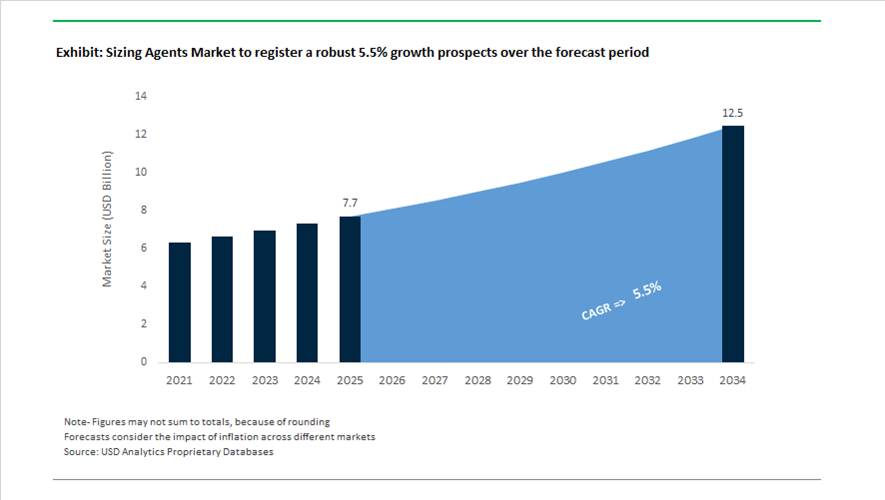
Sizing Agents Market Valuation 2025–2034: $7.7 Billion to $12.5 Billion at 5.5% CAGR Driven by Sustainable Paper Chemicals and Textile Performance Engineering
The global sizing agents market is valued at $7.7 billion in 2025 and is projected to reach $12.5 billion by 2034, expanding at a CAGR of 5.5%. Growth is supported by increasing demand for alkyl succinic anhydride (ASA), alkyl ketene dimer (AKD), rosin-based sizes, polymer surface sizing agents, and silicone-based sizing chemistries across paper, paperboard, packaging, technical textiles, and performance apparel applications. Sizing agents are critical for improving water resistance, ink adhesion, printability, tensile strength, and surface durability in high-speed paper machines and modern textile weaving operations. Rising sustainability requirements, lower chemical oxygen demand (COD) targets in wastewater discharge, and circular fashion commitments are accelerating reformulation of traditional sizing chemistries toward biodegradable and low-VOC alternatives.
In early 2024, Shin-Etsu introduced the KRW-6000 Series, a fast-curing, water-based silicone resin engineered for sizing applications. Its emulsifier-free formulation reduces VOC emissions while delivering high heat resistance and surface durability for coated substrates. During 2024–2025, Kemira finalized expansion of its ASA production line in Nanjing, China, supported by a €25 million investment to address Asia-Pacific demand, which accounts for more than half of global paper sizing consumption. These developments underscore capacity localization in key paper and board markets, particularly in China where packaging-grade paper demand remains structurally strong.
Innovation and sustainability repositioning intensified in 2025. On April 1, 2025, Solenis released its first integrated sustainability report following the Diversey acquisition, reporting that 73% of revenue is tied to customer sustainability initiatives, including advancements in paper sizing and water treatment chemistries. In 2025, Solenis launched imPress™ SB-798 technology for packaging mills, designed to eliminate surface ASA applications and reduce wet-end deposits while improving adhesion efficiency in high-speed paper production. Mid-2025, BASF promoted biodegradable polymer sizing agents tailored for high-speed air-jet textile looms, reducing COD load during desizing processes. In December 2025, Archroma introduced SUPER SYSTEMS+, advanced textile sizing formulations addressing color fade and durability, aligned with circular fashion standards. Archroma’s recognition as a Top Chemical Supplier Champion by Adidas in early 2025 further reinforced its positioning in sustainable textile supply chains.
Digitalization and regional capacity shifts shaped 2025–2026 dynamics. In late 2025, Solenis and Kemira accelerated deployment of AI-driven analytics across sizing lines to monitor coating uniformity in real time, reducing chemical waste by up to 15% and enabling predictive maintenance in paper mills. In mid-2025, Heraeus expanded specialty chemical capacity in Dresden, supporting high-purity sizing precursors for technical textiles and electronics-grade paper. In February 2026, Indian chemical manufacturers, including Silox India, secured funding for expansion projects in Gujarat to capitalize on the “China Plus One” textile sourcing shift. These investments strengthen South Asia’s role as a growing hub for textile sizing and finishing chemistries. The convergence of biodegradable polymer innovation, AI-enabled process optimization, regional capacity realignment, and packaging sustainability mandates is shaping the global sizing agents market trajectory toward $12.5 billion by 2034.
Key Trends and High-Impact Opportunities in the Global Sizing Agents Market
Strategic Shift Toward Bio-Based and Repulpable Sizing Agents in Paper Packaging
The sizing agents market is undergoing a structural realignment as pulp and paper producers accelerate the transition away from fossil-derived chemistries toward bio-based, water-compatible sizing solutions. This shift is non-negotiable and regulation-led, driven by the EU Packaging and Packaging Waste Regulation 2025/40, which entered into force in February 2025 and mandates that all packaging placed on the European market be recyclable at scale by 2030. As a result, traditional synthetic sizing systems are being phased out in favor of starch-based, polysaccharide, and lipid-derived formulations that deliver barrier performance without compromising recyclability.
Regulatory pressure is intensifying further with the upcoming ban on PFAS in food-contact packaging after August 12, 2026. This has catalyzed rapid adoption of water-based sizing agents and bio-derived barrier coatings across containerboard, cartonboard, and food-service packaging. Industry leaders such as Solenis and Kemira are scaling plant-based sizing technologies that now achieve up to 98% moisture barrier efficiency, effectively closing the historical performance gap versus petrochemical alternatives. In parallel, recyclability performance has become a commercial differentiator. By late 2025, European board producers were prioritizing repulpable sizing systems to achieve Grade A or B recyclability scores, critical in a region that reached an 81.5% paper and board recycling rate in 2024. Advanced bio-based sizings minimize the formation of stickies during repulping, reducing downtime and contamination in high-speed tissue and containerboard mills.
High-Performance Glass Fiber Sizing Enabling Recyclable Wind Energy Composites
A second structural trend is emerging from the wind energy sector, where blade lengths exceeding 80 meters are redefining material requirements at the fiber–resin interface. Sizing agents are no longer passive protective layers but are being engineered at the molecular level to enable compatibility with next-generation thermoplastic resin systems. This shift is foundational to the development of fully recyclable wind turbine blades and the circularity of composite materials.
In October 2024, the ZEBRA consortium successfully demonstrated a closed-loop recycling pathway for thermoplastic wind blades using Elium resin, with specialized sizing agents enabling recovery of approximately 75% of glass fibers for reuse in new blade production. Participants included Arkema and Owens Corning, underscoring strong industry alignment around sizing innovation. Policy momentum is reinforcing this trend. In January 2025, the U.S. Department of Energy released guidance recommending that 90% of decommissioned turbine mass be recycled, supported by $20 million in targeted funding. This initiative is accelerating demand for advanced silane-based sizing agents that allow reclaimed fibers to retain more than 70% of their original tensile strength, a critical threshold as roughly 25,000 tonnes of wind blades enter decommissioning annually from 2025 onward.
Conductive and Functional Sizing Agents for Smart Textiles and E-Wearables
The convergence of textiles and electronics is opening a high-margin opportunity for multifunctional sizing agents that move beyond protection to deliver active functionality. As of late 2025, fabric-level integration accounts for approximately 45% of total smart textile volumes, driven by demand for washable, durable electronic fabrics in healthcare monitoring and defense applications. In this context, sizing agents modified with carbon nanotubes or conductive polymers are being applied during fiber spinning to create in-fiber sensor architectures capable of real-time thermal mapping and physiological monitoring.
Defense and security agencies are emerging as early adopters, specifying antistatic and biometric-sensing fibers for uniforms and surveillance textiles. Manufacturing hubs in Asia Pacific, particularly China and South Korea, are scaling conductive sizing production to lower the historically high cost of e-textiles. For sizing agent producers, this segment offers premium pricing, strong intellectual property protection, and long qualification cycles that favor established suppliers with advanced formulation capabilities.
Specialized Sizing for Recycled Carbon and Glass Fiber Reinforcement
Circular economy adoption in aerospace and automotive composites is creating a critical opportunity for re-sizing agents tailored to recycled fibers. During pyrolysis, recycled carbon fiber loses its original surface sizing, severely reducing adhesion to polymer matrices. Restoring interfacial bonding through engineered re-sizing is therefore essential to unlocking the structural potential of recycled fibers.
In November 2025, a major North American electric vehicle manufacturer entered into a strategic supply agreement with Carbon Conversions to secure chopped recycled carbon fiber for interior and semi-structural components. The success of this integration depends on advanced sizing agents that enable recycled fibers to bond effectively with nylon and polypropylene matrices, restoring stiffness levels up to eight times higher than unreinforced plastics. Policy support is strengthening this opportunity. In December 2025, the Ministry of Economy, Trade and Industry included recycled carbon fiber adoption as a key performance indicator in its updated Green Growth Strategy. This has prompted companies such as Toray Industries to invest in dedicated recycled fiber R&D centers, with a strong focus on standardized sizing agents that enable consistent performance from discontinuous recycled fibers in high-volume automotive applications.
Sizing Agents Market Share and Segmentation Insights
Synthetic Sizing Agents Dominate the Market with Strong Adoption in Modern Papermaking Processes
Synthetic sizing agents accounted for 58.60% of the sizing agents market in 2025, establishing them as the leading product category in paper and board manufacturing. Key products such as alkyl ketene dimer (AKD), alkenyl succinic anhydride (ASA), and styrene-acrylic copolymers provide excellent water resistance, printability, and sheet strength in paper production. Their consistent performance and compatibility with modern papermaking processes make them superior to traditional natural sizing materials. A major 2025 industry driver is the continued transition toward neutral and alkaline papermaking systems, where synthetic sizing agents play a critical role in achieving stable sizing performance. These advanced formulations support higher machine speeds, improved sizing uniformity, and compatibility with calcium carbonate fillers, which are widely used in modern paper manufacturing.
Packaging Industry Drives Sizing Agent Demand Across Paper and Board Production
Packaging represents the largest end-use segment in the sizing agents market, accounting for 42.80% of global demand in 2025 due to the high production volume of packaging paper and board grades. Materials such as containerboard, folding cartonboard, corrugated packaging, and wrapping papers require sizing agents to improve water resistance, structural strength, and printing performance. The rapid growth of e-commerce logistics and sustainable fiber-based packaging solutions continues to support strong demand for paper packaging materials. A key 2025 industry trend is the increasing requirement for enhanced moisture resistance in packaging applications, particularly for food products and humidity-sensitive goods. Synthetic sizing technologies enable packaging materials to maintain mechanical integrity and visual quality during storage, transportation, and distribution in challenging environmental conditions.
Sizing Agents Market Competitive Landscape
The global sizing agents market in 2026 is shaped by bio-based AKD innovation, circular chemistry adoption, and regulatory-driven shifts toward sustainable paper and textile processing. Leading companies are investing in renewable feedstocks, PFAS-free formulations, and localized production to meet rising demand for eco-compliant packaging and textile sizing solutions.
Kemira Oyj Expands Bio-Based AKD and ASA Sizing Leadership with Strong Packaging Segment Performance
Kemira Oyj maintains a dominant position in the global sizing agents market, supported by €3.2 billion in 2025 revenue and a strong 18.4% EBITDA margin. Its Packaging & Hygiene Solutions segment generated €970 million, with sizing and strength chemicals contributing 15% of total revenue. The company’s expertise in Alkyl Ketene Dimer (AKD) and Alkenyl Succinic Anhydride (ASA) technologies enables high-performance water-resistant paper packaging. Kemira’s 2030 target of €500 million from renewable solutions is accelerating development of bio-based sizing agents and molded fiber additives. Sustainability initiatives include a CDP “A-” Water Security rating and a 33% Scope 3 emissions reduction target by 2033. Its strategic focus on renewable feedstocks and circular chemistry strengthens its leadership in sustainable sizing solutions.
Solenis Accelerates PHA-Based Barrier Coatings and AI-Driven Sizing Optimization at Global Scale
Solenis is scaling its presence in the sizing agents industry through advanced chemical management and sustainable barrier technologies across 160 countries and 78 manufacturing sites. Its partnership with PhaBuilder is advancing PHA-based sizing agents and coatings, offering fully compostable alternatives to plastic and wax barriers. Over 75% of innovation demand is now sustainability-focused, particularly targeting PFAS-free sizing chemistries for food-grade paper packaging. The company’s Blueprinting R&D model and FastTrack innovation pipeline enable rapid commercialization of eco-friendly solutions. Integration of Diversey and NCH has created a unified platform combining internal sizing, water treatment, and hygiene solutions. Solenis’ AI-enabled process optimization enhances machine efficiency and chemical dosing precision in large-scale paper production.
BASF SE Strengthens Localized Polymeric Sizing Production Through Zhanjiang Verbund Expansion
BASF SE is reinforcing its competitive position in the sizing agents market through large-scale production and cost optimization under its “Winning Ways” strategy. With 2025 sales of €59.7 billion and projected 2026 EBITDA of €6.2–€7.0 billion, the company is leveraging strong financial performance to expand specialty chemical capabilities. The Zhanjiang Verbund site in China enables localized manufacturing of polymeric sizing agents and binders for Asia-Pacific demand. BASF’s cost-saving initiatives achieved €1.7 billion in annual reductions, with a 2026 target of €2.3 billion supporting reinvestment in green chemistry. Its “local-for-local” model accelerates development of VOC-compliant surface sizing agents tailored to regional regulations. The company’s integrated value chain and innovation focus position it strongly in high-performance industrial additives.
Ingredion Incorporated Advances Plant-Based Starch Sizing and Clean-Label Film-Forming Technologies
Ingredion Incorporated is capitalizing on the shift toward natural polymer alternatives by expanding its plant-based starch sizing solutions for paper and textiles. With approximately $7.4 billion in annual sales and strong EPS guidance for 2026, the company is scaling its Texture & Healthful Solutions segment. Capacity expansion at its Indianapolis facility enhances specialty starch production for clean-label sizing applications. Its film-forming technologies improve strength, reduce oil absorption, and enable food-contact compliant paper coatings. Ingredion’s Idea Labs® network supports co-development of bio-derived sizing agents with global OEMs. The company’s focus on high-amylose starch and renewable feedstocks aligns with increasing demand for biodegradable and sustainable sizing chemistries.
Wacker Chemie AG Optimizes Polymer Binder Portfolio and Cost Structure for Textile Sizing Applications
Wacker Chemie AG is strengthening its role in the textile sizing agents market through its polymer binders and specialty silicones portfolio. The company reported €5.49 billion in 2025 sales and forecasts €550–€700 million EBITDA for 2026, supported by Project PACE delivering €300 million in cost savings. Its Polymers segment, generating €1.38 billion in revenue, supplies polyvinyl acetate (PVA) and VAE dispersions widely used in textile sizing formulations. Strategic capital reallocation toward biosolutions and high-purity silicones supports development of biodegradable and low-VOC textile finishes. Wacker’s focus on operational efficiency and specialty chemical innovation enhances competitiveness amid shifting sustainability regulations. Its integrated polymer chemistry capabilities position it as a key supplier in advanced textile sizing systems.
China Sizing Agents Market Driven by High-Speed Paper Capacity and Nano-Enhanced Performance
China’s sizing agents market is scaling through capacity expansion, consolidation of global leaders, and rapid adoption of advanced surface technologies in packaging and textiles. In 2025, Kemira completed the expansion of its Nanjing project with an investment of approximately €25 million, commissioning a modern production line for Alkenyl Succinic Anhydride sizing agents. This facility is aligned with the domestic demand surge for high-speed paper and paperboard grades, where runnability and water resistance are decisive performance metrics. China has also strengthened its position as the global center for Alkyl Ketene Dimer production. The Kemira–Tiancheng Chemicals joint venture in Yanzhou expanded its second AKD line in late 2025, reinforcing its status as the world’s largest AKD manufacturing hub supplying liquid packaging board and office stationery producers.
Environmental policy is reshaping supplier competitiveness. Under the 14th Five-Year Plan, local governments have tightened low-VOC standards for textile sizing agents, exemplified by Archroma receiving the Guangzhou “Outstanding Unit for Clean Production in 2025” recognition for its Panyu site. Performance-driven innovation is accelerating simultaneously. Domestic mills are deploying nanotechnology-enhanced surface sizing systems that lift recycled fiber packaging burst strength by roughly 20% compared with conventional starch-based approaches. Strategic consolidation is also evident, as BASF announced the consolidation of its Asian PolyTHF operations into the Caojing site, improving precursor integration for synthetic fiber sizing. While Archroma’s expanded Global Innovation Center in Mumbai serves the wider APAC region, its centralized digital-inkjet-compatible sizing R&D is increasingly deployed across Chinese textile supply chains.
United States Sizing Agents Market Defined by PFAS-Free Barriers and Onshore Starch Modification
The United States sizing agents market is being reshaped by sustainability mandates, tariff-driven localization, and process integration across paper and packaging. In August 2025, Solenis launched a portfolio of PHA-based barrier coatings under its “packaging through chemistry” initiative, enabling paper-based packaging to replace polyethylene films without compromising moisture and grease resistance. This direction aligns with strong state-level environmental regulations and consumer brand commitments to fiber-based packaging.
PFAS-free innovation is a core differentiator. Solenis introduced TopScreen™ and Contour™ SM technologies in 2025 to deliver oil and grease resistance for molded pulp cups and plates without intentionally added PFAS. Tariff updates on specialty starch derivatives and synthetic polymers in 2025 have reinforced the economics of domestic sourcing, prompting U.S. producers to increase capital expenditure for on-site starch modification facilities to control landed costs and supply risk. Strategic partnerships are accelerating process efficiency, including Solenis’ late-2025 collaboration with HEIDELBERG to develop flexographic-applied barrier coatings that eliminate offline coating steps for cupstock and liners. Corporate integration has further broadened reach, as the 2025 merger of NCH with Solenis created a diversified processing platform across specialized textile and paper sizing. Sustainability benchmarking remains a competitive signal, with leading players securing Cradle to Cradle Certified Material Health Gold status for more than 200 products spanning warp sizing and optical brighteners by late 2025.
India Sizing Agents Market Accelerated by MSME Expansion and ZDHC-Aligned Innovation
India’s sizing agents market is expanding through MSME-led capacity growth, centralized R&D, and export-oriented textile strategies. The Union Budget 2025–26 raised investment and turnover thresholds for manufacturing MSMEs, catalyzing regional production of sizing agents across textile clusters in Gujarat and Tamil Nadu under the Vocal for Local framework. This policy support has translated into higher availability of modified starches and cost-effective sizing formulations tailored to handloom and powerloom applications.
Innovation and compliance are converging. Archroma opened its expanded Global Innovation Center of Excellence in Mumbai in 2025, focusing on sustainable sizing solutions compliant with ZDHC MRSL Level 3 standards. Price dynamics have influenced formulation strategies, as BASF implemented price adjustments for Lupranate MDI in November 2025, prompting downstream users to optimize recipes and substitute toward bio-based or hybrid sizing chemistries. Export momentum remains strong. The Ministry of MSME reported assistance to over 10.71 lakh micro-enterprises under PMEGP through 2025, many of which are engaged in domestic production of modified starch sizing agents for textiles destined for international markets.
Germany Sizing Agents Market Anchored by Circular Systems and REACH-Ready Reformulation
Germany’s sizing agents industry is characterized by hybrid material systems, early regulatory compliance, and technical specialization for high-performance textiles. In early 2025, Evonik launched its Smart Effects initiative, integrating silanes and silica capabilities to develop hybrid sizing agents that enhance wet strength and durability in eco-certified textiles. This systems-level approach supports brand owners seeking certified circular and low-impact materials.
Energy transition strategies are embedded in synthesis pathways. Wacker and BASF intensified the use of biomass-derived methanol for specialty sizing polymers, targeting a 25% reduction in product-related carbon footprints by early 2026. Regulatory preparedness is advanced, with German manufacturers achieving approximately 90% compliance with the upcoming 2026 EU REACH roadmap, including the removal of restricted siloxanes and heavy-metal catalysts from industrial sizing formulations. Technical centers are also developing alkali-resistant sizing chemistries tailored to athleisure and performance fabrics, supporting durability under repeated washing and high-pH processing conditions.
Finland Sizing Agents Market Centered on Water Efficiency and Fiber Performance
Finland’s sizing agents market reflects a strategic pivot toward water stewardship and fiber optimization, led by Kemira. In its Q3 2025 investor presentation, Kemira highlighted its transformation into a water-focused company, with roughly 30% of revenue generated from specialty chemicals for the pulp and paper sector, including internal and surface sizing agents. This focus is translating into solutions that enhance water resistance and mechanical strength while reducing process water consumption.
Kemira’s 2025 initiatives under its Fiber Essentials platform emphasize sizing agents that improve packaging performance for top-tier global customers, which account for about a quarter of company revenue. Following the divestment of its Oil and Gas business in 2024, Kemira has redirected capital toward renewable and bio-based sizing solutions for food packaging and hygiene applications. This reallocation underscores Finland’s role as a center for sustainable pulp and paper chemistry, where sizing agents are engineered to meet stringent performance and environmental expectations simultaneously.
Comparative Snapshot: Country-Level Sizing Agents Industry Dynamics
Sizing Agents Market County Level Snapshot
Country
Core Demand Drivers
Strategic Focus Areas
Regulatory and Policy Influence
China
High-speed paper, packaging, textiles
ASA and AKD capacity, nano-surface sizing
14th Five-Year Plan, low-VOC standards
United States
Fiber-based packaging, molded pulp
PFAS-free barriers, onshore starch modification
State PFAS rules, tariff adjustments
India
Textiles, MSME manufacturing
ZDHC-compliant sizing, export-oriented starches
MSME incentives, PMEGP support
Germany
Eco-certified textiles, performance fabrics
Hybrid sizing systems, REACH-ready reformulation
EU REACH 2026 roadmap
Finland
Pulp and packaging optimization
Water-focused sizing, renewable solutions
Sustainability-driven procurement
Sizing Agents Market Report Scope
Sizing Agents Market
Parameter
Details
Market Size (2025)
$7.7 Billion
Market Size (2034)
$12.5 Billion
Market Growth Rate
5.5%
Segments
By Product Type (Natural Sizing Agents, Synthetic Sizing Agents, Hybrid & Nano-Enhanced Sizing Agents), By Form (Liquid, Powder), By Application (Paper & Board, Textile & Fiber, Glass Fiber, Other Industrial Applications), By End-Use Industry (Packaging, Apparel & Home Textiles, Printing & Writing, Industrial & Technical)
Study Period
2019- 2025 and 2026-2034
Units
Revenue (USD)
Qualitative Analysis
Porter’s Five Forces, SWOT Profile, Market Share, Scenario Forecasts, Market Ecosystem, Company Ranking, Market Dynamics, Industry Benchmarking
Companies
BASF SE, Kemira Oyj, Solenis, Archroma, Dow Inc., Evonik Industries AG, Akzo Nobel NV, Ingredion Incorporated, Shin-Etsu Chemical Co. Ltd., Zhejiang Xinan Chemical Industrial Group, Ashland Global Holdings Inc., CP Kelco, Clariant AG, Mitsubishi Chemical Group, Roquette Frères
Countries
US, Canada, Mexico, Germany, France, Spain, Italy, UK, Russia, China, India, Japan, South Korea, Australia, South East Asia, Brazil, Argentina, Middle East, Africa
Sizing Agents Market Segmentation
By Product Type
Natural Sizing Agents
Synthetic Sizing Agents
Hybrid & Nano-Enhanced Sizing Agents
By Form
Liquid
Powder
By Application
Paper & Board
Textile & Fiber
Glass Fiber
Other Industrial Applications
By End-Use Industry
Packaging
Apparel & Home Textiles
Printing & Writing
Industrial & Technical
By Region
North America (United States, Canada, Mexico)
Europe (Germany, France, United Kingdom, Spain, Italy, Rest of Europe)
Asia Pacific (China, India, Japan, South Korea, Australia, Rest of APAC)
South and Central America (Brazil, Argentina, Rest of SCA)
Middle East and Africa (Saudi Arabia, UAE, South Africa, Rest of Middle East, Rest of Africa)
2. Sizing Agents Market Landscape & Outlook (2025–2034)
2.1. Introduction to Sizing Agents Market
2.2. Market Valuation and Growth Projections (2025–2034)
2.3. Demand Drivers: Sustainable Paper Chemicals and Textile Performance Engineering
2.4. Strategic Developments: Capacity Expansion, Innovation, and Digitalization
2.5. Market Dynamics: Bio-Based Reformulation, Low-VOC Requirements, and Circular Economy Trends
3. Innovations Reshaping the Sizing Agents Market
3.1. Trend: Shift Toward Bio-Based and Repulpable Sizing Agents in Paper Packaging
3.2. Trend: High-Performance Glass Fiber Sizing for Recyclable Wind Energy Composites
3.3. Opportunity: Conductive and Functional Sizing Agents for Smart Textiles
3.4. Opportunity: Specialized Sizing for Recycled Carbon and Glass Fiber Reinforcement
4. Competitive Landscape and Strategic Initiatives
4.1. Mergers and Acquisitions
4.2. R&D and Material Innovation
4.3. Sustainability and ESG Strategies
4.4. Market Expansion and Regional Focus
5. Market Share and Segmentation Insights: Sizing Agents Market
5.1. By Product Type
5.1.1. Natural Sizing Agents
5.1.2. Synthetic Sizing Agents
5.1.3. Hybrid & Nano-Enhanced Sizing Agents
5.2. By Form
5.2.1. Liquid
5.2.2. Powder
5.3. By Application
5.3.1. Paper & Board
5.3.2. Textile & Fiber
5.3.3. Glass Fiber
5.3.4. Other Industrial Applications
5.4. By End-Use Industry
5.4.1. Packaging
5.4.2. Apparel & Home Textiles
5.4.3. Printing & Writing
5.4.4. Industrial & Technical
5.5. By Region
5.5.1. North America
5.5.2. Europe
5.5.3. Asia Pacific
5.5.4. South and Central America
5.5.5. Middle East and Africa
6. Country Analysis and Outlook of Sizing Agents Market
6.1. United States
6.2. Canada
6.3. Mexico
6.4. Germany
6.5. France
6.6. Spain
6.7. Italy
6.8. UK
6.9. Russia
6.10. China
6.11. India
6.12. Japan
6.13. South Korea
6.14. Australia
6.15. South East Asia
6.16. Brazil
6.17. Argentina
6.18. Middle East
6.19. Africa
7. Sizing Agents Market Size Outlook by Region (2025–2034)
7.1. North America Sizing Agents Market Size Outlook to 2034
7.1.1. By Product Type
7.1.2. By Form
7.1.3. By Application
7.1.4. By End-Use Industry
7.1.5. By Region
7.2. Europe Sizing Agents Market Size Outlook to 2034
7.2.1. By Product Type
7.2.2. By Form
7.2.3. By Application
7.2.4. By End-Use Industry
7.2.5. By Region
7.3. Asia Pacific Sizing Agents Market Size Outlook to 2034
7.3.1. By Product Type
7.3.2. By Form
7.3.3. By Application
7.3.4. By End-Use Industry
7.3.5. By Region
7.4. South America Sizing Agents Market Size Outlook to 2034
7.4.1. By Product Type
7.4.2. By Form
7.4.3. By Application
7.4.4. By End-Use Industry
7.4.5. By Region
7.5. Middle East and Africa Sizing Agents Market Size Outlook to 2034
7.5.1. By Product Type
7.5.2. By Form
7.5.3. By Application
7.5.4. By End-Use Industry
7.5.5. By Region
8. Company Profiles: Leading Players in the Sizing Agents Market
8.1. BASF SE
8.2. Kemira Oyj
8.3. Solenis
8.4. Archroma
8.5. Dow Inc.
8.6. Evonik Industries AG
8.7. Akzo Nobel NV
8.8. Ingredion Incorporated
8.9. Shin-Etsu Chemical Co. Ltd.
8.10. Zhejiang Xinan Chemical Industrial Group
8.11. Ashland Global Holdings Inc.
8.12. CP Kelco
8.13. Clariant AG
8.14. Mitsubishi Chemical Group
8.15. Roquette Frères
9. Methodology
9.1. Research Scope
9.2. Market Research Approach
9.3. Market Sizing and Forecasting Model
9.4. Research Coverage
9.5. Data Horizon
9.6. Deliverables
10. Appendix
10.1. Acronyms and Abbreviations
10.2. List of Tables
10.3. List of Figures
Sizing Agents Market Segmentation
By Product Type
Natural Sizing Agents
Synthetic Sizing Agents
Hybrid & Nano-Enhanced Sizing Agents
By Form
Liquid
Powder
By Application
Paper & Board
Textile & Fiber
Glass Fiber
Other Industrial Applications
By End-Use Industry
Packaging
Apparel & Home Textiles
Printing & Writing
Industrial & Technical
By Region
North America (United States, Canada, Mexico)
Europe (Germany, France, United Kingdom, Spain, Italy, Rest of Europe)
Asia Pacific (China, India, Japan, South Korea, Australia, Rest of APAC)
South and Central America (Brazil, Argentina, Rest of SCA)
Middle East and Africa (Saudi Arabia, UAE, South Africa, Rest of Middle East, Rest of Africa)
The global sizing agents market is valued at $7.7 billion in 2025 and is projected to reach $12.5 billion by 2034, growing at a CAGR of 5.5%. Growth is driven by rising demand in packaging paper, technical textiles, and sustainable materials. Increasing adoption of biodegradable and low-VOC sizing agents further supports long-term expansion.
Regulations such as the EU Packaging and Packaging Waste Regulation and PFAS restrictions are accelerating the shift toward bio-based, water-borne, and repulpable sizing agents. Manufacturers are replacing fossil-derived chemistries with starch, polysaccharide, and lipid-based systems. This transition also reduces COD levels and improves recyclability performance in paper and packaging.
Key opportunities include bio-based sizing for recyclable packaging, advanced glass fiber sizing for wind turbine blades, and conductive sizing agents for smart textiles. Re-sizing solutions for recycled carbon fiber are also gaining traction. These segments offer premium margins and align with circular economy and energy transition trends.
Packaging is the largest demand segment, accounting for over 42% of market consumption due to growth in e-commerce and sustainable paperboard. Textile and technical fiber applications are also expanding rapidly, particularly in performance apparel and industrial fabrics. Demand is further supported by high-speed papermaking and advanced weaving technologies.
Key players include BASF SE, Kemira Oyj, Solenis, Archroma, Dow Inc., Evonik Industries AG, and Akzo Nobel NV. These companies focus on bio-based sizing innovation, AI-driven process optimization, and PFAS-free formulations. Strategic investments in regional production and circular chemistry strengthen their competitive positioning.