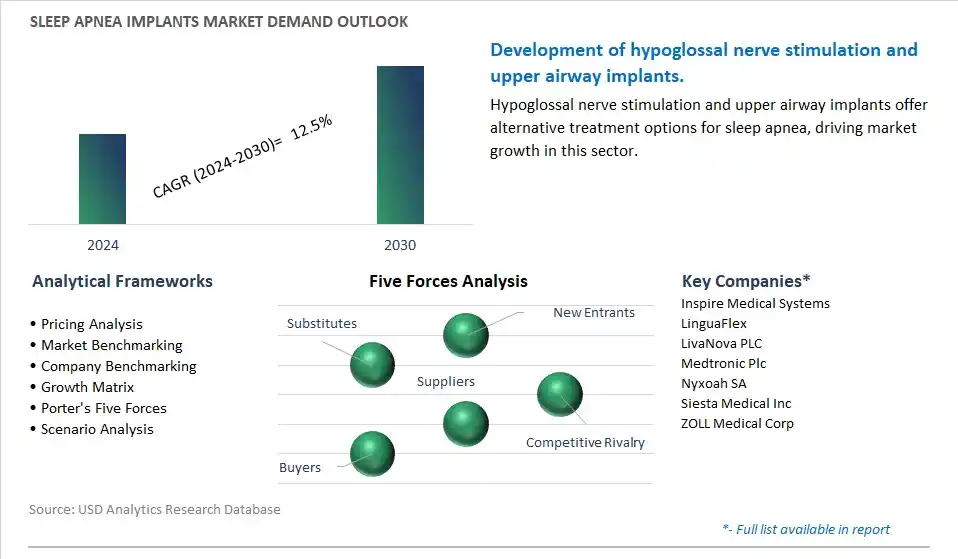
Sleep Apnea Implants Market is estimated to increase at a growth rate of 12.5% CAGR over the forecast period from 2024 to 2030.
The global Sleep Apnea Implants Market Study analyzes and forecasts the market size across 6 regions and 24 countries for diverse segments including By Product (Hypoglossal Neurostimulation Devices, Phrenic Nerve Stimulator, Palatal Implants), By Indication (Obstructive Sleep Apnea, Central Sleep Apnea), By End-User (Hospitals, Ambulatory Surgical Centers, Office Based Clinics).
An Introduction to Sleep Apnea Implants Market in 2024
The Sleep Apnea Implants Market comprises implantable devices, hypoglossal nerve stimulators, and upper airway stimulation systems used in the treatment of obstructive sleep apnea (OSA) and related sleep-disordered breathing conditions. Sleep apnea implants deliver neuromodulation or mechanical support to airway muscles, preventing airway collapse, snoring, and apnea events during sleep. Market trends focus on minimally invasive implant procedures, patient selection criteria, long-term efficacy studies, and regulatory approvals for sleep apnea implant technologies to provide alternative treatment options for OSA patients intolerant to CPAP therapy or non-surgical interventions.
Sleep Apnea Implants Market Competitive Landscape
The global Sleep Apnea Implants Industry is highly competitive with a large number of companies focusing on niche market segments. Amidst intense competitive conditions, Sleep Apnea Implants Companies are investing in new product launches and strengthening distribution channels. Key companies operating in the Sleep Apnea Implants Industry include- Inspire Medical Systems, LinguaFlex, LivaNova PLC, Medtronic Plc, Nyxoah SA, Siesta Medical Inc, ZOLL Medical Corp.
Sleep Apnea Implants Market Trend: Advancements in Minimally Invasive Implantable Devices
A notable trend in the Sleep Apnea Implants market is the continuous advancements in minimally invasive implantable devices for the treatment of obstructive sleep apnea (OSA). Manufacturers are focusing on developing innovative implants that offer effective airway support and patency during sleep while minimizing invasiveness and postoperative discomfort for patients. These implants typically target anatomical structures such as the soft palate, tongue base, or hypoglossal nerve to prevent collapse and obstruction of the upper airway. The trend towards minimally invasive implants reflects a growing demand for alternative treatment options that provide long-term symptom relief and improved quality of life for patients with moderate to severe OSA, particularly those who are intolerant to continuous positive airway pressure (CPAP) therapy.
Sleep Apnea Implants Market Driver: Increasing Prevalence of Obstructive Sleep Apnea
The primary driver for the Sleep Apnea Implants market is the escalating prevalence of obstructive sleep apnea (OSA) globally. OSA is a common sleep disorder characterized by recurrent episodes of partial or complete upper airway obstruction during sleep, leading to disrupted breathing patterns, fragmented sleep, and daytime fatigue. As the prevalence of risk factors such as obesity, aging population, and sedentary lifestyles continues to rise, so does the incidence of OSA and its associated comorbidities, including hypertension, cardiovascular disease, and diabetes. With a growing recognition of the impact of untreated OSA on patient health and quality of life, there's an increasing demand for effective treatment modalities such as sleep apnea implants that address underlying anatomical factors contributing to airway collapse and obstruction.
Sleep Apnea Implants Market Opportunity: Expansion of Indications and Patient Population
An opportunity exists in the expansion of indications and patient population for sleep apnea implants beyond traditional candidates with moderate to severe OSA. While current implants are primarily indicated for patients who are unable to tolerate or adhere to CPAP therapy, there's potential for broader adoption among patients with milder forms of OSA or upper airway resistance syndrome (UARS) who experience persistent symptoms despite conservative management. By conducting clinical trials, collecting real-world evidence, and obtaining regulatory approvals for expanded indications, manufacturers can tap into a larger patient population and offer implantable solutions to individuals with varying degrees of upper airway collapsibility and sleep-disordered breathing patterns. Moreover, strategic collaborations with sleep medicine specialists, otolaryngologists, and healthcare providers facilitate patient identification, referral, and access to implantation procedures, contributing to the growth and adoption of sleep apnea implants as a mainstream treatment option for OSA.
Sleep Apnea Implants Market Share Analysis: Hypoglossal Neurostimulation Devices is the fastest growing market segment over the forecast period to 2030
The fastest growing segment in the Sleep Apnea Implants Market is the Hypoglossal Neurostimulation Devices product category. This growth is primarily driven by advancements in neurostimulation technology, offering effective treatment options for obstructive sleep apnea (OSA) and central sleep apnea (CSA) patients. Hypoglossal neurostimulation devices target the nerves controlling the tongue and upper airway muscles, helping to prevent airway collapse during sleep. The rising prevalence of sleep apnea disorders, coupled with the growing awareness of the benefits of neurostimulation therapy, contributes to the rapid adoption of these devices among hospitals, ambulatory surgical centers, and office-based clinics. Additionally, the demand for minimally invasive treatments and the focus on improving patient outcomes further fuel the growth of hypoglossal neurostimulation devices in the Sleep Apnea Implants Market.
Sleep Apnea Implants Market Segmentation
By Product
Hypoglossal Neurostimulation Devices
Phrenic Nerve Stimulator
Palatal Implants
By Indication
Obstructive Sleep Apnea
Central Sleep Apnea
By End-User
Hospitals
Ambulatory Surgical Centers
Office Based Clinics
Geographical Analysis
North America (United States, Canada, Mexico)
Europe (Germany, France, United Kingdom, Spain, Italy, Rest of Europe)
Asia Pacific (China, India, Japan, South Korea, Rest of Asia Pacific)
South America (Brazil, Argentina, Rest of South America)
Middle East and Africa (Saudi Arabia, UAE, Rest of Middle East, South Africa, Egypt, Rest of Africa)
Sleep Apnea Implants Companies
Inspire Medical Systems
LinguaFlex
LivaNova PLC
Medtronic Plc
Nyxoah SA
Siesta Medical Inc
ZOLL Medical Corp
* List not Exhaustive
Reasons to Buy the Sleep Apnea Implants Market Study
• Deepen your industry insights and navigate uncertainties for strategy formulation, CAPEX, and Operational decisions
• Gain access to detailed insights on the Sleep Apnea Implants Market, encompassing current market size, growth trends, and forecasts till 2030.
• Access detailed competitor analysis, enabling competitive advantage through a thorough understanding of market players, strategies, and potential differentiation opportunities
• Stay ahead of the curve with insights on technological advancements, innovations, and upcoming trends
• Identify lucrative investment avenues and expansion opportunities within the Sleep Apnea Implants Industry, guided by robust, data-backed analysis.
• Understand regional and global markets through country-wise analysis, regional market potential, regulatory nuances, and dynamics
• Execute strategies with confidence and speed through information, analytics, and insights on the industry value chain
• Corporate leaders, strategists, financial experts, shareholders, asset managers, and governmental representatives can make long-term planning scenarios and build an integrated and timely understanding of market dynamics
• Benefit from tailored solutions and expert consultation based on report insights, providing personalized strategies aligned with specific business needs.
TABLE OF CONTENTS
1 Introduction to 2024 Sleep Apnea Implants Market
1.1 Market Overview
1.2 Quick Facts
1.3 Scope/Objective of the Study
1.4 Market Definition
1.5 Countries and Regions Analyzed
1.6 Units, Currency, and Conversions
1.7 Industry Value Chain
2 Research Methodology
2.1 Market Size Estimation
2.2 Sources and Research Methodology
2.3 Data Triangulation
2.4 Assumptions and Limitations
3 Executive Summary
3.1 Global Sleep Apnea Implants Market Size Outlook, $ Million, 2021 to 2030
3.2 Sleep Apnea Implants Market Outlook by Type, $ Million, 2021 to 2030
3.3 Sleep Apnea Implants Market Outlook by Product, $ Million, 2021 to 2030
3.4 Sleep Apnea Implants Market Outlook by Application, $ Million, 2021 to 2030
3.5 Sleep Apnea Implants Market Outlook by Key Countries, $ Million, 2021 to 2030
4 Market Dynamics
4.1 Key Driving Forces of Sleep Apnea Implants Industry
4.2 Key Market Trends in Sleep Apnea Implants Industry
4.3 Potential Opportunities in Sleep Apnea Implants Industry
4.4 Key Challenges in Sleep Apnea Implants Industry
5 Market Factor Analysis
5.1 Value Chain Analysis
5.2 Competitive Landscape
5.2.1 Global Sleep Apnea Implants Market Share by Company (%), 2023
5.2.2 Product Offerings by Company
5.3 Porter’s Five Forces Analysis
5.4 Pricing Analysis and Outlook
6 Growth Outlook Across Scenarios
6.1 Growth Analysis-Case Scenario Definitions
6.2 Low Growth Scenario Forecasts
6.3 Reference Growth Scenario Forecasts
6.4 High Growth Scenario Forecasts
7 Global Sleep Apnea Implants Market Outlook by Segments
7.1 Sleep Apnea Implants Market Outlook by Segments, $ Million, 2021- 2030
By Product
Hypoglossal Neurostimulation Devices
Phrenic Nerve Stimulator
Palatal Implants
By Indication
Obstructive Sleep Apnea
Central Sleep Apnea
By End-User
Hospitals
Ambulatory Surgical Centers
Office Based Clinics
8 North America Sleep Apnea Implants Market Analysis and Outlook To 2030
8.1 Introduction to North America Sleep Apnea Implants Markets in 2024
8.2 North America Sleep Apnea Implants Market Size Outlook by Country, 2021-2030
8.2.1 United States
8.2.2 Canada
8.2.3 Mexico
8.3 North America Sleep Apnea Implants Market size Outlook by Segments, 2021-2030
By Product
Hypoglossal Neurostimulation Devices
Phrenic Nerve Stimulator
Palatal Implants
By Indication
Obstructive Sleep Apnea
Central Sleep Apnea
By End-User
Hospitals
Ambulatory Surgical Centers
Office Based Clinics
9 Europe Sleep Apnea Implants Market Analysis and Outlook To 2030
9.1 Introduction to Europe Sleep Apnea Implants Markets in 2024
9.2 Europe Sleep Apnea Implants Market Size Outlook by Country, 2021-2030
9.2.1 Germany
9.2.2 France
9.2.3 Spain
9.2.4 United Kingdom
9.2.4 Italy
9.2.5 Russia
9.2.6 Norway
9.2.7 Rest of Europe
9.3 Europe Sleep Apnea Implants Market Size Outlook by Segments, 2021-2030
By Product
Hypoglossal Neurostimulation Devices
Phrenic Nerve Stimulator
Palatal Implants
By Indication
Obstructive Sleep Apnea
Central Sleep Apnea
By End-User
Hospitals
Ambulatory Surgical Centers
Office Based Clinics
10 Asia Pacific Sleep Apnea Implants Market Analysis and Outlook To 2030
10.1 Introduction to Asia Pacific Sleep Apnea Implants Markets in 2024
10.2 Asia Pacific Sleep Apnea Implants Market Size Outlook by Country, 2021-2030
10.2.1 China
10.2.2 India
10.2.3 Japan
10.2.4 South Korea
10.2.5 Indonesia
10.2.6 Malaysia
10.2.7 Australia
10.2.8 Rest of Asia Pacific
10.3 Asia Pacific Sleep Apnea Implants Market size Outlook by Segments, 2021-2030
By Product
Hypoglossal Neurostimulation Devices
Phrenic Nerve Stimulator
Palatal Implants
By Indication
Obstructive Sleep Apnea
Central Sleep Apnea
By End-User
Hospitals
Ambulatory Surgical Centers
Office Based Clinics
11 South America Sleep Apnea Implants Market Analysis and Outlook To 2030
11.1 Introduction to South America Sleep Apnea Implants Markets in 2024
11.2 South America Sleep Apnea Implants Market Size Outlook by Country, 2021-2030
11.2.1 Brazil
11.2.2 Argentina
11.2.3 Rest of South America
11.3 South America Sleep Apnea Implants Market size Outlook by Segments, 2021-2030
By Product
Hypoglossal Neurostimulation Devices
Phrenic Nerve Stimulator
Palatal Implants
By Indication
Obstructive Sleep Apnea
Central Sleep Apnea
By End-User
Hospitals
Ambulatory Surgical Centers
Office Based Clinics
12 Middle East and Africa Sleep Apnea Implants Market Analysis and Outlook To 2030
12.1 Introduction to Middle East and Africa Sleep Apnea Implants Markets in 2024
12.2 Middle East and Africa Sleep Apnea Implants Market Size Outlook by Country, 2021-2030
12.2.1 Saudi Arabia
12.2.2 UAE
12.2.3 Oman
12.2.4 Rest of Middle East
12.2.5 Egypt
12.2.6 Nigeria
12.2.7 South Africa
12.2.8 Rest of Africa
12.3 Middle East and Africa Sleep Apnea Implants Market size Outlook by Segments, 2021-2030
By Product
Hypoglossal Neurostimulation Devices
Phrenic Nerve Stimulator
Palatal Implants
By Indication
Obstructive Sleep Apnea
Central Sleep Apnea
By End-User
Hospitals
Ambulatory Surgical Centers
Office Based Clinics
13 Company Profiles
13.1 Company Snapshot
13.2 SWOT Profiles
13.3 Products and Services
13.4 Recent Developments
13.5 Financial Profile
List of Companies
Inspire Medical Systems
LinguaFlex
LivaNova PLC
Medtronic Plc
Nyxoah SA
Siesta Medical Inc
ZOLL Medical Corp
14 Appendix
14.1 Customization Offerings
14.2 Subscription Services
14.3 Related Reports
14.4 Publisher Expertise
