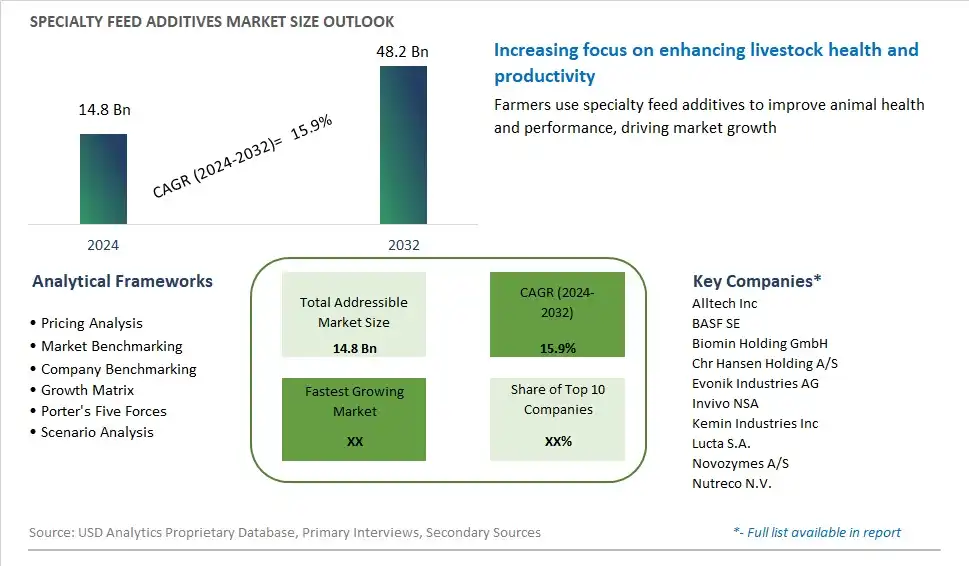
Global Specialty Feed Additives Market Size is valued at $14.8 Billion in 2024 and is forecast to register a growth rate (CAGR) of 15.9% to reach $48.2 Billion by 2032.
The global Specialty Feed Additives Market Comprehensive Study analyzes and forecasts the market size across 6 regions and 24 countries for diverse segments -By Type (Flavors & Sweeteners, Minerals, Binders, Vitamins, Acidifiers, Antioxidants, Others), By Function (Gut Health & Digestive Performance, Mycotoxin Management, Palatability Enhancement, Preservation Of Functional Ingredients, Others), By Livestock (Swine, Ruminants, Poultry, Aquatic Animals, Others), By Form (Liquid, Dry, Others)
An Introduction to Specialty Feed Additives Market
Specialty feed additives play a crucial role in modern animal husbandry by enhancing the health, growth, and productivity of livestock and poultry. In 2024, the market for specialty feed additives is witnessing significant growth, driven by the increasing demand for high-quality animal protein products and the growing awareness of animal welfare and sustainability practices. These additives encompass a diverse range of ingredients, including probiotics, enzymes, vitamins, minerals, and prebiotics, formulated to meet the specific nutritional needs of different livestock species at various stages of growth. Manufacturers are innovating with advanced formulations and delivery systems to optimize the efficacy and bioavailability of specialty feed additives, ensuring maximum benefits for both animals and producers. Additionally, stringent regulations and quality standards are shaping the market landscape, with a focus on safety, efficacy, and environmental sustainability driving product development and market expansion.
Specialty Feed Additives Competitive Landscape
The market report analyses the leading companies in the industry including Alltech Inc, BASF SE, Biomin Holding GmbH, Chr Hansen Holding A/S, Evonik Industries AG, Invivo NSA, Kemin Industries Inc, Lucta S.A., Novozymes A/S, Nutreco N.V., and Others.
Specialty Feed Additives Market Dynamics
Specialty Feed Additives Market Trend: Rising Demand for Customized Nutritional Solutions in Animal Feed
The market for Specialty Feed Additives is experiencing a prominent trend driven by the rising demand for customized nutritional solutions in animal feed. As the livestock industry continues to evolve, there's a growing recognition of the importance of tailored feed formulations to meet the specific nutritional needs of different animal species and production systems. Specialty feed additives, including vitamins, minerals, amino acids, enzymes, and probiotics, offer targeted solutions to enhance animal health, growth performance, and feed efficiency. This trend is driven by the desire to optimize animal nutrition, reduce environmental impact, and improve the quality and safety of animal-derived products. As farmers and feed manufacturers seek innovative ways to maximize productivity and profitability while ensuring animal welfare and sustainability, the demand for specialty feed additives is expected to grow significantly.
Market Driver: Increasing Focus on Animal Health and Performance
The market for Specialty Feed Additives is primarily driven by the increasing focus on animal health and performance in livestock production systems. With rising global population and changing dietary preferences driving higher demand for animal protein, there's growing pressure on livestock producers to optimize production efficiency and output. Specialty feed additives play a crucial role in supporting animal health, immunity, and performance by addressing nutritional deficiencies, enhancing digestion and nutrient absorption, and mitigating stress factors. This driver is reinforced by the need to minimize the use of antibiotics and growth promoters in animal feed, in response to regulatory restrictions and consumer concerns about antimicrobial resistance and food safety. By investing in innovative feed additive solutions backed by scientific research and efficacy trials, livestock producers can improve animal welfare, productivity, and profitability, driving the adoption of specialty feed additives across the industry.
Market Opportunity: Expansion into Sustainable and Natural Feed Additive Solutions
The market for Specialty Feed Additives presents a significant opportunity for expansion into sustainable and natural feed additive solutions to address growing consumer demand for environmentally friendly and ethically sourced animal products. As sustainability becomes a key driver of consumer purchasing decisions, there's a rising preference for products that are produced using sustainable and eco-friendly practices throughout the supply chain. Specialty feed additive manufacturers can capitalize on this opportunity by developing innovative additives derived from renewable sources, such as plant extracts, algae, and microbial fermentation, that offer comparable or superior efficacy to conventional additives. Additionally, there's an opportunity to invest in natural feed additives with functional properties, such as antioxidant, antimicrobial, and immune-modulating effects, to support animal health and reduce reliance on synthetic additives. By aligning with consumer values and market trends towards sustainability and naturalness, companies can differentiate their products, enhance brand reputation, and capture market share in the rapidly growing segment of specialty feed additives.
Specialty Feed Additives Market Share Analysis: Minerals held the dominant market share in 2024
In the Specialty Feed Additives market, the "Minerals" segment is the largest, commanding significant prominence for several compelling reasons. Minerals are essential nutrients required for the overall health, growth, and performance of livestock and poultry, making them indispensable components of animal feed formulations. These minerals, including calcium, phosphorus, magnesium, and zinc, play crucial roles in bone development, immune function, reproduction, and metabolism. Further, mineral deficiencies can lead to various health issues and reduced productivity in animals, underscoring the importance of supplementing feed with adequate mineral levels. Additionally, the growing focus on animal welfare, productivity, and disease prevention drives the demand for specialized mineral additives tailored to the specific nutritional requirements of different livestock species and production stages. With their vital roles in animal nutrition and health, the Minerals segment maintains its dominance in the Specialty Feed Additives market, shaping the landscape of animal feed formulations and nutritional solutions globally.
Specialty Feed Additives Market Share Analysis: Gut Health & Digestive Performance market is poised to register the fastest growth rae over the forecast period to 2032
Among the segments delineated in the Specialty Feed Additives market, the "Gut Health & Digestive Performance" segment is the fastest-growing, propelled by several key factors. As livestock producers increasingly prioritize animal health and performance, there is a growing recognition of the critical role that gut health plays in overall animal well-being and productivity. Specialized feed additives designed to support gut health and digestive function are witnessing surging demand as they help optimize nutrient absorption, enhance immune function, and mitigate the risk of digestive disorders. Further, with the rise of antibiotic-free and natural production practices, there is heightened interest in alternative strategies to promote gut health and optimize digestive performance in livestock and poultry. Additionally, the growing awareness of the impact of gut health on animal growth efficiency and feed conversion ratios drives the adoption of gut health additives as essential components of modern animal nutrition programs. With their proven efficacy and potential to enhance animal performance and welfare, the Gut Health & Digestive Performance segment is poised to sustain its rapid growth, reshaping the landscape of specialty feed additives towards holistic approaches to animal nutrition and health management.
Specialty Feed Additives Market Share Analysis: Poultry held the dominant market share in 2024
In the Specialty Feed Additives market, the "Poultry" segment is the largest, commanding significant prominence for several compelling reasons. Poultry farming, including chickens, turkeys, and ducks, represents a substantial portion of the global livestock industry, driving significant demand for specialized feed additives. Poultry producers prioritize the health, growth, and performance of their flocks, leading to extensive utilization of feed additives to optimize nutrition, promote growth, and enhance disease resistance. Additionally, the intensification of poultry production and the shift towards more sustainable and efficient farming practices further propel the demand for specialty feed additives tailored to the unique nutritional requirements and production challenges of poultry. Further, with the increasing global demand for poultry products such as meat and eggs, there is a heightened focus on maximizing production efficiency and ensuring product quality, driving the adoption of advanced feed additive solutions. With their vital role in supporting poultry health, productivity, and profitability, the Poultry segment maintains its dominance in the Specialty Feed Additives market, shaping the landscape of poultry nutrition and production globally.
Specialty Feed Additives Market Segmentation
By Type
Flavors & Sweeteners
Minerals
Binders
Vitamins
Acidifiers
Antioxidants
Others
By Function
Gut Health & Digestive Performance
Mycotoxin Management
Palatability Enhancement
Preservation Of Functional Ingredients
Others
By Livestock
Swine
Ruminants
Poultry
Aquatic Animals
Others
By Form
Liquid
Dry
Others
Countries Analyzed
North America (US, Canada, Mexico)
Europe (Germany, UK, France, Spain, Italy, Russia, Rest of Europe)
Asia Pacific (China, India, Japan, South Korea, Australia, South East Asia, Rest of Asia)
South America (Brazil, Argentina, Rest of South America)
Middle East and Africa (Saudi Arabia, UAE, Rest of Middle East, South Africa, Egypt, Rest of Africa)
Specialty Feed Additives Companies Profiled in the Study
Alltech Inc
BASF SE
Biomin Holding GmbH
Chr Hansen Holding A/S
Evonik Industries AG
Invivo NSA
Kemin Industries Inc
Lucta S.A.
Novozymes A/S
Nutreco N.V.
*- List Not Exhaustive
Chapter 1. TABLE OF CONTENTS
Chapter 2. Introduction to Specialty Feed Additives Market
2.1. Market Overview
2.2. Key Statistics and Report Highlights
2.3. Scope of the Comprehensive Study
2.3.1. Market Definition
2.3.2 Countries and Regions Covered
2.3.3 Research Objective
2.3.4 Units, Currency, and Conversions
2.3.5 Industry Value Chain
2.4. Key Market Segments
2.5. Key Companies
2.6. Study Period
Chapter 3. Strategic Analysis Review
3.1. Specialty Feed Additives Pricing Analysis and Forecast
3.2. Porter’s Five Forces
3.3. Market Ecosystem
3.4. SWOT Analysis
3.5. Regulatory Scenario
3.3. Effects of Inflation, Russia-Ukraine War, moderating economic growth, and other macroeconomic factors
Chapter 4. Competitive Landscape
4.1. Market Share Analysis
4.1.1. Global Specialty Feed Additives Market Share by Company, 2023
4.1.2. Product Offerings of Leading Specialty Feed Additives Companies
4.2. Market Entropy
4.2.1. New Product Launches in the Industry
4.2.2. Mergers, Acquisitions, Joint ventures, and Partnerships
4.3. Key Strategies and Best Practices
Chapter 5. Global Market Projections: Best, Reference, and Low Case Scenarios
5.1. Growth Analysis- Case Scenario Definitions
5.2. Low Growth Case Scenario Forecasts
5.3. Reference Growth Case Scenario Forecasts
5.4. High Growth Case Scenario Forecasts
Chapter 6. Market Dynamics
6.1. Specialty Feed Additives Market Drivers
6.2. Specialty Feed Additives Market Challenges
6.6. Specialty Feed Additives Market Opportunities
6.4. Specialty Feed Additives Market Trends
Chapter 7. Global Specialty Feed Additives Market Outlook Trends
7.1. Global Specialty Feed Additives Revenue (USD Million) and CAGR (%) by Type (2021-2032)
7.2. Global Specialty Feed Additives Revenue (USD Million) and CAGR (%) by Application (2021-2032)
7.3. Global Specialty Feed Additives Revenue (USD Million) and CAGR (%) by Product (2021-2032)
By Type
Flavors & Sweeteners
Minerals
Binders
Vitamins
Acidifiers
Antioxidants
Others
By Function
Gut Health & Digestive Performance
Mycotoxin Management
Palatability Enhancement
Preservation Of Functional Ingredients
Others
By Livestock
Swine
Ruminants
Poultry
Aquatic Animals
Others
By Form
Liquid
Dry
Others
Chapter 8. Global Specialty Feed Additives Regional Analysis and Outlook
8.1. Global Specialty Feed Additives Revenue (USD Million) By Regions (2021- 2032)
8.2. North America Specialty Feed Additives Revenue (USD Million) by Country (2021-2032)
8.2.1. United States Specialty Feed Additives Regional Analysis and Outlook
8.2.2. Canada Specialty Feed Additives Regional Analysis and Outlook
8.2.3. Mexico Specialty Feed Additives Regional Analysis and Outlook
8.3. Europe Specialty Feed Additives Revenue (USD Million), by Country (2021-2032)
8.3.1. Germany Specialty Feed Additives Regional Analysis and Outlook
8.3.2. France Specialty Feed Additives Regional Analysis and Outlook
8.3.3. United Kingdom Specialty Feed Additives Regional Analysis and Outlook
8.3.4. Spain Specialty Feed Additives Regional Analysis and Outlook
8.3.5. Italy Specialty Feed Additives Regional Analysis and Outlook
8.3.6. Russia Specialty Feed Additives Regional Analysis and Outlook
8.3.7. Rest of Europe Specialty Feed Additives Regional Analysis and Outlook
8.4. Asia Pacific Specialty Feed Additives Revenue (USD Million) by Country (2021-2032)
8.4.1. China Specialty Feed Additives Regional Analysis and Outlook
8.4.2. Japan Specialty Feed Additives Regional Analysis and Outlook
8.4.3. India Specialty Feed Additives Regional Analysis and Outlook
8.4.4. South Korea Specialty Feed Additives Regional Analysis and Outlook
8.4.5. Australia Specialty Feed Additives Regional Analysis and Outlook
8.4.6. South East Asia Specialty Feed Additives Regional Analysis and Outlook
8.4.7. Rest of Asia Pacific Specialty Feed Additives Regional Analysis and Outlook
8.5. South America Specialty Feed Additives Revenue (USD Million), by Country (2021-2032)
8.5.1. Brazil Specialty Feed Additives Regional Analysis and Outlook
8.5.2. Argentina Specialty Feed Additives Regional Analysis and Outlook
8.5.3. Rest of South America Specialty Feed Additives Regional Analysis and Outlook
8.6. Middle East and Africa Specialty Feed Additives Revenue (USD Million) by Country (2021-2032)
8.6.1. Middle East Specialty Feed Additives Regional Analysis and Outlook
8.6.2. Africa Specialty Feed Additives Regional Analysis and Outlook
Chapter 9. North America Specialty Feed Additives Analysis and Outlook
9.1. North America Specialty Feed Additives Revenue (USD Million) by Segments (2021-2032)
9.1.1. North America Specialty Feed Additives Revenue (USD Million) by Type (2021-2032)
9.1.2. North America Specialty Feed Additives Revenue (USD Million) by Application (2021-2032)
9.1.3. North America Specialty Feed Additives Revenue (USD Million) by Product (2021-2032)
By Type
Flavors & Sweeteners
Minerals
Binders
Vitamins
Acidifiers
Antioxidants
Others
By Function
Gut Health & Digestive Performance
Mycotoxin Management
Palatability Enhancement
Preservation Of Functional Ingredients
Others
By Livestock
Swine
Ruminants
Poultry
Aquatic Animals
Others
By Form
Liquid
Dry
Others
Chapter 10. Europe Specialty Feed Additives Analysis and Outlook
10.1. Europe Specialty Feed Additives Revenue (USD Million), by Segments (USD Million) (2021-2032)
10.1.1. Europe Specialty Feed Additives Revenue (USD Million) by Type (2021-2032)
10.1.2. Europe Specialty Feed Additives Revenue (USD Million) by Application (2021-2032)
10.1.3. Europe Specialty Feed Additives Revenue (USD Million) by Product (2021-2032)
By Type
Flavors & Sweeteners
Minerals
Binders
Vitamins
Acidifiers
Antioxidants
Others
By Function
Gut Health & Digestive Performance
Mycotoxin Management
Palatability Enhancement
Preservation Of Functional Ingredients
Others
By Livestock
Swine
Ruminants
Poultry
Aquatic Animals
Others
By Form
Liquid
Dry
Others
Chapter 11. Asia Pacific Specialty Feed Additives Analysis and Outlook
11.1. Asia Pacific Specialty Feed Additives Revenue (USD Million), and Revenue (USD Million) by Segments (2021-2032)
11.1.1. Asia Pacific Specialty Feed Additives Revenue (USD Million) by Type (2021-2032)
11.1.2. Asia Pacific Specialty Feed Additives Revenue (USD Million) by Application (2021-2032)
11.1.3. Asia Pacific Specialty Feed Additives Revenue (USD Million) by Product (2021-2032)
By Type
Flavors & Sweeteners
Minerals
Binders
Vitamins
Acidifiers
Antioxidants
Others
By Function
Gut Health & Digestive Performance
Mycotoxin Management
Palatability Enhancement
Preservation Of Functional Ingredients
Others
By Livestock
Swine
Ruminants
Poultry
Aquatic Animals
Others
By Form
Liquid
Dry
Others
Chapter 12. South America Specialty Feed Additives Analysis and Outlook
12.1. South America Specialty Feed Additives Revenue (USD Million), by Segments (2021-2032)
12.1.1. South America Specialty Feed Additives Revenue (USD Million) by Type (2021-2032)
12.1.2. South America Specialty Feed Additives Revenue (USD Million) by Application (2021-2032)
12.1.3. South America Specialty Feed Additives Revenue (USD Million) by Product (2021-2032)
By Type
Flavors & Sweeteners
Minerals
Binders
Vitamins
Acidifiers
Antioxidants
Others
By Function
Gut Health & Digestive Performance
Mycotoxin Management
Palatability Enhancement
Preservation Of Functional Ingredients
Others
By Livestock
Swine
Ruminants
Poultry
Aquatic Animals
Others
By Form
Liquid
Dry
Others
Chapter 13. Middle East and Africa Specialty Feed Additives Analysis and Outlook
13.1. Middle East and Africa Specialty Feed Additives Revenue (USD Million), by Segments (2021-2032)
13.1.1. Middle East and Africa Specialty Feed Additives Revenue (USD Million) by Type (2021-2032)
13.1.2. Middle East and Africa Specialty Feed Additives Revenue (USD Million) by Application (2021-2032)
13.1.3. Middle East and Africa Specialty Feed Additives Revenue (USD Million) by Product (2021-2032)
By Type
Flavors & Sweeteners
Minerals
Binders
Vitamins
Acidifiers
Antioxidants
Others
By Function
Gut Health & Digestive Performance
Mycotoxin Management
Palatability Enhancement
Preservation Of Functional Ingredients
Others
By Livestock
Swine
Ruminants
Poultry
Aquatic Animals
Others
By Form
Liquid
Dry
Others
Chapter 14. Specialty Feed Additives Company Profiles
14.1 Business Overview
14.2 Product Profiles
14.3 SWOT Profiles
14.5 Recent Developments
14.6 Financial Profile
List of Companies
Alltech Inc
BASF SE
Biomin Holding GmbH
Chr Hansen Holding A/S
Evonik Industries AG
Invivo NSA
Kemin Industries Inc
Lucta S.A.
Novozymes A/S
Nutreco N.V.
15. Methodology and Data Sources
15.1 Customization Offerings
15.2 Subscription Services
15.3 Related Reports
15.4 Publisher Expertise
LIST OF TABLES
Table 1 Market Segmentation Analysis
Table 2 Global Specialty Feed Additives Market Share of Leading Companies, 2023
Table 3 Product Offerings of Leading Companies
Table 4 Low Growth Scenario Forecasts
Table 5 Reference Case Growth Scenario
Table 6 High Growth Case Scenario
Table 7 Global Specialty Feed Additives Revenue (USD Million) And CAGR (%) By Type (2021-2032)
Table 8 Global Specialty Feed Additives Revenue (USD Million) And CAGR (%) By Application (2021-2032)
Table 9 Global Specialty Feed Additives Revenue (USD Million) And CAGR (%) By Product (2021-2032)
Table 10 Global Specialty Feed Additives Market Revenue (USD Million) By Regions (2021-2032)
Table 11 Global Specialty Feed Additives Market Share (%) By Regions (2021-2032)
Table 12 North America Specialty Feed Additives Revenue (USD Million) By Country (2021-2032)
Table 13 Europe Specialty Feed Additives Revenue (USD Million) By Country (2021-2032)
Table 14 Asia Pacific Specialty Feed Additives Revenue (USD Million) By Country (2021-2032)
Table 15 South America Specialty Feed Additives Revenue (USD Million) By Country (2021-2032)
Table 16 Middle East and Africa Specialty Feed Additives Revenue (USD Million) By Region (2021-2032)
Table 17 North America Specialty Feed Additives Revenue (USD Million) By Type (2021-2032)
Table 18 North America Specialty Feed Additives Revenue (USD Million) By Application (2021-2032)
Table 19 North America Specialty Feed Additives Revenue (USD Million) By Product (2021-2032)
Table 20 Europe Specialty Feed Additives Revenue (USD Million) By Type (2021-2032)
Table 21 Europe Specialty Feed Additives Revenue (USD Million) By Application (2021-2032)
Table 22 Europe Specialty Feed Additives Revenue (USD Million) By Product (2021-2032)
Table 23 Asia Pacific Specialty Feed Additives Revenue (USD Million) By Type (2021-2032)
Table 24 Asia Pacific Specialty Feed Additives Revenue (USD Million) By Application (2021-2032)
Table 25 Asia Pacific Specialty Feed Additives Revenue (USD Million) By Product (2021-2032)
Table 26 South America Specialty Feed Additives Revenue (USD Million) By Type (2021-2032)
Table 27 South America Specialty Feed Additives Revenue (USD Million) By Application (2021-2032)
Table 28 South America Specialty Feed Additives Revenue (USD Million) By Product (2021-2032)
Table 29 Middle East and Africa Specialty Feed Additives Revenue (USD Million) By Type (2021-2032)
Table 30 Middle East and Africa Specialty Feed Additives Revenue (USD Million) By Application (2021-2032)
Table 31 Middle East and Africa Specialty Feed Additives Revenue (USD Million) By Product (2021-2032)
LIST OF FIGURES
Figure 1. Market Scope
Figure 2. Pricing Forecasts Per Unit, 2023- 2032
Figure 3. Porter’s Five Forces
Figure 4. Global Specialty Feed Additives Market Revenue (USD Million) By Regions (2021-2032)
Figure 5. Global Specialty Feed Additives Market Share (%) By Regions (2023)
Figure 6. North America Specialty Feed Additives Revenue (USD Million) By Country (2021-2032)
Figure 7. United States Specialty Feed Additives Revenue (USD Million) By Country (2021-2032)
Figure 8. Canada Specialty Feed Additives Revenue (USD Million) By Country (2021-2032)
Figure 9. Mexico Specialty Feed Additives Revenue (USD Million) By Country (2021-2032)
Figure 10. Europe Specialty Feed Additives Revenue (USD Million) By Country (2021-2032)
Figure 11. Germany Specialty Feed Additives Revenue (USD Million) By Country (2021-2032)
Figure 12. France Specialty Feed Additives Revenue (USD Million) By Country (2021-2032)
Figure 13. United Kingdom Specialty Feed Additives Revenue (USD Million) By Country (2021-2032)
Figure 14. Spain Specialty Feed Additives Revenue (USD Million) By Country (2021-2032)
Figure 15. Italy Specialty Feed Additives Revenue (USD Million) By Country (2021-2032)
Figure 16. Russia Specialty Feed Additives Revenue (USD Million) By Country (2021-2032)
Figure 17. Rest of Europe Specialty Feed Additives Revenue (USD Million) By Country (2021-2032)
Figure 11. Asia Pacific Specialty Feed Additives Revenue (USD Million) By Country (2021-2032)
Figure 12. China Specialty Feed Additives Revenue (USD Million) By Country (2021-2032)
Figure 13. Japan Specialty Feed Additives Revenue (USD Million) By Country (2021-2032)
Figure 14. India Specialty Feed Additives Revenue (USD Million) By Country (2021-2032)
Figure 15. South Korea Specialty Feed Additives Revenue (USD Million) By Country (2021-2032)
Figure 16. Australia Specialty Feed Additives Revenue (USD Million) By Country (2021-2032)
Figure 17. South East Asia Specialty Feed Additives Revenue (USD Million) By Country (2021-2032)
Figure 18. South America Specialty Feed Additives Revenue (USD Million) By Country (2021-2032)
Figure 19. Brazil Specialty Feed Additives Revenue (USD Million) By Country (2021-2032)
Figure 20. Argentina Specialty Feed Additives Revenue (USD Million) By Country (2021-2032)
Figure 21. Rest of Asia Pacific Specialty Feed Additives Revenue (USD Million) By Country (2021-2032)
Figure 22. Middle East and Africa Specialty Feed Additives Revenue (USD Million) By Region (2021-2032)
Figure 23. Saudi Arabia Specialty Feed Additives Revenue (USD Million) By Region (2021-2032)
Figure 24. The UAE Specialty Feed Additives Revenue (USD Million) By Region (2021-2032)
Figure 25. Rest of Middle East Specialty Feed Additives Revenue (USD Million) By Region (2021-2032)
Figure 26. South Africa Specialty Feed Additives Revenue (USD Million) By Region (2021-2032)
Figure 27. Africa Specialty Feed Additives Revenue (USD Million) By Region (2021-2032)
Figure 28. North America Specialty Feed Additives Revenue (USD Million) By Type (2021-2032)
Figure 29. North America Specialty Feed Additives Revenue (USD Million) By Application (2021-2032)
Figure 30. North America Specialty Feed Additives Revenue (USD Million) By Product (2021-2032)
Figure 31. Europe Specialty Feed Additives Revenue (USD Million) By Type (2021-2032)
Figure 32. Europe Specialty Feed Additives Revenue (USD Million) By Application (2021-2032)
Figure 33. Europe Specialty Feed Additives Revenue (USD Million) By Product (2021-2032)
Figure 34. Asia Pacific Specialty Feed Additives Revenue (USD Million) By Type (2021-2032)
Figure 35. Asia Pacific Specialty Feed Additives Revenue (USD Million) By Application (2021-2032)
Figure 36. Asia Pacific Specialty Feed Additives Revenue (USD Million) By Product (2021-2032)
Figure 37. South America Specialty Feed Additives Revenue (USD Million) By Type (2021-2032)
Figure 38. South America Specialty Feed Additives Revenue (USD Million) By Application (2021-2032)
Figure 39. South America Specialty Feed Additives Revenue (USD Million) By Product (2021-2032)
Figure 40. Middle East and Africa Specialty Feed Additives Revenue (USD Million) By Type (2021-2032)
Figure 41. Middle East and Africa Specialty Feed Additives Revenue (USD Million) By Application (2021-2032)
Figure 42. Middle East and Africa Specialty Feed Additives Revenue (USD Million) By Product (2021-2032)
By Type
Flavors & Sweeteners
Minerals
Binders
Vitamins
Acidifiers
Antioxidants
Others
By Function
Gut Health & Digestive Performance
Mycotoxin Management
Palatability Enhancement
Preservation Of Functional Ingredients
Others
By Livestock
Swine
Ruminants
Poultry
Aquatic Animals
Others
By Form
Liquid
Dry
Others
Countries Analyzed
North America (US, Canada, Mexico)
Europe (Germany, UK, France, Spain, Italy, Russia, Rest of Europe)
Asia Pacific (China, India, Japan, South Korea, Australia, South East Asia, Rest of Asia)
South America (Brazil, Argentina, Rest of South America)
Middle East and Africa (Saudi Arabia, UAE, Rest of Middle East, South Africa, Egypt, Rest of Africa)
