Sports Underwear Market Outlook: Innovation in Performance Fabrics and Athleisure Demand
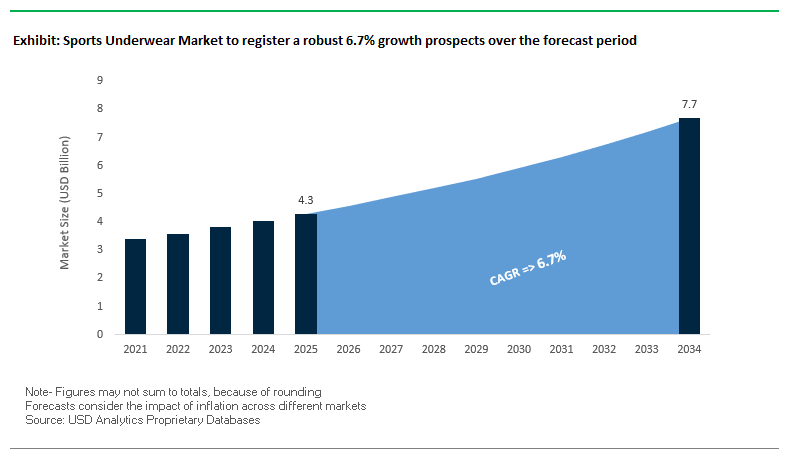
The global sports underwear market is anticipated to grow from $4.3 billion in 2025 to $7.7 billion in 2034, at a CAGR of 6.7%. Where sports apparel, consumer health, and fashion intersect, the category is growing with materials technology innovation, increasing sports participation, and the ongoing athleisure trend boom. The industry players are investing in new materials, ergonomic fit, and sustainable manufacturing to meet the shifting needs of elite athletes and the everyday fitness enthusiast.
Sport underwear has developed from being purely functional clothing to a component of sporting identity and lifestyle fashion. Application of moisture-wicking, thermoregulating, and compression-enhancing materials is making way for increased performance and comfort. At the same time, eco-conscious consumers are pressuring brands to use recycled fibers and green production methods in their products. With the athleisure market determining consumer patterns, consumers are also demanding quality undergarments for everyday, casual use.
Key Insights for Industry Professionals:
- Sports Participation Surge: Fitness culture expansion worldwide is boosting demand for specialized performance undergarments.
- Material Innovation: New-generation fabrics provide temperature control, stretchability, and durability.
- Athleisure Influence: Crossover designs suitable for both sports and lifestyle use are expanding market reach.
- Sustainability Push: Eco-friendly materials and ethical manufacturing are increasingly critical to brand positioning.
- Brand Differentiation: Strategic sponsorships and athlete endorsements are shaping competitive advantage.
Recent Developments and Strategic Moves in Sports Underwear Market
Recent developments in the sport underwear industry have been marked by daring product development and celebrity partnerships. In July 2025, Lululemon grew its tech apparel category with the launch of new fibers like Nulu, which is designed to deliver a "next-to-nothing" ultra-light feel appropriate for sport underwear that requires comfort and superior performance. In March 2025, Hanky Panky partnered with Saalt to produce a leak-proof panty line that combined lace motifs with high-tech gusset technology, demonstrating how functionality and fashion are converging in the intimate apparel category.
Sport sponsorships are one of the most popular ways of achieving brand exposure. In September 2024, Adidas signed a multi-year sponsorship deal with Liverpool FC, from the 2025/26 season, continuing international expansion in performance wear categories, including underwear. Under Armour's October 2024 return of its "Protect This House" campaign re-strengthened its connection with a new generation of athletes, further establishing its authenticity and brand loyalty.
Sustainability remains a key to market strategy. Not a sportswear company, Vitra's May 2025 move to produce the Eames Plastic Chair from post-consumer recycled polypropylene reflects the larger cross-industry movement toward recycled content a trend increasingly adopted by more and more sport underwear companies. In addition, digital retail innovation such as mobile ordering and online personalization features rolled out in August 2024 by top lifestyle and food companies is matched by the sportswear industry's focus on convenience gains through e-commerce innovation.
Trends and Opportunities Transforming the Sports Underwear Market
Bio-Sensing Fabric Integration Elevates Performance Monitoring
The adoption of bio-sensing wear to sports briefs is transforming sports wear with the use of high-tech materials and wearable technology. Smart wear, with biometric sensors based upon textiles, takes real-time physiological measurements such as heart rate, muscle activity, hydration, and core temperature. Hexoskin and Myant are at the forefront with products that allow easy data transfer for real-time performance feedback. AI-based predictive analytics that transcend mere tracking utilize this information to forecast fatigue, schedule hydration for maximum gain, and prevent injury through personalized training adjustments. The latest wearable, breathable biosensor fabrics technologies ensure sensor incorporation without compromising comfort and are ideal for long-term wear in high-intensity sports.
Sustainable High-Performance Fibers Meet Eco-Driven Demand
The trend toward sustainable athletic wear is propelling demand for eco-friendly sports underwear with sustainable yet high-functioning fibers. Recycled polyester and nylon from ocean trash and post-consumer waste equal high-performance moisture-wicking and durability without the environmental footprint. Plant-based fibers such as Tencel and hemp are gaining traction due to their breathability, biodegradability, and very low water usage in cultivation. Brands are using a blended fiber approach for mixing natural fibers with performance synthetics for balance in stretch, temperature control, and sweat management. Blended balance of sustainability and performance is emerging as a major differentiator in the competitive sportswear market.
Women’s Sports Underwear Innovation Gap
The under-addressed needs of female athletes represent a high-value growth opportunity. As women's engagement in sports has grown exponentially, product innovation has been inappropriately centered around male performance gear. Women's sports underwear innovation could fill gaps in fit precision, targeted support, and physiological monitoring. Expanded size ranges, impact-specific compression zone design for high-motion sports, and integration of tech for menstrual cycle and hormone monitoring can differentiate brands. Smart sports bras with personalized adjustability, breathable padding, and sweat-zoning fabrics are set to lead the way, especially in markets with high running participation, high-intensity sports participation, and team sports participation.
Military and Tactical Performance Base Layers
The military and tactical category is becoming a niche but high-margin market for performance underwear manufacturers. The market requires base layers to possess ultimate durability, multi-climate performance, and advanced protective qualities. Fire-resistant fabrics, antimicrobial finishes, and ballistic fragment protection are being engineered, which meet the special requirements of defense forces. Odor-controlling, quick-drying, and abrasion-resistant tactical underwear optimizes usage in combat conditions. Reinforced construction and ergonomic fits reduce fatigue during extended operations, offering opportunities for suppliers who can satisfy strict military standards without compromising comfort.
Market Share Insights: Product and Application Segments in Sports Underwear
Product Segment Performance: Sports Bras Lead, Boxer Briefs Dominate Men’s Category
sports bras with 40% market share remain the largest product category, driven by women's involvement in fitness and technology in supportive yet lightweight constructions. Moisture-wicking materials, bespoke size, and seamless constructions are taking comfort to new levels for high-impact sports. Boxer briefs (25%) remain dominant in the men's market due to their compression, support, and anti-chafe performance. Base layers are gaining traction for cold-weather sports and endurance sports with compression benefits, muscle recovery support, and thermal regulation. Trunks, briefs, and thongs remain in smaller shares but are increasing in niche performance-driven subsegments, including cycling, dance, and competitive swimming.
.png)
Application Segment Performance: Gym & Training Drive Demand, Yoga Gains Share
Training and gym sports underwear (35% market share) dominates the market because of the necessity for consumers to use flexible, breathable, and moisture-wicking materials for mixed workouts. Running sports underwear focuses on muscle stabilization and gliding comfort, whereas yoga sports underwear focuses on stretch fabrics and non-constricting fits for flexibility. Cycling sports underwear has padding and aerodynamic fits, which are attractive to professional and amateur cyclists. Outdoor sports and streetwear segments are being positively impacted by the athleisure trend because consumers want to use the underwear that can easily transition from athletic to casual use, rendering sports underwear more versatile outside of performance environments.
Competitive Landscape – Leading Brands Defining Performance and Lifestyle Appeal in Sports Underwear
The global sports underwear market is driven by brands with strong athletic heritage, innovation capabilities, and the ability to integrate style into performance gear. Key players included are Nike, Inc., Adidas AG, Under Armour, Inc., Lululemon Athletica Inc., Puma SE, ASICS Corporation, Hanesbrands Inc., Fruit of the Loom, Inc., Decathlon S.A., Champion (Hanesbrands Inc), New Balance Athletics, Inc., Jockey International, Inc., Columbia Sportswear Company, Patagonia, Inc., Sweaty Betty, Others.
Nike Inc. – Global Leader in Performance-Driven Apparel
Nike leverages its unmatched brand awareness and technological innovation to dominate the sports underwear category. Its seamless construction, sweat-wicking fabric, and compressive fit designs support athlete performance. Its environmental-friendly manufacturing processes align with its mission to reduce environmental impact, appealing to eco-conscious consumers. Nike sports underwear is high-impact training and everyday athletic style, positioning it as a category leader.
Adidas AG – Blending Heritage and High-Performance Technology
Adidas pairs its AEROREADY and CLIMACOOL+ technologies with signature fashion elements to make its sports briefs attractive to professional sports athletes and lifestyle consumers. Its partnership with Liverpool FC helps drive its leadership in the football category, with the effect spilling over to sales in comparable product categories. Adidas maintains its competitive edge by combining athletic performance with fashion-driven designs.
Lululemon Athletica Inc. – Premium Comfort and Technical Fabric Innovator
Lululemon's undergarment line for sports is supplemented by its own Nulu fabric, adding more softness and performance. Renowned for community outreach and upscale positioning, the brand is extending its product appeal from yoga enthusiasts to male athletes and multi-sport consumers. Its focus on quality, fit, and streamlined design resonates with the growing athleisure shopper segment.
Under Armour Inc. – Authentic Athlete-Centric Performance Brand
Under Armour's athletic undergarments product line is based on its HeatGear® and ColdGear® technologies, which provide comfort and moisture management regardless of weather conditions. Re-introducing the "Protect This House" campaign once again secures alignment with competitive athletes in addition to generating new excitement in its core product lines. Under Armour's approach to design of first and foremost performance continues to be relevant in high-performance apparel.
ASICS Corporation – Technical Precision with a Focus on Running and Performance Sports
ASICS, while best known for footwear, also produces solid base layers and sports briefs for runners and distance athletes. Its focus on functional fit, durability, and temperature regulation aligns with its purpose as a wellness brand. As it aims for 30 new Indian stores by 2025, ASICS is expanding its global retail presence, focusing on high-growth markets with increasing sports participation.
United States: Innovation-Driven Athletic Wear and Expanding Consumer Base
The United States sports underwear market is a global leader in fabric innovation, driven by a strong fitness culture and a well-established sports apparel ecosystem. Manufacturers are introducing patented moisture-wicking fabrics, odor-control treatments, and seamless 3D die-cast technology to provide enhanced comfort, support, and zero-friction performance during high-intensity workouts. Brands are also leveraging body heat contouring technology to ensure optimal fit and thermal regulation, making sports underwear a staple for activities ranging from CrossFit and marathon running to yoga and casual fitness. The market is bolstered by advanced R&D investment and partnerships between sportswear brands, textile engineers, and athletic institutions, ensuring products meet the high expectations of both professional athletes and fitness enthusiasts.
Health and wellness trends continue to fuel product demand, with brands positioning sports underwear as essential gear for performance enhancement and injury prevention. The focus on inclusivity offering multiple fits, extended sizing, and gender-neutral lines is broadening the appeal beyond professional sports to everyday consumers who value comfort and style. Major U.S. brands use targeted marketing campaigns, athlete endorsements, and influencer collaborations to link product performance to athletic achievement and lifestyle aspirations. This combination of cutting-edge technology, market inclusivity, and brand storytelling positions the U.S. as a dominant force in shaping global sports underwear trends.
Germany: Precision Performance Apparel and Sustainable Design Leadership
Germany’s sports underwear market is defined by a deep commitment to engineering precision and athletic performance, supported by domestic powerhouses such as Adidas and Puma. These brands combine technical expertise with ergonomic design principles, creating sports underwear that maximizes support, breathability, and durability under demanding athletic conditions. The country’s athletic community, from professional sports leagues to recreational clubs, demands performance-tested apparel that meets strict European quality standards. German manufacturers are also integrating advanced fiber blends, including recycled polyester and bio-based elastane, to meet environmental regulations and growing consumer expectations for sustainability.
Eco-consciousness is a defining market driver, with sports underwear increasingly produced from recycled ocean plastics, organic cotton blends, and low-impact dyes. The market is also tapping into the 50+ active demographic, offering performance underwear with enhanced comfort, support, and ease of wear for a generation that continues to prioritize health and mobility. The blending of style with functionality designing products suitable for both high-performance training and casual athleisure has strengthened the domestic appeal while bolstering exports across Europe. This alignment of technical mastery, environmental responsibility, and evolving consumer lifestyle trends ensures Germany’s competitive position in the global market.
United Kingdom: Eco-Friendly Athleisure and Inclusive Sportswear Innovation
The United Kingdom sports underwear market is at the forefront of sustainable and personalized athletic wear, with consumers seeking ethically sourced materials and environmentally responsible manufacturing processes. Brands are responding with eco-friendly fibers, biodegradable packaging, and carbon-neutral supply chains, often highlighting their sustainability credentials as a competitive advantage. Personalization is a growing trend, with brands offering custom fit options, size inclusivity, and unisex collections to cater to a broad demographic. This customization aligns with the UK’s increasing demand for apparel that combines athletic functionality with individual style preferences.
The post-pandemic wellness boom has significantly impacted the market, with more consumers engaging in outdoor activities, home workouts, and organized sports. Digital-first retail strategies dominate the UK landscape, with sports underwear sales increasingly driven by e-commerce platforms, social media marketing, and online fitness communities. Inclusivity in marketing featuring diverse body types, genders, and athletic abilities has further strengthened consumer loyalty. By combining eco-conscious production, tech-enabled personalization, and omnichannel retail strategies, the UK continues to carve out a strong position in the global sports underwear market.
China: High-Capacity Manufacturing and Fabric Technology Leadership
China’s sports underwear market benefits from a vast and technologically advanced manufacturing ecosystem, enabling large-scale production without compromising on quality. The country’s textile industry is a global leader in high-elasticity spandex blends, antimicrobial microfibers, and moisture-wicking performance fabrics that are essential for sports underwear manufacturing. This innovation capacity is supported by automated production lines, enabling brands to rapidly prototype and mass-produce high-performance products for both domestic and international markets.
Domestic sportswear brands are gaining momentum, competing with global giants by offering customized designs, region-specific fits, and trend-driven styles. The rise of live-streaming e-commerce and integrated social commerce platforms such as Tmall and Douyin has given manufacturers direct-to-consumer channels with massive reach. In addition, China’s focus on athleisure combining athletic functionality with streetwear appeal is fueling demand for sports underwear that is both performance-ready and style-conscious. This synergy of production scale, textile innovation, and digital retail dominance positions China as a critical growth hub in the global market.
Japan: High-Performance Textiles and Functional Athleisure Fusion
Japan’s sports underwear market stands out for its advanced textile engineering and focus on functional elegance. Domestic manufacturers are renowned for developing fabrics with superior moisture control, breathability, and thermal regulation, catering to athletes who demand peak performance. The Japanese consumer market places high value on craftsmanship, durability, and comfort, resulting in products that balance high-tech features with meticulous construction.
With an aging yet active population, Japan’s sports underwear segment also targets the senior fitness market, designing garments that offer support, easy movement, and lightweight comfort for low- to medium-impact activities. The popularity of athleisure in Japan means that sports underwear is often designed for everyday wear, blending seamlessly with casual fashion trends. Brands are leveraging minimalist aesthetics, advanced fiber technologies, and multifunctional designs to create products that appeal equally to competitive athletes and style-conscious consumers. This combination of material innovation, demographic targeting, and lifestyle integration secures Japan’s reputation as a leader in premium sports underwear solutions.
Sports Underwear Market Report Scope
Sports Underwear Market
|
Parameter
|
Details
|
|
Market Size (2025)
|
$4.3 Billion
|
|
Market Size (2034)
|
$7.7 Billion
|
|
Market Growth Rate
|
6.7%
|
|
Segments
|
By Product Type (Sports Bras, Boxer Briefs, Trunks, Briefs, Thongs, Base Layers), By Material (Synthetic (Nylon, Polyester, Spandex), Natural (Cotton, Bamboo), Blends), By Gender (Men, Women), By Application (Running, Gym & Training, Yoga, Outdoor Sports, Cycling, Casual Wear), By Distribution Channel (Online Retail, Sporting Goods Stores, Supermarkets & Hypermarkets, Exclusive Brand Outlets)
|
|
Study Period
|
2019- 2024 and 2025-2034
|
|
Units
|
Revenue (USD)
|
|
Qualitative Analysis
|
Porter’s Five Forces, SWOT Profile, Market Share, Scenario Forecasts, Market Ecosystem, Company Ranking, Market Dynamics, Industry Benchmarking
|
|
Companies
|
Nike, Inc., Adidas AG, Under Armour, Inc., Lululemon Athletica Inc., Puma SE, ASICS Corporation, Hanesbrands Inc., Fruit of the Loom, Inc., Decathlon S.A., Champion (Hanesbrands Inc), New Balance Athletics, Inc., Jockey International, Inc., Columbia Sportswear Company, Patagonia, Inc., Sweaty Betty, Others.
|
|
Countries
|
US, Canada, Mexico, Germany, France, Spain, Italy, UK, Russia, China, India, Japan, South Korea, Australia, South East Asia, Brazil, Argentina, Middle East, Africa
|
Sports Underwear Market Segmentation
By Product
- Sports Bras
- Boxer Briefs
- Trunks
- Briefs
- Thongs
- Base Layers
By Material
By Gender
By Application
- Running
- Gym & Training
- Yoga
- Outdoor Sports
- Cycling
- Casual Wear
By Distribution Channel
- Online Retail
- Sporting Goods Stores
- Supermarkets & Hypermarkets
- Exclusive Brand Outlets
Countries Analyzed
- North America (US, Canada, Mexico)
- Europe (Germany, UK, France, Spain, Italy, Russia, Rest of Europe)
- Asia Pacific (China, India, Japan, South Korea, Australia, South East Asia, Rest of Asia)
- South America (Brazil, Argentina, Rest of South America)
- Middle East and Africa (Saudi Arabia, UAE, Rest of Middle East, South Africa, Egypt, Rest of Africa)
Top Companies in Sports Underwear Market
- Nike Inc.
- Adidas AG
- Under Armour Inc.
- Lululemon Athletica Inc.
- Puma SE
- ASICS Corporation
- Hanesbrands Inc.
- Fruit of the Loom Inc.
- Decathlon S.A.
- Champion (Hanesbrands Inc)
- New Balance Athletics Inc.
- Jockey International Inc.
- Columbia Sportswear Company
- Patagonia Inc.
- Sweaty Betty
* List Not Exhaustive
Research Coverage
This report from USDAnalytics investigates the dynamic Sports Underwear Market, delivering an in-depth analysis of its growth trajectory, innovation patterns, and strategic developments. It reviews the latest breakthroughs in performance fabrics, sustainability-driven manufacturing, and the integration of wearable technology into athletic apparel. With a sharp focus on competitive benchmarking, emerging trends, and evolving consumer demands, this report highlights how leading brands are redefining sports underwear as both a performance essential and a lifestyle statement. The study examines recent product launches, high-profile sponsorships, and global expansion strategies, making this report an essential resource for manufacturers, retailers, investors, and industry professionals seeking actionable market intelligence from 2025 to 2034. Scope includes-
- Segmentation:
- By Product: Sports Bras, Boxer Briefs, Trunks, Briefs, Thongs, Base Layers
- By Material: Synthetic, Natural, Blends
- By Gender: Men, Women
- By Application: Running, Gym & Training, Yoga, Outdoor Sports, Cycling, Casual Wear
- By Distribution Channel: Online Retail, Sporting Goods Stores, Supermarkets & Hypermarkets, Exclusive Brand Outlets
- Geographic Scope: Analysis spans 25+ countries across North America, Europe, Asia Pacific, Latin America, the Middle East & Africa.
- Timeframe: Historic data from 2021 to 2024 and forecast data from 2025 to 2034.
- Companies: Profiles and analysis of 15+ leading companies, including Nike Inc., Adidas AG, Under Armour Inc., Lululemon Athletica Inc., Puma SE, ASICS Corporation, Hanesbrands Inc., and more.
Methodology
The Sports Underwear Market analysis is built on a combination of primary and secondary research methods to ensure accuracy and depth. Primary research involved interviews with industry executives, brand strategists, textile engineers, and retailers to capture first-hand insights on market dynamics, product innovations, and consumer preferences. Secondary research incorporated company reports, patent filings, trade publications, and regulatory updates to validate and enrich the findings. Advanced data modeling techniques were applied to forecast market performance from 2025 to 2034, considering macroeconomic indicators, sports participation rates, athleisure adoption trends, and sustainability shifts. Competitive intelligence mapping was conducted to benchmark leading players’ strengths, weaknesses, and innovation strategies.
Deliverables:
- Comprehensive Market Research Report (PDF and Excel) with detailed tables, charts, and interactive visualizations.
- Country-Specific Forecasts & Analysis.
- Segment-Wise Revenue Forecasts (2025–2034).
- Competitive Analysis, Benchmarking, and SWOT Profiles.
- Recent Developments & Innovation Tracker.
- Executive Summary & Analyst Commentary.
- Post-Purchase Analyst Support for Client-Specific Questions and Custom Data Requirements.
