Stretchable Conductive Materials Market Size, Overview, and Growth Outlook (2025–2034)
Stretchable Conductive Materials Market Set to Surge to $20.8 Billion by 2034 Driven by Wearable and Flexible Electronics
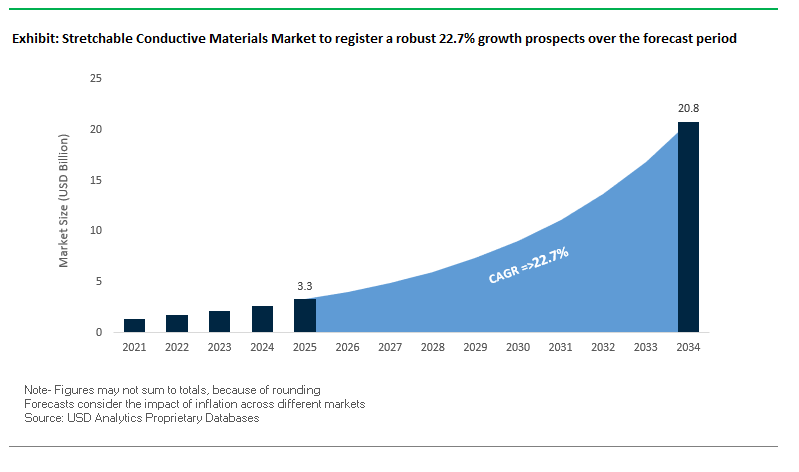
The global stretchable conductive materials market is expected to grow from $3.3 billion in 2025 to $20.8 billion by 2034, reflecting a CAGR of 22.7%. This high-growth sector bridges materials science and electronics, providing conductive inks, polymers, and composites that maintain electrical performance even when stretched or bent.
Key Insights for Industry Professionals:
Wearable and biomedical devices are driving demand for flexible, comfortable electronics such as smartwatches, fitness trackers, and electronic skin patches.
The rise of foldable smartphones, flexible displays, and curved TVs is accelerating the need for materials that withstand repeated mechanical strain.
Nanocomposite materials combining silver nanowires, carbon nanotubes (CNTs), graphene, and flexible polymers are enhancing conductivity, elasticity, and long-term reliability.
Integration with advanced manufacturing processes such as 3D printing and screen printing enables scalable production of flexible electronics.
Focus on bio-based and sustainable materials reflects industry trends toward eco-conscious production and functional performance.
The market outlook indicates that innovations in flexible electronics, nanocomposite materials, and scalable manufacturing will be pivotal in defining growth and competitive advantage.
Market Analysis: Strategic Developments and Material Innovations Are Accelerating Growth in Stretchable Conductive Materials
The stretchable conductive materials industry is experiencing rapid technological advancements and strategic moves. In August 2024, DuPont acquired assets from C3Nano Inc., strengthening its position in nanotechnology-based materials for flexible electronics. In February 2025, Covestro showcased Platilon® TPU films for smart medical skin patches at the MD&M West conference, highlighting their utility for patient comfort and remote monitoring.
Research and material innovation remain central to market growth. A review article in August 2025 emphasized the use of nanoparticles and essential oils in stretchable films, enhancing mechanical and antimicrobial properties. Meanwhile, Tate & Lyle and Roquette introduced plant-based, clean-label starches and coatings in May and April 2025, reflecting a trend toward bio-based materials that can potentially extend into flexible electronics substrates.
Corporate strategies also illustrate market consolidation and global expansion. ProAmpac’s acquisition of PAC Worldwide in July 2025 broadens its footprint in flexible packaging, potentially integrating stretchable conductive materials for smart packaging applications. Additionally, Berry Global’s launch of Bontite Sustane Stretch Film with 30% PCR content in February 2025 highlights growing attention to sustainable and recyclable materials across industrial sectors.
Trends and Opportunities Driving the Stretchable Conductive Materials Market
Transition from Metal-Based to Intrinsically Stretchable Polymer Composites
The stretchable conductive materials market is undergoing a fundamental shift away from rigid, metal-based composites toward intrinsically stretchable conductive polymers. Traditional conductors, such as silver nanowires or metal flakes embedded in elastomers, often crack and lose conductivity under repeated bending or stretching, limiting their use in wearable and biomedical electronics. Recent breakthroughs in material science are overcoming this barrier. For example, an August 2025 scientific study demonstrated a newly engineered polymer capable of maintaining electrical conductivity of over 1000 S/cm under 100% strain, with stable performance across 1,000 stretch-relax cycles. This durability makes it a game-changer for next-generation electronics.
Another major driver is the biocompatibility and manufacturability of polymer-based materials. PEDOT:PSS, a widely studied conductive polymer, is emerging as a leading candidate for soft, skin-friendly sensors due to its solution processability and compatibility with printing technologies. This makes it possible to fabricate customized, flexible electronic circuits directly onto substrates, significantly simplifying production. As regulatory and market demand for safer and more eco-friendly biomedical devices increases, the transition to polymer composites is becoming an industry-wide trend, bridging the gap between laboratory innovation and scalable, commercial manufacturing.
Integration into Commercial Biomedical Monitoring Devices
Stretchable conductive materials are transitioning from proof-of-concept research to real-world deployment in medical technology. A leading medical device company recently launched a wireless, wearable health monitor equipped with stretchable electrodes capable of continuously tracking ECG, heart rate, and respiratory rate for several days. Unlike rigid sensors, stretchable materials conform seamlessly to skin and muscle movements, reducing motion artifacts and ensuring clinical-grade accuracy in patient monitoring.
The adoption extends beyond monitoring to assistive robotics and rehabilitation devices. For example, a 2022 research paper described a stretchable conductive rubber cord sensor embedded in a soft cuff, capable of detecting muscle contractions to control a prosthetic hand. This represents a direct translation of material innovation into practical, life-enhancing applications. With aging populations and rising demand for remote patient monitoring, the integration of stretchable conductive materials into wearables, implants, and rehabilitation robotics is becoming one of the most transformative trends in healthcare technology.
Development of Materials for Next-Generation Human-Machine Interfaces (HMI)
The next frontier for stretchable conductive materials lies in human-machine interfaces (HMI). Advanced prosthetics are a prime application area, where ultra-durable, high-conductivity materials are required to provide intuitive, responsive control. For instance, carbon-impregnated rubber sensors that change resistance under strain are being deployed to detect muscle contractions, allowing prosthetic limbs to respond naturally to user intent. This significantly improves the precision and usability of prosthetics, moving closer to restoring natural motor function.
Beyond prosthetics, immersive AR/VR ecosystems are another opportunity space. Stretchable, skin-mounted conductors are critical for building haptic suits and gloves that deliver real-time tactile feedback. Unlike rigid sensors, soft conductors conform intimately to the skin, enabling more precise and realistic interactions in virtual environments. This capability is expected to drive adoption in gaming, defense training, and remote robotic operations, positioning stretchable conductive materials as a cornerstone technology in the evolution of wearable HMI systems.
Creating Sustainable and Biodegradable Formulations
Sustainability is emerging as a high-value growth opportunity in the stretchable conductive materials market, particularly as the proliferation of disposable biomedical devices raises concerns about e-waste. Research published in February 2025 demonstrated the use of plasticized chitosan substrates combined with recyclable silver nanowires to produce biodegradable stretchable electronics. These devices can safely decompose after use, reducing waste while allowing recovery of valuable metals.
The next step is fully biodegradable self-healing materials, designed for transient electronics. An August 2025 scientific paper outlined the development of a biodegradable self-healing conductor combining an elastomer with a conductive composite that can autonomously repair damage while maintaining functionality. Once its operational life ends, the material breaks down harmlessly in the environment. This innovation aligns directly with global goals to reduce electronic waste, creating significant opportunities for manufacturers to position themselves at the intersection of biocompatibility, sustainability, and high-performance electronics.
Competitive Landscape: Leading Stretchable Conductive Materials Companies Are Driving Innovation, Sustainability, and Global Expansion
The stretchable conductive materials market is dominated by players leveraging materials science expertise, polymer innovation, and global manufacturing networks to supply high-performance, flexible electronics solutions.
DuPont de Nemours, Inc.: Expanding Nanotechnology Leadership in Stretchable Electronics
DuPont offers Intexar™ Smart Clothing Technology and a suite of stretchable electronic inks for wearables. In August 2024, DuPont acquired C3Nano Inc., strengthening its portfolio of transparent, flexible films and inks. Core strengths include materials science expertise, brand recognition, and vertical integration, with strategic focus on high-performance, sustainable materials for healthcare and wearable electronics.
Henkel AG & Co. KGaA: Providing High-Performance Conductive Inks for Printed Electronics
Henkel supplies conductive inks with silver, carbon, and other pigments, ideal for circuits, switches, and antennas in flexible electronics. The company emphasizes recyclable and sustainable materials, leveraging its global manufacturing network and vertical integration to deliver reliable solutions. Strategic initiatives focus on driving the circular economy while meeting high-performance requirements.
The Lubrizol Corporation: Advancing Stretchable TPU Solutions for Wearables
Lubrizol offers ESTANE® thermoplastic polyurethane (TPU) for wearables, balancing flexibility, durability, and ease of processing. The company emphasizes bio-based polymers and high-performance films for electronics. Lubrizol’s strengths lie in polymer science expertise and vertical integration, with a strategic focus on innovative and sustainable specialty chemicals for flexible electronics.
3M Company: Delivering Reliable Electrically Conductive Materials for Advanced Electronics
3M provides Electrically Conductive Adhesive Transfer Tapes for bonding and grounding in stretchable electronics. In February 2024, 3M spun off Solventum to focus on healthcare applications. Core strengths include global manufacturing reach and material innovation, with strategic focus on sustainability and scalable solutions for the flexible electronics industry.
Covestro AG: Supplying High-Quality TPU Films for Smart Medical and Wearable Applications
Covestro offers Platilon® TPU films, providing flexible substrates for printed electronics and smart skin patches. Launched in February 2025, these films enhance patient comfort and remote monitoring. Covestro’s strengths include polymer expertise and vertical integration, with a strategic focus on bio-based, sustainable materials for high-performance flexible electronics.
Inks & Pastes Dominate Market Share by Product Type in Stretchable Conductive Materials Industry
Inks and pastes account for 40% of the stretchable conductive materials market, making them the undisputed leader due to their versatility, scalability, and cost-effectiveness. Conductive inks—silver, carbon, and conductive polymers—are the backbone of printed electronics, allowing manufacturers to integrate stretchable circuits, sensors, and antennas onto flexible substrates with high throughput. Their adaptability across screen, inkjet, and aerosol-jet printing processes makes them compatible with a wide range of applications, from wearables and medical sensors to RFID antennas. This scalability and relative affordability have positioned inks and pastes as the enabler of mass-market adoption, while films, fibers, and elastomers remain critical but more application-specific.
Wearable Electronics Hold the Largest Market Share by Application in Stretchable Conductive Materials Industry
Wearable electronics command 35% of the application share in the stretchable conductive materials industry, underscoring their role as the highest-volume driver of demand. Consumer demand for smartwatches, AR/VR headsets, and fitness trackers continues to surge, and stretchable materials enable these devices to remain comfortable, durable, and functionally reliable under constant mechanical stress. The integration of stretchable conductors into straps, flexible joints, and embedded sensors ensures seamless signal transmission and device longevity, directly linking material innovation to consumer electronics adoption. As health monitoring expands into mainstream wearables, this segment will continue to outpace others in volume growth, setting the benchmark for innovation in flexible electronics.
United States: Defense Funding and Breakthrough Material Innovations
The United States stretchable conductive materials market is strongly shaped by federal funding and advanced research initiatives. The U.S. Department of Defense and the National Science Foundation (NSF) are financing projects in flexible hybrid electronics (FHE), particularly for wearable sensors and smart textiles designed for defense and biomedical applications. Academic institutions are also at the forefront of innovation. For example, UC Berkeley researchers developed a method for producing transparent, stretchable graphene electrodes through a low-cost printing process, which represents a breakthrough in high-performance wearable electronics.
Corporate players are equally active. DuPont expanded its portfolio of stretchable silver conductive inks, enabling improved conductivity under repeated deformation and wash cycles—critical for durable wearable circuits. Rogers Corporation introduced a new generation of ultra-flexible conductive foams tailored for biomedical sensors and bendable devices, ensuring both tensile strength and low resistance. A growing trend in the U.S. is the exploration of liquid metal–polymer hybrid composites that create self-forming conductive networks without requiring sintering, an innovation that could transform flexible electronics manufacturing. With the semiconductor sector investing heavily in flexible displays and stretchable components, the U.S. is positioning itself as a global leader in materials innovation for next-generation electronics.
European Union: Chips Act Investments and Circular Economy Regulations
The European Union stretchable conductive materials market is being driven by massive public investments and regulatory alignment with sustainability goals. The European Chips Act and Chips Joint Undertaking (JU) are mobilizing over €80 billion for semiconductor manufacturing and R&D, creating opportunities to scale stretchable conductor commercialization. Additionally, the Horizon Europe Programme allocated €180 million for breakthrough technologies, including soft wearable garments and stretchable bioelectronics to support healthcare and mobility applications.
Key European companies are actively contributing to the market. Heraeus Materials Technology in Germany specializes in high-purity conductive polymers for sensors, biomedical devices, and flexible displays, while Covestro AG is advancing sustainable polymer solutions that merge lightweight conductive materials with a circular economy approach. Regulatory frameworks are equally influential. The Ecodesign for Sustainable Products Regulation (ESPR) emphasizes durability and repairability in electronics, aligning with the development of longer-lasting conductive materials. The EU’s dual push—sustainability compliance and digital innovation funding—is accelerating the adoption of stretchable conductive materials across consumer electronics, healthcare, and automotive applications.
China: Academic Collaborations and Demand for Advanced Consumer Electronics
The China stretchable conductive materials market is expanding under the dual influence of regulatory reforms and academic partnerships. The “14th Five-Year Plan” emphasizes sustainable material use in electronics, promoting eco-friendly alternatives across consumer products. Academic collaborations are pivotal; researchers at Jiangnan University and the University of Cambridge developed graphene-based conductive cotton fabrics, enabling wearable textiles with integrated sensing capabilities.
China’s electronics sector is increasingly focused on traceability and anti-counterfeiting measures, integrating QR codes and embedded security features into packaging and devices. Rising demand for premium and technologically advanced consumer products—such as flexible displays, smartwatches, and health-monitoring wearables—is driving investments in stretchable conductive networks and advanced polymer composites. Combined with tax incentives for remanufacturing and green technology adoption, China is solidifying its position as a key market for high-end flexible electronics built with stretchable conductive materials.
Japan: Flexible Electronics Consortia and Smart Material Innovation
The Japan stretchable conductive materials market benefits from government-backed sustainability policies and advanced research collaborations. While the Plastic Resource Circulation Strategy (2025) primarily targets packaging, it fosters a broader transition to sustainable materials, influencing electronics as well. The DENAN product scheme, under the Ministry of Economy, Trade, and Industry (METI), ensures compliance with electronic device safety standards, which impacts stretchable materials used in smart electronics.
Academic and industry partnerships are central. The Yamagata University Flexible Electronics Collaborative (YU-FLEC) spearheads R&D in flexible circuits and new conductive materials, while Kuraray Co., Ltd. has launched thermoplastic elastomers with conductive fillers, tailored for e-skin applications, smart clothing, and wearable health monitors. Japan is also advancing bio-based alternatives, with positive list systems introduced in June 2025 to regulate food-safe synthetic materials, ensuring safe integration of conductive polymers into consumer-facing applications. These developments reinforce Japan’s reputation as a leader in flexible, lightweight, and biocompatible conductive materials for next-generation wearables.
South Korea: Government Funding and Self-Healing Conductive Materials
The South Korea stretchable conductive materials market is flourishing through strategic government investments and academic breakthroughs. The government has allocated over $34 billion to boost semiconductors, AI, and rechargeable battery sectors, which are key application areas for stretchable electronics. Additionally, $6.94 billion will be invested in AI development by 2027, encouraging integration of AI chips with stretchable circuits for smarter wearable systems.
Research institutions are pivotal. In August 2024, KAIST researchers unveiled a graphene-based stretchable conductor with self-healing capabilities, designed for wearable and implantable medical devices. This innovation ensures long-term reliability, maintaining conductivity even after repeated stretching and minor damages. The government is also reinforcing its dominance in the display industry, focusing on OLED and inorganic light-emitting displays, both of which utilize stretchable conductive substrates. By coupling robust R&D with policy-driven financial support, South Korea is emerging as a global hub for next-generation conductive materials and wearable electronics.
By Conductor Material (Graphene, CNTs, Silver, Copper, Liquid Metals, Conductive Polymers, Stretchable Composites), By Product Type (Inks & Pastes, Films & Sheets, Fibers & Textiles, Foams & Elastomers), By Application (Wearable Electronics, Biomedical & Healthcare, Aerospace & Defense, Automotive, Robotics & Soft Robotics, Consumer Electronics), By Manufacturing Technique (Screen Printing, 3D Printing, Inkjet Printing, Roll-to-Roll Processing)
Study Period
2019- 2024 and 2025-2034
Units
Revenue (USD)
Qualitative Analysis
Porter’s Five Forces, SWOT Profile, Market Share, Scenario Forecasts, Market Ecosystem, Company Ranking, Market Dynamics, Industry Benchmarking
Companies
DuPont de Nemours, Inc., 3M Company, Dow Inc., Henkel AG & Co. KGaA, Covestro AG, LG Chem, Toray Industries, Inc., Mitsubishi Chemical Corporation, Solvay S.A., Heraeus Holding GmbH, Parker Hannifin Corp., Lord Corporation (part of Parker Hannifin), Nanoleq AG, StretchSense Limited, Creative Materials Inc.
Countries
US, Canada, Mexico, Germany, France, Spain, Italy, UK, Russia, China, India, Japan, South Korea, Australia, South East Asia, Brazil, Argentina, Middle East, Africa
Europe (Germany, UK, France, Spain, Italy, Russia, Rest of Europe)
Asia Pacific (China, India, Japan, South Korea, Australia, South East Asia, Rest of Asia)
South America (Brazil, Argentina, Rest of South America)
Middle East and Africa (Saudi Arabia, UAE, Rest of Middle East, South Africa, Egypt, Rest of Africa)
Top Companies in Stretchable Conductive Materials Market
DuPont de Nemours, Inc.
3M Company
Dow Inc.
Henkel AG & Co. KGaA
Covestro AG
LG Chem
Toray Industries, Inc.
Mitsubishi Chemical Corporation
Solvay S.A.
Heraeus Holding GmbH
Parker Hannifin Corp.
Lord Corporation (part of Parker Hannifin)
Nanoleq AG
StretchSense Limited
Creative Materials Inc.
* List Not Exhaustive
Methodology
The Stretchable Conductive Materials Market report by USDAnalytics has been prepared using a robust, multi-step research methodology designed for industry professionals seeking accurate and actionable insights. Our approach combined extensive primary research, including interviews with materials scientists, R&D engineers, product development managers, and procurement heads from leading companies such as DuPont, Henkel, Lubrizol, 3M, and Covestro, with detailed secondary research sourced from corporate reports, patents, academic journals, regulatory documents, conference proceedings, and industry publications. Market sizing and forecasts were determined through top-down and bottom-up approaches, considering product types, conductor materials, applications, and manufacturing techniques, while cross-validating with historical market trends and emerging technological innovations such as nanocomposites, polymer-based conductors, and self-healing materials. Special attention was given to sustainability-driven innovations, bio-based polymers, and regulatory compliance across key regions including the U.S., EU, China, Japan, South Korea, and India. This methodology ensures that USDAnalytics delivers a holistic view of market drivers, opportunities, competitive landscape, and future growth trajectories for stretchable conductive materials, bridging technical insights with strategic business decision-making.
Deliverables:
Comprehensive Market Research Report (PDF and Excel) with detailed tables, charts, and interactive visualizations.
Country-Specific Forecasts & Analysis.
Segment-Wise Revenue Forecasts (2025–2034).
Competitive Analysis, Benchmarking, and SWOT Profiles.
Recent Developments & Innovation Tracker.
Executive Summary & Analyst Commentary.
Post-Purchase Analyst Support for Client-Specific Questions and Custom Data Requirements.
Table of Contents: Stretchable Conductive Materials Market
1. Executive Summary
1.1. Market Highlights
1.2. Key Findings
1.3. Global Market Snapshot
2. Stretchable Conductive Materials Market Landscape & Outlook (2025–2034)
2.1. Introduction to Stretchable Conductive Materials Market
2.2. Market Valuation and Growth Projections (2025–2034)
2.3. Market Drivers and Technological Advancements
2.4. Key Strategic Developments
2.5. Challenges and Restraints
3. Innovations Reshaping the Stretchable Conductive Materials Market
3.1. Trend: Transition from Metal-Based to Intrinsically Stretchable Polymer Composites
3.2. Trend: Integration into Commercial Biomedical Monitoring Devices
3.3. Opportunity: Development of Materials for Next-Generation Human-Machine Interfaces (HMI)
3.4. Opportunity: Creating Sustainable and Biodegradable Formulations
4. Competitive Landscape and Strategic Initiatives
4.1. Mergers, Acquisitions and Strategic Alliances
4.2. R&D and Material Innovation
4.3. Sustainability and Strategies
4.4. Market Expansion and Regional Focus
5. Market Share and Segmentation Insights: Stretchable Conductive Materials Market
5.1. By Conductor Material
5.1.1. Graphene
5.1.2. CNTs
5.1.3. Silver
5.1.4. Copper
5.1.5. Liquid Metals
5.1.6. Conductive Polymers
5.1.7. Stretchable Composites
5.2. By Product Type
5.2.1. Inks & Pastes
5.2.2. Films & Sheets
5.2.3. Fibers & Textiles
5.2.4. Foams & Elastomers
5.3. By Application
5.3.1. Wearable Electronics
5.3.2. Biomedical & Healthcare
5.3.3. Aerospace & Defense
5.3.4. Automotive
5.3.5. Robotics & Soft Robotics
5.3.6. Consumer Electronics
5.4. By Manufacturing Technique
5.4.1. Screen Printing
5.4.2. 3D Printing
5.4.3. Inkjet Printing
5.4.4. Roll-to-Roll Processing
6. Country Analysis and Outlook of Stretchable Conductive Materials Market
6.1. United States
6.2. Canada
6.3. Mexico
6.4. Germany
6.5. France
6.6. Spain
6.7. Italy
6.8. UK
6.9. Russia
6.10. China
6.11. India
6.12. Japan
6.13. South Korea
6.14. Australia
6.15. South East Asia
6.16. Brazil
6.17. Argentina
6.18. Middle East
6.19. Africa
7. Stretchable Conductive Materials Market Size Outlook by Region (2025-2034)
7.1. North America Market Size Outlook to 2034
7.1.1. By Conductor Material
7.1.2. By Product Type
7.1.3. By Application
7.1.4. By Manufacturing Technique
7.2. Europe Market Size Outlook to 2034
7.2.1. By Conductor Material
7.2.2. By Product Type
7.2.3. By Application
7.2.4. By Manufacturing Technique
7.3. Asia Pacific Market Size Outlook to 2034
7.3.1. By Conductor Material
7.3.2. By Product Type
7.3.3. By Application
7.3.4. By Manufacturing Technique
7.4. South America Market Size Outlook to 2034
7.4.1. By Conductor Material
7.4.2. By Product Type
7.4.3. By Application
7.4.4. By Manufacturing Technique
7.5. Middle East and Africa Market Size Outlook to 2034
7.5.1. By Conductor Material
7.5.2. By Product Type
7.5.3. By Application
7.5.4. By Manufacturing Technique
8. Company Profiles: Leading Players in the Stretchable Conductive Materials Market
8.1. DuPont de Nemours, Inc.
8.2. 3M Company
8.3. Dow Inc.
8.4. Henkel AG & Co. KGaA
8.5. Covestro AG
8.6. LG Chem
8.7. Toray Industries, Inc.
8.8. Mitsubishi Chemical Corporation
8.9. Solvay S.A.
8.10. Heraeus Holding GmbH
8.11. Parker Hannifin Corp.
8.12. Lord Corporation (part of Parker Hannifin)
8.13. Nanoleq AG
8.14. StretchSense Limited
8.15. Creative Materials Inc.
9. Methodology
9.1. Research Scope
9.2. Market Research Approach
9.3. Market Sizing and Forecasting Model
9.4. Research Coverage
9.5. Data Horizon
9.6. Deliverables
10. Appendix
10.1. Acronyms and Abbreviations
10.2. List of Tables
10.3. List of Figures
The global stretchable conductive materials market is expected to surge from USD 3.3 billion in 2025 to USD 20.8 billion by 2034, reflecting a CAGR of 22.7%. Growth is primarily driven by the rising adoption of wearable electronics, biomedical devices, and flexible consumer electronics that require materials capable of maintaining conductivity under mechanical strain.
Inks and pastes lead the market with 40% share due to their versatility, scalability, and compatibility with printing techniques like screen, inkjet, and 3D printing. Films, fibers, and elastomers remain critical for specialized applications in medical sensors, robotics, and flexible displays, complementing mass-market adoption.
Sustainability is a key trend, with manufacturers integrating bio-based polymers, plant-derived coatings, and recyclable composites. Innovations in biodegradable self-healing materials and eco-conscious polymer substrates address e-waste concerns while maintaining high-performance conductivity for wearables and biomedical devices.
Wearable electronics dominate with a 35% application share, including smartwatches, fitness trackers, and AR/VR headsets. Biomedical devices, soft robotics, and human-machine interfaces are also driving demand, as stretchable materials ensure comfort, durability, and reliable signal transmission under repeated mechanical stress.
Major players include DuPont, Henkel, 3M, Lubrizol, Covestro, LG Chem, and Toray Industries. These companies focus on polymer innovation, nanocomposites, scalable manufacturing, and sustainability, providing high-performance inks, films, fibers, and elastomers for wearables, healthcare, robotics, and consumer electronics applications.