Market Overview: Lightweighting, Fatigue Life Extension, and High-Temperature Performance Accelerate Advanced Polymer Composites Adoption
The Advanced Polymer Composites (APC) market, valued at USD 14.6 billion in 2025 and projected to reach USD 27.4 billion by 2035 at a 6.5% CAGR, has moved decisively from selective substitution to structural material of record across aerospace, electric mobility, wind energy, and high-reliability electronics. This market matters now because OEMs are no longer optimizing around peak strength alone; instead, they are prioritizing specific stiffness, fatigue life, thermal stability, and lifecycle cost under increasingly aggressive operating profiles. In aircraft structures, EV platforms, and large wind blades, APCs enable weight reductions that directly translate into fuel efficiency, extended range, higher payloads, or lower levelized cost of energy-outcomes that metals increasingly struggle to deliver without system-level penalties.
Demand is being reshaped by a structural shift in design and manufacturing philosophy. Aerospace primes and Tier-1 suppliers are expanding the use of CFRP and high-temperature thermoplastic composites not only for primary structures but also for brackets, ribs, clips, and interior systems where fatigue and corrosion drive maintenance cost. In electric vehicles, OEMs are specifying composites for battery enclosures, crash structures, and power electronics housings to manage thermal loads, electromagnetic shielding, and vibration while offsetting the mass of battery packs. Wind turbine manufacturers, On the other hand, are pushing composite formulations that can sustain billions of fatigue cycles over 25-30-year lifetimes as blade lengths extend beyond 100 meters, placing unprecedented stress on resin systems and fiber-matrix interfaces. Across these applications, thermoplastic composites are gaining share over thermosets due to shorter cycle times, weldability, and repairability, aligning with high-volume manufacturing and modular assembly strategies.
APCs are displacing metallic systems where their performance advantages deliver measurable business impact. Higher specific stiffness reduces structural mass, improving energy efficiency and payload economics; superior fatigue resistance extends inspection intervals and asset life; and high-temperature polymer matrices support continuous operation in demanding thermal environments without corrosion-related degradation. From a manufacturing perspective, the market’s next phase will be defined by scalable automation (AFP/ATL, compression molding, hybrid metal-composite joining) and the ability to qualify materials against OEM damage tolerance and recyclability requirements.
Recent developments underscore the growing strategic importance of APCs across aerospace, mobility, and renewable energy ecosystems. In Dec 2025, Toray Industries achieved a breakthrough in nanofiltration membrane technology enabling 95% lithium recovery from spent batteries, reflecting the integration of composite materials innovation into circular economy models. Nov 2025 saw Hexcel outline an aggressive high-rate aerospace manufacturing strategy to support anticipated next-generation single-aisle platforms, demonstrating industry readiness for scaled composite adoption. On the other hand, Oct 2025 marked a pivotal moment when Hyundai Motor Group expanded its partnership with Toray to accelerate composite integration for advanced EV structures and special-purpose vehicles, reinforcing the role of APCs in electrification.
High-performance reinforcement materials continue to evolve, as evidenced by Hexcel’s Sep 2025 launch of HexForce® 1K reinforcement fabric, optimized for complex geometries and ultra-lightweight structures. Supply chain commitments strengthened in Jul 2025, when Toray Advanced Composites secured long-term contracts to deliver space-grade composite materials for mega-constellation satellite substrates-an indicator of the rising commercial space sector’s demand for thermally stable, ultra-light components.
Sustainability took center stage in Jun 2025 with Toray, Daher, and TARMAC Aerosave launching a targeted end-of-life recycling initiative for thermoplastic composites used in commercial aircraft-a long-awaited circularity milestone. Solvay reinforced this sustainability emphasis in Mar 2025 with expanded recycling capacity for specialty polymers. Earlier milestones included Toray’s Sep 2024 rollout of its PESU-based Cetex® TC1130 for sustainable aircraft interiors, aligning with airline carbon reduction goals.
Advanced Polymer Composites Market Trends and Opportunities
High-Temperature Thermoplastic Composites Redefining Aerospace Interior and Structural Design
A decisive shift is underway in aerospace materials strategy as OEMs move from legacy thermoset composites toward high-temperature thermoplastic systems, particularly LMPAEK (Low Melt Polyaryletherketone) families. The strategic driver is not incremental weight reduction, but certification speed, fire safety assurance, and manufacturing flexibility. Unlike epoxy-based systems, these thermoplastics inherently meet stringent Flammability, Smoke, and Toxicity (FST) requirements without halogenated additives, eliminating secondary coating steps and reducing compliance risk across global aviation authorities.
In December 2025, Toray Advanced Composites completed NCAMP qualification for its Cetex® TC1225 LMPAEK fabric system—an inflection point for aerospace supply chains. NCAMP-qualified data allows airframers to bypass years of redundant material testing, compressing development timelines for interior panels, clips, brackets, and increasingly secondary structural parts exposed to elevated thermal loads. This directly supports next-generation narrowbody and widebody programs under cost and delivery pressure.
Thermal resilience is also reshaping core materials. High-temperature honeycomb structures, such as BMI-based non-metallic cores, are being deployed in engine-adjacent zones where aluminum cores face creep and oxidation risk. Beyond performance, end-of-life circularity is becoming a procurement criterion. In mid-2025, Toray, Daher, and TARMAC Aerosave launched a joint thermoplastic recycling initiative—highlighting that reprocessability and reshaping are now competitive advantages as airlines and lessors target closed-loop aircraft material flows by 2030.
Automated CFRP Manufacturing Scaling into Mass-Market EV Platforms
In automotive electrification, advanced polymer composites are transitioning from niche performance vehicles to high-volume EV architectures, particularly in battery enclosures where weight, fire resistance, and structural integration converge. The strategic breakthrough is not material capability alone, but automation-driven cost normalization through large-format molding and highly integrated designs.
At JEC World 2025, Forward Engineering—working with SABIC—demonstrated a 1.8 m × 1.4 m injection-molded CFRP battery case, integrating cooling channels, load paths, and thermal barriers into a single molded structure. This approach eliminates dozens of fasteners and welds typical of aluminum housings, reducing assembly complexity while delivering step-change stiffness-to-weight performance. For EV OEMs, this directly offsets the mass penalty of larger battery packs without sacrificing crash or fire performance.
Parallel development is occurring at the materials formulation level. The BMW Group-led Future Sustainable Car Materials (FSCM) program is engineering next-generation GFRP/CFRP Sheet Molding Compounds that meet UL2596 fire resistance while remaining compatible with high-speed compression and injection molding. By 2025, technical disclosures confirm that automated CFRP lines have reduced labor intensity sufficiently to enable deployment across mainstream EV platforms, targeting up to 40% mass reduction versus steel-intensive battery enclosures—without the recyclability challenges associated with thermoset-dominated legacy CFRP.
Type IV Composite Pressure Vessels Accelerating the Hydrogen Mobility Stack
Hydrogen mobility is emerging as one of the most material-intensive growth vectors for advanced polymer composites, anchored by Type IV Composite Overwrapped Pressure Vessels (COPVs). These systems—HDPE liners reinforced with carbon fiber composites—are now the default architecture for 700-bar onboard storage in fuel-cell trucks, buses, maritime vessels, and future regional aviation platforms.
The performance bar is rising rapidly. In 2025, the U.S. Department of Energy reaffirmed aggressive onboard storage targets, forcing manufacturers to deploy ultra-high-tensile carbon fibers and precision filament winding capable of surviving rapid refueling cycles and extreme thermal swings from −40 °C to 85 °C. These are no longer lab benchmarks—they are commercial qualification thresholds tied directly to fleet uptime and total cost of ownership.
Industrial scaling is already visible. Hexagon Purus and Luxfer Gas Cylinders are expanding Type IV capacity across Europe, North America, and Asia, including strategic manufacturing alignment with CIMC to serve the Asian hydrogen corridor. At the materials level, newly engineered hydrogen-resistant epoxy systems—featuring extended shelf life and low-viscosity processing—are enabling faster RTM and winding cycles while delivering 1,500+ refueling cycle durability, a prerequisite for commercial freight adoption.
Robotic Automated Fiber Placement Unlocking Defense and Space Scale
Automated Fiber Placement (AFP) has moved from a productivity enhancer to a strategic enabler for defense and space platforms, where structural complexity, part size, and reliability thresholds exceed the limits of manual layup. Robotic AFP enables precise fiber steering around cutouts, curvature, and load paths—delivering optimized strength-to-weight ratios in fuselages, wings, and cryogenic tanks.
By 2025, industry data indicates that over 70% of modern military aircraft and nearly 70% of new civil aircraft rely on AFP-manufactured primary structures. The economics are compelling: AFP reduces material scrap by approximately 20% and improves layup efficiency by ~35%, directly translating into cost and throughput advantages for long-run programs.
A key structural shift is the democratization of AFP. In February 2025, Addcomposites introduced the AFP-XS system, allowing SMEs to retrofit standard industrial robots into AFP cells via a subscription model. This reduces capital barriers from multi-million-dollar investments to manageable operational expenditure—expanding AFP adoption beyond tier-one primes.
In parallel, the rise of human-rated space infrastructure is intensifying demand for AFP-produced composite tanks and pressure vessels. Collaboration between NASA, ESA, and private suppliers is accelerating qualification of space-grade carbon fiber composites, where robotic placement enables part-count reduction, defect minimization, and repeatable quality—all critical for crewed missions and commercial orbital habitats.
Market Share by Material Type: Glass Fiber Reinforced Polymers Secure Cost-Performance Leadership
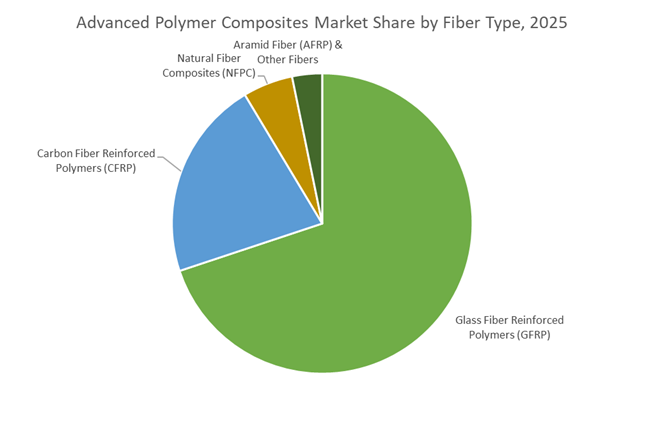
Glass Fiber Reinforced Polymers (GFRP) account for approximately 65% of the global Advanced Polymer Composites Market, reflecting their unmatched ability to balance mechanical performance, durability, and cost at industrial scale. This dominance is anchored in the continuous evolution of advanced glass fiber chemistries, where high-modulus and corrosion-resistant grades have significantly narrowed the performance gap with carbon fiber while preserving a far superior cost structure. Modern high-strength glass fibers enable meaningful weight reduction without triggering the exponential material cost increases associated with carbon composites, making GFRP the default choice for high-volume structural applications. Market share is further reinforced by exceptional corrosion resistance, particularly in aggressive or moisture-rich environments, where GFRP structures outperform steel by eliminating rust-driven degradation and maintenance cycles. From a lifecycle economics perspective, the ability of GFRP components to maintain mechanical integrity over decades materially reduces total cost of ownership in infrastructure, marine, and industrial applications. Thermal insulation behavior also strengthens adoption, as GFRP naturally acts as a thermal break, improving energy efficiency in transportation and building assemblies without secondary insulation layers. Collectively, these scalability, durability, and lifecycle cost advantages position GFRP as the material backbone of the advanced polymer composites market, sustaining its commanding share.
Market Share by Application: Transportation Drives Structural Lightweighting at Scale
The transportation sector represents approximately 35% of total demand in the Advanced Polymer Composites Market, making it the largest and most strategically influential application segment. This leadership is driven by structural pressures to reduce mass across automotive, rail, and aerospace platforms as manufacturers pursue fuel efficiency, emissions reduction, and electrification targets. Advanced polymer composites enable step-change weight savings relative to metals, directly translating into extended electric vehicle range, lower energy consumption, and improved system efficiency. Market share is further reinforced by the role of composites in part consolidation, where complex molded structures replace multiple metal components, reducing assembly time, fastener count, and supply-chain complexity—an increasingly critical advantage as OEMs streamline production lines. In aerospace and rail applications, reduced structural weight also lowers operational stress on engines, tracks, and supporting infrastructure, improving long-term maintenance economics for operators. Beyond weight, composites deliver fatigue resistance and corrosion immunity, extending service intervals and asset lifespans under high-duty cycles. As transportation systems increasingly prioritize efficiency, durability, and modular design, this segment remains the primary demand engine for advanced polymer composites, anchoring its leading market share globally.
Competitive Landscape: Leading Suppliers Shaping High-Performance Composite Innovation
The competitive landscape for APCs is heavily shaped by vertically integrated fiber manufacturers, specialty polymer suppliers, and composite innovators with strong aerospace credentials. Leaders differentiate through automation capability, high-temperature material expertise, recycling initiatives, and long-term OEM partnerships.
Hexcel Corporation - A Global Leader in Aerospace-Grade Carbon Fiber & Prepreg Technologies
Hexcel’s vertical integration-from carbon fiber production to HexPly® prepregs-positions it as a top-tier supplier for prime aerospace and defense programs. The company supplies composite materials to 100+ space and defense platforms, highlighting its reliability in mission-critical environments. Its Flex-Core® HRH-302 honeycomb core offers superior stiffness-to-weight ratios, enabling ultra-light aerospace structures. Hexcel’s Malaysia JV (ACM) supports efficient global supply for major aircraft programs, including Boeing, reinforcing its strategic role in high-rate composite manufacturing.
Toray Industries, Inc. - The World’s Leading Carbon Fiber Supplier With Expanding Mobility Focus
Toray’s dominance in PAN-based carbon fiber underpins much of the global CFRP industry. The company continues to expand its thermoplastic composite portfolio through Toray Advanced Composites, with Cetex® LMPAEK™ achieving NCAMP qualification for high-rate aerospace uses. Strategic partnerships-such as the 2025 collaboration with Hyundai Motor Group-demonstrate Toray’s growing leadership in EV battery structures and next-generation mobility composites. Its end-of-life aircraft recycling program reflects Toray’s proactive approach to composite sustainability challenges.
Solvay (through Syensqo) offers one of the broadest arrays of high-performance polymers-PEEK, PEKK, PPS, and PEI-enabling composites for extreme thermal, chemical, and mechanical environments. Its polymers support structural lightweighting, thermal management, and power electronics requirements for EVs and aircraft. The company's strategic realignment toward specialty materials underscores its commitment to next-gen composites. Solvay’s circularity initiatives, including recycling 80%+ of SOLVAir® residues, position it as an environmental leader in polymer chemistry.
SGL Carbon SE - Integrated Carbon Fiber Solutions For Wind Energy & Automotive Scaling
SGL Carbon’s end-to-end value chain-from precursor to finished composite components-ensures secure supply for industrial customers. The company’s materials are widely adopted in the wind energy sector, enabling the longest and most efficient turbine blades due to superior strength-to-weight performance. SGL is also scaling high-volume CFRP automotive manufacturing via RTM and other automated technologies. Its development of recycled carbon fiber (rCF) products aligns with the market’s push for lower-footprint composites in both industrial and consumer segments.
Mitsubishi Chemical Corporation - High-Modulus CFRP and Tailored Matrix Systems For Precision Applications
Mitsubishi Chemical offers CFRP variants spanning continuous and chopped fibers for aerospace, automotive, and high-rate processing applications. Its pitch-based carbon fibers deliver extremely high modulus, meeting the precision needs of satellites and specialized industrial equipment. The company provides versatile polymer matrices, including epoxy and polyurethane systems, optimized for prepregs and molding compounds. Its improved process efficiencies cater to mass-market segments such as sports equipment, where large-scale carbon fiber utilization continues to grow.
In 2025, the United States consolidated leadership in advanced polymer composites by aligning trade defense, federal procurement, and scale-up of high-temperature systems. Spring tariff escalations on imported carbon fiber and aerospace-grade resins reinforced domestic supply chains, while proposed CHIPS and Science Act grants accelerated materials adjacent to advanced packaging and avionics. This policy stack favored carbon fiber reinforced polymers (CFRP), bismaleimide and polyimide matrices, and out-of-autoclave (OOA) processing for rapid-rate production. On the industrial front, Hexcel deepened vertical integration via a resin systems acquisition and launched HexForce® 1K woven reinforcements to meet ultra-high-rate aerospace demand. Parallel DoD funding prioritized OOA and AFP to compress cycle times by ~30%, supporting hypersonic structures, stealth platforms, and next-gen commercial aviation.
China - High-End Manufacturing, NEV Scale, and Wind Mega-Structures
As the 14th Five-Year Plan closed, China pivoted from volume to quality and automation, achieving domestic capability in T800/T1000 carbon fibers and accelerating thermoplastic composite lines. National standards issued in 2025 concentrated on NEV composites, aerospace equipment, and hydrogen hardware, while renewable capacity growth drove demand for ultra-large (>120 m) wind blades and pressure vessels. Industrial parks in Jiangsu and Zhejiang emphasized automated fiber placement and stamp-formed thermoplastics to raise throughput and consistency. The result is a tightly coupled ecosystem supplying CFRP/GFRP for wind, storage, and mobility-supported by elevated R&D intensity and consolidation to stabilize pricing and quality.
Germany - Thermoplastic Fuselages, Recycling, and EU Funding
Germany anchored Europe’s clean-aviation transition by proving thermoplastic fuselage viability at scale. The Multi-Functional Fuselage Demonstrator, led by Airbus and Fraunhofer-Gesellschaft, validated laser/ultrasonic welding to remove rivets-cutting weight and cost by ~10%. EU-backed programs advanced chemical recycling of reinforced polymers and recycled carbon fiber (rCF) nonwovens, tackling end-of-life constraints. Horizon Europe allocations reinforced bio-composites and circularity, positioning Germany as the EU’s integration hub for multifunctional, recyclable composite structures.
Japan - Hydrogen Economy Materials and Green Resins
Japan leveraged materials leadership to serve hydrogen transport and power electronics. Teijin introduced Tenax™ PW for high-pressure hydrogen tanks, aligning composites with national fuel-cell logistics. Toray Industries adjusted pricing amid precursor inflation while rolling out photo-definable polyimide sheets that lower semiconductor packaging costs. Strategic acquisitions expanded thermoplastic capabilities for EV structures, underscoring Japan’s focus on sustainable, high-performance resin systems across energy and electronics.
France - Green Aviation, AFP Subsidies, and End-of-Life Programs
France remained the showcase for composite innovation through JEC World and Paris Air Show momentum. Recycling consortia-combining Toray Advanced Composites, Daher, and Tarmac Aerosave-launched thermoplastic end-of-life recovery at scale, feeding secondary structures back into production. AFP investments under “France 2030” sustained capacity for welded thermoplastic torsion boxes, achieving up to 20% weight reduction and advancing TRL maturity for fastener-free assembly.
India - PLI Expansion, Technical Textiles, and Space Pull-Through
India accelerated its “China-Plus-One” role via PLI extensions for MMF and technical textiles, translating scheme turnover into new GFRP pipe plants and carbon-fiber automotive parts. Domestic sourcing strengthened for space and defense as ISRO missions pulled advanced matrices into satellite substrates. With incentives driving capacity and skills, India is scaling industrial composites for infrastructure, mobility, and aerospace while anchoring cost-competitive manufacturing.
2025 National Strategic Matrix - Advanced Polymer Composites
Advanced Polymer Composites Matrix
Country
Primary Technical Focus
Key 2025 Policy / Milestone
Industrial Signal
United States
High-temp defense, OOA/AFP
Trade defense + CHIPS materials grants
Faster cycles; sovereign CFRP
China
NEV & wind mega-structures
14th FYP standards, automation parks
Scale + quality thermoplastics
Germany
Thermoplastic welding & recycling
MFFD validation; Horizon Europe
~10% weight/cost gains
Japan
Hydrogen storage & green resins
Tenax™ PW; polyimide advances
Energy + electronics pull
France
AFP & aircraft EoL
France 2030 subsidies; recycling consortia
20% weight reduction
India
Technical textiles & MMF
PLI extensions; space sourcing
Rapid capacity build
Advanced Polymer Composites Market Report Scope
Advanced Polymer Composites Market
Parameter
Details
Market Size (2025)
$14.6 Billion
Market Size (2035)
$27.4 Billion
Market Growth Rate
6.5%
Segments
By Fiber Type (CFRP, GFRP, AFRP, Natural Fiber Composites, Other Fibers), By Resin Type (Thermoset Resins, Thermoplastic Resins), By Manufacturing Process (Lay-Up, Filament Winding, RTM, Pultrusion, Injection & Compression Molding, Additive Manufacturing), By End-User Industry (Aerospace & Defense, Automotive, Wind Energy, Marine, Construction & Infrastructure, Electrical & Electronics, Sporting Goods)
Study Period
2019- 2024 and 2025-2034
Units
Revenue (USD)
Qualitative Analysis
Porter’s Five Forces, SWOT Profile, Market Share, Scenario Forecasts, Market Ecosystem, Company Ranking, Market Dynamics, Industry Benchmarking
Companies
Toray Industries Inc., Hexcel Corporation, Solvay S.A., Teijin Limited, Mitsubishi Chemical Group Corporation, SGL Carbon SE, Owens Corning, BASF SE, Huntsman International LLC, Gurit Holding AG, DuPont de Nemours Inc., Zoltek Corporation, Arkema S.A., SABIC, TenCate Advanced Composites
Countries
US, Canada, Mexico, Germany, France, Spain, Italy, UK, Russia, China, India, Japan, South Korea, Australia, South East Asia, Brazil, Argentina, Middle East, Africa
Advanced Polymer Composites Market Segmentation
By Fiber Type
Carbon Fiber Reinforced Polymers (CFRP)
Glass Fiber Reinforced Polymers (GFRP)
Aramid Fiber Reinforced Polymers (AFRP)
Natural Fiber Composites (NFPC)
Other Fibers
By Resin Type
Thermoset Resins
Thermoplastic Resins
By Manufacturing Process
Lay-up Process
Filament Winding
Resin Transfer Molding (RTM)
Pultrusion
Injection and Compression Molding
Additive Manufacturing
By End-User Industry
Aerospace and Defense
Automotive
Wind Energy
Marine
Construction and Infrastructure
Electrical and Electronics
Sporting Goods
By Region
North America (United States, Canada, Mexico)
Europe (Germany, France, United Kingdom, Spain, Italy, Rest of Europe)
Asia Pacific (China, India, Japan, South Korea, Australia, Rest of APAC)
South and Central America (Brazil, Argentina, Rest of SCA)
Middle East and Africa (Saudi Arabia, UAE, South Africa, Rest of Middle East, Rest of Africa)
Top Companies in Advanced Polymer Composites Market
Toray Industries, Inc.
Hexcel Corporation
Solvay S.A.
Teijin Limited
Mitsubishi Chemical Group Corporation
SGL Carbon SE
Owens Corning
BASF SE
Huntsman International LLC
Gurit Holding AG
DuPont de Nemours, Inc.
Zoltek Corporation
Arkema S.A.
SABIC
TenCate Advanced Composites
*- List not Exhaustive
Table of Contents: Advanced Polymer Composites Market
2. Advanced Polymer Composites Market Landscape & Outlook (2025–2034)
2.1. Introduction to Advanced Polymer Composites Market
2.2. Market Valuation and Growth Projections (2025–2034)
2.3. Structural Shift From Metal Substitution to Material of Record
2.4. Performance Drivers: Lightweighting, Fatigue Life, and Thermal Stability
2.5. Manufacturing Evolution: Automation, Qualification, and Circularity
3. Innovations Reshaping the Advanced Polymer Composites Market
3.1. Trend: High-Temperature Thermoplastic Composites in Aerospace Structures
3.2. Trend: Automated CFRP Manufacturing for Mass-Market EV Platforms
3.3. Opportunity: Type IV Composite Pressure Vessels for Hydrogen Mobility
3.4. Opportunity: Robotic Automated Fiber Placement in Defense and Space
4. Competitive Landscape and Strategic Initiatives
4.1. Mergers and Acquisitions
4.2. R&D and Material Innovation
4.3. Sustainability and ESG Strategies
4.4. Market Expansion and Regional Focus
5. Market Share and Segmentation Insights: Advanced Polymer Composites Market
5.1. By Fiber Type
5.1.1. Carbon Fiber Reinforced Polymers (CFRP)
5.1.2. Glass Fiber Reinforced Polymers (GFRP)
5.1.3. Aramid Fiber Reinforced Polymers (AFRP)
5.1.4. Natural Fiber Composites (NFPC)
5.1.5. Other Fiber Types
5.2. By Resin Type
5.2.1. Thermoset Resins
5.2.2. Thermoplastic Resins
5.3. By Manufacturing Process
5.3.1. Lay-up Process
5.3.2. Filament Winding
5.3.3. Resin Transfer Molding (RTM)
5.3.4. Pultrusion
5.3.5. Injection and Compression Molding
5.3.6. Additive Manufacturing
5.4. By End-User Industry
5.4.1. Aerospace and Defense
5.4.2. Automotive
5.4.3. Wind Energy
5.4.4. Marine
5.4.5. Construction and Infrastructure
5.4.6. Electrical and Electronics
5.4.7. Sporting Goods
6. Country Analysis and Outlook of Advanced Polymer Composites Market
6.1. United States
6.2. Canada
6.3. Mexico
6.4. Germany
6.5. France
6.6. Spain
6.7. Italy
6.8. United Kingdom
6.9. Russia
6.10. China
6.11. India
6.12. Japan
6.13. South Korea
6.14. Australia
6.15. South East Asia
6.16. Brazil
6.17. Argentina
6.18. Middle East
6.19. Africa
7. Advanced Polymer Composites Market Size Outlook by Region (2025–2034)
7.1. North America Advanced Polymer Composites Market Size Outlook to 2034
7.1.1. By Fiber Type
7.1.2. By Resin Type
7.1.3. By Manufacturing Process
7.1.4. By End-User Industry
7.2. Europe Advanced Polymer Composites Market Size Outlook to 2034
7.2.1. By Fiber Type
7.2.2. By Resin Type
7.2.3. By Manufacturing Process
7.2.4. By End-User Industry
7.3. Asia Pacific Advanced Polymer Composites Market Size Outlook to 2034
7.3.1. By Fiber Type
7.3.2. By Resin Type
7.3.3. By Manufacturing Process
7.3.4. By End-User Industry
7.4. South America Advanced Polymer Composites Market Size Outlook to 2034
7.4.1. By Fiber Type
7.4.2. By Resin Type
7.4.3. By Manufacturing Process
7.4.4. By End-User Industry
7.5. Middle East and Africa Advanced Polymer Composites Market Size Outlook to 2034
7.5.1. By Fiber Type
7.5.2. By Resin Type
7.5.3. By Manufacturing Process
7.5.4. By End-User Industry
8. Company Profiles: Leading Players in the Advanced Polymer Composites Market
8.1. Toray Industries, Inc.
8.2. Hexcel Corporation
8.3. Solvay S.A.
8.4. Teijin Limited
8.5. Mitsubishi Chemical Group Corporation
8.6. SGL Carbon SE
8.7. Owens Corning
8.8. BASF SE
8.9. Huntsman International LLC
8.10. Gurit Holding AG
8.11. DuPont de Nemours, Inc.
8.12. Zoltek Corporation
8.13. Arkema S.A.
8.14. SABIC
8.15. TenCate Advanced Composites
9. Methodology
9.1. Research Scope
9.2. Market Research Approach
9.3. Market Sizing and Forecasting Model
9.4. Research Coverage
9.5. Data Horizon
9.6. Deliverables
10. Appendix
10.1. Acronyms and Abbreviations
10.2. List of Tables
10.3. List of Figures
Advanced Polymer Composites Market Segmentation
By Fiber Type
Carbon Fiber Reinforced Polymers (CFRP)
Glass Fiber Reinforced Polymers (GFRP)
Aramid Fiber Reinforced Polymers (AFRP)
Natural Fiber Composites (NFPC)
Other Fibers
By Resin Type
Thermoset Resins
Thermoplastic Resins
By Manufacturing Process
Lay-up Process
Filament Winding
Resin Transfer Molding (RTM)
Pultrusion
Injection and Compression Molding
Additive Manufacturing
By End-User Industry
Aerospace and Defense
Automotive
Wind Energy
Marine
Construction and Infrastructure
Electrical and Electronics
Sporting Goods
By Region
North America (United States, Canada, Mexico)
Europe (Germany, France, United Kingdom, Spain, Italy, Rest of Europe)
Asia Pacific (China, India, Japan, South Korea, Australia, Rest of APAC)
South and Central America (Brazil, Argentina, Rest of SCA)
Middle East and Africa (Saudi Arabia, UAE, South Africa, Rest of Middle East, Rest of Africa)
The global Advanced Polymer Composites Market was valued at USD 14.6 billion in 2025 and is forecast to reach USD 27.4 billion by 2035, expanding at a CAGR of 6.5% during 2026–2035. Growth is driven by structural lightweighting, extended fatigue life, and lifecycle cost advantages over metals.
Glass Fiber Reinforced Polymers (GFRP) lead the market with around 65% share due to their strong cost-performance balance and corrosion resistance. Carbon Fiber Reinforced Polymers (CFRP) are gaining traction in aerospace, EV battery structures, and hydrogen storage where maximum stiffness-to-weight and fatigue performance are required.
High-temperature thermoplastic composites are gaining adoption due to shorter cycle times, weldability, repairability, and recyclability. These advantages support high-rate aerospace production, automated EV manufacturing, and circularity targets, while also meeting stringent fire, smoke, and toxicity requirements without secondary treatments.
In electric vehicles, composites reduce mass in battery enclosures, crash structures, and power electronics housings while managing thermal and vibration loads. In wind energy and hydrogen mobility, composites enable long-life blades and Type IV pressure vessels capable of sustaining extreme fatigue cycles and high-pressure operation, directly improving system efficiency and uptime.