Market Overview: Structural Performance Metrics Driving the Global Adoption of Ultra High Performance Concrete
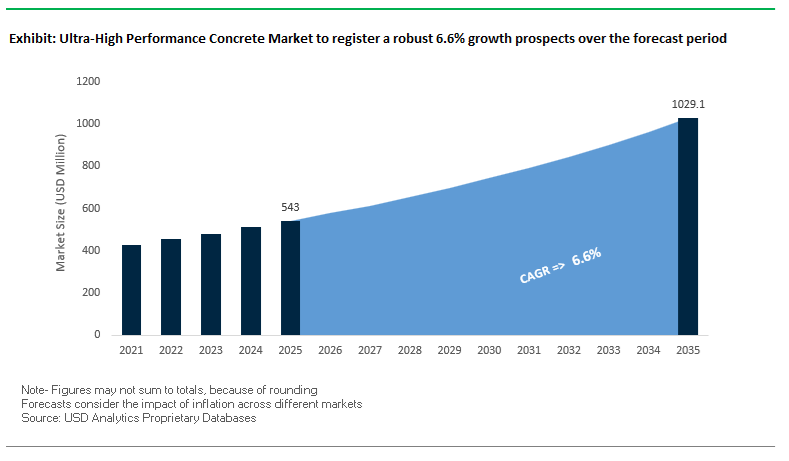
The Ultra High Performance Concrete Market is projected to expand from USD 543 million in 2025 to USD 1,028.9 million by 2035, registering a robust CAGR of 6.6%. The rapid acceleration in UHPC adoption is driven by the material’s superior compressive strength, ductility, durability, and resistance to harsh environmental conditions, making it indispensable for next-generation bridges, precast components, architectural façades, railway infrastructure, and seismic-resilient structures. Manufacturers and vendors are intensifying R&D to meet rising demand for sustainable, high-strength, low-permeability UHPC suitable for long-service-life infrastructure.
UHPC distinguishes itself from traditional high-performance concrete through its minimum compressive strength threshold of 150 MPa, often reaching beyond 200 MPa depending on fiber loading and particle packing optimization. The integration of 1–3% high-strength steel fibers significantly increases tensile strength (>7 MPa) and allows strain-hardening behavior, enabling the creation of slender and lightweight structural elements without compromising mechanical integrity. In marine and coastal environments, UHPC’s extremely low chloride permeability (<100 Coulombs as per ASTM C1202) results in service life extensions that can far exceed conventional concrete. Freeze–thaw durability evaluations further reinforce UHPC’s value, retaining nearly 100% of its mechanical properties after 600+ cycles, establishing it as a preferred material for bridge overlays, pavements, and high-wear infrastructure in severe climates.
Key Insights for UHPC Manufacturers and Vendors
Compressive Strength Baseline: UHPC must meet ≥150 MPa, often outperforming conventional mixes by 4–8×.
Fiber Reinforcement Advantage: Steel or hybrid fiber systems deliver >7 MPa tensile capacity and critical strain-hardening effects.
The UHPC market is experiencing rapid maturity as manufacturers, construction contractors, and public agencies increasingly integrate the material into high-performance infrastructure programs. In October 2025, KING Construction Products introduced UP-FX Poly, a high-strength fiber-reinforced UHPC optimized for structural retrofitting and rapid bridge repair, highlighting the trend toward fast-curing, field-deployable formulations that reduce downtime in transportation networks. The funding landscape is also expanding—August 2025 saw a USD 50 million investment from a North American infrastructure fund to accelerate the precast UHPC adoption in Accelerated Bridge Construction (ABC) across the United States. The emphasis on reducing on-site construction time is driving significant demand for precast UHPC deck panels, closure pours, and retrofitting solutions.
Sustainability-driven UHPC innovation is strengthening adoption globally. In March 2024, CEMEX launched a next-gen sustainable UHPC incorporating calcined clays and industrial by-products, designed to reduce the carbon footprint of high-strength concrete systems. This aligns with major trends toward low-carbon construction materials and circular economy requirements. Likewise, April 2024 marked Sika AG’s acquisition of a UHPC admixture technology firm in Southeast Asia, expanding its ability to support local high-rise construction and complex architectural façades.
The R&D landscape is similarly dynamic. In November 2025, researchers achieved a breakthrough hybrid fiber-reinforced UHPC design using steel and polyvinyl alcohol (PVA) fibers, recording a 310% increase in energy absorption capacity—a critical performance metric for seismic and blast-resistant structures in high-risk zones. Meanwhile, infrastructure operators are expanding UHPC use cases: in September 2025, a major European railway deployed UHPC sleepers promising a 100-year service life, unmatched vibration resistance, and reduced maintenance cycles in high-traffic corridors.
Regulatory momentum also supports market expansion. In January 2024, the U.S. Federal Highway Administration (FHWA) officially updated guidelines to prioritize field-cast UHPC closure pours for prefabricated bridge elements, setting a national standard for long-term durability and joint protection. Partnerships such as Holcim’s June 2025 agreement with a major Middle Eastern precast specialist to scale Ductal® UHPC façade systems further highlight UHPC’s growing role in lightweight, aesthetic architectural applications.
Structural Evolution Toward Corrosion-Resistant Bridge Decks, Ultra-Slender Architectural Facades, Rapid-Rehabilitation UHPC Shotcrete, and Ultra-High Early Strength Precast Systems
Market Trend 1: Mandated Use of Ultra-Low Permeability UHPC in Bridge Deck Overlays and Jointless Decks for Long-Term Corrosion Mitigation
The most influential trend reshaping the UHPC market is the growing regulatory shift toward UHPC-based bridge deck overlays and jointless deck systems, driven by corrosion mitigation requirements and lifecycle cost reduction mandates. UHPC’s ability to deliver negligible chloride permeability, defined by ASTM C1202 values of <100 Coulombs, represents a 10× to 100× improvement compared to conventional concrete. This performance directly addresses chloride ingress—the primary degradation mechanism for rebar corrosion in bridge structures.
UHPC’s compressive strength routinely exceeding 150 MPa creates a structural reliability margin 3–5× higher than the typical 30–50 MPa concrete used in highway infrastructure. Even more critical is its strain-hardening flexural behavior, enabled by 1.5–2.5% steel fiber inclusion, generating residual flexural strengths of 7–15 MPa after first cracking. This ductility prevents catastrophic brittle failure and enables longer-lasting overlays under heavy traffic loads.
Because of UHPC’s ultra-dense matrix, overlays require significantly less material, typically 25–50 mm thickness, compared with the much thicker traditional concrete overlays. These thin, high-strength, low-permeability overlays are now becoming standard in regions prioritizing 75- to 100-year design life for bridges, positioning UHPC as a critical material in long-term infrastructure resilience programs.
Market Trend 2: Rapid Expansion of UHPC-Based Prefabricated Architectural Facades and Slender Structural Shells
UHPC’s architectural potential is driving a parallel trend: the widespread fabrication of complex, ultra-slender façade panels and structural shells with geometries that would be structurally unfeasible using traditional concrete. The material’s superior workability enables minimum wall thicknesses of just 10–15 mm, while maintaining exceptional strength, dimensional accuracy, and surface finish.
Architectural UHPC elements routinely achieve slenderness ratios >100, enabling lightweight fins, louvers, façade ribs, and freeform structural features that satisfy both aesthetic and structural requirements. The inclusion of 0.15–0.25 mm diameter steel microfibers (13–20 mm length) at up to 2% volume fraction eliminates the need for conventional steel reinforcement even in thin sections, reducing fabrication complexity and enhancing corrosion resistance.
Additionally, UHPC exhibits surface porosity levels <0.2%, eliminating the need for heavy protective coatings and ensuring long-term color stability, weather resistance, and visual uniformity. As global architecture continues shifting toward parametric design, curved surfaces, and lightweight cladding, UHPC is becoming the flagship material enabling next-generation façade engineering.
Market Opportunity 1: Breakthrough Growth in Spray-Applied UHPC for Rapid Rehabilitation of Bridges, Tunnels, and Critical Infrastructure
Spray-applied UHPC—also known as UHPC shotcrete—represents one of the most commercially scalable opportunities in the UHPC market, especially for rapid rehabilitation initiatives in tunnels, retaining walls, marine structures, and aging bridges. Its structural efficacy arises from exceptional bond performance, achieving slant shear bond strengths of 30–40 MPa, which is multiple times higher than the 5–15 MPa typical of conventional repair mortars.
A major technical challenge is fiber retention during high-velocity spray application; however, advanced formulations maintain flexural strengths of 15–25 MPa, directly comparable to cast UHPC. Spray-applied UHPC can be installed quickly across a wide thickness range—20 to 100 mm in a single pass—enabling both thin protective layers and heavy structural repairs.
Importantly, optimized UHPC shotcrete formulations achieve rebound rates <10%, dramatically reducing waste and making the technology viable for large-scale infrastructure rehabilitation programs. As governments increasingly adopt accelerated construction and rapid reopening requirements for transportation networks, spray-applied UHPC stands out as a transformative opportunity for asset management and structural life extension.
Market Opportunity 2: Development of Ultra-High Early Strength (UHES) UHPC for Precast and Rapid-Replacement Bridge Systems
Another high-growth opportunity lies in UHES UHPC formulations engineered for Accelerated Bridge Construction (ABC). These specialized materials deliver extreme early compressive strength—typically 80–100 MPa within 4–12 hours at ambient temperatures—enabling structural elements to be demolded, handled, and installed within the same day.
By comparison, conventional high-performance concrete requires 7+ days to reach similar strength levels, making UHES UHPC an unparalleled enabler of rapid bridge deck replacement, precast girder fabrication, modular construction, and emergency infrastructure restoration. The performance is driven by a very low water-to-binder ratio (0.18–0.25) combined with accelerators such as lithium carbonate to intensify early hydration.
UHPC precast elements fabricated using UHES technology can be fully cast, cured, and ready for shipment within 24 hours, compressing project timelines dramatically. As transportation authorities increasingly prioritize rapid replacement to minimize traffic disruptions, UHES UHPC is emerging as one of the most strategically important material innovations for future bridge systems.
Ultra High Performance Concrete Market Share Analysis
Market Share by Product Type: Reactive Powder Concrete Leads Due to Superior Strength and Proven Commercial Scalability
Reactive Powder Concrete (RPC) holds the dominant share of the global Ultra-High Performance Concrete (UHPC) market—approximately 50%—because it represents the most mature, technically validated, and commercially scalable UHPC formulation. Unlike later UHPC variants, RPC benefits from decades of performance data, standardized production methodologies, and broad industry acceptance, having emerged as the first UHPC technology capable of delivering ultra-high compressive strengths exceeding 200–800 MPa. Its unique composition—built on optimized particle packing, absence of coarse aggregates, dense quartz-based fillers, and ultra-low water-to-binder ratios—enables exceptional mechanical properties, durability, and impermeability, making it suitable for high-stress infrastructure applications where structural performance and lifecycle efficiency are critical. The material’s compatibility with modern admixtures, particularly advanced superplasticizers, enhances workability, enabling the production of thin, complex, high-precision precast components. This combination of technical superiority and production practicality has positioned RPC as the benchmark UHPC product used in large-volume civil engineering projects, transportation infrastructure, and defense-grade structures. As governments and engineering firms prioritize long-life, corrosion-resistant materials for bridges, façades, and precast elements, RPC continues to secure the highest revenue and volume share within the global UHPC landscape.
Market Share by Application: Roads & Bridges Dominate Owing to Reliability, Durability, and Lifecycle Cost Advantages
The Roads & Bridges segment accounts for the largest share—approximately 45%—of the global UHPC market due to the material’s unparalleled performance in structural efficiency, long-term durability, and resistance to aggressive environmental exposures. Transportation infrastructure worldwide faces accelerated degradation from chloride penetration, freeze–thaw cycles, and heavy traffic loads, making UHPC the preferred solution for bridge decks, link slabs, girder connections, and precast modular elements. Its extremely low permeability and dense microstructure enable UHPC components to achieve service lives exceeding 100 years, significantly reducing rehabilitation and maintenance costs compared with conventional concrete, which typically lasts only 40–50 years. UHPC also enables lighter and slimmer structural elements, reducing dead loads and facilitating accelerated bridge construction (ABC) techniques that shorten installation times by up to 35%, lowering labor costs and minimizing traffic disruptions. These advantages make UHPC especially valuable for national infrastructure renewal programs, aging bridge replacement initiatives, and mega-transportation projects across North America, Europe, and Asia. As governments intensify investment in resilient infrastructure and climate-adaptive materials, the Roads & Bridges segment is expected to remain the largest and most technically demanding application area for UHPC globally.
Country Analysis: Global Ultra High Performance Concrete Hotspots and Infrastructure Transformation
United States: Lifecycle-Cost Reduction and Defense-Grade UHPC Accelerating National Infrastructure Renewal
The United States continues to position itself as a high-value adopter of Ultra High Performance Concrete (UHPC), driven by its urgent infrastructure modernization agenda and demanding performance requirements across defense, bridge engineering, and long-term civil durability. By 2024, over 60% of the nation’s ~130 bridge link-slab retrofit projects incorporated UHPC, signaling a market shift toward high-strength, low-maintenance materials. State Departments of Transportation increasingly specify UHPC for deck joints and link slabs, with Federal Highway Administration (FHWA) data confirming lifecycle cost savings of 25–35%, primarily due to extended service intervals exceeding two decades. This reinforces UHPC’s role as a transformative solution for aging U.S. bridges, which face persistent deterioration challenges and require materials capable of resisting freeze–thaw cycles, chloride penetration, and dynamic vehicular loads.
Beyond civil infrastructure, UHPC adoption in the defense sector is accelerating. U.S. military agencies specify blast-resistant UHPC panels to protect critical facilities such as ammunition depots and forward-operating infrastructure, leveraging compressive strengths frequently above 150 MPa and UHPC’s exceptional post-crack toughness, which prevents spalling during projectile impact. This dual-domain adoption—civil and defense—creates a stable demand trajectory for high-grade UHPC. The supply chain is also strengthening: Holcim’s acquisition of King William Sand & Gravel Co. (July 2024) ensures secure access to premium precursor materials required for consistent UHPC performance, enabling scalability for large-scale deployments across North America.
China: Industrialization of Steel–UHPC Composite Decks and Nation-Scale Bridge Engineering
China remains the global epicenter for mass-scale UHPC deployment, particularly in steel–UHPC composite bridge decking, lightweight long-span structures, and large-volume infrastructure linking metropolitan regions. The 2023 completion of a steel–UHPC composite truss pedestrian bridge in Guangdong, featuring pre-stressed UHPC chords, transverse beams, and deck slabs, underscores China’s ability to marry high-performance materials with rapid construction cycles and century-long design life expectations. These advancements support the national emphasis on ultra-durable, low-maintenance public infrastructure capable of withstanding intense loading and aggressive weathering.
Industrial production has expanded correspondingly, with over 377,312 m² of bridge deck area constructed using steel–UHPC composite systems in 2024 alone. This scale demonstrates China’s capability not only to innovate in UHPC technology but to commercialize and industrialize it across regional and national transportation corridors. The strong alignment between government infrastructure goals and UHPC’s material performance—especially crack resistance, fatigue durability, and reduced structural dead load—cements China's leadership in next-generation civil engineering materials.
European Union / Germany: Regulatory Reform, Prefabrication, and Sustainability Shaping UHPC Innovation
The European Union—supported strongly by German engineering and materials science expertise—has entered a new phase of UHPC industrialization guided by regulatory modernization and sustainability frameworks. The revised Construction Products Regulation (CPR), effective January 2025, introduces Digital Product Passports, strengthens sustainability metrics, and modernizes the European Technical Assessment (ETA) process. These changes directly support innovative UHPC products, enabling faster certification for high-performance structural and façade systems.
Sustainability remains a dominant theme. EU rules now promote prefabricated and modular UHPC elements, targeting a 10–15% reduction in construction waste, which aligns with the material’s precision-casting capabilities and minimal maintenance profile. In parallel, major producers such as Heidelberg Materials continue advancing decarbonization strategies, including the launch of its net-zero concrete solution in February 2024, reflecting a region-wide shift toward green cementitious technologies. As European automotive, rail, and building sectors intensify their sustainability focus, UHPC’s long lifespan, resistance to carbonation, and compatibility with recycled aggregates enhance its adoption across high-value construction applications.
Japan: Seismic Resilience Engineering and High-Durability UHPC for Thin-Walled Structures
Japan’s UHPC market is shaped by its seismic vulnerability and its long-standing leadership in advanced materials engineering. Research published in March 2025 demonstrates that UHPC jacketing improves the lateral capacity of reinforced concrete bridges by up to 53%, positioning UHPC as a cornerstone material in next-generation seismic retrofitting strategies. These findings are especially relevant for Japan’s aging bridge inventory, many of which require strengthening to withstand increasingly frequent seismic events.
Japanese construction firms continue to advance UHPC applications in thin, high-durability precast elements, tapping into the material’s unique balance of compressive strength, ultra-low permeability, and tensile ductility when fiber-reinforced. This has enabled new industrial applications, including precast retrofitting sleeves, thin-walled architectural panels, and long-service-life municipal infrastructure components. Japan’s deeply embedded culture of precision engineering and quality assurance enhances UHPC technology refinement, supporting long-term performance in extreme seismic and marine environments.
Saudi Arabia / Middle East: UHPC for Giga-Project Architecture and Climate-Resilient High-Rise Construction
The Middle East—especially Saudi Arabia—has emerged as a hotbed for architectural UHPC adoption, driven by iconic giga-projects and climate-resilient façade engineering. The region’s high temperatures, sand abrasion, and corrosive marine environment fuel demand for UHPC’s exceptional durability, aesthetic versatility, and low maintenance requirements. UHPC precast panels, 3D-sculpted façades, and thin architectural envelopes are rapidly being integrated into megadevelopments such as NEOM, The Line, and other high-rise mixed-use complexes, where long-term visual and structural stability is critical.
Saudi Arabia’s construction momentum—combined with a strong push toward prefabrication and digitally designed façades—positions UHPC as a strategic material for both structural and aesthetic applications. Its ability to maintain color stability, resist chloride attack, and offer moldable geometric freedom provides a competitive edge over traditional high-strength concrete in luxury and high-performance structures across the Gulf region.
Norway / Nordics: UHPFRC Deployment for Harsh Climate Bridge Rehabilitation and Long-Life Infrastructure
The Nordic region, particularly Norway, has become a leader in UHPFRC (Ultra-High-Performance Fiber-Reinforced Concrete) deployment for bridge rehabilitation projects subjected to severe freeze–thaw cycles, deicing chemicals, and marine exposure. The region’s infrastructure demands exceptionally durable materials capable of resisting cracking, chloride intrusion, and fatigue-related deterioration—conditions under which UHPFRC demonstrates unmatched performance.
Full-scale production and standardized deployment of UHPFRC overlays and deck repairs reflect Norway’s mission to extend bridge service life while minimizing disruptions in a climate where maintenance windows are narrow. Nordic engineering institutes continue to refine fiber distribution, curing protocols, and surface bonding treatments tailored for cold-weather conditions, positioning the region as a benchmark for UHPC performance in extreme climates.
Competitive Landscape: Global Leaders Expanding UHPC Solutions for Infrastructure, High-Rise Construction & Architectural Applications
The competitive landscape is defined by global construction materials companies, precast manufacturers, and advanced concrete technology specialists expanding their UHPC product portfolios to target infrastructure, building, and specialty engineering applications. Strategic priorities include lightweight façade systems, sustainable cementitious materials, fiber-engineered UHPC, and high-performance mix designs meeting stringent durability and structural requirements.
Holcim Ltd. (Lafarge) – Global Pioneer of Ductal® UHPC Solutions
Holcim is recognized globally for its Ductal® UHPC brand, widely used in architectural façades, long-span bridges, and complex structural elements requiring exceptional mechanical performance and aesthetic versatility. The company promotes UHPC’s ability to enable slender, lightweight structures while delivering long-term durability and weather resistance. Holcim continues to expand R&D investment into eco-efficient UHPC formulations aligned with global decarbonization targets. Its integrated approach—combining UHPC mixes, design optimization, and precast production capabilities—has shaped Holcim into one of the most influential players in the UHPC market.
Sika AG – Leading Innovator in UHPC Admixtures and High-Performance Fiber Systems
Sika’s competitive advantage lies in its specialized UHPC chemical additives, including superplasticizers, silica fume products, and proprietary admixtures that enable UHPC’s ultra-low water-to-binder ratio and enhanced fresh mix behavior. The company offers a comprehensive UHPC portfolio through its Sikacrete® systems, supported by global manufacturing facilities and strong distribution networks. Sika’s acquisition strategy—including the April 2024 purchase of a UHPC admixture technology company—enhances its capabilities across high-rise construction, façade applications, and precast infrastructure components.
CEMEX S.A.B. de C.V. – Accelerating Sustainable and Infrastructure-Focused UHPC Deployment
CEMEX is strategically aligned with large-scale infrastructure programs across North America and Europe, offering cost-optimized UHPC mixes for bridges, pavements, and urban development. The company’s sustainable UHPC formulations, launched in March 2024, incorporate supplementary cementitious materials to reduce carbon emissions. CEMEX actively acquires UHPC innovators and fiber reinforcement startups to expand its range of high-performance cementitious materials. With growing demand for durable, long-service-life structures, CEMEX remains a central player in transportation and civil engineering UHPC applications.
TAKTL LLC – Architectural UHPC Specialist with Deep Expertise in Precast Design
TAKTL is a leading U.S. manufacturer of architectural UHPC panels, specializing in proprietary formulations that deliver tailored textures, colors, finishes, and aesthetic profiles for façade and design applications. The company leverages advanced precast fabrication facilities to produce high-precision, thin, lightweight UHPC panels that meet both structural integrity and architectural expression requirements. TAKTL’s specialization in non-load-bearing components positions it as a unique competitor focused exclusively on the design-driven UHPC segment.
ceEntek focuses on nano-engineered UHPC solutions incorporating carbon nanofibers (CNF), designed to optimize crack control, ductility, and microstructural refinement. The company is strategically positioned in the APAC region—a rapidly expanding market for high-rise buildings, precast components, and transportation infrastructure. ceEntek’s proprietary UHPC technology aims to push performance thresholds beyond standard fiber-reinforced composites, making it a strong competitor in next-generation UHPC materials.
VSL International – Integrating UHPC into Advanced Bridge Construction & Post-Tensioning Systems
VSL International differentiates itself through its engineering and construction integration expertise, applying UHPC to post-tensioning, cable-stay bridges, and specialized grouting applications. The company has been instrumental in deploying UHPC as a high-performance field-cast connection material for prefabricated bridge elements, significantly improving joint durability and reducing maintenance cycles. Its leadership in large-span bridge engineering gives VSL a unique advantage among UHPC suppliers.
US, Canada, Mexico, Germany, France, Spain, Italy, UK, Russia, China, India, Japan, South Korea, Australia, South East Asia, Brazil, Argentina, Middle East, Africa
2. Ultra-High Performance Concrete Market Landscape & Outlook (2025–2035)
2.1. Introduction to Ultra-High Performance Concrete Market
2.2. Market Valuation and Growth Projections (2025–2035)
2.3. Key Growth Drivers: Infrastructure Durability, Seismic Resilience, and Accelerated Construction
2.4. Technical Performance Overview: Strength, Ductility, and Durability Metrics
2.5. Regulatory and Standards Landscape (ASTM, FHWA, CPR, Sustainability Mandates)
3. Structural Trends and Material Innovation Analysis
3.1. Trend: Ultra-Low Permeability UHPC for Bridge Deck Overlays and Jointless Deck Systems
3.2. Trend: Ultra-Slender Architectural Facades and Thin-Walled Structural Elements
3.3. Opportunity: Spray-Applied UHPC for Rapid Infrastructure Rehabilitation
3.4. Opportunity: Ultra-High Early Strength UHPC for Accelerated Bridge Construction
4. Competitive Landscape and Strategic Developments
4.1. Product Launches and UHPC Mix Innovation
4.2. Mergers, Acquisitions, and Technology Licensing
4.3. Sustainability Strategies and Low-Carbon UHPC Development
4.4. Infrastructure Partnerships and Precast Expansion Initiatives
5. Market Share and Segmentation Analysis: Ultra-High Performance Concrete Market
5.1. By Product Type
5.1.1. Reactive Powder Concrete (RPC)
5.1.2. Slurry-Infiltrated Fibrous Concrete (SIFCON)
5.1.3. Compact Reinforced Composite (CRC)
5.1.4. Specialized UHPC Mixes
5.2. By Component Type
5.2.1. Structural Elements
5.2.2. Precast Elements
5.2.3. Field-Cast Connections and Joints
5.2.4. Wear Surface Overlays
5.3. By Application
5.3.1. Roads and Bridges
5.3.2. Building Construction
5.3.3. Military and Protective Infrastructure
5.3.4. Marine Structures
5.3.5. Industrial Flooring and Bases
6. Country Analysis and Regional Adoption Trends
6.1. United States
6.2. Canada
6.3. Mexico
6.4. Germany
6.5. France
6.6. Spain
6.7. Italy
6.8. United Kingdom
6.9. Russia
6.10. China
6.11. India
6.12. Japan
6.13. South Korea
6.14. Australia
6.15. South East Asia
6.16. Brazil
6.17. Argentina
6.18. Middle East
6.19. Africa
7. Ultra-High Performance Concrete Market Size Outlook by Region (2025–2035)
7.1. North America Ultra-High Performance Concrete Market Size Outlook to 2035
7.1.1. By Product Type
7.1.2. By Component Type
7.1.3. By Application
7.2. Europe Ultra-High Performance Concrete Market Size Outlook to 2035
7.2.1. By Product Type
7.2.2. By Component Type
7.2.3. By Application
7.3. Asia Pacific Ultra-High Performance Concrete Market Size Outlook to 2035
7.3.1. By Product Type
7.3.2. By Component Type
7.3.3. By Application
7.4. South and Central America Ultra-High Performance Concrete Market Size Outlook to 2035
7.4.1. By Product Type
7.4.2. By Component Type
7.4.3. By Application
7.5. Middle East and Africa Ultra-High Performance Concrete Market Size Outlook to 2035
7.5.1. By Product Type
7.5.2. By Component Type
7.5.3. By Application
8. Company Profiles: Leading Players in Ultra-High Performance Concrete Market
8.1. Holcim Ltd.
8.2. Sika AG
8.3. CEMEX S.A.B. de C.V.
8.4. TAKTL LLC
8.5. ceEntek Pte Ltd
8.6. VSL International
8.7. Vicat
8.8. Buzzi Unicem
8.9. GCP Applied Technologies
8.10. ACCIONA
8.11. Sobute New Materials
8.12. RAMPF Group
8.13. Gulf Precast Concrete
8.14. UltraTech Cement
8.15. EPC Engineering & Technologies
9. Research Methodology
9.1. Scope of the Study
9.2. Data Sources and Assumptions
9.3. Market Estimation and Forecasting Methodology
9.4. Validation and Triangulation
10. Appendix
10.1. Acronyms and Definitions
10.2. List of Tables
10.3. List of Figures
The Ultra-High Performance Concrete Market is valued at USD 543 million in 2025 and is expected to reach USD 1,028.9 million by 2035, expanding at a CAGR of 6.6% during 2025–2035. Growth is driven by demand for long-life bridges, precast components, architectural façades, and resilient infrastructure.
UHPC is defined by a minimum compressive strength of 150 MPa, often exceeding 200 MPa, combined with ultra-low permeability and fiber-induced ductility. Steel or hybrid fiber reinforcement (typically 1–3% by volume) enables tensile strengths above 7 MPa and strain-hardening behavior not achievable with conventional concrete.
UHPC offers chloride permeability below 100 Coulombs (ASTM C1202), exceptional freeze–thaw resistance, and service lives exceeding 75–100 years. These properties significantly reduce corrosion, maintenance frequency, and lifecycle costs, making UHPC ideal for bridge decks, link slabs, overlays, and accelerated bridge construction (ABC).
The fastest-growing segments include bridge deck overlays, precast structural elements, architectural façades, and rapid-rehabilitation applications such as spray-applied UHPC shotcrete. Ultra-high early strength UHPC is also gaining traction for rapid bridge replacement and modular precast systems.
Key players include Holcim, Sika, CEMEX, TAKTL, and VSL International. These companies compete through UHPC mix innovation, fiber engineering, sustainable formulations, and large-scale infrastructure deployment.

 Market Share by Application, 2025.png)