Undecylenic Acid Market Overview 2025–2034: $3.5 Billion to $5.3 Billion at 4.7% CAGR Anchored in Sustainable Castor Feedstock, Pharma-Grade Expansion, and Bio-Polymer Demand
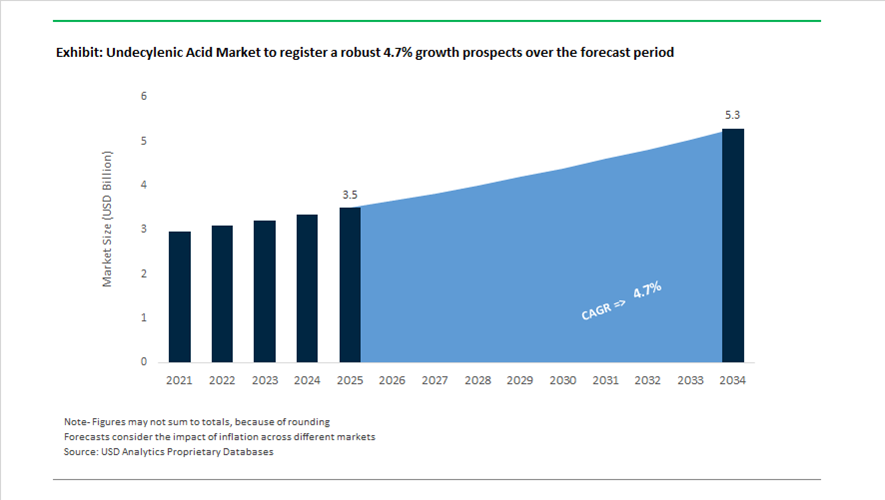
The global Undecylenic Acid market is valued at $3.5 billion in 2025 and is projected to reach $5.3 billion by 2034, expanding at a CAGR of 4.7%. Undecylenic acid, a C11 terminal unsaturated fatty acid derived primarily from castor oil cracking, serves as a key intermediate in antifungal pharmaceuticals, cosmetic actives, bio-lubricants, nylon 11 polymers, specialty esters, and high-performance antimicrobial formulations. Market growth is closely linked to sustainable castor seed supply chains, expanding pharmaceutical applications, and rising demand for bio-based polymer precursors. Structural momentum is concentrated in certified renewable feedstocks, pharma-grade purity segments, and downstream derivatives such as 1,11-undecanediol for advanced personal care formulations.
Feedstock sustainability and capacity expansion intensified between 2024 and 2026. In March 2024, Arkema’s Oleris® Undecylenic Acid received USDA BioPreferred® certification, confirming 100% bio-based content and reinforcing its positioning in carbon-neutral cosmetics and lubricants. In October 2024, Oleon integrated its South American operations under Oleon Brasil SA, consolidating castor oil crushing and derivative production into its global sustainable chemistry platform. During 2025, Arkema operationalized expanded Oleris® production capacity across Marseille and Singapore, targeting a 50% increase in global bio-based oleochemical output to meet demand from bio-polymers and pharmaceutical intermediates. In mid-2025, BASF transitioned major Asian production hubs to 100% renewable electricity, reducing carbon intensity in auxiliary intermediates used for ricinoleic acid cracking. On February 18, 2026, the Pragati Sustainable Castor Program partners announced Year 9 milestones, educating more than 7,000 farmers and producing over 74,500 tons of certified sustainable castor seed, securing long-term traceable feedstock for undecylenic acid production. In February 2026, Jayant Agro-Organics reported resilient financial performance in its castor derivatives segment despite logistics volatility, underscoring supply chain stability in India, the world’s primary castor producer.
Pharmaceutical and specialty derivative applications are expanding the addressable market. In late 2024 and 2025, Acme Synthetic Chemicals reaffirmed 1,200 TPA capacity for 99% minimum purity EP/BP/USP-grade undecylenic acid, strengthening exports to regulated pharmaceutical markets in Europe and North America. At the 2025 Chemspec exhibition, Arkema showcased high-purity undecylenic acid as a critical intermediate for GLP-1 peptide drug synthesis, leveraging its reactive terminal double bond in advanced conjugation chemistry for weight-loss and diabetes therapeutics. In October 2025, demand for 1,11-undecanediol, derived from undecylenic acid, gained traction as a multifunctional antimicrobial and moisturizing ingredient in clean beauty and anti-aging formulations. Clinical validation further broadened therapeutic potential. In January 2026, published multicenter trial data on 15% undecylenic acid cream demonstrated significant reduction in viral shedding and itching in recurrent herpes labialis, suggesting expanded antiviral applications beyond its established antifungal use.
Trends and Opportunities Shaping the Undecylenic Acid Market
Plant-Powered Reformulation in OTC Antifungal Foot Care
The undecylenic acid market is undergoing a structural repositioning within over-the-counter antifungal foot care, driven by the rapid mainstreaming of clean-label and plant-derived actives. In 2025, consumer health brands are no longer treating undecylenic acid as a legacy fatty acid but are actively elevating it as a premium, bio-based “hero ingredient” aligned with sustainability-led purchasing behavior. Updated FDA DailyMed filings through late 2024 and 2025 show a clear shift toward high-potency undecylenic acid concentrations, typically around 25%, combined with botanical carriers such as tea tree oil and clove bud oil to strengthen natural efficacy narratives.
This reformulation trend is reinforced by the ingredient’s unique regulatory positioning. Unlike many botanical extracts that remain adjunctive or cosmetic, undecylenic acid retains FDA-recognized antifungal efficacy through direct disruption of fungal cell membranes. In 2025 OTC monograph reviews, it continues to stand out as one of the few naturally derived fatty acids capable of delivering clinically relevant outcomes without synthetic actives. This has enabled innovation in dual-benefit systems that combine treatment and cosmetic improvement, particularly nail renewal formats that integrate urea to enhance nail appearance while addressing infection. From a market perspective, this dual functionality is expanding average selling prices and extending undecylenic acid’s lifecycle in mature antifungal categories that are otherwise saturated by low-cost generics.
Strategic Scaling of C11 Derivatives for Bio-Lubricants and Advanced Polymers
Beyond healthcare, undecylenic acid is gaining strategic importance as a renewable C11 platform chemical for high-performance polymers and environmentally acceptable lubricants. Chemical majors are accelerating investments to secure castor-based feedstock integration, recognizing that undecylenic acid offers a rare combination of bio-derived carbon content, low-temperature flexibility, and chemical versatility. Under Project Pragati, industry leaders including Arkema, BASF, and Jayant Agro-Organics have scaled certified castor supply chains, enabling consistent production of undecylenic acid marketed for polyamide synthesis.
Polyamide 11 derived from undecylenic acid is increasingly displacing petroleum-based Nylon 12 in automotive fuel lines, flexible tubing, and additive manufacturing filaments, primarily due to its 100% bio-based carbon content and superior resistance to chemicals and low temperatures. In parallel, the lubricant industry is leveraging undecylenic acid esters to formulate next-generation estolides with higher viscosity indices and superior biodegradability. The 2024–2025 integration of castor derivatives into biosynthetic lubricant portfolios is directly targeting marine and aviation applications, where regulatory frameworks mandate environmentally acceptable lubricants. This industrial scaling trend is repositioning undecylenic acid from a niche fatty acid into a core building block within renewable materials value chains.
Bio-Based Preservative Systems for Sensitive Skin Cosmetics
A major opportunity for undecylenic acid is emerging in cosmetic preservation as regulators and consumers converge on reducing reliance on traditional preservatives such as parabens and phenoxyethanol. In sensitive-skin and dermatologist-tested formulations, undecylenic acid salts, particularly zinc undecylenate, are being adopted as multifunctional ingredients that combine antimicrobial protection with direct skin-benefit claims. Research published across 2024 and 2025 demonstrates that zinc undecylenate delivers bacteriostatic performance in liquid cleansers and emulsions while also acting as an antiseborrheic agent, a combination that synthetic preservatives cannot replicate.
The commercial significance of this lies in formulation efficiency and label simplification. By delivering both product protection and consumer-facing benefits, undecylenic acid derivatives reduce the need for multi-component preservative systems. In 2025, COSMOS-compliant undecylenic acid grades have unlocked access to the European organic and natural cosmetics segment, where clean-beauty demand is accelerating at double-digit rates. This positions undecylenic acid as a strategic enabler for premium skincare brands seeking regulatory resilience, mild sensory profiles, and credible bio-based positioning within a highly competitive beauty market.
Agrochemical Synergists for Resistance Management
A high-value niche is forming in crop protection, where undecylenic acid is being repositioned as a bio-fungicidal synergist rather than a standalone pesticide. Agricultural trials conducted in late 2024 highlight its physical mode of action, which disrupts fungal cell walls rather than targeting metabolic pathways. This mechanical mechanism significantly lowers the risk of resistance development, a critical advantage as systemic fungicides face declining efficacy in high-value horticulture.
In 2025, agrochemical suppliers are incorporating undecylenic acid into liquid bio-fungicide formulations used as tank-mix partners in organic viticulture and soft-fruit cultivation. These systems allow growers to reduce total synthetic chemical load by up to 30% while maintaining disease control and crop quality. This aligns directly with the EU Farm to Fork strategy’s long-term objective of halving pesticide usage by 2030. For undecylenic acid producers, this application represents a margin-accretive expansion into regulated bio-agriculture markets, where performance, sustainability credentials, and resistance management converge to support long-term demand growth.
Undecylenic Acid Market Share and Segmentation Insights
Grade Market Share: Pharmaceutical Grade Leads with OTC Antifungal Applications
Pharmaceutical grade undecylenic acid holds a 48.60% market share in 2025, driven by its established role as an active ingredient in over-the-counter antifungal treatments for skin infections such as athlete’s foot, ringworm, and yeast conditions. Its proven efficacy, safety profile, and regulatory approvals make it the preferred grade for healthcare applications. Cosmetic and industrial grades serve additional uses in personal care and chemical processing. A key market dynamic is the stability of the generic antifungal segment, where consistent consumer demand for trusted, widely available treatments supports steady pharmaceutical grade consumption across global markets.
Application Market Share: Cosmetics and Personal Care Leads with Natural Antimicrobial Demand
Cosmetics and personal care account for 38.60% of the undecylenic acid market in 2025, supported by its antimicrobial and antifungal properties in deodorants, skin care products, and foot care formulations. Pharmaceuticals, polymers and plastics, industrial chemicals, and agrochemicals represent additional application areas. A significant growth trend is the rising demand for natural and plant-based ingredients, as undecylenic acid derived from castor oil aligns with clean-label and sustainable formulation strategies. Its role as a naturally derived preservative alternative continues to expand in cosmetic formulations, supported by its GRAS status and compatibility with modern personal care product requirements.
Undecylenic Acid Market Competitive Landscape
The Undecylenic Acid market in 2026 is shaped by vertical integration in castor oil supply chains, regenerative sourcing initiatives, and the rising demand for high-purity grades supporting peptide synthesis, GLP-1 drug manufacturing, specialty polyamides, and bio-based performance chemicals.
Arkema Expands Oleris® Capacity for Pharmaceutical-Grade Undecylenic Acid
Arkema is setting the global benchmark in the Undecylenic Acid market through its Oleris® advanced bio-materials platform based on 100% renewable castor oil. The company completed a 50% global capacity expansion, anchored by its Jurong Island bio-factory, strengthening supply for high-purity C11 derivatives. Its strategic pivot toward pharmaceutical applications positions undecylenic acid as a critical intermediate in peptide synthesis and GLP-1 therapeutics. Arkema’s Castor Farmer Education Fund enhances feedstock traceability and regenerative sourcing across India. Its proprietary thermal cracking and terminal double bond technology enable high-performance applications in flavors, fragrances, and bio-conjugation chemistry. This integration of sustainability and high-purity chemistry reinforces Arkema’s leadership in specialty bio-based intermediates.
Jayant Agro-Organics Strengthens Vertical Integration in Castor-Based Derivatives
Jayant Agro-Organics Limited is reinforcing its leadership in the Undecylenic Acid market through full-spectrum vertical integration from castor seed sourcing to specialty derivatives production. The company reported ₹1,21,096.20 lakhs in FY2025 revenue, reflecting stable demand across industrial and specialty chemical segments. Its strategic shift toward castor-based derivatives highlights a transition away from commodity oil trading to high-value chemical manufacturing. Through the SATVA initiative, Jayant Agro is aligning operations with sustainability and carbon-neutral growth objectives. Participation in the Pragati Sustainable Castor Program ensures long-term feedstock security with certified sustainable cultivation. Its strong partnerships across aerospace, electronics, and specialty chemicals reinforce its role as a preferred global supplier.
BASF SE Integrates Undecylenic Acid into Bio-Lubricants and Personal Care Solutions
BASF SE is leveraging its global Verbund integration to expand the role of undecylenic acid derivatives in high-performance and sustainable applications. The company is focusing on bio-lubricant formulations for electric vehicles, where castor-based esters offer superior thermal stability and viscosity performance. Its involvement in the Pragati initiative has improved agricultural yields and stabilized raw material supply chains. BASF also integrates undecylenic acid derivatives such as zinc undecylenate into personal care products targeting antifungal treatments and clean beauty formulations. The company is advancing Product Carbon Footprint transparency across its oleochemical portfolio to support Scope 3 emissions reduction strategies. This combination of sustainability and application diversification strengthens BASF’s position in global specialty chemicals.
Hokoku Corporation Focuses on High-Purity Undecylenic Acid for Specialty Polymers
Hokoku Corporation is positioning itself in the Undecylenic Acid market through high-purity distillation and specialty polymer integration. Its undecylenic acid is a key intermediate in Nylon 11 and Nylon 12 production, supporting demand in automotive and electronics sectors requiring high-performance bio-based resins. The company also produces pharmaceutical-grade material used in antifungal formulations, ensuring stability and compliance in OTC healthcare applications. Expansion of distribution hubs in Southeast Asia is enhancing its reach in cosmetics and pharmaceutical markets. Hokoku is diversifying into related castor derivatives such as 12-HAS and ricinoleic acid to support lubricant and grease formulations. Its focus on precision chemistry and niche applications strengthens its competitive positioning.
Kokuyo Camlin Strengthens Specialty Chemical Portfolio with Undecylenic Acid Applications
Kokuyo Camlin Ltd. is emerging as a regional player in the Undecylenic Acid market by leveraging its specialty chemicals division for value-added applications. The company reported a turnaround to ₹3.98 crore net profit in Q4 2025, supported by a 10.84% increase in revenue driven by specialty chemical demand. Its low debt-to-equity ratio of 0.09 ensures financial stability and supports continued investment in castor derivative production. Kokuyo Camlin is channeling resources into R&D for antimicrobial coatings based on undecylenic acid derivatives, targeting healthcare and industrial surfaces. Government incentives and GST benefits have enabled capital reallocation toward higher-margin chemical segments. This strategic pivot enhances its competitiveness in South Asia’s growing bio-based chemical market.
India Undecylenic Acid Market Anchored in Castor Feedstock Control and Export-Oriented Value Addition
India occupies a structurally dominant position in the global Undecylenic Acid market due to its near-monopolistic control over castor oil feedstocks. At the 23rd Global Castor Conference 2025 held in Gandhinagar, the Gujarat government reiterated that the state accounts for over 85% of India’s castor production, translating into roughly 70% of global Undecylenic Acid feedstock availability. This upstream concentration provides Indian producers with unmatched pricing leverage, supply continuity, and traceability advantages, particularly as downstream customers increasingly demand bio-based and sustainably sourced fatty acid intermediates.
Capacity modernization is reinforcing this advantage. Jayant Agro-Organics, one of the world’s primary Undecylenic Acid suppliers, disclosed in its Q2 FY 2025–26 filings a strategic pivot toward R&D-driven value-added derivatives. The company is prioritizing high-purity Undecylenic Acid grades tailored for pharmaceutical, cosmetic, and specialty polymer export markets, signaling a clear move away from commoditized bulk sales. Policy frameworks are accelerating this shift. Under India’s Production Linked Incentive schemes for specialty chemicals, manufacturers are being incentivized to transition from exporting crude castor oil to higher-margin derivatives such as Undecylenic Aldehyde and Zinc Undecylenate, improving both export realization and domestic processing depth.
Sustainability initiatives further strengthen India’s market positioning. The Pragati Initiative, led by the Sustainable Castor Association with founding members including Arkema and Jayant Agro, has audited and certified more than 10,000 farmers as of 2025. Certified farms have achieved yields 57% higher than local government averages through precision agriculture. Parallel water conservation programs delivered a 33% reduction in irrigation consumption by mid-2025, directly lowering the environmental footprint of Undecylenic Acid production. Indian refiners are also integrating solar-thermal systems into vacuum distillation units to reduce the carbon intensity of the castor oil cracking process, aligning the supply chain with global ESG expectations.
France Undecylenic Acid Market Defined by Bio-Based Innovation and Aerospace-Grade Applications
France represents the innovation nucleus of the Undecylenic Acid market in Europe, driven by advanced bio-material research and downstream specialization. Arkema’s Oleris platform, showcased extensively in 2025, positions Undecylenic Acid as a 100% bio-based and climate-positive feedstock derived from castor oil. The platform emphasizes that castor bean cultivation absorbs more atmospheric CO₂ during growth than is emitted during manufacturing, an argument increasingly resonant with European regulators and sustainability-driven end users.
Pharmaceutical-grade differentiation is a key growth vector. In late 2024, Arkema introduced high-purity grades of 10-Undecenoic Acid that comply with stringent pharmacopeia standards, specifically targeting topical antifungal and dermatological formulations. These grades address rising demand for traceable, plant-derived actives in regulated healthcare applications, where supplier qualification and batch consistency are critical.
France is also expanding Undecylenic Acid use in advanced materials. Chemical clusters are increasingly utilizing it as a precursor for Polyamide 11 under the Rilsan brand, with 2025 contracts focused on lightweight, bio-based tubing for hydrogen-powered aircraft prototypes. This aerospace alignment positions Undecylenic Acid beyond traditional cosmetic and pharmaceutical uses, embedding it into next-generation mobility and energy-transition supply chains.
United States Undecylenic Acid Market Driven by Nanomedicine, Clean-Label Consumer Demand, and Bio-Lubricants
The United States Undecylenic Acid market is characterized by downstream application innovation rather than feedstock control. In 2025, a technical report from BenchChem highlighted the use of Undecylenic Acid as a functional component in nanomedicine, particularly within solid lipid nanoparticles designed to enhance transdermal penetration of lipophilic drugs. Its hydrophobic profile is increasingly leveraged in dermatology and topical drug delivery systems, supporting higher bioavailability without synthetic penetration enhancers.
Regulatory clarity is shaping formulation strategies. The U.S. Food and Drug Administration 2025 Guidance Agenda introduced updated considerations for human- and animal-derived materials. Although Undecylenic Acid is plant-derived, manufacturers are aligning testing protocols with newly emphasized alternative microbial methods, especially where the acid functions as a stabilizer in biologics and veterinary products.
Industrial applications are also expanding. In late 2024, Biosynthetic Technologies acquired Innoleo, LLC to integrate Undecylenic Acid-derived estolides into environmentally acceptable lubricants for marine and industrial uses. Concurrently, clean-label consumer trends are boosting fragrance demand. During the 2025 holiday cycle, U.S. e-commerce sales drove a 12% increase in the use of Undecylenic Acid esters such as Ethyl Undecylenate in premium botanical mists and personal care sprays.
China Undecylenic Acid Market Shaped by Capacity Expansion and Biopolymer Integration
China’s Undecylenic Acid market is advancing through capacity expansion and targeted downstream integration. Under the 14th Five-Year Plan, fine chemical self-sufficiency has become a strategic priority. In 2025, the Ministry of Industry and Information Technology tracked new domestic Undecylenic Acid capacity additions to support local Nylon 11 and Nylon 12 value chains, reducing reliance on imported intermediates.
Pricing dynamics reflect this capacity build-out. As domestic supply caught up with rising demand from cosmetics and specialty polymers, Chinese export prices for industrial-grade Undecylenic Acid corrected by 5.5% in early 2026, despite broader global logistics volatility. This adjustment has improved competitiveness across Asia-Pacific markets.
Innovation is increasingly visible in biopolymer applications. Manufacturers in Zhejiang have successfully deployed Undecylenic Acid as a chain terminator in specialty resins, enhancing flexibility and chemical resistance in eco-friendly coatings. This application positions the molecule as a functional modifier rather than a commodity fatty acid, supporting higher technical value capture.
Germany Undecylenic Acid Market Influenced by Regulatory Alignment and Sustainable Procurement
Germany’s Undecylenic Acid market is primarily shaped by regulatory foresight and downstream brand requirements. In Q4 2025, the European Commission initiated an evaluation of the Biocidal Products Regulation, prompting German manufacturers to proactively reclassify and align Undecylenic Acid applications toward PT1 human hygiene and PT2 disinfectant categories. This proactive compliance strategy is designed to preserve formulation continuity under tightening safety criteria.
Sustainable sourcing mandates further influence demand. German cosmetic leaders such as Beiersdorf updated their 2025 procurement frameworks to prioritize EcoVadis-certified castor derivatives. This has strengthened preference for Undecylenic Acid sourced from Pragati-compliant Indian supply chains, reinforcing traceability, ethical farming, and ESG alignment across European cosmetic and personal care portfolios.
Summary of Country-Level Undecylenic Acid Market Characteristics
Undecylenic Acid Market County Level Snapshot
Country
Strategic Focus
Key Demand Drivers
Market Positioning
India
Feedstock dominance and derivative exports
Castor control, PLI incentives, sustainable farming
By Grade (Pharmaceutical Grade, Industrial Grade, Cosmetic Grade), By Application (Pharmaceuticals, Polymers and Plastics, Cosmetics and Personal Care, Industrial Chemicals, Agrochemicals), By Derivative Type (Zinc Undecylenate, Calcium Undecylenate, Methyl Undecylenate, Ethyl Undecylenate, Undecylenic Aldehyde)
Study Period
2019- 2025 and 2026-2034
Units
Revenue (USD)
Qualitative Analysis
Porter’s Five Forces, SWOT Profile, Market Share, Scenario Forecasts, Market Ecosystem, Company Ranking, Market Dynamics, Industry Benchmarking
Companies
Arkema S.A., Jayant Agro Organics Limited, Hokoku Corporation, Oleon NV, Acme Synthetic Chemicals, Castor and Patience, Sebacic India Limited, Indo Castor Oil, Joshi Agrochem, A.S. Joshi and Company, Givaudan SA, Symrise AG, Godrej Industries Limited, Triveni Interchem Private Limited, Hengshui Jinghua Chemical Co. Ltd.
Countries
US, Canada, Mexico, Germany, France, Spain, Italy, UK, Russia, China, India, Japan, South Korea, Australia, South East Asia, Brazil, Argentina, Middle East, Africa
Undecylenic Acid Market Segmentation
By Grade
Pharmaceutical Grade
Industrial Grade
Cosmetic Grade
By Application
Pharmaceuticals
Polymers and Plastics
Cosmetics and Personal Care
Industrial Chemicals
Agrochemicals
By Derivative Type
Zinc Undecylenate
Calcium Undecylenate
Methyl Undecylenate
Ethyl Undecylenate
Undecylenic Aldehyde
By Region
North America (United States, Canada, Mexico)
Europe (Germany, France, United Kingdom, Spain, Italy, Rest of Europe)
Asia Pacific (China, India, Japan, South Korea, Australia, Rest of APAC)
South and Central America (Brazil, Argentina, Rest of SCA)
Middle East and Africa (Saudi Arabia, UAE, South Africa, Rest of Middle East, Rest of Africa)
2. Undecylenic Acid Market Landscape & Outlook (2025–2034)
2.1. Introduction to Undecylenic Acid Market
2.2. Market Valuation and Growth Projections (2025–2034)
2.3. Sustainable Castor Feedstock and Supply Chain Integration
2.4. Pharmaceutical-Grade Expansion and Specialty Derivatives Growth
2.5. Bio-Polymer Demand and Renewable Chemical Applications
3. Innovations Reshaping the Undecylenic Acid Market
3.1. Trend: Plant-Based Reformulation in OTC Antifungal Applications
3.2. Trend: Scaling of C11 Derivatives for Bio-Lubricants and Advanced Polymers
3.3. Opportunity: Bio-Based Preservative Systems in Cosmetics
3.4. Opportunity: Agrochemical Synergists for Resistance Management
4. Competitive Landscape and Strategic Initiatives
4.1. Mergers and Acquisitions
4.2. R&D and Material Innovation
4.3. Sustainability and ESG Strategies
4.4. Market Expansion and Regional Focus
5. Market Share and Segmentation Insights: Undecylenic Acid Market
5.1. By Grade
5.1.1. Pharmaceutical Grade
5.1.2. Industrial Grade
5.1.3. Cosmetic Grade
5.2. By Application
5.2.1. Pharmaceuticals
5.2.2. Polymers and Plastics
5.2.3. Cosmetics and Personal Care
5.2.4. Industrial Chemicals
5.2.5. Agrochemicals
5.3. By Derivative Type
5.3.1. Zinc Undecylenate
5.3.2. Calcium Undecylenate
5.3.3. Methyl Undecylenate
5.3.4. Ethyl Undecylenate
5.3.5. Undecylenic Aldehyde
5.4. By Region
5.4.1. North America
5.4.2. Europe
5.4.3. Asia Pacific
5.4.4. South and Central America
5.4.5. Middle East and Africa
6. Country Analysis and Outlook of Undecylenic Acid Market
6.1. United States
6.2. Canada
6.3. Mexico
6.4. Germany
6.5. France
6.6. Spain
6.7. Italy
6.8. UK
6.9. Russia
6.10. China
6.11. India
6.12. Japan
6.13. South Korea
6.14. Australia
6.15. South East Asia
6.16. Brazil
6.17. Argentina
6.18. Middle East
6.19. Africa
7. Undecylenic Acid Market Size Outlook by Region (2025-2034)
7.1. North America Undecylenic Acid Market Size Outlook to 2034
7.1.1. By Grade
7.1.2. By Application
7.1.3. By Derivative Type
7.1.4. By Region
7.2. Europe Undecylenic Acid Market Size Outlook to 2034
7.2.1. By Grade
7.2.2. By Application
7.2.3. By Derivative Type
7.2.4. By Region
7.3. Asia Pacific Undecylenic Acid Market Size Outlook to 2034
7.3.1. By Grade
7.3.2. By Application
7.3.3. By Derivative Type
7.3.4. By Region
7.4. South America Undecylenic Acid Market Size Outlook to 2034
7.4.1. By Grade
7.4.2. By Application
7.4.3. By Derivative Type
7.4.4. By Region
7.5. Middle East and Africa Undecylenic Acid Market Size Outlook to 2034
7.5.1. By Grade
7.5.2. By Application
7.5.3. By Derivative Type
7.5.4. By Region
8. Company Profiles: Leading Players in the Undecylenic Acid Market
8.1. Arkema S.A.
8.2. Jayant Agro Organics Limited
8.3. Hokoku Corporation
8.4. Oleon NV
8.5. Acme Synthetic Chemicals
8.6. Castor and Patience
8.7. Sebacic India Limited
8.8. Indo Castor Oil
8.9. Joshi Agrochem
8.10. A.S. Joshi and Company
8.11. Givaudan SA
8.12. Symrise AG
8.13. Godrej Industries Limited
8.14. Triveni Interchem Private Limited
8.15. Hengshui Jinghua Chemical Co. Ltd.
9. Methodology
9.1. Research Scope
9.2. Market Research Approach
9.3. Market Sizing and Forecasting Model
9.4. Research Coverage
9.5. Data Horizon
9.6. Deliverables
10. Appendix
10.1. Acronyms and Abbreviations
10.2. List of Tables
10.3. List of Figures
Undecylenic Acid Market Segmentation
By Grade
Pharmaceutical Grade
Industrial Grade
Cosmetic Grade
By Application
Pharmaceuticals
Polymers and Plastics
Cosmetics and Personal Care
Industrial Chemicals
Agrochemicals
By Derivative Type
Zinc Undecylenate
Calcium Undecylenate
Methyl Undecylenate
Ethyl Undecylenate
Undecylenic Aldehyde
By Region
North America (United States, Canada, Mexico)
Europe (Germany, France, United Kingdom, Spain, Italy, Rest of Europe)
Asia Pacific (China, India, Japan, South Korea, Australia, Rest of APAC)
South and Central America (Brazil, Argentina, Rest of SCA)
Middle East and Africa (Saudi Arabia, UAE, South Africa, Rest of Middle East, Rest of Africa)
The global undecylenic acid market is valued at $3.5 billion in 2025 and is projected to reach $5.3 billion by 2034, growing at a CAGR of 4.7%. Growth is supported by increasing demand for bio-based chemicals, pharmaceutical applications, and specialty polymers. Sustainable castor feedstock availability remains a critical growth enabler.
Key drivers include rising demand for plant-based antifungal actives, expansion of nylon 11 and bio-polymer applications, and increasing adoption in clean-label cosmetics. The shift toward sustainable oleochemicals and renewable feedstocks is accelerating market penetration across multiple industries.
Cosmetics and personal care lead with a 38.6% market share in 2025, driven by antimicrobial and preservative applications. Pharmaceutical applications also hold a significant share due to widespread OTC antifungal treatments. Additionally, polymer and lubricant sectors are emerging as high-growth segments.
Opportunities include bio-based preservative systems for cosmetics, expansion of C11 derivatives in advanced polymers and lubricants, and growing use in agrochemical synergists. Demand for multifunctional ingredients in clean beauty and circular materials is creating high-margin application areas.
Key players include Arkema S.A., Jayant Agro Organics Limited, BASF SE, Oleon NV, and Hokoku Corporation. These companies focus on vertical integration, sustainable sourcing, and high-purity product development. Strategic investments in bio-based chemistry and derivatives are shaping competitive positioning.