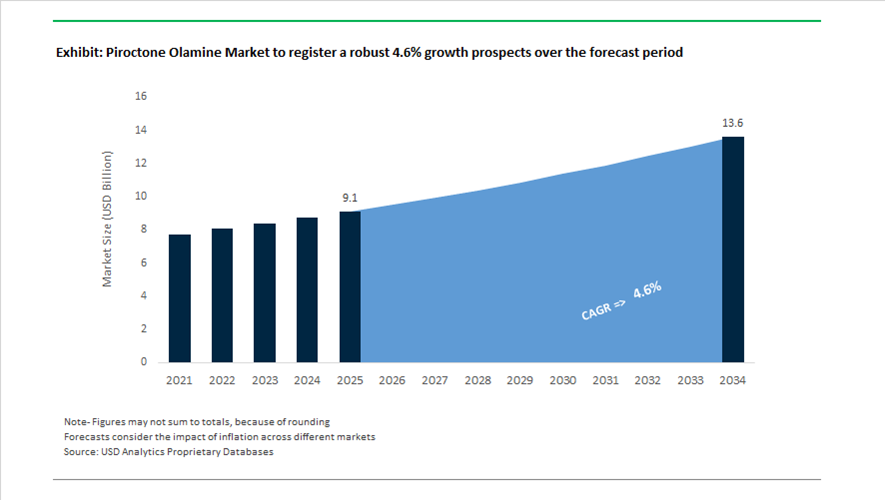
Piroctone Olamine Market Size 2025–2034: $9.1 Billion to $13.6 Billion at 4.6% CAGR Driven by Zinc Pyrithione Replacement and Scalp Microbiome Innovation
The global piroctone olamine market is projected to grow from $9.1 billion in 2025 to $13.6 billion by 2034, registering a CAGR of 4.6%. Piroctone olamine, a broad-spectrum antifungal active widely used in anti-dandruff shampoos and scalp-care formulations, has gained structural importance following regulatory restrictions on zinc pyrithione in the European Union. Demand is accelerating across sulfate-free shampoos, leave-on scalp serums, professional salon products, and microbiome-balanced formulations. The ingredient’s favorable toxicological profile, compatibility with sensitive-skin claims, and proven efficacy against Malassezia species position it as a primary replacement active in premium and mass-market haircare portfolios.
Capacity expansion and supply chain realignment marked 2025 as a pivotal year. In March 2025, Kumar Organic Products Limited commissioned a new manufacturing block in India specifically to address the global supply gap created by the zinc pyrithione ban. The expansion strengthens India’s position as a key export hub for piroctone olamine to Europe and North America. In November 2025, Kumar Organic received an EcoVadis Gold rating, reinforcing its ESG credentials at a time when multinational cosmetic brands require traceable, sustainability-certified sourcing partners.
Formulation science and delivery systems are evolving rapidly. In May 2025, Clariant introduced Velsan® Flex, designed to stabilize higher concentrations of piroctone olamine in clear, sulfate-free shampoos without compromising transparency. In late 2025, BASF Care Chemicals released formulation guidance integrating Scalposine™ with piroctone olamine, targeting dual-action scalp microbiome balance and antifungal performance. Meanwhile, in June 2025, Startec launched a liquid piroctone olamine concentrate to resolve solubility and dusting issues associated with powder handling, enabling faster production cycles for independent beauty brands.
Premiumization and professional channel growth are reinforcing volume expansion. In early 2024, L’Oréal Professionnel launched its Scalp Advanced range, positioning high-concentration piroctone olamine formulas within salon-grade dermo-cosmetic offerings. Throughout 2024, Unilever completed global rollout of reformulated Clear and Dove variants featuring Scalp+ Technology, where piroctone olamine replaced legacy actives. These large-scale reformulations substantially increased baseline global consumption.
Sustainability and regulatory oversight continue to influence market dynamics. In August 2025, Spec-Chem Industry secured ECO-LABEL and Green Seal compatibility for its SpecKare® PO grade, supporting green-certified anti-dandruff products. In February 2026, the European Commission’s Scientific Committee on Consumer Safety reaffirmed piroctone olamine’s safety profile but issued updated concentration guidance for leave-on formats such as dry shampoos, prompting reformulation testing among EU manufacturers.
Advanced delivery technologies are also expanding application potential. In 2024, Evonik integrated novel deposition-enhancing surfactant systems following its acquisition of Novachem, improving active ingredient retention during rinse-off cycles. In January 2026, Wacker Chemie expanded cyclodextrin complex production in the United States to enable controlled-release piroctone olamine systems in serums and leave-on conditioners, a high-growth scalp treatment segment.
Trends and Opportunities Shaping the Global Piroctone Olamine Market
ZPT Replacement and the Regulatory-Led Shift Toward Clean-Label Anti-Dandruff Systems
The global piroctone olamine market is being fundamentally reshaped by regulatory intervention, most notably the European Union’s prohibition of Zinc Pyrithione under Regulation (EU) 2021/1902 due to its CMR 1B classification. Since the ban became effective for cosmetic use, piroctone olamine has emerged as the dominant replacement active, not merely because it is compliant, but because it offers a superior balance of antifungal efficacy, formulation flexibility, and eco-toxicological safety. Unlike zinc pyrithione, piroctone olamine is fully compatible with transparent and sulfate-free surfactant systems, enabling premium aesthetics alongside functional performance.
By 2024–2025, the transition had moved beyond compliance-driven reformulation into product premiumization. In April 2025, Unilever launched its Clear ScalpCeuticals Pro range incorporating a patented piroctone olamine complex. Internal clinical data disclosed by the company showed up to 500% higher anti-dandruff protection versus baseline systems, alongside measurable improvements in scalp barrier renewal. This positioned piroctone olamine as a biotech-style scalp health active rather than a like-for-like antimicrobial substitute.
Mass-market brands across Europe and North America have followed a similar trajectory. Reformulated anti-dandruff SKUs under Dove DermaCare and Head & Shoulders EU portfolios have shifted to piroctone olamine to meet post-2022 compliance audits. Importantly, piroctone olamine enables “gentle-on-scalp” and “clear formulation” claims, which were structurally unattainable with zinc-based actives. Industry launch tracking in 2025 indicates that more than 70% of new anti-dandruff products in regulated markets now carry clean-label positioning, with piroctone olamine acting as the enabling ingredient.
Expansion from Rinse-Off to Leave-On Scalp Health and Hair Density Solutions
A second major trend is the migration of piroctone olamine from rinse-off shampoos into leave-on scalp serums, tonics, and density treatments. This shift reflects a broader redefinition of dandruff as a chronic scalp condition linked to micro-inflammation, oxidative stress, and impaired follicular anchoring rather than a purely cosmetic flaking issue.
Clinical validation has played a decisive role. In 2024–2025, Procter & Gamble published results from an eight-week randomized, double-blind study demonstrating that topical scalp application of piroctone olamine significantly reduced hair shedding compared to placebo. The study attributed the outcome to improved stratum corneum integrity and reduced oxidative scalp stress, establishing piroctone olamine as a cosmetic antioxidant with measurable hair-retention benefits.
This evidence has accelerated the growth of multifunctional scalp serums positioned at the intersection of cosmetics and OTC hair care. Recent launches combining salicylic acid with piroctone olamine target both follicular congestion and fungal imbalance, appealing to consumers seeking alternatives to pharmaceutical actives such as minoxidil. As a result, piroctone olamine demand is increasingly being driven by higher-value leave-on formats, which consume lower volumes per unit but command significantly higher margins and repeat-use frequency.
Preservative Boosting and Formulation Simplification in Clean and Natural Cosmetics
Beyond its antifungal role, piroctone olamine is gaining traction as a multifunctional preservative booster, particularly in formulations positioned as “natural,” “low-preservative,” or “sensitive-skin.” Its broad-spectrum antimicrobial activity allows formulators to reduce or eliminate traditional preservatives such as phenoxyethanol, which are increasingly scrutinized by consumers and advocacy groups.
In 2025, specialty ingredient suppliers highlighted the efficacy of piroctone olamine at concentrations as low as 0.05 to 0.2% in neutral-pH systems, including sunscreens and facial cleansers. This secondary functionality is especially valuable in sun care and water-rich emulsions, where microbial control is critical but ingredient lists are under pressure to remain minimal. By serving both as an active treatment and a microbial stabilizer, piroctone olamine reduces formulation complexity, shortens development timelines, and lowers total ingredient costs, creating a clear incentive for adoption in premium clean-beauty portfolios.
The opportunity extends into adjacent categories such as deodorants, intimate washes, and waterless cosmetics, where odor control and fungal suppression are required without aggressive biocides. As clean-label standards tighten across Europe and North America, piroctone olamine is increasingly positioned as a “functional efficiency” ingredient rather than a single-use active.
Premiumization of Pet Care Through Human-Grade Dermocosmetic Actives
The rapid humanization of pets has opened a parallel growth channel for piroctone olamine in veterinary and premium grooming products. Canine seborrheic dermatitis, primarily caused by Malassezia yeast, mirrors the fungal mechanisms seen in human dandruff, making piroctone olamine directly transferable across species when formulated at appropriate concentrations and pH levels.
The global pet care market is projected to reach approximately $207 billion in 2025, with above-average growth in medicated shampoos, wipes, and ear-care products. In the European Union, the absence of a dedicated animal cosmetics regulation has allowed faster adoption of human-grade actives in pet formulations, provided safety and dermatological testing is demonstrated. This regulatory flexibility has enabled piroctone olamine to enter premium pet shampoos and anti-itch treatments positioned as preventative healthcare rather than episodic therapy.
Veterinary-backed grooming brands are increasingly co-developing formulations with dermatologists to deliver visible flake reduction and itch relief without steroidal or pharmaceutical actives. For ingredient suppliers, this segment represents a structurally attractive opportunity characterized by lower price sensitivity, strong brand loyalty, and growing demand for clinically validated functional ingredients.
Piroctone Olamine Market Share and Segmentation Insights
Pharmaceutical and premium cosmetic grade piroctone olamine accounted for 58.60% of the Piroctone Olamine Market by purity grade in 2025, reflecting strong demand from premium personal care and dermatological product formulations. This high-purity grade is widely used in anti-dandruff shampoos, scalp treatments, and specialized skincare products where strict safety, efficacy, and regulatory compliance standards are required. Manufacturers favor pharmaceutical and cosmetic grade piroctone olamine due to its proven antifungal performance against Malassezia yeasts and compatibility with modern cosmetic formulations. In 2025, premiumization of anti-dandruff and scalp care product categories is driving increased use of high-purity piroctone olamine as brands position products as advanced scalp health solutions rather than conventional dandruff treatments.
Hair Care Segment Drives Piroctone Olamine Demand in Scalp Treatment and Anti-Dandruff Products
Hair care represented 68.40% of the Piroctone Olamine Market by application in 2025, making it the dominant segment across personal care product formulations. Piroctone olamine is widely incorporated into shampoos, scalp serums, conditioners, and treatment products designed to control dandruff and improve scalp microbiome balance. Its ability to inhibit Malassezia growth while maintaining excellent skin compatibility supports its widespread adoption in premium hair care brands. In 2025, the growing convergence between scalp health and hair wellness product development is expanding the role of piroctone olamine in formulations targeting scalp sensitivity, sebum balance, and long-term scalp maintenance within advanced hair care product portfolios.
Piroctone Olamine Market Competitive Landscape
The global piroctone olamine market is expanding as a zinc pyrithione alternative, driven by regulatory bans and rising demand for scalp-focused dermo-cosmetics. Competition is defined by ≥99.5% purity benchmarks, multifunctional formulations, and integration into clinical-grade anti-dandruff, anti-acne, and antimicrobial applications.
Clariant Leads Premium Octopirox™ Positioning with Multifunctional Stability and Clean Beauty Compliance
Clariant AG dominates the piroctone olamine market through its Octopirox™ brand, widely recognized for high-performance anti-dandruff formulations. The product functions as both an antimicrobial active and preservative, enabling reduced reliance on parabens and phenoxyethanol in formulations. Octopirox™ maintains stability across a wide pH range (3.0 to 9.0), supporting transparent shampoo systems and leave-on scalp treatments. Its low aquatic toxicity profile eliminates hazard labeling in several regions, aligning with clean beauty and EU regulatory standards. The company emphasizes 99%+ active substance with strong thermal and pH stability for clinical-grade applications. Strategy focuses on multifunctionality, formulation efficiency, and regulatory-compliant dermo-cosmetic solutions.
Kumar Organic Expands Clinical and Preservative Applications with Kopirox High-Purity Delivery Systems
Kumar Organic Products Limited (KOPL) is strengthening its position with Kopirox-branded piroctone olamine targeting high-growth dermo-cosmetic markets. The January 2026 launch of Kopirox PE introduces a paraben-free liquid preservative system combining piroctone olamine with antibacterial carriers for enhanced stability. Clinical studies in 2025 demonstrate superior performance versus ketoconazole and zinc pyrithione in improving hair shaft diameter, expanding applications into hair density therapies. Production maintains assay levels between 98.0% and 101.5%, supporting pharmaceutical-grade usage in seborrheic dermatitis treatment. The company operates with global regulatory coverage across North America, EMEA, and APAC as a TrustSEAL-certified supplier. Strategy emphasizes clinical differentiation, formulation innovation, and high-purity active delivery systems.
Yantai Aurora Scales Global Supply with High-Purity Production and Cost-Efficient Manufacturing Leadership
Yantai Aurora Chemical Co., Ltd. leads the piroctone olamine market in volume production and global supply scale. The company completed a 15–20% capacity expansion between 2024 and 2025 to address demand shifts following zinc pyrithione restrictions. It controls approximately 22% of global manufacturing share, serving as a key source manufacturing facility for multinational FMCG companies. Product offerings focus on 99%+ purity piroctone olamine optimized for cost-efficient, large-scale personal care applications. Investments in clean-room packaging and particle size optimization improve dissolution rates in cold-process formulations. Strategy centers on volume leadership, supply reliability, and manufacturing efficiency.
Spec-Chem Advances High-Purity Multifunctional Actives with Sebum Regulation and Microencapsulation Technology
Spec-Chem Industry Inc. is focusing on premium dermo-cosmetic applications with high-purity piroctone olamine exceeding 99.5% assay levels. A $10 million facility upgrade in 2025 enhances production quality to meet zero-impurity requirements for high-end formulations. The company positions piroctone olamine as a sebum regulator, addressing oily scalp conditions and inflammation alongside antifungal efficacy. Product applications extend to deodorants and antiperspirants, leveraging odor-control properties. Microencapsulation technology protects the active from UV degradation and enables sustained release in anti-acne and facial care products. Strategy emphasizes multifunctionality, advanced delivery systems, and high-performance dermo-cosmetic actives.
Huateng Pharma Expands Pharmaceutical-Grade Piroctone Olamine Supply Through CDMO Integration
Hunan Huateng Pharmaceutical Co., Ltd. is positioning itself as a CDMO-focused supplier of high-purity piroctone olamine for pharmaceutical and personal care applications. The May 2024 introduction of its product into global markets leverages its expertise in heterocyclic compound synthesis and API manufacturing. The company supplies crystalline piroctone olamine suitable for antifungal ointments meeting USFDA and EDQM regulatory requirements. Expansion into liquid formulations during 2025–2026 supports SMEs lacking advanced formulation capabilities. Its heterocyclic synthesis platform enables cost-efficient production of multiple antifungal actives within a single supply chain. Strategy focuses on pharmaceutical compliance, CDMO partnerships, and flexible product formats.
Germany – Sustainability-Led Repositioning and Advanced Delivery Science
Germany has emerged as the strategic anchor for premium-grade Piroctone Olamine development, driven by portfolio realignment and regulatory foresight. In April 2025, Clariant formally launched its Clariant Beauty division, integrating Octopirox™ with high-efficacy actives from Lucas Meyer Cosmetics. This restructuring reflects a deliberate shift toward “Sophisticated Efficacy” and “Conscious Beauty,” positioning Piroctone Olamine not only as an anti-dandruff active but also as a multifunctional scalp-care ingredient aligned with premium personal care formulations. Germany-based R&D teams have extended this positioning through the “PuriSafe” concept platform, demonstrated in late 2025, where Piroctone Olamine is engineered to deliver antifungal performance alongside preservative support in minimalist formulations.
From a compliance and technology standpoint, German producers are setting global benchmarks. Clariant confirmed that its updated Octopirox™ manufacturing protocols now emphasize a high Renewable Carbon Index, directly supporting Germany’s 2026 industrial decarbonization targets. At the same time, domestic manufacturers have led early compliance with the Omnibus Act VII framework effective September 1, 2025, which tightens CMR classification thresholds for cosmetic ingredients. Patent activity in 2025 around coacervate-based delivery systems further underscores Germany’s innovation depth, enabling improved scalp retention and efficacy at lower active concentrations, a key differentiator in premium and dermatologically positioned haircare.
China – Regulatory Streamlining and Precursor Localization
China’s Piroctone Olamine landscape in 2025–2026 is shaped by regulatory recalibration and supply chain localization. In September 2025, National Institutes for Food and Drug Control issued updated technical guidelines that streamline New Cosmetic Ingredient registration. For medium-risk claims such as anti-dandruff, several toxicological requirements may now be waived when robust scientific justification is available. This change significantly lowers the barrier for reformulated or upgraded Piroctone Olamine products entering the domestic market, accelerating innovation cycles for scalp-care brands.
At the same time, enforcement intensity is increasing under the Cosmetic Supervision and Administration Regulation. From 2026 onward, all Piroctone Olamine-based special cosmetics must undergo five-year NMPA renewals with updated safety dossiers, reinforcing quality discipline across the value chain. Chinese producers such as Dalian Handom Chemicals and Hebei Tianao have proactively standardized export grades at ≥99% purity to satisfy EU and North American buyer specifications. Policy support under the 2025–2026 Work Plan for Stabilizing Growth is also driving domestic synthesis of 3,5-trimethylhexanoic acid, reducing reliance on imported precursors and strengthening China’s cost competitiveness in large-volume industrial supply.
India – Export-Led Scale and Compliance-Driven Credibility
India has consolidated its role as the world’s primary export hub for Piroctone Olamine, leveraging scale, cost efficiency, and regulatory alignment. By late 2025, exporters such as Chemspec Chemicals Pvt Ltd and Vineet Laboratories accounted for more than half of global active shipments, reflecting strong penetration into European, Middle Eastern, and Southeast Asian markets. This export dominance is underpinned by compliance credentials. Vineet Labs confirmed ISO 9001 and ISO 14001 certifications alongside audits aligned with ICH Q7 standards, positioning Indian material as suitable for both cosmetic and quasi-pharmaceutical applications.
Capacity dynamics indicate tightening supply. Leading manufacturers reported full utilization through 2025, prompting announced investments in new production lines for pyridine-based intermediates scheduled for commissioning by Q3 2026. Market consolidation is also visible at the distribution level, with firms such as Megha International and Nueva Chemie LLP expanding networks to serve rising demand for Halal-certified and vegan-compliant preservative systems. Government backing through the 2025–2026 Union Budget has reinforced this momentum by prioritizing antifungal APIs within specialty chemical clusters in Gujarat and Maharashtra, improving access to finance and infrastructure for exporters.
European Union – Regulatory Substitution and Preservation Reformulation
At the regional level, the European Union is acting as a demand catalyst for Piroctone Olamine through regulatory substitution effects. The Omnibus Act VII, effective September 1, 2025, banned several legacy cosmetic substances, accelerating reformulation cycles in premium haircare. As a result, Piroctone Olamine has gained prominence as a safer, well-characterized alternative for anti-dandruff and scalp-health positioning. Preservation strategies are also evolving. Industry adoption of naturally derived systems such as Nipaguard SCE Vita, based on Velsan™ SC technology, leverages Piroctone Olamine’s antimicrobial performance to achieve full renewable carbon claims.
Sustainability transparency is now a structural requirement. Amendments to the EU Cosmetics Regulation mandate expanded Product Safety Reports in 2025, including explicit environmental toxicity disclosures for antifungal agents. This has favored suppliers with robust life-cycle data and traceable sourcing, indirectly reinforcing Germany- and India-based producers that have already invested in compliance-ready documentation and greener synthesis pathways.
Comparative Snapshot – Piroctone Olamine Industry by Region
Piroctone Olamine Market County Level Snapshot
Region
Primary Strategic Driver
2025–2026 Focus Area
Structural Position
Germany
Sustainability and advanced delivery
Coacervates, high RCI production
Innovation and regulatory leader
China
Regulatory streamlining and localization
NCI reform, precursor security
High-volume domestic supplier
India
Export scale and compliance
Capacity expansion, certified APIs
Global supply hub
European Union
Regulatory substitution
Safer preservation systems
Demand and standards driver
Piroctone Olamine Market Report Scope
Piroctone Olamine Market
Parameter
Details
Market Size (2025)
$9.1 Billion
Market Size (2034)
$13.6 Billion
Market Growth Rate
4.6%
Segments
By Purity Grade (Pharmaceutical & Premium Cosmetic Grade, Standard Industrial Grade, Specialty Application Grade), By Application (Hair Care, Skin Care, Bath & Body, Deodorants & Antiperspirants, Sun Care), By Distribution Channel (Direct Sales, Retail Sales, Online Channels), By End-User (Individual Consumers, Professional Salons & Spas, Pharmaceutical & Dermatological Clinics)
Study Period
2019- 2025 and 2026-2034
Units
Revenue (USD)
Qualitative Analysis
Porter’s Five Forces, SWOT Profile, Market Share, Scenario Forecasts, Market Ecosystem, Company Ranking, Market Dynamics, Industry Benchmarking
US, Canada, Mexico, Germany, France, Spain, Italy, UK, Russia, China, India, Japan, South Korea, Australia, South East Asia, Brazil, Argentina, Middle East, Africa
Piroctone Olamine Market Segmentation
By Purity Grade
Pharmaceutical & Premium Cosmetic Grade
Standard Industrial Grade
Specialty Application Grade
By Application
Hair Care
Skin Care
Bath & Body
Deodorants & Antiperspirants
Sun Care
By Distribution Channel
Direct Sales
Retail Sales
Online Channels
By End-User
Individual Consumers
Professional Salons & Spas
Pharmaceutical & Dermatological Clinics
By Region
North America (United States, Canada, Mexico)
Europe (Germany, France, United Kingdom, Spain, Italy, Rest of Europe)
Asia Pacific (China, India, Japan, South Korea, Australia, Rest of APAC)
South and Central America (Brazil, Argentina, Rest of SCA)
Middle East and Africa (Saudi Arabia, UAE, South Africa, Rest of Middle East, Rest of Africa)
2. Piroctone Olamine Market Landscape & Outlook (2025–2034)
2.1. Introduction to Piroctone Olamine Market
2.2. Market Valuation and Growth Projections (2025–2034)
2.3. Key Growth Drivers: Zinc Pyrithione Replacement and Scalp Microbiome Innovation
2.4. Regulatory and Sustainability Landscape: EU Restrictions and Safety Guidance
2.5. Supply Chain and Capacity Dynamics: Expansion, ESG Compliance, and Global Realignment
3. Innovations Reshaping the Piroctone Olamine Market
3.1. Trend: Regulatory-Led Shift Toward Clean-Label Anti-Dandruff Systems
3.2. Trend: Expansion from Rinse-Off to Leave-On Scalp Health Applications
3.3. Opportunity: Preservative Boosting and Formulation Simplification in Clean Beauty
3.4. Opportunity: Premiumization in Pet Care and Dermatological Applications
4. Competitive Landscape and Strategic Initiatives
4.1. Mergers and Acquisitions
4.2. R&D and Material Innovation
4.3. Sustainability and ESG Strategies
4.4. Market Expansion and Regional Focus
5. Market Share and Segmentation Insights: Piroctone Olamine Market
5.1. By Purity Grade
5.1.1. Pharmaceutical & Premium Cosmetic Grade
5.1.2. Standard Industrial Grade
5.1.3. Specialty Application Grade
5.2. By Application
5.2.1. Hair Care
5.2.2. Skin Care
5.2.3. Bath & Body
5.2.4. Deodorants & Antiperspirants
5.2.5. Sun Care
5.3. By Distribution Channel
5.3.1. Direct Sales
5.3.2. Retail Sales
5.3.3. Online Channels
5.4. By End-User
5.4.1. Individual Consumers
5.4.2. Professional Salons & Spas
5.4.3. Pharmaceutical & Dermatological Clinics
5.5. By Region
5.5.1. North America
5.5.2. Europe
5.5.3. Asia Pacific
5.5.4. South and Central America
5.5.5. Middle East and Africa
6. Country Analysis and Outlook of Piroctone Olamine Market
6.1. United States
6.2. Canada
6.3. Mexico
6.4. Germany
6.5. France
6.6. Spain
6.7. Italy
6.8. UK
6.9. Russia
6.10. China
6.11. India
6.12. Japan
6.13. South Korea
6.14. Australia
6.15. South East Asia
6.16. Brazil
6.17. Argentina
6.18. Middle East
6.19. Africa
7. Piroctone Olamine Market Size Outlook by Region (2025–2034)
7.1. North America Piroctone Olamine Market Size Outlook to 2034
7.1.1. By Purity Grade
7.1.2. By Application
7.1.3. By Distribution Channel
7.1.4. By End-User
7.1.5. By Region
7.2. Europe Piroctone Olamine Market Size Outlook to 2034
7.2.1. By Purity Grade
7.2.2. By Application
7.2.3. By Distribution Channel
7.2.4. By End-User
7.2.5. By Region
7.3. Asia Pacific Piroctone Olamine Market Size Outlook to 2034
7.3.1. By Purity Grade
7.3.2. By Application
7.3.3. By Distribution Channel
7.3.4. By End-User
7.3.5. By Region
7.4. South America Piroctone Olamine Market Size Outlook to 2034
7.4.1. By Purity Grade
7.4.2. By Application
7.4.3. By Distribution Channel
7.4.4. By End-User
7.4.5. By Region
7.5. Middle East and Africa Piroctone Olamine Market Size Outlook to 2034
7.5.1. By Purity Grade
7.5.2. By Application
7.5.3. By Distribution Channel
7.5.4. By End-User
7.5.5. By Region
8. Company Profiles: Leading Players in the Piroctone Olamine Market
8.1. Clariant AG
8.2. Chemspec Chemicals Pvt. Ltd.
8.3. Vineet Laboratories Ltd.
8.4. Starchem Enterprises
8.5. Dalian Handom Chemicals Co. Ltd.
8.6. Hebei Tianao Technology Co. Ltd.
8.7. Yantai Aurora Chemical Co. Ltd.
8.8. Nigam Pharmachem Industries
8.9. Megha International
8.10. Nueva Chemie LLP
8.11. Somu Organo Chem Pvt. Ltd.
8.12. Beri Pharma Co. Ltd.
8.13. Shreeneel Chemicals
8.14. Nemi Chemicals
8.15. Suzhou Oulit Biopharmaceutical Co. Ltd.
9. Methodology
9.1. Research Scope
9.2. Market Research Approach
9.3. Market Sizing and Forecasting Model
9.4. Research Coverage
9.5. Data Horizon
9.6. Deliverables
10. Appendix
10.1. Acronyms and Abbreviations
10.2. List of Tables
10.3. List of Figures
Piroctone Olamine Market Segmentation
By Purity Grade
Pharmaceutical & Premium Cosmetic Grade
Standard Industrial Grade
Specialty Application Grade
By Application
Hair Care
Skin Care
Bath & Body
Deodorants & Antiperspirants
Sun Care
By Distribution Channel
Direct Sales
Retail Sales
Online Channels
By End-User
Individual Consumers
Professional Salons & Spas
Pharmaceutical & Dermatological Clinics
By Region
North America (United States, Canada, Mexico)
Europe (Germany, France, United Kingdom, Spain, Italy, Rest of Europe)
Asia Pacific (China, India, Japan, South Korea, Australia, Rest of APAC)
South and Central America (Brazil, Argentina, Rest of SCA)
Middle East and Africa (Saudi Arabia, UAE, South Africa, Rest of Middle East, Rest of Africa)
The global piroctone olamine market is valued at $9.1 billion in 2025 and is expected to reach $13.6 billion by 2034, growing at a CAGR of 4.6%. Growth is driven by regulatory replacement of zinc pyrithione and increasing demand for scalp microbiome-focused formulations in premium haircare.
The EU ban on zinc pyrithione has structurally shifted demand toward piroctone olamine as a compliant antifungal active. Its compatibility with sulfate-free and transparent formulations enables premium positioning. This transition has significantly increased global consumption across both mass-market and salon-grade products.
Formulation trends include microbiome-balanced systems, sulfate-free shampoos, and multifunctional preservative boosters. Advanced delivery technologies such as cyclodextrin complexes and deposition-enhancing surfactants are improving active retention. These innovations are enabling higher efficacy in both rinse-off and leave-on applications.
Leave-on scalp serums, hair density treatments, and dermo-cosmetic formulations are emerging as high-margin segments. These products leverage piroctone olamine for antifungal, antioxidant, and scalp health benefits. Expansion into deodorants, sun care, and premium pet grooming products is further diversifying demand.