Unit Dose Packaging Market Overview: Pre-Measured Doses, Medication Safety and Automated Dispensing Support Market Expansion
Unit-dose packaging contains a quantity of product intended for a single administration or use, whereas unit-of-use packaging contains the quantity required for a complete course of therapy or defined treatment period. This distinction is particularly important in pharmaceutical markets, where unit-dose formats are used to preserve dose identity, support controlled dispensing, and reduce handling before administration.
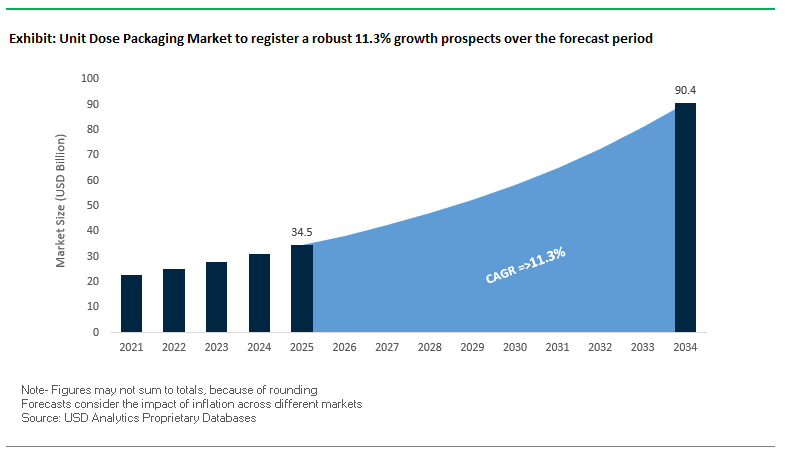
The global Unit Dose Packaging Market is valued at USD 34.5 billion in 2025 and is projected to reach USD 90.4 billion by 2034, expanding at a CAGR of 11.3%. The market includes blister packs, strip packs, sachets, pouches, ampoules, vials, syringes, cartridges, tubes and other packaging formats designed to provide a pre-measured quantity for single use. Pharmaceuticals represent the largest application, while nutraceuticals, personal care and cosmetics, food and beverages, and homecare products extend unit-dose concepts into consumer markets.
Healthcare represents the most technically demanding portion of the market. Pharmaceutical unit-dose packaging is characterized by requirements involving product identity, stability, labeling, medication safety, pharmacy workflow and administration.. In hospitals and other institutional settings, manufacturer-prepared or professionally repackaged unit doses can reduce manual preparation and integrate with barcode-enabled inventory, automated dispensing and patient-specific medication distribution.
Demand is therefore increasingly connected to manufacturer-prepared unit doses, hospital pharmacy automation, barcode medication administration, ready-to-administer medicines, sterile single-dose production and integrated drug-delivery systems. These requirements make unit-dose packaging more than a container category; it increasingly connects pharmaceutical manufacturing, packaging operations, pharmacy distribution and medication administration.
Key Unit Dose Packaging Market Insights
Blister packs account for approximately 35% of the Unit Dose Packaging Market by product type, reflecting their extensive use in tablets and capsules. Pharmaceuticals represent around 50% of demand by application, supported by dosage accuracy, product protection, institutional dispensing and ready-to-administer medication requirements.
Recent Developments and Manufacturer Strategies in Unit Dose Packaging
Recent developments indicate that unit-dose packaging is expanding beyond conventional oral-solid blistering toward hospital-ready medicines, automated pharmacy packaging, sterile Blow-Fill-Seal production and integrated single-dose drug-delivery systems. Manufacturers and technology providers are investing in formats that reduce medication preparation, preserve individual-dose identification and integrate more readily with hospital dispensing and administration systems.
ApiJect Launches Hospital Platform with More Than 300 Unit-Dose Generic Medicines
In May 2026, ApiJect Systems' subsidiary The Vanguard Utility launched a U.S. hospital unit-dose medicines platform through Global Pharmacy Reserve. ApiJect reported that the platform includes more than 300 unit-dose generic medicines, with commercial shipments beginning May 1, 2026. The initial supply model combines pharmaceutical sourcing, repackaging, quality assurance and distribution while ApiJect develops additional U.S.-based drug-finishing capacity.
The launch connects unit-dose packaging directly with hospital pharmaceutical supply. Medicines arriving in pharmacy-ready individual formats can reduce the need for hospitals to transfer products from bulk packages into internally prepared single doses. This direction is consistent with current ASHP policy, which advocates manufacturer provision of medicines in unit-dose or other health-system-optimized formats where appropriate.
Swisslog Healthcare Integrates Packaging, Storage and Dispensing in PillPick Octave
In July 2025, Swisslog Healthcare launched PillPick Octave, an automated hospital-pharmacy unit-dose platform integrating packaging, robotic storage and dispensing. The system stores more than 50,000 unit doses and uses barcode verification during medication handling. Swisslog also reported a 44% reduction in plastic packaging material compared with its previous packaging configuration and added enhanced vision inspection for damaged or incorrectly packaged doses.
The platform illustrates how packaging requirements are increasingly being defined by automated medication workflows. Physical pack dimensions, barcode quality, seal consistency and machine handling now matter alongside conventional barrier protection because individually packaged medications may move directly from manufacturer packs into centralized robotic storage and patient-specific dispensing.
In April 2025, The Ritedose Corporation announced a seventh Syntegon packaging line at its South Carolina facility. The line was designed to process approximately 160 million to 170 million vials annually and double the company's capacity for individually wrapped vial medications. The investment complements an additional 180-million-unit expansion in sterile Blow-Fill-Seal capacity for ophthalmic and respiratory medicines.
Ritedose's expansion demonstrates the increasing integration of primary pharmaceutical manufacturing and unit-dose packaging. Blow-Fill-Seal processing forms, fills and seals individual sterile containers, while secondary wrapping provides individually identified and protected doses for distribution. The format is particularly relevant to respiratory and ophthalmic products where single-use containers can support preservative-free formulations and controlled administration.
Nipro and Nemera Validate Unit-Dose Microvials for Single-Dose Nasal Delivery
In January 2025, Nipro PharmaPackaging and Nemera announced successful compatibility testing between Nipro Unit-Dose microvials and Nemera's UniSpray single-metered-dose nasal device. Testing covered dose delivery, reliability, safety and device performance, with the collaboration targeting combination products including rescue and crisis-intervention therapies.
The partnership demonstrates the convergence of primary packaging and drug-delivery devices. In these applications, formulation protection, delivery-system compatibility and precise dose release are important functional characteristics of the unit-dose container. Nemera's UniSpray platform delivers a single metered liquid dose and is designed for ready-to-use administration without priming.
Unit-Dose Development Expands from Packaging Components to Medication-Use Systems
These developments represent different parts of the unit-dose value chain. ApiJect addresses hospital-ready medicine supply, Swisslog Healthcare integrates individual doses into pharmacy automation, Ritedose combines sterile manufacturing with individually wrapped vials, and Nipro/Nemera integrate primary packaging with a single-dose delivery device. Collectively, they demonstrate that unit dose increasingly encompasses the full path from pharmaceutical production and identification through dispensing and administration.
Hospital Pharmacy Workflows Strengthen Demand for Manufacturer-Prepared Unit Doses
Hospitals and health-system pharmacies represent a major functional use case for pharmaceutical unit-dose packaging. When appropriate medicines arrive in manufacturer-prepared individual doses, pharmacy teams can avoid some of the handling associated with transferring products from bulk bottles into smaller packages, relabeling doses and performing additional internal packaging verification.
ASHP's current Unit Dose Packaging Availability policy identifies manufacturer-prepared unit-dose packages and other health-system-optimized formats as relevant to medication safety, operational efficiency and waste reduction.. The policy also addresses the availability of stability information when health-system pharmacies repackage medication outside manufacturers' original bulk containers.
This shifts part of the packaging function upstream toward pharmaceutical manufacturers, commercial repackagers and contract packaging organizations. Individual doses prepared before arrival at the hospital can enter inventory, automated dispensing and medication-administration workflows with product identification already attached.
The commercial significance extends beyond packaging-unit cost. Hospitals also evaluate pharmacy labor, repackaging equipment, internal quality control, inventory accuracy, medication waste and the speed with which medicines can be made available to clinical units.
Blister Packs, Sachets, Vials, Syringes and Pouches Address Different Unit-Dose Requirements
Unit-dose packaging covers multiple product architectures because solid, liquid and sterile medicines require different combinations of barrier properties, sterility, dosing accuracy and administration functionality.
Blister and Strip Packs Support Oral Solid-Dose Medicines
Blister and strip packs are widely used for tablets and capsules because individual doses can remain physically separated while retaining product identification and protection until administration. Their high-volume manufacturing capability supports prescription drugs, OTC medicines and nutraceutical products.
Blister packaging in the unit-dose market is primarily evaluated through single-dose distribution, medication identification and pharmacy workflow, while detailed blister-film chemistry is addressed separately in healthcare blister packaging analysis.
Sachets and Pouches Extend Pre-Measured Dosing to Powders and Liquids
Single-dose sachets, pouches and stick packs support powders, granules, oral liquids and nutraceutical formulations. These formats can provide a pre-measured quantity without requiring consumers or healthcare workers to use a separate measuring device.
Catalent, for example, offers CGMP stick-pack manufacturing for clinical and commercial pharmaceutical programs and positions stick packs as portable single-dose formats for oral formulations.
Ampoules and Vials Serve Sterile Single-Dose Applications
Ampoules and vials remain important unit-dose formats within parenteral products packaging, as well as respiratory, diagnostic and other sterile applications.. Material selection can include tubular or molded glass and polymer systems depending on drug compatibility, sterilization, filling technology and storage requirements.
SGD Pharma supplies molded and tubular pharmaceutical vials and ampoules, including ready-to-use molded glass systems for aseptic filling.
Syringes and Cartridges Combine Packaging with Pre-Measured Delivery
Prefilled syringes and cartridges integrate the pharmaceutical container with dose preparation and delivery. Their value in unit-dose applications comes from providing a defined quantity while reducing preparation immediately before administration.
West Pharmaceutical Services supplies components and safety systems for prefillable syringes, including ready-to-use polymer syringe technologies used in single- and multi-dose drug delivery.
Dose-Level Labeling and Barcodes Support Medication Identification and Administration
A core advantage of pharmaceutical unit-dose labeling and packaging is that product identification can remain associated with the medicine until administration. FDA's unit-dose labeling policy for oral solid and liquid dosage forms requires or addresses information including the established drug name, active-ingredient strength, expiration date, lot or control number, and identification of the manufacturer, packer or distributor. FDA also recommends the National Drug Code designation on applicable unit-dose labels.
In hospital pharmacy environments, machine-readable identification adds another layer of functionality. Barcodes can connect individual medication packs with inventory, robotic picking, automated dispensing cabinets and bedside medication-administration systems.
This digital function is distinct from pharmaceutical supply-chain serialization. Under U.S. DSCSA requirements, standardized product identifiers apply to covered commercial prescription-drug packages and homogeneous cases; an individual hospital unit dose is not automatically the serialized commercial package. Likewise, EU falsified-medicine rules place the unique identifier and anti-tampering device on relevant medicine outer packaging, rather than imposing a blanket requirement to serialize every individual unit-dose cavity or pouch.
Pharmacy Automation Changes Physical and Digital Packaging Requirements
Hospital pharmacy automation increasingly influences how unit-dose packs are configured. Automated systems are designed around recognition, storage, retrieval and dispensing while preserving package integrity and the association between each dose and its identifying information.
Swisslog's PillPick Octave uses barcoded individual doses within an automated storage and dispensing environment capable of holding more than 50,000 doses. Vision inspection assists with verification, while standardized packaging enables robotic movement from pharmacy inventory to patient-specific dispensing.
sufficient printed area for medication information;
machine vision compatibility;
reliable performance in automated storage and picking.
These requirements are becoming part of packaging specifications earlier in product development as hospitals expand centralized pharmacy automation.
Unit-Dose Stability and Repackaging Require Pharmaceutical Qualification
Changing a medicine from its original commercial package to another unit-dose container can affect its exposure to moisture, oxygen, light and other environmental conditions. FDA states that repackaging into a different container-closure system can affect shelf life, linking expiration dating with the protective properties of the replacement packaging.
FDA's 2020 guidance addresses expiration dating for solid oral drug products repackaged into unit-dose containers by commercial pharmaceutical repackagers. The guidance was issued because increased unit-dose repackaging created questions concerning stability studies and appropriate expiration periods.
The issue remains operationally relevant. In its FY2024 pharmaceutical quality report, FDA stated that it had investigated post-market reports involving impurity, dissolution and assay stability failures in solid oral medicines repackaged in unit-dose blister packages. FDA subsequently tested 15 products in a focused assignment and reported no out-of-specification results in the sampled products.
For pharmaceutical manufacturers and repackagers, packaging selection therefore involves material barrier performance, storage conditions, package integrity, stability data, expiry assignment and documented processing controls—not only package dimensions or cost.
Regulatory and Professional Standards Shape Pharmaceutical Unit-Dose Packaging
United States: FDA Labeling and Repackaging Requirements
FDA's unit-dose guidance covers oral solid and liquid products packaged for institutional use and establishes detailed labeling expectations. FDA separately addresses stability and expiration dating for solid oral drugs repackaged into unit-dose containers.
ASHP supplements the regulatory framework from the healthcare-provider perspective by advocating manufacturer-prepared unit-dose medicines and stability information when hospitals must repackage products.
European Union: Safety Features Apply Primarily to Commercial Medicine Packaging
EU falsified-medicine measures require a unique identifier and anti-tampering device on the outer packaging of relevant medicines. These provisions strengthen medicine authentication at the applicable commercial packaging level and do not establish universal serialization requirements for every individual unit-dose package.
China: Pharmaceutical Packaging Materials Enter Expanded GMP Framework
China's NMPA Pharmaceutical Packaging Materials Annex came into force on January 1, 2026. It requires pharmaceutical packaging-material manufacturers to maintain comprehensive quality-management systems, control changes, assess raw-material suppliers and release individual batches through quality-management procedures. Drug marketing authorization holders must also qualify and monitor packaging suppliers.
These provisions increase the importance of documentation, production consistency and formal change management for suppliers of unit-dose films, containers and other pharmaceutical packaging materials.
Ready-to-Administer and Sterile Single-Dose Formats Expand Healthcare Applications
Single-dose packaging is expanding beyond oral solid-dose medicines into sterile liquid therapies where reduced preparation and controlled fill volumes are important. Blow-Fill-Seal containers, individually wrapped vials, prefilled syringes and integrated delivery systems can reduce the number of manipulation steps between pharmaceutical production and patient administration.
BFS technology is particularly relevant to respiratory and ophthalmic medicines because individual polymer containers can be formed, filled and sealed within one continuous manufacturing process. Ritedose has expanded both BFS production and individually wrapped vial packaging capacity for these applications.
Drug-device combinations extend the concept further. Single-dose nasal systems integrate the primary container with a delivery mechanism designed to administer one premeasured dose. Aptar Pharma's Unidose nasal platform and Nemera's UniSpray are examples of this packaging-and-delivery convergence.
Medication Error Reduction Strengthens the Healthcare Value Proposition
Unit-dose systems can support medication safety by maintaining medicine identity and quantity until administration. Compared with medicines supplied only in bulk containers, individual packages can reduce some manual measuring and repackaging steps and provide a physical location for dose-specific information.
The safety effect becomes stronger when packaging is integrated with wider medication-use systems. Barcoded unit doses can interact with computerized pharmacy inventory, automated dispensing cabinets and bedside verification systems, helping maintain continuity of information as a medication moves through the hospital.
ASHP explicitly links manufacturer-prepared unit-dose availability with medication safety and operational efficiency.
Packaging itself does not eliminate medication errors, but properly identified individual doses can support the broader controls used by hospitals and long-term care facilities to verify the correct medicine, strength and administration schedule.
Home Healthcare and Long-Term Care Expand Demand for Organized Single-Dose Formats
Chronic medication use, older populations and continued movement of care toward residential and home environments increase the value of packaging formats that simplify medication management outside hospitals.
Unit-dose blister cards, strip packs and pouches can organize medication by date, administration period or therapy sequence while allowing the individual dose to remain identifiable. These formats can also support pharmacists and caregivers managing repeated dosing schedules.
Jones Healthcare Group provides unit-dose and multi-dose adherence blister systems designed for retail pharmacy, long-term care, assisted living and automated pharmacy workflows. Its FlexRx One unit-dose format is designed around monthly dosing and automated filling.
This portion of the market overlaps medication adherence packaging, pharmacy automation and patient-centered dispensing rather than conventional primary pharmaceutical manufacturing alone.
Pharmaceuticals account for approximately half of the market, while nutraceuticals, personal care and cosmetics, food and beverages, and homecare products provide additional demand.
Nutraceutical applications include individually packaged vitamins, powders, supplements and functional ingredients in blisters, sachets and stick packs. Personal care uses single-use tubes, pods, ampoules and small-format packages for controlled application and travel convenience. Food and beverage companies use sachets, pods and pouches for portioning, while homecare brands use pre-measured formats to simplify handling of concentrated products.
The broader application base brings consumer and personal-care packaging suppliers into competition alongside specialist pharmaceutical packaging companies.
Sustainable Unit-Dose Packaging Prioritizes Material Efficiency, Recyclability and Dose-Level Waste Reduction
Unit-dose packaging creates a distinct sustainability challenge because individually wrapped products can require more packaging material per dose than bulk formats. Material reduction is therefore closely linked with product protection, identification, seal integrity, sterility and automated-handling requirements.
Current approaches include downgauged films, mono-material structures, recyclable blister systems, lightweight pharmacy pouches and right-sized single-dose containers. Swisslog Healthcare's PillPick Octave provides one example at the dispensing stage, with the company reporting a 44% reduction in plastic packaging material compared with its previous system.
For pharmaceutical products, sustainability changes remain constrained by medicine quality requirements. Material-reduction initiatives in pharmaceutical packaging remain constrained by moisture and oxygen protection, sterility and stability requirements.
The same distinction is important in Europe. Specific medicinal-product exemptions and patient-safety provisions mean that general packaging circularity requirements do not apply uniformly across pharmaceutical packaging.
Unit Dose Packaging Market Share Insights
Blister Packs Lead Unit Dose Packaging Market Share by Product Type
Blister packs account for approximately 35% of the global Unit Dose Packaging Market, making them the largest product type. Their position reflects their extensive use for tablets and capsules and their ability to maintain individual-dose separation, product identification and barrier protection.
Their importance also extends into institutional workflows. Individual cavities or separated units can be incorporated into pharmacy dispensing processes while retaining dose-level information until administration.
Other product formats are expanding the market into different therapies. Sachets and strip packs serve powders and oral formulations, individually wrapped vials support sterile liquids, and syringes and cartridges combine pre-measured packaging with drug delivery.
Pharmaceuticals Account for Approximately 50% of Unit Dose Packaging Demand
Pharmaceutical applications represent approximately 50% of global market demand, reflecting requirements for dosage accuracy, product protection, controlled dispensing and individually identifiable medicines.
The segment encompasses multiple dosage forms. Tablets and capsules primarily use blister and strip packaging; powders and granules can use sachets or stick packs; ophthalmic and respiratory products can use sterile single-dose containers; injectables use ampoules, vials and prefilled systems; and nasal medicines increasingly incorporate metered unit-dose delivery devices.
Nutraceutical, personal-care, food and homecare applications broaden the remaining market through convenience, hygiene, portion control and pre-measured consumption.
Unit Dose Packaging Market Analysis by Country and Region
United States Unit Dose Packaging Market: Hospital Pharmacy Systems and Ready-to-Use Medicines Support Adoption
The United States has an established institutional unit-dose ecosystem supported by FDA labeling requirements, health-system pharmacy practices and growing pharmacy automation. ASHP currently advocates manufacturer-provided unit-dose formats where appropriate because of their role in medication safety, operating efficiency and waste reduction.
Recent manufacturing and supply investments reinforce this infrastructure. ApiJect's hospital platform provides more than 300 unit-dose generics, while Ritedose has expanded individually wrapped vial and BFS capacity for sterile respiratory and ophthalmic medicines.
The market spans oral-solid repackaging, hospital pharmacy automation, sterile single-dose medicines and ready-to-administer systems.
European Union Unit Dose Packaging Market: Authentication and Pharmaceutical Packaging Requirements Shape Development
European medicine packaging operates within a regulated authentication framework under which covered medicines require a unique identifier and anti-tampering device on outer packaging.
Unit-dose pack development is consequently linked with wider systems for medicine identification, labeling and patient safety. At the same time, European packaging circularity policy is increasing attention to material efficiency and simplified packaging structures, while medicine quality and safety requirements continue to govern pharmaceutical applications.
Pharmaceutical suppliers therefore balance material selection with protection, validated production, labeling and compatibility with dispensing systems.
China Unit Dose Packaging Market: Packaging-Material GMP Strengthens Quality and Supplier Controls
China's NMPA Pharmaceutical Packaging Materials Annex establishes formal quality-management, supplier-audit and change-control requirements for pharmaceutical packaging-material manufacturers from January 2026.
These requirements are directly relevant to unit-dose films, containers and closures used with pharmaceutical products because packaging suppliers must maintain documented production controls and communicate material or process changes to drug marketing authorization holders.
The regulatory environment therefore places greater emphasis on pharmaceutical-grade manufacturing discipline alongside production capacity and packaging performance.
India Unit Dose Packaging Market: Large Generic Pharmaceutical Base Supports High-Volume Packaging Demand
India ranks among the world's largest pharmaceutical producers. Government data identifies the country as the third-largest pharmaceutical producer by volume, with 2024–25 pharmaceutical exports of approximately USD 30.47 billion.
This manufacturing scale supports high-volume demand for blisters, strips, ampoules, vials, sachets and other individual-dose formats serving domestic and export markets. Generic medicines and oral solid-dose production are particularly important because packaging operations are influenced by cost efficiency, barrier protection, printed information, production speed and destination-market requirements.
India's strong export orientation also means packaging configurations frequently need to accommodate different labeling, stability and serialization requirements across international markets.
Japan Unit Dose Packaging Market: PTP and Individual Medication Identification Support Structured Dispensing
Japan has an established pharmaceutical environment for press-through-pack and strip packaging of tablets and capsules. Japanese official packaging terminology identifies PTP blister packs as primary packaging for capsules and tablets and separately recognizes strip packaging and vials.
These formats support structured pharmaceutical dispensing and individual medication identification, particularly across oral solid-dose therapies. The country's aging population and established pharmacy system also sustain demand for packaging that facilitates clear dosing and handling.
Brazil Unit Dose Packaging Market: Fractionated Medicines Require Individual Pack Integrity and Identification
ANVISA allows specified pharmaceutical presentations—including ampoules, prefilled syringes, sachets, blisters and strip packs—to be registered for fractionated dispensing when the packaging is specifically developed for that purpose. Individual units must retain product quality, safety and identifying information after subdivision.
Brazil's framework makes package divisibility, unit-level information and maintenance of primary-package integrity particularly relevant. The pharmaceutical manufacturer must develop and register the fractionable packaging before pharmacies can dispense individual units.
Competitive Landscape: Packaging Materials, Drug-Delivery Systems and Contract Packaging Define Participation
The Unit Dose Packaging Market includes pharmaceutical packaging suppliers, primary-container manufacturers, drug-delivery specialists, contract packaging companies and broader packaging groups serving healthcare and consumer applications. Key companies covered in the report include Amcor plc, Huhtamaki Oyj, West Pharmaceutical Services, Gerresheimer AG, Tekni-Plex, AptarGroup, Albéa, Constantia Flexibles, Sonoco Products Company, SGD Pharma, Jones Healthcare Group, Nelipak Healthcare Packaging, Ropack Inc., and Catalent Inc.
Competition spans blister films and lidding, flexible sachets and strip packs, pharmaceutical vials and ampoules, prefillable syringes and cartridges, adherence packaging, sterile-barrier systems and contract packaging services. Amcor, Huhtamaki, Constantia Flexibles and Tekni-Plex participate strongly in flexible and blister-related packaging; West Pharmaceutical Services, Gerresheimer, SGD Pharma and AptarGroup are active across injectable primary packaging and drug-delivery systems; while Jones Healthcare Group, Ropack, Nelipak Healthcare Packaging and Catalent contribute through adherence formats, healthcare-specific packaging and contract manufacturing or packaging capabilities. Competitive positioning is shaped by pharmaceutical-grade manufacturing, barrier and container performance, sterile processing compatibility, dose identification, packaging automation and the ability to support regulated healthcare applications.
Unit Dose Packaging Market Report Scope
Unit Dose Packaging Market
Parameter
Details
Market Size (2025)
$34.5 Billion
Market Size (2034)
$90.4 Billion
Market Growth Rate
11.3%
Segments
By Product Type (Blister Packs, Sachets & Strip Packs, Ampoules & Vials, Tubes, Syringes & Cartridges, Bottles & Jars, Pouches), By Material (Plastics, Glass, Aluminum Foil, Paper & Paperboard), By Application (Pharmaceuticals, Nutraceuticals, Personal Care & Cosmetics, Food & Beverages, Homecare & Cleaning Products), By End-Use Industry (Pharmaceuticals & Healthcare, Consumer Goods, Food & Beverage, Industrial)
Study Period
2020- 2025 and 2026-2034
Units
Revenue (USD)
Qualitative Analysis
Porter’s Five Forces, SWOT Profile, Market Share, Scenario Forecasts, Market Ecosystem, Company Ranking, Market Dynamics, Industry Benchmarking
Companies
Amcor plc, Berry Global, Inc., Huhtamaki Oyj, West Pharmaceutical Services, Inc., Gerresheimer AG, Tekni-Plex, Inc., AptarGroup, Inc., Albéa, Constantia Flexibles Group GmbH, Sonoco Products Company, SGD Pharma, Jones Healthcare Group, Nelipak Healthcare Packaging, Ropack Inc., Catalent Inc.
Countries
US, Canada, Mexico, Germany, France, Spain, Italy, UK, Russia, China, India, Japan, South Korea, Australia, South East Asia, Brazil, Argentina, Middle East, Africa
Unit Dose Packaging Market Segmentation
By Product Type
Blister Packs
Sachets & Strip Packs
Ampoules & Vials
Tubes
Syringes & Cartridges
Bottles & Jars
Pouches
By Material
Plastics
Glass
Aluminum Foil
Paper & Paperboard
By Application
Pharmaceuticals
Nutraceuticals
Personal Care & Cosmetics
Food & Beverages
Homecare & Cleaning Products
By End-Use Industry
Pharmaceuticals & Healthcare
Consumer Goods
Food & Beverage
Industrial
Countries Analyzed
North America (US, Canada, Mexico)
Europe (Germany, UK, France, Spain, Italy, Russia, Rest of Europe)
Asia Pacific (China, India, Japan, South Korea, Australia, South East Asia, Rest of Asia)
South America (Brazil, Argentina, Rest of South America)
Middle East and Africa (Saudi Arabia, UAE, Rest of Middle East, South Africa, Egypt, Rest of Africa)
Top Companies in Unit Dose Packaging Market
Amcor plc
Huhtamaki Oyj
West Pharmaceutical Services, Inc.
Gerresheimer AG
Tekni-Plex, Inc.
AptarGroup, Inc.
Albéa
Constantia Flexibles Group GmbH
Sonoco Products Company
SGD Pharma
Jones Healthcare Group
Nelipak Healthcare Packaging
Ropack Inc.
Catalent Inc.
* List Not Exhaustive
Research Coverage
The USDAnalytics Unit Dose Packaging Market study examines pre-measured, single-use packaging across pharmaceutical, healthcare and selected consumer applications. Pharmaceutical analysis covers manufacturer-prepared unit doses, commercial repackaging, hospital pharmacy workflows, automated dispensing, barcoding, sterile single-dose manufacturing, ready-to-administer systems and drug-device combinations.
The research evaluates blister packs, strips, sachets, pouches, ampoules, vials, syringes, cartridges, tubes and other individual-dose formats. Material analysis covers plastics, glass, aluminum foil and paper-based structures according to the existing quantitative market model.
The study also analyzes non-pharmaceutical uses in nutraceuticals, personal care, food and beverages, and homecare products where pre-measured packaging supports convenience, hygiene, portability or controlled product quantity.
Competitive coverage includes material suppliers, pharmaceutical packaging companies, primary-container manufacturers, drug-delivery specialists and contract packaging organizations listed in the USDAnalytics market scope.
Research Methodology
USDAnalytics combines primary research with structured secondary research to estimate market size, segmentation and competitive conditions. Primary inputs include interactions with pharmaceutical manufacturers, packaging-material suppliers, converters, contract packaging companies, healthcare stakeholders and other relevant participants.
Secondary research includes company filings and official announcements, regulatory documentation, government publications, technical literature and authoritative healthcare-pharmacy sources. For this study, regulatory and professional evidence includes material from the U.S. FDA, ASHP, European Commission, China's NMPA, Brazil's ANVISA and relevant national pharmaceutical authorities.
Market sizing uses historical demand, application volumes, packaging-format adoption, pharmaceutical production, material usage and regional market conditions. Manufacturer announcements are used to validate technology, investment and strategy developments but remain separate from USDAnalytics proprietary market estimates.
Deliverables:
Comprehensive Market Research Report (PDF and Excel) with detailed tables, charts, and interactive visualizations.
Country-Specific Forecasts & Analysis.
Segment-Wise Revenue Forecasts (2025–2034).
Competitive Analysis, Benchmarking, and SWOT Profiles.
Recent Developments & Innovation Tracker.
Executive Summary & Analyst Commentary.
Post-Purchase Analyst Support for Client-Specific Questions and Custom Data Requirements.
Table of Contents: Unit Dose Packaging Market
1. Executive Summary
1.1. Market Highlights
1.2. Key Findings
1.3. Global Market Snapshot
2. Unit Dose Packaging Market Landscape & Outlook (2025–2034)
2.1. Introduction to Unit Dose Packaging Market
2.2. Market Valuation and Growth Projections (2025–2034)
2.3. Market Drivers: Patient Safety, Regulatory Compliance, and Sustainability
2.4. Technological Innovations and Smart Packaging Solutions
2.5. Strategic Investments and Mergers Shaping the Market
3. Innovations Reshaping the Unit Dose Packaging Market
3.1. Trend: Mandatory Adoption Driven by Medication Safety Regulations
3.2. Trend: Integration of Anti-Counterfeiting and Serialization Technologies
3.3. Opportunity: Expansion into Home Healthcare and Telemedicine
3.4. Opportunity: Development of Sustainable and Recyclable Mono-Material Blister Packs
4. Competitive Landscape and Strategic Initiatives
4.1. Mergers, Acquisitions and Strategic Alliances
4.2. R&D and Material Innovation
4.3. Sustainability and Strategies
4.4. Market Expansion and Regional Focus
5. Market Share and Segmentation Insights: Unit Dose Packaging Market
5.1. By Product Type
5.1.1. Blister Packs
5.1.2. Sachets & Strip Packs
5.1.3. Ampoules & Vials
5.1.4. Tubes
5.1.5. Syringes & Cartridges
5.1.6. Bottles & Jars
5.1.7. Pouches
5.2. By Material
5.2.1. Plastics
5.2.2. Glass
5.2.3. Aluminum Foil
5.2.4. Paper & Paperboard
5.3. By Application
5.3.1. Pharmaceuticals
5.3.2. Nutraceuticals
5.3.3. Personal Care & Cosmetics
5.3.4. Food & Beverages
5.3.5. Homecare & Cleaning Products
5.4. By End-Use Industry
5.4.1. Pharmaceuticals & Healthcare
5.4.2. Consumer Goods
5.4.3. Food & Beverage
5.4.4. Industrial
6. Country Analysis and Outlook of Unit Dose Packaging Market
6.1. United States
6.2. Canada
6.3. Mexico
6.4. Germany
6.5. France
6.6. Spain
6.7. Italy
6.8. UK
6.9. Russia
6.10. China
6.11. India
6.12. Japan
6.13. South Korea
6.14. Australia
6.15. South East Asia
6.16. Brazil
6.17. Argentina
6.18. Middle East
6.19. Africa
7. Unit Dose Packaging Market Size Outlook by Region (2025-2034)
7.1. North America Unit Dose Packaging Market Size Outlook to 2034
7.1.1. By Product Type
7.1.2. By Material
7.1.3. By Application
7.1.4. By End-Use Industry
7.2. Europe Unit Dose Packaging Market Size Outlook to 2034
7.2.1. By Product Type
7.2.2. By Material
7.2.3. By Application
7.2.4. By End-Use Industry
7.3. Asia Pacific Unit Dose Packaging Market Size Outlook to 2034
7.3.1. By Product Type
7.3.2. By Material
7.3.3. By Application
7.3.4. By End-Use Industry
7.4. South America Unit Dose Packaging Market Size Outlook to 2034
7.4.1. By Product Type
7.4.2. By Material
7.4.3. By Application
7.4.4. By End-Use Industry
7.5. Middle East and Africa Unit Dose Packaging Market Size Outlook to 2034
7.5.1. By Product Type
7.5.2. By Material
7.5.3. By Application
7.5.4. By End-Use Industry
8. Company Profiles: Leading Players in the Unit Dose Packaging Market
8.1. Amcor plc
8.2. Berry Global, Inc.
8.3. Huhtamaki Oyj
8.4. West Pharmaceutical Services, Inc.
8.5. Gerresheimer AG
8.6. Tekni-Plex, Inc.
8.7. AptarGroup, Inc.
8.8. Albéa
8.9. Constantia Flexibles Group GmbH
8.10. Sonoco Products Company
8.11. SGD Pharma
8.12. Jones Healthcare Group
8.13. Nelipak Healthcare Packaging
8.14. Ropack Inc.
8.15. Catalent Inc.
9. Methodology
9.1. Research Scope
9.2. Market Research Approach
9.3. Market Sizing and Forecasting Model
9.4. Research Coverage
9.5. Data Horizon
9.6. Deliverables
10. Appendix
10.1. Acronyms and Abbreviations
10.2. List of Tables
10.3. List of Figures
Unit Dose Packaging Market Segmentation
By Product Type
Blister Packs
Sachets & Strip Packs
Ampoules & Vials
Tubes
Syringes & Cartridges
Bottles & Jars
Pouches
By Material
Plastics
Glass
Aluminum Foil
Paper & Paperboard
By Application
Pharmaceuticals
Nutraceuticals
Personal Care & Cosmetics
Food & Beverages
Homecare & Cleaning Products
By End-Use Industry
Pharmaceuticals & Healthcare
Consumer Goods
Food & Beverage
Industrial
Countries Analyzed
North America (US, Canada, Mexico)
Europe (Germany, UK, France, Spain, Italy, Russia, Rest of Europe)
Asia Pacific (China, India, Japan, South Korea, Australia, South East Asia, Rest of Asia)
South America (Brazil, Argentina, Rest of South America)
Middle East and Africa (Saudi Arabia, UAE, Rest of Middle East, South Africa, Egypt, Rest of Africa)
The global unit dose packaging market is expected to grow from USD 34.5 billion in 2025 to USD 90.4 billion by 2034, at a robust CAGR of 11.3%. Growth is driven by rising demand for patient safety, regulatory compliance, sustainable materials, and advanced anti-counterfeiting features across pharmaceuticals, nutraceuticals, and personal care sectors.
Regulations such as the U.S. Drug Supply Chain Security Act (DSCSA), EU Packaging and Packaging Waste Regulation (PPWR), and India’s EPR guidelines are accelerating adoption by mandating serialization, traceability, and tamper-evident features. Compliance ensures patient safety, reduces medication errors, and enhances supply chain integrity for pharmaceuticals and healthcare products.
Blister packs lead the market, accounting for approximately 35% of global share due to their tamper-evident design, precise dose visibility, and robust barrier properties. Other key formats include sachets, vials, pre-filled syringes, and tubes, each catering to specific pharmaceutical, nutraceutical, and personal care applications while supporting compliance and patient adherence.
Sustainability initiatives are driving the shift toward mono-material, PVC-free, and biodegradable packaging solutions. Companies are developing recyclable polypropylene (PP), polyethylene (PE), and PET blister packs, aligning with circular economy regulations, ESG commitments, and growing consumer demand for eco-friendly healthcare and nutraceutical packaging.
North America and Europe are driven by stringent regulations and digital health integration, China and India by regulatory tightening, smart packaging adoption, and e-pharmacy expansion, Japan by an aging population and low-carbon initiatives, and Brazil by rising chronic disease prevalence and investments in sustainable, pre-measured formats. Each region presents opportunities for tailored, high-performance unit dose solutions.
More Healthcare and Pharmaceutical Packaging Reports