
The global Wide Field Imaging Devices Marketstudy analyzes and forecasts the market size across 6 regions and 24 countries for diverse segments including By Application (Diabetic retinopathy, Retinopathy of prematurity, Choroidal melanoma, Retinal vein occlusion, Hemoglobinopathy, Uveitis, Others), By Modality (Tabletop, Hand-held), By End-user (Specialty clinics, Hospitals, Ambulatory Surgical Centers).
In 2024, the wide field imaging devices market is thriving, fueled by advancements in ophthalmic imaging technologies, retinal diagnostics, and the growing prevalence of retinal diseases such as diabetic retinopathy, age-related macular degeneration (AMD), and retinal vein occlusion requiring early detection and timely intervention for vision preservation. Wide field imaging devices encompass fundus cameras, scanning laser ophthalmoscopes (SLOs), and optical coherence tomography (OCT) systems capable of capturing high-resolution images of the retina, macula, and optic nerve head, offering ophthalmologists, retinal specialists, and optometrists comprehensive visualization of retinal anatomy, pathology, and microvascular changes. With the increasing demand for non-invasive retinal imaging, teleophthalmology services, and diabetic eye screening programs, wide field imaging devices play a crucial role in early disease detection, disease monitoring, and treatment planning for patients with retinal disorders. With ongoing innovations in imaging modalities, image analysis algorithms, and telemedicine platforms, the wide field imaging devices market is experiencing rapid expansion and adoption, offering eye care professionals advanced tools and technologies for retinal diagnostics, disease management, and vision rehabilitation, driving advancements in ophthalmic imaging and retinal health assessment.
A significant trend in the wide field imaging devices market is the continuous advancements in imaging technology, leading to enhanced visualization and diagnosis. Wide field imaging devices utilize innovative imaging modalities such as optical coherence tomography (OCT), fluorescein angiography (FA), and fundus photography to capture high-resolution images of the retina and posterior segment of the eye. Recent technological innovations, including improved optics, image processing algorithms, and digital imaging sensors, enable clinicians to obtain wide field views of the retina with higher clarity, detail, and depth. Moreover, integration of artificial intelligence (AI) and machine learning algorithms enhances image analysis, interpretation, and disease detection, facilitating early diagnosis and personalized treatment planning for various retinal conditions such as diabetic retinopathy, age-related macular degeneration, and retinal vascular diseases. As healthcare providers prioritize early detection, disease monitoring, and patient-centered care, the trend towards advancements in imaging technology drives market growth and innovation in the field of ophthalmic diagnostics and retinal imaging.
The rising incidence of retinal diseases and age-related eye disorders serves as a significant driver for the wide field imaging devices market. Retinal diseases, including diabetic retinopathy, macular degeneration, retinal vein occlusion, and retinal detachment, are leading causes of vision loss and blindness worldwide, particularly among the aging population. Age-related changes in the retina, such as thinning of the macula, development of drusen, and formation of retinal lesions, increase the risk of retinal pathology and vision impairment. Early detection and timely intervention are critical for preserving vision and preventing irreversible damage in patients with retinal diseases. Wide field imaging devices play a crucial role in retinal screening, diagnosis, and monitoring, enabling comprehensive evaluation of retinal anatomy, pathology, and vascular changes. Moreover, advancements in teleophthalmology, remote imaging, and telemedicine expand access to retinal care, particularly in underserved areas and remote communities. As the prevalence of retinal diseases continues to rise globally, driven by factors such as aging demographics, diabetes epidemic, and lifestyle changes, the demand for wide field imaging devices grows, supporting market expansion and adoption of advanced ophthalmic imaging technologies.
The integration of wide field imaging devices into telemedicine platforms presents a promising opportunity for growth within the ophthalmic care market. Telemedicine enables remote consultation, diagnosis, and treatment of patients with retinal diseases and eye disorders, leveraging digital imaging, telecommunications, and information technology to connect patients with ophthalmologists and retinal specialists. Wide field imaging devices, with their ability to capture high-quality retinal images and share diagnostic information electronically, play a crucial role in teleophthalmology programs, enabling virtual retinal examinations, disease monitoring, and teleconsultations between healthcare providers and patients. By integrating wide field imaging devices into telemedicine platforms, healthcare organizations can improve access to specialized eye care services, reduce healthcare disparities, and enhance patient outcomes. Moreover, partnerships between medical device manufacturers, telemedicine providers, and healthcare networks can facilitate technology integration, platform interoperability, and regulatory compliance, driving market penetration and adoption of wide field imaging solutions in the growing teleophthalmology market. Additionally, reimbursement policies, regulatory frameworks, and government incentives supporting telemedicine adoption and remote patient monitoring initiatives create favorable market conditions for the expansion of wide field imaging devices in teleophthalmology, driving revenue growth and market expansion in the evolving landscape of digital healthcare delivery.
By Application
Diabetic retinopathy
Retinopathy of prematurity
Choroidal melanoma
Retinal vein occlusion
Hemoglobinopathy
Uveitis
Others
By Modality
Tabletop
Hand-held
By End-User
Specialty clinics
Hospitals
Ambulatory Surgical Centers
Geographical Analysis
North America (United States, Canada, Mexico)
Europe (Germany, France, United Kingdom, Spain, Italy, Rest of Europe)
Asia Pacific (China, India, Japan, South Korea, Rest of Asia Pacific)
South America (Brazil, Argentina, Rest of South America)
Middle East and Africa (Saudi Arabia, UAE, Rest of Middle East, South Africa, Egypt, Rest of Africa)
Carl Zeiss Meditec AG
Centervue S.P.A.
Clarity Medical Systems Inc
Docs Eye Care
Epipole Ltd
Forus Health Pvt. Ltd
Heidelberg Engineering Inc
Medibell Medical Vision Technologies Ltd
Phoenix Technology Group Llc
Visunex Medical Systems Inc
• Deepen your industry insights and navigate uncertainties for strategy formulation, CAPEX, and Operational decisions
• Gain access to detailed insights on the Wide Field Imaging Devices Market, encompassing current market size, growth trends, and forecasts till 2030.
• Access detailed competitor analysis, enabling competitive advantage through a thorough understanding of market players, strategies, and potential differentiation opportunities
• Stay ahead of the curve with insights on technological advancements, innovations, and upcoming trends
• Identify lucrative investment avenues and expansion opportunities within the Wide Field Imaging Devices Market industry, guided by robust, data-backed analysis.
• Understand regional and global markets through country-wise analysis, regional market potential, regulatory nuances, and dynamics
• Execute strategies with confidence and speed through information, analytics, and insights on the industry value chain
• Corporate leaders, strategists, financial experts, shareholders, asset managers, and governmental representatives can make long-term planning scenarios and build an integrated and timely understanding of market dynamics
• Benefit from tailored solutions and expert consultation based on report insights, providing personalized strategies aligned with specific business needs.
TABLE OF CONTENTS
1 Introduction to 2024 Wide Field Imaging Devices Market
1.1 Market Overview
1.2 Quick Facts
1.3 Scope/Objective of the Study
1.4 Market Definition
1.5 Countries and Regions Analyzed
1.6 Units, Currency, and Conversions
1.7 Industry Value Chain
2 Research Methodology
2.1 Market Size Estimation
2.2 Sources and Research Methodology
2.3 Data Triangulation
2.4 Assumptions and Limitations
3 Executive Summary
3.1 Global Wide Field Imaging Devices Market Size Outlook, $ Million, 2021 to 2030
3.2 Wide Field Imaging Devices Market Outlook by Type, $ Million, 2021 to 2030
3.3 Wide Field Imaging Devices Market Outlook by Product, $ Million, 2021 to 2030
3.4 Wide Field Imaging Devices Market Outlook by Application, $ Million, 2021 to 2030
3.5 Wide Field Imaging Devices Market Outlook by Key Countries, $ Million, 2021 to 2030
4 Market Dynamics
4.1 Key Driving Forces of Wide Field Imaging Devices Industry
4.2 Key Market Trends in Wide Field Imaging Devices Industry
4.3 Potential Opportunities in Wide Field Imaging Devices Industry
4.4 Key Challenges in Wide Field Imaging Devices Industry
5 Market Factor Analysis
5.1 Value Chain Analysis
5.2 Competitive Landscape
5.2.1 Global Wide Field Imaging Devices Market Share by Company (%), 2023
5.2.2 Product Offerings by Company
5.3 Porter’s Five Forces Analysis
5.4 Pricing Analysis and Outlook
6 Growth Outlook Across Scenarios
6.1 Growth Analysis-Case Scenario Definitions
6.2 Low Growth Scenario Forecasts
6.3 Reference Growth Scenario Forecasts
6.4 High Growth Scenario Forecasts
7 Global Wide Field Imaging Devices Market Outlook by Segments
7.1 Wide Field Imaging Devices Market Outlook by Segments, $ Million, 2021- 2030
By Application
Diabetic retinopathy
Retinopathy of prematurity
Choroidal melanoma
Retinal vein occlusion
Hemoglobinopathy
Uveitis
Others
By Modality
Tabletop
Hand-held
By End-User
Specialty clinics
Hospitals
Ambulatory Surgical Centers
8 North America Wide Field Imaging Devices Market Analysis and Outlook To 2030
8.1 Introduction to North America Wide Field Imaging Devices Markets in 2024
8.2 North America Wide Field Imaging Devices Market Size Outlook by Country, 2021-2030
8.2.1 United States
8.2.2 Canada
8.2.3 Mexico
8.3 North America Wide Field Imaging Devices Market size Outlook by Segments, 2021-2030
By Application
Diabetic retinopathy
Retinopathy of prematurity
Choroidal melanoma
Retinal vein occlusion
Hemoglobinopathy
Uveitis
Others
By Modality
Tabletop
Hand-held
By End-User
Specialty clinics
Hospitals
Ambulatory Surgical Centers
9 Europe Wide Field Imaging Devices Market Analysis and Outlook To 2030
9.1 Introduction to Europe Wide Field Imaging Devices Markets in 2024
9.2 Europe Wide Field Imaging Devices Market Size Outlook by Country, 2021-2030
9.2.1 Germany
9.2.2 France
9.2.3 Spain
9.2.4 United Kingdom
9.2.4 Italy
9.2.5 Russia
9.2.6 Norway
9.2.7 Rest of Europe
9.3 Europe Wide Field Imaging Devices Market Size Outlook by Segments, 2021-2030
By Application
Diabetic retinopathy
Retinopathy of prematurity
Choroidal melanoma
Retinal vein occlusion
Hemoglobinopathy
Uveitis
Others
By Modality
Tabletop
Hand-held
By End-User
Specialty clinics
Hospitals
Ambulatory Surgical Centers
10 Asia Pacific Wide Field Imaging Devices Market Analysis and Outlook To 2030
10.1 Introduction to Asia Pacific Wide Field Imaging Devices Markets in 2024
10.2 Asia Pacific Wide Field Imaging Devices Market Size Outlook by Country, 2021-2030
10.2.1 China
10.2.2 India
10.2.3 Japan
10.2.4 South Korea
10.2.5 Indonesia
10.2.6 Malaysia
10.2.7 Australia
10.2.8 Rest of Asia Pacific
10.3 Asia Pacific Wide Field Imaging Devices Market size Outlook by Segments, 2021-2030
By Application
Diabetic retinopathy
Retinopathy of prematurity
Choroidal melanoma
Retinal vein occlusion
Hemoglobinopathy
Uveitis
Others
By Modality
Tabletop
Hand-held
By End-User
Specialty clinics
Hospitals
Ambulatory Surgical Centers
11 South America Wide Field Imaging Devices Market Analysis and Outlook To 2030
11.1 Introduction to South America Wide Field Imaging Devices Markets in 2024
11.2 South America Wide Field Imaging Devices Market Size Outlook by Country, 2021-2030
11.2.1 Brazil
11.2.2 Argentina
11.2.3 Rest of South America
11.3 South America Wide Field Imaging Devices Market size Outlook by Segments, 2021-2030
By Application
Diabetic retinopathy
Retinopathy of prematurity
Choroidal melanoma
Retinal vein occlusion
Hemoglobinopathy
Uveitis
Others
By Modality
Tabletop
Hand-held
By End-User
Specialty clinics
Hospitals
Ambulatory Surgical Centers
12 Middle East and Africa Wide Field Imaging Devices Market Analysis and Outlook To 2030
12.1 Introduction to Middle East and Africa Wide Field Imaging Devices Markets in 2024
12.2 Middle East and Africa Wide Field Imaging Devices Market Size Outlook by Country, 2021-2030
12.2.1 Saudi Arabia
12.2.2 UAE
12.2.3 Oman
12.2.4 Rest of Middle East
12.2.5 Egypt
12.2.6 Nigeria
12.2.7 South Africa
12.2.8 Rest of Africa
12.3 Middle East and Africa Wide Field Imaging Devices Market size Outlook by Segments, 2021-2030
By Application
Diabetic retinopathy
Retinopathy of prematurity
Choroidal melanoma
Retinal vein occlusion
Hemoglobinopathy
Uveitis
Others
By Modality
Tabletop
Hand-held
By End-User
Specialty clinics
Hospitals
Ambulatory Surgical Centers
13 Company Profiles
13.1 Company Snapshot
13.2 SWOT Profiles
13.3 Products and Services
13.4 Recent Developments
13.5 Financial Profile
List of Companies
Carl Zeiss Meditec AG
Centervue S.P.A.
Clarity Medical Systems Inc
Docs Eye Care
Epipole Ltd
Forus Health Pvt. Ltd
Heidelberg Engineering Inc
Medibell Medical Vision Technologies Ltd
Phoenix Technology Group Llc
Visunex Medical Systems Inc
14 Appendix
14.1 Customization Offerings
14.2 Subscription Services
14.3 Related Reports
14.4 Publisher Expertise
By Application
Diabetic retinopathy
Retinopathy of prematurity
Choroidal melanoma
Retinal vein occlusion
Hemoglobinopathy
Uveitis
Others
By Modality
Tabletop
Hand-held
By End-User
Specialty clinics
Hospitals
Ambulatory Surgical Centers
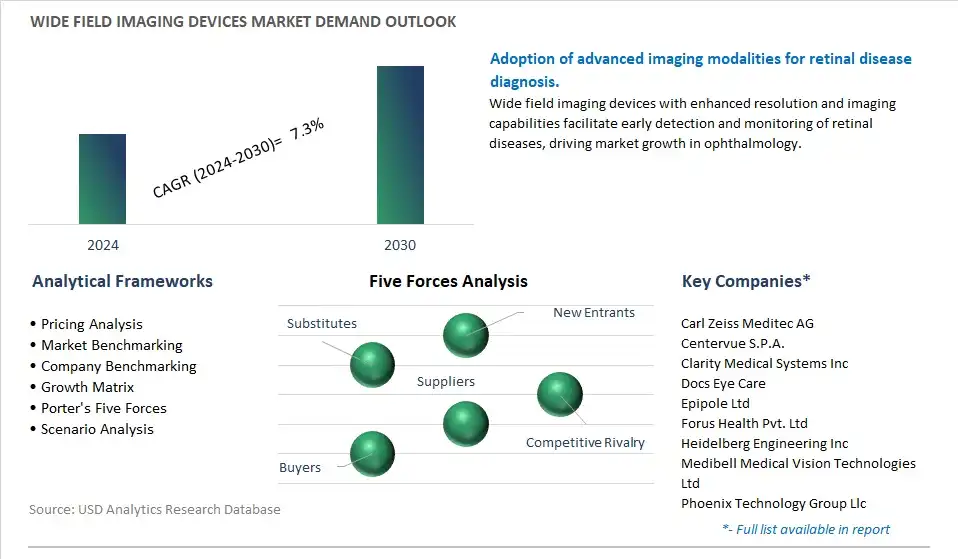
The global Wide Field Imaging Devices Market is one of the lucrative growth markets, poised to register a 7.3% growth (CAGR) between 2024 and 2030.
Emerging Markets across Asia Pacific, Europe, and Americas present robust growth prospects.
Carl Zeiss Meditec AG, Centervue S.P.A., Clarity Medical Systems Inc, Docs Eye Care, Epipole Ltd, Forus Health Pvt. Ltd, Heidelberg Engineering Inc, Medibell Medical Vision Technologies Ltd, Phoenix Technology Group Llc, Visunex Medical Systems Inc
Base Year- 2023; Estimated Year- 2024; Historic Period- 2018-2023; Forecast period- 2024 to 2030; Currency: USD; Volume