Women’s Cosmetics Market Outlook – Digital Acceleration and Premium Beauty Expansion
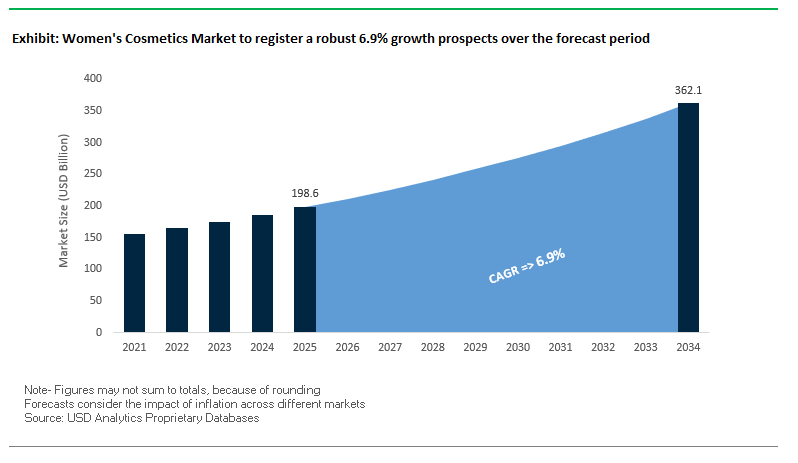
The global women’s cosmetics market is expected to grow from USD 198.6 billion in 2025 to USD 362.1 billion by 2034, reflecting a CAGR of 6.9%. Such a marketplace is driven by the intersection of digitalisation, premiumisation, and dermatology beauty trends, as it shifts to address emerging consumer needs and geographical areas of growth. E-commerce is increasingly a driver of international sales, supported by the rise of social commerce platforms such as TikTok Shop that are both discovery and conversion engines. Luxury fragrance, skincare, and multi-performance makeup products are seeing growing aspiration as consumers seek greater efficacy, exclusivity, and personalized results. Sustainability, ethical sourcing, and transparency, on the other hand, are table stakes in brand positioning at present, driving long-term loyalty and market valuation.
Key Insights for Industry Professionals
- E-commerce as a Core Channel – Nearly one-third of beauty sales now originate online, driven by rapid adoption of social commerce.
- Premium Beauty Surge – Growth is especially strong in serums, luxury skincare, and niche fragrances.
- Science-Backed Formulations – The rise of “dermatological beauty” is blurring the line between cosmetics and therapeutics.
- Emerging Market Opportunities – Latin America and the Middle East are outpacing mature markets in growth rates.
- Sustainability Mandates – Consumers expect cruelty-free, ethically sourced, and eco-friendly product solutions.
Women’s Cosmetics Market Analysis – Strategic Moves, Acquisitions, and Innovation Trends
Women's beauty cosmetics are seeing more merger activity, product innovation and technological synergies among world and regional players. In June 2025, L'Oréal announced a deal to buy UK skincare brand Medik8, the high-end brand famous for clinically tested formulas, bolstering its Luxe Division and continuing to strengthen its dermatological beauty portfolio. American Exchange Group expanded its presence with the buyout of Urban Skin Rx in 2025, a move to access a broader, more-diverse base of customers across both the retail and e-commerce platforms.
Corporate restructuring is also affecting competitive positioning. Shiseido, in August 2025, focused on structural reforms in Japan, China, and travel retail to optimize operations and increase profitability amid market headwinds. RENÉE Cosmetics, meanwhile, raised $30 million in funding in August 2025 to drive product innovation and reinforce digital distribution in rapidly expanding markets like India.
Brand partnerships and innovation programs are also fueling marketplace velocity. e.l.f. Beauty in July 2025 announced its final merger agreement to acquire prestige beauty firm rhode, reflecting intent to expand its premium portfolio and globally. Kylie Cosmetics in May 2025 introduced the "Hybrid Blush," responding to call for long-lasting, multi-texture products. Estée Lauder's partnership with Microsoft in August 2025 generated an AI Innovation Lab to enhance predictive demand planning and operational efficiency. Finally, Coty outlined its strategic growth pillars in February 2025, including omnichannel growth and product innovation based on AI, fortifying its fragrance and cosmetics leadership.
Transformative Trends and High-Value Opportunities in the Women’s Cosmetics Market
Menopause-Specific Cosmetic Science Redefining Targeted Skincare
Women's cosmetics market is undergoing a scientific revolution with the advent of menopause-specific cosmetic solutions. Ditching mass anti-aging products, brands are developing targeted solutions addressing hormonal changes during perimenopause and menopause. Clinical trials confirm that loss of estrogen reduces collagen and elastin, compromising skin hydration and elasticity. Proxylane and Cassia extract innovative products demonstrated measurable wrinkle decrease and moisture within 56 days. Thermoregulatory actives such as Niacinamide PC are gaining popularity to improve pigmentation equilibrium and elasticity, counteracting visible hormonal influence. AI-diagnostic skin apps are bridging the gap towards hyper-personalized product recommendations, advancing cosmetic to medical-grade skin care. Market giants such as DSM-Firmenich are launching menopause-targeted product ranges such as "Meringue Facial Cream" and "Time Freeze Eye Serum," showing healthy market prospects in the niche.
Sustainable Color Cosmetics with Bio-Pigments Upending Traditional Formulations
Sustainable color cosmetics are emerging as a competition differentiator, with bio-pigments being an eco-friendly, non-toxic replacement for synthetic dyes. Obtained from microbes like fungi, yeast, and microalgae, these pigments are not just biodegradable but contain high concentrations of skin-active ingredients, such as antioxidant and anti-inflammatory action. Pigments like β-carotene and Astaxanthin possess great color presentation and enhance skin health. Bio-pigments are particularly reacting to growing consumer demand for the eco-toxicity and environmental persistence of petrochemical dyes, while advances in strain improvement and fermentation technology are lowering costs of production and facilitating scale-up. Two-sided attraction of sustainability and effective skincare performance makes bio-pigments a strategic growth platform for brands that want to appeal to eco-conscious consumers in the women's cosmetics market.
AI-Powered Cosmetic Prescriptions for Precision Skincare
AI-facilitated cosmetic prescriptions are emerging as a game-changing prospect in the women's cosmetics industry. Solutions rely on algorithm-driven analysis of skin type, lifestyle, and environmental factors to recommend personalized regimens backed by clinical evidence. The approach enhances effectiveness and consumer compliance, delivering a medical-grade advantage to cosmetics. Regulatory validation, such as FDA approval of AI-facilitated medical devices, paves the way for brands to sell clinically tested cosmetic prescription software. Moreover, conversational AI chatbots are augmenting customer interactions by delivering real-time, highly relevant recommendations and answering complex questions, forging seamless consumer experience deepening brand loyalty.
AR Virtual Try-On Redefining Cosmetic Surgery Consultations
The use of AR for cosmetic consultations offers customers an interactive, pre-visualization experience for surgery and non-surgery treatments. With the potential to view realistic before-and-after simulations, AR reduces uncertainty, allows for accurate expectations, and enhances patient-surgeon communication. Software solutions like Crisalix's 3D simulation software give personalized visualizations that also act as surgical planning tools, enhancing safety and precision. For clinics, offering AR consultations can be an up-market offering and supplementary revenue stream, engaging patients seeking transparency and confidence in their aesthetic choices. This technology personalization aligns with consumer demands for knowledge-based choice and customized beauty solutions.
Women’s Cosmetics Market Share and Segmentation Insights
Dominance of Skincare and Makeup as Core Product Segments
Skincare leads the women's cosmetic market with the highest share at 38% in 2025, driven by advances in sun protection, anti-aging, and wellness-focused formulations. The growth of "skintellectual" consumers has created a surge in demand for evidence-driven products addressing targeted issues like pigmentation, barrier repair, and hydration. Makeup, with 32% market share, is enjoying a revival with hybrid products that blend cosmetic performance with skincare capabilities in line with the "skinification" trend. Social media channels further this demand, as consumers try out dramatic, customized styles. Haircare is the most rapidly growing product category, fueled by singled-out scalp-formula solutions, and fragrance is transforming into mood-based and multi-tasking formats. Personal hygiene is also seeing premiumization, especially in women's care, with green and dermatologically tested products gaining ground.
.png)
Mass Market Leadership and Accelerated Premium Segment Expansion
The mass market segment takes the lead with 45% share, powered by price affordability, extensive distribution networks, and aggressive online promotion campaigns. Companies here ride on fast product turnover, seasonal release, and influencer partnerships to stay in view. The premium segment with 40% share is growing more rapidly with the "affordable luxury" trend and customer demand for high-performance, sustainably produced products. Specialty cosmetics are carving a increasing space by providing dermatologist-recommended and clinically tested formulas. The intersection of premium and mass categories, or "masstige," is fusing traditional price and positioning divides. Sustainability, clean beauty declarations, and direct-to-consumer tactics are becoming table stakes across all categories.
Competitive Landscape – Key Players Shaping the Global Women’s Cosmetics Market
The women's cosmetics industry is controlled by multinational conglomerates with diversified portfolios, robust innovation pipelines, and omnichannel know-how. L'Oréal, The Estée Lauder Companies Inc., Shiseido Company, Limited, Procter & Gamble, Coty Inc., Unilever, Chanel, LVMH, Johnson & Johnson, Amorepacific Corporation, Revlon, Kao Corporation, Natura &Co, Kose Corporation, The Body Shop, Others are some of the major players.
L'Oréal S.A. – Enlarging Dermatological Beauty Leadership
L'Oréal's portfolio of diversified brands includes premium, mass, and professional segments. With Lancôme, Maybelline, and Kiehl's among its brands, the company extends its "Beauty Tech champion" positioning by augmenting the consumer experience with AI, AR, and virtual try-ons. Its acquisition of Medik8 targets a high-performance skincare growth strategy, while digital sales accounting for 29% of overall revenue in H1 2025 demonstrate healthy e-commerce traction.
The Estée Lauder Companies Inc. – Premiumization and AI-Driven Operations
Estée Lauder's La Mer, Clinique, and MAC portfolio addresses the prestige and luxury beauty business. Estée Lauder's AI-powered supply chain, created in collaboration with Microsoft, is automating forecasting and inventory, while targeted expansion to Amazon and TikTok Shop broadens global access. Through premium positioning focus, Estée Lauder is harmonizing mature market stability with growth expansion in emerging markets.
Shiseido Company, Limited – Strategic Reforms and Brand Strengthening
Shiseido's emphasis on its core brands Clé de Peau Beauté and NARS is fueling performance in core categories, such as fragrance. Structural reforms implemented in 2025 enhanced profitability amid sales headwinds. The company is betting on integrated customer experiences with in-store skin analysis technology fused with digital marketing efforts and a return to positive growth in China in Q2 2025.
Coty Inc. – Fragrance Leadership and Omnichannel Growth
Prestige fragrance portfolio, led by Hugo Boss and Burberry, represents more than 60% of revenue. Its "All In To Win" initiative is built on agility, productivity, and technology innovation, including AI-driven product development. Coty's robust social commerce approach has driven online brand advocacy, as debt reduction below 3x leverage increases its ability to make strategic investments in the future.
United States: Regulatory Modernization, Tech-Enhanced Shopping, and Clean Beauty Leadership
The U.S. women’s cosmetics market is evolving under the influence of the Modernization of Cosmetics Regulation Act of 2022 (MoCRA), which mandates facility registration, product listing with the FDA, and robust adverse event reporting. This regulatory shift is pushing brands toward greater transparency, safety compliance, and traceable formulations. The market is also a global leader in AI- and AR-powered beauty technology, with virtual try-on experiences and AI skin analysis tools now integrated into most major e-commerce platforms. These tools not only improve the consumer journey but also significantly boost conversion rates.
Biotechnology is reshaping product formulation, with brands leveraging lab-based fermentation and bioengineering to create potent, stable, and sustainable actives such as peptides that mimic keratin for hair care and polyphenols for anti-aging skincare. Sustainability remains a major growth driver, with strong consumer preference for eco-friendly packaging, refillable systems, and clean-label formulations free from parabens, sulfates, and other controversial ingredients. The rapid rise of Direct-to-Consumer (D2C) brands, often using omnichannel retail strategies, is fostering closer brand–consumer relationships, agile product launches, and personalized shopping experiences.
European Union: Regulation-Driven Innovation, Sustainable Packaging, and Ethical Testing
The EU maintains one of the world’s strictest cosmetic regulatory frameworks, with the Cosmetics Regulation banning over 1,300 chemicals and requiring comprehensive safety assessments. This standard has influenced a global move toward cleaner and safer formulations. Circular economy principles are shaping the industry’s approach to packaging brands are shifting to refillable containers and recyclable materials, including wood pulp–based bottles, to comply with plastic waste reduction mandates.
The EU’s anti-greenwashing measures are pushing companies to validate environmental claims using AI-powered analysis and blockchain-based ingredient tracking, ensuring transparency and accountability from sourcing to final product. With the region’s ban on animal testing, companies are advancing in silico safety assessments and computational toxicology methods, enabling ethical and faster product development without compromising regulatory compliance.
China: E-Commerce Dominance, AI-Powered Personalization, and Rapid Innovation Cycles
China’s women’s cosmetics market is heavily shaped by e-commerce, social media, and livestreaming sales, where Key Opinion Leaders (KOLs) and influencers drive high engagement and immediate purchasing decisions. Brands are integrating AI personalization tools such as smart mirrors, skin analysis apps, and chatbot-driven recommendations to deliver tailored skincare regimens and cosmetic suggestions at scale.
AI also plays a crucial role in accelerating product development, with real-time analysis of social media trends and consumer feedback guiding the creation of products that match the latest beauty preferences. This agility gives Chinese brands a competitive edge in trend responsiveness. Meanwhile, updated cosmetic safety and efficacy regulations are enforcing stricter registration, testing, and labeling standards, raising the quality threshold and building greater consumer trust in both domestic and international markets.
India: Premiumization, D2C Growth, and Ayurvedic–Modern Fusion
India’s women’s cosmetics sector is experiencing premiumization, driven by rising disposable incomes, increased exposure to global beauty trends, and consumer willingness to invest in luxury and specialty products. The D2C brand boom with players like Mamaearth and Sugar Cosmetics has brought tailored product lines that emphasize natural, organic, and cruelty-free formulations aligned with local preferences.
Social media and influencer marketing are strong purchase drivers, with beauty bloggers shaping product awareness and adoption through tutorials and reviews. The Cosmetics (Amendment) Rules, 2025 have introduced tighter controls on labeling, batch testing, and exports, aligning India’s safety and quality standards with international norms. A unique feature of the market is its fusion of traditional Ayurvedic botanicals such as turmeric, neem, and ashwagandha with modern cosmetic science, creating products that resonate with both heritage-conscious and efficacy-driven consumers.
Women’s Cosmetics Market Report Scope
Women’s Cosmetics Market
|
Parameter
|
Details
|
|
Market Size (2025)
|
$198.6 Billion
|
|
Market Size (2034)
|
$362.1 Billion
|
|
Market Growth Rate
|
6.9%
|
|
Segments
|
By Product (Skincare, Makeup, Haircare, Fragrance, Personal Hygiene), By Category (Mass, Premium, Professional), By Distribution Channel (Online Retail (E-commerce, Brand Websites), Offline Retail (Hypermarkets/Supermarkets, Department Stores, Specialty Stores)), By Ingredient (Natural, Synthetic, Organic, Bio-active), By End-Use (Mass Market, Professional), By Age Group (Gen Z, Millennials, Gen X, Baby Boomers)
|
|
Study Period
|
2019- 2024 and 2025-2034
|
|
Units
|
Revenue (USD)
|
|
Qualitative Analysis
|
Porter’s Five Forces, SWOT Profile, Market Share, Scenario Forecasts, Market Ecosystem, Company Ranking, Market Dynamics, Industry Benchmarking
|
|
Companies
|
L'Oréal, The Estée Lauder Companies Inc., Shiseido Company, Limited, Procter & Gamble, Coty Inc., Unilever, Chanel, LVMH, Johnson & Johnson, Amorepacific Corporation, Revlon, Kao Corporation, Natura &Co, Kose Corporation, The Body Shop, Others.
|
|
Countries
|
US, Canada, Mexico, Germany, France, Spain, Italy, UK, Russia, China, India, Japan, South Korea, Australia, South East Asia, Brazil, Argentina, Middle East, Africa
|
Women’s Cosmetics Market Segmentation
By Product
- Skincare
- Makeup
- Haircare
- Fragrance
- Personal Hygiene
By Category
- Mass
- Premium
- Professional
By Distribution Channel
- Online Retail
- E-commerce
- Brand Websites
- Offline Retail
- Hypermarkets/Supermarkets
- Department Stores
- Specialty Stores
By Ingredient
- Natural
- Synthetic
- Organic
- Bio-active
By Age Group
- Gen Z
- Millennials
- Gen X
- Baby Boomers
Countries Analyzed
- North America (US, Canada, Mexico)
- Europe (Germany, UK, France, Spain, Italy, Russia, Rest of Europe)
- Asia Pacific (China, India, Japan, South Korea, Australia, South East Asia, Rest of Asia)
- South America (Brazil, Argentina, Rest of South America)
- Middle East and Africa (Saudi Arabia, UAE, Rest of Middle East, South Africa, Egypt, Rest of Africa)
Top Companies in Women’s Cosmetics Market
- L'Oréal
- The Estée Lauder Companies Inc.
- Shiseido Company Limited
- Procter & Gamble
- Coty Inc.
- Unilever
- Chanel
- LVMH
- Johnson & Johnson
- Amorepacific Corporation
- Revlon
- Kao Corporation
- Natura &Co
- Kose Corporation
- The Body Shop
* List Not Exhaustive
Research Coverage
This report from USDAnalytics investigates the dynamic global women’s cosmetics market, delivering an in-depth examination of digital acceleration, premium beauty expansion, and science-backed product innovation. It reviews transformative industry trends, breakthrough formulations, regulatory shifts, and market disruptions shaping the future of women’s cosmetics. The analysis highlights strategic acquisitions, mergers, AI-powered personalization, sustainable packaging, and ingredient innovations redefining competitive positioning. Covering 25+ countries across North America, Europe, Asia Pacific, Latin America, the Middle East & Africa, this report is an essential resource for decision-makers seeking to identify growth opportunities, evaluate competitive strategies, and navigate evolving consumer preferences. It also presents segmentation by product, category, distribution channel, ingredient type, and age group, along with company profiles of 15+ leading global brands, offering actionable intelligence to industry professionals for investment, product development, and market expansion strategies. Scope includes-
- Segmentation:
- By Product: Skincare, Makeup, Haircare, Fragrance, Personal Hygiene
- By Category: Mass, Premium, Professional
- By Distribution Channel: Online Retail, Offline Retail
- By Ingredient: Natural, Synthetic, Organic, Bio-active
- By Age Group: Gen Z, Millennials, Gen X, Baby Boomers
- Geographic Scope: Analysis spans 25+ countries across North America, Europe, Asia Pacific, Latin America, the Middle East & Africa.
- Historic Data: 2021 to 2024
- Forecast Data: 2025 to 2034
- Company Coverage: Profiles and analysis of 15+ leading global companies.
Methodology
The research methodology for this report integrates primary and secondary data collection to ensure comprehensive and accurate market insights. Primary research involved interviews with C-level executives, product managers, R&D specialists, and regulatory experts from leading cosmetic companies. Secondary research included the review of trade publications, government databases, corporate annual reports, patent filings, sustainability disclosures, and cosmetic regulatory frameworks across major regions. Market estimates and forecasts were derived using a combination of top-down and bottom-up approaches, applying data triangulation for validation. Advanced analytics tools and AI-assisted data modeling were used to identify emerging trends, measure market attractiveness, and assess competitive intensity. The methodology ensures that the insights provided are fact-based, actionable, and relevant to strategic decision-making in the women’s cosmetics sector.
Deliverables:
- Comprehensive Market Research Report (PDF and Excel) with detailed tables, charts, and interactive visualizations.
- Country-Specific Forecasts & Analysis.
- Segment-Wise Revenue Forecasts (2025–2034).
- Competitive Analysis, Benchmarking, and SWOT Profiles.
- Recent Developments & Innovation Tracker.
- Executive Summary & Analyst Commentary.
- Post-Purchase Analyst Support for Client-Specific Questions and Custom Data Requirements.
