
Industrial desalination is entering a more complex economic phase. Recovering additional freshwater from saline wastewater can reduce the volume requiring disposal, but the remaining concentrate becomes progressively more saline and difficult to process. High-recovery reverse osmosis, osmotically assisted membrane systems and thermal crystallization can extend treatment beyond the operating limits of conventional desalination, although each additional separation stage changes energy consumption, chemical requirements and residual-handling costs.
This distinction is becoming more significant across chemical manufacturing, power generation, semiconductor production, oil and gas, mining and lithium processing. Industrial facilities generate brines with different dissolved-salt compositions, organic contaminants and scaling characteristics, meaning that the same treatment technology can produce very different commercial outcomes. A membrane configuration that reduces disposal expenditure for one wastewater stream may require uneconomic pretreatment or thermal energy for another.
Recent developments in high-recovery desalination demonstrate three separate sources of economic value: recovering additional usable water, reducing residual-liquid disposal and producing marketable materials from concentrated brine. The technologies may contribute to more than one outcome, but increased recovery does not automatically establish profitable resource recovery.
Why High-Recovery Desalination Changes the Economics of Brine Disposal
Conventional reverse osmosis separates a saline feed into treated water and a concentrated residual stream. As water recovery increases, the remaining dissolved salts become concentrated in a smaller liquid volume. This reduces the quantity requiring disposal or further treatment but increases osmotic pressure, mineral-scaling potential and the difficulty of maintaining stable membrane performance.
For industrial facilities with access to permitted liquid discharge or economical concentrate disposal, maximum water recovery may not produce the lowest overall treatment cost. The economics change where disposal requires deep-well injection, extensive evaporation ponds, off-site transport or thermal treatment. In these circumstances, additional membrane concentration can reduce the capacity required for downstream equipment and the volume of liquid handled through the disposal system.
Minimal liquid discharge (MLD) and zero liquid discharge (ZLD) therefore represent different commercial objectives. MLD reduces the residual liquid stream, while ZLD involves eliminating liquid discharge through further concentration, evaporation and solids separation. ZLD does not necessarily eliminate waste-handling expenditure because crystallization produces salts and other solids that must be recovered, processed, sold or disposed of.
A November 2024 analysis published in Nature Water evaluated 75 configurations across conventional treatment, membrane concentration, thermal processing and crystallization. The modeled recovery range extended from 32.6% to 98.6%, with substantial differences in cost and energy consumption. The analysis demonstrated that maximum water recovery, minimum operating expenditure and minimum energy consumption do not necessarily occur within the same treatment configuration.
The relationship between water recovery and concentrate volume can be illustrated through a simple liquid balance.
Figure 1. Higher Water Recovery Reduces Residual Brine Volume — Illustrative 100 m³ Feedwater Balance
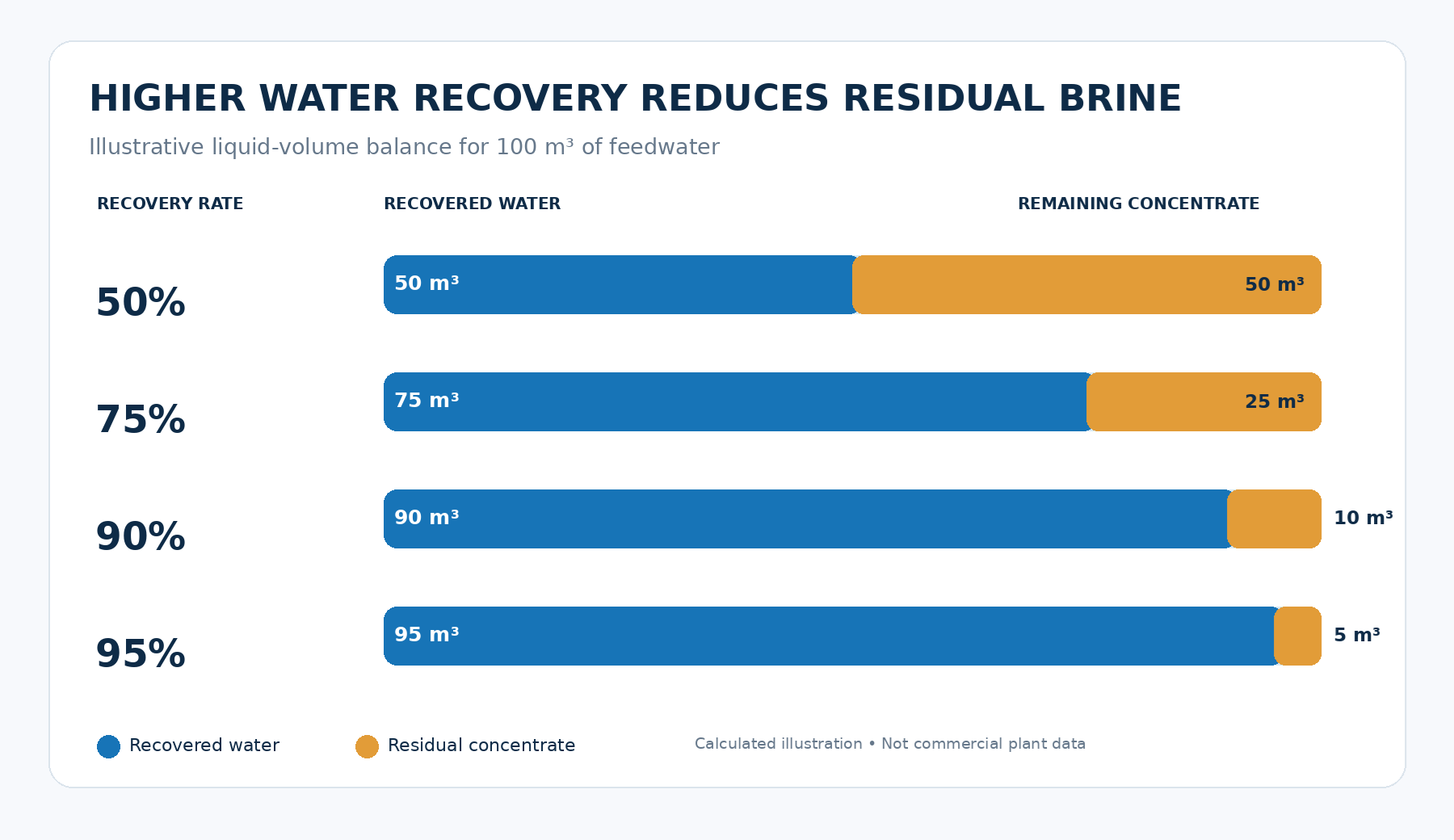
At 95% recovery, only five cubic metres of residual liquid remain from an initial 100 cubic metres of feed. However, the example does not indicate the concentration of dissolved salts, the electricity required to achieve that recovery or the feasibility of further solids separation. The residual stream also remains a liquid requiring management.
Membrane Brine Concentration Extends Water Recovery Before Thermal Treatment
High-recovery membrane systems are extending the concentration range in which water can be separated without relying entirely on evaporation. Conventional RO becomes increasingly constrained as concentrate salinity raises osmotic pressure and scaling risks. Osmotically assisted reverse osmosis (OARO), ultra-high-pressure RO and staged nanofiltration–RO architectures address these limitations through different operating principles.
OARO uses an intermediate solution to modify the osmotic-pressure difference across a membrane, permitting additional concentration of streams that are difficult to process using conventional RO alone. Ultra-high-pressure membrane systems instead operate at elevated hydraulic pressures, sometimes combining membranes with different salt-rejection characteristics to distribute concentration duty across successive stages.
Within integrated membrane-based desalination systems, reducing the liquid volume entering an evaporator can change downstream thermal-equipment requirements. A smaller downstream brine flow may reduce evaporator capacity and the volume processed through crystallization, although the benefit depends on the additional electricity, membrane area, cleaning and pretreatment required by the concentration stage.
In May 2026, Aquatech acquired FTS H2O, combining commercial OARO, forward osmosis and membrane brine-crystallization technologies within a broader industrial water-treatment portfolio. The Aquatech–FTS H2O acquisition brought together the RecovOAR and ConcentratOAR platforms with integrated MLD, ZLD and resource-recovery capabilities. FTS reported commercial OARO applications in power generation, chemicals, produced water, semiconductors and lithium processing, including concentration of selected brines to approximately 250 g/L and beyond.
The acquisition illustrates the growing commercial connection between membrane-process suppliers and full-flowsheet treatment providers. High-salinity membrane technology is increasingly evaluated as part of integrated hybrid desalination processes, where pretreatment, membrane concentration, evaporation and crystallization perform different separation duties.
Similar development is occurring in ultra-high-pressure membrane treatment. In February 2026, Saltworks Technologies completed a field trial of its FusionRO system on Permian Basin produced water in Texas. The trial validated operation at 1,800 psi using a two-loop RO/NF configuration. The company had previously supplied systems for lithium refining and industrial water reuse, providing commercial deployment references beyond laboratory testing.
The importance of this approach lies in its operating configuration. Membrane stages with different selectivity and pressure characteristics can concentrate difficult streams while changing equipment count, hydraulic complexity and the load transferred to downstream thermal treatment. Long-duration operating value remains dependent on membrane integrity, feedwater pretreatment, scaling control and the maintenance requirements of high-pressure equipment.
Table 1. High-Recovery Desalination Technologies and Their Commercial Roles
|
Separation process |
Primary function |
Source of commercial value |
Principal economic constraint |
|
Conventional RO |
Produce treated water while rejecting dissolved salts |
Established water recovery and equipment availability |
Osmotic pressure, scaling and recovery limits |
|
OARO |
Extend membrane concentration using osmotic assistance |
Lower residual brine volume and potentially reduced thermal duty |
Process staging, membrane area and feed chemistry |
|
Ultra-high-pressure RO/NF |
Concentrate saline streams through high-pressure membrane separation |
Additional recovered water and reduced downstream liquid flow |
Pumping energy, mechanical pressure limits and membrane life |
|
Forward osmosis |
Transfer water into a concentrated draw solution |
Difficult-feed concentration and lower hydraulic pressure |
Draw regeneration, reverse solute flux and fouling |
|
Hybrid-batch RO |
Increase recovery through controlled hydraulic cycling |
Reduced concentrate generation and potential chemical savings |
Scaling, operating-cycle performance and feed variability |
|
Membrane–thermal treatment |
Combine membrane concentration with evaporation or distillation |
Extended recovery and reduced liquid discharge |
Electrical and thermal energy demand |
|
Crystallization |
Recover water while separating dissolved salts into solids |
ZLD operation and possible saleable material production |
Solids purity, crystallizer cost and byproduct handling |
Forward Osmosis Economics Depend on Draw-Solution Regeneration
Forward osmosis differs from pressure-driven reverse osmosis because water transport is generated primarily through the osmotic-pressure difference between a feed solution and a more concentrated draw solution. This characteristic can support the concentration of high-fouling wastewater, difficult industrial liquids and streams containing heat-sensitive constituents.
The FO membrane separates water from the feed, but the extracted water initially enters the draw solution. Unless the diluted draw solution can be used directly, a second process must recover the water and regenerate the draw solute. Thermal separation, reverse osmosis, membrane distillation and other regeneration technologies may perform this function, depending on draw chemistry and process requirements.
This makes the economics of forward-osmosis membrane separation fundamentally different from a comparison of membrane operating pressure alone. Low hydraulic-pressure requirements do not establish low total energy consumption if draw regeneration requires substantial electricity or heat.
Draw-solution chemistry also influences reverse solute flux, concentration polarization, fouling and the amount of draw material that must be replenished. Industrial wastewater containing oils, organics or dissolved minerals may create different cleaning and separation requirements from a relatively clean brackish-water feed.
An experimental and technoeconomic study published in ACS Omega in September 2026 evaluated sodium chloride, magnesium sulfate and sodium acetate draw solutions using municipal wastewater. The modeled levelized water cost differed substantially among the draw solutions under the study's assumptions, while the chemistry offering stronger organic-contaminant rejection did not deliver the lowest modeled cost. This illustrates how membrane selectivity, draw-solute price, regeneration energy and fouling performance can pull process economics in different directions.
FO–membrane distillation configurations can use thermal separation to regenerate the draw solution, while other integrated arrangements may use reverse osmosis or thermally responsive solutes. The commercial value of the FO stage is therefore linked to the quality and concentration of the feed, the availability of suitable regeneration energy and the resulting water or process-product requirements.
The membrane alone does not determine the economics of an FO installation. The complete draw-solution loop determines how much usable water is recovered and the cost of achieving that recovery.
From Brine Concentration to Industrial Salt and Mineral Recovery
Reducing brine volume can lower disposal exposure without producing any saleable material. Resource recovery introduces a separate commercial requirement: dissolved constituents must be separated into products with acceptable purity, processing cost and market demand.
Sodium chloride, magnesium compounds, lithium-bearing materials, acids, alkalis and other dissolved constituents may have industrial value, but their recovery depends on concentration, interfering ions and downstream separation chemistry. Crystallization can generate mixed salts that require further purification, while selective recovery of individual compounds may need precipitation, ion exchange, electrodialysis or additional membrane treatment.
A major proposed project illustrates the emerging connection between water supply and industrial salt production. In August 2026, Acwa signed a joint-development agreement with Indonesia's PT GARAM for an approximately USD 400 million integrated desalination and industrial-salt facility at Manyar, Gresik, East Java. The Acwa–PT GARAM development agreement outlines planned production of approximately 62,500 m³/day of desalinated water and 500,000 tonnes/year of high-purity industrial salt.
The project introduces a potential dual-output commercial structure, with desalinated water and industrial salt serving different customers and revenue channels. Its economics depend on energy consumption, crystallization technology, salt purity, industrial offtake and the capital requirements of integrating two production lines. As of October 2026, the announcement represents a development agreement rather than verified commercial operation.
The distinction between technically recoverable materials and commercially valuable products is particularly significant for inland brackish-water treatment. A brine may contain large quantities of salts, but low commodity prices, transportation distances and additional purification requirements can limit the revenue available from recovery.
In June 2026, the National Alliance for Water Innovation published a technoeconomic assessment of brine valorization from brackish groundwater desalination. Researchers paired groundwater chemistry with regional markets for road salts, fertilizers, construction materials, hydrochloric acid and sodium hydroxide, using treatment-process models to assess recovery costs.
The preliminary findings showed that byproduct recovery was not the lowest-cost configuration in most modeled scenarios because separation expenditure could exceed the market value of the recovered material. More favorable results emerged for selected highly saline feeds and specific product combinations. This establishes a crucial boundary in resource-recovery economics: reducing waste-disposal expenditure and generating profitable byproduct revenue require different economic conditions.
Commercial Milestones in High-Recovery Desalination: From Membrane Field Trials to Integrated Recovery Projects
Recent developments show that high-recovery technology is commercializing through multiple routes rather than a single dominant process architecture. Membrane suppliers are extending the concentration range of industrial treatment systems, while integrated water companies are combining different separation stages and evaluating secondary products derived from brine.
Commercial maturity varies considerably across high-recovery desalination technologies. Existing industrial deployments establish equipment operating references, while field trials provide feed-specific performance evidence and pilot installations support process validation under controlled conditions. These stages carry different implications for equipment procurement, operating-cost estimates, and the reliability of projected water-recovery benefits.
SUEZ and Salinity Solutions' 2026 HyBatch pilot provides evidence of high water recovery under defined municipal wastewater conditions. Its commercial significance lies in the relationship between concentrate reduction, hydraulic operation, membrane cleaning, and the additional costs of achieving higher recovery, rather than the reported recovery percentage alone.
ACCIONA's LIFE INDESAL demonstration introduces a different economic relationship by connecting desalination-brine treatment with energy recovery and on-site chemical production. The potential commercial value depends on the balance between recovered utilities, additional process-equipment costs, operating reliability, and the quality of the recovered outputs. The demonstrated results remain specific to the pilot configuration.
Table 2. Verified High-Recovery Desalination and Resource-Recovery Developments, 2025–2026
|
Development |
Technology or verified quantitative evidence |
Commercialization stage |
Economic significance |
|
Aquatech–FTS H2O, May 2026 |
OARO, FO and membrane brine crystallization |
Completed acquisition; existing commercial OARO installations |
Integrated membrane concentration and MLD/ZLD supply |
|
Saltworks FusionRO, 2025–2026 |
Two-loop UHP RO/NF system validated at 1,800 psi |
Industrial deployments and field trial |
Concentration of difficult brines before thermal treatment |
|
SUEZ–Salinity Solutions, April 2026 |
100 m³/day hybrid-batch RO; reported 90–95% recovery |
Municipal wastewater pilot |
Reduced residual volume under tested conditions |
|
ACCIONA LIFE INDESAL, February 2026 |
0.1 kWh/m³ brine energy recovery and on-site cleaning chemicals |
Completed demonstration |
Integration of brine, chemical and energy recovery |
|
Acwa–PT GARAM, August 2026 |
Proposed 62,500 m³/day water and 500,000 tonnes/year salt |
Joint-development agreement |
Potential water-and-industrial-salt revenue streams |
|
NAWI, June 2026 |
Modeling of brine chemistry, recovery configurations and regional byproduct demand |
Technoeconomic research |
Feed-specific limits to profitable mineral recovery |
These developments demonstrate that the commercial maturity of high-recovery technology varies significantly. Industrial membrane installations provide evidence of equipment deployment, municipal pilots establish process performance under specific feed conditions, and resource-recovery development agreements describe proposed future production rather than operating revenue.
Where High-Recovery Membrane and Thermal Systems Create Different Commercial Value
The economics of high-recovery desalination depend on where additional separation changes the cost structure of the overall treatment train. For a facility with expensive concentrate disposal, reducing residual volume may create value even without recovering any saleable minerals. For a site with access to low-cost waste heat, membrane–thermal integration may offer a different operating balance from an electrically driven high-pressure membrane system.
Conversely, where energy is expensive and brine disposal is relatively straightforward, additional concentration stages can increase the levelized cost of recovered water. As salinity rises, osmotic pressure, scaling and crystallization requirements become more demanding, while recovering the final fraction of water may require disproportionate separation effort.
Figure 2. From RO Concentrate to High-Recovery Membrane Treatment and Resource Recovery
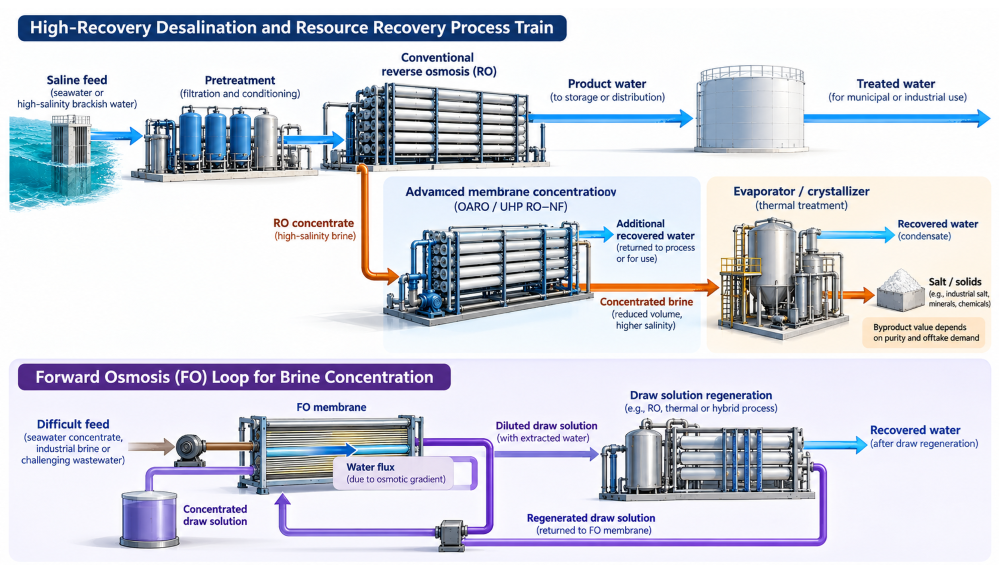
The distinction is particularly relevant to brackish-water desalination systems, where inland disposal permits, concentrate chemistry and local demand for recovered commodities can determine whether additional separation has commercial value. Similar considerations apply to mining, chemical manufacturing and lithium-processing facilities, although their feed compositions and product specifications differ substantially.
A high-recovery membrane system may primarily provide additional water production. A membrane–evaporator configuration may provide lower disposal volume. An integrated crystallization facility may produce solid salts, but those salts become a commercial product only when composition, purity, handling and offtake conditions support sale.
The evidence from recent field trials, commercial installations and technoeconomic research shows that higher water recovery is a process-performance outcome, lower brine-disposal expenditure is an operating-cost outcome, and resource valorization is a separate product-economics outcome. Their relationship depends on the full separation train, feedwater chemistry, energy supply, residual-handling requirements and the markets available for recovered materials.