Hybrid Desalination Systems Market Outlook and Strategic Imperatives
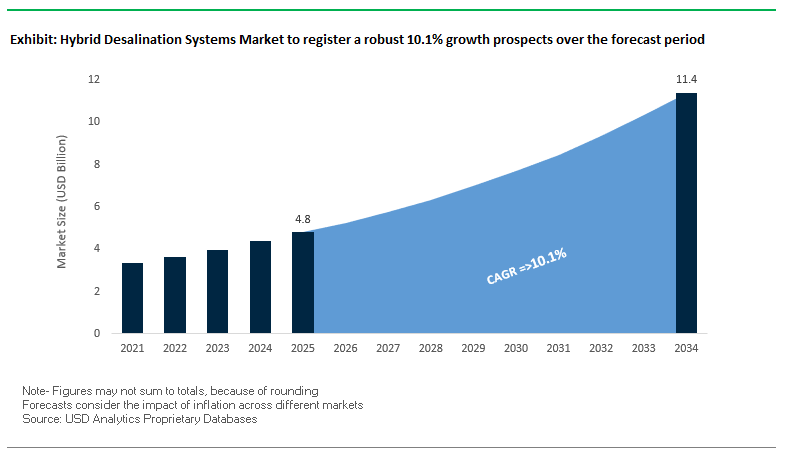
The Hybrid Desalination Systems Market is projected to grow from USD 4.8 billion in 2025 to USD 11.4 billion by 2034, expanding at a robust CAGR of 10.1%. The strong growth trajectory reflects the technology’s unique ability to address complex water treatment challenges by combining reverse osmosis (RO) and thermal desalination processes into a single, flexible platform. Hybrid configurations enable operators to manage diverse feedwater qualities, optimize energy consumption, and ensure operational resilience even under fluctuating environmental and market conditions.
The technology’s appeal is underscored by landmark projects such as the Ras Al-Khair plant in Saudi Arabia, the largest desalination facility in the world, which operates as an RO–MSF hybrid to deliver massive capacity while maintaining water quality consistency. Its adoption is gaining pace in the Middle East, Asia-Pacific, and coastal North America, particularly in regions with varying salinity levels and energy availability.
Hybrid desalination is also emerging as a sustainability enabler, integrating renewable energy sources such as solar and wind, reusing waste heat from power plants, and deploying innovations to reduce brine discharge and chemical usage. The environmental advantage is shaping policy support and investment appetite, positioning hybrid systems as a pivotal technology in the global shift toward low-carbon water infrastructure.
Strategic Imperatives for Shareholders:
Prioritize markets with abundant waste heat sources to leverage hybrid cost efficiencies.
Invest in renewable-hybrid integration for regulatory compliance and ESG positioning.
Expand R&D into low-chemical, low-brine configurations to enhance environmental credentials.
Pursue public-private partnerships (PPPs) in water-scarce economies to secure long-term contracts.
Adopt advanced monitoring and digital optimization tools to maximize plant efficiency and asset lifespan.
The hybrid desalination sector in 2025 is experiencing rapid diversification in technology integration and application areas, with major industry moves underscoring the convergence of energy efficiency, sustainability, and large-scale deployment.
In November 2023, Veolia set a sustainability benchmark by inaugurating the largest solar power plant on a desalination facility in the Middle East, highlighting the accelerating trend of coupling desalination with renewable energy. While not a hybrid plant, the initiative showcases the potential for low-carbon energy integration.
In September 2025, Veolia secured a multi-million-dollar contract with Petrobras for seawater desalination aboard two FPSOs in Brazil, demonstrating the demand for compact, high-reliability water treatment in offshore energy environments where waste heat utilization is a key advantage. Just months earlier, in April 2025, SUEZ broke ground on the Philippines’ largest seawater RO desalination facility in Metro Iloilo, with a daily capacity of 66,500 m³. The inclusion of SeaDAF™ pre-treatment technology indicates a growing emphasis on pre-filtration efficiency.
March 2025 marked DuPont’s launch of its Multibore™ PRO ultrafiltration membranes, designed to optimize desalination pretreatment with fewer modules and a smaller footprint, directly improving hybrid system cost-effectiveness. Meanwhile, IDE Technologies continued its leadership in sustainable mega-scale projects with the Sorek 2 plant in Israel, integrating advanced energy recovery devices.
Other notable moves include Veolia’s June 2025 Drop® technology for PFAS destruction and SUEZ’s October 2024 Danish wastewater upgrade using ozonation and GAC filtration, mirroring hybrid-style technology stacking to meet emerging micropollutant regulations. Furthermore, IDE’s collaboration with Fort Lauderdale for a large-scale municipal water plant highlights the adaptability of hybrid principles to urban resilience planning.
Trends and Opportunities in Hybrid Desalination Systems Market
Trend 1: Hybrid RO-MED Systems Gain Popularity for High-Efficiency Desalination
The desalination industry is increasingly adopting hybrid systems combining reverse osmosis (RO) with membrane distillation (MED), offering a robust solution to varying feedwater conditions. By leveraging the strengths of both technologies, hybrid RO-MED systems enhance total water recovery, achieving up to 15% higher output compared to standalone MED units. The synergy allows RO units to pre-treat feedwater, reducing the thermal load on MED, while the MED unit effectively handles high-salinity brine, optimizing overall efficiency. Energy costs are reduced as the thermal MED unit can utilize waste heat, while RO consumes comparatively lower electricity. Additionally, hybrid systems produce superior water quality, with lower total dissolved solids (TDS), making them suitable for potable, industrial, and agricultural applications where water quality is critical.
Trend 2: Waste Heat Utilization in Hybrid Desalination for Industrial Applications
Industrial facilities, including power plants and manufacturing units, are increasingly utilizing hybrid desalination systems to convert waste heat into clean water, boosting overall process efficiency. Low-grade industrial waste heat, often below 100°C, is ideal for thermal desalination technologies such as MED and membrane distillation (MD). Integration of hybrid desalination with power plants has demonstrated improvements in overall plant efficiency by up to 22.3%. Co-generation strategies further allow simultaneous production of electricity and potable water, as exemplified by combined internal combustion and inverse Brayton cycle systems, where waste heat powers RO units, yielding both hydrogen and freshwater. The trend aligns with industrial sustainability objectives, reducing operational costs while enhancing resource utilization.
Opportunity 1: Hybrid Systems for Zero-Liquid Discharge (ZLD) in Mining & Textiles
Water-intensive industries like mining and textiles face increasing regulatory pressure to minimize environmental impact, driving adoption of Zero-Liquid Discharge (ZLD) solutions. Hybrid desalination systems, combining RO, electrodialysis, and thermal crystallizers, enable water recovery exceeding 90%, significantly reducing freshwater dependency. The concentrated brine becomes a valuable resource for extracting minerals such as sodium chloride and sodium sulfate, generating additional revenue streams. Implementation of hybrid ZLD systems ensures compliance with stringent environmental regulations, particularly in Asia and North America, while reducing off-site wastewater disposal and lowering the environmental footprint of industrial effluent.
Opportunity 2: AI-Optimized Hybrid Systems for Dynamic Feedwater Conditions
The integration of AI and machine learning into hybrid desalination systems is creating opportunities for real-time optimization, especially under fluctuating feedwater conditions. AI algorithms analyze sensor data to adjust operational parameters instantly, optimizing performance for variable salinity and temperature levels, such as in estuarine sources. Energy consumption can be reduced by up to 50% through AI-driven fine-tuning of RO pressures and MED thermal loads. Moreover, AI predicts and mitigates membrane fouling, recommends optimal cleaning schedules, and ensures consistent water quality. Advanced platforms, including artificial neural networks and genetic algorithms, provide expert-level operational decisions, balancing water quality, energy efficiency, and system stability for large-scale industrial and municipal applications.
Hybrid Desalination Systems Market Share Insights
Integrated Process Hybrids Secure 65% Market Share as Performance Leaders
Integrated process hybrids, combining technologies such as MED-RO, NF-RO, or FO-RO, dominate the market with around 65% share by 2025. Their advantage lies in balancing efficiency, recovery rates, and energy savings, making them the preferred choice for both municipal and industrial deployments. By leveraging complementary processes, these systems deliver superior water quality with reduced scaling risks. In contrast, energy hybridization models, accounting for 35%, are emerging as sustainability enablers, particularly with renewable-powered RO systems reducing carbon intensity and operating costs.
Brine Management Hybrids Drive the Shift Toward Zero Liquid Discharge
Brine management hybrids represent 30% of the global market, reflecting rising demand for circular economy solutions that minimize brine volume and enhance freshwater recovery. These systems often integrate RO with electrodialysis or mechanical vapor compression (MVC) to push toward Zero Liquid Discharge (ZLD) or enable resource recovery from concentrated brine streams. Load-following systems are also gaining traction, allowing operators to synchronize operations with renewable energy availability or grid price signals, which is a key differentiator in energy-intensive desalination.
Potable Grade Water Accounts for Half of Hybrid System Output
Potable-grade water (<500 ppm TDS) constitutes nearly 49.6% of hybrid desalination system output, underlining the sector’s central role in municipal water supply. Achieving the standard often requires multi-stage RO combined with advanced post-treatment polishing to meet stringent drinking water norms. Industrial-grade water (500–1,000 ppm), with 31.8% share, has become the workhorse segment, serving cooling towers, boiler feedwater, and other non-potable industrial uses where cost efficiency is prioritized over ultra-purity. Meanwhile, process-specific water and agricultural-grade output (5%) remain niche but strategic applications, tailored for high-value industries or water-scarce agriculture.
AI-Driven Optimization Emerging as Next-Gen Control Strategy
Algorithm-based optimization currently accounts for 41.6% of control strategies, setting the standard for operational efficiency through model-driven process adjustments. However, AI-powered real-time control, at 28.7%, is the fastest-growing segment, enabling plants to adapt dynamically to feedwater fluctuations, equipment performance decay, and renewable energy variability. Digital twin technology further enhances system management, providing simulation capabilities for predictive maintenance and operator training. Legacy manual switching systems are rapidly being phased out as automation and machine learning redefine hybrid desalination operations.
Industrial Sector Leads with 46.2% Share as Key Innovation Driver
Industries represent the largest end-user segment, capturing 46.2% of the global market, driven by the need for cost-optimized, process-specific water and compliance with ZLD mandates. Hybrid configurations offer the flexibility to achieve high recovery rates while minimizing operational expenditure in sectors like power generation, chemicals, and mining. Municipal adoption follows with 35%, where large-scale integrated hybrids (e.g., RO-MED) ensure cost-efficient, resilient water supply for growing urban populations. Meanwhile, ZLD-focused facilities and agricultural applications highlight specialized and emerging niches, shaped by environmental regulations and agribusiness demand in arid regions.
Country Analysis of the Hybrid Desalination Systems Market
Saudi Arabia: Leading in Large-Scale Hybrid Desalination and Power Integration
Saudi Arabia is a dominant force in the hybrid desalination systems market, driven by national water security and sustainability goals under Vision 2030. The Ras Al-Khair plant exemplifies the Kingdom’s leadership, combining Multi-Stage Flash (MSF) and Reverse Osmosis (RO) technologies with a 2,400 MW power generation component, making it one of the world’s largest hybrid water and power facilities. The Saline Water Conversion Corporation (SWCC) is actively advancing energy-efficient hybrid desalination solutions to meet increasing municipal and industrial water demand. These initiatives highlight Saudi Arabia’s strategic approach to sustainable and high-capacity water supply solutions.
United Arab Emirates: Pioneering Renewable Energy-Integrated Hybrid Desalination
The UAE has emerged as a global leader in renewable-energy-integrated hybrid desalination systems, emphasizing both water sustainability and carbon footprint reduction. Projects such as the Taweelah power and water complex are designed to increase RO desalination capacity while minimizing reliance on traditional thermal methods and fossil fuels. The UAE is also a hub for research and development in solar-powered hybrid desalination, enabling the country to enhance operational efficiency, improve water security, and set benchmarks for energy-efficient water infrastructure.
Israel: Advanced Hybrid Desalination and Membrane Technology Innovation
Israel has positioned itself as a global pioneer in hybrid desalination systems, integrating sophisticated RO systems into its national water grid. Facilities like the Sorek plant demonstrate large-scale efficiency, optimized energy consumption, and innovative membrane technologies. Israel’s expertise extends beyond domestic water security, with the country exporting hybrid desalination knowledge and technology to water-stressed regions worldwide, reflecting its leadership in high-performance, energy-efficient desalination solutions.
Spain: Transitioning to Energy-Efficient Hybrid Desalination for Agriculture
Spain, Europe’s largest desalination market, is actively modernizing its water infrastructure by upgrading legacy thermal plants with reverse osmosis technology to improve energy efficiency. Significant public and private investments support hybrid desalination projects, particularly for the agricultural sector, enhancing drought resilience. European Union policies on sustainable water management further encourage Spain’s adoption of renewable-integrated hybrid desalination systems, positioning it as a leader in energy-efficient water solutions across Europe.
United States: Expanding Hybrid Desalination in Water-Scarce Regions
The U.S. is witnessing growing adoption of hybrid desalination systems in arid states such as California, Arizona, and Texas. Projects like the Claude “Bud” Lewis Carlsbad plant showcase the feasibility of large-scale seawater desalination integrated with advanced treatment processes. Government initiatives and private-sector investments are also driving the development of modular and containerized hybrid systems, allowing rapid deployment in regions facing water scarcity and groundwater depletion, thereby enhancing resilient and sustainable water infrastructure.
Morocco: Scaling Renewable Hybrid Desalination to Address Drought
Morocco is prioritizing hybrid desalination systems as a core part of its national water strategy in response to severe drought conditions. Large-scale projects, including one near Rabat, aim to supply drinking water to millions of people. The country’s integration of solar-powered hybrid desalination solutions demonstrates a commitment to reducing operational energy consumption, ensuring sustainable and resilient water supply. Morocco’s approach positions it as a leading hybrid desalination market in Africa, combining renewable energy with advanced RO technologies for long-term water security.
The hybrid desalination systems market is led by a group of global technology providers combining membrane and thermal expertise to deliver high-performance, scalable solutions. Competition is defined by mega-project execution capability, energy optimization know-how, and the ability to tailor designs for diverse feedwater sources.
IDE Technologies – A Global Benchmark in Mega-Scale Hybrid Projects
IDE Technologies stands at the forefront of large-scale, high-performance desalination with expertise spanning reverse osmosis (RO), nanofiltration (NF), and thermal processes such as multi-effect distillation (MED) and mechanical vapor compression (MVC). Its portfolio includes RO–MSF hybrid plants like Sorek I & II and Carlsbad, which deliver exceptional operational flexibility. With over 60 years of global project experience, IDE is trusted for its energy efficiency, reliability, and scale execution in both municipal and industrial applications.
Veolia Environnement S.A. – Ecological Transformation in Desalination
Veolia applies a full-lifecycle, ecological transformation approach to water resources, integrating membrane and thermal distillation technologies into hybrid configurations. Projects like the Fujairah plant in the UAE, producing 590,000 m³/day via combined processes, highlight its execution capacity. Its GreenUp strategic plan targets a doubling of operated desalination capacity by 2030, focusing on Middle East and Pacific Asia growth. Veolia also leverages Hubgrade digital optimization to maximize operational efficiency in hybrid systems.
SUEZ S.A. – Circular Solutions and Hybrid Technology Expertise
SUEZ delivers circular water management through a balanced mix of membrane filtration, biological treatment, and advanced oxidation. Its hybrid desalination capabilities are applied in both municipal and industrial contexts, with landmark contracts like the Philippines’ Metro Iloilo SWRO plant showcasing its ability to integrate pre-treatment and recovery technologies. SUEZ’s AQUADVANCED® digital platform enhances operational oversight, while strategic partnerships address regulatory drivers such as micropollutant control.
DuPont Water Solutions – Material Science Leadership in Membrane Innovation
DuPont dominates the membrane technology segment with FilmTec™ RO and NF membranes as well as Multibore™ PRO ultrafiltration for hybrid pretreatment. Its focus on anti-fouling, long-life, and high-contaminant removal membranes strengthens hybrid plant reliability. Recognized with the 2025 BIG Innovation Award, DuPont continues to push the boundaries of energy-efficient, sustainable purification materials that directly impact hybrid system performance.
Fisia Italimpianti – Thermal Desalination Specialist in Hybrid Configurations
Fisia Italimpianti’s strength lies in multi-stage flash (MSF) and multi-effect distillation (MED), often integrated with RO to deliver high-efficiency hybrid plants in Middle East and North African markets. The company excels in projects where low-cost energy or waste heat is available, enabling competitive water production costs. With deep engineering expertise and a proven track record in complex, multi-technology projects, Fisia remains a key enabler of large-scale hybrid deployments.
Hybrid Desalination Systems Market Report Scope
Hybrid Desalination Systems Market
Parameter
Details
Market Size (2025)
$4.8 Billion
Market Size (2034)
$11.4 Billion
Market Growth Rate
10.1%
Segments
By System Architecture (Integrated Process Hybrids, Energy Hybridization), By Operational Flexibility (Load-Following Systems, Brine Management Hybrids, Seasonal Configuration Systems), By Water Quality Output (Potable Grade (<500 ppm TDS), Industrial Grade (500-1,000 ppm TDS), Agricultural Grade (1,000-2,000 ppm TDS), Process-Specific Quality), By Control Strategy (Manual Switching Systems, Algorithm-Based Optimization, AI-Powered Real-Time Adjustment, Digital Twin Managed), By End-User (Municipal, Industrial, Zero Liquid Discharge, Agricultural)
Study Period
2019- 2024 and 2025-2034
Units
Revenue (USD)
Qualitative Analysis
Porter’s Five Forces, SWOT Profile, Market Share, Scenario Forecasts, Market Ecosystem, Company Ranking, Market Dynamics, Industry Benchmarking
Companies
Veolia, Aquatech International LLC, IDE Technologies, Thermax Limited, Doosan Enerbility, SUEZ, Fanniroo Group, Abengoa S.A., ACCIONA
Countries
US, Canada, Mexico, Germany, France, Spain, Italy, UK, Russia, China, India, Japan, South Korea, Australia, South East Asia, Brazil, Argentina, Middle East, Africa
Hybrid Desalination Systems Market Segmentation
By System Architecture
Integrated Process Hybrids
Thermal-Membrane Cascades
Membrane-Membrane Stacks
Energy Recovery Hybrids
Energy Hybridization
Fossil-Renewable Combos
Waste Heat Integration
Grid-Renewable Microgrids
By Operational Flexibility
Load-Following Systems
Brine Management Hybrids
Seasonal Configuration Systems
By Water Quality Output
Potable Grade (<500 ppm TDS)
Industrial Grade (500-1,000 ppm TDS)
Agricultural Grade (1,000-2,000 ppm TDS)
Process-Specific Quality
By Control Strategy
Manual Switching Systems
Algorithm-Based Optimization
AI-Powered Real-Time Adjustment
Digital Twin Managed
By End-User
Municipal
Industrial
Power Generation
Oil & Gas
Semiconductors & Pharmaceuticals
Zero Liquid Discharge
Agricultural
Countries Analyzed
North America (US, Canada, Mexico)
Europe (Germany, UK, France, Spain, Italy, Russia, Rest of Europe)
Asia Pacific (China, India, Japan, South Korea, Australia, South East Asia, Rest of Asia)
South America (Brazil, Argentina, Rest of South America)
Middle East and Africa (Saudi Arabia, UAE, Rest of Middle East, South Africa, Egypt, Rest of Africa)
Top Companies in Hybrid Desalination Systems Market
Veolia
Aquatech International LLC
IDE Technologies
Thermax Limited
Doosan Enerbility
SUEZ
Fanniroo Group
Abengoa S.A.
ACCIONA
* List Not Exhaustive
Research Coverage
This report investigates the Global Hybrid Desalination Systems Market, delivering in-depth analysis reviews of technology adoption, regulatory dynamics, and investment strategies that are shaping the industry’s evolution through 2034. Published by USDAnalytics, the study highlights breakthroughs in hybrid RO–thermal configurations, waste-heat utilization, and renewable-powered systems that are redefining operational efficiency and sustainability benchmarks. It also highlights case studies such as the Ras Al-Khair mega-plant in Saudi Arabia and AI-optimized hybrid deployments in estuarine regions, showcasing how hybrid desalination offers resilience under diverse feedwater and energy conditions. By profiling leading players and regional initiatives, and by exploring opportunities across municipal, industrial, and zero-liquid-discharge applications, this report is an essential resource for policymakers, EPC contractors, utilities, and technology providers seeking a competitive edge in the global desalination transformation.
Scope Includes:
Segmentation: By Technology (RO-MSF, RO-MED, NF-RO, FO-RO, Electrodialysis-Thermal Hybrids), By Energy Source (Grid, Renewable, Waste-Heat, Hybrid), By Application (Municipal, Industrial, Agricultural, ZLD), By Plant Configuration (Fixed, Mobile, Containerized), and By Product Water Quality (Potable, Industrial, Process-Specific, Agricultural).
Geographic Scope: Analysis spans 25+ countries across North America, Europe, Asia Pacific, Latin America, the Middle East & Africa.
Historic Data: 2021 to 2024, and Forecast Data: 2025 to 2034.
Companies: Analysis and profiles of 15+ leading companies including IDE Technologies, Veolia, SUEZ, DuPont Water Solutions, and Fisia Italimpianti.
Methodology
The research methodology employed by USDAnalytics integrates primary research with secondary intelligence to ensure accurate and actionable insights. Primary data was collected through interviews with plant operators, policymakers, EPC firms, and technology developers to validate adoption patterns, investment priorities, and regulatory influences. Secondary research involved a comprehensive review of company filings, desalination project databases, policy frameworks, and peer-reviewed publications. Market size estimations used a combination of top-down and bottom-up approaches, with triangulation across capacity installations, technology adoption rates, and regional deployment pipelines. Advanced scenario modeling accounted for variables such as renewable integration, waste-heat availability, brine management regulations, and digital optimization strategies, delivering reliable long-term forecasts aligned with industry realities.
Deliverables:
Comprehensive Market Research Report (PDF and Excel) with detailed tables, charts, and interactive visualizations.
Country-Specific Forecasts & Analysis.
Segment-Wise Revenue Forecasts (2025–2034).
Competitive Analysis, Benchmarking, and SWOT Profiles.
Recent Developments & Innovation Tracker.
Executive Summary & Analyst Commentary.
Post-Purchase Analyst Support for Client-Specific Questions and Custom Data Requirements.
Table of Contents: Hybrid Desalination Systems Market
1. Executive Summary
1.1. Market Highlights
1.2. Strategic Imperatives for Shareholders
1.3. Global Market Snapshot
2. Hybrid Desalination Systems Market Outlook (2025–2034)
2.1. Introduction to the Hybrid Desalination Systems Market
2.2. Market Valuation and Growth Projections (2025–2034)
2.2.1. Current Market Size (2025): $4.8 Billion
2.2.2. Forecasted Market Size (2034): $11.4 Billion at 10.1% CAGR
2.3. Key Drivers and Market Dynamics
2.3.1. Combination of RO and Thermal Processes for Flexibility and Resilience
2.3.2. Management of Diverse Feedwater Qualities
2.3.3. Integration of Renewable Energy and Waste Heat
The hybrid desalination systems market is expected to grow from USD 4.8 billion in 2025 to USD 11.4 billion by 2034, registering a CAGR of 10.1%. Growth is supported by the technology’s flexibility to treat varying salinity levels, optimize energy usage, and enhance resilience in both municipal and industrial applications across the Middle East, Asia-Pacific, and coastal North America.
Hybrid configurations combine the efficiency of RO with the robustness of thermal processes like MSF and MED, enabling up to 15% higher water recovery and superior water quality compared to single-technology systems. This dual approach also improves operational stability under fluctuating feedwater conditions and allows integration with waste heat and renewable energy sources, reducing lifecycle costs.
The industrial sector leads with 45% share, particularly in power, mining, and textiles where hybrid systems support zero-liquid-discharge compliance and resource recovery. Municipal utilities follow with 35% of demand, leveraging RO-MED and RO-MSF hybrids for resilient potable supply. Agriculture and niche ZLD applications are also emerging, driven by sustainability and regulatory pressures.
Saudi Arabia leads with mega-scale hybrid plants such as Ras Al-Khair, which couples desalination with 2,400 MW of power generation. The UAE is pioneering solar-integrated hybrid facilities, while Israel has advanced RO-based hybrids like Sorek 2, featuring cutting-edge membranes and energy recovery devices. These projects set global benchmarks in scalability, efficiency, and sustainability.
Recent breakthroughs include DuPont’s Multibore™ PRO membranes for optimized pretreatment, AI-driven control platforms reducing energy use by up to 50%, and integrated brine management hybrids enabling near-ZLD recovery. Veolia’s renewable-powered deployments and IDE’s large-scale digitalized plants further demonstrate how hybrid systems are evolving into cost-efficient, low-carbon water infrastructure solutions.

.png)