Strong Growth Driven by Energy Efficiency, Brine Management, and Resource Recovery
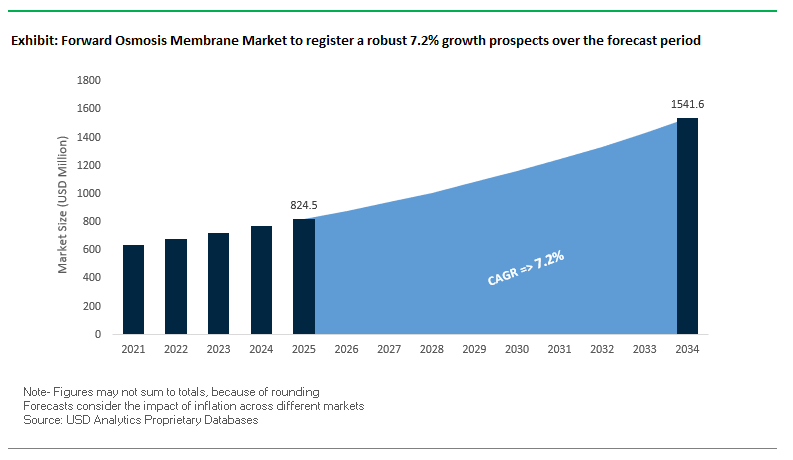
The forward osmosis (FO) membrane market is projected to grow from USD 824.5 billion in 2025 to USD 1,541.5 billion by 2034, reflecting a CAGR of 7.2%. This growth trajectory is underpinned by the rising demand for low-energy water purification systems, increasing adoption of FO in brine concentration, and expanding applications in resource recovery and wastewater treatment. Unlike reverse osmosis (RO), FO relies on natural osmotic gradients rather than high hydraulic pressure, which significantly reduces energy consumption and operational costs. This feature makes FO particularly attractive for industries operating under stringent sustainability mandates and seeking to cut greenhouse gas emissions.
For industry Stakeholders, key questions revolve around FO’s ability to manage high-salinity brines exceeding 70,000 ppm TDS, its competitive edge in treating high-fouling industrial wastewaters, and the scalability of FO for large-scale desalination and hybrid membrane systems. Buyers are also evaluating how FO enables value-added resource recovery, such as concentration of valuable products in the food, beverage, and pharmaceutical industries, without compromising product quality.
Key Insights for Industry Stakeholders
Low Energy Consumption: FO consumes up to 30% less energy than reverse osmosis (RO), making it a sustainable alternative for power-constrained regions.
Reduced Fouling & Maintenance: Lower fouling propensity reduces downtime and cleaning requirements, improving system reliability in challenging feed streams.
High-Salinity Brine Treatment: FO can effectively treat brines with over 70,000 ppm TDS, beyond the capacity of conventional membranes.
Resource Recovery Advantage: FO enables concentration of valuable industrial by-products at lower temperatures, preserving product integrity and boosting profitability.
The forward osmosis membrane market is witnessing rapid innovation, with recent advancements focusing on material science, hybrid systems, and sustainable operations. In August 2025, a scientific article introduced the integration of electrostatic air spray deposition and nanofiltration composites, improving hydrophilicity and stability developments directly relevant to FO’s efficiency. In July 2025, Nanostone Water and Solecta merged to form Acuriant Technologies, a move expected to strengthen hybrid FO systems by combining ceramic and polymeric expertise. Just a month earlier, in June 2025, research demonstrated a PVDF-PAN blended FO membrane achieving higher fluxes than commercial CTA membranes, marking a leap in performance optimization.
Sustainability continues to shape FO adoption. A May 2025 study highlighted FO’s ability to cut energy consumption and greenhouse gas emissions in municipal treatment plants, strengthening its role as a climate-resilient water solution. Meanwhile, research in March 2025 unveiled a thermally responsive ionic liquid draw agent that can be efficiently retrieved, addressing one of FO’s long-standing challenges draw solution regeneration. Earlier developments also underscore FO’s global expansion: a September 2024 containerized, solar-powered FO plant in Oman for produced water treatment showcased decentralized, renewable-powered deployment models. In January 2024, Trevi Systems pioneered a renewable FO seawater desalination facility in Hawaii, using solar thermal energy for draw regeneration, setting a benchmark for sustainable desalination.
With stronger material innovations, hybrid configurations, and renewable-powered FO plants, the industry is positioned to meet rising global demand for energy-efficient, resilient, and high-performance water treatment technologies.
Growth of Hybrid FO-RO Systems in Desalination and Wastewater Treatment
A major trend shaping the forward osmosis membrane market is the integration of FO membranes with reverse osmosis (RO) to create hybrid FO-RO systems, particularly in large-scale desalination and advanced wastewater treatment. This approach uses forward osmosis as a low-energy pre-treatment step, which substantially reduces fouling and scaling in the RO stage, cutting down operational costs and extending membrane lifespan. According to a study published on ResearchGate, a hybrid FO-RO setup achieved an overall energy consumption of just 0.90 kWh/m³, significantly lower than the 3.02 kWh/m³ typically required by standalone RO processes. This reduction in energy use makes the technology attractive for municipal desalination projects and industrial wastewater reuse, where energy costs are a critical factor. With government bodies such as the U.S. Department of Energy (DOE) funding FO-RO research projects, and utilities in water-scarce regions seeking sustainable alternatives, the adoption of hybrid FO-RO systems is positioned as a transformative trend that enhances both operational efficiency and cost-effectiveness.
Application of Forward Osmosis in Resource Recovery from Industrial Wastewater
Another significant trend is the growing use of FO membranes in resource recovery applications, where wastewater streams are concentrated to extract valuable by-products. Unlike pressure-driven membranes that often struggle with high fouling, FO membranes can handle challenging streams such as landfill leachate, food industry effluents, and petrochemical wastewater while recovering clean water. A pilot project documented in the journal Water Research demonstrated that FO technology successfully concentrated high-BOD wastewater from a food processing facility, producing a nutrient-rich solution that could be repurposed as liquid fertilizer, while reducing the waste volume requiring treatment. This aligns with the global push toward a circular economy, where industries are under pressure to recover resources rather than dispose of them. By enabling both cost savings in treatment and the creation of marketable by-products, FO membranes are increasingly viewed as a technology that not only supports sustainability but also creates new revenue streams for industrial operators.
Essential Role in Emergency and Humanitarian Water Supply Solutions
One of the most promising opportunities for FO membranes lies in their deployment for emergency water supply, disaster relief, and military use. The inherently low-energy and low-pressure nature of FO systems allows them to be configured into portable, gravity-driven devices that do not require electricity or complex infrastructure. The U.S. Department of Defense has supported the development of backpack-sized FO purifiers for soldiers in remote or hostile environments, enabling safe drinking water production from highly saline or contaminated sources. Companies such as HTI (Hydration Technology Innovations), now part of AquaVenture Holdings, have pioneered hydration bags that use glucose as a draw solute to purify water in disaster zones. These systems are uniquely valuable for humanitarian aid organizations, NGOs, and military logistics, highlighting FO’s role in critical response scenarios where conventional desalination or filtration technologies are impractical.
Rising Corporate Investments and Collaborations to Scale FO Commercialization
Another major opportunity comes from strategic investments and collaborations aimed at moving FO membranes from the research stage to full-scale commercial deployment. For example, ZwitterCo, a leading advanced membrane developer, announced an oversubscribed €54 million Series B funding round, with capital dedicated to rapidly scaling FO and related breakthrough membrane technologies. This infusion of capital, backed by venture capital firms and industry players, signals growing investor confidence in the scalability of FO beyond niche applications. Such financial commitments are expected to accelerate manufacturing scale-up, cost reductions, and product innovation, making FO membranes increasingly competitive with established pressure-driven technologies. As the industry shifts from pilot-scale systems to commercial-scale installations, companies that secure strong partnerships and investment pipelines are well-positioned to capture early market leadership in the FO segment.
Market Share Analysis of the Forward Osmosis Membrane Market
Market Share by Type
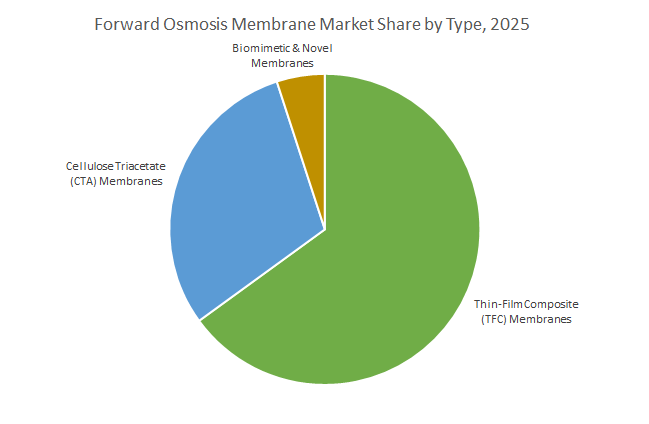
Thin-Film Composite (TFC) membranes are projected to dominate with around 65% share by 2025, due to their high water flux, superior selectivity, and reduced reverse solute diffusion. Their polyamide active layer provides enhanced performance in commercial desalination and wastewater reuse projects, making them the leading choice in emerging large-scale FO applications. Cellulose Triacetate (CTA) membranes, holding about 30% share, remain relevant thanks to their robust chlorine resistance and proven performance record, particularly in pilot studies and applications where fouling resistance outweighs efficiency concerns. Meanwhile, biomimetic and next-generation membranes, which represent about 5% of the market, are still in the R&D phase. Incorporating innovations such as aquaporins, carbon nanotubes, and graphene oxide, they promise revolutionary performance gains, positioning them as the future frontier of FO membranes.
Market Share by Application
The largest application segment, representing 35% of the market, is wastewater treatment and resource recovery, where FO membranes deliver unmatched efficiency in concentrating industrial effluents such as mining wastewater, RO brines, and landfill leachate. Food and beverage processing holds about 25% share, where FO is used to gently concentrate juices, milk, coffee, and other sensitive liquids without degrading flavor or nutrition a distinct advantage over thermal concentration. Desalination and water reuse, making up around 20%, is seeing rapid adoption of FO-RO hybrid systems that reduce fouling and cut down energy consumption in large-scale plants. Emergency hydration and life sciences account for about 15%, covering portable FO hydration devices, military purifiers, and biopharmaceutical processes for concentrating delicate biomolecules. The remaining 5% includes niche applications across specialty chemicals and R&D, demonstrating the versatility of FO membranes in addressing diverse industrial and humanitarian needs.
Market Share by Module
Flat sheet modules currently dominate the market with about 70% share, largely because FO is still an emerging technology, and flat sheets are the preferred format for pilot systems, R&D projects, and early commercial deployments. They provide easier handling and cleaning, which is essential for exploring new industrial applications. Spiral wound modules, projected to hold around 25% share, are becoming the configuration of choice as the market transitions toward commercial scale-up, offering higher packing density and lower capital costs per unit of membrane area. This format is especially suited to water reuse and hybrid desalination projects. Hollow fiber modules, with a niche 5% share, face design challenges unique to FO but are expected to slowly grow in adoption as engineering advances improve their stability and efficiency.
United States: Government Funding and Strong R&D Driving FO Membrane Adoption
The United States forward osmosis membrane market is strongly backed by government funding and advanced academic research. The U.S. Department of Energy (DOE) and the National Alliance for Water Innovation (NAWI) recently selected 12 projects aimed at improving energy efficiency in desalination and water reuse. Among these, one project is developing electrospray printing technology to manufacture porous membranes that enhance filtration efficiency a breakthrough with direct applications in forward osmosis.
Research support from the National Science Foundation (NSF) continues to fuel innovations in water purification, chemical separations, and biopharmaceutical processing, making the U.S. a leader in FO R&D. Corporate investments also signal strong market confidence: California-based Active Membranes closed its initial seed funding in 2024, while ZwitterCo raised €54 million in Series B funding for advanced membrane technologies. Together, these initiatives underscore the U.S. as a hub for next-generation FO membrane technologies in desalination, industrial wastewater, and pharmaceuticals.
China: Regulatory Push and FO Applications in Zero-Liquid Discharge
China’s forward osmosis membrane market is expanding rapidly due to stringent regulatory enforcement and ongoing technological advancements. The Ministry of Ecology and Environment (MEE) is implementing strict industrial wastewater discharge policies, compelling companies to adopt advanced FO membrane technologies to meet emission standards.
Chinese researchers in 2024 developed hollow-fiber ultrafiltration membranes with enhanced antifouling properties, which are often integrated into multi-stage water treatment systems that include FO for high-quality final output. The industrial boom in textiles and petrochemicals is a major driver of FO adoption, particularly for zero-liquid discharge (ZLD) applications where FO membranes excel at handling high-solids-content wastewater. This positions China as one of the most lucrative FO markets worldwide.
India: Expanding FO Adoption Through Government Missions and Green Bonds
India’s forward osmosis membrane market is benefiting from strong government initiatives, innovative projects, and infrastructure investment. The Jal Jeevan Mission promotes water access in rural regions, while the Department of Science & Technology (DST) successfully piloted a solar thermal FO system in Tamil Nadu, producing 20,000 liters of freshwater per day in a drought-prone area. This project highlights FO’s role in providing decentralized, sustainable desalination solutions.
On the infrastructure side, the Ghaziabad Nagar Nigam raised ₹150 crore through India’s first Certified Green Municipal Bond to fund a tertiary sewage treatment plant (TSTP) utilizing advanced membrane technologies. Corporate players are also eyeing India’s growing market: in November 2024, Toyobo MC Corporation, a Japanese membrane specialist, announced its entry into India’s water treatment sector. Together, these developments demonstrate India’s growing reliance on FO membranes for wastewater reuse, desalination, and rural water supply.
Saudi Arabia: Desalination Leader Exploring FO as a Strategic Alternative
Saudi Arabia, the global leader in desalination, is increasingly investing in forward osmosis technology as part of its long-term sustainability agenda. While ACWA Power’s Jubail 3A desalination plant uses reverse osmosis (RO) to produce 600,000 cubic meters of water daily, forward osmosis is being explored as a potential energy-saving pre-treatment alternative to RO.
The Saline Water Conversion Corporation (SWCC) continues to advance highly energy-efficient seawater RO membranes, exemplified by the Yanbu 4 plant with a capacity of 450,000 cubic meters per day. Importantly, FO gained traction when Trevi Systems partnered with the Saudi Water Partnership Company (SWPC) to implement a forward osmosis pilot desalination plant, highlighting the Kingdom’s openness to next-generation water treatment technologies.
Germany: FO Membranes for Industrial Wastewater and Sustainability Goals
Germany is a recognized leader in industrial wastewater treatment using membrane technologies, with a strong focus on sustainability. Companies like PWT Wassertechnik specialize in membrane-based processes, including forward osmosis, to treat and reuse water in compliance with strict EU environmental standards. This makes Germany a pioneer in applying FO membranes in energy-intensive industries and circular water reuse projects.
Corporate players such as MANN+HUMMEL are advancing both FO membranes and digital water solutions, with applications extending into industrial process optimization and green energy initiatives. This dual emphasis on innovation and compliance reinforces Germany’s role as a strategic hub for FO membrane development in Europe.
Japan: FO Innovation in Food, Pharma, and Global Water Projects
Japan’s forward osmosis membrane market is driven by cutting-edge R&D and international collaborations. Asahi Kasei has developed an original FO membrane system designed for high-level liquid concentration by dehydration without heating or pressurization, offering major applications in the food and pharmaceutical industries where product quality must be preserved.
Strategic collaborations are further strengthening Japan’s global influence. Toray Industries is supplying membranes for a next-generation desalination project in Saudi Arabia that transforms a conventional evaporation facility into a sustainable, membrane-based operation. While primarily focused on RO, these projects open pathways for FO integration, underlining Japan’s position as a technology provider in global desalination and industrial water treatment markets.
Competitive Landscape: Key Companies Shaping the FO Membrane Market
The forward osmosis membrane market is highly competitive, with players ranging from technology pioneers to integrated water solution providers. Competition centers on membrane innovation, global deployments, and sustainability-driven applications.
Modern Water – Proven FO Deployments in Global Markets
Modern Water is a pioneer in FO technology, offering containerized and modular systems for desalination and industrial wastewater treatment. Its FO systems have been deployed in Oman and Gibraltar, showcasing real-world scalability. By focusing on high-salinity brines and difficult effluents, Modern Water delivers solutions where conventional RO systems fail. Its low-energy process design positions it strongly in markets with limited power infrastructure.
FTS H2O – Specialized FO Systems for Industrial Wastewater
FTS H2O manufactures FO membranes in flat sheet and spiral-wound formats, leveraging a proprietary cellulose-based material for high abrasion and fouling resistance. Its solutions are widely adopted in landfill leachate treatment and brine concentration, where wastewaters are too challenging for pressure-driven membranes. With lower pretreatment needs and cost savings in both capital and operating expenditures, FTS H2O emphasizes industrial-scale adoption with high ROI.
Aquaporin stands out with its Aquaporin Inside® product line, using natural aquaporin proteins to deliver high selectivity and rapid water transport. Its unique bio-mimetic approach offers unmatched efficiency in water purification and concentration. Aquaporin has established strategic partnerships for commercialization, including collaborations with chemical majors, and is expanding FO use cases beyond industrial treatment into personal hydration and niche medical applications.
Toray Industries – Material Science and Integrated Solutions Leader
Toray Industries, known for its global leadership in RO membranes, is extending its expertise into FO through advanced polymer science and R&D investment. While FO is not yet its flagship segment, Toray’s comprehensive membrane portfolio across RO, NF, UF, and MF allows it to develop hybrid FO systems. With a global manufacturing and supply footprint, Toray is well-positioned to meet demand for integrated, scalable separation technologies.
SUEZ Water Technologies & Solutions – Integrated FO Solutions in Circular Water Management
As part of Veolia, SUEZ leverages FO membranes within its holistic water management portfolio, addressing municipal and industrial needs. Its strong execution track record in large-scale water reuse and desalination projects makes it a key player in FO adoption at scale. Through continuous R&D investment and acquisitions such as LANXESS’s RO membrane line, SUEZ is creating hybrid FO-RO solutions that enhance system efficiency and align with global circular economy objectives.
Forward Osmosis Membrane Market Report Scope
Forward Osmosis Membrane Market
Parameter
Details
Market Size (2025)
$824.5 Million
Market Size (2034)
$1541.5 Million
Market Growth Rate
7.2%
Segments
By Type (Cellulose Triacetate (CTA) Membranes, Thin-Film Composite (TFC) Membranes, Biomimetic & Novel Membranes), By Application (Food & Beverage Processing, Wastewater Treatment & Resource Recovery, Desalination & Water Reuse, Emergency Hydration & Life Sciences), By Module (Flat Sheet, Spiral Wound, Hollow Fiber)
Study Period
2019- 2024 and 2025-2034
Units
Revenue (USD)
Qualitative Analysis
Porter’s Five Forces, SWOT Profile, Market Share, Scenario Forecasts, Market Ecosystem, Company Ranking, Market Dynamics, Industry Benchmarking
Companies
Aquaporin A/S, DuPont de Nemours, Inc., Veolia, Koch Separation Solutions, Toray Industries, Inc., SUEZ, The Dow Chemical Company, Forward Water Technologies Corp., LG Chem, IDE Technologies Ltd., Oasys Water, Inc., Trevi Systems, Fluid Technology Solutions, FTS (Fluid Technology Solutions), Mitsubishi Chemical Corporation
Countries
US, Canada, Mexico, Germany, France, Spain, Italy, UK, Russia, China, India, Japan, South Korea, Australia, South East Asia, Brazil, Argentina, Middle East, Africa
Forward Osmosis Membrane Market Segmentation
By Type
Cellulose Triacetate (CTA) Membranes
Thin-Film Composite (TFC) Membranes
Biomimetic & Novel Membranes
By Application
Food & Beverage Processing
Wastewater Treatment & Resource Recovery
Desalination & Water Reuse
Emergency Hydration & Life Sciences
By Module
Flat Sheet
Spiral Wound
Hollow Fiber
Countries Analyzed
North America (US, Canada, Mexico)
Europe (Germany, UK, France, Spain, Italy, Russia, Rest of Europe)
Asia Pacific (China, India, Japan, South Korea, Australia, South East Asia, Rest of Asia)
South America (Brazil, Argentina, Rest of South America)
Middle East and Africa (Saudi Arabia, UAE, Rest of Middle East, South Africa, Egypt, Rest of Africa)
Top Companies in the Forward Osmosis Membrane Industry include-
Aquaporin A/S
DuPont de Nemours, Inc.
Veolia
Koch Separation Solutions
Toray Industries, Inc.
SUEZ
The Dow Chemical Company
Forward Water Technologies Corp.
LG Chem
IDE Technologies Ltd.
Oasys Water, Inc.
Trevi Systems
Fluid Technology Solutions
FTS (Fluid Technology Solutions)
Mitsubishi Chemical Corporation
*- List not Exhaustive
Research Coverage
This report investigates the Forward Osmosis (FO) Membrane market’s size, growth drivers, and competitive dynamics across desalination, wastewater reuse, and resource-recovery workflows; the analysis reviews duty conditions (high TDS, high fouling), compares CTA vs. TFC vs. biomimetic stacks, and highlights breakthroughs in draw-solution recovery, hybrid FO-RO architectures, and module scale-up that reshape CAPEX/OPEX. Produced by USDAnalytics, the study triangulates deployments, cost curves, and regulatory catalysts to quantify adoption inflection points, stress-tests bankability under multiple energy/chemistry scenarios, and benchmarks vendors on flux stability, reverse solute diffusion, and lifecycle economics this report is an essential resource for utilities, EPCs, plant owners, and investors seeking defensible forecasts and procurement guidance through 2034. Scope Includes-
Segmentation – By Type: Cellulose Triacetate (CTA) Membranes; Thin-Film Composite (TFC) Membranes; Biomimetic & Novel Membranes | By Application: Food & Beverage Processing; Wastewater Treatment & Resource Recovery; Desalination & Water Reuse; Emergency Hydration & Life Sciences | By Module: Flat Sheet; Spiral Wound; Hollow Fiber
Geographic Scope: Analysis spans 25+ countries across North America, Europe, Asia Pacific, Latin America, the Middle East & Africa.
Companies (Profiles of 15+ firms): Aquaporin A/S; DuPont de Nemours, Inc.; Veolia; Koch Separation Solutions; Toray Industries, Inc.; SUEZ; The Dow Chemical Company; Forward Water Technologies Corp.; LG Chem; IDE Technologies Ltd.; Oasys Water, Inc.; Trevi Systems; Fluid Technology Solutions (FTS); Mitsubishi Chemical Corporation
Methodology
USDAnalytics applied a mixed top-down/bottom-up model: top-down TAM/SAM by end-use and regulation; bottom-up plant simulations using membrane area, water flux, reverse solute diffusion, draw chemistry/recovery energy, pretreatment load, and cleaning regimes to yield kWh/m³ and $/m³. We synthesized vendor datasheets, tender wins, pilot logs, and 50+ expert interviews (operators, OEMs, EPCs) to validate performance under high-salinity (>70,000 ppm TDS) and high-fouling feeds. Competitive scoring normalizes CTA/TFC/biomimetic stacks on permeability, fouling rebound, chlorine/temperature envelopes, and module packing density. Scenario and sensitivity analyses cover energy prices, draw-recovery routes (thermal, osmotic, switchable solvents), and hybrid FO-RO configurations to 2034.
Deliverables:
Comprehensive Market Research Report (PDF and Excel) with detailed tables, charts, and interactive visualizations.
Country-Specific Forecasts & Analysis.
Segment-Wise Revenue Forecasts (2025–2034).
Competitive Analysis, Benchmarking, and SWOT Profiles.
Recent Developments & Innovation Tracker.
Executive Summary & Analyst Commentary.
Post-Purchase Analyst Support for Client-Specific Questions and Custom Data Requirements.
Table of Contents: Forward Osmosis (FO) Membrane Market
1. Executive Summary
1.1. Market Highlights
1.2. Key Insights for Industry Stakeholders
1.3. Global Market Snapshot
2. Forward Osmosis Membrane Market Outlook (2025–2034)
2.1. Market Overview: Growth Driven by Energy Efficiency, Brine Management, and Resource Recovery
2.2. Market Valuation and Growth Projections (2025–2034)
2.2.1. Current Market Size (2025): USD 824.5 Billion
FO lowers particulate and scaling loads before RO, so RO runs at reduced pressure and with longer cleaning intervals. Plants report lower specific energy (kWh/m³), improved permeate stability, and deferred RO membrane replacements. The net effect is double-digit OPEX savings and smaller high-pressure trains, improving project IRR for utilities in energy-constrained regions.
TFC active layers typically deliver higher flux and lower reverse solute diffusion, raising throughput in high-TDS or viscous feeds. CTA retains an edge in chlorine tolerance and some fouling scenarios, useful in rugged pilots. Selection should weigh flux at operating temperature, draw chemistry, cleanability, and expected chemical exposure to maximize lifecycle economics.
Yes, FO’s osmotic-gradient driving force avoids the steep pressure/energy curve of RO at very high salinity, enabling stable water flux on brines beyond RO’s economic limit. The key is pairing with an efficient draw-solution regeneration route (e.g., low-grade thermal, switchable solvents, or NF/RO polishing) so overall kWh/m³ and $/m³ remain competitive.
Processes that monetize concentrates dairy/juice concentration, nutrient capture, dye/catalyst recovery, and RO-brine volume reduction see the strongest ROI. FO preserves heat-sensitive products, cuts evaporator duty in ZLD trains, and reduces solids-handling fees. Adding value from recovered products plus lower energy and chemicals typically shortens payback versus pressure-driven or thermal-only routes.
Include guaranteed RSD at design flux and temperature, allowable draw carryover, and permeate quality targets after draw recovery. Require validated cleaning envelopes, pressure/flow windows to maintain shear, and online monitoring (normalized flux, conductivity balance) with alarms. For hybrids, set RO inlet SDI/TDS specs and integrate bypass/flush logic to safeguard the RO stage.