Market Overview: Hybrid Membrane Systems Market Expands with Industrial Water Recovery, ZLD Technologies and Integrated Separation Processes
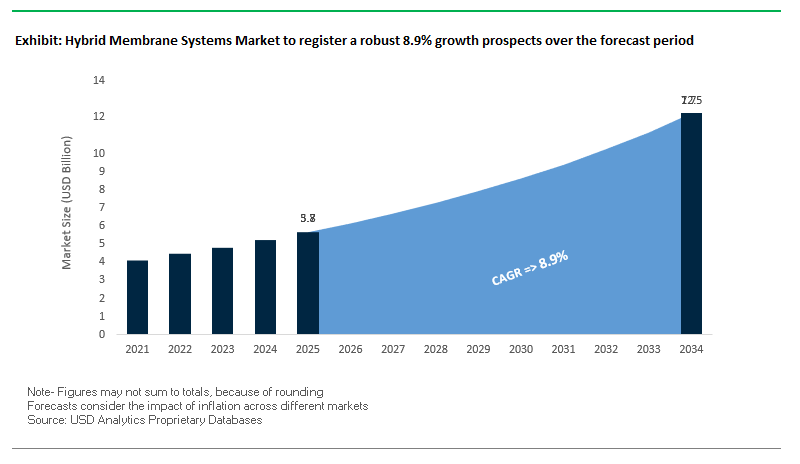
The global Hybrid Membrane Systems Market is projected to increase from USD 5.8 billion in 2025 to USD 12.5 billion by 2034, registering a CAGR of 8.9% during the forecast period. Market expansion is supported by increasing demand for industrial wastewater recycling, advanced desalination, zero-liquid-discharge (ZLD) systems and integrated water purification technologies. Growing pressure on freshwater resources, industrial wastewater discharge requirements and the need to manage high-salinity effluents are strengthening demand for treatment configurations that combine membrane separation with complementary physical, chemical, biological and thermal processes.
Hybrid membrane systems integrate multiple separation technologies to achieve treatment objectives that may be difficult or economically inefficient with individual processes. These configurations include ultrafiltration–reverse osmosis (UF–RO), membrane bioreactor–reverse osmosis (MBR–RO), nanofiltration–electrodialysis (NF–ED), forward osmosis–reverse osmosis (FO–RO), and membrane separation combined with advanced oxidation, evaporation or crystallization. Applications span industrial wastewater treatment, municipal water reuse, seawater desalination, resource recovery and high-purity process-water production. Membrane–non-membrane configurations are particularly important in applications requiring extensive contaminant removal, brine concentration and downstream management of residual solids.
Industrial wastewater treatment and ZLD/MLD applications represent major sources of commercial demand, particularly across power generation, chemicals and petrochemicals, textiles, pharmaceuticals, food and beverage, mining and semiconductor manufacturing. Treatment economics are influenced by freshwater procurement costs, wastewater disposal charges, electricity consumption, membrane replacement, chemical cleaning and residual brine management. In high-salinity wastewater applications, membrane-based concentration can reduce the liquid volume entering thermal evaporation and crystallization stages, affecting both installed treatment capacity and operating costs. Custom-engineered systems maintain a prominent market position because feedwater characteristics, recovery requirements and discharge conditions vary substantially between industrial facilities.
Regional market activity reflects differences in industrial concentration, water availability, regulatory requirements and desalination infrastructure. Asia Pacific remains a leading market region, supported by manufacturing activity, municipal wastewater reclamation and industrial water recycling projects in China, India and other economies. The Middle East represents an important market for hybrid desalination and advanced brine management, while North America and Europe contribute demand from industrial wastewater treatment, water reuse, high-purity manufacturing and environmental compliance. Across these regions, the market encompasses membrane manufacturers, integrated treatment technology providers, engineering contractors and specialized system integrators, with project economics increasingly influenced by water recovery efficiency, treatment reliability and the total cost of operating multistage separation systems.
Key Insights: Hybrid Membrane Systems Market
Membrane, Non-Membrane Systems Dominate Technology Demand: Membrane–non-membrane hybrid systems account for 70% of the market in 2025, compared with 30% for membrane–membrane hybrids. Configurations combining RO or NF with evaporation, crystallization, advanced oxidation and biological treatment are prominent in complex industrial wastewater and high-salinity applications.
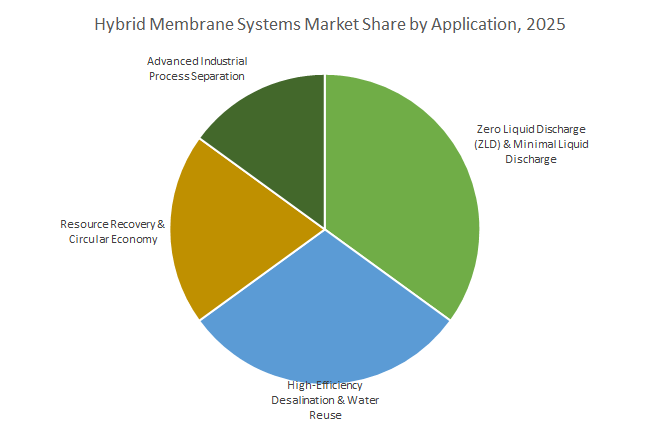
ZLD and MLD Represent the Largest Application Segment: Zero Liquid Discharge and Minimal Liquid Discharge applications account for 35% of the market in 2025, followed by high-efficiency desalination and water reuse at 30%, resource recovery at 20%, and advanced industrial process separation at 15%. Industrial effluent concentration, wastewater reuse and brine management are significant sources of hybrid-system demand.
Custom-Engineered Systems Lead Integration Demand: Custom-engineered hybrid membrane systems hold 80% of market share in 2025, while pre-engineered and packaged systems account for 20%. Large industrial wastewater and municipal treatment projects frequently involve application-specific process integration, whereas packaged systems serve more standardized treatment capacities and operating conditions.
Asia Pacific and Water-Stressed Regions Support Market Expansion: Industrial wastewater recycling activity in China, India and other Asia Pacific economies contributes to regional demand. Middle Eastern desalination projects, North American industrial water recovery systems and European wastewater treatment requirements represent additional sources of hybrid membrane system deployment.
Treatment Economics Shape Industrial Adoption: Capital expenditure, specific energy consumption, membrane replacement costs, pretreatment chemicals, maintenance requirements and concentrate-disposal expenses influence the economics of integrated membrane treatment. In ZLD/MLD applications, increased membrane-based brine concentration can reduce the volume requiring thermal treatment, although actual cost performance depends on feedwater composition, recovery targets and system configuration.
Hybrid Separation Technologies Extend Resource Recovery Applications: Integration of RO, NF, UF, electrodialysis, membrane bioreactors and advanced oxidation enables selective contaminant removal, higher water recovery and separation of potentially recoverable materials. Applications include industrial salt recovery, wastewater reclamation, high-purity process water and advanced brine treatment.
Recent Developments in Hybrid Membrane Systems, High-Recovery Separation and Industrial Water Reuse
Recent developments in the hybrid membrane systems market reflect increasing commercialization of integrated membrane processes, higher-recovery desalination technologies and advanced industrial wastewater treatment systems. In April 2026, Toray Industries announced plans to launch its F-HFUG Series ultrafiltration membrane module in May 2026 for wastewater reuse applications. The technology incorporates a nominal pore size of 0.005 micrometers and is designed to reduce biopolymer-related fouling in downstream reverse osmosis processes. The Toray F-HFUG membrane development announcement reflects continued product development in UF–RO treatment configurations used for advanced water reclamation.
In April 2026, DuPont expanded its FilmTec Fortilife portfolio with the XC220 and XC-Max UHP reverse osmosis elements for industrial wastewater concentration, resource recovery and MLD/ZLD applications. The new elements extend membrane-based separation into higher-salinity operating ranges, potentially reducing the volume of concentrate requiring downstream evaporation and crystallization. According to the DuPont FilmTec Fortilife portfolio announcement, the XC220 and XC-Max UHP products are designed for brine concentrations of up to 220 g/L and 250 g/L NaCl, respectively, under specified operating conditions. The development expands the available membrane technologies for integrated high-recovery treatment systems.
Hybrid reverse osmosis technology also progressed through industrial-scale pilot activity. In April 2026, SUEZ and Salinity Solutions launched a Hybrid Batch Reverse Osmosis pilot at the Béziers wastewater treatment plant in France. The installation has a treatment capacity of 100 m³/day and targets water recovery of 90–95%, with reduced concentrate production and chemical-cleaning requirements among its reported objectives. The SUEZ–Salinity Solutions industrial pilot demonstrates continued evaluation of high-recovery membrane configurations under municipal wastewater operating conditions.
Commercial projects provide further evidence of integrated membrane deployment. In July 2025, Veolia announced the Vitória Water Reclamation Station in Brazil, combining membrane bioreactor, ultrafiltration and reverse osmosis technologies to supply reclaimed municipal wastewater to industrial users. The planned facility has a treatment capacity of 38,880 m³/day and is designed to reclaim 85% of wastewater from the Camburi basin. In March 2025, Gradiant and Archroma announced the implementation of a membrane- and oxidation-based ZLD system at Archroma's Mahachai facility in Thailand, incorporating counterflow reverse osmosis and advanced oxidation. The project was reported to enable 90–95% wastewater recovery alongside the recovery of usable mineral streams, illustrating the application of hybrid separation technologies in industrial water recycling and resource recovery.
Regulatory Framework and E-E-A-T: Industrial Effluent Requirements, Water Reuse Standards and Hybrid Membrane Validation
Regulatory requirements influencing hybrid membrane systems vary by industrial sector, wastewater composition, intended reuse application and discharge destination. In the European Union, the Water Reuse Regulation (EU) 2020/741, applicable since June 26, 2023, establishes minimum water-quality, monitoring, permitting and risk-management requirements for treated urban wastewater reused in agricultural irrigation. The regulation does not establish universal industrial wastewater recycling or ZLD requirements, although membrane-based treatment may form part of the processes used to achieve applicable reclaimed-water quality standards.
The revised Urban Wastewater Treatment Directive (EU) 2024/3019 entered into force on January 1, 2025, introducing strengthened provisions concerning wastewater collection, nutrient removal, micropollutant treatment, resource recovery and water reuse. Member States are required to transpose specified provisions by July 31, 2027, with individual obligations subject to separate implementation schedules. The directive provides a broader regulatory framework for advanced treatment processes without mandating a particular hybrid membrane configuration.
In the United States, industrial wastewater discharge is regulated through the Clean Water Act, National Pollutant Discharge Elimination System permits and sector-specific effluent limitations guidelines. The Environmental Protection Agency's 2024 steam-electric wastewater rule strengthened discharge standards for specified coal-fired power plant wastewater streams. Subsequently, the EPA's December 2025 deadline extensions and January 2026 corrections modified applicable compliance schedules. These requirements are sector-specific and do not constitute a nationwide ZLD mandate for all industrial facilities.
Technical validation also incorporates internationally recognized water reuse standards. ISO 20426:2018 provides guidance for assessing and managing pathogen-related health risks associated with nonpotable water reuse, including reclaimed water originating from municipal and industrial sources. NSF/ANSI 350 establishes performance requirements for onsite residential and commercial water reuse treatment systems. Across hybrid membrane applications, treatment assessment includes permeate quality, membrane integrity, microbial reduction where relevant, contaminant removal, recovery performance and verification against applicable discharge or reuse-water specifications.
Emerging Trends and Growth Opportunities in the Hybrid Membrane Systems Market
Growth of Hybrid MBR Systems for Water Reuse and Reclamation
A defining trend in the hybrid membrane systems market is the rising adoption of hybrid membrane bioreactor (MBR) systems that integrate MBR with nanofiltration (NF) or reverse osmosis (RO). This multi-barrier approach enhances organic contaminant removal and produces reclaimed water that meets stringent urban and industrial reuse standards. According to Frontiers in Membrane Science and Technology, hybrid MBR-RO systems outperform standalone configurations, making them critical for groundwater recharge and circular water economy models. The ability to achieve high-quality effluent for industrial reuse is propelling market demand globally.
Development of Energy-Efficient Hybrid FO-RO Systems for Desalination
Another major trend is the integration of forward osmosis (FO) with reverse osmosis (RO) to reduce energy consumption and fouling in desalination plants and high-salinity wastewater treatment. FO’s low-pressure, low-fouling characteristics make it an effective pre-treatment step, allowing RO membranes to operate more efficiently and last longer. A report by the U.S. Department of Energy (DOE) highlights an FO-membrane distillation (MD) hybrid project powered by industrial waste heat, which demonstrated over 60% reductions in both energy costs and carbon emissions. These findings position hybrid FO-RO and FO-MD as game-changing technologies for energy-efficient desalination and industrial wastewater reuse.
Rising Adoption in Industrial Wastewater Treatment and On-Site Reuse
Hybrid membrane systems are rapidly gaining traction in industrial wastewater treatment, where conventional single-process systems fall short. Industries such as oil & gas, chemicals, and food & beverage face increasingly stringent discharge regulations and are turning to UF + RO or UF + NF + AOP hybrids to meet compliance while cutting costs. A global case study from a leading water technology provider reported that a sugar refinery adopting a UF + RO hybrid recovered high-quality water for reuse in cooling towers and boilers, significantly lowering freshwater intake and wastewater disposal expenses. This demonstrates that hybrid systems not only meet regulatory mandates but also deliver tangible economic benefits.
Integration with Advanced Oxidation Processes (AOPs) for Micropollutant Removal
A critical growth opportunity lies in the integration of membranes with advanced oxidation processes (AOPs) such as photocatalysis or ozonation. According to a Water Research review, hybrid AOP-membrane systems effectively degrade micropollutants and persistent organic compounds, making downstream filtration more efficient while reducing membrane fouling. This dual treatment strategy is particularly valuable for producing ultrapure water in pharmaceutical, semiconductor, and high-tech applications. As industries face mounting concerns over emerging contaminants, AOP-membrane hybrids are emerging as a next-generation solution for advanced water treatment and reuse.
Market Share Analysis of the Hybrid Membrane Systems Market
Market Share by Type: Membrane-Non-Membrane Systems Lead with 70% Share
By type, membrane-non-membrane hybrid systems dominate the market with 70% projected share in 2025, primarily because they address treatment challenges that membranes alone cannot. These include RO/NF combined with evaporators or crystallizers for Zero Liquid Discharge (ZLD), UF/NF integrated with activated carbon or AOPs for micropollutant removal, and MBR combined with anaerobic digestion for energy recovery. Their dominance reflects the industry’s push toward sustainability, resource recovery, and regulatory compliance. Conversely, membrane-membrane hybrids (30%), such as UF + RO, FO + RO, and NF + ED, play a strategic role in desalination and selective ion recovery, extending membrane lifespan and improving system efficiency.
Market Share by Application: ZLD and Minimal Liquid Discharge at the Forefront
In application terms, Zero Liquid Discharge (ZLD) and Minimal Liquid Discharge (MLD) account for 35% share in 2025, making them the largest and fastest-growing segment of the hybrid membrane systems market. This growth is driven by strict environmental mandates in power generation, textiles, and chemicals, where only hybrids (e.g., RO + Crystallizer + CCRO) can achieve complete discharge compliance. High-efficiency desalination and water reuse (30%) remain another key segment, with UF/MF + RO as the global standard and emerging hybrids like FO + RO gaining traction for higher recovery and reduced fouling. Resource recovery (20%) is a rising frontier, with NF + ED hybrids enabling lithium, potassium, and magnesium extraction from brines, transforming wastewater into a revenue-generating stream. Finally, advanced industrial process separations (15%) such as NF + chromatography in food & beverage or hybrids for pharmaceuticals support industries requiring ultra-precise separations beyond the capability of single technologies.
Market Share by System Integration Level: Custom-Engineered Solutions Dominate at 80%
The custom-engineered hybrid systems segment dominates with 80% market share, reflecting the unique and complex nature of wastewater streams and client requirements. Large-scale industrial and municipal projects require tailored engineering to optimize technology integration for compliance, efficiency, and cost control. However, the pre-engineered/packaged hybrid systems segment (20%) is expanding, particularly for standardized use cases like industrial reuse (UF/MF + RO skids) and ZLD applications in upstream oil & gas. These pre-designed units offer faster deployment, lower upfront costs, and repeatable performance, making them increasingly attractive for mid-sized industries with defined water reuse or discharge needs.
Competitive Landscape: Global Hybrid Membrane Systems Market
The global Hybrid Membrane Systems Market competitive landscape includes integrated water technology providers, membrane manufacturers, industrial wastewater treatment companies and specialized separation-system suppliers. Veolia participates through advanced municipal and industrial treatment systems integrating membrane bioreactors, ultrafiltration and reverse osmosis, including large-scale water reclamation infrastructure. SUEZ maintains capabilities in advanced wastewater treatment, desalination and high-recovery membrane processes, including hybrid batch RO applications. Xylem Inc., incorporating the former Evoqua Water Technologies business, competes through industrial water treatment systems, integrated purification technologies and water infrastructure solutions.
Membrane manufacturers occupy an important position in hybrid treatment-system supply chains. DuPont de Nemours, Inc. supplies FilmTec RO and NF membranes and inge ultrafiltration technologies used in integrated water treatment and desalination processes. Toray Industries, Inc. participates through RO, UF, NF and MBR membrane technologies, including fouling-resistant products for wastewater reclamation. LG Chem Ltd., through LG Water Solutions, supplies NanoH₂O thin-film nanocomposite reverse osmosis membranes for seawater desalination, brackish-water treatment and industrial reuse. Asahi Kasei Corporation provides Microza hollow-fiber microfiltration and ultrafiltration membranes used in water purification, industrial filtration and pretreatment for reverse osmosis systems.
Specialized membrane equipment suppliers contribute to hybrid separation through component manufacturing and system integration. Pentair plc, through X-Flow, supplies hollow-fiber UF and NF technologies used in wastewater treatment, membrane pretreatment and water recycling. Kubota Corporation provides submerged flat-sheet membrane systems for biological wastewater treatment and reuse applications. MANN+HUMMEL participates through MICRODYN-NADIR, BIO-CEL and related membrane technologies covering MBR, UF, RO and industrial process separations. Kovalus Separation Solutions, formerly Koch Separation Solutions, supplies membrane filtration, ion-exchange and evaporation technologies for water treatment, food processing and industrial separation.
Integrated engineering and industrial treatment providers compete across ZLD/MLD, advanced water reuse and high-salinity wastewater management. Aquatech International provides membrane-based brine concentration, industrial water recycling and thermal treatment technologies, including RecovOAR osmotically assisted reverse osmosis. Thermax Limited participates through industrial wastewater treatment, reverse osmosis and evaporation-based ZLD configurations. Gradiant supplies counterflow reverse osmosis, advanced oxidation and integrated industrial water recovery processes for chemicals, textiles, semiconductor manufacturing and other water-intensive applications.
Industrial process-water specialists provide additional capabilities in multistage purification and water recovery. Kurita Water Industries Ltd. operates across ultrapure-water production, industrial wastewater reclamation and combined treatment systems incorporating RO, UF, ion exchange and associated process technologies. Competitive differentiation across the wider market reflects membrane performance, integration capabilities, project execution experience, packaged-system availability, operating reliability and treatment costs. The commercial structure includes direct membrane supply, engineered treatment projects, equipment packages and ongoing water-treatment services.
United States: Government-Backed Innovations Driving Hybrid Membrane Adoption
The United States stands at the forefront of hybrid membrane system development, propelled by robust government funding and strong R&D initiatives. The U.S. Department of Energy (DOE) actively funds projects that integrate multiple membrane technologies to optimize industrial water reuse. Notably, RTI International is developing a hybrid system that synergistically combines forward osmosis (FO) with membrane distillation (MD) technology, utilizing waste heat to enhance energy efficiency for high-TDS industrial wastewater applications. Complementing these efforts, the National Science Foundation (NSF) supports research centers dedicated to innovating new membranes for water purification, chemical separations, and biopharmaceutical processing.
For instance, the University of California, San Diego has developed a hybrid system combining biodegradable polymer cores with genetically modified cell membranes, showcasing significant advances in biomimetic membrane applications. Corporate participation further accelerates commercialization; Veolia, in collaboration with DOE-funded projects, is demonstrating hybrid FO/MD systems for industrial wastewater, ensuring a direct pipeline from academic research to industrial deployment. This strong government-industry-academia synergy positions the U.S. as a leading market for hybrid membrane systems, particularly in industrial wastewater treatment, water reuse, and advanced biopharmaceutical applications.
China: Regulatory Policies and Industrial Expansion Driving Hybrid Membrane Demand
China’s hybrid membrane systems market is significantly influenced by stringent environmental regulations and rapid industrial expansion. The Ministry of Ecology and Environment (MEE) enforces strict wastewater discharge standards, compelling industrial operators to adopt advanced treatment technologies capable of comprehensive water purification. Hybrid systems, often combining membrane bioreactors (MBR) with reverse osmosis (RO) or nanofiltration (NF), have emerged as critical solutions to achieve zero-liquid discharge (ZLD) objectives, particularly in high-demand sectors such as textiles and petrochemicals. The push for advanced wastewater management aligns with ongoing investments in R&D; a 2024 study highlighted the development of hollow-fiber ultrafiltration (UF) membranes with enhanced antifouling properties. Innovations in individual membrane components directly enhance hybrid system efficiency, improving reliability, recovery rates, and operational longevity. Consequently, regulatory pressure, industrial expansion, and technological innovation collectively drive the robust adoption of hybrid membrane systems across China.
Germany: Technological Leadership in Industrial Hybrid Membrane Systems
Germany maintains a leadership position in hybrid membrane systems through advanced industrial wastewater treatment and continuous technological innovation. A 2025 study confirmed Germany’s nanofiltration membrane segment as the largest in Europe, reflecting strong adoption of hybrid solutions designed for environmental sustainability and efficient water management. Companies like Separionics are pioneering hybrid systems that integrate electro-membranes, such as electrodialysis, with pressure-driven membranes like RO, enabling efficient desalination and industrial water treatment. Separionics’ hybrid RO and electrical sorption system deployed in Tanzania exemplifies Germany’s global reach and technological expertise. Leading corporations such as MANN+HUMMEL focus on delivering innovative membrane and digital solutions tailored to industrial process water management, green energy applications, and hybrid system optimization. Germany’s focus on precision engineering, sustainability, and hybrid configurations underlines its prominent role in the European and global hybrid membrane systems market.
India: Government Programs and Infrastructure Investment Boosting Hybrid Membrane Deployment
India is witnessing accelerated adoption of hybrid membrane systems, driven by government initiatives, infrastructure investment, and corporate participation. Programs such as the "Jal Jeevan Mission" aim to provide safe and affordable drinking water, while the Department of Science & Technology’s Water Technology Initiative supports R&D in nanomaterial-based filtration, which is critical for hybrid systems. Infrastructure investments are also a major driver; for example, Ghaziabad Nagar Nigam issued India’s first Certified Green Municipal Bond, raising ₹150 crore to establish a state-of-the-art Tertiary Sewage Treatment Plant (TSTP). This facility utilizes hybrid membrane filtration systems for wastewater treatment and industrial reuse, highlighting India’s commitment to sustainable water management. Leading Indian companies like Thermax are actively developing hybrid systems for industrial wastewater applications, combining technologies for enhanced water recovery, energy efficiency, and scalability. Collectively, government programs, private sector initiatives, and infrastructure development are catalyzing hybrid membrane system adoption across India.
Japan: Academic and Corporate R&D Accelerating Global Hybrid Membrane Solutions
Japan remains a key technology provider in the global hybrid membrane systems market, driven by cutting-edge academic and corporate research. The Membrane Engineering Group at Kobe University is pioneering functional membranes for water and atmospheric applications, providing a foundation for next-generation hybrid systems. Japanese corporations, particularly Toray Industries, continue to innovate in reverse osmosis (RO) membrane technology, supplying high-performance membranes for large-scale desalination and water purification projects, such as the Saudi Arabia desalination plant. The Ministry of the Environment further supports sustainable infrastructure, allocating USD 1.2 billion in 2024 for wastewater treatment systems integrated with MBR and other hybrid membrane technologies. Japan’s combined emphasis on research, industrial application, and government support solidifies its position as a global leader in hybrid membrane solutions.
Australia: Water Scarcity and Recycling Initiatives Driving Hybrid Membrane Innovation
Australia’s hybrid membrane systems market is strongly influenced by water scarcity, recycling initiatives, and academic research. The Australian Water Recycling Centre of Excellence has funded projects demonstrating the performance and cost benefits of ceramic membranes in treating high-organic secondary effluent, often integrated into hybrid systems for optimal results. Research institutions such as the Institute for Sustainable Industries and Liveable Cities (ISILC) at Victoria University focus on increasing water recovery from desalination and reducing fouling and scaling in membranes, addressing key operational challenges in hybrid configurations. Australia’s focus on sustainable water management, combined with government-backed research and recycling initiatives, fosters the adoption of advanced hybrid membrane systems in municipal, industrial, and agricultural applications.
Hybrid Membrane Systems Market Report Scope
Hybrid Membrane Systems Market
Parameter
Details
Market Size (2025)
$5.8 Billion
Market Size (2034)
$12.5 Billion
Market Growth Rate
8.9%
Segments
By Type (Membrane-Membrane Hybrid Systems, Membrane-Non-Membrane Hybrid Systems), By Application (Zero Liquid Discharge (ZLD) & Minimal Liquid Discharge, High-Efficiency Desalination & Water Reuse, Resource Recovery & Circular Economy, Advanced Industrial Process Separation), By System Integration Level (Custom-Engineered Systems, Pre-Engineered/Packaged Systems), By End-User (Desalination, Municipal Wastewater Treatment & Reuse, Industrial Wastewater Treatment, Potable Water Treatment, Brine & Concentrate Management)
Study Period
2020- 2025 and 2026-2034
Units
Revenue (USD)
Qualitative Analysis
Porter’s Five Forces, SWOT Profile, Market Share, Scenario Forecasts, Market Ecosystem, Company Ranking, Market Dynamics, Industry Benchmarking
Companies
SUEZ, Veolia, DuPont de Nemours, Inc., Toray Industries, Inc., Pentair plc, Xylem Inc., Asahi Kasei Corporation, Kubota Corporation, The Dow Chemical Company, MANN+HUMMEL, Evoqua Water Technologies, Koch Separation Solutions, LG Chem, Aquatech International, Thermax Limited
Countries
US, Canada, Mexico, Germany, France, Spain, Italy, UK, Russia, China, India, Japan, South Korea, Australia, South East Asia, Brazil, Argentina, Middle East, Africa
Hybrid Membrane Systems Market Segmentation
By Type
Membrane-Membrane Hybrid Systems
Membrane-Non-Membrane Hybrid Systems
By Application
Zero Liquid Discharge (ZLD) & Minimal Liquid Discharge
High-Efficiency Desalination & Water Reuse
Resource Recovery & Circular Economy
Advanced Industrial Process Separation
By System Integration Level
Custom-Engineered Systems
Pre-Engineered/Packaged Systems
By End-User
Desalination
Municipal Wastewater Treatment & Reuse
Industrial Wastewater Treatment
Potable Water Treatment
Brine & Concentrate Management
Countries Analyzed
North America (US, Canada, Mexico)
Europe (Germany, UK, France, Spain, Italy, Russia, Rest of Europe)
Asia Pacific (China, India, Japan, South Korea, Australia, South East Asia, Rest of Asia)
South America (Brazil, Argentina, Rest of South America)
Middle East and Africa (Saudi Arabia, UAE, Rest of Middle East, South Africa, Egypt, Rest of Africa)
Leading Companies in the Hybrid Membrane Systems Market
Prepared by USDAnalytics, this report investigates the global Hybrid Membrane Systems landscape with a full-stack market view sizing, adoption curves, and bankability while our analysis reviews technology pairings (e.g., RO–UF, FO–RO, NF–ED), integration levels, and end-use economics; it highlights breakthrough material science, ESG-linked procurement, and digital optimization that lift recovery, cut kWh/m³, and de-risk compliance. Built for utilities, EPCs, OEMs, and industrial owners, this report is an essential resource for comparing TCO/ROI across ZLD/MLD, desalination, and resource-recovery use cases, aligning capex with policy incentives, and prioritizing vendor shortlists through evidence-backed performance benchmarks. Scope Includes-
Segmentation: By Type (Membrane–Membrane Hybrid Systems, Membrane–Non-Membrane Hybrid Systems); By Application (Zero Liquid Discharge (ZLD) & Minimal Liquid Discharge, High-Efficiency Desalination & Water Reuse, Resource Recovery & Circular Economy, Advanced Industrial Process Separation); By System Integration Level (Custom-Engineered Systems, Pre-Engineered/Packaged Systems); By End-User (Desalination, Municipal Wastewater Treatment & Reuse, Industrial Wastewater Treatment, Potable Water Treatment, Brine & Concentrate Management).
Geographic Scope: Analysis spans 25+ countries across North America, Europe, Asia Pacific, Latin America, the Middle East & Africa.
Historic data from 2021 to 2024 and forecast data from 2025 to 2034.
Companies (Profiles of 15+ companies): SUEZ; Veolia; DuPont de Nemours, Inc.; Toray Industries, Inc.; Pentair plc; Xylem Inc.; Asahi Kasei Corporation; Kubota Corporation; The Dow Chemical Company; MANN+HUMMEL; Evoqua Water Technologies; Koch Separation Solutions; LG Chem; Aquatech International; Thermax Limited.
Research Methodology
USDAnalytics evaluates the global Hybrid Membrane Systems Market through an integrated top-down and bottom-up market-sizing methodology covering membrane technology combinations, application categories, system integration levels, end-user industries and regional demand. The published research framework includes analysis of more than 1,000 identified facilities, pilot installations and awarded projects, supported by over 35 expert interviews across technology suppliers, engineering contractors, operators and regulatory stakeholders.
Market estimates are triangulated using industrial water treatment activity, wastewater reclamation projects, desalination infrastructure, hybrid separation technology adoption, treatment capacity and supplier-market information. The techno-economic assessment incorporates capital expenditure, operating costs, membrane performance, energy consumption, water recovery, treatment reliability and concentrate-management requirements across UF–RO, MBR–RO, FO–RO, NF–ED and membrane–thermal treatment configurations.
The 2025–2034 market forecast incorporates industrial wastewater recycling demand, ZLD/MLD adoption, desalination capacity, resource recovery activity, regulatory developments and regional infrastructure requirements. Competitive analysis examines membrane portfolios, system integration capabilities, technology differentiation, geographic presence and participation in industrial and municipal water treatment applications.
Deliverables:
Comprehensive Market Research Report (PDF and Excel) with detailed tables, charts, and interactive visualizations.
Country-Specific Forecasts & Analysis.
Segment-Wise Revenue Forecasts (2025–2034).
Competitive Analysis, Benchmarking, and SWOT Profiles.
Recent Developments & Innovation Tracker.
Executive Summary & Analyst Commentary.
Post-Purchase Analyst Support for Client-Specific Questions and Custom Data Requirements.
Table of Contents: Hybrid Membrane Systems Market
1. Executive Summary
1.1. Market Highlights
1.2. Key Insights for Industry Stakeholders
1.3. Global Market Snapshot
2. Hybrid Membrane Systems Market Outlook (2025–2034)
2.1. Market Overview: Growth Driven by Sustainable and Energy-Efficient Solutions
2.2. Market Valuation and Growth Projections (2025–2034)
Hybrid trains use RO/NF for high-recovery pre-concentration and pass only a smaller brine load to thermal units or crystallizers. This cuts steam/electric demand, reduces scaling in evaporators, and shrinks brine-haul volumes. With CCRO or staged RO, many plants achieve double-digit OPEX savings and deferred capex on thermal capacity while meeting zero-discharge mandates.
FO as a pre-step operates at low pressure, removing water across an osmotic gradient and rejecting foulants before RO. The downstream RO then runs at lower pressure with slower flux decline, extending membrane life and cleaning intervals. Plants typically report materially lower specific energy (kWh/m³) and improved uptime, especially on high-TDS, high-organics feeds.
Refining/chemicals, textiles, and mining benefit when UF/NF+RO replaces partial evaporation and enables reuse in boilers/cooling. F&B and pharma realize ROI by pairing MBR/UF with RO or NF+ED for reclaim and product/water recovery. Projects with high water tariffs or discharge fees, or with waste-heat available for FO/MD, usually reach payback first.
Specify guaranteed recovery and permeate quality, maximum specific energy, normalized flux recovery after CIP, and brine quality suitable for the chosen thermal/AOP step. Require scalable skids, online SDI/turbidity monitoring, open-protocol PLC/SCADA, and lifecycle spares/cleaning plans. Include verification testing (FAT/SAT) and performance-linked payments tied to 6–12 months of operations.
Rapid industrial growth meets tightening discharge rules, while water stress pushes reuse and ZLD adoption. Governments fund large desalination/reuse programs, and local manufacturing lowers installed costs for RO, UF/NF, and packaged hybrids. The combination of policy pressure, capex pipelines, and skilled EPC capacity keeps APAC in a sustained leadership position.