Strong Growth Outlook for the Membranes for Water and Wastewater Market
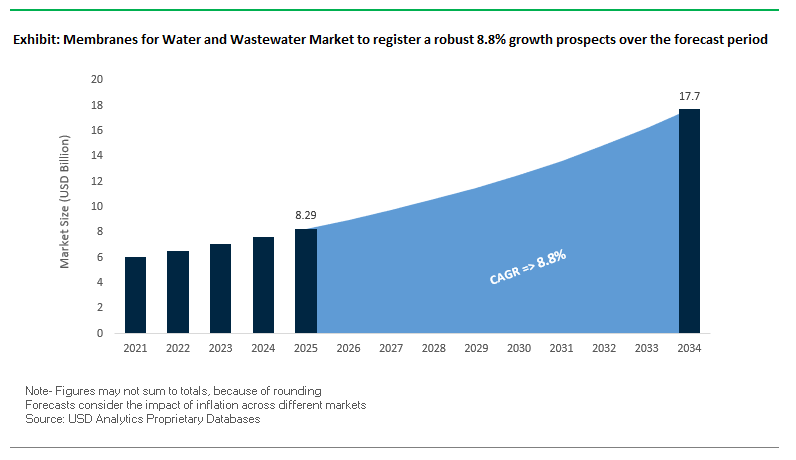
The global membranes for water and wastewater market is projected to grow from USD 8.29 billion in 2025 to USD 17.7 billion by 2034, reflecting a CAGR of 8.8%. This surge is fueled by rising industrial adoption of water reuse, decentralized treatment solutions, and urgent demand for potable water accessibility. Membranes have emerged as a cornerstone of sustainable water management, enabling industries and municipalities to optimize resource efficiency, meet environmental compliance, and lower operating costs.
Industrial adoption is the single largest driver, with industries contributing to almost half of the global water recycle and reuse revenue. Advanced filtration membranes particularly reverse osmosis (RO), ultrafiltration (UF), and membrane bioreactors (MBR) are central to this transformation, ensuring cost-effective treatment of complex effluents. At the same time, municipalities and communities are deploying decentralized modular systems, such as nanofiltration skids and compact membrane bioreactors, that deliver 50–500 cubic meters per day of potable or process water while reducing reliance on large-scale centralized networks.
Technology advancements are significantly reshaping the market. New low-pressure ultrafiltration units and energy-efficient RO stacks are cutting electricity consumption for both industrial and municipal operators. Meanwhile, sustainability is no longer optional as of 2024, 2.2 billion people still lacked access to safely managed drinking water (WHO/UNICEF), highlighting the urgent global need for scalable purification systems. The market is therefore pivoting toward solutions that reduce chemical use, minimize waste, and support long-term water security.
Key Insights: Membranes for Water and Wastewater Market
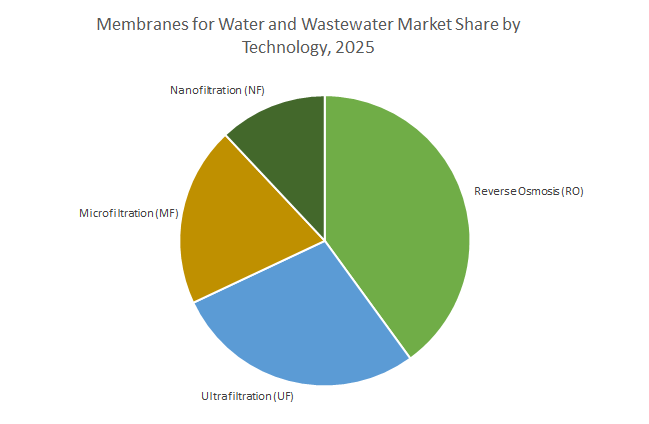
Reverse Osmosis Leads Membrane Technology Demand: Reverse osmosis accounts for 40% of the market in 2025, reflecting its established role in seawater desalination, brackish-water treatment and industrial water purification. Ultrafiltration represents 28%, followed by microfiltration at 20%.
Wastewater Treatment and Reuse Represent the Largest Application: Wastewater treatment and reuse account for 38% of market demand in 2025, compared with 35% for potable water production and 27% for industrial process-water pretreatment. Municipal reclamation, industrial wastewater recycling and membrane-based purification contribute to demand across these applications.
Polymeric Membranes Maintain Material Dominance: Polymeric membranes hold approximately 92% of the market in 2025, supported by scalable manufacturing, established RO and UF applications and broad compatibility with municipal and industrial treatment systems. Ceramic membranes account for 8%, with applications concentrated in more demanding wastewater streams requiring higher chemical, thermal or mechanical resistance.
Industrial Water Recycling Expands End-Use Demand: Power generation, food and beverage, chemicals and pharmaceuticals, oil and gas, mining and microelectronics are important industrial membrane applications. Industrial users as contributors to nearly half of the broader global water recycling and reuse revenue base, reflecting the commercial importance of industrial water recovery infrastructure.
Decentralized Treatment Supports Modular Membrane System Demand: Compact membrane bioreactor, UF, NF and RO systems serve industrial estates, commercial facilities and communities with distributed treatment requirements. Decentralized installations in the illustrative 50–500 m³/day capacity range, alongside larger centralized municipal and industrial treatment plants.
Operating Costs and Membrane Performance Influence Market Competition: Specific energy consumption, membrane fouling, chemical cleaning, membrane replacement, recovery efficiency and concentrate management affect the lifecycle economics of membrane treatment systems. Developments in low-fouling RO membranes, UF pretreatment, modular filtration equipment and advanced membrane materials are expanding application-specific treatment capabilities.
Recent Developments in Water and Wastewater Membranes, Industrial Water Reuse and Advanced Filtration
Recent developments in the membranes for water and wastewater market reflect continued commercialization of fouling-resistant membrane materials, advanced ultrafiltration technologies and higher-recovery industrial water treatment systems. In September 2026, Nitto Denko Corporation and its subsidiary Hydranautics began sales of the PRO-XR1-X-LD reverse osmosis membrane element for challenging industrial wastewater reuse applications. The product targets wastewater streams associated with semiconductor manufacturing, mining and other industrial operations where membrane fouling can affect treatment reliability. The Nitto and Hydranautics fouling-resistant RO membrane launch reflects increasing product differentiation around wastewater compatibility, fouling control and maintenance requirements.
Toray Industries expanded its water-treatment membrane activities during 2026 across ultrafiltration, nanofiltration and reverse osmosis. In September, the company announced an order to supply reverse osmosis membranes for Singapore's Changi NEWater Factory 3, reinforcing the role of membrane separation in advanced municipal wastewater reclamation. In August, Toray announced two new nanofiltration membrane element models for industrial wastewater treatment and advanced water purification. Earlier, in April, the company announced plans to launch its F-HFUG Series ultrafiltration module in May 2026, incorporating a nominal pore size of 0.005 micrometers to reduce biopolymer transmission and downstream RO biofouling. The Toray F-HFUG ultrafiltration membrane announcement reflects increasing integration of membrane pretreatment performance with overall wastewater reuse operating economics.
Industrial water recovery technologies are also extending the application range of reverse osmosis membranes. In April 2026, DuPont introduced FilmTec Fortilife XC220 and XC-Max UHP membrane elements for minimal-liquid-discharge (MLD), zero-liquid-discharge (ZLD) and resource-recovery applications. The products are designed for higher-salinity operating conditions, with the XC220 element supporting brine concentrations of up to 220 g/L NaCl and the XC-Max UHP element designed for concentrations up to 250 g/L NaCl under specified conditions. The DuPont FilmTec Fortilife product expansion extends membrane-based concentration into applications involving reduced wastewater discharge volumes and integration with downstream thermal treatment.
Large-scale municipal-to-industrial water recycling represents another area of membrane deployment. In July 2025, Veolia announced its selection to deliver the Vitória Water Reclamation Station in Brazil, integrating membrane bioreactor and reverse osmosis technologies for industrial water supply. The planned facility has a processing capacity of 38,880 m³/day and is designed to reclaim 85% of municipal wastewater from the Camburi basin. The project illustrates the growing use of multistage membrane treatment to convert municipal wastewater into an alternative industrial water source, particularly in regions facing competing freshwater demands.
Key Trends and Opportunities in the Membranes for Water and Wastewater Market
One of the most transformative trends in the membranes for water and wastewater market is the enforcement of increasingly stringent discharge and reuse regulations by global authorities. In India, for example, the Central Pollution Control Board (CPCB) mandates effluent treatment and reuse, with penalties exceeding ₹80,000 crore already imposed by the National Green Tribunal (NGT) for non-compliance. Such regulatory actions are forcing municipalities and industries to invest in membrane-based treatment systems to meet quality norms, minimize liabilities, and ensure sustainable water management practices.
Breakthroughs in High-Performance Membrane Materials
Technological innovation is rapidly reshaping the market, with next-generation membranes being designed for higher efficiency, reduced fouling, and extended operational lifespans. Research from Imperial College London, for instance, showcased a PVDF-based membrane that is 15 times more efficient than existing standards while maintaining pore size integrity. This breakthrough overcomes the traditional trade-off between permeance and separation quality, opening new avenues for cost-effective, high-performance solutions that can address both municipal and industrial challenges.
Expanding Industrial Investments in Water Reuse Systems
Corporate strategies increasingly center around water sustainability, with industries prioritizing on-site wastewater treatment and reuse to mitigate risks associated with scarcity and regulatory pressures. A global filtration technology leader recently announced a large-scale membrane manufacturing facility in India to meet rising demand, while LG Water Solutions launched new ultrafiltration and membrane bioreactor products engineered for higher durability. These investments highlight a clear opportunity for membrane suppliers to capitalize on the surge of industrial and commercial adoption.
Rising Role of Desalination in Securing Water Supply
With freshwater resources under growing strain, desalination projects represent a critical growth avenue for membrane adoption. Reverse osmosis membranes dominate this trend, particularly in arid and coastal regions. A large-scale plant upgrade in Morocco exemplifies this shift, designed to increase desalination capacity and combat water scarcity. Similar initiatives across the Middle East, North Africa, and parts of Asia underscore desalination as a strategic opportunity for membrane manufacturers to scale operations and secure long-term contracts with governments and utilities.
Regulatory Framework and E-E-A-T: Drinking Water Standards, Wastewater Discharge Requirements and Membrane Performance Validation
Regulatory requirements influencing the membranes for water and wastewater market differ according to water source, treatment application, discharge destination and public-health exposure. In the European Union, the revised Urban Wastewater Treatment Directive (EU) 2024/3019 entered into force on January 1, 2025, establishing an updated framework for wastewater collection, treatment, nutrient removal, micropollutant control and resource recovery. Member States must transpose the directive by July 31, 2027, while individual obligations follow separate implementation schedules. The directive is technology-neutral and does not require membrane filtration as a universal treatment process.
The EU Water Reuse Regulation (EU) 2020/741, applicable since June 26, 2023, establishes minimum water-quality, monitoring, permitting and risk-management requirements for treated urban wastewater reused in agricultural irrigation. These provisions do not constitute universal requirements for industrial or potable reuse. Separately, Directive (EU) 2020/2184 governs drinking-water quality, including contaminant parameters, risk-based monitoring and hygienic requirements for materials in contact with water intended for human consumption.
In the United States, the Clean Water Act regulates point-source wastewater discharges through the Environmental Protection Agency's National Pollutant Discharge Elimination System. Applicable permits incorporate technology-based limitations and receiving-water-specific conditions. Membrane filtration can contribute to compliance with relevant treatment requirements, although individual permit conditions determine the necessary effluent quality and treatment performance.
Technical validation is also influenced by recognized material and product standards. NSF/ANSI/CAN 61 establishes health-effects criteria for materials and components in contact with drinking water, including relevant filtration products. It does not independently certify membrane contaminant-removal performance. Membrane treatment assessment commonly includes permeate quality, filtration integrity, salt rejection, turbidity, membrane fouling, recovery rates and chemical compatibility, with performance requirements differing between potable water, wastewater reuse and industrial process-water applications.
Market Share Analysis of the Membranes for Water and Wastewater Market
Market Share by Technology
Reverse Osmosis (RO) is projected to lead the technology landscape with a 40% share in 2025, driven by its indispensable role in desalination and industrial process water treatment. Its ability to remove dissolved salts and ions makes it the ultimate choice for high-purity water production. Ultrafiltration (UF), holding about 28% share, serves as the backbone for municipal potable water and membrane bioreactor (MBR) systems, also acting as the preferred pre-treatment for RO plants. Microfiltration (MF) accounts for 20%, widely applied in turbidity removal and wastewater clarification, while Nanofiltration (NF), with 12%, is gaining ground as a sustainable alternative to chemical softening, offering selective removal of divalent ions and organic contaminants.
Market Share by Application
Wastewater Treatment & Reuse will dominate with 38% market share by 2025, reflecting the growing emphasis on circular water economies, industrial water recycling, and zero-liquid discharge (ZLD) systems. Potable Water Production follows closely at 35%, driven by population growth, infrastructure modernization, and the need to replace conventional sand filtration plants with more compact and reliable membrane systems. Pre-treatment for Industrial Processes, projected at 27%, holds strong value importance, particularly in sectors such as microelectronics, pharmaceuticals, and power generation, where ultra-pure water is critical to operational integrity and product quality.
Market Share by Material
Polymeric membranes will overwhelmingly dominate the market, representing around 92% share by 2025, due to their cost-effectiveness, scalability, and wide applicability across all water treatment processes. Continuous improvements in polymeric formulations such as PVDF, PES, and PA enhance fouling resistance and operational durability, reinforcing their stronghold. Ceramic membranes, though at 8%, represent the fastest-growing niche, particularly in extreme industrial wastewater environments where polymers underperform. Their resistance to high temperatures, aggressive chemicals, and abrasive conditions positions them as the preferred choice for heavy-duty operations with long-term lifecycle value.
Membranes for Water and Wastewater Market – Country Analysis
China: Regulatory Policies and Infrastructure Investment Driving Membrane Adoption
China’s membranes for water and wastewater market is largely shaped by stringent environmental regulations and strategic government investments. The Ministry of Ecology and Environment (MEE) mandates strict compliance for industrial wastewater discharge, compelling companies to implement advanced membrane filtration systems. In 2024, researchers introduced hollow-fiber ultrafiltration membranes with enhanced antifouling properties, aiming to improve long-term efficiency and reduce maintenance costs of membrane bioreactors (MBRs). Further, China’s 14th Five-Year Plan (2021-2025) emphasizes expanding natural gas production and storage infrastructure, which is expected to increase the adoption of nanofiltration and other membrane technologies in the oil and gas sector, reinforcing China’s position as a critical market for water and wastewater membrane solutions.
Saudi Arabia: Desalination Projects and Technological Advancements Fueling Market Growth
Saudi Arabia is a global leader in desalination, driving strong demand for advanced membranes for water and wastewater treatment. ACWA Power’s Jubail 3A desalination plant, an independent water project (IWP), uses reverse osmosis (RO) membranes to produce 600,000 cubic meters of freshwater per day, highlighting large-scale industrial adoption. The Saline Water Conversion Corporation (SWCC) is advancing energy-efficient RO membranes, such as those at the Yanbu 4 desalination plant producing 450,000 cubic meters per day, supporting the Kingdom’s sustainable development goals. Government initiatives led by the Saudi Water Partnership Company (SWPC), including projects like Rabigh 4, focus on reverse osmosis-based membrane solutions, establishing a strategic shift toward membrane-driven water management infrastructure.
United States: Government Funding and Academic Research Accelerating Membrane Innovation
The United States membranes for water and wastewater market is bolstered by substantial government funding, academic research, and corporate initiatives addressing emerging water contaminants. The Bipartisan Infrastructure Law provides over $50 billion to the Environmental Protection Agency (EPA) to enhance water infrastructure, including addressing PFAS and other emerging contaminants through advanced membrane filtration technologies. NSF-funded research centers focus on developing innovative membranes for water purification, chemical separations, and biopharmaceutical processes, further advancing the market. Corporations such as Veolia Water Technologies have deployed treatment capacities using advanced membrane systems to deliver PFAS-compliant water to over 140,000 Americans, underscoring the combined impact of public and private sector initiatives on market growth.
India: Government Programs and Strategic Infrastructure Investments Driving Adoption
India’s membranes for water and wastewater market is growing rapidly due to government initiatives, urban infrastructure investments, and industrial adoption. The Jal Jeevan Mission and the Department of Science & Technology’s Water Technology Initiative promote R&D in filtration technologies to provide safe and affordable water in rural regions. The Ghaziabad Nagar Nigam successfully raised ₹150 crore via India’s first Certified Green Municipal Bond to develop a Tertiary Sewage Treatment Plant (TSTP) utilizing advanced membrane filtration, including ultrafiltration, for industrial wastewater reuse. Additionally, VA TECH WABAG’s seven-year O&M contract for the 110 MLD SWRO Nemmeli Desalination Plant in Chennai, valued at INR 415 crores, highlights large-scale adoption of membrane technologies, emphasizing India’s commitment to sustainable water management.
Japan: Academic Excellence and Corporate Innovation Strengthening Market Position
Japan’s membranes for water and wastewater market is driven by advanced academic research and corporate innovation. A 2024 study from Kobe University’s Membrane Engineering Group demonstrated development of biomimetic and highly porous membranes for water and atmospheric applications, highlighting Japan’s focus on functional and efficient membrane technologies. Toray Industries continues to provide high-performance RO membranes for large-scale desalination projects, such as those in Saudi Arabia, where hollow-fiber ultrafiltration and other membranes serve as critical pretreatment solutions. Japan’s dual focus on research excellence and global project deployment positions it as a key technology provider in the membranes market.
Germany: Industrial Wastewater Treatment and Technological Leadership
Germany is a prominent market for membranes in water and wastewater treatment, driven by industrial applications and technological innovation. PWT Wassertechnik specializes in membrane processes for industrial water reuse, ensuring compliance with strict European environmental regulations. Multinational MANN+HUMMEL focuses on developing innovative membrane, filtration, and digital solutions to address global water challenges, with applications in industrial processes and green energy. Germany’s combination of regulatory adherence, industrial expertise, and technological advancement underscores its leadership in the global membranes market.
Australia: Water Recycling Initiatives and Academic Research Promoting Sustainability
Australia, a country facing chronic water scarcity, has positioned itself as a leader in water recycling and reuse, driving demand for membranes for water and wastewater treatment. The Sydney Water Wollongong Water Resource Recovery Facility employs a combination of microfiltration, ultrafiltration, and reverse osmosis membranes to treat wastewater for irrigation and industrial use. Academic research at Victoria University’s Institute for Sustainable Industries and Liveable Cities (ISILC) focuses on increasing water recovery from desalination and reducing membrane fouling and scaling, critical challenges in sustainable water management. These efforts highlight Australia’s strategic adoption of membrane solutions to enhance water security and efficiency.
Competitive Landscape: Key Players Driving Global Growth
The global Membranes for Water and Wastewater Market competitive landscape includes established membrane manufacturers, integrated water treatment providers, specialized filtration companies and engineering contractors. DuPont de Nemours, Inc. participates through FilmTec reverse osmosis and nanofiltration membranes, inge ultrafiltration and MemCor wastewater treatment technologies. Toray Industries, Inc. maintains a broad portfolio covering RO, NF, UF and membrane bioreactor applications, including large-scale desalination and wastewater reclamation. Nitto Denko Corporation, through Hydranautics, supplies RO and NF membrane elements for municipal desalination, potable water treatment and industrial wastewater recovery. LG Chem Ltd., through LG Water Solutions, supplies NanoH₂O thin-film nanocomposite RO membranes for seawater desalination, brackish-water purification and industrial water treatment.
Integrated water technology companies participate across equipment supply, treatment infrastructure and membrane-based water reuse projects. Veolia supplies advanced membrane treatment through its water technology portfolio, including ZeeWeed ultrafiltration and PROflex reverse osmosis configurations. SUEZ operates as a separate water and environmental services company, with capabilities in industrial desalination, wastewater treatment, membrane filtration and advanced water reclamation. Xylem Inc., incorporating Evoqua Water Technologies following its completed 2023 acquisition, participates through industrial water purification, membrane-based treatment and water infrastructure services. VA TECH WABAG Ltd. provides engineering and project execution capabilities across seawater desalination, municipal wastewater treatment and industrial water reuse.
Membrane equipment suppliers compete through product architecture, filtration performance and application-specific treatment capabilities. Pentair plc, through its X-Flow portfolio, supplies hollow-fiber ultrafiltration and nanofiltration membranes for municipal water treatment, wastewater reuse and industrial separation. Asahi Kasei Corporation provides Microza hollow-fiber microfiltration and ultrafiltration membranes used in water purification, RO pretreatment and industrial filtration. Kubota Corporation supplies submerged flat-sheet membrane units for membrane bioreactor systems, particularly in municipal and industrial wastewater treatment. Mitsubishi Chemical Group Corporation participates through STERAPORE hollow-fiber membrane technology for water purification, wastewater treatment and biological membrane separation.
Specialized membrane companies contribute to competition through filtration materials, module manufacturing and industrial applications. MANN+HUMMEL participates through its Water & Membrane Solutions activities, including MICRODYN-NADIR spiral-wound membranes and UF, NF and RO technologies for water and industrial process treatment. Kovalus Separation Solutions, formerly Koch Separation Solutions, supplies PURON membrane bioreactor and ultrafiltration technologies, together with reverse osmosis and nanofiltration elements for high-purity and industrial separation applications. CERAFILTEC participates in the ceramic membrane segment, supplying silicon-carbide membrane systems for municipal and industrial water treatment where robust filtration materials and demanding feedwater conditions are relevant.
Competition across the market reflects differences in membrane chemistry, manufacturing scale, module configuration, filtration efficiency, fouling resistance and service capabilities. Polymeric membrane suppliers compete primarily across high-volume municipal water treatment, desalination and industrial reuse applications, while ceramic membrane providers participate in more specialized wastewater treatment requirements. Commercial differentiation also reflects lifecycle treatment costs, regional manufacturing availability, membrane replacement services, project execution capabilities and integration with biological treatment, chemical conditioning and advanced purification processes.
Membranes for Water and Wastewater Market Report Scope
Membranes for Water and Wastewater Market
Parameter
Details
Market Size (2025)
$8.29 Billion
Market Size (2034)
$17.7 Billion
Market Growth Rate
8.8%
Segments
By Technology (Microfiltration, Ultrafiltration, Nanofiltration, Reverse Osmosis), By Application (Potable Water Production, Wastewater Treatment & Reuse, Pre-treatment for Industrial Processes), By Material (Polymeric Membranes, Ceramic Membranes), By Module Design (Spiral Wound, Hollow Fiber, Plate & Frame, Tubular), By End-Users (Municipalities, Industrial Users, Power Generation, Oil & Gas, Food & Beverage, Chemicals & Pharmaceuticals, Mining & Metals, Microelectronics, EPC Companies)
Study Period
2020- 2025 and 2026-2034
Units
Revenue (USD)
Qualitative Analysis
Porter’s Five Forces, SWOT Profile, Market Share, Scenario Forecasts, Market Ecosystem, Company Ranking, Market Dynamics, Industry Benchmarking
Companies
DuPont de Nemours, Inc., SUEZ, Veolia, Xylem Inc., Pentair plc, Toray Industries, Inc., Asahi Kasei Corporation, Kubota Corporation, LG Chem, The Dow Chemical Company, MANN+HUMMEL, Evoqua Water Technologies, Hydranautics (a Nitto Group Company), Koch Industries, V.A. TECH WABAG Ltd.
Countries
US, Canada, Mexico, Germany, France, Spain, Italy, UK, Russia, China, India, Japan, South Korea, Australia, South East Asia, Brazil, Argentina, Middle East, Africa
Membranes for Water and Wastewater Market Segmentation
By Technology
Microfiltration (MF)
Ultrafiltration (UF)
Nanofiltration (NF)
Reverse Osmosis (RO)
By Application
Potable Water Production
Wastewater Treatment & Reuse
Pre-treatment for Industrial Processes
By Material
Polymeric Membranes
Ceramic Membranes
By Module Design
Spiral Wound
Hollow Fiber
Plate & Frame
Tubular
By End-Users
Municipalities
Industrial Users
Power Generation
Oil & Gas
Food & Beverage
Chemicals & Pharmaceuticals
Mining & Metals
Microelectronics
EPC Companies
Countries Analyzed
North America (US, Canada, Mexico)
Europe (Germany, UK, France, Spain, Italy, Russia, Rest of Europe)
Asia Pacific (China, India, Japan, South Korea, Australia, South East Asia, Rest of Asia)
South America (Brazil, Argentina, Rest of South America)
Middle East and Africa (Saudi Arabia, UAE, Rest of Middle East, South Africa, Egypt, Rest of Africa)
Top Companies in the Membranes for Water and Wastewater Industry include-
This report investigates the global membranes for water and wastewater market, delivering analysis reviews on how industrial reuse mandates, decentralized treatment models, and digitalized plant design are accelerating deployment across utilities and process industries. It highlights breakthroughs that compress energy use and cleaning frequency, advances in module engineering that stabilize RO pretreatment and MBR operations, and policy tailwinds that prioritize resilient potable supply in water-stressed regions. The study further highlights the shift from chemical-intensive flowsheets to low-waste, membrane-centric operations, mapping procurement drivers, reliability KPIs, and country-level implementation pathways. With clear linkages to circular-economy goals and emerging contaminant control, this report is an essential resource for engineers, EPCs, asset owners, and investors planning scalable, regulation-ready projects. Developed by USDAnalytics, it converts technical performance into bankable outcomes for decision-makers. Scope Includes-
Segmentation: By Technology (Microfiltration (MF), Ultrafiltration (UF), Nanofiltration (NF), Reverse Osmosis (RO)), By Application (Potable Water Production; Wastewater Treatment & Reuse; Pre-treatment for Industrial Processes), By Material (Polymeric Membranes; Ceramic Membranes), By Module Design: Spiral Wound; Hollow Fiber; Plate & Frame; Tubular), By End-Users: Municipalities; Industrial Users; Power Generation; Oil & Gas; Food & Beverage; Chemicals & Pharmaceuticals; Mining & Metals; Microelectronics; EPC Companies)
Geographic Scope: Analysis spans 25+ countries across North America, Europe, Asia Pacific, Latin America, the Middle East & Africa.
Time Frame: Historic data 2021–2024 and forecasts 2025–2034.
Companies: Profiles of 15+ companies (e.g., DuPont, SUEZ, Veolia, Xylem, Pentair, Toray, Asahi Kasei, Kubota, LG Chem, Dow, MANN+HUMMEL, Evoqua, Hydranautics, Koch, VA TECH WABAG).
Research Methodology
USDAnalytics evaluates the global Membranes for Water and Wastewater Market through a combined top-down and bottom-up market-sizing methodology covering microfiltration, ultrafiltration, nanofiltration and reverse osmosis technologies; potable water production, wastewater treatment and reuse, and industrial process-water pretreatment; polymeric and ceramic membranes; module designs; end-use industries; and regional markets. The research incorporates primary interviews with municipal water utilities, industrial water users, membrane manufacturers, engineering contractors and technology providers, supplemented by company disclosures, regulatory publications, technical literature, project information and industry data.
Market estimates are triangulated using water treatment infrastructure activity, membrane equipment demand, installed treatment capacity, replacement cycles, industrial wastewater recycling and desalination projects. The assessment incorporates membrane operating parameters, energy requirements, fouling characteristics, cleaning frequency, treatment-system economics and membrane replacement intervals. The forecast framework covers 2025–2034, supported by historical market analysis, regional water infrastructure trends, industrial water demand, technology adoption and regulatory developments. Competitive benchmarking examines supplier technology portfolios, application coverage, system integration capabilities and lifecycle water treatment costs.
Deliverables:
Comprehensive Market Research Report (PDF and Excel) with detailed tables, charts, and interactive visualizations.
Country-Specific Forecasts & Analysis.
Segment-Wise Revenue Forecasts (2026–2034).
Competitive Analysis, Benchmarking, and SWOT Profiles.
Recent Developments & Innovation Tracker.
Executive Summary & Analyst Commentary.
Post-Purchase Analyst Support for Client-Specific Questions and Custom Data Requirements.
Table of Contents: Membranes for Water and Wastewater Market
1. Executive Summary
1.1. Market Highlights
1.2. Key Insights for Stakeholders
1.3. Global Market Snapshot
2. Membranes for Water and Wastewater Market Outlook (2025–2034)
2.1. Introduction: Growth Drivers and Industry Transformation
2.2. Market Valuation and Growth Projections (2025–2034)
Membranes deliver predictable effluent quality with smaller footprints, enabling compliance under variable feeds and tightening standards. They reduce chemical dependency, stabilize downstream RO, and simplify expansion via modular skids. For operators targeting reuse/ZLD, membranes turn capex into measurable opex savings through lower energy per m³ and fewer upsets.
UF is the frontline barrier for turbidity/pathogens in potable plants and MBRs; RO delivers high-purity water and desalination; NF offers selective divalent removal and organic control as a low-chemical softening route; MF supports clarification and pretreatment. Blended trains (UF→RO or MF→NF) tailor quality while optimizing energy and chemical use.
Polymeric membranes dominate on cost and scalability, with ongoing resin/formulation advances boosting fouling resistance. Ceramics command higher capex but excel in harsh, high-temperature, or abrasive duties with long service lives and wide CIP envelopes often cutting unplanned downtime and total lifecycle cost in extreme industrial effluents.