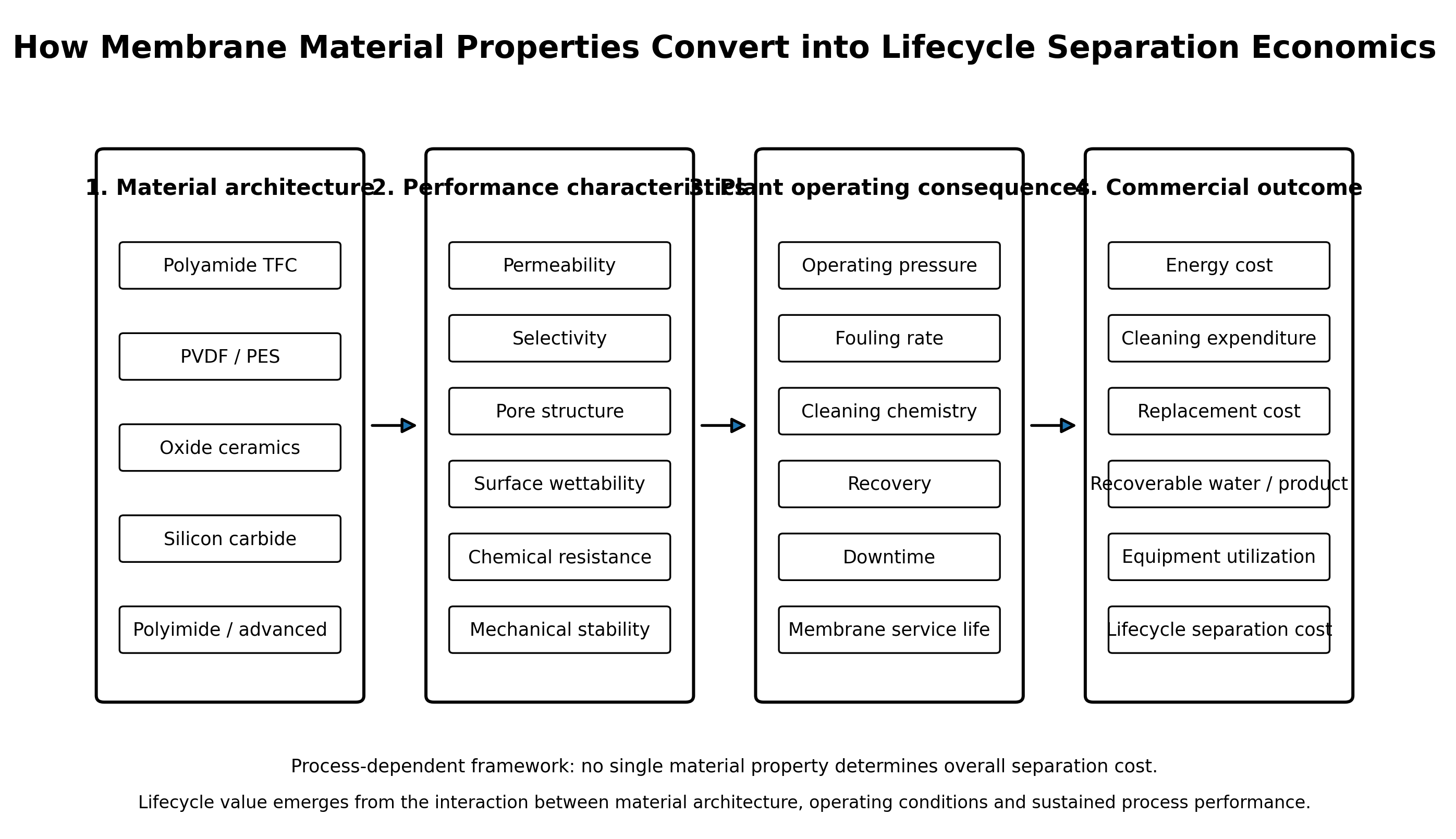
Membrane materials are usually compared through permeability, rejection, pore size, chemical resistance or molecular selectivity. For industrial buyers, however, those properties matter only when they remain stable under actual feed conditions. A membrane that produces high initial flux can lose its economic advantage if organic fouling increases cleaning frequency, oxidants degrade the selective layer, aggressive process chemistry shortens operating life, or a material change requires extensive requalification.
This is changing how membrane performance is valued across water treatment, industrial wastewater reuse, food processing, gas separation and biopharmaceutical manufacturing. Polyamide thin-film composites remain central to reverse osmosis and nanofiltration. PVDF and PES dominate many porous filtration applications. Alumina, zirconia, titania and silicon carbide extend filtration into more chemically and thermally demanding environments. Polyimides, biomimetic selective layers and carbon-based materials serve applications where molecular transport rather than conventional pore filtration determines process value.
The commercial comparison therefore extends beyond membrane purchase price. Energy consumption, fouling behavior, cleaning chemistry, recoverable product, membrane replacement, process downtime, validation requirements and manufacturing consistency together determine lifecycle separation economics.
Membrane Value Starts Where Material Properties Meet Operating Conditions
A membrane material does not create value through permeability or selectivity independently. Higher permeability can reduce required membrane area or operating pressure, but greater flux may also accelerate concentration polarization or fouling under particular feeds. Stronger selectivity can improve permeate quality while requiring higher pressure or reducing product recovery. Greater chemical resistance can support more aggressive cleaning but may come with higher material and module costs.
The commercial comparison therefore depends on the operating environment.
For municipal water treatment, membrane value is often measured through treated-water output, energy use, rejection stability, cleaning frequency and replacement interval. Industrial wastewater introduces greater variation in oils, organics, salts and suspended solids. Food processing adds product recovery and hygienic cleaning. Gas separation is evaluated through permeability, selectivity, pressure and valuable-gas recovery. Biopharmaceutical filtration adds validated retention, extractables, protein recovery and supplier qualification.
Table 1. Membrane Materials Change Different Parts of the Lifecycle Cost Equation
|
Material platform |
Principal commercial strength |
Important operating constraint |
Buyer-facing performance measure |
Main lifecycle-cost exposure |
|
Polyamide TFC |
High RO/NF selectivity with industrial-scale manufacturing |
Oxidant sensitivity and feed-dependent fouling |
Rejection, permeability, operating pressure |
Energy, cleaning and replacement |
|
PVDF |
Mechanical strength and chemical durability in UF/MBR applications |
Fluoropolymer regulatory exposure and application-specific fouling |
Flux stability, integrity and cleanability |
Service life, cleaning and qualification |
|
PES / PSU |
Established porous membrane processing and surface modification |
Performance varies with feed chemistry and foulants |
Flux, pore consistency and product interaction |
Fouling, cleaning and process qualification |
|
Alumina / zirconia / titania |
High thermal and chemical-cleaning tolerance |
Higher initial membrane and module cost |
Permeance, pore distribution and stability |
Capital cost versus operating life |
|
Silicon carbide |
Broad chemical resistance and harsh-feed compatibility |
Specialized manufacturing and module economics |
Flux recovery, chemical tolerance and durability |
Cleaning, membrane life and equipment utilization |
|
Polyimide / specialty gas polymers |
Selective molecular gas transport |
Plasticization and mixed-gas effects |
Permeability, selectivity and product recovery |
Compression energy and membrane life |
|
Biomimetic / carbon / advanced materials |
Specialized transport mechanisms |
Scale-up, defect control and qualification |
Application-specific selectivity and stability |
Manufacturing yield and commercialization cost |
The same material can therefore occupy very different value positions depending on the process. A lower-cost polymer can outperform an inorganic material where feeds are controlled and replacement is straightforward, while a higher-cost ceramic membrane can become economically attractive where aggressive cleaning, high temperatures or repeated membrane failure dominate operating expenditure.
Selective-Layer Engineering Is Moving the Economics Beyond Polymer Labels
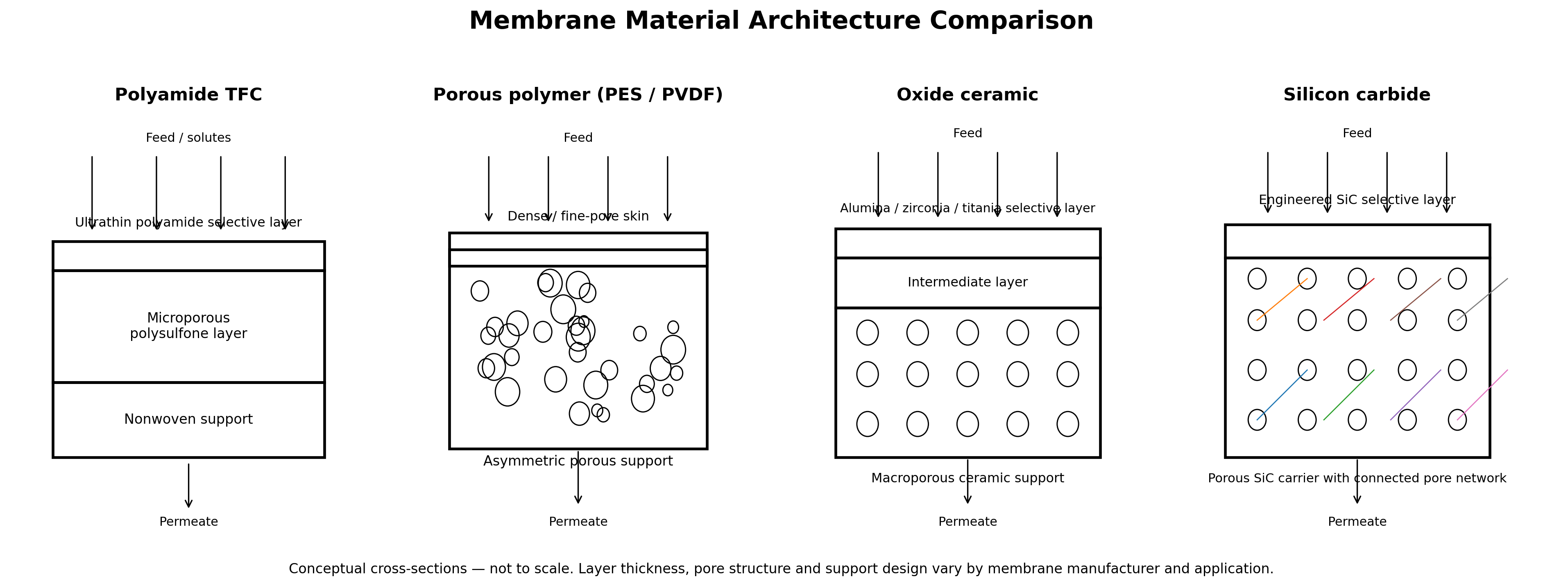
Polyamide thin-film composite membranes demonstrate why membrane chemistry alone provides an incomplete description of commercial performance. FilmTec nanofiltration membranes, for example, use a multilayer structure consisting of a polyester support web, a microporous polysulfone interlayer and an ultrathin polyamide selective barrier. Each layer performs a separate mechanical or transport function.
Commercial development is increasingly concentrated on tuning that architecture around specific process costs.
DuPont's upgraded FilmTec NF270-400/34, launched in March 2026, was reported to achieve equivalent flux with 6–10% lower energy consumption and up to 30% lower initial pressure drop than its preceding configuration. The significance is not simply an incremental membrane-performance improvement. Lower pressure requirements can reduce pumping demand, while lower pressure drop can influence hydraulic stability across membrane trains.
At the other end of the operating range, the 2026 Fortilife XC220 and XC-Max UHP products extend membrane concentration into much higher salinity conditions. DuPont specifies brine concentration up to 220 g/L NaCl for XC220 and up to 250 g/L for XC-Max UHP under their respective operating conditions. That moves membrane-based concentration further into applications where downstream thermal processes have traditionally carried a larger share of the separation load.
These developments illustrate how commercial polymeric membrane platforms are increasingly differentiated through pressure requirements, fouling behavior, concentration capability and recovery economics, rather than polymer identity alone.
Chemical Cleaning Can Reverse the Polymer-versus-Ceramic Cost Comparison
Initial membrane cost can provide a misleading comparison in chemically aggressive applications.
Polymeric membranes offer manufacturing scale, relatively low material cost and extensive installed infrastructure. In many water-treatment applications, those advantages are decisive. Their economic position can weaken, however, when feed conditions require frequent exposure to oxidants, extreme pH, solvents, elevated temperature or abrasive solids.
Ceramic materials move the cost equation in the opposite direction. Alumina, zirconia, titania and silicon carbide typically carry higher initial equipment costs, but their resistance to aggressive cleaning can permit operating regimes unavailable to many polymeric membranes.
Saint-Gobain's recrystallized silicon carbide Crystar platform, for example, specifies chemical resistance across pH 0–14, including operation with corrosive liquids and aggressive cleaning conditions. The material is also positioned around high-temperature and thermal-shock resistance.
Where cleaning intensity and membrane replacement materially affect production availability, the economics of ceramic membrane systems can therefore shift away from acquisition cost toward permeability recovery, chemical tolerance, membrane lifetime and avoided process interruption.
This distinction is particularly relevant in oily industrial wastewater, fermentation, chemical recovery and high-solids process streams. The financial value of a membrane capable of harsher clean-in-place conditions is partly determined by how quickly production capacity can be restored after fouling and how often the element requires replacement.
Figure 1. How Membrane Material Properties Convert into Lifecycle Separation Economics
Material Substitution Is Becoming a Qualification Problem, Not Simply a Resin Change
Fluoropolymer regulation is adding a new variable to membrane-material selection, particularly for PVDF-based ultrafiltration and membrane bioreactor products.
The European PFAS restriction process remains under evaluation rather than representing an existing blanket prohibition on PVDF membranes. ECHA's Risk Assessment Committee adopted its opinion on the universal PFAS restriction proposal in March 2026, while the broader scientific and socio-economic evaluation continued. ECHA's ongoing PFAS restriction evaluation therefore has relevance to membrane suppliers without establishing that all current fluoropolymer membrane applications are prohibited.
Veolia's October 2026 non-PVDF ultrafiltration development illustrates the commercial complexity of material substitution. The continuation of its existing PVDF portfolio shows that alternative membrane chemistries must be qualified against established filtration performance, cleaning conditions, and installed-equipment requirements before broader replacement occurs.
The transition from one membrane polymer to another is commercially more complex than changing raw resin. Membrane casting or spinning conditions, pore formation, mechanical strength, potting materials, cleaning protocols, integrity testing and drinking-water certifications can all require validation. Installed systems may also have operating histories based on the physical properties of the incumbent membrane.
Material substitution therefore creates a qualification and installed-base problem. An alternative polymer must reproduce sufficient permeability, durability and cleanability while fitting existing module manufacturing and operating requirements.
Ceramic Microstructure Is Becoming as Important as Ceramic Chemistry
Ceramic membranes are often described primarily by composition—alumina, titania, zirconia or silicon carbide. Recent technical work shows why that description is incomplete.
Fluid transport depends not only on nominal pore size but also on pore connectivity, through-pore density, selective-layer thickness, support resistance and internal flow distribution. Manufacturing processes such as powder preparation, coating and sintering therefore influence the usable permeance of the finished membrane.
In September 2026, Sumitomo Chemical's high-through-pore-density alumina development reported experimental ceramic microfiltration membranes with more than three times the steady-state permeance of the comparison membrane while maintaining comparable separation performance under the stated test conditions. The work, conducted with Kobe University, attributed the improvement to greater through-pore density rather than simply increasing nominal pore size.
This has direct commercial relevance if transferred successfully to industrial production. Higher stable permeance can reduce the membrane area required for a given filtration capacity, increase throughput within an existing module envelope, or reduce the frequency at which fouling limits useful production.
Silicon carbide approaches the same problem from a different material position. Its commercial appeal in difficult filtration environments combines pore architecture with corrosion resistance, thermal stability and low susceptibility to aggressive cleaning chemistry.
The comparison is therefore becoming more sophisticated than “polymer versus ceramic.” Membrane microstructure, surface properties and manufacturing repeatability determine how the intrinsic material properties translate into filtration capacity.
Gas Separation Shows Why Water-Treatment Metrics Cannot Define Material Value
Water-treatment membranes are commonly discussed through flux, rejection, transmembrane pressure and fouling. Gas separation requires a different performance language.
Gas membranes are evaluated through permeability, selectivity between molecular species, feed pressure, plasticization resistance, mixed-gas effects, product purity and recovery. Compression energy can dominate process economics, while losing a valuable gas such as methane or hydrogen through the permeate stream can materially alter project value.
Evonik's SEPURAN membranes use proprietary polyimide hollow fibers for separations involving carbon dioxide, methane, hydrogen and nitrogen. The company reports service lives exceeding ten years in applicable products and positions polymer durability alongside selectivity and energy efficiency.
Commercial scale is also becoming visible in manufacturing infrastructure. In June 2026, Air Products' USD 70 million gas-membrane manufacturing expansion opened in Missouri, adding capacity for PRISM membrane separators serving bio-LNG, nitrogen generation and other gas-processing applications.
These differences explain why membrane-material economics cannot be evaluated through a single permeability or rejection metric. Water purification, industrial gas upgrading, food concentration, and bioprocess filtration impose different requirements for selectivity, operating pressure, chemical compatibility, product recovery, and membrane lifetime. The same material property can therefore produce substantially different operating value across industrial applications.
Advanced Materials Face a Manufacturing and Qualification Threshold
High laboratory selectivity does not automatically produce a commercially viable membrane.
An advanced material must be manufactured reproducibly as a thin selective layer or fiber, maintain low defect rates, survive module fabrication, perform in representative feed mixtures and retain separation properties over commercially meaningful operating periods. Those requirements can be more restrictive than achieving a high permeability or rejection value in laboratory testing.
Toray's all-carbon CO₂/methane separation technology illustrates the importance of field duration. In January 2026, the company reported results from a one-year trial at a biogas facility in Japan and stated that moisture-removal costs were approximately 70% below the comparison technology under the evaluated conditions. The significance is not the percentage as an industry-wide benchmark; it is the movement of an emerging material platform into sustained operating validation.
Aquaporin's earlier biomimetic membrane development illustrates both the technical potential and commercialization risk associated with advanced selective layers. Its forward-osmosis membranes incorporated aquaporin proteins into a polyamide thin-film composite architecture, combining biological water-channel functionality with engineered membrane-support structures. The company's February 2026 bankruptcy demonstrates that membrane differentiation does not independently establish financial sustainability; repeatable manufacturing, customer qualification, commercial-scale orders, and operating revenue remain separate requirements.
That progression—from material concept through repeatable membrane production and application validation—is central to the broader membrane separation materials supply chain. Manufacturing yield, defect control, module integration and customer qualification can determine commercial viability as strongly as intrinsic membrane selectivity.
Table 2. Recent Membrane Material Developments and What They Demonstrate
|
Period |
Company |
Material development |
Commercialization stage |
What it demonstrates |
|
Mar. 2026 |
DuPont |
Upgraded FilmTec NF270 selective-layer platform |
Commercial product |
Lower pressure and energy can add value without changing the broad membrane chemistry |
|
Apr. 2026 |
DuPont |
Fortilife XC220 and XC-Max UHP |
Commercial product |
Polymeric membranes are extending further into high-brine MLD/ZLD duties |
|
Sep. 2026 |
Sumitomo Chemical |
High-through-pore-density alumina |
Material development / research |
Ceramic permeance can be increased through microstructure control rather than larger nominal pores |
|
Oct. 2026 |
Veolia |
Non-PVDF ultrafiltration membrane generation |
Development / planned commercial availability |
Material portfolios are diversifying in response to evolving fluoropolymer regulation |
|
Jan. 2026 |
Toray |
All-carbon CO₂/CH₄ separation membrane |
One-year field trial |
Emerging materials require longer-duration validation before broad commercialization |
|
Jun. 2026 |
Air Products |
PRISM membrane manufacturing expansion |
Commercial-scale manufacturing |
Gas-separation growth requires repeatable fiber production and module-scale supply |
Material Value Is Ultimately Determined at Process Level
The commercial separation value of a membrane material is established after chemistry meets feed composition, operating pressure, fouling, cleaning and production requirements.
Polyamide TFC remains highly valuable where selective salt or solute rejection can be delivered at practical pressure. PVDF and PES provide different balances of strength, processability and cleanability across porous membrane applications. Oxide ceramics and silicon carbide become more relevant when chemical and thermal tolerance reduce replacement or cleaning constraints. Polyimides monetize molecular selectivity in gas processing, while emerging carbon and biomimetic materials must demonstrate reproducible manufacturing and sustained field stability before laboratory advantages translate into broader industrial adoption.
The result is a shift away from simple material-price comparisons toward lifecycle separation economics.
A membrane with higher acquisition cost can create greater process value when it reduces energy, maintains permeability after cleaning, extends operating life, recovers more product, avoids production interruptions or supports separation conditions that would otherwise require additional treatment stages.
That is why membrane-material competition is increasingly determined not by a single property, but by how reliably the entire material architecture sustains separation performance over the operating life of the process.
Membrane Material Architecture Comparison