AI in Cosmetic Market Outlook: Hyper-Personalization and Tech-Driven Beauty Transformation
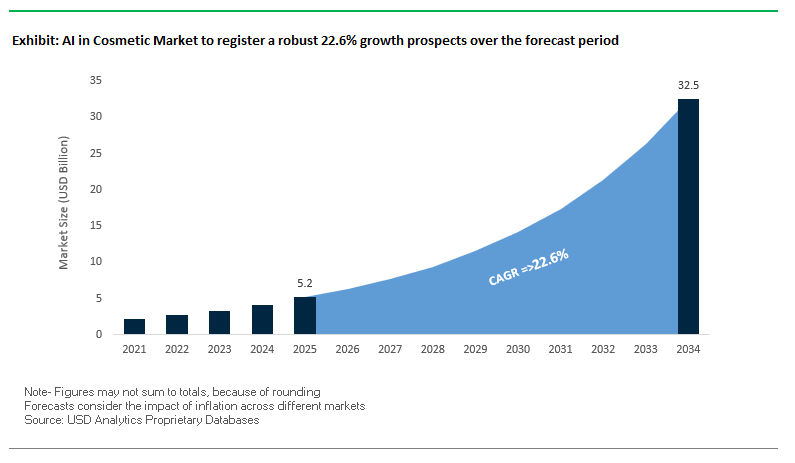
The global AI in cosmetic market is projected to expand from USD 5.2 billion in 2025 to USD 32.5 billion by 2034, growing at a CAGR of 22.6%. This high-growth market is being transformed by the coming together of artificial intelligence, augmented reality, and high-end data analytics to provide hyper-personalized skincare, makeup, and haircare experiences. As beauty companies move from mass-market solutions to customized solutions, AI is empowering precision diagnostics, real-time virtual try-ons, and ingredient-level formulation optimization. The technology is also emerging as a strategic lever for supply chain efficiency, inventory planning, and sustainable product development.
Key Insights for Industry Professionals
- AI Personalization at Scale: From selfie-based analysis to environmental factor consideration, AI delivers precision product matching.
- Virtual Try-On Integration: AR-powered real-time simulations reduce returns and increase online conversion rates.
- Smart Diagnostics Expansion: AI-powered skin analysis tools now assess wrinkles, pigmentation, acne, and hydration in seconds.
- Formulation Acceleration: Machine learning shortens R&D cycles by analyzing ingredient databases and clinical data.
- Omnichannel Optimization: AI supports both physical retail and e-commerce through customer data-driven insights.
AI in Cosmetic Market Analysis: Strategic Developments and Technological Milestones
The AI in the beauty space is seeing fast cycles of innovation, characterized by funding rounds, partnerships, and acquisitions that couple beauty knowledge with AI strengths. In February 2024, Shiseido collaborated with Accenture to bring AI formulation technology on board its "VOYAGER" platform, leveraging more than a century's worth of R&D information to speed up new product development. By July 2025, L'Oréal broadened its dermatological beauty business by acquiring UK's Medik8, enhancing its clinical skincare lineup and fortifying its AI-based diagnostic framework.
Funding activity also keeps pace. RENÉE Cosmetics raised $30 million in August 2025 to expand its technology-enabled beauty products, demonstrating the faith of investors in AI-driven personalization. Likewise, Blank Beauty raised a $6 million Series A in July 2025 to deepen its AI-based color science and robotics to support on-demand cosmetic manufacturing. In January 2025, Perfect Corp. acquired AR leader Wannaby, taking its virtual try-on capabilities into luxury fashion a step that highlights the worth of multi-category AI application.
Strategic collaborations are expanding AI’s role beyond consumer-facing tools. Estée Lauder, in partnership with Microsoft, launched an AI Innovation Lab in August 2025 to enhance demand forecasting, inventory optimization, and sustainability tracking. Additionally, Perfect Corp.’s AI Skin Analysis was rolled out for remote skincare televisits in August 2025, signalling a clear move toward tele-beauty solutions. M&A activity is also influencing the competitive profile, with e.l.f. Beauty in July 2025 declaring its intention to buy prestige beauty firm rhode for a maximum of $1 billion, with the objective of combining AI and digital strategies for international market development.
Emerging Trends and High-Growth Opportunities in the AI in Cosmetic Market
Generative AI Driving Hyper-Personalized Cosmetic Formulations
Generative AI is transforming product creation in the AI in cosmetic market by delivering hyper-personalized formulations at hitherto unprecedented velocity and magnitude. By processing massive ingredient datasets, consumer insights, and clinical trial outcomes, generative AI compresses R&D cycles by as much as 45% and cuts costs by about 30%, as evidenced through industry case studies. Predictive modeling guarantees 92% accuracy in predicting ingredient interaction and formula stability, so that brands can concentrate resources on the most promising formulations. Top cosmetic brands are tapping into AI-driven co-creation platforms, which allow consumers to become directly involved in product creation. This not only increases brand engagement but also guarantees that launches are exactly in tune with market demand. In addition, AI speeds up inventory planning and minimizes waste by allowing accurate forecasting, an important ability in a rapidly evolving beauty market.
Computer Vision Revolutionizing Real-Time Skin Diagnoses and Product Suggestions
Computer vision technology is being established as a key enabler of personalization in the AI in cosmetic business. Dermatology-trained AI models, developed from databases of more than 70,000 medically graded images, can have up to 95% test-retest reliability in detecting skin issues like wrinkles, pores, redness, and oiliness. The machines examine facial pictures pixel by pixel to create detailed reports of skin health and personalized product suggestions. Dermatologist validation boosts market confidence, with companies such as Vichy using AI-powered tools to suggest scientifically proven skincare regimes. Beyond diagnostics, computer vision is becoming an in-moment formulation tool, forecasting ingredient performance and allowing for personalized skincare solutions at the moment of contact, both online and in-store.
AI-Powered Skin Microbiome Fingerprinting for Personalized Skincare
Skin microbiome fingerprinting is one of the most exciting frontiers in the AI in cosmetic market. By charting an individual's microbial profile, AI makes it possible to formulate customized pre-, pro-, and postbiotic skincare products that target the underlying causes of conditions like acne, eczema, and rosacea. Commercial, at-home skin microbiome testing kits have already been introduced by companies, utilizing proprietary sequencing software to provide data-driven product recommendations. AI integration with genetic and microbiome information enables companies to create synbiotic formulas with specific prebiotics and probiotics for perfect skin wellness. Beyond enhancing treatment efficacy, the customized strategy integrates companies into the forefront of dermatological innovation.
Blockchain and AI for Ingredient Provenance and Supply Chain Transparency
The use of blockchain and AI in the cosmetic industry is transforming supply chain transparency and authenticity verification. Blockchain creates an indestructible record of each step of a product's lifecycle from source to shelf, allowing consumers to authenticate claims like "cruelty-free" or "organic" through QR code scans. AI adds value by processing real-time IoT sensor information to track ingredient purity, alerting on anomaly in storage environments such as temperature or humidity. This two-technology solution fights against counterfeit products, preserves brand reputation, and facilitates compliance with ethics-based sourcing requirements. Additionally, AI-driven smart contracts on blockchain platforms automate supplier payments and inventory tracking, streamlining operations and improving overall supply chain efficiency.
Market Share Insights of the AI in Cosmetic Industry
Market Share by Technology: Computer Vision Leads
Computer vision took the largest market share in AI in cosmetic in 2025 at 42% due to its extensive use across virtual try-on technologies and sophisticated skin diagnostics. These technologies lead the market because they can provide instant high-accuracy results which have an immediate impact on purchasing decisions. Machine learning, accounting for 30% of the market, drives most personalization recommendation engines, predictive analytics, and customer profiling software, allowing brands to personalize marketing campaigns and products. Generative AI is the most rapidly expanding category, transforming product development and marketing content generation, and Natural Language Processing (NLP) aids AI chatbots, virtual assistants, and customer sentiment analysis for customer interactions. Hybrid AI models, integrating several technologies, are becoming the norm for providing seamless personalization and operational effectiveness.
Market Share by Application: Virtual try-on Dominates
Virtual try-on is the leader in the application category with 35% market share due to consumers seeking innovative, AR-enabled makeup apps that enhance purchase confidence and lower returns. Customized skincare and makeup follow with 28% as AI-driven diagnostic platforms provide customized routines based on individual skin profiles. Customer support and marketing use cases deploy AI to produce hyper-personalized campaigns, materials, and instant consumer support, while formulation applies AI to speed up ingredient optimization and testing. Supply chain management, although a niche market, has considerable promise through AI-driven demand forecasting and blockchain-based traceability. Together, these uses make AI a critical growth driver for cosmetic companies seeking to drive customer experience and operational excellence.
.png)
Competitive Landscape – Leading Innovators in AI-Powered Beauty
The beauty tech AI leader is a combination of global beauty conglomerates and beauty tech specialist firms that embed AI in product development, consumer interaction, and operational effectiveness. The major players involved are L'Oréal, The Estée Lauder Companies Inc., Perfect Corp., Amorepacific Corporation, Shiseido Company, Limited, Procter & Gamble, Coty Inc., The Hut Group (THG), Revieve, Beiersdorf AG, Function of Beauty, Proven Skincare, Prose, Neutrogena (Johnson & Johnson), Curology, Others.
L'Oréal S.A. – Beauty Tech Champion with Innovative AI Diagnostics
L'Oréal's 2018 acquisition of ModiFace continues to be a landmark move, propelling its virtual try-on platforms across brands. Its AI diagnostic capabilities like SkinScreen by Lancôme and K-scan by Kérastase provide accuracy tests for skin and hair health. The company's tech incubator regularly deploys innovations like Makeup Genius and AI-driven smart hairbrushes. L'Oréal also leverages AI for tracking sustainability, joining hands with IMPACT+ to calculate and minimize CO₂ emissions from online campaigns.
The Estée Lauder Companies Inc. – AI-Driven Supply Chain and Consumer Experience
Estée Lauder's collaboration with Microsoft drives predictive supply chain and has yielded consumer applications such as the Voice-Enabled Makeup Assistant (VMA) for visually impaired consumers. The company's AI Innovation Lab speeds up R&D by mining large data sets for formulation intelligence. Its vision is to incorporate AI throughout the value chain to drive personalization, sustainability, and operational resilience.
Perfect Corp. – World Leading Virtual Try-On and AI-based Skin Analysis
Perfect Corp.'s YouCam Makeup and YouCam AR platforms are used by more than 500 international brands. Its AI Skin Analysis provides instant multi-parameter skin analyses, supporting both retail and clinical use. Wannaby's acquisition broadens its fashion-related AR and AI capabilities and enhances cross-category positioning. Performance analytics indicate AI implementation can increase conversion rates by more than 300%, such as in the case of NARS Cosmetics.
Shiseido Company, Limited – AI-Powered Formulation and Customized Beauty
Shiseido's adoption of AI in its VOYAGER platform speeds up the selection of ingredients and formulation of products. Its AI-powered in-store visualizer machines merge facial scans with questionnaire information to develop personalized skincare routines. Committed to its 2030 Vision, Shiseido is positioning itself to be at the forefront of personalized beauty and wellness through the combination of artisanal craftsmanship and cutting-edge AI in a "human-machine co-creation" approach.
United States: Hyper-Personalization, Virtual Try-On Leadership, and AI-Driven Compliance
The United States is at the forefront of AI-driven personalized skincare solutions, with brands deploying advanced algorithms to assess high-resolution selfies for signs of aging, pigmentation, and texture concerns. Platforms like Olay’s Skin Advisor are achieving up to 90% accuracy in predicting skin age, underscoring the role of AI in precision beauty recommendations. Augmented reality (AR) integrated with AI is transforming consumer engagement, with solutions from L’Oréal’s ModiFace and Perfect Corp. enabling real-time virtual try-ons for makeup and hair color, significantly improving conversion rates and reducing return rates for cosmetics.
AI is also streamlining product formulation through predictive modeling, allowing R&D teams to simulate ingredient interactions and predict product performance before physical prototyping. This has shortened development cycles and lowered costs. In operations, AI is optimizing supply chains through demand forecasting and inventory automation, ensuring better stock control. The Modernization of Cosmetics Regulation Act (MoCRA) is further fueling AI adoption for regulatory compliance, with AI-powered cosmetovigilance platforms automating adverse event reporting and regulatory documentation, ensuring U.S. brands meet evolving safety and transparency standards.
China: E-Commerce Integration, AI-Driven Personalization, and Beauty Tech Hardware Growth
China’s AI cosmetics sector thrives at the intersection of e-commerce, social media, and livestreaming commerce, where AI-enabled virtual try-on and recommendation engines deliver immersive, real-time shopping experiences to massive online audiences. This approach not only drives sales but also enables rapid consumer data collection for targeted marketing. Companies like Amorepacific are innovating with voice-activated AI chatbots and Micro LED beauty mirrors for advanced skin diagnostics and personalized skincare routines.
Personalization operates at massive scale, with AI analyzing social media trends, user reviews, and purchase patterns to tailor both marketing campaigns and product development. The market is also seeing a sharp rise in smart beauty devices from connected skin analyzers to intelligent mirrors integrated into at-home skincare ecosystems. These high-tech solutions align with Chinese consumers’ increasing comfort with AI-driven lifestyle technologies and their preference for highly customized beauty experiences.
European Union: Regulatory-Backed AI Innovation and Sustainable Supply Chain Transparency
The European Union’s AI cosmetics market is deeply shaped by stringent regulatory frameworks that prioritize sustainability, ethical sourcing, and consumer trust. Anti-greenwashing regulations are prompting brands to adopt AI tools capable of scientifically validating sustainability claims, including the use of bio-based or recycled ingredients. AI and blockchain technologies are also being combined to create immutable ingredient traceability systems, ensuring compliance with the EU’s transparency and ethical sourcing mandates.
In product safety, AI is supporting in silico toxicology to predict allergenicity and irritation potential, providing a regulatory-compliant alternative to animal testing while accelerating product launches. With GDPR enforcement, AI tools must be designed to protect consumer privacy, making transparency in data collection and algorithmic decision-making a competitive advantage. The EU’s combination of compliance-driven innovation, ethical sourcing technologies, and privacy-first AI is positioning its cosmetics sector as a global model for responsible AI adoption.
South Korea: K-Beauty AI Leadership, Smart Devices, and Generative Product Development
South Korea’s global leadership in K-Beauty is reinforced by its early adoption of AI for trend analysis, product development, and consumer engagement. Domestic brands are mining extensive datasets on consumer preferences, skin types, and global beauty trends to rapidly design and launch innovative products. The proliferation of smart skincare devices including portable analyzers and app-linked sensors allows consumers to monitor their skin conditions in real-time, with AI tailoring product recommendations to environmental and seasonal factors.
Generative AI is emerging as a powerful tool for both cosmetic formulation design and marketing content creation, enabling hyper-targeted campaigns and even AI-generated visuals customized for specific consumer segments. This tech-enabled agility supports South Korea’s ability to set beauty trends worldwide and reinforces its competitive position in both premium skincare technology and fast-moving consumer cosmetics.
AI in Cosmetic Market Report Scope
AI in Cosmetic Market
|
Parameter
|
Details
|
|
Market Size (2025)
|
$5.2 Billion
|
|
Market Size (2034)
|
$32.5 Billion
|
|
Market Growth Rate
|
22.6%
|
|
Segments
|
By Technology (Machine Learning, Computer Vision, Generative AI, Natural Language Processing), By Application (Personalized Skincare & Makeup, Virtual Try-on, Product Formulation & R&D, Supply Chain Management, Customer Service & Marketing), By End-Use Sector (Skincare, Makeup, Haircare, Fragrance), By Distribution Channel (Online Retail (E-commerce, Brand Websites), Offline Retail (Specialty Stores, Department Stores)), By Pricing (Mass Market, Premium, Luxury)
|
|
Study Period
|
2019- 2024 and 2025-2034
|
|
Units
|
Revenue (USD)
|
|
Qualitative Analysis
|
Porter’s Five Forces, SWOT Profile, Market Share, Scenario Forecasts, Market Ecosystem, Company Ranking, Market Dynamics, Industry Benchmarking
|
|
Companies
|
L'Oréal, The Estée Lauder Companies Inc., Perfect Corp., Amorepacific Corporation, Shiseido Company, Limited, Procter & Gamble, Coty Inc., The Hut Group (THG), Revieve, Beiersdorf AG, Function of Beauty, Proven Skincare, Prose, Neutrogena (Johnson & Johnson), Curology, Others.
|
|
Countries
|
US, Canada, Mexico, Germany, France, Spain, Italy, UK, Russia, China, India, Japan, South Korea, Australia, South East Asia, Brazil, Argentina, Middle East, Africa
|
AI in Cosmetic Market Segmentation
By Technology
- Machine Learning
- Computer Vision
- Generative AI
- Natural Language Processing
By Application
- Personalized Skincare & Makeup
- Virtual Try-on
- Product Formulation & R&D
- Supply Chain Management
- Customer Service & Marketing
By End-Use Sector
- Skincare
- Makeup
- Haircare
- Fragrance
By Distribution Channel
- Online Retail
- E-commerce
- Brand Websites
- Offline Retail
- Specialty Stores
- Department Stores
By Pricing
- Mass Market
- Premium
- Luxury
Countries Analyzed
- North America (US, Canada, Mexico)
- Europe (Germany, UK, France, Spain, Italy, Russia, Rest of Europe)
- Asia Pacific (China, India, Japan, South Korea, Australia, South East Asia, Rest of Asia)
- South America (Brazil, Argentina, Rest of South America)
- Middle East and Africa (Saudi Arabia, UAE, Rest of Middle East, South Africa, Egypt, Rest of Africa)
Top Companies in AI in Cosmetic Market
- L'Oréal
- The Estée Lauder Companies Inc.
- Perfect Corp.
- Amorepacific Corporation
- Shiseido Company
- Limited
- Procter & Gamble
- Coty Inc.
- The Hut Group (THG)
- Revieve
- Beiersdorf AG
- Function of Beauty
- Proven Skincare
- Prose
- Neutrogena (Johnson & Johnson)
- Curology
* List Not Exhaustive
Research Coverage
This report investigates the AI in Cosmetic Market, connecting demand signals from hyper-personalized skincare, AR/virtual try-on, and AI formulation to supply-side shifts in data infrastructure, compliance, and retail activation. Built by USDAnalytics, it captures breakthroughs in computer vision diagnostics, generative-AI pipelines, and blockchain-backed provenance; delivers analysis reviews on monetization models and margin lift; and distills highlights on where value pools are forming across brands, beauty-tech vendors, and retailers. By translating standards, privacy rules, and ecosystem partnerships into quantified growth pathways, this report is an essential resource for executives, product leaders, investors, and operators planning roadmaps, budgets, and M&A in tech-driven beauty. Scope includes-
- Segmentation (covered end-to-end):
- By Technology: Machine Learning, Computer Vision, Generative AI, Natural Language Processing
- By Application: Personalized Skincare & Makeup, Virtual Try-on, Product Formulation & R&D, Supply Chain Management, Customer Service & Marketing
- By End-Use Sector: Skincare, Makeup, Haircare, Fragrance
- By Distribution Channel: Online Retail, Offline Retail
- By Pricing: Mass Market, Premium, Luxury
- Geographic Scope: 25+ countries across North America, Europe, Asia Pacific, Latin America, and the Middle East & Africa.
- Timeframe: Historic 2021–2024; forecast 2025–2034.
- Companies: Strategy assessments and profiles of 15+ leaders and innovators.
Methodology
USDAnalytics applies a triangulated method: primary interviews with beauty conglomerates, indie brands, dermatology KOLs, retailers, cloud/AI vendors, and regulators; plus secondary research spanning patents, clinical literature, SaaS pricing sheets, SDK/API docs, certification and privacy guidance, and marketplace telemetry. We size demand bottom-up by country and channel using adoption curves for virtual try-on, diagnostics, and AI formulation suites, then reconcile top-down to beauty category revenues and device installs. Forecasts incorporate scenario tests for privacy rules (e.g., consented imagery), GPU/compute pricing, model-accuracy gains, and retail return-rate deltas from try-on. Competitive benchmarking scores vendors on model performance, inference latency, bias controls, integration effort (SDK time-to-value), and unit economics (conversion lift, AOV, return reduction). Sensitivity and triangulation checks ensure robustness.
Deliverables:
- Comprehensive Market Research Report (PDF and Excel) with detailed tables, charts, and interactive visualizations.
- Country-Specific Forecasts & Analysis.
- Segment-Wise Revenue Forecasts (2025–2034).
- Competitive Analysis, Benchmarking, and SWOT Profiles.
- Recent Developments & Innovation Tracker.
- Executive Summary & Analyst Commentary.
- Post-Purchase Analyst Support for Client-Specific Questions and Custom Data Requirements.
