Commercial Car Care Cosmetics Market Outlook – Premium Detailing, Protective Coatings, and DIY Growth
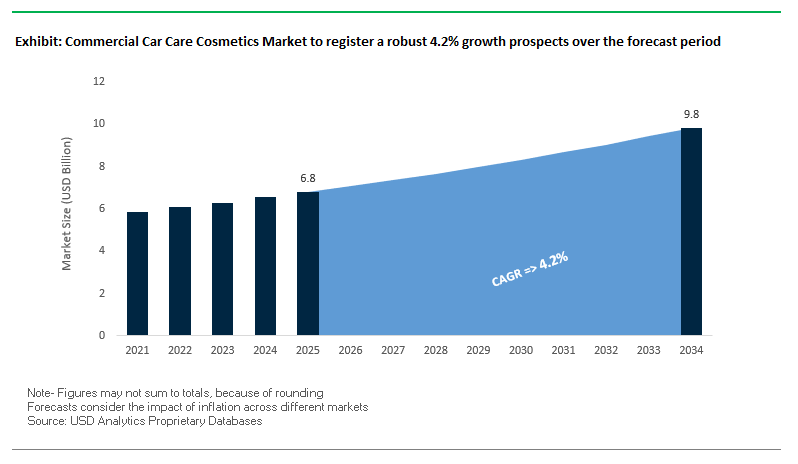
The global commercial car care cosmetics market is forecast to expand from USD 6.8 billion in 2025 to USD 9.8 billion by 2034, registering a CAGR of 4.2%. This growth is fueled by a high demand from consumers for vehicle appearance, long-term protection, and advanced protection solutions. Professional detailing stores and the increasing do-it-yourself (DIY) segment are both being targeted by the market, with increased demand for multi-purpose products with cleaning, polishing, and protection in one application. Increased application of ceramic coatings, paint protection films, and nanotechnology-based solutions is rendering products longer lasting and requiring less maintenance.
Key Insights for Industry Professionals
- Exterior Detailing Dominance – Over 62% of demand comes from exterior cleaning and detailing products, led by waxes, polishes, and coatings.
- Passenger Vehicle Focus – More than 58% of usage is linked to passenger cars, with premium car owners forming a significant high-spend customer segment.
- Multifunctional Demand – Over 57% of buyers prefer all-in-one solutions that save time and effort while delivering professional-grade results.
- Recurring Purchase Behavior – Around 65% of vehicle owners invest regularly in car care, with waxing and polishing representing 38% of product demand.
- Advanced Formulations – Ceramic and nanotech-infused solutions are driving innovation in durability, scratch resistance, and gloss retention.
Commercial Car Care Cosmetics Market Analysis – Recent Developments and Strategic Shifts
The market continues to experience a technology-led shift in direction with a concentration on innovative surface protection, sustainability, and tailored solutions. The trends in demand in July 2025 indicated that 63% of users were in search of appearance-enhancing products and 58% for exterior maintenance and paint protection, further highlighting the significance of preservation of beauty in buying decisions.
Motul expanded its product portfolio in January 2025 with the launch of a comprehensive Car Care series of high-performance cleaning products, accessories, and detailing products aimed at performance. Similarly, LIQUI MOLY launched a Display Cleaner and Detailer in June 2025 to cater to the rising need for interior screen care in safer vehicles. Self-healing ceramic coatings, launched in September 2024, are revolutionary technology, and minor swirl marks can be made to disappear with the application of heat, boosting the demand for high-end protection services.
Global M&A activity is impacting distribution channels and product penetration. Acquisition of Iveco Group N.V. by Tata Motors in July 2025 has the potential to drive demand for commercial vehicle-specific vehicle care products, especially for fleet maintenance. Greater application of AI, robotics, and sanitation technology demonstrated by YEEDI's M14 PLUS robot is driving potential future vehicle cleaning automation. Across the industry, awareness of regulation is growing, with companies adopting best practice to meet evolving trade and safety regulations and ensure continuous supply chains.
Technological Trends and Emerging Opportunities in the Commercial Car Care Cosmetics Market
Graphene-Based Ceramic Coatings: Next-Generation Paint Protection
The use of graphene-based ceramic coating is transforming long-term car surface protection. By adding graphene a material harder than steel but incredibly flexible to ceramic coating formulations, manufacturers produce an ultra-long-lasting shield that resists UV degradation, chemical etching, and micro-scratches for up to ten years. Its honeycomb molecular structure reduces cracking and increases resilience in high-heat conditions, which is especially desirable in warm climate markets. The exceptional hydrophobic performance provides better water beading and sheeting, making maintenance easier while shortening wash intervals. Additionally, the intrinsic anti-static nature of graphene repels dust and debris, enabling vehicles to look better in the showroom for a longer time. This technology is positioning graphene coatings as a high-end option for both consumer detailing and commercial fleet maintenance.
Water Recycling Pressure Washers: Sustainability Meets Cost Efficiency
Stricter environmental regulations and tighter water rationing are compelling the adoption of water recycling pressure washing equipment on commercial car wash operations. Closed-loop systems recycle and filter up to 85% of wash water, enabling compliance with drought-related regulations and reducing utility cost. In addition to cost savings, businesses utilizing water reclamation technology construct their green brand identity, attracting environmentally conscious consumers as well as setting themselves apart in competitive markets. Increased filtration to remove micro-particles and hydrocarbons is also being adopted by the majority of operators, reconciling environmental compliance with high-performance cleaning demands while maximizing cleaning capacity.
Opportunity: Autonomous AI-Drone Drying Systems
Car drying still is an automatic car wash process bottleneck, and autonomous drone drying presents a breakthrough solution. Artificial intelligence-based vision systems can identify residual water spots and direct drones to use high-pressure air nozzles on wet spots alone, conserving energy from wasted airflow. Targeted drying not only provides cost savings in operations but also eliminates physical contact, eliminating the risk of micro-abrasions or swirl marks critical for luxury and performance vehicles. This opportunity is particularly attractive to technology companies seeking to introduce robotics and AI to high-volume commercial car care.
Opportunity: EV-Specific Car Care Formulations
Increased adoption of electric vehicles is driving demand for EV-safe detailing chemicals that safeguard high-voltage equipment and deliver best-in-class looks. Battery-safe cleaners, non-conductive degreasers, and regenerative braking dust wheel cleaning recipes will be new product lines. Positioning the lines as EV-specialized products allows brands to connect with a rapidly expanding, value-driven customer base that is attuned to sustainability concerns. With EV owners more likely to pay a premium for high-performance maintenance, the opportunity gives manufacturers the potential to claim a high-value niche before the market becomes saturated.
Commercial Car Care Cosmetics Market Share and Segmentation Insights
Market Share by Product Type: Cleaning Products Lead, Protective Coatings Accelerate
Cleaning Products are at 35% because of consistent demand from commercial car washes, dealerships, and fleets. The segment is shifting toward biodegradable, pH-balanced, and water-conserving formulations that are environmentally friendly without compromising on professional-level cleaning capability. Polishing & Waxing Products account for 30%, with ceramic and graphene waxes driving premiumization. Protective Coatings are the fastest-growing subsegment, with commercial and individual owners both appreciating paint protection and UV protection. Interior Care Products are driven by increased hygiene issues, with antimicrobial dashboard sprays and leather conditioners seeing high usage in used-car refurbishment and luxury detailing.
.png)
Market Share by Specialty Products: Glass Cleaners Dominate, Tire Dressings Regain Momentum
Glass Cleaners have the highest specialty product penetration at 40% because safety-critical, streak-free visibility in consumer and fleet segments is driving demand. Advances in anti-fog and rain-repellent additives enhance product performance. Tire Dressings are next at 30%, rebounding as post-pandemic detailing services experience surging demand for cosmetic tire improvement and UV protection. Bug & Tar Removers are evolving with eco-friendly, non-acidic products aimed at seasonal and geographic needs, while Wheel Cleaners as a niche are a necessity in high-end vehicle care. Overall, across specialties, the market is moving toward multi-functional, high-performance products with professional outcomes and consumer-level ease of use.
Competitive Landscape – Leading Innovators in Car Care Solutions
The global commercial car care cosmetics industry is characterized by international brands that leverage heritage, R&D superiority, and distribution muscle to address professional and DIY bases. Major players that are included are 3M, Wahl Clipper Corporation, Turtle Wax, Inc., The Armor All/STP Products Company, S. C. Johnson & Son, Inc. (Glade), Chemical Guys, SONAX GmbH, Adolf Würth GmbH & Co. KG, Autoglym, Liqui Moly GmbH, Cartec B.V., Jopasu Systems Pvt. Ltd., Soft99 Corporation, Simoniz USA, Inc., Mothers Polishes Waxes Cleaners, Others.
3M Company – Innovation-Driven Automotive Appearance Solutions
3M taps into decades of material science knowledge to provide a broad spectrum of automotive detailing and repair products. Its portfolio comprises abrasives, adhesives, sealants, waxes, polishes, headlight restoration kits, and scratch removers. The company's approach incorporates consumer-friendly do-it-yourself kits and professional-level systems, complemented by instructional materials to help deliver the best results. 3M's ecosystem strategy designing products and consumables to integrate with each other supports its presence in both auto body repair stores and home garages. Its brand equity and technology leadership make it the go-to provider for appearance restoration and protection.
Illinois Tool Works Inc. (ITW) – Heritage Brands Powering Aftermarket Growth
ITW's Polymers & Fluids segment underpins its presence in automobile care with brands Rain-X, Slime, and Permatex. These range from windshield treatments to sealants and adhesives relied upon by technicians globally. ITW is a master at product innovation and retail penetration, serving mass-market retailers and specialty stores alike. Its strategy of emphasizing high-recognition brands guarantees repeat customer loyalty, with continued R&D providing performance enhancements in durability, ease of use, and environmental compliance. By integrating mass distribution with focused brand placement, ITW has a firm competitive advantage in premium as well as daily car care.
Würth Group – Professional Car Care Maintenance and Detailing Solutions
The Auto Division of Würth Group provides a wide range of chemical-technical products, detailing materials, and repair goods. Its direct sales structure supports close customer relationships with mechanics, body shops, and detailers worldwide. With more than 400 firms operating in 80+ nations, Würth's size facilitates quick market flexibility and stable product availability. Its acquisition of LIQUI MOLY added premium lubricants and cleaning products to enhance its automotive chemical offerings. Würth's vision of being a one-stop professional supplier resonates with the expectations of commercial customers to deliver dependability, technical guidance, and product depth.
Turtle Wax, Inc. – Legacy Brand Reinventing Shine and Protection
Turtle Wax is a leading car care name worldwide, linked with waxes, polishes, and protection products for more than seven decades. Its pipeline of innovation involves ceramic-infused waxes, synthetic sealants, and innovative cleaning formulations for lasting gloss and durability. Its award-winning product lines serve enthusiasts and mainstream consumers alike, offering accessibility without any compromise on performance. Turtle Wax continues to evolve its branding and formulations to match consumer preferences for ease of use, higher protection, and environmental packaging.
Sonax GmbH – European High-End Surface Care Expertise
Sonax is famous for scientifically developed cleaning and protection products relied on in more than 100 countries. Its range of products includes manual wash items, automatic car wash chemicals, polishes, waxes, and glass cleaners, both for professional detailers and retail purchasers. The dedication to R&D by the brand guarantees continuous innovation, with products specifically designed to maintain both optical beauty and functional longevity. Through international growth, the emphasis on high-quality formulas, and strong professional support, Sonax established itself as a global expert in high-performance vehicle surface care.
United States: Innovation Leadership, Sustainability, and Service Network Expansion
The United States is a global leader in car care technology development, with companies like Chemical Guys pushing the boundaries through product innovations such as “HydroInterior” ceramic-infused cleaning solutions that extend ceramic protection to interior surfaces. Sustainability is becoming a core differentiator, with brands like 3M introducing eco-friendly waterless wash kits made from biodegradable components, achieving a 33% reduction in water use per wash during trials.
Franchise expansion is a key growth driver, as detailing and car wash chains broaden their networks and premium service offerings, including ceramic coatings and paint protection films (PPF). Digital integration is also reshaping the market, with AI-powered online tools offering personalized product recommendations based on vehicle type, color, and local climate conditions. The robust U.S. used car market further amplifies demand, as owners seek high-quality products to restore and maintain pre-owned vehicles.
Germany – Chemical Excellence, B2B Strength, and Regulatory-Driven Innovation
Germany’s market stands out for advanced chemical formulations in car care cosmetics. SONAX GmbH’s premium ceramic spray line now offers a formula delivering 41% greater surface durability with enhanced UV resistance and water-beading properties. The country’s strong B2B segment is fueled by demand from professional detailing centers and automotive workshops tied to its world-renowned automotive manufacturing base.
Strict EU environmental regulations push companies to develop biodegradable and low-toxicity products, ensuring compliance while meeting consumer expectations for safety and sustainability. High levels of brand loyalty in Germany further motivate established brands to continuously innovate while maintaining uncompromising quality standards.
Japan – Premium Aesthetics, Niche Specialization, and Eco-Innovation
Japan’s commercial car care cosmetics market thrives on aesthetic precision and product specialization. SOFT99 Corporation’s recent launch of an all-vegan interior cleaner series gained strong traction with environmentally conscious consumers, reflecting a growing alignment between performance and sustainability. Japanese car owners place a high emphasis on high-gloss finishes and long-lasting protective solutions, driving demand for premium waxes, polishes, and sealants.
The country’s growing e-commerce penetration allows for greater access to niche products and extensive consumer reviews, influencing purchase decisions. Japanese brands are particularly adept at creating specialized formulations for different paint types, glass surfaces, and interior materials, catering to the exacting standards of local car enthusiasts.
India – Franchise Expansion, Domestic Production, and Rising Car Care Awareness
India’s car care cosmetics sector is undergoing rapid franchise network expansion, with brands like 3M Car Care, The Detailing Mafia, and CarzSpa opening detailing studios nationwide. These facilities offer services ranging from foam washing to high-end ceramic coatings, tapping into growing urban vehicle ownership.
Government programs such as Make in India and the Production Linked Incentive (PLI) Scheme are fostering domestic manufacturing, indirectly supporting local car care production. Increased vehicle sales, coupled with higher disposable incomes, are boosting demand for both DIY car care kits and professional detailing services. Rising awareness of vehicle maintenance as a way to preserve resale value is driving broader adoption of premium car care solutions.
Brazil – Sustainable Innovation, Premiumization, and Market Potential
Brazilian companies are advancing sustainability and innovation by leveraging agricultural by-products in car care formulations and integrating advanced production technologies. This reflects a wider national trend toward environmental responsibility. While the government’s public investment in unrelated sectors (e.g., public pet hospitals) does not directly impact car care, it signals a policy environment open to quality-of-life and ancillary industry support.
The premiumization trend is accelerating, with Brazilian car owners increasingly investing in high-performance cosmetics that protect paint finishes and elevate vehicle aesthetics. This willingness to spend on quality products positions Brazil as a strong growth market in Latin America’s car care cosmetics industry.
Commercial Car Care Cosmetics Market Report Scope
Commercial Car Care Cosmetics Market
|
Parameter
|
Details
|
|
Market Size (2025)
|
$6.8 Billion
|
|
Market Size (2034)
|
$9.8 Billion
|
|
Market Growth Rate
|
4.2%
|
|
Segments
|
By Product Type (Cleaning Products (Shampoos, Degreasers, Wheel Cleaners), Polishing & Waxing Products, Protective Coatings (Ceramic, Graphene), Interior Care Products (Upholstery Cleaners, Conditioners, Air Fresheners), Specialty Products (Glass Cleaners, Tire Dressings, Bug & Tar Removers)), By Application (Exterior, Interior), By Distribution Channel (Offline (Specialty Stores, Automotive Dealerships, Supermarkets), Online (E-commerce Platforms, Brand Websites))
|
|
Study Period
|
2019- 2024 and 2025-2034
|
|
Units
|
Revenue (USD)
|
|
Qualitative Analysis
|
Porter’s Five Forces, SWOT Profile, Market Share, Scenario Forecasts, Market Ecosystem, Company Ranking, Market Dynamics, Industry Benchmarking
|
|
Companies
|
3M, Wahl Clipper Corporation, Turtle Wax, Inc., The Armor All/STP Products Company, S. C. Johnson & Son, Inc. (Glade), Chemical Guys, SONAX GmbH, Adolf Würth GmbH & Co. KG, Autoglym, Liqui Moly GmbH, Cartec B.V., Jopasu Systems Pvt. Ltd., Soft99 Corporation, Simoniz USA, Inc., Mothers Polishes Waxes Cleaners, Others.
|
|
Countries
|
US, Canada, Mexico, Germany, France, Spain, Italy, UK, Russia, China, India, Japan, South Korea, Australia, South East Asia, Brazil, Argentina, Middle East, Africa
|
Commercial Car Care Cosmetics Market Segmentation
By Product
- Cleaning Products (Shampoos, Degreasers, Wheel Cleaners)
- Polishing & Waxing Products
- Protective Coatings (Ceramic, Graphene)
- Interior Care Products
- Upholstery Cleaners
- Conditioners
- Air Fresheners
- Specialty Products
- Glass Cleaners
- Tire Dressings
- Bug & Tar Removers
By Application
By Distribution Channel
- Offline
- Specialty Stores
- Automotive Dealerships
- Supermarkets
- Online
- E-commerce Platforms
- Brand Websites
Countries Analyzed
- North America (US, Canada, Mexico)
- Europe (Germany, UK, France, Spain, Italy, Russia, Rest of Europe)
- Asia Pacific (China, India, Japan, South Korea, Australia, South East Asia, Rest of Asia)
- South America (Brazil, Argentina, Rest of South America)
- Middle East and Africa (Saudi Arabia, UAE, Rest of Middle East, South Africa, Egypt, Rest of Africa)
Top Companies in Commercial Car Care Cosmetics Market
- 3M
- Wahl Clipper Corporation
- Turtle Wax Inc.
- The Armor All/STP Products Company
- S. C. Johnson & Son Inc. (Glade)
- Chemical Guys
- SONAX GmbH
- Adolf Würth GmbH & Co. KG
- Autoglym
- Liqui Moly GmbH
- Cartec B.V.
- Jopasu Systems Pvt. Ltd.
- Soft99 Corporation
- Simoniz USA Inc.
- Mothers Polishes Waxes Cleaners
* List Not Exhaustive
Research Coverage
Prepared by USDAnalytics, this report investigates the global Commercial Car Care Cosmetics Market, unpacking demand patterns across professional detailing and DIY buyers, assessing technology breakthroughs such as graphene-ceramic protection and water-recycling wash systems, and mapping how premiumization and sustainability reshape product mixes. Our analysis reviews revenue pools by product family and specialty items, evaluates channel shifts as online accelerates, and benchmarks regional growth dynamics in the U.S., Germany, Japan, India, and Brazil. The study highlights emerging opportunities—from EV-safe chemistries to autonomous drying workflows—and the competitive moves of leading brands expanding high-margin coating portfolios. With defensible sizing, pricing intelligence, and scenario forecasts through 2034, this report is an essential resource for chemical formulators, distributors, franchise operators, and investors planning capacity, branding, and go-to-market strategies. Scope includes-
- Segmentation:
- By Product – Cleaning Products; Polishing & Waxing Products; Protective Coatings (Ceramic, Graphene); Interior Care Products; Specialty Products.
- By Application – Exterior; Interior.
- By Distribution Channel – Offline; Online.
- Geographic Scope: Analysis spans 25+ countries across North America, Europe, Asia Pacific, Latin America, the Middle East & Africa.
- Time Frame: Historic data 2021–2024 and forecast data 2025–2034.
- Companies: Analysis/profiles of 15+ companies including 3M, Turtle Wax, SONAX GmbH, Chemical Guys, Würth Group, Autoglym, Liqui Moly GmbH, Soft99, The Armor All/STP Products Company, S. C. Johnson & Son (Glade), Cartec B.V., Simoniz USA, Mothers, Jopasu Systems, and others.
Methodology
USDAnalytics applied a mixed-methods approach combining top-down and bottom-up sizing. We compiled secondary evidence (company filings, trade statistics, patent and safety databases, retail panels, and tender records) and executed primary interviews with formulators, detailer chains, car-wash operators, e-commerce marketplaces, and regional distributors to validate volumes, ASPs, and channel margins. Market models normalize pricing (retail vs. pro concentrates), convert liters to value, and reconcile fleet vs. passenger car use. Forecasts (2025–203leverage time-series econometrics, EV-park growth, solvent/commodity cost curves, and regulatory scenarios (water, VOC, REACH). Quality control includes triangulation across sources, sensitivity tests on elasticity and adoption of graphene coatings, and cross-checks against import/export flows.
Deliverables:
- Comprehensive Market Research Report (PDF and Excel) with detailed tables, charts, and interactive visualizations.
- Country-Specific Forecasts & Analysis.
- Segment-Wise Revenue Forecasts (2025–2034).
- Competitive Analysis, Benchmarking, and SWOT Profiles.
- Recent Developments & Innovation Tracker.
- Executive Summary & Analyst Commentary.
- Post-Purchase Analyst Support for Client-Specific Questions and Custom Data Requirements.
