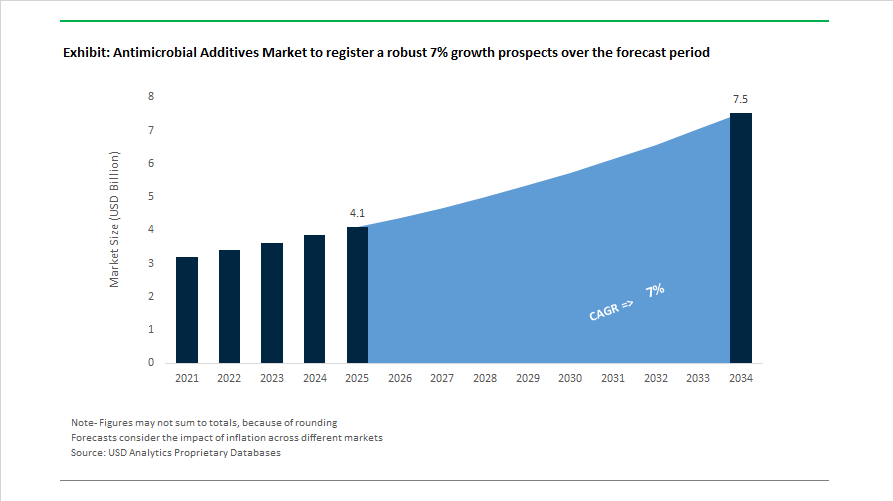
The antimicrobial additives market is valued at $4.1 billion in 2025 and is projected to reach $7.5 billion by 2034, advancing at a 7% CAGR. Growth is anchored in demand for built-in antimicrobial plastics, odor-control textile finishes, healthcare polymer additives, antimicrobial powder coatings, food-contact antimicrobial films, and non-PFAS hygiene technologies. High-touch surfaces in medical diagnostics, public infrastructure, polymer consumer goods, and performance textiles are shifting from surface sprays to embedded antimicrobial technologies that offer long-term efficacy, regulatory traceability, and resistance to wash-off degradation. Innovation priorities include heavy-metal-free odor control, bio-based antimicrobial masterbatches, low-haze optical additives for clear plastics, ISO and USP medical compliance, EU BPR approvals, and migration-safe additives for food packaging plastics.
Regulatory and sustainability realignment shaped early market evolution. In February 2024, Silver Zinc Zeolite received positive support from the EU Biocidal Products Committee for use across disinfectants, film preservatives, and polymerized materials, strengthening confidence in inorganic antimicrobial technologies. In April 2024, BASF launched a food-grade antimicrobial additive line for plastic packaging, engineered to inhibit bacterial growth on film surfaces without food migration. During 2024, Microban expanded its Lab Center of Excellence and introduced Freshology nature-inspired odor control, compliant with China’s GB/T 33610 textile standard. The same year, Milliken & Company delivered the first fully non-PFAS firefighter turnout textiles integrating antimicrobial and flame-retardant performance. AkzoNobel integrated BioCote into its Interpon D powder coatings portfolio in 2024, targeting hospitals and public buildings.
Medical polymer innovation accelerated in January 2025 when Avient presented antimicrobial PCR plate materials at Pharmapack, reducing optical crosstalk in diagnostics. In February 2025, Avient launched Cesa WithStand SX additives for clear polycarbonates, maintaining optical clarity while enabling microbial resistance on transparent barriers. Healthcare material upgrades continued in November 2025 when Avient introduced non-PFAS Mevopur additives for pipette tips at Medica, eliminating silicone coatings and meeting ISO and USP medical standards. By late 2025, Avient expanded its Mevopur portfolio to bio-based polymers, lowering carbon footprint in medical devices. Textile and polymer hygiene converged in February 2026 as Sanitized AG formed an exclusive global distribution alliance with Rudolf Group, streamlining compliance in the garment sector. In the same month, Microban presented Ascera and LapisShield antimicrobial technologies at PLASTINDIA 2026, highlighting acid-inspired antibacterial systems and water-based coating protection for glass and polymer surfaces.
Trends and Opportunities Transforming the Antimicrobial Additives Market
The Global Antimicrobial Additives Market is evolving rapidly as hygiene-centric construction practices, regulatory crackdowns on legacy biocides, and sustainability-driven material innovation reshape demand across plastics, paints & coatings, healthcare surfaces, and food-contact applications. Growth is increasingly concentrated in built-in antimicrobial polymers, non-leaching antimicrobial technologies, and bio-based antimicrobial additives, as manufacturers pivot away from temporary surface coatings toward lifetime-integrated protection. These shifts are redefining product development strategies across commercial infrastructure, medical devices, packaging, and consumer goods.
Hygienic-by-Design Construction Drives Permanent Antimicrobial Integration in High-Touch Materials
Post-pandemic building standards have normalized the “hygienic-by-design” philosophy, accelerating the permanent integration of antimicrobial additives directly into polymer and ceramic matrices. At PLASTINDIA 2026, Microban International highlighted surging adoption of built-in antimicrobial protection across transportation hubs and marine environments, where treated PVC flooring and technical fabrics are now standard specifications to prevent biofilm formation and material degradation.
Healthcare infrastructure is a major demand engine. A 2025 analysis cited by Persistence Market Research shows hospitals increasingly embedding silver- and copper-based antimicrobial additives into bed rails, door handles, and wall panels, achieving over 99% bacterial reduction within hours and directly addressing healthcare-associated infection costs that can exceed $45,000 per case. Meanwhile, the European Chemicals Agency reported in its 2025 monitoring update that paints and coatings represent one of the fastest-growing antimicrobial application segments, as commercial buildings adopt mold-inhibiting additives to improve indoor air quality (IAQ) while reducing long-term structural maintenance expenses.
Regulatory Pressure Forces Phase-Out of Legacy Biocides and Accelerates Safer Chemistry Adoption
Regulatory scrutiny is intensifying around traditional antimicrobial chemistries such as triclosan, isothiazolinones, and certain inorganic metal systems due to environmental persistence and antimicrobial resistance risks. In December 2025, the European Chemicals Agency updated its Biocidal Products Regulation work plan, signaling stricter risk assessments for metal-based additives and advancing Chromium (VI) toward full restriction. This is compelling rapid reformulation toward safer organic and hybrid antimicrobial systems across European markets.
In North America, the U.S. Environmental Protection Agency reported record pesticide registration reviews in early 2026, with its Antimicrobials Division prioritizing re-evaluation of Copper Pyrithione and similar agents under modern ecotoxicity benchmarks. Parallel pressure is coming from PFAS regulations. Following France’s Law No. 2025-188, which bans PFAS-containing products from January 1, 2026, antimicrobial coating manufacturers are transitioning en masse toward hydrophilic polymer and silicone-based antimicrobial technologies, eliminating fluorinated surfactants while maintaining surface energy control and durability.
Bio-Based and Natural Antimicrobial Additives Unlock Clean-Label Growth in Food and Consumer Applications
Sustainability mandates and consumer preference for non-synthetic ingredients are opening a high-margin opportunity for bio-based antimicrobial additives derived from botanical and fermentation sources. In May 2025, BASF launched Verdemon, a mustard-bran-derived antimicrobial targeting food-contact materials. At the same time, DSM-Firmenich expanded its Guardian portfolio of natural antimicrobials, aligning with an estimated 6.8% CAGR in food-grade antimicrobial applications.
Fermentation-based solutions are also scaling rapidly. IFF has broadened its MicroGARD platform using next-generation bio-derived strains designed to suppress spoilage in dairy and beverage processing while preserving clean-label positioning. With 73% of global consumers now favoring non-synthetic ingredients, these solutions are gaining traction among premium food brands. Complementing this trend, Microban’s Ascera technology, which leverages nature-inspired organic acids, is enabling plastics manufacturers to market environmentally responsible hygiene solutions, capturing pricing premiums across North America and the EU.
Non-Leaching and Surface-Modified Antimicrobial Technologies Redefine Long-Term Efficacy
A critical growth frontier lies in non-leaching antimicrobial additives that remain chemically tethered to surfaces, preventing toxic ion release while maintaining high microbial kill rates. Research published in Frontiers in Bioengineering (2025) demonstrates copper-graphene heterostructures that inactivate pathogens through mechanical membrane disruption rather than chemical migration, significantly reducing cytotoxicity concerns associated with free metal ions.
Smart surface technologies are advancing in parallel. Nanosilver thin films are now widely deployed in medical catheters and device housings, delivering continuous antimicrobial performance without systemic silver accumulation. Beyond healthcare, siloxane-based liquid-infused slippery coatings are emerging as non-toxic alternatives to traditional marine biocides, preventing microorganism attachment through low-friction physics. These biofouling-resistant surfaces align closely with objectives of the UN Global Plastic Treaty to reduce chemical pollution in aquatic ecosystems, positioning surface-engineered antimicrobial additives as a cornerstone of next-generation sustainable materials.
Antimicrobial Additives Market Share and Segmentation Insights
Market Share by Application: Plastics Lead Adoption While Coatings and Paper Gain from Post-COVID Hygiene Standards
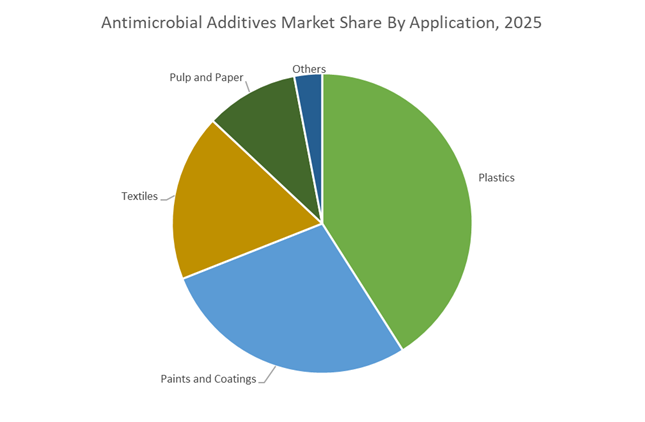
Plastics account for approximately 41% of antimicrobial additives demand in 2025, making polymer compounding the largest application segment. Silver ions, zinc pyrithione, copper-based systems, and legacy organics are integrated into PE, PP, ABS, and engineering plastics for medical devices, food packaging, consumer electronics, and appliance components such as refrigerator liners and washing machine drums. Post-COVID hygiene awareness has permanently elevated demand for antimicrobial touchpoint surfaces. Paints and coatings rank second, driven by hospital walls, HVAC systems, mold-prone interiors, and food processing facilities, with silver and copper technologies dominant and zinc-based solutions gaining on cost. Textiles remain important for activewear and medical fabrics using silver chloride and quaternary silanes, while pulp and paper benefits from EU plastic restrictions that favor antimicrobial-treated food-contact boards and tissues. Regionally, Asia-Pacific represents over 45% of global consumption, anchored by China’s plastics, textiles, and electronics manufacturing base.
Market Share by End-Use Industry: Healthcare Anchors Volume as Packaging and Construction Accelerate
Healthcare represents roughly 34% of antimicrobial additive consumption in 2025, spanning hospitals, clinics, and pharmaceutical manufacturing where antimicrobial plastics, flooring, and high-touch surfaces support infection control. This segment is recession-resistant, governed by FDA and EPA claim requirements, and backed by sustained hygiene budgets. Packaging follows, led by food, beverage, and personal care formats that use antimicrobial masterbatches to extend shelf life and enable active packaging, increasingly within recyclable PE and PP mono-material structures. Consumer goods leverage “odor-free” and hygienic positioning across footwear, electronics, and household products. Construction demand is rising through antimicrobial sealants, drywall, ceiling tiles, and insulation, supported by LEED and WELL building standards and Asia-Pacific infrastructure spending. Automotive remains smaller but premium, with antimicrobial HVAC components, seat fabrics, and interior touchpoints gaining traction as mobility services and EV brands emphasize easily sanitized cabins.
The antimicrobial additives market is rapidly evolving as manufacturers prioritize PFAS-free formulations, non-heavy-metal technologies, recyclable polymer compatibility, and regulatory-ready masterbatches. Competition in 2026 is centered on branded hygiene systems, silver-ion and organic antimicrobial chemistries, odor-control functionality, and integrated service platforms that combine technical validation with marketing support. Market leaders are differentiating through circular plastics compatibility, medical-grade performance, textile hygiene management, and bio-based carrier systems. Strategic investments in EV plastics, healthcare materials, and high-contact consumer surfaces are reshaping the competitive landscape, with suppliers increasingly bundling antimicrobial efficacy, sustainability metrics, and global distribution into turnkey solutions for OEMs and brand owners.
Branded antimicrobial technologies and PFAS-free innovation leadership define Microban International
Microban enters 2026 as the global benchmark for branded antimicrobial protection, leveraging high-visibility partnerships and its consumer-facing “Seal of Confidence.” Its Ascera™ non-heavy-metal technology and LapisShield™ platform for water-based coatings on polymers and glass anchor its portfolio. The company is aggressively driving PFAS-free reformulation, highlighted by its Gold Sponsorship at Future of PVC 2026 and strong presence at PLASTINDIA. Microban’s turnkey Partner Portal integrates 24/7 technical support with marketing assets, enabling rapid product launches with validated hygiene claims. Strategically, Microban is expanding beyond bacteria control into odor capture and environmental durability, positioning itself as a full-spectrum hygiene solutions provider.
Circular plastics integration strengthens antimicrobial positioning for BASF SE
BASF is embedding antimicrobial additives into its VALERAS® sustainability platform, making hygiene a core pillar of circular plastics in 2026. At K 2025, BASF introduced durability-focused solutions with carbon transparency that preserve recyclability. Its HyGentic® silver-ion technology delivers high-efficacy protection for medical plastics and food-contact packaging, while recent polyamide integrations enable high-heat antimicrobial components for EV applications. BASF’s deep vertical integration allows it to balance high antimicrobial loading with dust-free delivery forms compliant with food safety and organic farming standards. This combination of scale, material science, and recycling compatibility positions BASF as a preferred partner for regulated healthcare and mobility markets.
Global hygiene management platform accelerates growth for Sanitized AG
Sanitized AG leads the hygiene management segment through Swiss-engineered antimicrobial precision and its highly recognized Sanitized® Seal of Confidence. In February 2026, Sanitized entered an exclusive worldwide distribution partnership with RUDOLF Group, dramatically expanding its reach across textile finishing, polymers, and coatings. The company’s 2026 portfolio emphasizes biocide-free and skin-friendly additives that neutralize odor while preserving natural skin flora. Its “One-Phase to the Customer” strategy integrates service, technical consulting, and global availability into a single workflow. With strong traction in performance textiles and consumer goods, Sanitized continues to help brands differentiate in an increasingly hygiene-aware global market.
Regulatory-ready masterbatches anchor healthcare growth at Avient Corporation
Avient specializes in regulatory-ready antimicrobial masterbatches designed for medical devices, electronics, and high-contact consumer products. Its Cesa™ WithStand™ additives combat bacteria, mold, and fungi, while GLS™ TPEs with embedded antimicrobial functionality target soft-touch wearables and medical components. Avient also leads in “aversive technology,” combining antimicrobial protection with UV stabilization and pest repellency in single masterbatches for wire and cable manufacturers. Backed by ISCC PLUS certified sites, Avient supplies mass-balance bio-based antimicrobial carriers to Europe and Asia. Its strategy centers on globalization and specialization, delivering compliance-focused material systems for healthcare and infrastructure applications.
Molecular engineering and non-leaching solutions power Milliken & Company
Milliken brings advanced material science to antimicrobial additives, focusing on non-leaching, clarity-preserving technologies for medical textiles and packaging. Its BioSmart™ platform enables fabrics to bind chlorine during washing, creating an active antimicrobial shield that eliminates 99.9% of bacteria. Complementing this, SilverShield® and Millad® ClearX™ 9000 series provide antimicrobial compatibility for transparent pharmaceutical packaging. Milliken’s molecular engineering ensures additives do not compromise color or optical performance, making them ideal for N95-grade masks and premium medical containers. Strategically, Milliken is transitioning all new antimicrobial solutions to PFAS-free formats aligned with circular flooring and textile ecosystems.
BioCote operates a consultative model centered on traceability and lifetime antimicrobial performance. Its portfolio spans silver, zinc, organic compounds, and synergistic blends delivering rapid microbial reduction without recyclability trade-offs. BioCote provides partners with Blacklight validation and continuous effectiveness monitoring, reinforcing quality assurance across treated products. In 2025, the company launched low-dosage masterbatch pellets achieving 99.99% microbial reduction while preserving polymer mechanics. By February 2026, BioCote became a BCF Associate Member, helping shape antimicrobial standards for UK and European infrastructure coatings. Its focus on quality metrics and real-world durability positions BioCote as a trusted specialist for long-life applications.
South Korea Antimicrobial Additives Market: Appliance-Led Scale-Up and Certification-Driven Differentiation
South Korea has positioned antimicrobial additives as a strategic extension of its advanced manufacturing ecosystem, particularly in appliances, construction materials, and specialty glass. A notable milestone was achieved in 2025 when LG Electronics unveiled its PuroTec™ glass-matrix antimicrobial additive at K 2025. The company has elevated PuroTec into a core B2B growth engine, reporting that annual sales more than doubled year over year by late 2025. This growth is underpinned by LG’s dedicated production facility at LG Smart Park in Changwon, which operates at an annual capacity of 4,500 tons of glass-powder antimicrobial materials.
Beyond scale, South Korea is differentiating through certification leadership and application diversity. In September 2025, LG signed a memorandum of understanding with SGS Korea to co-develop globally harmonized antimicrobial performance standards, addressing persistent market concerns around unverifiable efficacy claims. At the technology level, South Korean firms are extending antimicrobial additives beyond plastics into mineral wash laundry systems and marine glass for ecosystem restoration. Collaborative development between LG Chem and LG Electronics has also produced antibacterial plastics tailored for high-touch appliance and automotive interiors, reinforcing South Korea’s vertically integrated innovation model.
United States Antimicrobial Additives Market: Advanced Framework Materials and Regulatory Streamlining
The United States market is increasingly defined by high-performance antimicrobial platforms that combine durability, safety, and multifunctionality. In November 2025, Milliken & Company announced a strategic supply relationship with Numat Technologies, integrating metal-organic framework materials into textiles. These MOF-enabled systems enable reactive, self-decontaminating fabrics targeted at defense, healthcare, and first-responder applications, signaling a move toward active rather than passive antimicrobial protection.
Regulatory and environmental pressures are accelerating PFAS-free transitions. U.S. manufacturers, including Microban International, are explicitly positioning new polymer additives as non-PFAS solutions to align with 2025–2026 environmental mandates. On the regulatory front, the U.S. Environmental Protection Agency released updated guidance PRN 98-10 at the end of 2025, streamlining notifications for minor formulation amendments. This reform is expected to reduce approval bottlenecks under the Pesticide Registration Improvement Act framework. Product innovation remains focused on multifunctional systems, such as Microban’s AkoTech™ platform, which combines antimicrobial efficacy with water and oil repellency for high-traffic flooring and touchscreen surfaces. Capital investment is increasingly directed toward built-in protection that prevents odor, staining, and microbial degradation in recycled plastics, supporting circular material strategies.
European Union Antimicrobial Additives Market: Regulation, Recycling, and Public Health Alignment
Within the European Union, Germany continues to act as the innovation and compliance anchor for antimicrobial additives. A major inflection point occurred in late 2025 when the European Commission launched a comprehensive evaluation of the Biocidal Products Regulation. The consultation process, running through March 2026, is intended to address approval delays for novel biocidal technologies, a long-standing concern for specialty additive developers.
At the same time, export and sustainability compliance is tightening. Regulation 2023/905 will enforce stricter antimicrobial restrictions on imported animal products from September 2026, increasing the importance of traceable and authorized antimicrobial systems. German-led sustainability platforms are responding proactively. BASF expanded its VALERAS® additive journey at K 2025, demonstrating how antimicrobial and light-stabilizing systems such as the TINUVIN® NOR® series enable higher recycled content usage in demanding agricultural and outdoor environments. Public health considerations are also influencing innovation priorities. In December 2025, the European Commission signed a €3.5 million agreement with the World Health Organization to strengthen global responses to antimicrobial resistance, indirectly supporting research into alternative antibacterial strategies that complement conventional additive technologies.
China Antimicrobial Additives Market: Capital-Driven Scaling and Infrastructure-Led Adoption
China’s antimicrobial additives industry is being propelled by aggressive capital deployment and state-backed industrial modernization. Between 2022 and 2024, venture capital funding in additive manufacturing and advanced materials reached approximately $1.95 billion, nearly matching U.S. investment levels and accelerating domestic scale-up of antimicrobial precursors. This influx of capital has enabled rapid translation of laboratory concepts into production-ready masterbatches.
Under the national 14th Five-Year Plan, advanced materials have been designated as a strategic priority. As a result, antimicrobial additives are increasingly integrated into large-scale infrastructure projects, including public transit interiors, healthcare facilities, and the expanding cold-chain packaging network. Chinese suppliers are also executing a cost-competitive export strategy. Participation by Chinese exhibitors at global trade fairs such as Formnext and K Show rose sharply by 2025, positioning domestically produced antimicrobial masterbatches as ready-to-deploy alternatives for Western OEMs seeking price stability and supply security.
Structural Drivers Shaping the Antimicrobial Additives Industry
Antimicrobial Additives Market County Level Snapshot
Region
Primary Growth Lever
Strategic Direction
South Korea
Appliance-led scale and certification
Glass-matrix additives, verified global performance standards
By Type (Inorganic Antimicrobial Additives, Organic Antimicrobial Additives), By Form (Powder, Liquid, Masterbatches), By Application (Plastics, Paints and Coatings, Textiles, Pulp and Paper), By End Use Industry (Healthcare, Packaging, Construction, Automotive, Consumer Goods)
Study Period
2019- 2025 and 2026-2034
Units
Revenue (USD)
Qualitative Analysis
Porter’s Five Forces, SWOT Profile, Market Share, Scenario Forecasts, Market Ecosystem, Company Ranking, Market Dynamics, Industry Benchmarking
Companies
BASF SE, Microban International, LG Chem, Milliken and Company, Polygiene Group, Avient Corporation, Sanitized, LyondellBasell Industries, Dow Inc, BioCote, DuPont, Lonza Group, Ishizuka Glass, Sciessent, Clariant AG
Countries
US, Canada, Mexico, Germany, France, Spain, Italy, UK, Russia, China, India, Japan, South Korea, Australia, South East Asia, Brazil, Argentina, Middle East, Africa
Antimicrobial Additives Market Segmentation
By Type
Inorganic Antimicrobial Additives
Organic Antimicrobial Additives
By Form
Powder
Liquid
Masterbatches
By Application
Plastics
Paints and Coatings
Textiles
Pulp and Paper
By End Use Industry
Healthcare
Packaging
Construction
Automotive
Consumer Goods
By Region
North America (United States, Canada, Mexico)
Europe (Germany, France, United Kingdom, Spain, Italy, Rest of Europe)
Asia Pacific (China, India, Japan, South Korea, Australia, Rest of APAC)
South and Central America (Brazil, Argentina, Rest of SCA)
Middle East and Africa (Saudi Arabia, UAE, South Africa, Rest of Middle East, Rest of Africa)
2. Antimicrobial Additives Market Landscape & Outlook (2025–2034)
2.1. Introduction to Antimicrobial Additives Market
2.2. Market Valuation and Growth Projections (2025–2034)
2.3. Key Growth Drivers: Medical Polymers, Hygienic Textiles, and Food-Safe Plastics
2.4. Regulatory Environment: EU BPR, FDA and EPA Claims, PFAS-Free Mandates
2.5. Technology Evolution: Embedded Antimicrobial Masterbatches, Bio-Based Additives, and Migration-Safe Systems
3. Innovations Reshaping the Antimicrobial Additives Market
3.1. Trend: Heavy-Metal-Free and PFAS-Free Antimicrobial Technologies
3.2. Trend: Bio-Based and Circular-Ready Antimicrobial Carriers
3.3. Opportunity: Medical-Grade Polymers with Built-In Antimicrobial Protection
3.4. Opportunity: Odor-Control Textile Finishes and Food-Contact Active Packaging
4. Competitive Landscape and Strategic Initiatives
4.1. Mergers and Partnerships
4.2. R&D in Medical, Textile, and Packaging Hygiene
4.3. Sustainability and Circular Plastics Integration
4.4. Global Distribution and Compliance Platforms
5. Market Share and Segmentation Insights: Antimicrobial Additives Market
5.1. By Type
5.1.1. Inorganic Antimicrobial Additives
5.1.2. Organic Antimicrobial Additives
5.2. By Form
5.2.1. Powder
5.2.2. Liquid
5.2.3. Masterbatches
5.3. By Application
5.3.1. Plastics
5.3.2. Paints and Coatings
5.3.3. Textiles
5.3.4. Pulp and Paper
5.4. By End Use Industry
5.4.1. Healthcare
5.4.2. Packaging
5.4.3. Construction
5.4.4. Automotive
5.4.5. Consumer Goods
6. Country Analysis and Outlook of Antimicrobial Additives Market
6.1. United States
6.2. Canada
6.3. Mexico
6.4. Germany
6.5. France
6.6. Spain
6.7. Italy
6.8. UK
6.9. Russia
6.10. China
6.11. India
6.12. Japan
6.13. South Korea
6.14. Australia
6.15. South East Asia
6.16. Brazil
6.17. Argentina
6.18. Middle East
6.19. Africa
7. Antimicrobial Additives Market Size Outlook by Region (2025–2034)
7.1. North America Antimicrobial Additives Market Size Outlook to 2034
7.1.1. By Type
7.1.2. By Form
7.1.3. By Application
7.1.4. By End Use Industry
7.2. Europe Antimicrobial Additives Market Size Outlook to 2034
7.2.1. By Type
7.2.2. By Form
7.2.3. By Application
7.2.4. By End Use Industry
7.3. Asia Pacific Antimicrobial Additives Market Size Outlook to 2034
7.3.1. By Type
7.3.2. By Form
7.3.3. By Application
7.3.4. By End Use Industry
7.4. South America Antimicrobial Additives Market Size Outlook to 2034
7.4.1. By Type
7.4.2. By Form
7.4.3. By Application
7.4.4. By End Use Industry
7.5. Middle East and Africa Antimicrobial Additives Market Size Outlook to 2034
7.5.1. By Type
7.5.2. By Form
7.5.3. By Application
7.5.4. By End Use Industry
8. Company Profiles: Leading Players in the Antimicrobial Additives Market
8.1. BASF SE
8.2. Microban International
8.3. LG Chem
8.4. Milliken and Company
8.5. Polygiene Group
8.6. Avient Corporation
8.7. Sanitized
8.8. LyondellBasell Industries
8.9. Dow Inc
8.10. BioCote
8.11. DuPont
8.12. Lonza Group
8.13. Ishizuka Glass
8.14. Sciessent
8.15. Clariant AG
9. Methodology
9.1. Research Scope
9.2. Market Research Approach
9.3. Market Sizing and Forecasting Model
9.4. Research Coverage
9.5. Data Horizon
9.6. Deliverables
10. Appendix
10.1. Acronyms and Abbreviations
10.2. List of Tables
10.3. List of Figures
Antimicrobial Additives Market Segmentation
By Type
Inorganic Antimicrobial Additives
Organic Antimicrobial Additives
By Form
Powder
Liquid
Masterbatches
By Application
Plastics
Paints and Coatings
Textiles
Pulp and Paper
By End Use Industry
Healthcare
Packaging
Construction
Automotive
Consumer Goods
By Region
North America (United States, Canada, Mexico)
Europe (Germany, France, United Kingdom, Spain, Italy, Rest of Europe)
Asia Pacific (China, India, Japan, South Korea, Australia, Rest of APAC)
South and Central America (Brazil, Argentina, Rest of SCA)
Middle East and Africa (Saudi Arabia, UAE, South Africa, Rest of Middle East, Rest of Africa)
The Antimicrobial Additives Market is valued at $4.1 billion in 2025 and is forecast to reach $7.5 billion by 2034, expanding at a 7% CAGR. Growth is driven by healthcare plastics, food-contact packaging, odor-control textiles, and built-in antimicrobial surfaces replacing temporary spray-based treatments across medical, consumer, and infrastructure applications.
Plastics dominate with roughly 41% share in 2025, led by antimicrobial PE, PP, ABS, and engineering polymers used in medical devices, food packaging, and appliances. Healthcare represents about 34% of end-use demand, while packaging is accelerating through active antimicrobial films. Construction materials and performance textiles are gaining traction under permanent post-COVID hygiene standards.
Suppliers are rapidly moving toward PFAS-free systems, heavy-metal-free odor control, and bio-based masterbatches to meet EU BPR approvals, FDA food-contact rules, and ISO/USP medical requirements. Migration-safe additives and recyclable polymer compatibility are now mandatory, pushing innovation in silver-ion alternatives, organic antimicrobials, and circular-plastics-ready hygiene solutions.
Medical-grade polymers are adopting non-PFAS, clarity-preserving additives for diagnostics and devices, while food packaging is integrating antimicrobial masterbatches to extend shelf life in mono-material PE and PP structures. Consumer goods are leveraging odor-neutralizing additives for differentiation, and construction is scaling antimicrobial sealants and panels aligned with WELL and LEED building standards.
Key innovation leaders include BASF SE, Microban International, Avient Corporation, Sanitized AG, Milliken & Company, BioCote Ltd, and LG Chem. These players are competing on PFAS-free platforms, medical-grade masterbatches, branded hygiene systems, circular plastics integration, and textile odor-control technologies.