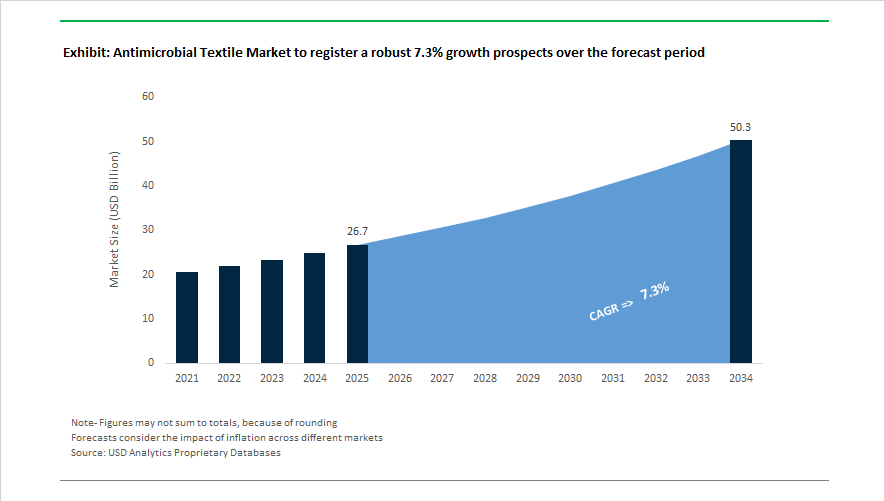
The antimicrobial textile market is valued at $26.7 billion in 2025 and is forecast to reach $50.3 billion by 2034, advancing at a 7.3% CAGR. Growth is anchored in rising demand for antimicrobial fabrics, odor-control textiles, silver-free antimicrobial finishes, PFAS-free performance treatments, medical nonwovens, activewear hygiene technologies, and sustainable textile auxiliaries. Applications span healthcare PPE, sports apparel, home textiles, defense uniforms, technical workwear, mattress ticking, and protective gear, where hygiene, durability, and environmental compliance are core purchasing criteria. The market is transitioning from legacy metal-ion biocides toward bio-based antimicrobial chemistry, citric-derived treatments, recyclable fiber systems, GOTS-approved additives, and integrated moisture management plus antimicrobial functionality platforms.
Sustainability-led material transformation began reshaping the supply base in 2024 when Milliken & Company introduced non-PFAS turnout gear integrating antimicrobial performance with flame resistance. In late 2024, Noble Biomaterials launched Ionic+ Botanical, replacing metallic ions with plant-derived citric-based antimicrobial chemistry. In early 2025, BASF commissioned its commercial loopamid facility in Shanghai, enabling circular nylon 6 fibers used in high-performance antimicrobial technical textiles. April 2025 marked GOTS approval for Sanitized OX20, expanding organic textile compatibility. In February 2025, DeRucci integrated Sanitized antimicrobial technology into AI-powered mattresses, signaling growth in smart wellness furniture. During 2025, Avient expanded Cesa WithStand antimicrobial additives for medical PPE without compromising transparency of nonwovens. June 2025 saw Microban International introduce H2O Shield, a PFAS-free water-resistant finish compatible with antimicrobial platforms. 2025 also included Polygiene Group extending StayFresh technology into home textiles, promoting lower wash frequency and sustainability.
Strategic consolidation and channel integration intensified in late 2025 and early 2026. Sanitized AG transitioned to full family ownership in 2025, reinforcing long-term R&D focus. In December 2025, Huntsman appointed new executive leadership as part of its shift toward specialty textile chemistries. In January 2026, Archroma and HeiQ formed a partnership to globalize advanced antimicrobial and odor-control technologies. The most significant structural shift occurred in February 2026 when the Rudolf Group secured exclusive global distribution rights for Sanitized AG technologies, unifying finishing systems with hygiene platforms under a single supply interface for global mills.
Trends and Opportunities Reshaping Technology Choice, Regulatory Pathways, and Margin Pools in the Antimicrobial Textile Market
Strategic Pivot from Silver-Ion Systems Toward Non-Metal Organic Antimicrobials
Antimicrobial textiles are transitioning away from metallic systems due to increasing environmental scrutiny tied to silver nanoparticle runoff, wastewater contamination, and bioaccumulation risk. As of mid-2025, EU REACH treated-article reporting rules require disclosure and justification for metallic biocides, pushing textile processors toward organic quaternary ammonium silanes, bio-derived chitosan, and non-leaching odor-neutralizing additives such as Sciessent NOBO™.
A key commercial driver is lifecycle durability. Studies presented at the 2025 International Conference on Sustainable Textiles reported that organic silane coatings retain 99.9% bacterial efficacy after 50 industrial wash cycles, while reducing metallic release into effluent streams by nearly 80%. This shift is shaping upstream retailer strategies, with brands such as Marks & Spencer updating 2025 fabric procurement charters to favor OEKO-TEX ECO PASSPORT-compliant non-metal finishes, effectively locking non-metal antimicrobials into mass-market tender requirements.
Polymer-Stage Integration via Antimicrobial Masterbatches for Permanent Protection
A second strategic trend involves a move upstream in the textile value chain, embedding antimicrobial functionality directly into polyester and nylon during melt-extrusion. This masterbatch model is reshaping cost structure by shifting antimicrobial spend from finishing plants to polymer suppliers, compressing finishing step water usage by 15–20% according to ALOK Masterbatches (2025).
In March 2024, Poddar Pigments announced thermally stable antimicrobial masterbatches capable of enduring 300°C heat-setting, solving the historic challenge of surface coatings degrading during dyeing. The commercial landscape is expanding to glass-matrix innovations such as LG PuroTec (K-2025), which delivers controlled ion-release for lifetime odor protection and prevents discoloration and microbial staining across apparel, bedding, and automotive interiors.
Mandated Use in Healthcare Textiles for HAI Risk Control
Hospital textiles are becoming revenue-critical assets as multidrug-resistant organisms (MDROs) such as Candida auris reshape procurement rules. The ISO 20743:2025 update now requires a minimum 3-log pathogen reduction for antimicrobial clinical textiles, pushing hospitals to procure AAMI Level 3 and Level 4 woven and laminated gowns with permanent antimicrobial layers.
In emerging markets, the ICMR 2025 guidance highlights the patient-risk contribution of soft-surface contamination, opening procurement pipelines for “smart” curtains with embedded antimicrobial functionality designed to remain active throughout usage cycles instead of requiring routine microbial disinfection. Cost data from hospital network public filings suggests reusable antimicrobial linens provide up to 30% procurement savings over three-year spans, while helping meet the EU Textile Waste Framework Directive 2025 reduction goals. Spending power is therefore consolidating among suppliers that can provide validated efficacy, sterility documentation, and supply chain traceability.
Smart-Release and pH-Responsive Antimicrobial Coatings in Premium Sportswear
The premium segment is shifting to textiles that respond to user conditions. Smart antimicrobial systems like Agion® transition from passive odor-control to moisture-activated release, allowing antimicrobial agents to remain dormant until sweat and microbes trigger deployment, reducing rinse-out and extending garment lifespan.
A pipeline of advanced “bio-hybrid” performance textiles is emerging from research programs including MIT pilots, where microbial-cell-lined layers dynamically open when humidity spikes, creating ventilation-on-demand. Commercial case studies published by Fibre2Fashion reference Active XL systems combining odor elimination, thermoregulation, and UV blocking, enabling athletes to re-wear performance apparel multiple times before washing, aligning with sustainability preferences and reducing total cost-per-use.
Antimicrobial Textile Market Share and Segmentation Insights
Market Share by Fabric Type: Polyester Anchors Volume While Polycotton Blends Accelerate Institutional Adoption
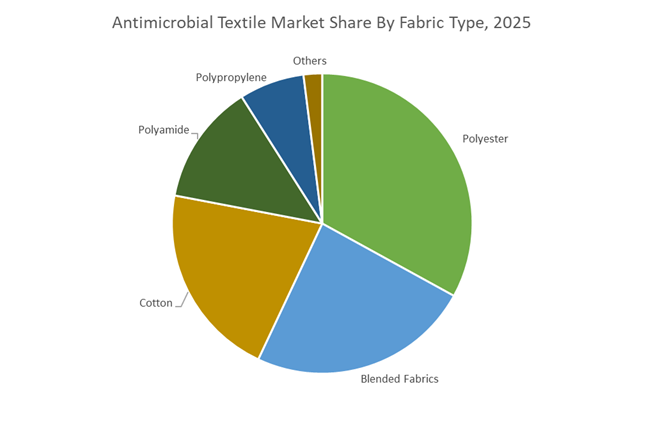
Polyester accounts for approximately 33% of the global antimicrobial textile market in 2025, retaining dominance due to low cost, durability, and strong compatibility with silver-based additives and quaternary silanes such as AEGIS and Silvadur. It is the preferred substrate for activewear, uniforms, and medical scrubs, with recycled polyester (rPET) further strengthening adoption in sustainability-driven markets. Blended fabrics represent the fastest-growing segment, led by polyester-cotton constructions that balance comfort and performance for healthcare linens, workwear, and military uniforms, despite greater chemical complexity in antimicrobial fixation. Cotton continues to lose share but remains relevant in towels, bed linens, and premium next-to-skin apparel, increasingly paired with chitosan, zinc, or bio-based finishes. Polyamide maintains a strong niche in athleisure and hosiery for odor control, while polypropylene serves specialty medical and geotextile applications where hydrophobicity and low bacterial adhesion provide inherent advantages.
Market Share by End-Use Application: Healthcare Dominates as Odor-Control Apparel Drives Consumer Uptake
Medical and healthcare applications represent roughly 38% of antimicrobial textile demand in 2025, covering surgical gowns, drapes, masks, hospital bedding, uniforms, and wound dressings, where infection control is non-negotiable and silver, copper oxide, and quaternary ammonium chemistries dominate. Reusable antimicrobial fabrics are increasingly replacing single-use disposables to reduce medical waste. Apparel and fashion rank second, propelled by sportswear, innerwear, and casual clothing where anti-odor and hygiene freshness influence purchasing decisions, accelerating adoption across global brands. Home textiles follow, driven by hotel sanitation protocols and mold prevention in humid residential environments. Commercial and industrial uses span workwear, cleanroom garments, and transportation seating, benefiting from extended garment life and reduced laundering. Technical and specialty textiles form a premium niche in military, automotive, and aerospace interiors. Regionally, Asia-Pacific leads production, while North America and Europe drive innovation in bio-based, PFAS-free antimicrobial finishes.
The antimicrobial textile market is rapidly evolving around permanent fiber-level protection, biocide-free odor control, probiotic finishes, and intrinsic antimicrobial fibers, driven by demand from healthcare, activewear, home textiles, and technical fabrics. Leading players are competing on wash-durable antimicrobial technologies, melt-spun antimicrobial polymers, PFAS-free treatments, microbiome-positive textiles, and medical-grade barrier fabrics. Strategic priorities include integrated masterbatch protection, sustainable silver alternatives, probiotic-based finishes, and GRS-certified recycled antimicrobial fibers. The competitive environment is increasingly shaped by ingredient branding, global finishing networks, and deep R&D in polymer additives, positioning antimicrobial textiles as a core differentiator across hygiene, comfort, and performance-driven apparel segments.
Permanent antimicrobial fiber engineering and medical-grade barriers led by Milliken & Company
Milliken anchors the antimicrobial textile market with permanent fiber modifications and Active Fluid Management technologies. Its BioSmart™ platform uniquely “recharges” antimicrobial efficacy during laundering by binding with chlorine, delivering 99.9% bacterial kill on contact. At PLASTINDIA 2026, Milliken introduced melt-spun polymer additives that embed antimicrobial performance directly into synthetic fibers, eliminating reliance on topical coatings. In 2025, the company pivoted capacity toward ANSI/AAMI Level 3 medical barrier fabrics under the Milliken Perimeter™ line for moderate-risk trauma settings. Strategically, Milliken is advancing Protective Transparency, developing high-clarity antimicrobial polypropylene for medical packaging and N95-grade filter media with integrated bacterial inhibition.
Global finishing dominance through Sanitized integration at RUDOLF Group
RUDOLF Group has emerged as a powerhouse in antimicrobial textiles following its February 2026 assumption of exclusive global distribution rights for Sanitized® technologies. Its flagship Sanitized® Odorex™ platform delivers biocide-free odor control using physical adsorption (OX20), ideal for Clean Beauty apparel. RUDOLF integrates antimicrobial agents into a unified finishing ecosystem, enabling garments to be antimicrobial, moisture-wicking, and PFC-free water-repellent in a single process. The company expanded technical service hubs in India and Vietnam in 2025 to support rising production of performance activewear and technical textiles. This vertically integrated finishing model positions RUDOLF as a one-stop partner for scalable Swiss-quality antimicrobial solutions.
Ingredient branding and PFAS-free built-in protection powered by Microban International
Microban leads antimicrobial ingredient branding with built-in textile protection designed at the masterbatch level. Its Ascera™ technology provides sustainable, metal-free antimicrobial performance with up to 99% efficacy against odor-causing bacteria. In early 2026, Microban partnered with Marine Fabricators to deploy LapisShield™ in marine-grade textiles, addressing mold and mildew challenges in saltwater environments. The company is actively driving PFAS-free reformulation across textile protection systems, presenting globally on fluorine-free performance alternatives. Microban’s core strength lies in integrating antimicrobials directly into polyester and nylon fibers, ensuring wash-durable protection that cannot be worn away, a critical advantage for consumer and industrial textiles.
Deeptech probiotics and luxury bio-finishes pioneered by HeiQ Materials AG
HeiQ Materials AG is redefining antimicrobial textiles through bio-based polymers, probiotics, and advanced silver-vesicle systems. In January 2026, it launched HeiQ Serica™, a silk-infused finishing technology delivering luxury hand-feel while naturally inhibiting microbial growth. HeiQ also entered a landmark co-marketing partnership with Archroma to scale sustainable antimicrobial and anti-odor innovations globally. Its HeiQ Viroblock combines silver with vesicle technology to suppress microbes on medical gowns, air filters, and upholstery. Strategically, HeiQ is advancing Microbiome-Positive Textiles via HeiQ Skin Care™, using active probiotics that migrate to skin to balance microflora, shifting the industry from bacteria elimination to health-focused fabric ecosystems.
High-wash silver systems and odor control expertise from Sanitized AG
Sanitized AG remains the authority behind the Sanitized® Seal of Confidence, delivering wash-resistant antimicrobial technologies for demanding textile applications. Its Sanitized® Silvertec™ platform is engineered for hospital linens and military uniforms requiring high-temperature laundering durability. In late 2025, Sanitized introduced Puretec™, a quaternary ammonium-based odor control system permanently anchored to fibers via silane chemistry, preventing leaching. Consumer trust remains a core strength, with Sanitized the most requested ingredient brand for home textiles such as mattresses, pillows, and carpets. Strategically, the company is expanding into niche fungicidal and insecticidal treatments for extreme outdoor and industrial environments where conventional antimicrobial finishes fail.
Intrinsic antimicrobial fibers scaled across Asia by Thai Acrylic Fiber Co. Ltd.
Thai Acrylic Fiber leads the intrinsic antimicrobial fiber segment with Amicor™, where active agents are embedded into the fiber core during spinning. This technology is the industry benchmark for anti-allergy bedding and soft toys, offering permanent, non-leaching protection. In 2025/2026, the company integrated recycled acrylic into Amicor™, delivering the first high-performance antimicrobial fiber certified under the Global Recycled Standard (GRS). It dominates the Home Comfort category, supplying carpets, upholstery, blankets, and mattresses that prioritize skin safety and long-term durability. Strategically, Thai Acrylic Fiber is investing across the RCEP region to provide tax-efficient, high-tech antimicrobial fibers to apparel manufacturers in China, India, and Indonesia.
South Korea Antimicrobial Textile Market: Glass-Matrix Platforms and Global Benchmarking of Antimicrobial Performance
South Korea has positioned itself as a global technology leader in antimicrobial textiles through advanced material science and certification-driven credibility. In late 2025, LG Electronics successfully scaled its PuroTec™ glass-matrix antimicrobial technology for B2B textile applications. The solution relies on a patented glass powder carrier that enables sustained ion release, delivering long-lasting odor control and microbial resistance in high-performance synthetic fibers without rapid depletion or wash-off. This durability profile has made the technology particularly attractive for automotive interiors, uniforms, and technical sportswear.
The country’s competitive edge is reinforced by intellectual property depth and standards leadership. South Korean firms now hold more than 420 patents related to glass-powder antimicrobial systems, supported by an annual production capacity of roughly 4,500 tons as of early 2026. In September 2025, partnerships with SGS Korea were established to co-develop international antimicrobial certification standards. These standards focus on low-leaching and long-term efficacy, addressing a critical trust gap in antimicrobial textile claims. Parallel innovation in surfactant-free “Mineral Wash” laundry technology highlights South Korea’s push to integrate antimicrobial protection into both textiles and their downstream care ecosystems.
India Antimicrobial Textile Market: Policy-Driven Adoption and Cost-Effective Antimicrobial Scale-Up
India’s antimicrobial textile market is being shaped by public health policy and export-oriented sustainability. The launch of the National Action Plan on AMR 2.0 (2025–2029) has created a strong institutional pull for antimicrobial textiles in healthcare, agriculture, and public infrastructure, positioning fabrics as preventive tools against multi-drug resistant pathogens. This policy alignment is translating into demand for hospital linens, protective workwear, and agri-textiles with built-in antimicrobial functionality rather than topical chemical treatments.
Industry response has been rapid and diversified. At BharatTex 2025, RSWM Limited unveiled its Panchtatva initiative, combining recycled polyester with natural fibers and antimicrobial functionality under direct endorsement from the Union Ministry of Textiles. Innovation is also emerging at the process level. In early 2025, Polyspin introduced Nano 5, a nano-enabled antimicrobial treatment designed for high-volume medical nonwovens, offering a cost-efficient solution for disposable PPE. Alongside these developments, Indian manufacturers are increasingly adopting plant-derived agents such as neem, chitosan, and aloe vera, aligning antimicrobial performance with the country’s strong position in organic and sustainable textile exports.
United States Antimicrobial Textile Market: Regulatory Clarity and Defense-Led Material Integration
The United States market is characterized by regulatory clarification and high-value application pull. In early 2025, the U.S. Environmental Protection Agency issued final guidance defining standardized efficacy test methods for antimicrobial claims on soft-surface textiles. This development allows manufacturers to substantiate public health claims in clinical and institutional settings, significantly reducing legal and reputational risk associated with antimicrobial marketing.
Defense and healthcare sectors are major catalysts. The U.S. military has expanded the use of copper-oxide embedded masterbatches in combat uniforms, favoring systems that provide odor and fungal control without the toxicity concerns associated with triclosan. In parallel, U.S.-based medical textile producers began piloting predictive hygiene systems in late 2025. These systems integrate antimicrobial fabrics with sensors that signal replacement based on bacterial load rather than time-based laundering cycles. This convergence of textiles, electronics, and infection control positions the U.S. as a leader in smart antimicrobial fabric applications rather than commodity antimicrobial finishes.
Germany Antimicrobial Textile Market: Bio-Economy Alignment and Circular Antimicrobial Fibers
Germany’s antimicrobial textile strategy is anchored in its broader bio-economy and circularity agenda. Supported by the Federal Ministry of Education and Research, the BIOTEXFUTURE project entered its industrial phase in late 2025, focusing on solution-spun chitosan fibers derived from fungal biomass. These fibers offer intrinsic antimicrobial properties without relying on additive chemistries, aligning with tightening EU scrutiny on biocides and textile effluents.
Equally important is Germany’s focus on end-of-life compatibility. Under the National BioEconomy 2030 strategy, firms are developing chemical recycling pathways for bio-based antimicrobial polymers, ensuring that antimicrobial functionality does not interfere with PET and polypropylene recyclability. At ISPO Munich 2025, German manufacturers showcased LightLining nonwovens that combine antimicrobial protection with thermal insulation for outdoor performance apparel. This highlights Germany’s emphasis on multifunctionality, durability, and recyclability rather than short-term antimicrobial treatments.
China Antimicrobial Textile Market: Precision Processing and Export-Driven Functional Compliance
China’s antimicrobial textile sector is undergoing a shift from volume-centric production to precision functionalization driven by export compliance. Investments in 2025 have prioritized digital dyeing and finishing platforms, including low-liquor and spray-based systems that apply antimicrobial finishes with dramatically reduced water usage compared to traditional dip processes. These systems allow Chinese mills to deliver consistent antimicrobial performance while meeting increasingly strict environmental benchmarks.
At the regulatory and market interface, PFAS-free mandates are reshaping finishing chemistry. As highlighted at Intertextile Shanghai 2025, Chinese producers are rapidly phasing out PFAS-based functional finishes in response to North American and European import restrictions. This transition is accelerating the adoption of alternative antimicrobial systems that balance durability with regulatory acceptance, reinforcing China’s role as a fast-adapting supplier for global apparel and technical textile brands.
Strategic Positioning by Country in the Antimicrobial Textile Industry
Antimicrobial Textile Market County Level Snapshot
Cost-effective nano and plant-based antimicrobials
United States
Regulatory clarity and defense demand
Smart textiles and embedded antimicrobial masterbatches
Germany
Bio-economy and circularity
Intrinsic antimicrobial fibers and recyclability
China
Export compliance and efficiency
Digital finishing and PFAS-free functional textiles
Antimicrobial Textile Market Report Scope
Antimicrobial Textile Market
Parameter
Details
Market Size (2025)
$26.7 Billion
Market Size (2034)
$50.3 Billion
Market Growth Rate
7.3%
Segments
By Fabric Type (Cotton, Polyester, Polyamide, Polypropylene, Blended Fabrics), By Active Agent (Metal and Metallic Salts, Synthetic Organic Compounds, Bio Based Agents, Nano Engineered Carriers), By Finishing Technique (Coating and Finishing, Incorporation During Fiber Production, Surface Modification), By End Use Application (Medical and Healthcare, Apparel and Fashion, Home Textiles, Commercial and Industrial, Technical and Specialty)
Study Period
2019- 2025 and 2026-2034
Units
Revenue (USD)
Qualitative Analysis
Porter’s Five Forces, SWOT Profile, Market Share, Scenario Forecasts, Market Ecosystem, Company Ranking, Market Dynamics, Industry Benchmarking
Companies
Milliken and Company, DuPont de Nemours Inc, BASF SE, Sanitized AG, Microban International, Polygiene Group, LG Electronics, Sciessent LLC, Toyobo Co Ltd, Unitika Ltd, Herculite Products Inc, Thai Acrylic Fibre Co Ltd, RSWM Limited, Suzhou Chunshen Fiber, Sioen Industries NV
Countries
US, Canada, Mexico, Germany, France, Spain, Italy, UK, Russia, China, India, Japan, South Korea, Australia, South East Asia, Brazil, Argentina, Middle East, Africa
Antimicrobial Textile Market Segmentation
By Fabric Type
Cotton
Polyester
Polyamide
Polypropylene
Blended Fabrics
By Active Agent
Metal and Metallic Salts
Synthetic Organic Compounds
Bio Based Agents
Nano Engineered Carriers
By Finishing Technique
Coating and Finishing
Incorporation During Fiber Production
Surface Modification
By End Use Application
Medical and Healthcare
Apparel and Fashion
Home Textiles
Commercial and Industrial
Technical and Specialty
By Region
North America (United States, Canada, Mexico)
Europe (Germany, France, United Kingdom, Spain, Italy, Rest of Europe)
Asia Pacific (China, India, Japan, South Korea, Australia, Rest of APAC)
South and Central America (Brazil, Argentina, Rest of SCA)
Middle East and Africa (Saudi Arabia, UAE, South Africa, Rest of Middle East, Rest of Africa)
2. Antimicrobial Textile Market Landscape & Outlook (2025–2034)
2.1. Introduction to Antimicrobial Textile Market
2.2. Market Valuation and Growth Projections (2025–2034)
2.3. Key Growth Drivers: Circular Fibers, PFAS-Free Finishes, and Healthcare Hygiene Demand
2.4. Regulatory Environment: EU REACH, ISO 20743, OEKO-TEX, GOTS, and Global Textile Waste Frameworks
2.5. Technology Evolution: Bio-Based Antimicrobials, Masterbatch Integration, and Smart-Release Systems
3. Trends and Opportunities in the Antimicrobial Textile Market
3.1. Trend: Transition from Silver-Ion to Non-Metal Organic Antimicrobial Systems
3.2. Trend: Polymer-Stage Masterbatch Integration for Permanent Protection
3.3. Opportunity: Healthcare Textile Mandates and MDRO Risk Control
3.4. Opportunity: Smart-Release and pH-Responsive Antimicrobial Sportswear
4. Competitive Landscape and Strategic Developments
4.1. Strategic Alliances and Distribution Consolidation
4.2. Ingredient Branding and Finishing Network Expansion
4.3. PFAS-Free Reformulation and Bio-Based Platforms
4.4. Regional Capacity Expansion and Circular Fiber Integration
5. Market Share and Segmentation Insights: Antimicrobial Textile Market
5.1. By Fabric Type
5.1.1. Cotton
5.1.2. Polyester
5.1.3. Polyamide
5.1.4. Polypropylene
5.1.5. Blended Fabrics
5.2. By Active Agent
5.2.1. Metal and Metallic Salts
5.2.2. Synthetic Organic Compounds
5.2.3. Bio Based Agents
5.2.4. Nano Engineered Carriers
5.3. By Finishing Technique
5.3.1. Coating and Finishing
5.3.2. Incorporation During Fiber Production
5.3.3. Surface Modification
5.4. By End Use Application
5.4.1. Medical and Healthcare
5.4.2. Apparel and Fashion
5.4.3. Home Textiles
5.4.4. Commercial and Industrial
5.4.5. Technical and Specialty
6. Country Analysis and Outlook of Antimicrobial Textile Market
6.1. United States
6.2. Canada
6.3. Mexico
6.4. Germany
6.5. France
6.6. Spain
6.7. Italy
6.8. United Kingdom
6.9. Russia
6.10. China
6.11. India
6.12. Japan
6.13. South Korea
6.14. Australia
6.15. South East Asia
6.16. Brazil
6.17. Argentina
6.18. Middle East
6.19. Africa
7. Antimicrobial Textile Market Size Outlook by Region (2025–2034)
7.1. North America Antimicrobial Textile Market Size Outlook to 2034
7.1.1. By Fabric Type
7.1.2. By Active Agent
7.1.3. By Finishing Technique
7.1.4. By End Use Application
7.2. Europe Antimicrobial Textile Market Size Outlook to 2034
7.2.1. By Fabric Type
7.2.2. By Active Agent
7.2.3. By Finishing Technique
7.2.4. By End Use Application
7.3. Asia Pacific Antimicrobial Textile Market Size Outlook to 2034
7.3.1. By Fabric Type
7.3.2. By Active Agent
7.3.3. By Finishing Technique
7.3.4. By End Use Application
7.4. South America Antimicrobial Textile Market Size Outlook to 2034
7.4.1. By Fabric Type
7.4.2. By Active Agent
7.4.3. By Finishing Technique
7.4.4. By End Use Application
7.5. Middle East and Africa Antimicrobial Textile Market Size Outlook to 2034
7.5.1. By Fabric Type
7.5.2. By Active Agent
7.5.3. By Finishing Technique
7.5.4. By End Use Application
8. Company Profiles: Leading Players in the Antimicrobial Textile Market
8.1. Milliken and Company
8.2. DuPont de Nemours Inc
8.3. BASF SE
8.4. Sanitized AG
8.5. Microban International
8.6. Polygiene Group
8.7. LG Electronics
8.8. Sciessent LLC
8.9. Toyobo Co Ltd
8.10. Unitika Ltd
8.11. Herculite Products Inc
8.12. Thai Acrylic Fibre Co Ltd
8.13. RSWM Limited
8.14. Suzhou Chunshen Fiber
8.15. Sioen Industries NV
9. Methodology
9.1. Research Scope
9.2. Market Research Approach
9.3. Market Sizing and Forecasting Model
9.4. Research Coverage
9.5. Data Horizon
9.6. Deliverables
10. Appendix
10.1. Acronyms and Abbreviations
10.2. List of Tables
10.3. List of Figures
Antimicrobial Textile Market Segmentation
By Fabric Type
Cotton
Polyester
Polyamide
Polypropylene
Blended Fabrics
By Active Agent
Metal and Metallic Salts
Synthetic Organic Compounds
Bio Based Agents
Nano Engineered Carriers
By Finishing Technique
Coating and Finishing
Incorporation During Fiber Production
Surface Modification
By End Use Application
Medical and Healthcare
Apparel and Fashion
Home Textiles
Commercial and Industrial
Technical and Specialty
By Region
North America (United States, Canada, Mexico)
Europe (Germany, France, United Kingdom, Spain, Italy, Rest of Europe)
Asia Pacific (China, India, Japan, South Korea, Australia, Rest of APAC)
South and Central America (Brazil, Argentina, Rest of SCA)
Middle East and Africa (Saudi Arabia, UAE, South Africa, Rest of Middle East, Rest of Africa)
The Antimicrobial Textile Market is valued at $26.7 billion in 2025 and is forecast to reach $50.3 billion by 2034, expanding at a 7.3% CAGR. Growth is fueled by healthcare PPE, odor-control apparel, PFAS-free performance finishes, and circular fiber adoption across activewear, home textiles, and technical fabrics.
The industry is pivoting from silver-ion systems toward non-metal organic antimicrobials, bio-based finishes, and polymer-stage masterbatch integration. Mills are embedding antimicrobial functionality directly into polyester and nylon during melt extrusion, reducing water usage in finishing while delivering wash-durable protection aligned with OEKO-TEX and GOTS requirements.
Healthcare dominates with roughly 38% share in 2025, driven by antimicrobial gowns, drapes, linens, and reusable PPE validated under ISO 20743. Apparel follows closely, led by odor-control activewear and innerwear, while home textiles and technical workwear are expanding through hotel hygiene standards, defense procurement, and industrial safety mandates.
Asia-Pacific leads production scale, while North America and Europe drive premium innovation in PFAS-free finishes and intrinsic antimicrobial fibers. South Korea is advancing glass-matrix antimicrobial platforms, India is scaling cost-effective plant-based systems for medical nonwovens, Germany is investing in circular bio-fibers, and China is accelerating digital, low-water antimicrobial finishing for export compliance.