Biofouling-Resistant Membranes Market Overview: Growth Outlook and Strategic Importance
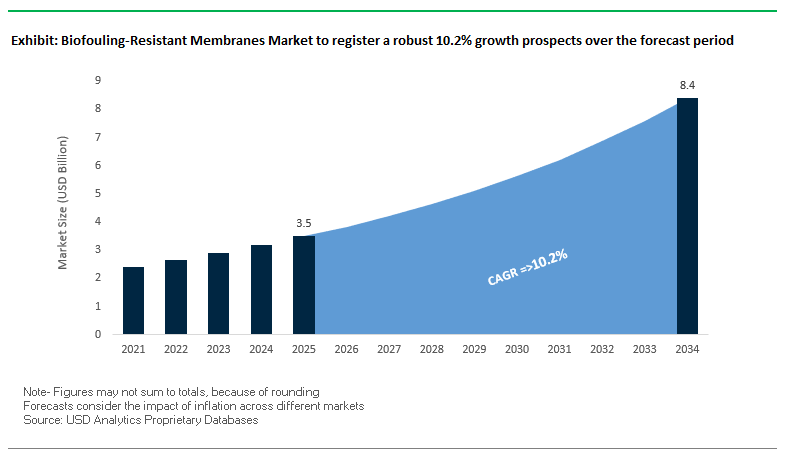
The global Biofouling-Resistant Membranes Market is valued at $3.5 billion in 2025 and is projected to reach $8.4 billion by 2034, expanding at a CAGR of 10.2%. Biofouling-resistant membranes include RO, NF, UF, MF and MBR membrane products, surface modifications and module configurations designed to reduce microbial attachment, biofilm accumulation, biologically induced pressure loss or irreversible fouling. Commercial technologies span fouling-resistant polyamide thin-film composite membranes, hydrophilic PES and PSU membranes, functional surface coatings, ceramic and silicon-carbide membranes, biomimetic materials and module architectures engineered around lower differential pressure or improved biomass removal.
Biofouling begins when microorganisms attach to membrane or spacer surfaces and develop extracellular polymeric substances that support increasingly stable biofilm structures. The resulting biomass can increase transmembrane pressure or spiral-wound differential pressure, reduce permeate production, alter feed-channel hydraulics and increase cleaning frequency. Biofouling therefore differs from inorganic scaling and inert colloidal fouling because microorganisms can continue growing after initial deposition under favorable nutrient and hydraulic conditions.
Commercial antifouling membrane performance involves several mechanisms rather than one universal surface treatment. Hydrophilic and zwitterionic surfaces reduce adhesion, antimicrobial functionality can suppress microorganisms near the membrane surface, feed-spacer geometry influences stagnant zones and biofilm accumulation, MBR aeration provides shear around membrane modules, and chemically durable ceramic membranes tolerate intensive cleaning after difficult fouling episodes. Long-term performance depends on surface stability, cleanability, hydraulic design and resistance to repeated operating and cleaning cycles.
Key Insights Driving Market Growth
Biofouling accounts for a major share of performance decline in membrane filtration systems, resulting in frequent chemical cleaning and significant operational downtime.
Zwitterionic polymers and nanocoatings represent the latest innovations, offering surface modifications that prevent microbial adhesion and biofilm formation.
Operating expenses in RO and NF plants are significantly impacted by fouling, strengthening the case for investment in antifouling membranes that reduce lifetime costs.
Low-energy, fouling-resistant membranes are a major focus of innovation, enabling high water permeability at reduced operating pressures critical for sustainable water reuse projects.
Market Analysis: Recent Developments in Biofouling-Resistant Membranes
The biofouling-resistant membranes industry is experiencing rapid innovation, marked by cutting-edge product launches, strategic collaborations, and growing investment in sustainable water treatment solutions.
Commercial RO development is increasingly addressing element hydraulics as well as membrane-surface fouling. In September 2026, Nitto Denko/Hydranautics launched PRO-XR1-X-LD, a fouling-resistant RO membrane targeted at difficult industrial wastewater and water-recovery applications. The commercial positioning combines high rejection with low element differential pressure, reflecting the importance of feed-channel hydraulics in fouling-prone spiral-wound systems.
Biofouling-specific RO design has also generated field operating evidence. DuPont's June 2025 technical evaluation of FilmTec Fortilife CR100 in industrial wastewater reported 64% more operating time between cleanings and 36% fewer annual cleanings than the comparator element under the documented test configuration. DuPont attributes the result to membrane chemistry and module design intended for biologically fouling-prone water, with performance figures representing company-reported field data.
Zwitterionic membrane chemistry has progressed into commercial food-processing and industrial-water product families. In 2025, ZwitterCo expanded its portfolio through Evolution, Elevation and Expedition membranes. Evolution targets high-protein and high-fat processing streams, while Elevation addresses wastewater affected by organic loading using permanently bonded zwitterionic surface chemistry. The company reported more than 20 Evolution installations across dairy, food, beverage, enzyme and fermentation applications by the end of 2025; the installation and performance data remain company-reported.
Hydrophilic polymeric membranes are also expanding across wastewater-reuse and high-solids applications. Commercial hollow-fiber products increasingly combine hydrophilic surface treatment with open module geometry, air-assisted cleaning and chemically resistant polymer structures to limit surface contamination and facilitate recovery after suspended-solids or organic loading.
Ceramic and silicon-carbide membranes occupy a different commercial position. Their principal advantage in biofouling-prone environments is not complete prevention of microbial attachment but mechanical and chemical resilience that enables intensive backwashing, oxidant exposure and high-strength CIP under difficult industrial wastewater conditions..
Biofouling-Resistant Membrane Validation, Certification and End-Use Requirements
Commercial biofouling resistance is evaluated through operating characteristics such as normalized flux stability, transmembrane pressure, spiral-wound differential pressure, cleaning interval, flux recovery after CIP and long-term membrane integrity. Laboratory measurements of bacterial adhesion or short-duration antimicrobial activity provide evidence of surface behavior but do not independently establish multi-year commercial fouling performance.
For drinking-water applications, NSF/ANSI/CAN 61 evaluates the health effects of materials and components that contact potable water. Certification can apply to membrane elements and components, but it does not certify that a membrane is antifouling or biofouling-resistant. Antifouling performance and drinking-water material safety therefore represent separate validation questions.
Food and dairy membrane applications operate under a different set of contact-material requirements because membranes can directly contact milk, whey, protein concentrates and fermentation products. Surface chemistry, extractables, cleaning agents and operating temperature therefore affect material qualification independently of antifouling performance.
Wastewater-reuse regulation similarly establishes treated-water and environmental requirements rather than mandating a specific antifouling membrane technology. The recast EU Urban Wastewater Treatment Directive requires Member States to promote reuse of treated urban wastewater where appropriate, particularly in water-stressed regions, creating an operating environment in which membrane fouling resistance affects plant reliability rather than serving as a regulatory specification itself.
Biofilm Formation and EPS Differentiate Biofouling from Organic and Colloidal Fouling
Biofouling develops through a biological sequence beginning with surface conditioning and microbial attachment. Dissolved organic material and proteins can first alter membrane-surface properties, after which microorganisms attach reversibly and then more strongly as colonies develop. Extracellular polymeric substances form a hydrated matrix containing polysaccharides, proteins, nucleic acids and trapped particulates.
The EPS matrix gives established biofilms characteristics that differ from loose particulate deposition. It can retain nutrients, protect microorganisms from hydraulic shear and some chemical exposures, and trap additional organic and inorganic matter. Biofilm accumulation within spiral-wound feed channels increases hydraulic resistance and can cause first-stage differential pressure to rise before severe changes appear in bulk permeate quality.
Organic fouling and biofouling can occur simultaneously without being identical. Proteins, oils and natural organic matter can deposit without living microbial growth, while biological films can incorporate those compounds after colonization. A membrane advertised as resistant to irreversible organic adhesion therefore does not automatically have demonstrated antimicrobial or anti-biofilm activity.
Colloidal fouling creates another distinction. Clay, metal hydroxides, silica particles and other suspended material can form a cake layer through physical deposition, whereas microbial biofilms continue generating biological material after attachment. Pretreatment performance therefore influences the substrate on which biological fouling subsequently develops.
Anti-Adhesion and Antimicrobial Membrane Surfaces Use Different Biofouling-Control Mechanisms
Anti-adhesion membranes reduce the probability that foulants remain strongly attached to a surface. Hydrophilic materials maintain a layer of associated water at the membrane interface, reducing hydrophobic interaction with proteins and cell surfaces. Lower irreversible attachment can improve cleaning recovery even when temporary deposition still occurs during operation.
Zwitterionic membranes use materials containing balanced positive and negative charges within the same molecular structure. Their strong hydration characteristics create a water-rich interfacial region that resists close contact by proteins, oils and other organic foulants. Zwitterionic chemistry is particularly relevant where organic fouling acts as a precursor to microbial adhesion.
Antimicrobial surfaces operate through a different mechanism. Immobilized antimicrobial agents, charged functional groups, catalytic materials and other active surfaces are designed to inhibit microorganisms after they approach or contact the membrane. Antimicrobial activity can reduce viable attachment without necessarily preventing deposition of dead cells, proteins or EPS components.
Commercial viability depends on retaining surface functionality during operation. Coatings or functional layers must remain stable under crossflow, backwashing, oxidants, acid and alkaline cleaning, and repeated wet-dry or shutdown cycles. Surface modification that substantially increases hydraulic resistance can also reduce membrane productivity despite improved adhesion resistance.
Major Biofouling-Resistance Technologies and Membrane Applications
Biofouling-Resistance Technologies and Membrane Applications
Reduces hydrophobic interaction with proteins, organics and microorganisms
UF, MF, MBR and RO
Antimicrobial Membrane Surfaces
Suppress microbial attachment or growth through active surface functionality
RO, NF, UF and specialty treatment
Low-dP Feed Spacers
Improve channel hydraulics and reduce accumulation zones
Spiral-wound RO and NF
MBR Aeration & Module Hydrodynamics
Shear removes biomass and suspended solids from membrane surfaces
Municipal and industrial MBR
Ceramic / SiC Membranes
High chemical and mechanical resistance supports intensive fouling recovery
Produced water and industrial wastewater
Biomimetic Membranes
Engineered water-channel architecture combined with low-fouling surface design
RO and specialty water purification
Feed-Spacer and Module Hydrodynamics Shape Biofilm Accumulation
Biofouling in spiral-wound RO and NF elements occurs on both the membrane sheet and the feed spacer. Spacer filaments create flow disturbance that improves mass transfer, but intersections and wake regions can also create localized conditions where particles and microorganisms accumulate.
Feed-channel pressure loss becomes commercially important when biofilm expands around spacer structures. Increasing differential pressure raises pumping requirements and can create uneven flow distribution between elements in an RO pressure vessel. Low-pressure-drop feed-spacer configurations therefore form part of modern biofouling-control membrane design even where the selective membrane chemistry remains unchanged.
Spacer thickness influences the trade-off between hydraulic openness and membrane packing density. Wider feed channels can tolerate higher solids or biological loading but reduce membrane area within a standard element. Element design therefore balances membrane productivity with the ability to maintain crossflow under biologically active feedwater.
Tubular and hollow-fiber systems control hydrodynamics differently. Higher crossflow velocity, air scouring, pulsed flow and larger hydraulic channels can physically disrupt biomass accumulation, while submerged modules rely more heavily on aeration and backwashing around external membrane surfaces.
MBR Aeration, Flux and Membrane Architecture Control Biomass Accumulation
Membrane bioreactors operate in direct contact with biologically active mixed liquor, making biomass accumulation an inherent design consideration. Hollow-fiber and flat-sheet membranes retain suspended solids while allowing treated water to pass, with fouling controlled through aeration, relaxation, backwashing and periodic chemical cleaning.
Air scouring creates shear around submerged membrane surfaces and limits development of thick cake layers. Aeration intensity interacts with membrane flux because higher permeate withdrawal increases transport of biomass and soluble microbial products toward the membrane. Transmembrane pressure rises when deposition exceeds the rate at which hydrodynamic cleaning removes accumulated material.
Module architecture affects how solids move through the membrane cassette. Open channels, single-header hollow-fiber designs and spacing between flat-sheet panels reduce zones where fibers, hair or biomass can become trapped. Physical module design therefore contributes to MBR fouling control alongside membrane-surface chemistry.
Membrane material remains relevant because hydrophobic surfaces can exhibit greater affinity for proteins and extracellular polymeric material. Hydrophilic modifications to PES, PSU and PVDF membranes are used to reduce surface interaction while preserving pore structure, permeability and mechanical strength.
Ceramic and Silicon-Carbide Membranes Compete Through Fouling Recoverability and Aggressive Cleanability
Ceramic and silicon-carbide membranes operate through a different commercial value proposition from polymeric antifouling coatings. Their inorganic structures provide high chemical resistance, mechanical stability and tolerance to elevated temperatures, enabling treatment of industrial wastewater that can rapidly damage conventional polymeric modules.
Biofilm and organic material can still accumulate on ceramic surfaces. Commercial differentiation comes from the ability to restore permeability using strong oxidants, acids, caustic solutions, high shear and intensive backwashing without the same level of polymer degradation risk.
Silicon carbide provides high hydrophilicity and chemical stability that can support treatment of oily and solids-rich wastewater. Pore structure and module geometry determine whether these membranes function as MF or UF barriers, while surface interaction affects oil, protein and biomass deposition.
Ceramic membranes are consequently relevant to produced water, chemical processing, food wastewater and difficult industrial reuse where repeated cleaning is part of normal operation. Their economics depend on membrane life, cleaning intensity, flux, module cost and the severity of the wastewater feed.
Cleaning Durability and Surface Stability Determine Commercial Antifouling Performance
Antifouling performance is commercially meaningful only when the membrane retains its properties through repeated cleaning and long operating periods. A surface treatment that reduces initial adhesion but gradually leaches, oxidizes or delaminates can lose its antifouling function before the underlying membrane reaches the end of its mechanical life.
RO and NF membranes can experience alternating acidic and alkaline cleaning, while UF and MBR membranes can also encounter oxidizing agents and frequent backwashing. Membrane support layers, adhesives, coatings, feed spacers and potting materials therefore have separate chemical-tolerance limits within the same element.
Flux recovery after cleaning provides one practical measure of fouling reversibility. Stable normalized permeability after multiple operating and CIP cycles indicates that deposited material can be removed without progressive irreversible loss of membrane performance. Differential-pressure recovery is particularly important in spiral-wound RO because residual spacer fouling can persist even after membrane-surface permeability has recovered.
Surface modifications must also preserve separation performance. Excessive coating thickness can increase transport resistance, while antimicrobial additives can alter salt rejection, pore size or surface charge. Commercial antifouling membrane design therefore evaluates permeability, selectivity, fouling resistance and coating durability simultaneously.
Market Share Analysis of the Biofouling-Resistant Membranes Market
Market Share by Membrane Type
By 2025, reverse osmosis (RO) membranes are projected to capture 35% of the market, cementing their position as the leading segment. RO membranes are indispensable for seawater desalination and ultrapure water production, where fouling directly impacts energy efficiency. Ultrafiltration (UF, 22%) and microfiltration (MF, 15%) membranes serve as critical pre-treatment technologies for RO systems, protecting them from particulate load and biofilm formation. Meanwhile, membrane bioreactor (MBR) membranes are the fastest-growing segment at 18%, driven by their integration of biological treatment with filtration. Nanofiltration (NF, 10%) maintains a niche role in selective softening and organic removal. The balance across segments reflects a growing ecosystem where anti-biofouling features are vital across both primary and supporting filtration processes.
Market Share by Material & Coating Technology
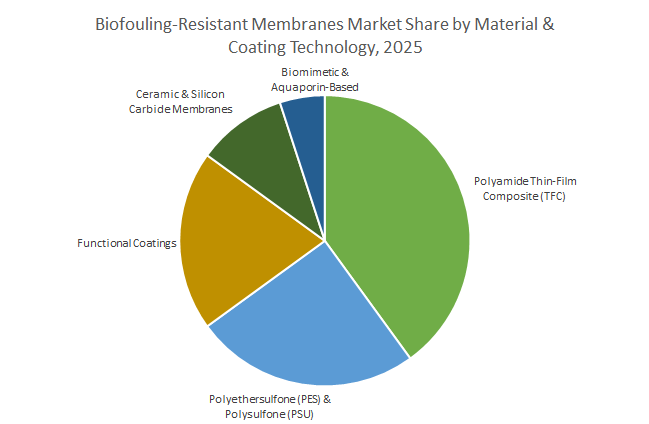
Polyamide thin-film composite (TFC) membranes dominate with 40% share, thanks to their ubiquity in RO and NF applications. Next in line are polyethersulfone (PES) and polysulfone (PSU) membranes (25%), which lead the UF/MF segment due to their mechanical strength and chemical resistance. Functional coatings (20%) are emerging as the fastest-scaling innovation, adding hydrophilic, zwitterionic, and antimicrobial properties to existing platforms without requiring full redesigns. Ceramic and silicon carbide membranes (10%) occupy a durable niche in harsh industrial environments, such as pharma and petrochemicals, where aggressive cleaning is required. Meanwhile, biomimetic and aquaporin-based membranes (5%) remain in early adoption but are considered the future of high-efficiency filtration, with disruptive potential as costs fall.
Market Share by Application
In terms of applications, municipal water and wastewater treatment leads with 30% market share, driven by large-scale adoption of biofouling-resistant membranes to meet tightening effluent discharge regulations and water reuse mandates. Industrial wastewater treatment (25%) is the second-largest segment, fueled by complex effluents from chemicals, textiles, and power generation, where fouling-resistant membranes ensure operational continuity. Seawater desalination (20%) remains a strategic growth market, especially in MENA, where biofouling-resistant RO membranes directly reduce energy consumption and LCOW. The food & beverage sector (15%) depends on membranes for product quality and waste valorization, while brackish water treatment and pharmaceuticals/biotech (5% each) serve specialized but critical niches. Collectively, these segments highlight how the biofouling-resistant membranes market underpins both water security and industrial productivity worldwide.
Competitive Landscape of the Biofouling-Resistant Membranes Market
The competitive landscape includes global antifouling membrane manufacturers, RO membrane suppliers, MBR module producers, ceramic membrane companies and functional-coating developers. Supplier differentiation centers on membrane-surface chemistry, feed-channel hydrodynamics, cleanability, differential-pressure behavior, permeability, contaminant rejection and resistance to repeated chemical cleaning.
Fouling-Resistant RO and NF Membrane Suppliers
DuPont Water Solutions, Nitto Denko/Hydranautics, Toray Industries, NanoH2O, Aquaporin and ZwitterCo participate across low-fouling RO, NF, biomimetic or surface-functionalized membrane platforms.
Commercial RO differentiation includes surface hydrophilicity, element pressure drop, feed-spacer geometry, rejection performance and recovery after cleaning. Products marketed for wastewater reuse or biologically active feedwater occupy a more specialized position than conventional brackish-water elements.
UF, MBR and Hydrophilic Polymeric Membrane Suppliers
Pentair X-Flow, MANN+HUMMEL Water & Fluid Solutions, Kuraray, Kubota, Kovalus Separation Solutions, Mitsubishi Chemical Group and Veolia Water Technologies participate through hollow-fiber, flat-sheet, tubular or MBR membrane technologies.
Competitive positioning reflects module openness, aeration requirements, hydrophilic surface treatment, backwashing behavior, fiber strength and resistance to biomass or solids accumulation.
Ceramic and Silicon-Carbide Membrane Suppliers
CERAFILTEC and LiqTech International represent the ceramic and silicon-carbide portion of the market. Their membrane platforms address difficult industrial water where aggressive cleaning, temperature tolerance and mechanical durability can be as important as preventing initial foulant attachment.
United States: Federal Research Funding and Commercial Zwitterionic Membranes Support Antifouling Technology Development
The United States combines commercial membrane development with federally funded research into lower-fouling water-treatment technologies. In 2024, the U.S. Department of Energy committed $75 million over five years to the second phase of the National Alliance for Water Innovation (NAWI), covering desalination and water-reuse technologies where membrane fouling, energy consumption and treatment cost remain important technical barriers.
NSF-backed membrane research has also addressed biological fouling directly. NALA Systems received NSF SBIR support for chlorine-resistant RO membranes intended to permit residual disinfectant exposure while reducing biofouling, cleaning and membrane degradation; NSF's project material cited an estimated 20–30% potential operating-cost reduction for the technology concept. America’s Seed Fund Commercial antifouling development is represented by ZwitterCo, which launched the Evolution, Elevation and Expedition membrane families in July 2025 for food processing, industrial water reuse and difficult wastewater applications using zwitterionic membrane chemistry.
China: Dual-Functional RO Research Targets Antibacterial and Anti-Adhesion Performance
China has active membrane research focused specifically on biological attachment and antimicrobial surface functionality. In January 2025, the Institute of Process Engineering of the Chinese Academy of Sciences reported development of a dual-functional RO membrane produced by grafting ionic-liquid and sulfonic-acid monomers onto the membrane surface. The research combined antibacterial activity with anti-adhesion characteristics and targeted water purification, desalination and high-salinity wastewater treatment.
The researchers reported full flux recovery after alkaline cleaning and a 99.8% bactericidal rate against E. coli under the laboratory conditions used in the study. The Chinese Academy of Sciences also cited literature indicating that biological fouling can account for more than 45% of membrane-fouling problems in the context discussed by the researchers. These results represent research-stage membrane performance rather than commercial full-scale operating data.
Germany: Ceramic Membrane Manufacturing Expands Into High-Fouling Wastewater Applications
Germany has a significant commercial position in durable ceramic membrane technology through Saarbrücken-based CERAFILTEC. In 2025, the company supplied ceramic membrane technology for a 49.2 million-liter-per-day municipal wastewater reuse MBR serving xAI's Memphis data-center cooling requirements. The system was developed around flat-sheet ceramic membranes selected for chemical-cleaning tolerance and long-duration operation under wastewater conditions.
CERAFILTEC has also documented four Indian produced-water installations treating a combined 13,000 m³/day of hot, oily wastewater. The company reports stable operation at temperatures up to 60°C, 96% oil removal during severe feed spikes and recovery after intensive cleaning. These are company-reported project results, but they demonstrate the commercial role of German ceramic membrane engineering in applications where recoverability from severe fouling is central to membrane selection.
Japan: MBR Development Focuses on Fouling Control, Aeration and Energy Efficiency
Japan has a long development history in membrane bioreactor technology, but the number of municipal sewerage MBR installations should be stated accurately. The Japan Sewage Works Agency reports 26 MBR installations in Japan's sewerage sector as of fiscal 2024, rather than the more than 3,000 installations stated in the earlier version of the report.
Japanese MBR development has increasingly focused on the relationship between fouling control and energy use. The Japan Sewage Works Agency reports that energy-efficient MBR configurations using improved membranes and optimized membrane-cleaning aeration have achieved electricity consumption of 0.4 kWh/m³ or less under evaluated conditions. JSWA also identifies rising membrane differential pressure at low water temperatures as a continuing MBR operating issue. Japan Sewage Works Agency Japan's Ministry of Land, Infrastructure, Transport and Tourism has maintained technical guidelines for introducing MBR into sewage works, supported by the A-JUMP demonstration program and subsequent technical evaluation.
Australia: Mining-Water Research and Ceramic Membrane Partnerships Expand Antifouling Development
Australian membrane activity is closely connected with water scarcity, industrial wastewater and mining-water reuse. In 2026, the Minerals Research Institute of Western Australia initiated a 2026–2029 research project with a A$167,518 grant to develop polymeric and ceramic membranes for mining and tailings wastewater. The program specifically includes bio-inspired additives, antifouling and anti-scaling surface modifications, and long-term membrane-performance modeling.
Commercial activity is also increasing around chemically durable membrane platforms. In May 2025, Osmoflo and Germany's CERAFILTEC expanded their partnership into an exclusive agreement covering Australia, New Zealand and the Pacific, including ceramic membrane applications in MBRs, drinking-water treatment and tertiary water reuse. Cerafiltec The Australian Government is separately funding membrane-related water-treatment pilots, including a A$230,000 National Water Grid project examining reuse of retired RO membranes in regional brackish-water treatment.
Netherlands: Full-Scale Operating Data Quantify the Cost of Membrane Fouling
The Netherlands provides unusually detailed full-scale evidence on the economics of membrane fouling. A study of **seven full-scale installations—four NF and three RO plants—**found fouling-related costs equal to approximately 11% of OPEX for the NF plants and 24% ±3% for the RO plants. The RO systems treated surface water or municipal wastewater effluent, while the NF systems used anoxic groundwater with lower biofouling potential. Premature membrane replacement was identified as the largest fouling-related cost component, followed by additional energy and cleaning-related downtime.
The Netherlands also hosts Pentair X-Flow's membrane development and manufacturing operations in Enschede. In May 2026, X-Flow announced plans to transition its tubular membrane portfolio from PVDF to hydrophilic PES while incorporating its Helix technology, which generates continuous turbulence at the membrane surface to reduce fouling and particle buildup. The product family serves MBR, leachate, produced-water and industrial wastewater applications.
By Membrane Type (Reverse Osmosis (RO) Membranes, Ultrafiltration (UF) Membranes, Nanofiltration (NF) Membranes, Microfiltration (MF) Membranes, Membrane Bioreactor (MBR) Membranes), By Material & Coating Technology (Polyamide Thin-Film Composite (TFC) Membranes, Polyethersulfone (PES) & Polysulfone (PSU) Membranes, Ceramic & Silicon Carbide Membranes, Biomimetic & Aquaporin-Based Membranes, Functional Coatings), By Application (Seawater Desalination, Brackish Water Treatment, Municipal Water & Wastewater Treatment, Industrial Wastewater Treatment, Pharmaceuticals & Biotechnology, Food & Beverage Processing), By End-User Industry (Municipal Utilities, Power Generation, Oil & Gas / Petrochemicals, Food & Beverage, Pharmaceuticals & Life Sciences, Textiles & Chemicals)
Study Period
2020- 2025 and 2026-2034
Units
Revenue (USD)
Qualitative Analysis
Porter’s Five Forces, SWOT Profile, Market Share, Scenario Forecasts, Market Ecosystem, Company Ranking, Market Dynamics, Industry Benchmarking
Companies
DuPont Water Solutions, ZwitterCo, Nitto Denko / Hydranautics, Toray Industries, NanoH2O, Aquaporin, Pentair X-Flow, MANN+HUMMEL Water & Fluid Solutions, Kuraray, Veolia Water Technologies, Kovalus Separation Solutions, Kubota Corporation, CERAFILTEC, LiqTech International, Mitsubishi Chemical Group
Countries
US, Canada, Mexico, Germany, France, Spain, Italy, UK, Russia, China, India, Japan, South Korea, Australia, South East Asia, Brazil, Argentina, Middle East, Africa
Europe (Germany, UK, France, Spain, Italy, Russia, Rest of Europe)
Asia Pacific (China, India, Japan, South Korea, Australia, South East Asia, Rest of Asia)
South America (Brazil, Argentina, Rest of South America)
Middle East and Africa (Saudi Arabia, UAE, Rest of Middle East, South Africa, Egypt, Rest of Africa)
Top Companies in the Biofouling-Resistant Membranes Industry include-
DuPont Water Solutions
ZwitterCo
Nitto Denko / Hydranautics
Toray Industries
NanoH2O
Aquaporin
Pentair X-Flow
MANN+HUMMEL Water & Fluid Solutions
Kuraray
Veolia Water Technologies
Kovalus Separation Solutions
Kubota Corporation
CERAFILTEC
LiqTech International
Mitsubishi Chemical Group
*- List not Exhaustive
Research Coverage
USDAnalytics evaluates biofouling-resistant and antifouling membrane technologies across RO, NF, UF, MF and MBR applications in municipal water, wastewater reuse, desalination, industrial wastewater, food processing and pharmaceutical treatment.
Technical analysis covers microbial attachment, EPS development, membrane-surface hydrophilicity, zwitterionic chemistry, antimicrobial functionality, feed-spacer hydraulics, MBR aeration, differential pressure, transmembrane pressure, cleaning recovery and coating stability. The study distinguishes biological fouling from organic, colloidal and inorganic fouling while recognizing their interaction in commercial systems.
Commercial assessment incorporates membrane product launches, module architecture, cleaning tolerance, material certification and full-scale operating evidence. Manufacturer-reported field-performance values are identified as company-reported results where independent validation is unavailable.
. Scope Includes-
Segmentation: By Membrane Type (RO, UF, NF, MF, MBR); By Material & Coating Technology (Polyamide TFC, PES & PSU, Ceramic & SiC, Biomimetic & Aquaporin-Based, Functional Coatings); By Application (Seawater Desalination, Brackish Water Treatment, Municipal Water & Wastewater, Industrial Wastewater, Pharmaceuticals & Biotechnology, Food & Beverage Processing); By End-User Industry (Municipal Utilities, Power Generation, Oil & Gas/Petrochemicals, Food & Beverage, Pharmaceuticals & Life Sciences, Textiles & Chemicals).
Geographic Scope: Analysis spans 25+ countries across North America, Europe, Asia Pacific, Latin America, the Middle East & Africa.
Historic data from 2021 to 2024 and forecast data from 2025 to 2034.
Companies (Profiles of 15+ companies): DuPont de Nemours, Inc.; Toray Industries, Inc.; SUEZ; Veolia; Pentair plc; Xylem Inc.; The Dow Chemical Company; ZwitterCo; Kubota Corporation; MANN+HUMMEL; Evoqua Water Technologies; Koch Separation Solutions; LG Chem; Kuraray Co., Ltd.; Mitsubishi Chemical Corporation.
Methodology
USDAnalytics combines primary research with secondary validation across membrane manufacturers, utilities, industrial water users, MBR operators, food processors, EPC companies and membrane-system integrators.
Secondary evidence includes membrane product documentation, regulatory and certification records, full-scale project information, company disclosures and peer-reviewed membrane research. Market sizing incorporates membrane area, installed capacity, replacement cycles, membrane type, coating technology, end-user application and regional deployment.
Forecasts assess commercial adoption of fouling-resistant TFC membranes, hydrophilic polymeric membranes, functional coatings, ceramic/SiC platforms and biomimetic membranes across water reuse, desalination and industrial separation.
Deliverables:
Comprehensive Market Research Report (PDF and Excel) with detailed tables, charts, and interactive visualizations.
Country-Specific Forecasts & Analysis.
Segment-Wise Revenue Forecasts (2026–2034).
Competitive Analysis, Benchmarking, and SWOT Profiles.
Recent Developments & Innovation Tracker.
Executive Summary & Analyst Commentary.
Post-Purchase Analyst Support for Client-Specific Questions and Custom Data Requirements.
Table of Contents: Biofouling-Resistant Membranes Market
1. Executive Summary
1.1. Market Highlights
1.2. Key Insights Driving Market Growth
1.3. Global Market Snapshot
2. Biofouling-Resistant Membranes Market Outlook (2025–2034)
2.1. Market Overview: Growth Driven by Efficiency and Sustainability
2.2. Market Valuation and Growth Projections (2025–2034)
2.2.1. Current Market Size (2025): USD 3.5 Billion
Field data show biofouling can drive 20–30% of opex via higher pressure, frequent CIPs, and downtime. Upgrading to biofouling-resistant TFC or coated elements typically trims cleanings by 30–50% and extends run length, lowering chemicals, energy per m³, and spare inventory often yielding 12–24-month paybacks.
Zwitterionic layers minimize initial adhesion and suit stable municipal feeds aiming to cut CIP frequency. Antimicrobial/biocidal surfaces add active kill mechanisms, favored for high-risk industrial feeds (F&B, petrochem) or warm intakes. Many buyers deploy hybrids: zwitterionic topcoats over robust PA layers for balanced durability and protection.
Pair coated RO with optimized DAF/UF, tight chloramine control, and biologically stable pretreatment (AOC reduction). Online SDI/ATP monitoring plus low-dose, non-oxidizing biocides during standby reduces biofilm rebound. Plants also benefit from smarter clean-in-place triggers based on normalized flux and differential pressure trends.
Yes, ceramic and SiC modules tolerate aggressive cleaning, shear, and temperature, enabling quick recovery from upset events and longer service life. While capex is higher, their resilience in oily/variable feeds and reduced lifecycle opex (fewer replacements, shorter CIPs) often close the economics in industrial MBRs.
Require guaranteed maxima for cleaning frequency per 1,000 operating hours, minimum flux-recovery post-CIP, and stable TMP slope under defined feed bioload. Mandate independent pilot data, coating durability cycles, and warranty terms tied to biofouling KPIs. Include provisions for online biofilm sensing and operator training to lock in outcomes.