Market Analysis: Celebrity Endorsements and Influencer Partnerships Drive Growth in the Brand Endorser Market
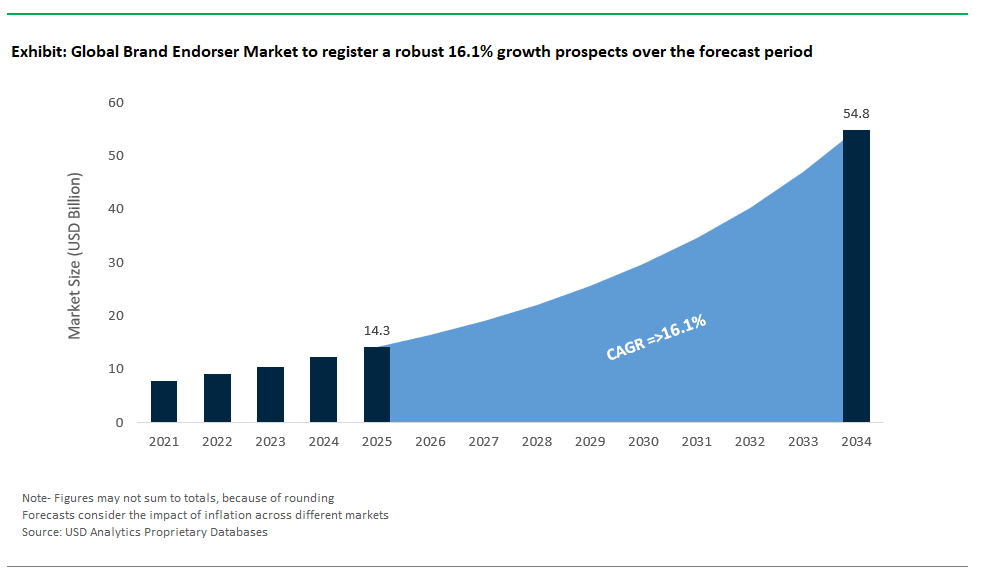
The Global Brand Endorser Market Size is estimated at $14.3 Billion in 2025 and is forecast to register an annual growth rate (CAGR) of 16.1% to reach $54.8 Billion by 2034.
The brand endorser market is experiencing strong momentum as major brands across diverse sectors ramp up celebrity endorsements and influencer collaborations to expand global reach and drive consumer engagement. In July 2025, Cremo Ice Cream backed by Yili Group appointed Thai artist Billkin as its official spokesperson as part of a sweeping brand upgrade, generating social media buzz and supporting international expansion across 13 countries, including Singapore, Malaysia, France, and Australia. Likewise, premium French skincare brand Galénic announced Chinese actress Zhao Liying as its new Global Brand Ambassador in January 2025, leveraging her massive influence in China to spotlight flagship products like the Galéniceutiques [N°1] VC Serum and deepen the brand’s resonance with Asian consumers.
Global product and entertainment partnerships continue to shape the brand endorser market. In June 2025, Nestlé’s KitKat launched a major collaboration with Formula 1 in Latin America, rolling out exclusive merchandise, in-store activations, and prize promotions that connect the world’s leading chocolate bar with F1’s vast international fan base an effort set to expand worldwide through 2026. Video technology provider Kaltura also tapped into the power of celebrity with a long-term partnership featuring actor David Duchovny for a 360-degree brand awareness campaign, highlighting the strategic use of high-profile endorsers to distinguish B2B brands and attract new audiences in competitive sectors.
Brands are also refining their endorsement strategies to optimize ROI and brand equity. Unilever, in its Q4 and full-year 2024 results, highlighted increased investment in its “Power Brands” such as Dove, Vaseline, and Comfort brands well-known for their history of celebrity and influencer partnerships. Meanwhile, recent SponsorUnited data reveals that 29% of brands in the endorsement space entered it for the first time in the last year (as of September 2024), many starting with single-influencer deals to test market traction for new products. This ongoing evolution underscores a dynamic and rapidly growing brand endorser market, where tailored celebrity collaborations, micro-influencer campaigns, and global event tie-ins are key to capturing consumer attention and building enduring brand loyalty.
Strategic Shifts in the Brand Endorser Market
Trend: Neuroscientific Validation of Endorser Impact via fNIRS Brain Imaging
The brand endorser market is entering a new era of data-driven decision-making with the adoption of neuroscientific validation techniques, particularly functional near-infrared spectroscopy (fNIRS) brain imaging. Unlike traditional engagement metrics that rely on surface-level indicators such as likes and shares, fNIRS enables marketers to assess neural activation patterns in regions like the dorsolateral prefrontal cortex a critical area linked to memory and decision-making. Research demonstrates that endorsements triggering strong activation in these areas can significantly enhance brand recall and purchase intent compared to endorsements assessed through conventional measures.
This advancement provides brands with an unprecedented ability to identify endorsers who genuinely resonate with target audiences at a subconscious level, optimizing ROI for endorsement campaigns. However, alongside this trend, studies indicate diminishing returns from “overexposed” influencers those involved in frequent brand collaborations. Neural adaptation in audiences reduces the novelty and persuasive effect of repeated endorsements, weakening brand impact. This insight underscores the importance of strategic partnerships with selectively positioned endorsers rather than adopting a saturation approach, ensuring authenticity and long-term consumer trust.
Opportunity: Dark Pattern Mitigation Specialists for Ethical Influence
A major opportunity within the brand endorser market lies in the rise of dark pattern mitigation specialists compliance experts dedicated to ensuring ethical influence in a tightening regulatory environment. Increased enforcement by agencies such as the FTC in the U.S. and the rollout of comprehensive laws like the EU Digital Services Act (DSA) are reshaping how brands and influencers operate. These frameworks demand higher transparency, explicit disclosure of paid partnerships, and the elimination of deceptive marketing practices.
To meet these obligations, brands are increasingly engaging certified compliance auditors to review influencer contracts, monitor content for dark patterns, and ensure adherence to ethical standards. This proactive approach not only reduces legal and reputational risks but also positions brands as consumer-centric and trustworthy. By 2025, the need for DSA-compliant influencer agreements and legal oversight is projected to create a multi-million-dollar market for compliance services. Brands that prioritize ethical engagement backed by professional auditing will not only avoid costly penalties but also strengthen consumer loyalty in an era where transparency and accountability define digital success.
Competitive Landscape: Brand Endorser Market
Lionel Messi: Redefining Athlete Endorsement and Global Influence
Lionel Messi remains one of the world’s most valuable brand endorsers, commanding an estimated $120 million annually, with endorsement income alone accounting for roughly $60–$70 million per year in 2025. Messi’s lifetime contract with Adidas stands as a cornerstone of his global endorsement portfolio, consistently ranking among the top athlete-brand partnerships. His commercial reach extends further through landmark deals with Apple TV+ (including a share in MLS Season Pass revenues), Saudi Tourism, Hard Rock International, PepsiCo, Budweiser, Mastercard, and major beverage and retail brands like Lowe’s and Royal Caribbean. Messi’s ability to drive consumer engagement was evident in the surge of Apple TV subscribers and Inter Miami’s brand value following his move to MLS. With innovative deals offering equity and revenue-sharing such as his future stake in Inter Miami CF Messi sets a new precedent in athlete endorsement, integrating brand ambassador roles with direct financial participation and personal brand ventures like Más+ by Messi (energy drinks) and The Messi Store (lifestyle apparel). His influence now bridges traditional sports marketing, lifestyle products, and even digital assets, making Lionel Messi an iconic force in the brand endorser market.
Cristiano Ronaldo: Global Icon and Billion-Dollar Brand Ambassador
Cristiano Ronaldo’s status as a brand endorser is underscored by annual endorsement earnings of around $100 million, complemented by a net worth that places him among the world’s wealthiest athletes. With a lifetime deal with Nike reportedly valued over $1 billion, Ronaldo’s relationship with the Swoosh is a benchmark in sports marketing history. His endorsement power is amplified by major partnerships with Binance, Herbalife, Clear, TAG Heuer, and luxury brands such as Jacob & Co. and MTG, in addition to deals with Abbott, Unilever, and DAZN. Ronaldo’s CR7 brand spanning hotels, fitness centers, fashion, and fragrances has become a case study in personal branding. His strategic move to Al Nassr in Saudi Arabia, accompanied by commercial tie-ups with local and global brands and a unique club ownership stake, further expands his influence into new markets and sets new standards for athlete compensation. With a social media following exceeding one billion, Ronaldo offers brands instant, global reach, making him a perennial leader in the brand endorsement and influencer market.
LeBron James: Billionaire Athlete and Multi-Platform Brand Builder
LeBron James is a trailblazer in the brand endorser landscape, with annual endorsement earnings estimated at $85 million in 2025 and a net worth exceeding $1.2 billion. His lifetime contract with Nike remains one of the most lucrative deals ever for an athlete, serving as a foundation for his sustained brand power. LeBron’s commercial partnerships include industry giants like AT&T, PepsiCo, and Walmart, alongside a significant stake in Blaze Pizza and high-profile investments in Fenway Sports Group. His entrepreneurial pursuits through The SpringHill Company where he remains the majority owner exemplify the modern athlete’s evolution from brand ambassador to media mogul, producing acclaimed content across platforms like Apple TV+. LeBron’s early investment in Beats by Dre, and his status as a key figure in cultural and commercial spheres, allow brands to tap into a unique blend of athletic achievement, social influence, and business acumen. As an active billionaire athlete, LeBron James continues to set new benchmarks for integrating endorsements, investments, and content ownership.
BTS: Global Pop Culture Phenomenon and Multi-Sector Brand Amplifiers
BTS stands as the most influential music group in the brand endorsement world, with a group valuation of approximately $500 million and a long roster of historic partnerships. Their collaborations with Hyundai, Samsung, McDonald’s, Louis Vuitton, FILA, Coca-Cola, and Lotte have yielded remarkable results, including sold-out product lines and viral campaigns like the “BTS Meal.” Despite their group hiatus for military service and solo projects, each member Jimin, Jungkook, V, RM, SUGA, Jin, and j-hope continues to drive immense brand value individually, serving as ambassadors for luxury brands such as Dior, Tiffany & Co., Calvin Klein, CELINE, Gucci, and more. This evolving endorsement strategy, shifting from group to targeted individual partnerships, enables brands to connect with diverse demographics while leveraging the overarching BTS effect. The group’s continued impact on luxury, technology, lifestyle, and FMCG sectors makes BTS and its members indispensable to global marketing strategies, even in the absence of active group activities.
Dwayne "The Rock" Johnson: Athlete, Actor, and Brand Owner
Dwayne Johnson known globally as “The Rock” is a powerhouse in brand endorsements and entrepreneurship, earning an estimated $75 million annually from endorsement and business deals in 2025. His iconic partnership with Under Armour, resulting in the Project Rock brand, demonstrates the effectiveness of co-branded, athlete-driven product lines. Johnson has evolved beyond traditional endorsements, taking ownership roles in ventures like ZOA Energy, Teremana Tequila, and Papatui, reflecting a shift toward authentic, invested brand ambassadorship. His board position with TKO Group Holdings (parent of WWE and UFC) and content production through Seven Bucks Productions further extend his influence across sports, entertainment, and lifestyle markets. With an unrivaled social media following and a reputation for authenticity and drive, The Rock’s partnerships with Apple TV+, Papa John’s, Slim Jim, and Cash App exemplify how modern celebrity endorsers create value as co-owners and cultural icons. Johnson’s ability to generate buzz and sales for his own and partner brands makes him a template for athlete-entrepreneur endorsement strategies in the current era.
Market Share and Segmentation Insights: Brand Endorser Market
By Type: Celebrity Endorsers Lead, UGC Grows Fastest
In the evolving brand endorser market, celebrity endorsers hold the largest market share at 30.2% in 2025. These are traditional high-profile figures such as actors and athletes, valued for their mass appeal and established recognition. However, the growth of this segment remains modest, limited by high costs and market saturation. The most dynamic shift is seen with user-generated endorsements (UGC), which represent the fastest-growing segment with a CAGR of 16.9%. UGC is rapidly transforming marketing as brands increasingly prioritize authenticity and consumer trust, harnessing everyday users and viral content especially across platforms like TikTok. Influencer endorsers (social media creators) are also on the rise, as brands focus on ROI-driven micro and nano-influencer campaigns that offer targeted engagement. Expert endorsers, brand ambassadors, testimonials, and product placements each play specialized but smaller roles, with influencers bridging the gap between traditional celebrity and consumer-led endorsements.
.png)
By Category: Actors Lead, Gaming Personalities Grow Fastest
When segmented by category, actors and actresses command the largest share at 24.9% in 2025, supported by longstanding partnerships in global advertising. Despite this lead, their growth rate is modest due to oversaturation in the market and shifting consumer preferences. In contrast, gaming personalities are the fastest-growing category, with an impressive CAGR of 17.4%. The surge is fueled by the global rise of esports, livestreaming, and interactive gaming culture driving unprecedented engagement, especially among Gen Z and younger audiences. Social media personalities are also gaining ground rapidly (14% CAGR), becoming the go-to channel for brands targeting digital-native consumers. Beauty and fashion gurus, musicians, models, public figures, and chefs each contribute unique value to specific verticals, but their market shares remain comparatively smaller.
United States: Influencer Marketing Spend, Athlete Endorsements, and AI Adoption
The United States continues to lead the global brand endorser market with influencer marketing spend projected to surpass $10 billion in 2025. The U.S. accounted for 22.7% of all sponsored influencer posts worldwide in 2024 an impressive 18.9 million posts showcasing the scale of the domestic market. Luxury brands are particularly increasing their investment in sports sponsorships and athlete partnerships in 2025, with LVMH as a Paris Olympics global partner and Louis Vuitton expanding its sports ambassador roster. Meanwhile, U.S. athletes are increasingly taking control of their image through their own media platforms, reshaping the dynamics of endorsement deals and offering brands new opportunities for direct audience engagement. These trends reflect the dominance of the U.S. in both volume and strategic innovation in the brand endorsement space.
In addition to traditional celebrity endorsements, the U.S. market is at the forefront of integrating technology with marketing, with 88% of marketers using AI-powered tools for influencer identification, audience analysis, and authenticity checks. The widespread adoption of AI streamlines campaign targeting, making endorsements more data-driven and effective. The 2025 Forbes list of highest-paid athletes underlines the value of endorsements in personal income: Stephen Curry ($156M), Dak Prescott ($137M), and LeBron James ($133.8M) all rank among the world’s top earners, largely due to their endorsement portfolios. This fusion of sports, entertainment, and technology cements the U.S. as the leading ecosystem for brand endorser strategies globally.
India: Bollywood and Sports Endorsements, New Accountability, and Sponsored Post Surge
India’s brand endorser market is uniquely characterized by the dominance of film and sports celebrities. In H1 2024, 75% of all celebrity-endorsed TV ads featured film stars, while sports personalities accounted for 14%. Cricket legends like MS Dhoni, who endorsed 52 brands in 2024, and Olympic champion Neeraj Chopra (brand value: $30 million, over 20 endorsements) reflect the power of sports in diversifying India’s endorsement scene. The rising influence of non-cricket athletes like Chopra and PV Sindhu is expanding the market, with emerging sports contributing to 14% of the ₹1,224 crore ($146 million) sports endorsement market, marking a 46% growth. Brands are increasingly leveraging celebrity power to penetrate deeper into the Indian consumer psyche.
On the regulatory front, India’s Supreme Court in May 2024 held celebrities and influencers equally liable for misleading advertisements, significantly raising the bar for due diligence and accountability in brand deals. India is also the third-largest contributor globally to sponsored posts, representing 6.7% of influencer-branded content in 2024. Noteworthy endorsement deals include Sachin Tendulkar as Bank of Baroda’s global ambassador, Havells India collaborating with South Indian film stars, and Fujifilm Instax signing Bollywood actors. This vibrant landscape, marked by stringent legal expectations and dynamic celebrity partnerships, is accelerating the evolution of India’s brand endorser market.
China: Brand Value Growth, Content Innovation, and AI-Driven Endorsements
China’s brand endorser market is rapidly expanding, with local brands such as East Money and New Oriental achieving impressive double-digit brand value growth in 2025 through innovative endorsement strategies. A notable trend is the use of micro-dramas 90% of which were custom or self-produced in 2024 for seamless product placement and creator-driven storytelling, indicating a strong shift towards content integration. Consumer optimism is fueling increased spending in consumer electronics (37.6%) and entertainment (36.5%), prompting brands to ramp up endorsement budgets and creative collaborations. Chinese endorsement strategies increasingly align with local culture and content consumption preferences, solidifying domestic brand loyalty.
AI plays a transformative role in China’s digital marketing, enabling hyper-personalized and emotionally resonant endorsement experiences. AI models now inject human-like traits into digital campaigns, enhancing the authenticity and relevance of brand communication. Over half of Chinese consumers (50.5%) are optimistic about the economy in 2025, leading brands to emphasize value-driven messaging and partner with endorsers who personify these ideals. As value alignment and digital innovation rise in importance, the selection and deployment of brand endorsers in China are increasingly shaped by data analytics, social values, and immersive content creation.
United Kingdom: Regulatory Rigor, Luxury and Sports Sponsorships, and Amplified Influencer Content
The United Kingdom’s brand endorser market is strongly shaped by one of the strictest regulatory frameworks in the world. The Advertising Standards Authority (ASA) requires clear labeling of paid partnerships (e.g., #ad at the beginning of captions), especially since April 2025. The promotion of unhealthy foods to under-16s is now banned, ensuring that influencer marketing remains ethical and transparent. The UK contributed 2.8 million sponsored influencer posts in 2024, accounting for 3.4% of the global total, highlighting its importance for brands targeting Western European audiences.
Luxury brands are doubling their sports sponsorship investments, as seen with Chanel’s new sponsorship of The Boat Race. Alcohol-free beverages like Guinness 0.0 and Asahi Super Dry 0.0% are also projected to drive large-scale endorsement campaigns in 2025. UK agencies are increasingly boosting or whitelisting influencer content, sometimes allocating up to 50% of campaign budgets for paid amplification, especially during peak retail periods. This demonstrates a sophisticated, ROI-driven approach to influencer partnerships and content distribution in the UK, where regulatory clarity and creative execution go hand in hand.
Brazil: Second Largest for Sponsored Posts, Local Influencer Growth, and Regional Content
Brazil stands as the world’s second-largest market for sponsored influencer posts, contributing 14.5% of global sponsored content in 2024. This highlights Brazil’s highly active and mature brand endorser market, underpinned by strong social media penetration and a vibrant digital creator ecosystem. Brands increasingly seek collaborations with local influencers who possess deep connections to regional audiences, enabling campaigns to resonate authentically with Brazil’s diverse demographics.
Localized content strategies are at the heart of Brazilian endorsement campaigns, with brands tailoring messaging and partnerships to specific communities and cultural trends. This regional focus ensures high engagement and impact, making influencer marketing a key pillar of brand communication in Brazil. As the market continues to grow, both domestic and international brands are expected to invest further in local partnerships to strengthen their foothold in this dynamic and expansive market.
Canada: AI Integration, Hyper-Local Focus, and Multi-Channel Endorsements
Canada’s brand endorser market is advancing through the integration of AI-driven tools for campaign design, influencer selection, and content optimization. Marketers increasingly leverage AI to match brands with the right endorsers, streamline brief generation, and enhance content relevance, resulting in significant time and resource efficiencies. Brands in Canada are also leading in the activation of nano and micro-influencers with hyper-local audiences, recognizing that authenticity and trust are amplified when endorsements come from familiar, community-rooted creators.
Multi-channel campaigns are now the norm, with brands distributing endorsed content across TikTok, Instagram, YouTube, connected TV (CTV), and digital out-of-home (DOOH) networks. This multi-platform approach ensures maximum visibility and reach, while also allowing for sophisticated performance tracking and audience segmentation. As Canadian consumers embrace influencer content on multiple touchpoints, the country’s brand endorser market will continue to evolve toward even greater personalization and strategic sophistication.
Australia: Influencer Investment, Authenticity, and Sports Endorsements
Australian brands are increasing their investment in influencer marketing as a critical pillar of their marketing strategies, drawn by the high engagement and credibility that authentic endorsements deliver. Regulators and consumers in Australia are placing heightened emphasis on transparency and authenticity, with brands expected to work with endorsers who genuinely align with brand values and disclose paid partnerships clearly. This ensures that endorsements resonate more deeply with audiences, fostering brand trust.
Sports stars and prominent media personalities are frequently chosen as endorsers by Australian brands, leveraging their widespread popularity and ability to connect with national audiences. The emphasis on relatable, homegrown talent ensures that brand messages are delivered with maximum cultural resonance and trust. As the market matures, authenticity and genuine brand-endorser alignment will remain paramount for successful endorsement campaigns in Australia.
France: Olympic Surge, Luxury Brand Leadership, and Micro-Influencer Momentum
The 2024 Paris Olympics was a pivotal moment for France’s brand endorser market, sparking a wave of athlete and team ambassador signings and an uptick in endorsement-driven marketing activities. French luxury brands LVMH, Dior, and Chanel remain global trendsetters in celebrity and influencer endorsements, strategically partnering with artists, athletes, and fashion icons to sustain their international presence and appeal. These high-profile collaborations reinforce France’s status as a capital of luxury marketing and brand elevation through endorsements.
Following broader European trends, French brands are allocating more endorsement budgets to micro and nano-influencers, recognizing their superior engagement rates and ability to reach niche or local audiences with authenticity. Regulatory scrutiny around disclosure and misleading claims has also increased, ensuring that influencer campaigns comply with stringent consumer protection standards. This combination of luxury-driven innovation, Olympic exposure, and grassroots influencer engagement makes France a vibrant, forward-looking market for brand endorsements.
Brand Endorser Market Report Scope
Brand Endorser Market
|
Parameter
|
Details
|
|
Market Size (2025)
|
$14.3 Billion
|
|
Market Size (2034)
|
$54.8 Billion
|
|
Market Growth Rate
|
16.1%
|
|
Segments
|
By Type (Celebrity Endorsers, Influencer Endorsers, Expert Endorsers, User-Generated Endorsements (UGC), Co-Branding/Brand Ambassador Endorsements, Testimonial Endorsements, Organizational Endorsements, Product Placement Endorsements), By Category (Actors/Actresses, Athletes/Sports Personalities, Musicians/Singers, Social Media Personalities/Content Creators, Models, Public Figures/Activists, Chefs/Food Personalities, Beauty & Fashion Gurus, Gaming Personalities), By Industry (Fast-Moving Consumer Goods (FMCG), Automotive, Electronics & Technology, Fashion & Apparel, Beauty & Personal Care, Healthcare & Pharmaceuticals, Sports & Fitness, Food & Beverages, E-commerce & Gaming, Banking & Financial Services (BFSI), Luxury Goods, Tourism & Hospitality, Government Campaigns/Public Service), By Target Audience (Youth (Gen Z, Millennials), Adults, Families, Specific Age Groups, Gender-Specific Audiences, Regional/Cultural Audiences)
|
|
Study Period
|
2019- 2024 and 2025-2034
|
|
Units
|
Revenue (USD)
|
|
Qualitative Analysis
|
Porter’s Five Forces, SWOT Profile, Market Share, Scenario Forecasts, Market Ecosystem, Company Ranking, Market Dynamics, Industry Benchmarking
|
|
Companies
|
WME/IMG, Influencer Marketing Hub, Obviously (Acquired by Later), NeoReach, Gleam Futures
|
|
Countries
|
US, Canada, Mexico, Germany, France, Spain, Italy, UK, Russia, China, India, Japan, South Korea, Australia, South East Asia, Brazil, Argentina, Middle East, Africa
|
Brand Endorser Market Segmentation
By Type
- Celebrity Endorsers
- Influencer Endorsers
- Expert Endorsers
- User-Generated Endorsements (UGC)
- Co-Branding/Brand Ambassador Endorsements
- Testimonial Endorsements
- Organizational Endorsements
- Product Placement Endorsements
By Category
- Actors/Actresses
- Athletes/Sports Personalities
- Musicians/Singers
- Social Media Personalities/Content Creators
- Models
- Public Figures/Activists
- Chefs/Food Personalities
- Beauty & Fashion Gurus
- Gaming Personalities
By Industry
- Fast-Moving Consumer Goods (FMCG)
- Automotive
- Electronics & Technology
- Fashion & Apparel
- Beauty & Personal Care
- Healthcare & Pharmaceuticals
- Sports & Fitness
- Food & Beverages
- E-commerce & Gaming
- Banking & Financial Services (BFSI)
- Luxury Goods
- Tourism & Hospitality
- Government Campaigns/Public Service
By Target Audience
- Youth (Gen Z, Millennials)
- Adults
- Families
- Specific Age Groups
- Gender-Specific Audiences
- Regional/Cultural Audiences
Countries Analyzed
- North America (US, Canada, Mexico)
- Europe (Germany, UK, France, Spain, Italy, Russia, Rest of Europe)
- Asia Pacific (China, India, Japan, South Korea, Australia, South East Asia, Rest of Asia)
- South America (Brazil, Argentina, Rest of South America)
- Middle East and Africa (Saudi Arabia, UAE, Rest of Middle East, South Africa, Egypt, Rest of Africa)
Top Companies in Brand Endorser Market
- WME/IMG
- Influencer Marketing Hub
- Obviously (Acquired by Later)
- NeoReach
- Gleam Futures
* List Not Exhaustive
Research Coverage
This comprehensive Brand Endorser Market report from USDAnalytics delivers in-depth market sizing, CAGR, and future value projections, placing recent developments such as neuroscientific validation of endorsements and new regulatory frameworks at the forefront of industry evolution. The study provides a structured analysis of market dynamics, influencer trends, compliance challenges, and the increasing role of AI and analytics in campaign optimization, tailored for industry professionals.
The report covers detailed segmentation by type (celebrity, influencer, expert, UGC, ambassador, testimonial, organizational, product placement), by category (actors, athletes, musicians, social media creators, models, activists, chefs, fashion and gaming personalities), by industry (FMCG, automotive, technology, fashion, beauty, healthcare, sports, e-commerce, BFSI, luxury, hospitality, government), and by target audience (youth, adults, families, gender-specific and cultural groups). It also features in-depth profiles and strategies of top companies such as WME/IMG, Influencer Marketing Hub, Obviously (Later), NeoReach, and Gleam Futures.
Geographic coverage spans North America, Europe, Asia Pacific, South America, and Middle East & Africa, offering historical data (2021–2024) and forecasts (2025–2034). The report is structured to support decision-makers, brand strategists, and agencies with actionable insights into recent trends, regulatory shifts, category growth, and the evolving brand endorser landscape worldwide.
Deliverables:
- Full Market Research Report (PDF, Excel): Complete data tables, market charts, and visual insights.
- Country-Level Forecasts & Analysis.
- Segment-wise Revenue Projections (2025–2034)
- Competitive Benchmarking & SWOT Analysis.
- Recent Developments & News Tracker
- Executive Summary & Analyst Insights.
- Post-Purchase Analyst Support for Client-Specific Questions and Custom Data Requirements.
