Breathable Antimicrobial Coatings Market Size and Growth Driven by Moisture Control and Hygiene Requirements
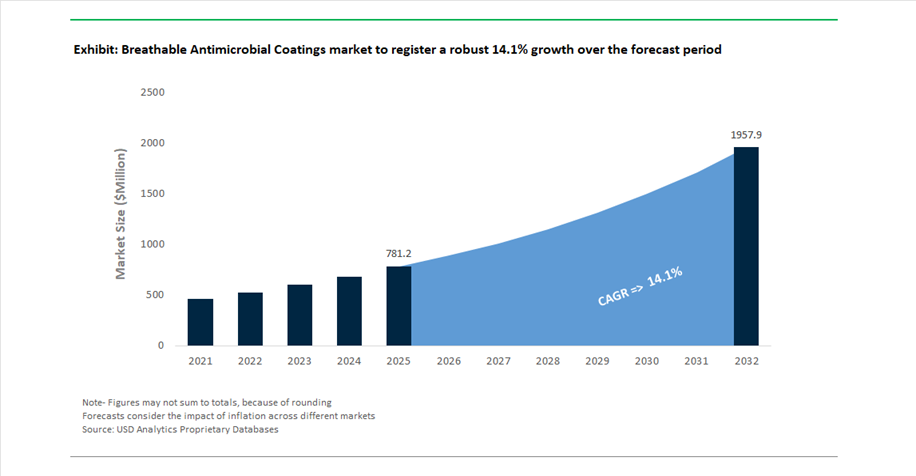
The Breathable Antimicrobial Coatings Market is projected to grow from USD 781.2 million in 2025 to USD 1,966.8 million by 2032, registering a strong CAGR of 14.1%. This rapid growth is driven by increasing demand for dual-function coatings that combine moisture vapor permeability with antimicrobial protection, particularly in construction, healthcare, and high-humidity environments.
These coatings are engineered to allow moisture vapor transmission (MVT) while preventing liquid water ingress, enabling surfaces to “breathe” without trapping humidity. At the same time, they incorporate bioactive agents such as silver ions and antimicrobial polymers that inhibit the growth of bacteria, mold, and fungi. This combination is critical in applications such as building envelopes, hospital interiors, food processing facilities, and technical textiles, where both hygiene and moisture regulation are essential for long-term performance and safety.
The market is also being shaped by increasing adoption of green building standards and indoor air quality regulations, which prioritize materials that prevent mold formation and reduce microbial contamination. Additionally, the rise of high-performance construction materials and renovation of aging infrastructure is creating demand for coatings that can maintain structural integrity while enhancing occupant health. Technological advancements are focused on nano-enabled breathable membranes, waterborne systems, and bio-based polymer matrices, enabling manufacturers to deliver coatings that meet both environmental and functional performance requirements.
Competitive dynamics are driven by innovation in multi-functional coatings, strategic collaborations, and expansion into high-value applications, positioning breathable antimicrobial coatings as a critical solution in modern building science and hygiene-focused environments
Smart Coating Innovation, Sustainable Material Development, and Strategic Expansion Transforming Market Dynamics
The breathable antimicrobial coatings market is evolving rapidly through advanced material innovation, sustainability initiatives, and strategic industry consolidation. In January 2026, PPG launched MASTER'S MARK™ BALLARD™ breathable interior paint, designed to allow walls to release moisture while maintaining a protective antimicrobial barrier, addressing common issues such as mold growth in humid environments. Similarly, NEI Corporation’s NANOMYTE® AM-100EC (June 2024) delivers 99.99% bacterial reduction while maintaining a breathable, easy-to-clean surface, making it suitable for healthcare and food service applications.
Sustainability and material innovation are central to market evolution. The September 2025 collaboration between AkzoNobel, Arkema, and BASF focuses on developing bio-based, breathable powder coatings with reduced carbon footprints, aligning with global demand for green-certified construction materials. Additionally, RPM International’s Innovation Center of Excellence is advancing VOC-compliant breathable coatings that prevent moisture buildup while maintaining structural durability in wood and masonry surfaces.
Strategic expansion and regional growth are reinforcing market penetration. Sherwin-Williams’ acquisition of BASF’s Brazilian architectural business (July 2025) enables expansion of breathable antimicrobial coatings in tropical climates, where humidity control is critical. Similarly, Nippon Paint’s focus on non-residential sectors (February 2026) is driving adoption of customized breathable and antimicrobial coatings in cleanrooms and high-specification industrial environments.
Application diversification is also expanding market scope. AkzoNobel’s bio-based interior coating for automotive cabins (2024–2025) demonstrates how breathable antimicrobial technologies are being adapted for vehicle interiors, enhancing comfort and hygiene in enclosed environments. Meanwhile, BioCote’s HACCP-certified antimicrobial additives (March 2026) are enabling the development of breathable coatings for food-contact surfaces, ensuring hygiene compliance in moisture-prone processing environments.
CDC and ASHRAE Standards Driving Adoption of Breathable Antimicrobial Wall Coatings
The breathable antimicrobial coatings industry is undergoing a structural shift as healthcare regulations increasingly emphasize indoor air quality and moisture management. Under updated 2026 guidance from the CDC and ASHRAE 241 standard, there is a clear move away from non-breathable, film-forming coatings in patient environments. These traditional coatings trap moisture within wall assemblies, creating conditions for mold growth that can become aerosolized and compromise infection control strategies.
Modern breathable antimicrobial coatings are engineered to deliver high vapor permeability, typically exceeding 10 perms, allowing wall systems to release trapped moisture while maintaining structural integrity. This “vapor-open” performance is critical for preventing interstitial mold formation, particularly in high-humidity healthcare settings. At the same time, these coatings integrate antimicrobial agents such as silver-ion and quaternary ammonium compounds, achieving up to 99.9% reduction in surface pathogens within a two-hour contact period, in line with healthcare hygiene benchmarks.
Compliance requirements are also evolving. Healthcare facility managers are increasingly specifying coatings that meet ASTM D1653 standards for water vapor transmission to align with Joint Commission environment-of-care guidelines. Beyond infection control, these coatings contribute to energy efficiency. By preventing moisture accumulation in insulation layers, breathable systems help HVAC infrastructure maintain up to 12% higher thermal efficiency, supporting hospital sustainability goals.
This convergence of infection control, moisture management, and energy efficiency is positioning breathable antimicrobial coatings as a preferred solution in healthcare infrastructure modernization.
EU BPR Article 58 Enforcement Driving Low-VOC, Vapor-Open Antimicrobial Coatings
In Europe, regulatory pressure under the Biocidal Products Regulation—particularly Article 58 governing treated articles—is reshaping the formulation and labeling of antimicrobial coatings. The focus has shifted toward coatings that balance antimicrobial efficacy with indoor air safety, limiting the use of certain isothiazolinone-based biocides known to impact indoor VOC levels.
The regulatory framework now enforces strict emission limits. Breathable antimicrobial coatings must maintain VOC levels below 30 g/L while ensuring that active ingredients do not leach into the indoor environment during vapor exchange. This requirement is driving innovation in non-leaching, contact-active antimicrobial systems that provide surface protection without compromising air quality.
Permeability standards are also becoming more defined. The European Chemicals Agency has issued guidance favoring vapor-open systems classified as Class I under EN ISO 7783, particularly for public building renovations. This is in response to increasing concerns around “Sick Building Syndrome” in highly insulated structures where moisture accumulation and poor air exchange can degrade indoor environments.
Material innovation is supporting compliance. The use of bio-based antimicrobial resins has increased by approximately 25%, as these materials naturally achieve vapor permeability through their porous molecular structures. Additionally, Digital Product Passport requirements now mandate detailed disclosure of permeability performance and antimicrobial durability over a five-year service life, increasing transparency and accountability in the market.
Military Housing Mold Remediation Creating Strong Demand for Vapor-Permeable Coatings
The implementation of the National Defense Authorization Act for Fiscal Year 2026 has created a significant opportunity for breathable antimicrobial coatings in military housing. The mandate requires the Department of Defense to adopt standardized mold remediation practices based on IICRC S520 guidelines, emphasizing long-term moisture control and indoor air quality improvement.
Breathable antimicrobial coatings are playing a central role in this transition. By allowing wall assemblies to dry after high-humidity events, these coatings prevent the growth of mold species such as Stachybotrys, commonly associated with severe indoor air quality issues. Unlike traditional impermeable coatings, vapor-permeable systems provide a passive, long-term solution that reduces the recurrence of mold-related problems.
Operational data highlights strong economic benefits. Military facilities utilizing these coatings report a 40% reduction in mold-related maintenance work orders, translating into significant cost savings across large-scale housing portfolios. Durability is also a key factor. Advanced formulations are engineered to withstand more than 2,000 scrub cycles without losing antimicrobial efficacy, ensuring long-term performance in high-traffic environments.
Food Processing Facility Walls Driving Demand for Hygienic, Vapor-Open Coating Systems
The food and beverage industry is creating a parallel demand for breathable antimicrobial coatings, particularly in controlled-atmosphere processing environments where humidity levels are consistently high. Regulations under the Food Safety Modernization Act and FDA standards are pushing facilities to adopt coatings that maintain hygienic surfaces while preventing structural degradation.
Traditional non-breathable coatings often fail in these environments due to vapor pressure buildup, leading to blistering and peeling that can contaminate production lines. Breathable coatings address this issue by equalizing moisture pressure across the coating layer, reducing the risk of flaking and contamination by approximately 35%.
In addition to structural performance, these coatings deliver high antimicrobial efficacy. Advanced systems achieve up to 99.99% reduction in pathogens such as Listeria monocytogenes, a critical requirement in food safety management. Importantly, these coatings are engineered to remain vapor-open while being liquid-tight, ensuring that surfaces can be effectively cleaned and sanitized without compromising moisture control.
Lifecycle performance further enhances their value. Breathable antimicrobial coatings in food processing facilities can maintain functionality for five to seven years, significantly outperforming traditional epoxy coatings that often fail within two years under similar conditions. This extended durability reduces maintenance frequency and operational disruptions.
Liquid Breathable Antimicrobial Coatings Lead Market with 58% Share Driven by Versatility and Textile Compatibility
Form Analysis: Waterborne Liquid Coatings Dominate with High MVTR and Multi-Substrate Application
Liquid coatings account for a dominant 58.0% share of the breathable antimicrobial coatings market in 2025, driven by their unmatched application versatility and compatibility with porous and flexible substrates. These coatings, primarily based on waterborne acrylics, polyurethane dispersions (PUD), and silicone emulsions, can be applied via spray, brush, roller, or dip methods, enabling use across textiles, leather, drywall, and concrete surfaces. A key advantage is their ability to maintain high moisture vapor transmission rates (MVTR) while delivering antimicrobial protection, preventing moisture buildup and enhancing comfort. This makes them essential for healthcare textiles such as privacy curtains, mattress covers, and patient gowns, where breathability reduces risks of skin maceration and fungal infections. Additionally, in building applications, these coatings allow water vapor permeability, preventing mold growth within wall systems. Their low-VOC, low-odor formulation further supports adoption in occupied environments, reinforcing their leadership in the breathable antimicrobial coatings market.
Healthcare Sector Dominates with 42% Share Driven by Infection Control and Moisture Management Needs
End-Use Industry Analysis: Medical Textiles and Cleanroom Applications Fuel Market Growth
The healthcare and pharmaceutical sector holds a leading 42.0% share of the breathable antimicrobial coatings market in 2025, driven by the dual requirement of infection control and moisture management in clinical environments. These coatings are extensively used on high-touch and patient-contact surfaces, including privacy curtains, mattress covers, bed linens, and medical gowns, where they provide continuous antimicrobial protection against multi-drug resistant organisms (MDROs) while maintaining breathability for patient comfort. A critical application is in preventing pressure ulcers and hospital-acquired infections (HAIs), as breathable coatings reduce moisture accumulation that contributes to skin damage. Additionally, in pharmaceutical cleanrooms, these coatings are applied to walls, ceilings, and HVAC systems to prevent microbial growth while maintaining controlled humidity conditions. Increasing regulatory pressure from CMS and The Joint Commission further accelerates adoption, as hospitals seek cost-effective solutions to minimize infection risks and improve patient outcomes, solidifying healthcare’s dominance in the global breathable antimicrobial coatings market.
Breathable Antimicrobial Coatings Market Competitive Landscape Driven by Low-VOC Chemistry, Moisture Control, and Smart Hygiene Surfaces
The breathable antimicrobial coatings market is driven by low-VOC coatings, moisture-regulating finishes, and antimicrobial surface technologies. Leading players are focusing on waterborne coatings, nanocoatings, and bio-based formulations to enhance indoor air quality, prevent biofilm formation, and meet stringent healthcare and building sustainability standards.
AkzoNobel leads breathable antimicrobial coatings with bio-based innovation and healthcare integration
AkzoNobel is a market leader in breathable antimicrobial coatings, driven by strong presence in healthcare infrastructure and waterborne coating technologies. Its antimicrobial portfolio accounts for significant market share in hygiene coatings, supported by low-VOC and breathable formulations. The company commercialized a bio-based coating for medical textiles with 99.9% efficacy against bacteria while maintaining airflow for patient comfort. Strategic partnerships with healthcare providers enhance adoption of moisture-regulating coatings that reduce hospital-acquired infections. The ongoing Axalta merger is expected to scale antimicrobial R&D capabilities. Product development focuses on sustainable coatings, healthcare applications, and bio-based innovation.
PPG advances antimicrobial coatings with radiation-curable technology and energy-efficient solutions
PPG Industries is a key innovator in breathable antimicrobial coatings, leveraging radiation-curable technologies for rapid and sustainable coating applications. The company installed advanced UV and EB curing systems in 2026, enabling solvent-free coatings with faster processing times. Its SILVERGARD coatings provide breathable antimicrobial protection for architectural and transit applications using silver-ion technology. PPG reported $15.9 billion in revenue with increased R&D investment in smart coating surfaces. Its energy-efficient coatings reduce carbon emissions by up to 65%, supporting ESG compliance. Product innovation focuses on nanocoatings, energy efficiency, and high-performance antimicrobial protection.
Sherwin-Williams strengthens breathable coatings leadership with mold-resistant and Microban-integrated systems
Sherwin-Williams dominates the breathable antimicrobial coatings market in North America, particularly in mold remediation and healthy building solutions. The company holds a leading share in the mold remediation segment, which accounts for 24% of the global market. Its Paint Shield and Microban-integrated coatings provide continuous antimicrobial protection by inhibiting bacterial growth within the paint structure. Expansion into over 120 countries supports global adoption of healthy workspace coatings. Its vertically integrated retail network ensures rapid deployment of zero-VOC antimicrobial products. Product development focuses on mold resistance, indoor air quality, and scalable distribution.
Nippon Paint drives APAC growth with AI-enabled breathable coatings and air-purifying technologies
Nippon Paint is a leading player in breathable antimicrobial coatings across the Asia-Pacific region, particularly in textile and architectural applications. The company holds leading market share in antimicrobial textile coatings, driven by strong regional demand. Its air-purifying coatings utilize photocatalytic oxidation to remove pollutants while preventing microbial growth in humid environments. Collaboration with the University of Tokyo supports AI-driven development of low-VOC and breathable coatings. Nippon Paint is targeting growth through advanced nanocomposite coatings. Product innovation focuses on smart coatings, air purification, and sustainable materials.
Sanitized AG leads specialty antimicrobial additives with regulatory-compliant and breathable textile solutions
Sanitized AG is a specialized leader in breathable antimicrobial coatings, particularly in textile and polymer additive applications. The company holds strong market share in antimicrobial additives for breathable materials. Its focus on zinc-pyrithione and silver-free technologies aligns with evolving EU REACH regulations on material safety. The company introduced moisture-wicking antimicrobial additives for sportswear that maintain breathability while eliminating bacteria. The Sanitized certification enhances product value and market acceptance across industries. Product development focuses on regulatory compliance, textile innovation, and high-performance antimicrobial solutions.
United States Breathable Antimicrobial Coatings Market: PFAS-Free Transition and Medical Textile Innovation Driving Demand
The United States is the leading demand center for breathable antimicrobial coatings, particularly in healthcare and indoor air quality (IAQ) applications. A major industry shift has occurred following the EPA’s 2025 directive, with 85% of antimicrobial binders transitioning to PFAS-free, water-based urethanes, ensuring compliance while maintaining vapor permeability.
Innovation is strongly focused on medical performance. Companies like Smith & Nephew are advancing high-MVTR antimicrobial coatings for wound care, accelerating healing while preventing infections such as MRSA. Government-backed “Clean Building” grants are driving large-scale adoption of breathable antimicrobial coatings across healthcare facilities to combat sick building syndrome. Additionally, emerging applications such as radar-transparent antimicrobial coatings for autonomous ambulance sensors highlight the integration of coatings with advanced technologies. Expansion in domestic production of breathable silicone resins further strengthens the U.S. market.
China Breathable Antimicrobial Coatings Market: Photocatalytic Nanotechnology and Smart Infrastructure Driving Scale
China dominates the market through high-volume production and advanced nanotechnology integration. Under the “Healthy China 2030” initiative, breathable antimicrobial coatings are now mandatory in new urban housing, significantly expanding demand.
Technological advancements are a key differentiator. The development of nano-titania breathable films enables coatings that neutralize airborne pathogens while maintaining full vapor exchange. Large-scale adoption in high-speed rail upholstery membranes demonstrates durability, with resistance to over 5,000 wash cycles. Strategic partnerships are accelerating innovation in non-leaching breathable biocides, while regulatory updates such as GB/T 39508-2026 formally define breathability as a core performance metric. These developments position China as a global leader in scalable, multifunctional antimicrobial coatings.
Germany sets the global benchmark for sustainable breathable antimicrobial coatings through strict regulations and advanced material innovation. The development of lignin-derived vapor-open primers is enabling carbon-negative solutions for timber construction and mold prevention in energy-efficient buildings.
Regulatory frameworks such as the updated EU Biocidal Products Regulation (BPR) now require validation of antimicrobial performance alongside vapor permeability stability. Technological advancements include hybrid UV-curable breathable coatings, reducing energy consumption in industrial processes by up to 30%. Additionally, Germany is leading in biocide-free antimicrobial coatings for HVAC systems, utilizing physical surface disruption instead of chemical agents. Investments in digital simulation labs are further enhancing long-term performance prediction, reinforcing Germany’s leadership in sustainable coatings.
India Breathable Antimicrobial Coatings Market: Healthcare Expansion and Bio-Based Innovation Driving Growth
India is emerging as a high-growth market for breathable antimicrobial coatings, supported by expanding healthcare infrastructure and domestic manufacturing. The PLI scheme has catalyzed $1.5 billion in investments in antimicrobial dispersions such as silver-ion and zinc oxide, strengthening local supply chains.
The market is driven by both infrastructure and consumer demand. The launch of “Breathe-Safe” antimicrobial interior coatings addresses mold challenges in high-humidity regions, while adoption in Vande Bharat trains highlights applications in public transportation. Innovations such as neem-based bioactive coatings are providing natural, low-VOC alternatives to synthetic biocides. Government mandates requiring breathable antimicrobial coatings in new AIIMS hospitals are further accelerating adoption, positioning India as a key growth hub.
South Korea Breathable Antimicrobial Coatings Market: Wearable Integration and Smart Surface Technologies Driving Innovation
South Korea is a pioneer in advanced applications of breathable antimicrobial coatings, particularly in electronics and healthcare wearables. The development of optically clear breathable coatings for OLED displays is enabling protection without compromising functionality in automotive dashboards and smart devices.
The market is also driven by strong demand for breathable antimicrobial adhesives in wearable medical devices, such as continuous glucose monitors, preventing skin irritation during prolonged use. Government-backed investments in peptide-based antimicrobial coatings are accelerating innovation, while technologies such as color-changing coatings that indicate efficacy loss are improving usability and safety. Integration into smart home systems further highlights South Korea’s leadership in next-generation coating applications.
Japan Breathable Antimicrobial Coatings Market: Nanoscale Precision and Aging Population Solutions Driving Adoption
Japan’s market is defined by precision engineering and solutions tailored to an aging population. Innovations such as hydrophilic self-cleaning antimicrobial coatings are widely used in elderly care facilities, maintaining hygiene while preserving breathability.
Applications in public infrastructure are expanding, with antiviral breathable coatings on transit touchpoints improving safety in high-density environments. Advanced materials such as cellulose nanofiber-reinforced coatings are enhancing durability without blocking microporous structures. Sustainability initiatives, including concentrated antimicrobial paste logistics, are reducing transport emissions. Government support under the Society 5.0 framework is further encouraging adoption in smart city infrastructure, reinforcing Japan’s leadership in advanced antimicrobial coating technologies.
By Material (Metallic-Based, Organic-Based, Hybrid Systems), By Form (Liquid Coatings, Powder Coatings, Gel-based Formulations, Aerosols and Sprays), By Technology (Water-borne, Solvent-borne, UV-Cured and Radiation Curable, Advanced Vapor Deposition), By Substrate Compatibility (Textiles and Non-wovens, Metals, Plastics and Polymers, Porous Building Materials, Glass and Ceramics), By Application Category (Indoor Air Quality, Mold and Mildew Remediation, Functional Textiles, Packaging Solutions), By End-Use Industry (Healthcare and Pharmaceutical, Food and Beverage, Building and Construction, Automotive and Transportation, Electronics and Consumer Goods)
Study Period
2019- 2025 and 2026-2032
Units
Revenue (USD)
Qualitative Analysis
Porter’s Five Forces, SWOT Profile, Market Share, Scenario Forecasts, Market Ecosystem, Company Ranking, Market Dynamics, Industry Benchmarking
Companies
Milliken & Company, Microban International, Ltd., Sanitized AG, PPG Industries, Inc., Akzo Nobel N.V., The Sherwin-Williams Company, BASF SE, DuPont de Nemours, Inc., Covalon Technologies Ltd., HeiQ Materials AG, H.B. Fuller Construction Products Inc., Axalta Coating Systems Ltd., Lonza Group AG, BioCote Limited, Paradigm Labs, Inc.
Countries
US, Canada, Mexico, Germany, France, Spain, Italy, UK, Russia, China, India, Japan, South Korea, Australia, South East Asia, Brazil, Argentina, Middle East, Africa
The market is projected to grow from USD 781.2 million in 2025 to USD 1,966.8 million by 2032, at a strong CAGR of 14.1%. This rapid expansion is driven by rising demand for coatings that combine moisture vapor permeability with antimicrobial protection. Growth is particularly strong in healthcare, construction, and high-humidity environments. Increasing IAQ regulations further support adoption.
Healthcare accounts for around 42% of market share due to strict infection control and moisture management requirements. These coatings are widely used in hospital walls, textiles, and cleanrooms to prevent microbial growth while allowing surfaces to breathe. They help reduce hospital-acquired infections and improve patient comfort. Regulatory pressure from healthcare standards is accelerating deployment.
Regulations such as EU BPR Article 58 and CDC/ASHRAE guidelines are pushing for low-VOC, non-leaching antimicrobial coatings. Manufacturers are developing vapor-open systems that meet strict permeability and emission limits. Compliance with ASTM and EN ISO standards is becoming essential. This is driving innovation in bio-based resins and safer antimicrobial chemistries.
Key innovations include nano-enabled breathable membranes, waterborne coatings, and bio-based polymer systems. Advanced coatings now achieve up to 99.99% microbial reduction while maintaining high MVTR performance. Smart coatings with air-purifying and photocatalytic properties are gaining traction. Durability improvements and multi-functional capabilities are enhancing lifecycle performance.
Leading players include PPG Industries, Inc., Akzo Nobel N.V., The Sherwin-Williams Company, BASF SE, Sanitized AG, and DuPont de Nemours, Inc.. These companies focus on low-VOC, waterborne, and nanotechnology-based coatings. Strategic collaborations and expansion into healthcare and construction sectors define their competitive strategies.