Market Overview: Car Wash Detergents and Soaps Market Growth Shaped by Digital Chemical Monitoring, Water Reclaim Formulas, and PFAS-Free Reformulation
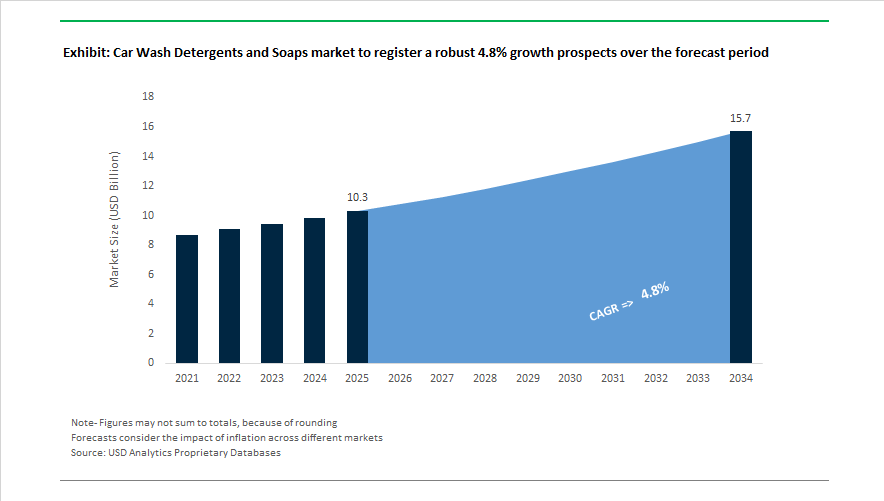
The car wash detergents and soaps market is projected to expand from USD 10.3 billion in 2025 to USD 15.7 billion by 2034, registering a CAGR of 4.8% as operators modernize chemical management, enhance wash performance, and align with environmental compliance. In 2024, National Carwash Solutions introduced reclaim-friendly chemistry at the ICA Show, eliminating surfactants and mineral oils that disrupt water recycling systems. The same year, NCS launched a seasonal fragrance program to differentiate express wash services, while the United States EPA regulatory updates in 2024 and 2025 accelerated PFAS-free detergent reformulations across the industry. Manufacturers such as AP Formulators and NCS shifted to alternative hydrophobic agents that deliver water beading without restricted fluorochemicals, reinforcing sustainable car wash chemistry as a core procurement priority.
Technology integration intensified during 2025. In April 2025, Simoniz USA unveiled the Nanobubbilizer at the ICA Show, using ultra-fine bubble aeration to increase detergent cling time and reduce per-wash chemical consumption. June 2025 saw Zep Inc. expand its professional auto segment through the Cherry Bomb Auto+ launch and NASCAR partnership, strengthening brand presence in retail and professional detailing channels. July 2025 marked a major retail-service convergence when Turtle Wax Pro piloted branded tunnel arches that integrated retail products into automated wash tunnels, boosting upsell opportunities and membership retention. October 2025 brought consolidation as DuBois Chemicals acquired Broadmoor Products, enhancing its ability to pair detergents with water treatment chemistry for complete system optimization.
Digitalization and AI-based control defined late 2025 and early 2026 developments. In November 2025, Sonny’s Enterprises launched the Quivio AI suite, enabling operators to monitor detergent consumption and optimize cost-per-car metrics in real time. December 2025 followed with Simoniz USA’s ChemCheck platform developed with Packwise, introducing drum-level cloud monitoring to detect leaks, automate reordering, and improve inventory control. Kärcher’s January 2026 rollout of the K! Control SB and Pay&Wash app expanded mobile-based detergent cycle selection in self-service bays, supported by centralized K! Connect dashboards. Early 2026 also saw Kärcher release the eco!Booster MAX nozzle, improving detergent application efficiency in professional high-pressure cleaning.
Trends and Opportunities Transforming Procurement, Formulation Strategy, and Demand Creation in the Car Wash Detergents and Soaps Market
Regulatory Overhaul and the Embedding of Digital Product Passports in Detergent Supply Chains
The regulatory environment for the Car Wash Detergents and Soaps Market has shifted from soft environmental commitments to legally binding, traceability-based compliance. Effective December 8, 2025, the Council of the European Union enacted the new Detergents and Surfactants Regulation, replacing EC No 648/2004. This transition marks the first global precedent requiring Digital Product Passports (DPPs) for detergents, which must provide scannable QR-code visibility into biodegradability data, surfactant toxicity, presence of microplastics, and animal testing status.
This shift will structurally influence procurement and formulation strategy. Manufacturers must now digitize ingredient documentation and embed sustainability disclosures at SKU level. For global brands supplying both retail and professional washes, this means aligning EU-compliant SKUs with U.S. market standards to avoid fragmented supply chains. Meanwhile, California’s Air Resources Board (CARB) extended its 2023–2025 toxicity and VOC monitoring survey deadline to September 2025, directly impacting detergent grades used in tunnel and conveyor systems. The mandated 0.2% VOC limit for professional concentrates accelerates capital investment into aqueous systems, biodegradable surfactants, and solvent-free degreasers. Suppliers that fail to meet this threshold risk becoming non-biddable within government and fleet procurement contracts.
Ceramic-Safe Chemistry Redefines Aftercare Benchmarks for Vehicle Appearance Protection
The proliferation of SiO₂-based ceramic coatings across consumer and professional car care has redefined the technical expectations placed upon wash detergents. Traditional alkaline traffic film removers (TFRs) erode ceramic hydrophobicity rapidly, diminishing contact angles and voiding coating warranties. Professional standards in 2025 now specify that maintenance shampoos remain within a pH-balanced 6.5–7.5 window to avoid surface degradation.
Leading commercial lines—including Turtle Wax Hybrid Solutions and IGL Coatings—have shifted to polymer-enriched “Ceramic Ceramic-Boost” shampoos, which leave sacrificial layers on the surface after every wash. This creates recurring revenue for operators and provides upsell justification through gloss longevity claims. The business implication is that pH-neutral polymer shampoos will increasingly replace commodity soaps in professional tunnel and bay car wash networks, elevating margin per liter and positioning chemistry as a recurring revenue stream rather than a commodity input.
Detergent Systems Built for Zero Liquid Discharge (ZLD) and High-TDS Water Operations
Water scarcity is transforming car wash operating economics, particularly in India, the Middle East, Southern U.S., and Western Europe, where wastewater discharge permits are increasingly restrictive. Modern water-recycling platforms such as Hydra-Loop and AquaRecycle report up to 60% reuse efficiencies. However, standard detergents foam excessively and leave residue in recycled water, compromising membrane filtration.
This has created a premium opportunity for low-residue detergents engineered specifically for high-TDS water. These ZLD-compatible formulations reduce RO membrane fouling and prolong filter lifespan, translating chemistry performance into operational cost savings for high-volume wash operators. Regulatory acceptance of microbial cleaning products (2025 EU update) also unlocks the deployment of bio-detergents capable of digesting oils and organic matter within reclamation tanks, preventing odor formation and mitigating pathogen risks such as Legionella—an emerging insurance liability for operators using stagnant recycled water.
Sensor-Safe and Aluminum-Compatible Detergents for Electrified and Autonomous Fleets
Fleet detergent formulations are shifting due to two automotive megatrends: the electrification of delivery and ride-share fleets, and the commercialization of Level 3 autonomous vehicles. Electric vehicles generate a different soil composition profile, dominated by iron oxides released during regenerative braking, which require specialized chelating detergents to dissolve without corroding anodized aluminum housings or polymer battery trays.
Simultaneously, autonomous and ADAS-equipped vehicles require sensor integrity. A microscopic soap film on LiDAR, radar, or HD camera lenses can distort beam reflections and trigger misnavigation. To address this, fleet-specific detergents in 2025 are being certified “Safe for Sensitive Electronics,” formulated to evaporate cleanly with zero film residue. This transforms detergents from a maintenance consumable into a risk-mitigation tool—directly linked to operational uptime and insurance compliance of fleets. This category is expected to drive subscription-based replenishment models and long-term supplier–operator partnerships.
Car Wash Detergents and Soaps Market Share and Segmentation Insights
Market Share by Product Type: Liquid Detergents Lead Volume While Foam Systems Accelerate Premium Adoption
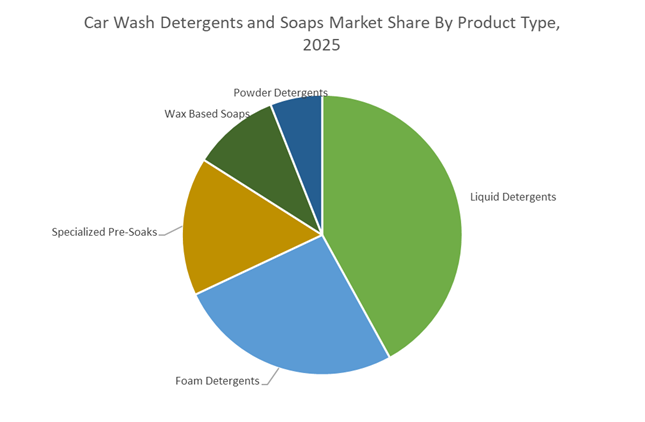
Liquid detergents account for 42% of global car wash detergent consumption in 2025, driven by ease of handling, precise dosing, and compatibility with both manual washing and automated tunnel systems. pH-balanced and biodegradable liquid formulations are gaining traction, particularly among professional operators and eco-conscious consumers, while concentrated and super-concentrated variants are reducing logistics costs and packaging waste. Foam detergents represent the fastest-growing segment, propelled by snow foam technologies and touchless wash systems that improve dwell time on vertical surfaces and enhance soil encapsulation, minimizing micro-scratching. Specialized pre-soaks hold significant share in commercial tunnels, combining alkaline degreasers, acidic mineral removers, and emerging enzymatic cleaners to address complex road soils in multi-step wash protocols. Wax-based soaps serve the premium DIY and detailing market, delivering gloss enhancement and hydrophobic protection through carnauba and synthetic polymers. Powder detergents remain the smallest and declining category, sustained mainly in price-sensitive regions due to dissolution challenges and surface abrasion risks.
Market Share by End User: Commercial Operators Dominate as DIY Premiumization Gains Momentum
Commercial service providers capture 58% of market demand in 2025, encompassing express tunnels, in-bay automatics, fleet wash facilities, and mobile detailing services. High-volume usage, bulk procurement, and consolidation among national car wash chains are strengthening buyer power while accelerating adoption of cost-efficient, high-performance chemistries. Individual consumers form the second-largest segment, influenced by online reviews and detailing communities, with growing preference for ceramic-infused soaps, pH-neutral formulas, and eco-certified products reflecting clear premiumization trends. Automotive OEMs and dealerships represent a smaller but stable outlet, utilizing approved detergents for pre-delivery inspection, used-car reconditioning, and warranty-safe cleaning of modern clear-coat and matte finishes, with demand closely tied to new and used vehicle sales cycles.
Competitive Landscape of the Car Wash Detergents and Soaps Market
The global car wash detergents and soaps market in 2026 is shaped by rapid adoption of ceramic-compatible shampoos, foam cannon detergents, touch-free commercial cleaners, and digitally monitored chemical dosing systems. Competition is intensifying across pH-neutral formulations, eco-friendly surfactants, water-recycling compatibility, and hybrid ceramic wash technologies. Leading brands are differentiating through graphene-safe soaps, Si-carbon protection layers, scent-engineered consumer products, and fleet-grade alkaline concentrates, while professional operators increasingly demand real-time chemical monitoring, subscription wash models, and automated dispensing. Growth is strongest across tunnel car washes, detailing franchises, commercial fleets, and mass-prestige DIY segments, positioning innovation, brand trust, and digital integration as decisive competitive factors.
Hybrid ceramic shampoos and digital wash ecosystems led by Turtle Wax, Inc.
Turtle Wax enters 2026 as a legacy brand reinvented through advanced chemical engineering and smart car wash integration. Its Hybrid Solutions Pro and Pure Wash series dominate the pH-neutral shampoo segment, with Pure Wash favored for maintaining graphene and ceramic coatings due to grit-suspending slickness technology. Through Turtle Wax Pro, the company expanded TRUE-VUE 2 monitoring in 2026, enabling operators to track detergent usage via smartphone apps for margin optimization. Strategically, Turtle Wax leverages 97% brand recognition to roll out loyalty apps and unlimited wash subscriptions. Backed by parent Transchem, vertical integration into eco-friendly surfactants ensures compliance with stringent North American environmental benchmarks.
German-engineered professional detergents from Sonax GmbH
Sonax defines Europe’s professional car wash standard in 2026 with precision-engineered detergents for manual detailing and automated tunnels. XTREME FoamGiant Shampoo and Ceramic Clear Glass 2-in-1 introduce Si-Carbon protection during washing, while DuoFoam ECO supports water recycling compatibility through ECOCERT-certified formulations that stabilize reclaimed water systems. Sonax’s PROFILINE range targets tunnel operators with high-gloss preservation soaps that reduce drying time by up to 15% . Business expansion in 2026 includes specialty alkaline concentrates for agriculture and commercial fleets, serving tractors and buses. Positioned as “The Professional’s Choice,” Sonax continues to dominate high-performance European car wash chemistry.
Sensory-driven ceramic wash innovation by Chemical Guys
Chemical Guys leads the lifestyle segment of the 2026 car wash detergents market with high-engagement products like Mr. Pink, HydroSuds, and Grip & Glide. HydroSuds Ceramic Car Wash remains a top seller among foam cannon enthusiasts seeking hydrophobic shine. The company’s InSynchro precision correction line integrates soaps with paint-defect removal for one-step DIY detailing. A core differentiator is proprietary scent technology, including new “Galactic Scents,” transforming car washing into a sensory experience. In 2026, Chemical Guys introduced HydroDry, a ceramic-infused drying aid that delivers instant gloss, reinforcing its dominance in consumer-focused ceramic wash systems.
Mass-prestige foam cannon growth driven by Armor All
Armor All accelerates in 2026 through hybrid ceramic soaps and motorsport branding under Energizer Auto. The launch of the All Podium Series, backed by Oracle Red Bull Racing, positions Armor All as a performance-first brand. Extreme Shield™ + Ceramic Car Wash delivers invisible protection with enhanced water beading, while reformulated Snow Foam and Ultra Shine products target the booming foam cannon segment with thicker, longer-dwelling lather. Leveraging Energizer’s global retail footprint, Armor All ensures wide availability across Tier-2 and Tier-3 cities, capturing the mass-prestige market with simplified, high-impact ceramic car wash solutions.
Industrial touch-free fleet cleaning leadership from Zep, Inc.
Zep dominates the Industrial & Institutional car wash sector in 2026, supplying concentrated detergents for truck fleets and commercial tunnels. Zep-O-Shine and T’N’T Brushless Truck Wash are engineered to remove road film and bugs without manual scrubbing, addressing labor shortages in commercial operations. Zep’s touch-free detergents feature climate-specific dilution ratios for streak-free results year-round. A 2026 partnership with Joe Gibbs Racing boosts brand visibility, while Zep’s consultative model installs automated dispensing systems at fleet depots, cutting chemical waste by up to 20% and reinforcing its leadership in professional-grade car wash chemistry.
Science-backed detailing franchises powered by 3M Company
3M remains the scientific benchmark in 2026, integrating materials science into predictable, professional car wash performance. Its Car Wash Soap/Shampoo is formulated for hard-water tolerance, enabling spot-free finishes even in tanker-supplied urban environments. The 3M Car Care Franchise model is rapidly expanding across India and Southeast Asia, transforming detailing into a scalable service business. Strategically, 3M markets its soaps as the foundation for paint protection films and ceramic coatings, emphasizing resale value preservation. By 2026, 3M transitioned to bulk 200- and 500-liter detergent formats, reducing plastic waste while supporting global service-center partners.
United States: Subscription Car Wash Models, Graphene Chemistry, and EPA Safer Choice Compliance Reshape Detergent Demand
The United States car wash detergents and soaps market is increasingly structured around subscription-driven wash volumes, regulatory compliance, and high-performance surface chemistry innovation. In late 2025, Mister Car Wash reported a 6% year-over-year increase in Unlimited Wash Club memberships, surpassing 2.2 million members. This recurring revenue model has stabilized bulk procurement of commercial-grade car wash detergents, high-foam shampoos, and conveyor-compatible pre-soaks across professional wash networks.
Product innovation remains central to brand differentiation. In June 2025, Zep Inc. launched the Cherry Bomb Auto+ Degreaser & Cleaner in collaboration with NASCAR, targeting high-performance degreasing for enthusiast and professional applications. Simultaneously, the EPA’s Safer Choice program recorded a surge in car care certifications in 2025 as manufacturers transitioned away from phosphates and petroleum-derived surfactants to meet wastewater discharge standards. Professional conveyor washes are adopting AI-based vehicle profiling systems that dynamically adjust pH-balanced soap dosing, reducing chemical waste by up to 15% per cycle. Premiumization is evident in graphene-infused soaps and waxes introduced by brands such as Turtle Wax, offering hydrophobic “self-cleaning” properties that extend wash intervals. Distribution expansion through Lowe’s and Walmart shelf placements has further amplified retail penetration of high-concentration detergents and advanced degreasers.
Germany: AI-Based Smartwash Systems, Closed-Loop Water Recycling, and Digital Product Passports Elevate Compliance Standards
Germany’s car wash detergent industry is defined by strict environmental regulation, advanced dosing automation, and biodegradable surfactant innovation. In January 2025, Henkel introduced Smartwash™ Technology, an AI-driven cartridge-based dosing platform that eliminates operator error and optimizes detergent concentration for conveyor and rollover wash systems. This aligns with national mandates requiring closed-loop water reclamation systems at new professional wash sites.
Manufacturers such as Sonax and Kärcher have launched low-foaming, biodegradable detergents engineered for compatibility with recycled process water. Sonax’s DuoFoam ECO line, certified under ECOCERT Detergent standards in 2025, reinforces the shift toward ultimate biodegradability in surfactant chemistry. Infrastructure synergy is evident through collaborations between TSG and Kärcher, deploying modular wash units that use AI to detect soil load and adjust pressure and soap volumes in real time. Specialized 2025 launches such as AcidStar and ActiveStar target high-soil commercial trucking fleets. Digital Product Passports, accessible via QR codes, now provide operators with instant SDS access and environmental impact metrics, strengthening transparency in commercial detergent procurement.
India’s car wash detergents and soaps market is expanding rapidly, fueled by rising vehicle ownership, detailing franchise proliferation, and water scarcity-driven innovation. In June 2025, Turtle Wax launched its “You Are How You Car™” global platform in India, highlighting the country’s status as a priority growth market for premium car shampoos, ceramic-infused detergents, and paint-protection solutions.
The Detailing Mafia expanded to over 220 centers in 2025, aggressively penetrating Tier-2 and Tier-3 cities where disposable income growth is shifting consumer preference from manual bucket washing to professional detailing. With car sales reaching approximately 3.8 million units in 2022/23, the expanding middle class is driving sustained demand for high-foaming shampoos, pH-neutral cleaners, and protective coating-compatible soaps. Water scarcity in major urban centers has catalyzed adoption of waterless car wash technologies using high-lubricity surfactants that encapsulate dirt without rinsing. Franchises are increasingly pursuing green certifications by transitioning to biodegradable, chemical-free formulations to attract environmentally conscious younger consumers. Improved highway infrastructure and EMI-based car financing have extended vehicle lifespans, reinforcing demand for long-term ceramic-boosted and paint-safe detergents.
United Kingdom: Strict Effluent Enforcement, Biodegradability Regulation, and E-Commerce-Driven Detailing Kits
The United Kingdom’s car wash detergents market is undergoing structural adjustment due to heightened environmental enforcement and consumer premiumization. The UK Environment Agency intensified inspections of hand car wash sites in 2025, strictly regulating the discharge of trade effluents such as traffic film removers and solvent-based cleaners into surface drainage systems. Under the 2025 Detergents and Surfactants Regulation, all surfactants must meet ultimate biodegradability criteria, effectively phasing out several legacy low-cost ingredients from the market.
Marketing innovation has also shaped demand. Turtle Wax deployed VFX-driven campaigns positioning car cleaning as “self-care,” boosting sales among the 18–34 demographic. Professional facilities are migrating to ultra-concentrated soap formulations requiring less water activation, responding to rising utility costs and localized water restrictions. E-commerce channels have recorded a 22% increase in online sales of professional-grade detailing kits, reflecting consumer preference for showroom-level finishes at home, particularly using high-pH pre-wash foams and ceramic-compatible shampoos.
Japan: Brushless Chemical Systems, EV-Safe Detergents, and Ceramic-Boosted Shampoos Lead Surface Chemistry Innovation
Japan is at the forefront of brushless, touch-free car wash technologies that rely primarily on advanced chemical performance rather than mechanical friction. Manufacturers such as Soft99 and Sensha have developed quick-evaporating, no-rinse soaps optimized for dense urban environments like Tokyo and Osaka, where drainage constraints limit traditional wash infrastructure.
Late 2025 R&D has centered on ceramic-boosted shampoos designed to replenish SiO₂ protective layers during routine maintenance washes. With accelerating EV adoption, Japanese producers are introducing low-conductivity detergents formulated to be safe for high-voltage charging ports and external battery sensors. Major fuel retailers are upgrading aging wash infrastructure with AI-based profiling systems that adjust soap dosing according to vehicle shape and surface complexity, optimizing chemical efficiency while protecting advanced vehicle coatings and embedded sensors.
China: On-Demand Car Wash Platforms, Surfactant Cost Leadership, and VOC Compliance Tightening
China’s car wash detergents and soaps industry is expanding alongside the rise of on-demand “doorstep” car wash services, projected to lead the Asia-Pacific region by 2030. This model has accelerated the development of ultra-concentrated detergents requiring minimal water, tailored for mobile service operators in high-density urban areas.
China remains the world’s largest private-label manufacturer of car wash soaps, supported by integrated coastal chemical parks leveraging newly expanded naphtha crackers to reduce domestic surfactant production costs. Despite competitive pricing, premiumization is evident as luxury vehicle owners increasingly demand imported German and U.S. high-gloss, paint-safe formulations. Regulatory oversight is intensifying: 2025 guidelines from the Ministry of Ecology and Environment have tightened VOC emission limits for aerosols and solvent-based car care cleaners, pushing manufacturers toward water-based, low-VOC surfactant systems. This balance between cost leadership, regulatory compliance, and premium demand defines China’s evolving car wash detergent landscape.
Car Wash Detergents and Soaps Market Report Scope
Car Wash Detergents and Soaps market
Parameter
Details
Market Size (2025)
$10.3 Billion
Market Size (2034)
$15.7 Billion
Market Growth Rate
4.8%
Segments
By Product Type (Foam Detergents, Liquid Detergents, Powder Detergents, Wax Based Soaps, Specialized Pre Soaks), By Vehicle Type (Passenger Cars, Commercial Vehicles, Motorcycles and Bicycles, Fleet Services), By Application Type (Automatic Car Wash, In Bay Automatic, Self Service, Professional Detailing), By Chemical Composition (Bio Based, Synthetic, Ceramic and Graphene Infused, PFAS Free), By End User (Individual Consumers, Commercial Service Providers, Automotive OEMs and Dealerships)
Study Period
2019- 2025 and 2026-2034
Units
Revenue (USD)
Qualitative Analysis
Porter’s Five Forces, SWOT Profile, Market Share, Scenario Forecasts, Market Ecosystem, Company Ranking, Market Dynamics, Industry Benchmarking
Companies
Sonnys Enterprises, Zep, Turtle Wax, Karcher, BASF SE, 3M, National Carwash Solutions, DuBois Chemicals, Chemical Guys, Meguiars, Armor All, Stangest, Simoniz, Ma Fra, Platinum Industries
Countries
US, Canada, Mexico, Germany, France, Spain, Italy, UK, Russia, China, India, Japan, South Korea, Australia, South East Asia, Brazil, Argentina, Middle East, Africa
Car Wash Detergents and Soaps Market Segmentation
By Product Type
Foam Detergents
Liquid Detergents
Powder Detergents
Wax Based Soaps
Specialized Pre Soaks
By Vehicle Type
Passenger Cars
Commercial Vehicles
Motorcycles and Bicycles
Fleet Services
By Application Type
Automatic Car Wash
In Bay Automatic
Self Service
Professional Detailing
By Chemical Composition
Bio Based
Synthetic
Ceramic and Graphene Infused
PFAS Free
By End User
Individual Consumers
Commercial Service Providers
Automotive OEMs and Dealerships
By Region
North America (United States, Canada, Mexico)
Europe (Germany, France, United Kingdom, Spain, Italy, Rest of Europe)
Asia Pacific (China, India, Japan, South Korea, Australia, Rest of APAC)
South and Central America (Brazil, Argentina, Rest of SCA)
Middle East and Africa (Saudi Arabia, UAE, South Africa, Rest of Middle East, Rest of Africa)
Top Companies in Car Wash Detergents and Soaps Industry
Sonnys Enterprises
Zep
Turtle Wax
Karcher
BASF SE
3M
National Carwash Solutions
DuBois Chemicals
Chemical Guys
Meguiars
Armor All
Stangest
Simoniz
Ma Fra
Platinum Industries
*- List not Exhaustive
Table of Contents: Car Wash Detergents and Soaps Market
2. Car Wash Detergents and Soaps Market Landscape & Outlook (2025–2034)
2.1. Introduction to Car Wash Detergents and Soaps Market
2.2. Market Valuation and Growth Projections (2025–2034)
2.3. Digital Chemical Monitoring and AI-Based Dosing Systems
2.4. PFAS-Free Reformulation and Environmental Compliance
2.5. Water Reclaim Chemistry and Zero Liquid Discharge Compatibility
3. Innovations Reshaping the Car Wash Detergents and Soaps Market
3.1. Trend: Ceramic-Safe and Graphene-Infused Shampoo Systems
3.2. Trend: Digital Product Passports and Smart Inventory Platforms
3.3. Opportunity: Sensor-Safe Fleet Detergents for EV and Autonomous Vehicles
3.4. Opportunity: ZLD-Compatible and Bio-Enzymatic Cleaning Formulations
4. Competitive Landscape and Strategic Initiatives
4.1. Mergers and Acquisitions
4.2. R&D and Formulation Innovation
4.3. Sustainability and ESG Strategies
4.4. Market Expansion and Regional Focus
5. Market Share and Segmentation Insights: Car Wash Detergents and Soaps Market
5.1. By Product Type
5.1.1. Foam Detergents
5.1.2. Liquid Detergents
5.1.3. Powder Detergents
5.1.4. Wax Based Soaps
5.1.5. Specialized Pre Soaks
5.2. By Vehicle Type
5.2.1. Passenger Cars
5.2.2. Commercial Vehicles
5.2.3. Motorcycles and Bicycles
5.2.4. Fleet Services
5.3. By Application Type
5.3.1. Automatic Car Wash
5.3.2. In Bay Automatic
5.3.3. Self Service
5.3.4. Professional Detailing
5.4. By Chemical Composition
5.4.1. Bio Based
5.4.2. Synthetic
5.4.3. Ceramic and Graphene Infused
5.4.4. PFAS Free
5.5. By End User
5.5.1. Individual Consumers
5.5.2. Commercial Service Providers
5.5.3. Automotive OEMs and Dealerships
6. Country Analysis and Outlook of Car Wash Detergents and Soaps Market
6.1. United States
6.2. Canada
6.3. Mexico
6.4. Germany
6.5. France
6.6. Spain
6.7. Italy
6.8. United Kingdom
6.9. Russia
6.10. China
6.11. India
6.12. Japan
6.13. South Korea
6.14. Australia
6.15. South East Asia
6.16. Brazil
6.17. Argentina
6.18. Middle East
6.19. Africa
7. Car Wash Detergents and Soaps Market Size Outlook by Region (2025–2034)
7.1. North America Car Wash Detergents and Soaps Market Size Outlook to 2034
7.1.1. By Product Type
7.1.2. By Vehicle Type
7.1.3. By Application Type
7.1.4. By Chemical Composition
7.1.5. By End User
7.2. Europe Car Wash Detergents and Soaps Market Size Outlook to 2034
7.2.1. By Product Type
7.2.2. By Vehicle Type
7.2.3. By Application Type
7.2.4. By Chemical Composition
7.2.5. By End User
7.3. Asia Pacific Car Wash Detergents and Soaps Market Size Outlook to 2034
7.3.1. By Product Type
7.3.2. By Vehicle Type
7.3.3. By Application Type
7.3.4. By Chemical Composition
7.3.5. By End User
7.4. South America Car Wash Detergents and Soaps Market Size Outlook to 2034
7.4.1. By Product Type
7.4.2. By Vehicle Type
7.4.3. By Application Type
7.4.4. By Chemical Composition
7.4.5. By End User
7.5. Middle East and Africa Car Wash Detergents and Soaps Market Size Outlook to 2034
7.5.1. By Product Type
7.5.2. By Vehicle Type
7.5.3. By Application Type
7.5.4. By Chemical Composition
7.5.5. By End User
8. Company Profiles: Leading Players in the Car Wash Detergents and Soaps Market
8.1. Sonnys Enterprises
8.2. Zep
8.3. Turtle Wax
8.4. Kärcher
8.5. BASF SE
8.6. 3M
8.7. National Carwash Solutions
8.8. DuBois Chemicals
8.9. Chemical Guys
8.10. Meguiars
8.11. Armor All
8.12. Stangest
8.13. Simoniz
8.14. Ma Fra
8.15. Platinum Industries
9. Methodology
9.1. Research Scope
9.2. Market Research Approach
9.3. Market Sizing and Forecasting Model
9.4. Research Coverage
9.5. Data Horizon
9.6. Deliverables
10. Appendix
10.1. Acronyms and Abbreviations
10.2. List of Tables
10.3. List of Figures
Car Wash Detergents and Soaps Market Segmentation
By Product Type
Foam Detergents
Liquid Detergents
Powder Detergents
Wax Based Soaps
Specialized Pre Soaks
By Vehicle Type
Passenger Cars
Commercial Vehicles
Motorcycles and Bicycles
Fleet Services
By Application Type
Automatic Car Wash
In Bay Automatic
Self Service
Professional Detailing
By Chemical Composition
Bio Based
Synthetic
Ceramic and Graphene Infused
PFAS Free
By End User
Individual Consumers
Commercial Service Providers
Automotive OEMs and Dealerships
By Region
North America (United States, Canada, Mexico)
Europe (Germany, France, United Kingdom, Spain, Italy, Rest of Europe)
Asia Pacific (China, India, Japan, South Korea, Australia, Rest of APAC)
South and Central America (Brazil, Argentina, Rest of SCA)
Middle East and Africa (Saudi Arabia, UAE, South Africa, Rest of Middle East, Rest of Africa)
The Car Wash Detergents and Soaps Market is valued at USD 10.3 billion in 2025 and is projected to reach USD 15.7 billion by 2034, expanding at a CAGR of 4.8%. Growth is supported by tunnel wash expansion, PFAS-free chemistry adoption, ceramic-compatible shampoos, and AI-driven detergent dosing across commercial wash networks.
Liquid detergents lead volume with 42% share, while foam detergents are the fastest-growing segment due to snow-foam and touchless systems. Commercial operators account for 58% of demand, driven by express tunnels and fleet washes, while DIY users are premiumizing toward ceramic-infused, pH-neutral, and biodegradable car shampoos.
EU Digital Product Passports, VOC limits, and PFAS restrictions are forcing suppliers to digitize ingredient transparency and reformulate toward biodegradable surfactants. At the same time, AI platforms now track detergent usage in real time, enabling operators to optimize cost-per-car, automate reordering, and reduce chemical waste by double-digit percentages.
Ceramic-coated vehicles require pH-balanced shampoos that preserve hydrophobic layers, replacing traditional alkaline soaps in professional tunnels. Meanwhile, EV fleets demand sensor-safe, residue-free detergents that protect LiDAR and aluminum battery housings. This shifts detergents from commodities to performance-critical inputs tied directly to uptime and warranty compliance.
Key players include Turtle Wax, Zep, Sonax, Chemical Guys, Armor All, 3M, National Carwash Solutions, and Kärcher. Competition centers on ceramic-compatible chemistry, PFAS-free surfactants, foam performance, digital dosing ecosystems, and fleet-grade touchless detergents.