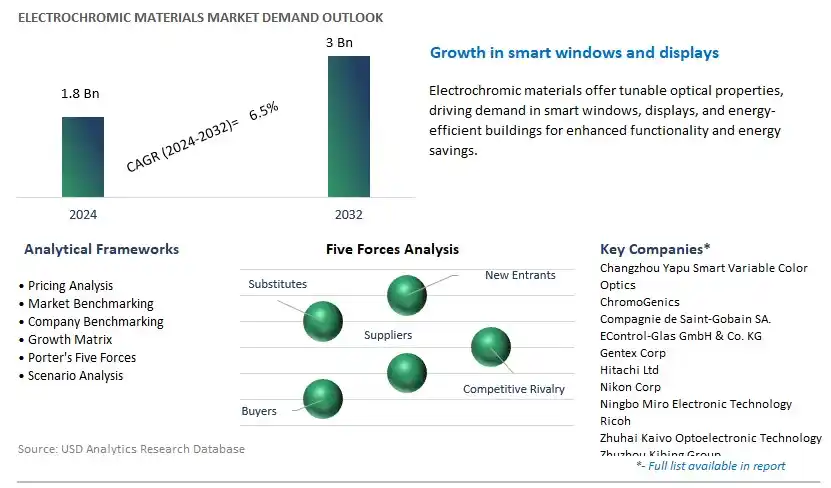
Global Electrochromic Materials Market Size is valued at $1.8 Billion in 2024 and is forecast to register a growth rate (CAGR) of 6.5% to reach $3 Billion by 2032.
The global Electrochromic Materials Market Study analyzes and forecasts the market size across 6 regions and 24 countries for diverse segments -By Product (Viologens, Conducting Polymers, Metal Oxides, Prussian Blue, Others), By End-User (Automotive, Electrical and Electronics, Building and Construction, Aerospace and Defense, Others).
An Introduction to Electrochromic Materials Market in 2024
Electrochromic materials are substances that change color or opacity in response to an applied electric field in 2024. These materials are used in electrochromic devices (ECDs), such as smart windows, mirrors, and displays, to control light transmission or reflectance for energy-efficient lighting, glare control, and privacy applications. Electrochromic materials exhibit reversible coloration and bleaching when subjected to an electric current, allowing users to adjust transparency or tinting levels to suit their preferences or environmental conditions. Common types of electrochromic materials include transition metal oxides, conducting polymers, and organic dyes, each offering different coloration mechanisms, response times, and optical properties. Electrochromic materials are integrated into thin-film coatings or laminates and are typically sandwiched between transparent conductive electrodes to form electrochromic layers. When a voltage is applied across the electrodes, ions migrate within the electrochromic layer, causing a change in optical properties such as absorption, reflection, or transmission of light. Electrochromic materials are valued for their energy-saving potential, as they can modulate solar heat gain and daylighting in buildings, vehicles, and electronic displays, reducing the need for artificial lighting and HVAC systems. With advancements in materials science and manufacturing techniques, electrochromic materials to evolve, offering innovative solutions for energy-efficient lighting and smart building technologies.
Electrochromic Materials Market Competitive Landscape
The market report analyses the leading companies in the industry including Changzhou Yapu Smart Variable Color Optics, ChromoGenics, Compagnie de Saint-Gobain SA., EControl-Glas GmbH & Co. KG, Gentex Corp, Hitachi Ltd, Nikon Corp, Ningbo Miro Electronic Technology, Ricoh, Zhuhai Kaivo Optoelectronic Technology, Zhuzhou Kibing Group, and others.
Electrochromic Materials Market Dynamics
Market Trend: Growing Demand for Smart Glass and Electrochromic Devices
An emerging trend in the electrochromic materials market is the growing demand for smart glass and electrochromic devices across various industries. Smart glass, which can change its transparency or color in response to electrical stimuli, is gaining popularity in architecture, automotive, aerospace, and consumer electronics sectors. This trend is driven by the increasing focus on energy efficiency, sustainability, and user comfort, as electrochromic materials offer dynamic control over light transmission, heat gain, and privacy. As advancements in electrochromic technology continue to improve performance and reduce costs, the market is witnessing a surge in applications for smart windows, rearview mirrors, displays, and other electronic devices, driving the growth of the electrochromic materials industry.
Market Driver: Advancements in Material Science and Nanotechnology
A primary driver accelerating the growth of the electrochromic materials market is the continuous advancements in material science and nanotechnology. Researchers and manufacturers are actively developing novel materials and nanocomposites with improved electrochromic properties, such as faster switching speeds, higher optical contrast, and enhanced durability. These advancements enable the production of more efficient and reliable electrochromic devices that meet the stringent performance requirements of various applications. Additionally, innovations in manufacturing processes, including thin-film deposition techniques and nanostructuring methods, contribute to cost reduction and scalability, further driving market adoption. As the pace of innovation in material science accelerates, the electrochromic materials market is poised for significant expansion across industries.
Market Opportunity: Integration into Next-Generation Smart Buildings and Vehicles
An opportunity for growth within the electrochromic materials market lies in the integration of these materials into next-generation smart buildings and vehicles. With the rise of the Internet of Things (IoT) and connected technologies, there is a growing demand for intelligent systems that can optimize energy usage, enhance comfort, and improve overall efficiency. Electrochromic materials offer a compelling solution for dynamic light and heat management in smart windows, sunroofs, and facades, enabling greater control over indoor environments while reducing reliance on artificial lighting and HVAC systems. Moreover, as automotive manufacturers increasingly focus on electrification and autonomous driving technologies, there is a growing need for energy-efficient and adaptive glazing solutions that enhance vehicle aesthetics, functionality, and safety. By leveraging the opportunities presented by smart buildings and vehicles, the electrochromic materials market can achieve widespread adoption and drive continued innovation in the field of dynamic optical materials.
Electrochromic Materials Market Share Analysis: Metal Oxides segment generated the highest revenue in 2024
Within the electrochromic materials market segmented by product, the Metal Oxides segment is the largest, driven by its excellent electrochromic properties and versatile applications. Metal oxides, such as tungsten oxide (WO3) and nickel oxide (NiO), exhibit reversible color changes in response to an applied electric field, making them ideal materials for electrochromic devices such as smart windows, rear-view mirrors, and displays. Metal oxides offer fast switching speeds, high optical contrast, and long-term stability, making them highly desirable for applications requiring efficient light and heat control. Additionally, metal oxides are compatible with various substrates and deposition techniques, allowing for flexible manufacturing processes and scalability. The Metal Oxides segment benefits from the increasing adoption of smart technologies in the construction, automotive, and electronics industries, driving the demand for electrochromic materials with superior performance and reliability. As industries seek sustainable and energy-efficient solutions for buildings and vehicles, the demand for metal oxides in electrochromic applications continues to grow, solidifying its position as the largest segment in the electrochromic materials market.
Electrochromic Materials Market Share Analysis: Building and Construction is poised to register the fastest CAGR over the forecast period
Among the segments categorized by end-users in the electrochromic materials market, the Building and Construction sector is the fastest-growing, propelled by the increasing adoption of smart technologies in architectural designs. Electrochromic materials play a crucial role in the building and construction industry by enabling the development of dynamic and energy-efficient smart windows and facades. These materials allow for real-time control over the transmission of light and heat, providing occupants with enhanced comfort, daylighting, and energy savings. Additionally, electrochromic windows help reduce reliance on artificial lighting and HVAC systems, contributing to sustainability efforts in the construction sector. As building owners and developers prioritize energy efficiency, indoor comfort, and sustainability in their projects, the demand for electrochromic materials in building and construction applications is experiencing rapid growth. Moreover, government regulations promoting energy-efficient building practices further accelerate the adoption of electrochromic technologies, driving the expansion of the Building and Construction segment in the electrochromic materials market.
Electrochromic Materials Market
By Product
Viologens
Conducting Polymers
Metal Oxides
Prussian Blue
Others
By End-User
Automotive
Electrical and Electronics
Building and Construction
Aerospace and Defense
Others
Countries Analyzed
North America (US, Canada, Mexico)
Europe (Germany, UK, France, Spain, Italy, Russia, Rest of Europe)
Asia Pacific (China, India, Japan, South Korea, Australia, South East Asia, Rest of Asia)
South America (Brazil, Argentina, Rest of South America)
Middle East and Africa (Saudi Arabia, UAE, Rest of Middle East, South Africa, Egypt, Rest of Africa)
Electrochromic Materials Companies Profiled in the Study
Changzhou Yapu Smart Variable Color Optics
ChromoGenics
Compagnie de Saint-Gobain SA.
EControl-Glas GmbH & Co. KG
Gentex Corp
Hitachi Ltd
Nikon Corp
Ningbo Miro Electronic Technology
Ricoh
Zhuhai Kaivo Optoelectronic Technology
Zhuzhou Kibing Group
*- List Not Exhaustive
TABLE OF CONTENTS
1 Introduction to 2024 Electrochromic Materials Market
1.1 Market Overview
1.2 Quick Facts
1.3 Scope/Objective of the Study
1.4 Market Definition
1.5 Countries and Regions Covered
1.6 Units, Currency, and Conversions
1.7 Industry Value Chain
2 Research Methodology
2.1 Market Size Estimation
2.2 Sources and Research Methodology
2.3 Data Triangulation
2.4 Assumptions and Limitations
3 Executive Summary
3.1 Global Electrochromic Materials Market Size Outlook, $ Million, 2021 to 2032
3.2 Electrochromic Materials Market Outlook by Type, $ Million, 2021 to 2032
3.3 Electrochromic Materials Market Outlook by Product, $ Million, 2021 to 2032
3.4 Electrochromic Materials Market Outlook by Application, $ Million, 2021 to 2032
3.5 Electrochromic Materials Market Outlook by Key Countries, $ Million, 2021 to 2032
4 Market Dynamics
4.1 Key Driving Forces of Electrochromic Materials Industry
4.2 Key Market Trends in Electrochromic Materials Industry
4.3 Potential Opportunities in Electrochromic Materials Industry
4.4 Key Challenges in Electrochromic Materials Industry
5 Market Factor Analysis
5.1 Value Chain Analysis
5.2 Competitive Landscape
5.2.1 Global Electrochromic Materials Market Share by Company (%), 2023
5.2.2 Product Offerings by Company
5.3 Porter’s Five Forces Analysis
5.4 Pricing Analysis and Outlook
6 Growth Outlook Across Scenarios
6.1 Growth Analysis-Case Scenario Definitions
6.2 Low Growth Scenario Forecasts
6.3 Reference Growth Scenario Forecasts
6.4 High Growth Scenario Forecasts
7 Global Electrochromic Materials Market Outlook by Segments
7.1 Electrochromic Materials Market Outlook by Segments, $ Million, 2021- 2032
By Product
Viologens
Conducting Polymers
Metal Oxides
Prussian Blue
Others
By End-User
Automotive
Electrical and Electronics
Building and Construction
Aerospace and Defense
Others
8 North America Electrochromic Materials Market Analysis and Outlook To 2032
8.1 Introduction to North America Electrochromic Materials Markets in 2024
8.2 North America Electrochromic Materials Market Size Outlook by Country, 2021-2032
8.2.1 United States
8.2.2 Canada
8.2.3 Mexico
8.3 North America Electrochromic Materials Market size Outlook by Segments, 2021-2032
By Product
Viologens
Conducting Polymers
Metal Oxides
Prussian Blue
Others
By End-User
Automotive
Electrical and Electronics
Building and Construction
Aerospace and Defense
Others
9 Europe Electrochromic Materials Market Analysis and Outlook To 2032
9.1 Introduction to Europe Electrochromic Materials Markets in 2024
9.2 Europe Electrochromic Materials Market Size Outlook by Country, 2021-2032
9.2.1 Germany
9.2.2 France
9.2.3 Spain
9.2.4 United Kingdom
9.2.4 Italy
9.2.5 Russia
9.2.6 Norway
9.2.7 Rest of Europe
9.3 Europe Electrochromic Materials Market Size Outlook by Segments, 2021-2032
By Product
Viologens
Conducting Polymers
Metal Oxides
Prussian Blue
Others
By End-User
Automotive
Electrical and Electronics
Building and Construction
Aerospace and Defense
Others
10 Asia Pacific Electrochromic Materials Market Analysis and Outlook To 2032
10.1 Introduction to Asia Pacific Electrochromic Materials Markets in 2024
10.2 Asia Pacific Electrochromic Materials Market Size Outlook by Country, 2021-2032
10.2.1 China
10.2.2 India
10.2.3 Japan
10.2.4 South Korea
10.2.5 Indonesia
10.2.6 Malaysia
10.2.7 Australia
10.2.8 Rest of Asia Pacific
10.3 Asia Pacific Electrochromic Materials Market size Outlook by Segments, 2021-2032
By Product
Viologens
Conducting Polymers
Metal Oxides
Prussian Blue
Others
By End-User
Automotive
Electrical and Electronics
Building and Construction
Aerospace and Defense
Others
11 South America Electrochromic Materials Market Analysis and Outlook To 2032
11.1 Introduction to South America Electrochromic Materials Markets in 2024
11.2 South America Electrochromic Materials Market Size Outlook by Country, 2021-2032
11.2.1 Brazil
11.2.2 Argentina
11.2.3 Rest of South America
11.3 South America Electrochromic Materials Market size Outlook by Segments, 2021-2032
By Product
Viologens
Conducting Polymers
Metal Oxides
Prussian Blue
Others
By End-User
Automotive
Electrical and Electronics
Building and Construction
Aerospace and Defense
Others
12 Middle East and Africa Electrochromic Materials Market Analysis and Outlook To 2032
12.1 Introduction to Middle East and Africa Electrochromic Materials Markets in 2024
12.2 Middle East and Africa Electrochromic Materials Market Size Outlook by Country, 2021-2032
12.2.1 Saudi Arabia
12.2.2 UAE
12.2.3 Oman
12.2.4 Rest of Middle East
12.2.5 Egypt
12.2.6 Nigeria
12.2.7 South Africa
12.2.8 Rest of Africa
12.3 Middle East and Africa Electrochromic Materials Market size Outlook by Segments, 2021-2032
By Product
Viologens
Conducting Polymers
Metal Oxides
Prussian Blue
Others
By End-User
Automotive
Electrical and Electronics
Building and Construction
Aerospace and Defense
Others
13 Company Profiles
13.1 Company Snapshot
13.2 SWOT Profiles
13.3 Products and Services
13.4 Recent Developments
13.5 Financial Profile
Changzhou Yapu Smart Variable Color Optics
ChromoGenics
Compagnie de Saint-Gobain SA.
EControl-Glas GmbH & Co. KG
Gentex Corp
Hitachi Ltd
Nikon Corp
Ningbo Miro Electronic Technology
Ricoh
Zhuhai Kaivo Optoelectronic Technology
Zhuzhou Kibing Group
14 Appendix
14.1 Customization Offerings
14.2 Subscription Services
14.3 Related Reports
14.4 Publisher Expertise
By Product
Viologens
Conducting Polymers
Metal Oxides
Prussian Blue
Others
By End-User
Automotive
Electrical and Electronics
Building and Construction
Aerospace and Defense
Others
Countries Analyzed
North America (US, Canada, Mexico)
Europe (Germany, UK, France, Spain, Italy, Russia, Rest of Europe)
Asia Pacific (China, India, Japan, South Korea, Australia, South East Asia, Rest of Asia)
South America (Brazil, Argentina, Rest of South America)
Middle East and Africa (Saudi Arabia, UAE, Rest of Middle East, South Africa, Egypt, Rest of Africa)
