Market Overview: First Aid Kit Packaging Market to Reach $1.07 Billion by 2034 at 4.6% CAGR
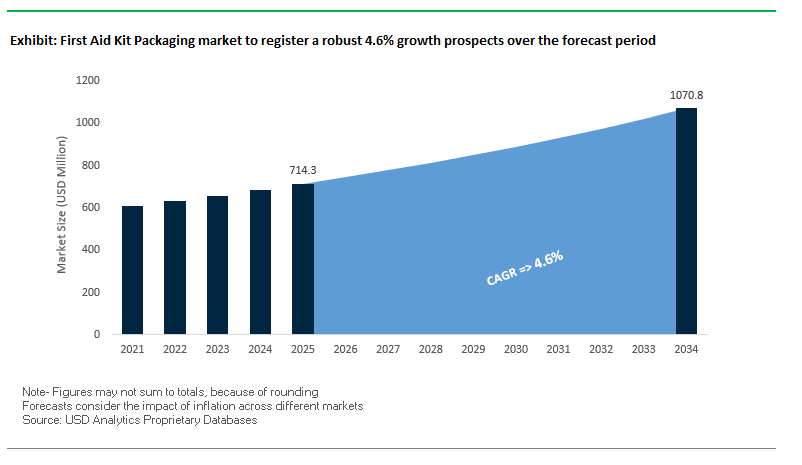
The global first aid kit packaging market is projected to grow from $714.3 million in 2025 to $1,070.7 million by 2034, reflecting a steady CAGR of 4.6%. This growth is fueled by the rising demand for durable, compliant, and portable packaging solutions across consumer, workplace, industrial, and military applications. The market is increasingly shaped by regulatory compliance, innovation in modular designs, and the integration of smart features, ensuring both accessibility and efficiency during emergencies. For industry professionals and buyers, the key questions are: How do manufacturers ensure regulatory compliance, what new technological features are emerging, and how are companies addressing the demand for sustainability and portability in first aid kit packaging?
Key Insights for buyers and professionals:
Durability & Protection: Packaging designed with high-impact plastics, metals, and rugged fabrics ensures supplies remain sterile and intact in harsh conditions.
Compliance-Driven Demand: Regulatory bodies like OSHA and ANSI are driving demand for standardized, clearly labeled, and fully compliant kits in workplaces and industries.
Portable & Modular Kits: Compact, customizable designs are gaining traction for outdoor activities, military operations, and sports applications.
Smart Packaging Adoption: Kits with QR codes and NFC chips are emerging, enabling users to access digital instructions, track expiry dates, and enhance real-time usability.
Market Analysis: Recent Developments Driving First Aid Kit Packaging Industry
The first aid kit packaging market has seen a wave of product innovations, corporate restructuring, and regulatory milestones, all shaping its competitive landscape.
In August 2025, Fristads introduced a new line of workwear-integrated first aid kits, showing the increasing trend of embedding medical preparedness within PPE solutions. In the same month, Cintas Corp. earned OSHA’s VPP Star Site certification for its Ohio location, reinforcing its position as a trusted provider of safety and first aid services.
The healthcare supply chain is also being reshaped by large corporate changes. In July 2025, 3M spun off its healthcare division into Solventum, creating a new independent company to focus on medical technologies and wound care both crucial components of professional first aid kits. That same month, Johnson & Johnson reported strong Q2 earnings, underlining its continued dominance in wound care and consumer health segments.
In June 2025, Honeywell Safety unveiled a new line of industrial PPE that integrates first aid components, highlighting how industrial safety solutions are converging with medical preparedness. In May 2025, Cintas partnered with a regional ambulance service, extending beyond product supply into first aid and safety training, marking a shift toward a safety-as-a-service model.
Earlier, in April 2025, 3M formally divested its healthcare business, setting the stage for Solventum’s independence. Meanwhile, in March 2025, First Aid Central launched its new “Grab-and-Go” kits for automotive and outdoor markets, catering to the rising demand for portable, consumer-friendly solutions. Together, these developments emphasize a market transitioning toward smarter, more integrated, and compliance-focused packaging solutions.
Trends and Opportunities Transforming the First Aid Kit Packaging Market
Regulatory Standardization and Compliance-Driven Design
The first aid kit packaging market is increasingly shaped by regulatory frameworks that mandate not only the contents but also how those contents are packaged, organized, and maintained. Global regulators such as OSHA in the United States and DIN standards in Europe set precise requirements for kit contents in different industries, forcing packaging to evolve from generic designs to compliance-specific solutions. For example, OSHA regulations require specialized items in high-risk sectors like logging, while European DIN 13157 standards dictate the exact number and type of bandages, sterile dressings, and antiseptic wipes workplaces must maintain.
Packaging innovation is now essential to ensure sterility and durability under diverse conditions. In highly regulated environments like aviation, kits must protect medications and instruments from variable temperatures and vibration while ensuring immediate accessibility. Agencies such as the EASA and FAA have set detailed requirements for on-board kits, compelling packaging suppliers to integrate protective materials, tamper-proof seals, and compact, compartmentalized designs. The legal implications are equally significant. Although not directly tied to first aid, U.S. court cases highlight that manufacturers are increasingly held accountable for regulatory compliance, underscoring the need for precise packaging that prevents liability risks.
Integration of Smart and Connected Packaging Technologies
A second major trend in the first aid kit packaging industry is the adoption of smart packaging technologies to address real-time visibility, compliance, and operational efficiency. By embedding QR codes, NFC tags, RFID systems, and IoT sensors, manufacturers are transforming static kits into dynamic, data-enabled systems.
For enterprises managing multiple kits across large facilities, connected packaging reduces manual inspection time from nearly an hour to just a few minutes by providing automated inventory checks and restocking alerts. Smart sensors enhance reliability by monitoring temperature, humidity, or unauthorized access, ensuring sensitive items like medications or high-value supplies maintain integrity. From a supply chain perspective, packaging embedded with tracking features offers end-to-end visibility, enabling manufacturers to authenticate kits, monitor usage, and prevent counterfeiting. This evolution from container to connected system marks a fundamental technological leap that aligns with enterprise demands for transparency, safety, and efficiency.
Development of Modular and Scalable Packaging Systems
One of the most promising opportunities lies in the creation of modular, configurable packaging systems that balance regulatory compliance with user-specific customization. Instead of one-size-fits-all kits, companies can deliver base kits compliant with OSHA or DIN standards, supplemented with specialized modules tailored to unique risks such as “Burn Care” for food processors or “Trauma Response” for construction sites.
This modularity reduces waste, enhances efficiency, and simplifies replenishment, as only the used module needs replacing rather than the entire kit. For businesses operating at different scales, modular kits also offer scalability: a small office may use a compact kit, while a large industrial site can deploy distributed modular pods or a central master kit. By addressing both compliance needs and operational flexibility, modular first aid packaging has the potential to redefine how organizations approach medical readiness.
Packaging as a User-Interface (UI) for Emergency Guidance
Another high-value opportunity lies in designing packaging that serves as an intuitive user-interface during emergencies. In high-stress situations, untrained users often struggle to locate the correct supplies or follow first aid protocols. Packaging that integrates color-coded compartments, logical layouts, and dynamic instructions acts as a silent guide, reducing errors and improving outcomes.
For example, a kit might feature a red-labeled compartment for bleeding control and a blue one for minor injuries, instantly directing the user to the right tools. QR codes and NFC-enabled labels can connect users to step-by-step instructional videos, transforming the packaging into an interactive training aid. Academic studies on packaging psychology confirm that visual cues and intuitive layouts build trust and confidence principles that, when applied to first aid, can dramatically improve usability. In essence, first aid kit packaging is evolving into a critical interface between user and medical protocol, ensuring compliance while saving valuable time in emergencies.
Competitive Landscape: Global Leaders and Specialized Manufacturers Shaping First Aid Kit Packaging
The first aid kit packaging industry combines the strengths of global healthcare giants with specialized safety manufacturers, each bringing unique value through brand strength, compliance expertise, or advanced materials.
Johnson & Johnson Consumer Inc. Leveraging Band-Aid® Brand Recognition for First Aid Kits
Johnson & Johnson is a household name in healthcare, with first aid kits under its Band-Aid® brand catering to consumer, sports, and home use. Its kits emphasize accessibility and convenience, with a growing focus on sustainable packaging. Leveraging its global R&D capabilities and distribution network, J&J delivers trusted solutions that dominate the consumer segment of the market.
3M Health Care (Now Solventum) Independent Powerhouse in Wound Care and Infection Prevention
Formerly 3M’s healthcare arm, Solventum is now a standalone public company (since July 2025), specializing in advanced wound care, tapes, and infection prevention products. Its offerings form the backbone of professional and hospital-grade first aid kits. With $8.2 billion in sales (2023), Solventum’s independence allows it to accelerate innovation and focus resources exclusively on healthcare packaging and supplies.
Cintas Corporation Safety-as-a-Service Model with Workplace First Aid Packaging
Cintas differentiates itself through a service-based model, supplying, servicing, and replenishing workplace first aid kits. Its strength lies in regulatory compliance management, ensuring workplaces meet OSHA/ANSI standards. With its nationwide service network and OSHA-certified recognition (August 2025), Cintas positions itself as a go-to provider for industrial first aid packaging solutions.
Certified Safety Manufacturing Inc. Specializing in Industrial and Emergency Response Kits
Certified Safety Manufacturing is a U.S.-based producer focused on industrial-grade kits that meet OSHA and ANSI standards. Its innovation pipeline includes the patented CPRotector barrier and ANSI-Plus packages, boosting both compliance and user safety. Known for American-made quality, it offers packaging across plastic, metal, and portable kit formats tailored to high-risk environments.
Honeywell Safety and Productivity Solutions Integrating First Aid with Industrial Safety Platforms
Honeywell brings its industrial safety expertise into first aid packaging, bundling kits within its larger PPE and Connected Worker platforms. With its new PPE line launched in June 2025, Honeywell continues to enhance integrated safety ecosystems. Its global reputation and ability to merge technology with protective equipment make its first aid solutions highly competitive in demanding industries.
First Aid Kit Packaging market Share Insights
Boxes Lead Market Share by Product Type in First Aid Kit Packaging
In 2025, boxes dominate the first aid kit packaging market with 45% share, serving as the durability and organization benchmark across industrial, commercial, and residential settings. Hard boxes deliver crush resistance and compliance for industrial workplaces, while soft boxes balance portability with compartmentalized organization for quick emergency response. Their dominance is anchored in safety standards such as OSHA and ANSI/ISEA regulations that mandate protected, clearly identifiable, and accessible first aid supplies in workplaces. Bags and pouches at 30% provide the portability advantage for outdoor activities, vehicles, and sports, offering lightweight, flexible options albeit with less structural protection. Cabinets serve as fixed-location solutions in warehouses and schools, backpacks cater to advanced mobile responders, and specialized containers address niche needs like marine or pocket-sized kits. Product-type share reflects a balance between compliance-driven durability for workplaces and mobility-focused formats for outdoor and consumer adoption, with boxes remaining the universal standard.
Industrial End-Use Dominates Market Share in First Aid Kit Packaging
By end-use, industrial applications represent 30% of the first aid kit packaging market in 2025, firmly anchored by regulatory mandates that require well-organized, durable, and compliant kits across factories, warehouses, and construction sites. These kits are essential for ensuring occupational safety and minimizing liability, making industrial demand the market’s backbone. Residential usage, at 20%, is a fast-rising growth driver as households embrace preparedness culture for natural disasters and general home safety, purchasing compact but high-volume kits. Offices and educational institutions sustain steady share under duty-of-care requirements, while automotive kits expand alongside vehicle volumes and safety recommendations. Sports and outdoor activities demand rugged, lightweight packaging for mobility, and military & defense, though smaller, shape innovation in high-spec tactical designs. End-use segmentation reveals that industrial compliance dictates baseline demand, while residential and outdoor preparedness trends fuel incremental growth, positioning regulatory frameworks and consumer safety awareness as the two pivotal forces shaping the market.
United States: Safety Regulations and Material Innovation Driving First Aid Kit Packaging
The U.S. first aid kit packaging market is strongly influenced by stringent safety regulations from bodies such as OSHA and ANSI, which mandate specific requirements for workplace first aid kits. This regulatory environment has spurred the development of durable, wall-mountable cabinets and highly organized cases to ensure quick accessibility in emergencies.
Material innovation is a key trend, with companies utilizing resilient plastics and advanced materials like DuPont’s Tyvek for sterile packaging due to its superior microbial barrier and tear resistance. The market is also shifting toward customized, application-specific kits for environments such as sports, automotive, industrial, and outdoor use, including rugged, waterproof cases and compact vehicle-friendly kits. Furthermore, the integration of smart technology, including sensors and tracking systems for inventory and expiration monitoring, is emerging as a crucial factor in enhancing operational efficiency and emergency readiness.
Germany: Standardized Compliance and Durable Solutions Shaping the Market
Germany’s first aid kit packaging industry is governed by strict DIN standards, including the well-known DIN 13164 for vehicles, which dictates the contents and protective packaging requirements. This regulatory focus has led to a market dominated by highly standardized, robust plastic or nylon cases designed to protect contents from moisture, dust, and external damage.
German manufacturers emphasize quality, durability, and long-term protection, producing reusable and sustainable packaging suitable for professional and consumer applications. Aligned with Europe’s circular economy initiatives, companies are exploring the use of recycled materials and reusable plastic cases, ensuring compliance while promoting environmental sustainability.
China: Production Scale and Domestic Demand Driving Market Expansion
China has emerged as a global leader in first aid kit packaging, thanks to its massive production capacity and ability to manufacture both plastic and fabric-based packaging for domestic and international markets. The industry benefits from cost-effective manufacturing while meeting quality standards, allowing large-scale export and supply to various regions.
Rising domestic demand is fueled by growing public health awareness, urbanization, and the need for first aid kits in homes, offices, and vehicles. Governmental initiatives on workplace safety regulations further boost demand for compliant first aid kit packaging in industrial and corporate settings, reinforcing China’s position as a major player in global first aid kit packaging.
India: Regulatory Push and Local Manufacturing Boost Industrial First Aid Kit Packaging
India’s first aid kit packaging market is heavily influenced by workplace safety regulations, such as The Factories Act, 1948, which mandates adequate first-aid appliances and trained personnel. This has significantly driven demand for industrial-grade durable packaging solutions.
The Make in India initiative has encouraged local manufacturing, enabling cost-effective and robust production of first aid kit packaging while reducing dependence on imports. Rapid growth in healthcare and industrial sectors is expanding the demand spectrum from basic home kits to specialized industrial and hospital-grade packaging, supporting a thriving domestic market.
Japan: Disaster Preparedness and High-Quality Packaging Driving Market Innovation
The Japanese first aid kit packaging industry is uniquely shaped by the nation’s emphasis on disaster preparedness, leading to a strong focus on emergency bags and backpacks that are lightweight, waterproof, and compartmentalized for essential first aid and survival supplies.
Japan’s market prioritizes high-quality, precision manufacturing to ensure that sensitive medical supplies are well-protected and accessible during emergencies. Additionally, eco-friendly and sustainable materials are increasingly used, driven by regulations such as the Act on the Promotion of Sorted Collection and Recycling of Containers and Packaging, which mandates proper labeling to facilitate recycling. These developments highlight Japan’s dual focus on safety, quality, and environmental responsibility in first aid kit packaging.
First Aid Kit Packaging Market Report Scope
First Aid Kit Packaging market
Parameter
Details
Market Size (2025)
$714.3 Million
Market Size (2034)
$1070.7 Million
Market Growth Rate
4.6%
Segments
By Product Type (Boxes, Bags & Pouches, Cabinets, Backpacks, Other Containers), By Material Type (Plastic, Metal, Fabric, Other Materials), By End-Use (Automotive, Military & Defense, Industrial, Residential, Offices & Educational Institutions, Sports & Outdoor Activities, Other End-Users), By Kit Type (Common Type Kits, Special Type Kits)
Study Period
2019- 2024 and 2025-2034
Units
Revenue (USD)
Qualitative Analysis
Porter’s Five Forces, SWOT Profile, Market Share, Scenario Forecasts, Market Ecosystem, Company Ranking, Market Dynamics, Industry Benchmarking
Companies
Acme United Corporation, Honeywell International Inc., 3M Company, Crownhill Packaging, The Durham Manufacturing Company, Reliance Medical Ltd., A2B Plastics Ltd., Gaggione SAS, Fieldtex Products Inc., SYSPAL Ltd., First Aid Supplies Pte Ltd., Medline Industries, Inc., DuPont de Nemours, Inc., Johnson & Johnson, Certified Safety Manufacturing Inc.
Countries
US, Canada, Mexico, Germany, France, Spain, Italy, UK, Russia, China, India, Japan, South Korea, Australia, South East Asia, Brazil, Argentina, Middle East, Africa
First Aid Kit Packaging Market Segmentation
By Product Type
Boxes
Bags & Pouches
Cabinets
Backpacks
Other Containers
By Material Type
Plastic
Metal
Fabric
Other Materials
By End-Use
Automotive
Military & Defense
Industrial
Residential
Offices & Educational Institutions
Sports & Outdoor Activities
Other End-Users
By Kit Type
Common Type Kits
Special Type Kits
Countries Analyzed
North America (US, Canada, Mexico)
Europe (Germany, UK, France, Spain, Italy, Russia, Rest of Europe)
Asia Pacific (China, India, Japan, South Korea, Australia, South East Asia, Rest of Asia)
South America (Brazil, Argentina, Rest of South America)
Middle East and Africa (Saudi Arabia, UAE, Rest of Middle East, South Africa, Egypt, Rest of Africa)
Top Companies in First Aid Kit Packaging market
Acme United Corporation
Honeywell International Inc.
3M Company
Crownhill Packaging
The Durham Manufacturing Company
Reliance Medical Ltd.
A2B Plastics Ltd.
Gaggione SAS
Fieldtex Products Inc.
SYSPAL Ltd.
First Aid Supplies Pte Ltd.
Medline Industries, Inc.
DuPont de Nemours, Inc.
Johnson & Johnson
Certified Safety Manufacturing Inc.
*List not Exhaustive
Research Coverage
This USDAnalytics report investigates the global first aid kit packaging market, exploring breakthroughs in material innovation, modular and portable designs, and smart packaging integration that are reshaping emergency preparedness solutions. The analysis reviews how regulatory compliance with standards such as OSHA, ANSI, DIN, and EASA drives packaging design, while highlighting advances in digital features like QR codes, NFC tags, and IoT-enabled inventory tracking. This report is an essential resource for industry professionals, procurement managers, and product developers seeking actionable insights into market dynamics, technological evolution, competitive strategies, and sustainability initiatives. It underscores the growing demand for durable, user-friendly, and environmentally conscious first aid kit packaging across industrial, residential, automotive, military, and outdoor applications. By combining historical data from 2021 to 2024 with a forecast through 2034, USDAnalytics provides a comprehensive view of growth opportunities, competitive landscape shifts, and sector-specific trends, enabling informed decision-making in a rapidly evolving market environment.
Scope Highlights:
Segmentation: By Product Type (Boxes, Bags & Pouches, Cabinets, Backpacks, Other Containers), By Material Type (Plastic, Metal, Fabric, Other Materials), By End-Use (Automotive, Military & Defense, Industrial, Residential, Offices & Educational Institutions, Sports & Outdoor Activities, Other End-Users), By Kit Type (Common Type Kits, Special Type Kits)
Geographic Scope: Analysis spans 25+ countries across North America, Europe, Asia Pacific, Latin America, the Middle East & Africa
Timeframe: Historical data from 2021 to 2024; forecast data from 2025 to 2034
Companies: Profiles and analysis of 15+ key manufacturers including Johnson & Johnson, Honeywell, Solventum (3M), Cintas Corporation, Certified Safety Manufacturing, Acme United Corporation, DuPont, and Medline Industries
Methodology
This study employs a multi-layered research methodology combining primary and secondary sources to ensure comprehensive market insights. USDAnalytics conducted interviews with industry experts, regulatory authorities, product designers, and procurement managers to capture first-hand perspectives on compliance, innovation, and smart packaging adoption. Secondary sources, including corporate filings, trade publications, regulatory databases, and market reports, were analyzed to quantify historical trends and project future growth. Top-down and bottom-up modeling approaches were applied to assess market size across product types, materials, kit types, and end-use segments. The research incorporates statistical and scenario analyses, evaluating regulatory impacts, modular design adoption, and technological advancements in durability, portability, and connected systems. Competitive benchmarking and validation through expert consultations ensure accuracy and actionable insights for decision-makers in industrial, healthcare, and consumer markets.
Deliverables:
• Comprehensive Market Research Report (PDF and Excel) with detailed tables, charts, and interactive visualizations.
• Country-Specific Forecasts & Analysis.
• Segment-Wise Revenue Forecasts (2025–2034).
• Competitive Analysis, Benchmarking, and SWOT Profiles.
• Recent Developments & Innovation Tracker.
• Executive Summary & Analyst Commentary.
• Post-Purchase Analyst Support for Client-Specific Questions and Custom Data Requirements.
2. First Aid Kit Packaging Market Landscape & Outlook (2025–2034)
2.1. Introduction to First Aid Kit Packaging Market
2.2. Market Valuation and Growth Projections (2025–2034)
2.3. Drivers of Market Growth: Regulatory Compliance & Safety Awareness
2.4. Technological Innovation and Smart Packaging Adoption
2.5. Future Outlook and Market Evolution
3. Innovations Reshaping the First Aid Kit Packaging Market
3.1. Trend: Compliance-Driven and Standardized Packaging
3.2. Trend: Smart and Connected Packaging Technologies
3.3. Opportunity: Modular and Scalable Packaging Systems
3.4. Opportunity: Packaging as a User-Interface for Emergency Guidance
4. Competitive Landscape: Global Leaders and Specialized Manufacturers
4.1. Johnson & Johnson Consumer Inc.
4.2. Solventum (3M Health Care Spin-Off)
4.3. Cintas Corporation
4.4. Certified Safety Manufacturing Inc.
4.5. Honeywell Safety and Productivity Solutions
5. Market Share and Segmentation Insights: First Aid Kit Packaging Market
5.1. By Product Type
5.1.1. Boxes
5.1.2. Bags & Pouches
5.1.3. Cabinets
5.1.4. Backpacks
5.1.5. Other Containers
5.2. By Material Type
5.2.1. Plastic
5.2.2. Metal
5.2.3. Fabric
5.2.4. Other Materials
5.3. By End-Use
5.3.1. Automotive
5.3.2. Military & Defense
5.3.3. Industrial
5.3.4. Residential
5.3.5. Offices & Educational Institutions
5.3.6. Sports & Outdoor Activities
5.3.7. Other End-Users
5.4. By Kit Type
5.4.1. Common Type Kits
5.4.2. Special Type Kits
6. Country Analysis and Outlook of First Aid Kit Packaging Market
6.1. United States
6.2. Canada
6.3. Mexico
6.4. Germany
6.5. France
6.6. Spain
6.7. Italy
6.8. UK
6.9. Russia
6.10. China
6.11. India
6.12. Japan
6.13. South Korea
6.14. Australia
6.15. South East Asia
6.16. Brazil
6.17. Argentina
6.18. Middle East
6.19. Africa
7. First Aid Kit Packaging Market Size Outlook by Region (2025–2034)
7.1. North America Market Size Outlook to 2034
7.1.1. By Product Type
7.1.2. By Material Type
7.1.3. By End-Use
7.2. Europe Market Size Outlook to 2034
7.2.1. By Product Type
7.2.2. By Material Type
7.2.3. By End-Use
7.3. Asia Pacific Market Size Outlook to 2034
7.3.1. By Product Type
7.3.2. By Material Type
7.3.3. By End-Use
7.4. South America Market Size Outlook to 2034
7.4.1. By Product Type
7.4.2. By Material Type
7.4.3. By End-Use
7.5. Middle East and Africa Market Size Outlook to 2034
7.5.1. By Product Type
7.5.2. By Material Type
7.5.3. By End-Use
8. Company Profiles: Leading Players in the First Aid Kit Packaging Market
8.1. Acme United Corporation
8.2. Honeywell International Inc.
8.3. 3M Company (Solventum)
8.4. Crownhill Packaging
8.5. The Durham Manufacturing Company
8.6. Reliance Medical Ltd.
8.7. A2B Plastics Ltd.
8.8. Gaggione SAS
8.9. Fieldtex Products Inc.
8.10. SYSPAL Ltd.
8.11. First Aid Supplies Pte Ltd.
8.12. Medline Industries, Inc.
8.13. DuPont de Nemours, Inc.
8.14. Johnson & Johnson
8.15. Certified Safety Manufacturing Inc.
9. Methodology
9.1. Research Scope
9.2. Market Research Approach
9.3. Market Sizing and Forecasting Model
9.4. Research Coverage
9.5. Data Horizon
9.6. Deliverables
10. Appendix
10.1. Acronyms and Abbreviations
10.2. List of Tables
10.3. List of Figures
First Aid Kit Packaging Market Segmentation
By Product Type
Boxes
Bags & Pouches
Cabinets
Backpacks
Other Containers
By Material Type
Plastic
Metal
Fabric
Other Materials
By End-Use
Automotive
Military & Defense
Industrial
Residential
Offices & Educational Institutions
Sports & Outdoor Activities
Other End-Users
By Kit Type
Common Type Kits
Special Type Kits
Countries Analyzed
North America (US, Canada, Mexico)
Europe (Germany, UK, France, Spain, Italy, Russia, Rest of Europe)
Asia Pacific (China, India, Japan, South Korea, Australia, South East Asia, Rest of Asia)
South America (Brazil, Argentina, Rest of South America)
Middle East and Africa (Saudi Arabia, UAE, Rest of Middle East, South Africa, Egypt, Rest of Africa)
Growth is driven by rising regulatory compliance requirements, demand for portable and modular kits, and increased adoption of smart packaging technologies. Industrial, automotive, and residential sectors are increasingly prioritizing durable, user-friendly, and compliant packaging solutions, while sustainability initiatives enhance market appeal.
Manufacturers adhere to standards such as OSHA, ANSI, DIN, and EASA, integrating durable materials, tamper-proof seals, and compartmentalized designs. Compliance-driven packaging ensures immediate accessibility, sterility, and safety while minimizing liability risks in workplaces, industrial sites, and public facilities.
Smart packaging with QR codes, NFC chips, RFID, and IoT sensors enables real-time inventory tracking, automated expiration monitoring, and digital instructions. These connected systems reduce manual checks, enhance emergency readiness, and offer end-to-end visibility across large facilities and distributed kits.
Boxes lead with 45% market share due to their durability, structural protection, and regulatory compliance. Bags and pouches provide portability for outdoor, automotive, and sports applications, while cabinets, backpacks, and specialized containers address industrial, residential, and tactical needs.
Sustainable materials such as recycled plastics, eco-friendly fabrics, and reusable packaging are increasingly adopted to meet environmental standards. Companies focus on durable, long-life designs that comply with circular economy principles while balancing portability, modularity, and emergency usability.
More Healthcare and Pharmaceutical Packaging Reports