Healthcare Packaging Market Overview: Pharmaceutical Safety, Medical Device Protection and Product Integrity Define Demand
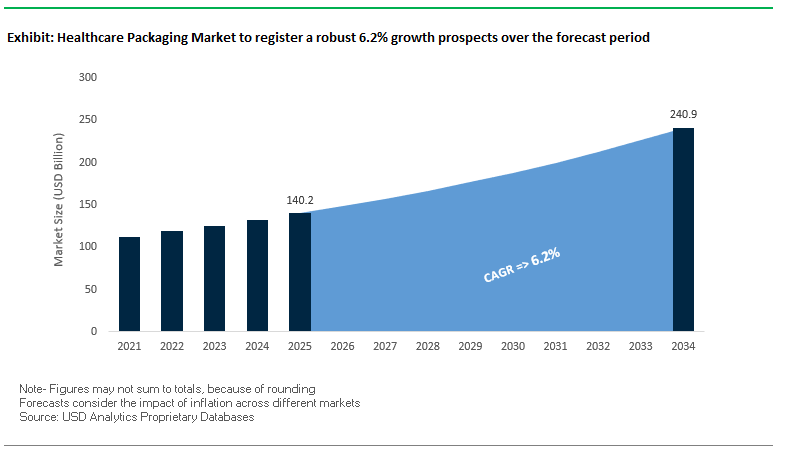
The global Healthcare Packaging Market is valued at USD 140.2 billion in 2025 and is projected to reach USD 240.9 billion by 2034, expanding at a CAGR of 6.2%. Blister packs account for approximately 25% of market demand by product type, while pharmaceutical manufacturing represents approximately 50% by end-use industry. The market covers plastics, paper and paperboard, glass, metals and foils, and bioplastics across primary, secondary and tertiary packaging formats.
Healthcare packaging represents the broad packaging ecosystem surrounding pharmaceuticals, biologics, medical devices, OTC products, nutraceuticals and home-healthcare products. Primary packaging includes blister packs, bottles, vials, ampoules, prefilled syringes, pouches and other systems that directly contain or immediately protect healthcare products. Secondary packaging includes cartons, labels, inserts and multipacks, while tertiary packaging supports storage, distribution and, where applicable, temperature-controlled transportation.
The market has a broader scope than specialized categories such as Pharmaceutical Packaging, Medical Device Packaging, Sterilized Packaging, Prefilled Syringe Packaging or Pharmaceutical Barrier Films. Drug packaging is shaped by formulation stability, container-closure compatibility, labeling and supply-chain traceability, while medical-device packaging additionally encompasses sterile barrier systems, mechanical protection, sterilization compatibility and device-level identification. This combination of pharmaceutical and medical-device packaging creates distinct requirements across the healthcare supply chain.
Current market development is concentrated around injectable and biologic primary packaging, ready-to-fill containers, sterile medical packaging, higher-barrier materials, package-level traceability, clinical-trial packaging and material transitions that retain healthcare-grade performance. Sustainability is increasingly visible in supplier portfolios, although material substitutions remain closely connected with drug stability, sterile-barrier performance, regulatory documentation and validated manufacturing processes.
Recent Developments and Company Strategies in Healthcare Packaging
Amcor Expands Sterile Medical Packaging Capacity in Malaysia
In April 2026, Amcor opened an advanced healthcare packaging coating facility in Subang Jaya, Selangor, Malaysia, representing an investment of more than USD 35 million. The facility introduced air-knife coating technology for coated medical paper used in sterile medical-device packaging and expanded Amcor's healthcare manufacturing footprint in Southeast Asia.
The investment reflects greater regionalization of medical packaging production around Asian device-manufacturing clusters. Coated medical papers function as components of sterile barrier systems in which porosity, sealability and sterilant compatibility are important performance variables.
Smurfit Westrock Opens EUR 40 Million Clinical and Adherence Packaging Facility
In November 2025, Smurfit Westrock inaugurated a dedicated adherence and clinical packaging facility near Dublin Airport following investment exceeding EUR 40 million. The facility supports clinical trials and regulated pharmaceutical packaging and houses approximately 170 employees across design, production and supporting functions.
The investment demonstrates increasing specialization within secondary pharmaceutical packaging. Clinical-trial packs frequently combine patient identification, dosing organization, randomization or blinding requirements, multilingual information and controlled packaging workflows that differ from standard commercial cartons.
Corning and SGD Pharma Localize Pharmaceutical Glass-Tubing Production in India
In September 2025, Corning and SGD Pharma inaugurated a pharmaceutical glass-tubing facility in Telangana, India. The plant manufactures Type I borosilicate glass tubing for injectable packaging, biologics, diagnostics and related applications and combines Corning's glass technology with SGD Pharma's vial-converting expertise.
The facility strengthens the upstream supply base for pharmaceutical primary packaging in India and reflects continuing localization of materials used for high-value injectable medicines.
Gerresheimer Adds Ready-to-Fill Vial Capacity in Germany
In October 2025, Gerresheimer began development of a new production facility at its Wertheim, Germany site with investment of approximately EUR 30 million. The 4,000-square-meter facility is planned to manufacture presterilized ready-to-fill vials using the company's EZ-fill Smart packaging platform from mid-2027, with processing conducted partly within an approximately 800-square-meter GMP Class C cleanroom.
The project extends the company's ready-to-fill vial infrastructure for injectable biologics and demonstrates the increasing connection between primary-container manufacture, sterilization, standardized packaging formats and pharmaceutical fill-finish operations.
Aptar Pharma Introduces Bio-Based Feedstock into Commercial Nasal Primary Packaging
In July 2025, Aptar Pharma announced that its Freepod nasal spray pump used with Haleon's Otrivin brand was being produced with 52% ISCC Plus-certified bio-based feedstock through a mass-balance approach. Aptar described it as its first drug-delivery system using this material approach to be commercialized globally.
The development illustrates a material transition within healthcare primary packaging that retains the established drug-delivery configuration while changing the source of part of the polymer feedstock.
Constantia Flexibles Expands Pharmaceutical Flexible Packaging Through Aluflexpack
In March 2025, Constantia Flexibles completed the acquisition of a majority of Aluflexpack, a European flexible-packaging manufacturer serving pharmaceutical and other regulated applications. Aluflexpack operated across nine countries with approximately 1,700 employees at the time of completion.
The transaction expands Constantia's flexible-packaging manufacturing base and reflects continuing consolidation around foil, laminate and high-barrier packaging capabilities.
Regulatory, Quality and Traceability Framework for Healthcare Packaging
Healthcare packaging operates under multiple regulatory frameworks because pharmaceuticals and medical devices are governed differently. Drug packaging is evaluated through pharmaceutical quality, container-closure, labeling and supply-chain requirements, while medical-device packaging additionally involves sterile barrier standards, device labeling and UDI requirements.
FDA Container-Closure Requirements Apply to Drugs, Biologics and Relevant Combination Products
In August 2026, FDA issued its draft guidance on Container Closure Systems for Human Drugs and Biological Products. The document provides updated principles for evaluating the quality of packaging systems used for human drugs and biologics and includes container-closure systems that are also device constituent parts of combination products. The document remains draft guidance, is not for implementation and contains non-binding recommendations as of September 2026.
For healthcare packaging, the guidance reinforces the relationship between container materials, closures, protection, compatibility and the finished drug product rather than treating packaging solely as a logistics component.
ISO 15378 Establishes a GMP-Oriented Framework for Pharmaceutical Primary Packaging Materials
ISO 15378:2017 for primary packaging materials for medicinal products specifies quality-management-system requirements with reference to Good Manufacturing Practice for organizations supplying primary packaging materials for medicinal products. The standard remained current following review in 2023, with a climate-action amendment published in 2024.
Its relevance extends across glass, elastomeric, polymer and other primary packaging components whose manufacturing consistency forms part of pharmaceutical quality management.
ISO 11607 Governs Sterile Barrier Packaging for Terminally Sterilized Medical Devices
ISO 11607-1:2019 for terminally sterilized medical-device packaging specifies requirements and test methods for materials, preformed sterile barrier systems, sterile barrier systems and packaging systems intended to maintain sterility until the point of use. The edition was reviewed and confirmed in 2024.
ISO 11607 therefore applies to an important sterilized packaging segment within the wider Healthcare Packaging Market, rather than to every pharmaceutical or non-sterile healthcare package.
Drug Serialization and Medical-Device UDI Are Distinct Traceability Systems
In the United States, DSCSA addresses enhanced interoperable electronic tracing at the package level for covered prescription drugs and defines product identifiers incorporating the standardized numerical identifier, lot number and expiration date. Current implementation also includes specific exemptions, including certain small-dispenser exemptions extending through November 27, 2027.
In the European Union, the Falsified Medicines Directive framework requires a unique identifier and anti-tampering device on the outer packaging of covered medicines. Medical devices follow a separate UDI framework under MDR, where UDI-carrier placement varies according to device class, unit packaging and higher packaging levels.
These systems demonstrate that “serialization” is not one universal healthcare-packaging requirement: pharmaceutical traceability and medical-device identification operate under different regulatory structures.
EU PPWR Includes Healthcare-Specific Exemptions
The EU Packaging and Packaging Waste Regulation, Regulation (EU) 2025/40 establishes circularity and recycled-content requirements across many packaging categories but contains specific exemptions relevant to medicinal products and healthcare applications. These include provisions for packaging and immediate packaging components needed to meet medicinal-product quality standards and exclusions from specified recycled-content requirements.
Healthcare packaging material transitions therefore operate alongside product-safety, sterility, stability and regulatory requirements rather than under the same material timetable as ordinary consumer packaging.
Primary Packaging Evolves with Biologics, Injectables and Sensitive Drug Formulations
Primary packaging is becoming more technically differentiated as biologics, injectable therapies and high-value formulations expand. Vials, ampoules, prefilled syringes, cartridges, nasal systems and other drug-contact packages interact directly with their pharmaceutical contents throughout the product shelf life..
Glass remains established across parenteral applications because of its chemical resistance, barrier performance and long pharmaceutical history, while advanced glass treatments, tighter dimensional controls and ready-to-fill configurations address breakage, particles and filling-line performance. Polymer containers serve applications where break resistance, weight, transparency or alternative drug-contact characteristics are relevant.
Injectable medicines also increase the importance of elastomeric closures, container-closure integrity and extractables/leachables evaluation. The expansion of ready-to-fill vials and syringes demonstrates how the packaging system is becoming increasingly integrated with aseptic filling rather than functioning as an isolated container.
Current capacity developments from Gerresheimer, SGD Pharma, West Pharmaceutical Services, BD and other healthcare suppliers reflect continued specialization around high-value primary packaging and injectable delivery systems.
Ready-to-Use and Ready-to-Fill Packaging Expands Across Injectable Medicines
Ready-to-use and ready-to-fill formats supply primary containers in preprocessed, sterilized configurations compatible with pharmaceutical filling operations. These systems are increasingly visible across vials, syringes and cartridges used for biologics and other injectable medicines.
In September 2024, Gerresheimer, Stevanato Group and SCHOTT Pharma established the Alliance for RTU focused on ready-to-use vials and cartridges and technical standardization around sterile primary packaging. Gerresheimer's subsequent Wertheim investment provides physical manufacturing evidence of the same development trajectory.
RTU and RTF systems connect container manufacture with washing, sterilization, nest or tray configuration, aseptic transfer and fill-finish-line compatibility. Their expansion is particularly associated with smaller-batch biologics, high-value injectable therapies and operations where container preparation is increasingly standardized upstream.
Sterile Barrier Packaging Supports Medical Device Integrity Through Distribution and Use
Sterile medical-device packaging combines microbial barrier performance with mechanical protection and controlled opening at point of use. Flexible pouches, coated papers, porous webs, lidding materials and thermoformed trays are used across surgical instruments, catheters, diagnostic devices, implants and procedure kits.
Packaging-system performance depends on the complete sterile barrier rather than on material properties alone. Seal integrity, puncture resistance, sterilant penetration where required, aging, distribution stresses and aseptic presentation all influence the final package.
Recent investment illustrates continued manufacturing specialization. Amcor's 2026 Malaysia facility expanded coated medical-paper capacity, while its healthcare portfolio also added recycle-ready high-shield medical laminates and thermoformed healthcare trays during 2025.
Serialization and UDI Create Distinct Packaging-Level Traceability Requirements
Healthcare packaging increasingly carries regulated digital identifiers, but the role of those identifiers differs between drugs and devices.
For prescription drugs covered by DSCSA, package-level product identifiers support interoperable electronic tracing and verification through the pharmaceutical distribution system. In the EU, covered medicines carry unique identifiers and anti-tampering features under the falsified-medicines framework.
Medical devices operate under UDI systems rather than pharmaceutical serialization legislation. Under the EU framework, UDI placement can occur on individual packaging or a higher packaging level depending on device class, intended setting and accessibility of higher-level packaging.
This separation is commercially important because labels, cartons and coding areas perform different regulatory functions according to whether the packaged healthcare product is a drug, biologic or medical device.
High-Barrier and Material-Efficient Packaging Platforms Expand Across Healthcare Applications
Pharmaceutical barrier films and high-barrier materials remain important across healthcare applications where moisture, oxygen and light exposure can affect product performance. Material simplification is becoming more visible in supplier portfolios. Huhtamaki's Omnilock Ultra PAPER, recognized at Pharmapack 2025, is positioned as a recyclable heat-sealable high-barrier paper structure intended to replace certain multilayer laminates. Amcor has also introduced recycle-ready high-shield laminates for medical applications including diagnostic sensors, catheters and wound-care devices.
Primary-packaging development is following a different route in some drug-delivery systems. Aptar's commercial use of certified bio-based feedstock in the Freepod nasal pump retains the existing delivery-system architecture while changing part of the polymer feedstock basis.
These developments indicate that sustainability-related innovation in healthcare packaging is occurring through several pathways—material reduction, recyclability-oriented structures, renewable feedstocks and simpler material combinations—while functional performance remains application-specific.
Patient-Centric, Child-Resistant and Adherence Packaging Shapes Dose Presentation
Healthcare packaging increasingly incorporates features associated with dose organization, access control and usability. Calendar blisters, unit-dose packs, senior-accessible child-resistant closures and adherence packs place greater emphasis on the interaction between the patient and package.
Child-resistant packaging remains particularly relevant for medications and other healthcare products where accidental access presents safety risks. The requirement is performance-based rather than equivalent to “child-proof” packaging, and adult accessibility remains part of the design and testing environment.
Adherence-oriented secondary packaging is also increasingly specialized. Smurfit Westrock's Dublin clinical and adherence facility demonstrates commercial investment in packaging that organizes treatment information and dose presentation around clinical-trial workflows.
Digital technologies can add authentication or data functions in selected applications, but their role varies considerably by product. Current market activity is more clearly established around regulated coding, UDI, clinical-trial packaging and structured dose presentation than around universal deployment of connected packaging.
Clinical-Trial Packaging Becomes More Specialized
Clinical-trial packaging operates under conditions that differ from normal commercial pharmaceutical packaging. Study packs can require randomization support, blinding, comparator-product handling, multiple dosing schedules, multilingual labeling, kit assembly and controlled reconciliation.
Smurfit Westrock's more than EUR 40 million Dublin investment provides direct evidence of increased specialization in this segment. The site supports both clinical-trial and regulated pharmaceutical packaging and complements the company's other clinical-packaging operations in China and the United States.
Growth in biologic and specialty-drug pipelines also increases the variety of container types entering clinical supply chains, including vials, prefilled systems and combination products. Secondary packaging consequently performs both physical-protection and study-management functions before a therapy reaches commercial-scale packaging.
Temperature-Assured Packaging Supports Biologics, Vaccines and Sensitive Healthcare Products
Tertiary healthcare packaging includes insulated shippers, refrigerant systems and temperature-assurance solutions used when pharmaceutical or biologic stability depends on controlled distribution conditions. This function is distinct from primary packaging, which directly contains the drug, and from sterile barrier packaging used for terminally sterilized devices.
Pharmaceutical cold-chain packaging is particularly associated with biologics, vaccines and other temperature-sensitive therapies where shipping excursions can affect product quality. The market includes reusable and single-use insulated systems, passive thermal packaging and data-supported shipment configurations.
Corporate ownership within this segment has changed. Sonoco Products Company completed the sale of its ThermoSafe temperature-assurance business to Arsenal Capital Partners on November 3, 2025, for consideration of up to USD 725 million. Corporate ownership within this segment changed in November 2025 when Sonoco Products Company completed the sale of its ThermoSafe temperature-assurance business to Arsenal Capital Partners for consideration of up to USD 725 million. ThermoSafe continues to participate in temperature-controlled packaging for pharmaceuticals, biologics and vaccines under its new ownership.
Healthcare Packaging Market Share Insights
Blister Packs Account for Approximately 25% of the Market by Product Type
Healthcare blister packaging accounts for approximately 25% of the Healthcare Packaging Market in 2025, representing the largest product-type share within the existing USDAnalytics quantitative model..
Their position reflects widespread use across oral solid dosage forms, particularly tablets and capsules. Individual cavities support unit-dose presentation, tamper evidence and controlled protection from environmental exposure. Barrier performance can be adjusted through PVC, PVdC, PCTFE, PET, PP, aluminum and other forming and lidding structures according to the drug's stability requirements.
Calendar formats and printed dosing information can additionally support treatment organization, while pharmaceutical serialization generally operates at the regulated package level rather than automatically at each individual blister cavity.
Pharmaceutical Manufacturing Represents Approximately 50% of Market Demand
Pharmaceutical packaging represents the largest end-use component of the broader healthcare packaging market, with pharmaceutical manufacturing accounting for approximately 50% of demand within the USDAnalytics framework.
The segment encompasses oral medicines, injectables, biologics, vaccines, topical products, inhalation systems and other dosage forms requiring combinations of product containment, stability protection, identification and distribution packaging.
Medical device packaging represents another important demand base, particularly across sterile barrier systems, protective trays and pouches used by medical-device OEMs. Nutraceutical and OTC companies, home-healthcare providers and contract packaging organizations extend demand beyond prescription pharmaceutical manufacturing into broader healthcare consumption and outsourced packaging services.
Healthcare Packaging Market Analysis by Country and Region
United States: Pharmaceutical Container-Closure Quality and Package-Level Drug Traceability Shape the Market
The United States healthcare packaging environment combines pharmaceutical quality requirements, medical-device regulation and prescription-drug traceability. FDA's 2026 draft container-closure guidance adds a current quality reference for drugs, biologics and relevant combination products, while DSCSA establishes enhanced electronic tracing and verification requirements at the package level for covered prescription drugs.
The current DSCSA environment includes exemptions for certain small dispensers through November 27, 2027, illustrating that implementation provisions vary by supply-chain participant. Medical devices operate under a separate identification regime, reinforcing the distinction between drug serialization and device UDI.
U.S. demand also reflects a large pharmaceutical, biologic and medical-device manufacturing base, supporting primary containers, sterile medical packaging, secondary cartons and labels, clinical-trial packs and temperature-assured distribution systems.
Germany and the European Union: Pharmaceutical Traceability, Medical-Device UDI and RTU Packaging Define Current Activity
European healthcare packaging operates under distinct pharmaceutical and device frameworks. The Falsified Medicines Directive requires defined safety features on the outer packaging of covered medicines, while MDR establishes UDI requirements for medical devices and relevant packaging levels.
Germany also remains an important pharmaceutical-packaging production base. Gerresheimer's approximately EUR 30 million Wertheim expansion will add ready-to-fill vial manufacturing using the EZ-fill Smart platform, with production scheduled from 2027.
The implementation of PPWR adds another material-policy layer but does not place all healthcare packaging under identical recycled-content requirements. Medicinal-product and sensitive healthcare packaging receive specific exemptions where product quality, safety or regulatory requirements apply.
China: Pharmaceutical Packaging Materials Enter a More Formalized GMP Framework
China introduced a significant packaging-specific quality change through the NMPA Pharmaceutical Packaging Materials Annex to the Good Manufacturing Practice for Drugs, which became effective January 1, 2026. The framework covers quality-management systems, inspections, supplier management, batch release, change management and the relationship between packaging-material suppliers and drug marketing-authorization holders.
The annex places pharmaceutical packaging materials within a formal GMP-oriented quality framework covering supplier management, inspections, batch release, change control and coordination between packaging-material suppliers and drug marketing-authorization holders.
China's extensive pharmaceutical and medical-device manufacturing base also sustains demand for glass containers, polymer packages, flexible barrier structures, labels, sterile packaging and secondary cartons across domestic and export-oriented production.
India: Pharmaceutical Manufacturing Scale Supports Localization of Primary Packaging Supply
India's healthcare packaging market is closely connected with its large pharmaceutical manufacturing base and extensive production of generic medicines, vaccines, injectables and biologics. Pharmaceutical packaging and labeling operate within India's Drugs Rules framework, while export-oriented production also interacts with the packaging specifications and regulatory requirements of destination markets.
A significant upstream development occurred in September 2025 when Corning and SGD Pharma inaugurated their pharmaceutical glass-tubing facility in Telangana. The plant produces Type I borosilicate tubing for injectable drug packaging, biologics and diagnostic applications.
The investment adds local high-quality glass-tubing capacity to India's pharmaceutical supply chain and complements the country's existing vial, ampoule, bottle, blister and flexible-packaging manufacturing base.
Competitive Landscape: Primary Containers, Sterile Barriers, Drug Delivery and Specialized Healthcare Packaging Define Competition
The Healthcare Packaging Market includes global flexible and rigid packaging groups, pharmaceutical-container manufacturers, drug-delivery specialists and healthcare-focused converters serving pharmaceuticals, medical devices, diagnostics and clinical applications. Amcor plc significantly expanded its healthcare portfolio through the April 2025 combination with Berry Global, bringing the former Berry operations into Amcor's broader flexible films, rigid containers, closures and healthcare packaging platform. Gerresheimer AG, West Pharmaceutical Services, Inc., SGD Pharma, AptarGroup, Inc., Becton, Dickinson and Company, and Origin Pharma Packaging compete across pharmaceutical glass and polymer containers, elastomeric components, dispensing systems, injectable packaging, drug-delivery interfaces and other primary healthcare formats. Competition in this part of the market is shaped by drug-material compatibility, sterile performance, container-closure integrity, extractables and leachables, ready-to-use formats, dimensional consistency and compatibility with automated fill-finish operations.
Flexible, paper-based and secondary healthcare packaging form a second major competitive group. Constantia Flexibles, Huhtamaki Oyj, Mondi Group, CCL Industries Inc. and Smurfit Westrock plc participate across pharmaceutical films and foils, labels, cartons, leaflets, clinical-trial packaging, adherence formats and medical-device packaging. Smurfit Westrock's current healthcare portfolio spans pharmaceutical cartons, labels, leaflets, adherence packaging, clinical-trial formats and medical-device packaging, supported by a dedicated healthcare manufacturing network; in November 2025, the company also opened a €40 million adherence and clinical packaging facility in Dublin. Unither Pharmaceuticals SAS participates through pharmaceutical contract manufacturing and unit-dose delivery formats, linking package configuration with drug-product manufacturing. Across these suppliers, competitive differentiation increasingly centers on high-barrier performance, patient-centric design, serialization and variable-data capability, recyclable and material-efficient structures, child-resistant and senior-friendly formats, and integration with pharmaceutical and medical-device production lines.
Recent portfolio changes have also altered the healthcare-packaging supplier landscape. TOPPAN Holdings completed its acquisition of Sonoco's Thermoformed and Flexibles Packaging business in April 2025, transferring healthcare assets including TEQ into TOPPAN's packaging platform. Sonoco subsequently completed the sale of ThermoSafe to Arsenal Capital Partners in November 2025, placing the temperature-assurance business under new ownership. These transactions reinforce the increasingly specialized structure of the market, where competition extends beyond packaging conversion to sterile barrier validation, drug-delivery integration, temperature-assured distribution, clinical packaging, regulatory documentation, digital identification, regional manufacturing capacity and sustainability performance.
Healthcare Packaging Market Report Scope
Healthcare Packaging Market
Parameter
Details
Market Size (2025)
$140.2 Billion
Market Size (2034)
$240.9 Billion
Market Growth Rate
6.2%
Segments
By Material Type (Plastics, Paper & Paperboard, Glass, Metal & Foils, Bioplastics), By Product Type (Blister Packs, Bottles & Containers, Vials & Ampoules, Pouches & Bags, Pre-Filled Syringes, Medication Tubes, Labels & Closures), By Packaging Format (Primary Packaging, Secondary Packaging, Tertiary Packaging), By End-Use Industry (Pharmaceutical Manufacturing, Medical Device OEMs, Nutraceuticals & OTC, Home-Healthcare Providers, Contract Packaging Organizations)
Study Period
2020- 2025 and 2026-2034
Units
Revenue (USD)
Qualitative Analysis
Porter’s Five Forces, SWOT Profile, Market Share, Scenario Forecasts, Market Ecosystem, Company Ranking, Market Dynamics, Industry Benchmarking
US, Canada, Mexico, Germany, France, Spain, Italy, UK, Russia, China, India, Japan, South Korea, Australia, South East Asia, Brazil, Argentina, Middle East, Africa
Healthcare Packaging Market Segmentation
By Material Type
Plastics
Paper & Paperboard
Glass
Metal & Foils
Bioplastics
By Product Type
Blister Packs
Bottles & Containers
Vials & Ampoules
Pouches & Bags
Pre-Filled Syringes
Medication Tubes
Labels & Closures
By Packaging Format
Primary Packaging
Secondary Packaging
Tertiary Packaging
By End-Use Industry
Pharmaceutical Manufacturing
Medical Device OEMs
Nutraceuticals & OTC
Home-Healthcare Providers
Contract Packaging Organizations
Countries Analyzed
North America (US, Canada, Mexico)
Europe (Germany, UK, France, Spain, Italy, Russia, Rest of Europe)
Asia Pacific (China, India, Japan, South Korea, Australia, South East Asia, Rest of Asia)
South America (Brazil, Argentina, Rest of South America)
Middle East and Africa (Saudi Arabia, UAE, Rest of Middle East, South Africa, Egypt, Rest of Africa)
Top Companies in Healthcare Packaging Market
Amcor plc
Smurfit Westrock plc
Gerresheimer AG
Mondi Group
AptarGroup, Inc.
Sonoco Products Company
Huhtamaki Oyj
CCL Industries Inc.
West Pharmaceutical Services, Inc.
SGD Pharma
Origin Pharma Packaging
Becton Dickinson and Company
Constantia Flexibles
Unither Pharmaceuticals SAS
* List Not Exhaustive
Methodology
USDAnalytics has employed a comprehensive, multi-layered research methodology to provide an authoritative analysis of the global Healthcare Packaging Market. Our approach combines extensive primary research, including interviews with pharmaceutical manufacturers, medical device OEMs, contract packaging organizations, and sustainability experts, alongside secondary research sourced from company filings, press releases, regulatory frameworks, trade publications, and industry events. Market sizing, CAGR projections, and forecast modeling are derived from historical demand trends, emerging regulations such as serialization mandates under the U.S. DSCSA and EU Falsified Medicines Directive, and innovations in high-barrier recyclable polymers, bio-based materials, and smart, patient-centric packaging solutions. Segmentation analysis spans material type, product type, packaging format, and end-use industry, while qualitative insights highlight strategic developments including mergers and acquisitions, global expansion, and sustainability-driven innovation. This methodology ensures USDAnalytics delivers actionable, data-driven insights for industry professionals, equipping stakeholders with a robust understanding of market dynamics, growth drivers, competitive landscapes, and emerging trends shaping healthcare packaging worldwide.
Deliverables:
Comprehensive Market Research Report (PDF and Excel) with detailed tables, charts, and interactive visualizations.
Country-Specific Forecasts & Analysis.
Segment-Wise Revenue Forecasts (2026–2034).
Competitive Analysis, Benchmarking, and SWOT Profiles.
Recent Developments & Innovation Tracker.
Executive Summary & Analyst Commentary.
Post-Purchase Analyst Support for Client-Specific Questions and Custom Data Requirements.
2. Healthcare Packaging Market Landscape & Outlook (2025–2034)
2.1. Introduction to Healthcare Packaging Market
2.2. Market Valuation and Growth Projections (2025–2034)
2.3. Market Drivers and Opportunities
2.4. Regulatory and Compliance Overview
2.5. Technological and Material Innovations
3. Innovations Reshaping the Healthcare Packaging Market
3.1. Trend: Integration of Serialization and Aggregation for Enhanced Traceability
3.2. Trend: Adoption of Patient-Centric Smart Packaging for Adherence
3.3. Opportunity: Development of High-Barrier Recyclable Polymers for Drugs
3.4. Opportunity: Expansion of Connected Packaging for Clinical Trials and Real-World Data
4. Competitive Landscape and Strategic Initiatives
4.1. Mergers, Acquisitions and Strategic Alliances
4.2. R&D and Material Innovation
4.3. Sustainability and Strategies
4.4. Market Expansion and Regional Focus
5. Market Share and Segmentation Insights: Healthcare Packaging Market
5.1. By Material Type
5.1.1. Plastics
5.1.2. Paper & Paperboard
5.1.3. Glass
5.1.4. Metal & Foils
5.1.5. Bioplastics
5.2. By Product Type
5.2.1. Blister Packs
5.2.2. Bottles & Containers
5.2.3. Vials & Ampoules
5.2.4. Pouches & Bags
5.2.5. Pre-Filled Syringes
5.2.6. Medication Tubes
5.2.7. Labels & Closures
5.3. By Packaging Format
5.3.1. Primary Packaging
5.3.2. Secondary Packaging
5.3.3. Tertiary Packaging
5.4. By End-Use Industry
5.4.1. Pharmaceutical Manufacturing
5.4.2. Medical Device OEMs
5.4.3. Nutraceuticals & OTC
5.4.4. Home-Healthcare Providers
5.4.5. Contract Packaging Organizations
6. Country Analysis and Outlook of Healthcare Packaging Market
6.1. United States
6.2. Canada
6.3. Mexico
6.4. Germany
6.5. France
6.6. Spain
6.7. Italy
6.8. UK
6.9. Russia
6.10. China
6.11. India
6.12. Japan
6.13. South Korea
6.14. Australia
6.15. South East Asia
6.16. Brazil
6.17. Argentina
6.18. Middle East
6.19. Africa
7. Healthcare Packaging Market Size Outlook by Region (2025–2034)
7.1. North America Healthcare Packaging Market Size Outlook to 2034
7.1.1. By Material Type
7.1.2. By Product Type
7.1.3. By Packaging Format
7.1.4. By End-Use Industry
7.2. Europe Healthcare Packaging Market Size Outlook to 2034
7.2.1. By Material Type
7.2.2. By Product Type
7.2.3. By Packaging Format
7.2.4. By End-Use Industry
7.3. Asia Pacific Healthcare Packaging Market Size Outlook to 2034
7.3.1. By Material Type
7.3.2. By Product Type
7.3.3. By Packaging Format
7.3.4. By End-Use Industry
7.4. South America Healthcare Packaging Market Size Outlook to 2034
7.4.1. By Material Type
7.4.2. By Product Type
7.4.3. By Packaging Format
7.4.4. By End-Use Industry
7.5. Middle East and Africa Healthcare Packaging Market Size Outlook to 2034
7.5.1. By Material Type
7.5.2. By Product Type
7.5.3. By Packaging Format
7.5.4. By End-Use Industry
8. Company Profiles: Leading Players in the Healthcare Packaging Market
8.1. Amcor plc
8.2. Berry Global Inc.
8.3. WestRock Company
8.4. Gerresheimer AG
8.5. Mondi Group
8.6. AptarGroup, Inc.
8.7. Sonoco Products Company
8.8. Huhtamaki Oyj
8.9. CCL Industries Inc.
8.10. West Pharmaceutical Services, Inc.
8.11. SGD Pharma
8.12. Origin Pharma Packaging
8.13. Becton Dickinson and Company
8.14. Constantia Flexibles
8.15. Unither Pharmaceuticals SAS
9. Methodology
9.1. Research Scope
9.2. Market Research Approach
9.3. Market Sizing and Forecasting Model
9.4. Research Coverage
9.5. Data Horizon
9.6. Deliverables
10. Appendix
10.1. Acronyms and Abbreviations
10.2. List of Tables
10.3. List of Figures
Healthcare Packaging Market Segmentation
By Material Type
Plastics
Paper & Paperboard
Glass
Metal & Foils
Bioplastics
By Product Type
Blister Packs
Bottles & Containers
Vials & Ampoules
Pouches & Bags
Pre-Filled Syringes
Medication Tubes
Labels & Closures
By Packaging Format
Primary Packaging
Secondary Packaging
Tertiary Packaging
By End-Use Industry
Pharmaceutical Manufacturing
Medical Device OEMs
Nutraceuticals & OTC
Home-Healthcare Providers
Contract Packaging Organizations
Countries Analyzed
North America (US, Canada, Mexico)
Europe (Germany, UK, France, Spain, Italy, Russia, Rest of Europe)
Asia Pacific (China, India, Japan, South Korea, Australia, South East Asia, Rest of Asia)
South America (Brazil, Argentina, Rest of South America)
Middle East and Africa (Saudi Arabia, UAE, Rest of Middle East, South Africa, Egypt, Rest of Africa)
Growth is fueled by rising demand in pharmaceuticals, biologics, and medical devices requiring sterile, high-barrier, and temperature-sensitive packaging. Sustainability pressures, adoption of bio-based polymers, and patient-centric adherence packaging further boost market expansion globally.
Serialization and aggregation systems ensure end-to-end traceability, meeting regulatory requirements like DSCSA and EU FMD. These systems help prevent counterfeit drugs, improve inventory management, and enable rapid recalls, strengthening global supply chain security.
Smart packaging integrates NFC, QR codes, and sensors to track adherence, provide dosage reminders, and enhance usability for seniors and children. Connected packaging also supports clinical trials, real-world data collection, and personalized patient engagement programs.
Mono-polymer and fiber-based barrier materials provide high protection for sensitive pharmaceuticals while enabling recyclability. These innovations address regulatory pressures for circular packaging systems without compromising sterility, drug stability, or safety standards.
Industry leaders include Amcor plc, Gerresheimer AG, AptarGroup, Constantia Flexibles, and Sonoco Products Company. These firms focus on sustainable materials, high-barrier solutions, smart packaging technologies, and global expansion to meet evolving pharmaceutical and medical device needs.
More Healthcare and Pharmaceutical Packaging Reports