Blister Packaging Market Overview: Pharmaceutical Protection, Retail Visibility and Material Innovation Shape Demand
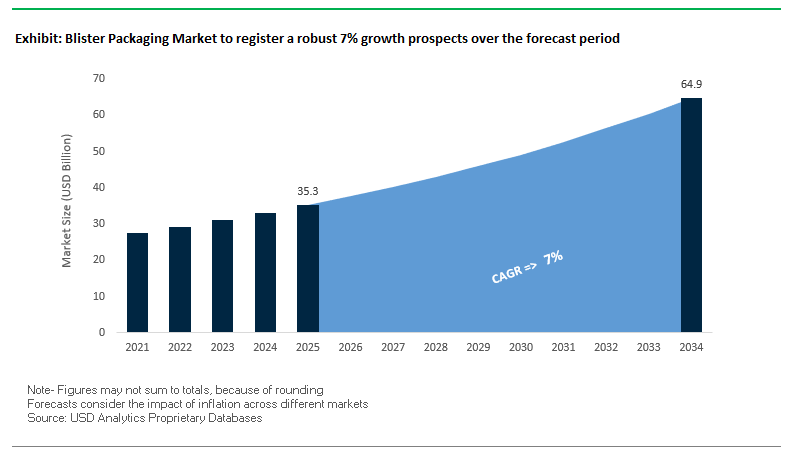
The global Blister Packaging Market is projected to increase from USD 35.3 billion in 2025 to USD 64.9 billion by 2034, expanding at a CAGR of 7%. Blister packaging combines a formed cavity with a lidding, card or backing structure to protect individual products while providing product visibility, tamper evidence, portion control or unit-dose packaging access. The market spans pharmaceutical and healthcare applications as well as consumer goods, food and confectionery, medical devices and industrial products. Thermoformed blisters, cold-form pharmaceutical blisters, carded retail blisters, trapped blisters and clamshell-type formats consequently serve different barrier, merchandising and handling requirements.
Pharmaceutical packaging applications represent 65% of end-use demand, making drug packaging the largest application. Tablets, capsules and other solid-dose products use blister systems to separate individual doses while protecting formulations from moisture, oxygen, light and physical damage according to stability requirements. Thermoformed structures can provide transparency, forming efficiency and high-speed processing, while cold-form aluminum structures provide high barrier protection for moisture-, oxygen- or light-sensitive formulations. Material selection increasingly extends beyond conventional PVC and aluminum toward PP, PET, PE, COC-containing structures and other engineered films intended to combine barrier performance with recyclability or reduced material use.
The market nevertheless extends materially beyond pharmaceuticals. Retail blister formats are used across hardware, electronics, personal care, pet products and other consumer goods where product visibility, theft deterrence, tamper evidence and shelf presentation are important. TOPPAN Packaging's Alloyd business, for example, combines blister cards, thermoforming, heat-sealing equipment and tooling for retail applications, illustrating how the broad blister market includes packaging converters and equipment suppliers outside the pharmaceutical value chain.
Material innovation is increasingly linked with manufacturing compatibility. New blister structures must satisfy barrier and mechanical requirements while forming, sealing, cutting and running consistently on commercial equipment. Current developments from Uhlmann and its material partners, TekniPlex Healthcare, Klöckner Pentaplast, ACG and Romaco demonstrate that recyclability, barrier performance and compatibility with established blister lines are increasingly being developed together rather than treated as separate objectives.
Key Industry Insights
Thermoform blister packaging accounts for approximately 70% of market demand, supported by high-speed production, material flexibility and applications across pharmaceuticals and consumer products.
Pharmaceuticals represent approximately 65% of end-use demand, while consumer goods, food and confectionery, medical devices and industrial applications broaden the market beyond healthcare.
Barrier requirements remain a primary material-selection criterion, with moisture-, oxygen- and light-sensitive formulations requiring higher-performance thermoform films, coated structures or cold-form aluminum systems.
Recyclable PP, PET and PE blister systems are moving toward commercial-line compatibility, with suppliers developing forming webs and lidding structures that can operate on conventional blister equipment.
Packaging-line compatibility is becoming an important B2B purchasing criterion as material suppliers and machinery manufacturers jointly address forming behavior, sealing windows, tooling, line speed and inspection requirements.
Recent Blister Packaging Developments and Manufacturer Strategies
Uhlmann, ETIMEX, Perlen Packaging and Faller Validate PP Blister Packaging Across the Value Chain
In April 2025, Uhlmann Pac-Systeme, ETIMEX Primary Packaging, Perlen Packaging and Faller Packaging disclosed a collaborative program focused on polypropylene pharmaceutical blister packaging. ETIMEX supplied PP blister films, while Perlen Packaging contributed material analysis and application expertise. The materials were tested on an Uhlmann BEC 400 blister machine under production-relevant conditions, and Faller developed associated paperboard secondary packaging. The project is significant because it addresses recyclable blister development across the forming film, machine-processing, sealing and secondary-packaging chain, rather than evaluating material recyclability independently from commercial manufacturing performance.
ACG Introduces Desiccant Cold-Form Laminate for Moisture-Sensitive Drugs
In December 2025, ACG launched DryPod, a desiccant-based cold-form laminate intended for highly moisture-sensitive pharmaceutical products. The company positioned the structure around improved moisture management and compatibility with existing blister-production environments, addressing limitations associated with specialized desiccant cold-form technologies. The development illustrates continued innovation within cold-form packaging even as recyclable thermoform structures receive greater attention. It also reinforces the importance of drug stability and moisture sensitivity in determining whether a formulation can move toward polymer-based thermoforming or continues to require more specialized high-barrier architectures.
Romaco Expands High-Speed Processing of PET and PP Mono-Material Blisters
In April 2026, Romaco presented its Unity 600 high-speed blister line with expanded capability for mono-material PET and PP blister foils in addition to conventional PVC/aluminum and aluminum/aluminum structures. The two-lane system can produce up to 600 blisters and 350 cartons per minute and integrates primary blister formation with secondary cartoning and downstream packaging functions. Romaco also reports software-based blister tracking and energy-management features within the line. The development is important to the wider market because recyclable film adoption depends on reliable commercial forming and sealing performance at production speeds, not simply on the availability of alternative resin structures.
TekniPlex Expands Recyclable Pharmaceutical Blister Structures Across Multiple Barrier Levels
In May 2026, TekniPlex Healthcare presented a portfolio of recyclable pharmaceutical blister systems designed around different moisture-barrier requirements. Its PP-based platform combines COC-containing thermoform films with PP barrier lidding for compatibility with the #5 PP recycling stream, while PET-based forming films and scored PET lidding target applications with lower barrier requirements. The company also offers a pharmaceutical-grade PET blister film containing 30% post-consumer recycled content through a mass-balance approach and continues to supply high-barrier pharmaceutical films, including Aclar laminates and PFAS-free PVdC-coated structures.. The portfolio demonstrates that blister sustainability is developing as a range of application-specific structures rather than a single universal replacement for PVC/aluminum packaging.
Klöckner Pentaplast Extends PP Blister Films into Higher Oxygen-Barrier Applications
Klöckner Pentaplast has expanded its kpNext pharmaceutical platform with kpNext RB5 and RB5.1, polypropylene-based thermoforming films intended to combine moisture protection with compatibility with the #5 recycling stream. RB5.1 incorporates an EVOH functional barrier layer to improve oxygen protection while maintaining a PP-based architecture. The company also positions the films as compatible with established blister-processing equipment, including standard tooling. This development is relevant because oxygen sensitivity has historically restricted the range of formulations that can move toward recyclable polyolefin blister structures.
TOPPAN Expands Broad Blister Packaging Capabilities Through Alloyd and Thermoforming Assets
In April 2025, TOPPAN Holdings completed its acquisition of Sonoco's Thermoformed and Flexibles Packaging business, bringing businesses including Alloyd and TEQ into the TOPPAN Packaging platform. The acquired operations span retail, healthcare, medical and other thermoformed packaging applications.
The broader retail blister market is also undergoing material redesign. In 2025, Alloyd received an AmeriStar award for a Nylabone packaging redesign that replaced a conventional plastic blister configuration with an FSC-certified paperboard structure. TOPPAN reports that the redesign eliminated more than 40 tons of plastic and reduced total package weight by 25%, while remaining compatible with existing Alloyd sealing equipment. The example illustrates how consumer blister packaging can evolve through paperboard substitution and tooling adaptation, a different sustainability pathway from pharmaceutical blister systems where drug-barrier requirements place tighter constraints on material changes.
Blister Machinery Integrates Inspection, Traceability and Material Flexibility
Blister equipment suppliers are expanding beyond forming and sealing into integrated inspection, serialization and production-data functions. ACG presented an integrated oral-solid-dose packaging platform at Interpack 2026 centered on its Blister X and Karton X systems, while its 2026 portfolio also includes AI-enabled blister inspection and track-and-trace technologies.
These developments reinforce a broader market shift: material suppliers, converters and equipment companies increasingly need to address blister performance as an integrated manufacturing system involving film properties, forming depth, sealing, inspection, coding, cartoning and line efficiency.
Key Market Trends and Emerging Opportunities Driving the Blister Packaging Industry
Mandated Adoption of Anti-Counterfeiting and Serialization Features
Global pharmaceutical regulations are compelling blister packaging manufacturers to integrate advanced anti-counterfeiting and serialization systems. The U.S. Drug Supply Chain Security Act (DSCSA) and the European Union’s Falsified Medicines Directive (FMD) require unique serial numbers on each unit, enabling end-to-end traceability. Blister packs now incorporate 2D Data Matrix codes containing GTIN, serial numbers, lot numbers, and expiration dates, ensuring products are verifiable throughout the supply chain. Compliance with these mandates involves significant investment in high-resolution cameras, precision lighting, and integrated vision systems for automated code verification, allowing manufacturers to prevent counterfeit medicines effectively. This trend is driving the adoption of advanced technologies in pharmaceutical packaging and positions serialized blister packs as critical tools for patient safety and regulatory adherence.
Strategic Shift Towards Recyclable Mono-material Polypropylene (PP) Blisters
Facing regulatory pressures from Extended Producer Responsibility (EPR) schemes and brand sustainability goals, the blister packaging market is rapidly transitioning from multi-material PVC/PVDC packs to recyclable mono-material polypropylene (PP) solutions. PVC-aluminum laminates, which account for roughly 70% of global pharmaceutical blister usage, are difficult to recycle due to their multi-layer composition. Innovative collaborations, including Etimex Primary Packaging, Perlen Packaging, and Faller Packaging, have developed mono-material PP blister packs that simplify recycling. European regulations, such as the Packaging and Packaging Waste Regulation (PPWR), further drive adoption, exemplified by SÜDPACK Medica’s NutriGuard solution. Concepts like the One-Material Blister (OMB), where both the bottom and lidding films use the same polymer, streamline the recycling process and reinforce circular economy initiatives, aligning with sustainability and corporate responsibility goals.
Development of High-Barrier, Compostable Polymer Blisters
A significant growth opportunity exists in creating fully compostable blister films that maintain critical moisture and oxygen barrier properties for pharmaceuticals and nutraceuticals. Existing biodegradable solutions often fail under real-world supply chain conditions, highlighting the need for high-performance compostable alternatives. Industry leaders and academic researchers are actively developing next-generation materials, such as paper-based compostable films and PLA sheets, which can withstand handling, transport, and storage while remaining environmentally friendly. The adoption of truly compostable blisters addresses mounting concerns over end-of-life pharmaceutical waste, particularly for nutraceutical products, and provides a sustainable alternative to conventional blister packs.
Integration of Smart Blister Packs for Enhanced Patient Adherence
The integration of smart technology into blister packs is transforming patient adherence monitoring and digital healthcare solutions. Embedded sensors, NFC tags, and other electronics allow real-time tracking of pill removal, offering accurate adherence data for clinical trials and healthcare providers. Studies show discrepancies between self-reported adherence and data captured by electronic smart blister packages, highlighting the importance of these innovations. Smart blister packs, such as those developed by Schreiner MediPharm, can transmit dosing data to mobile applications, providing patients with customized reminders, medication history tracking, and enhanced support. This integration of smart packaging not only improves patient care but also generates valuable insights for pharmaceutical companies and research institutions.
Blister Packaging Market Share Insights
Thermoform Blister Packaging Holds the Largest Market Share by Product Type
Thermoform blister packaging dominates the blister packaging industry with a commanding 70% share, underscoring its versatility and scalability. Its widespread use in the global pharmaceutical industry where over 80% of solid oral doses (pills, capsules, tablets) are blister packed in regions like Europe and Asia drives this dominance. Thermoforming allows manufacturers to tailor cavity design, combine plastics like PVC with barrier films such as PVDC, PCTFE, or Aclar®, and achieve an optimal balance of clarity, barrier protection, and cost efficiency. Beyond pharma, thermoformed blisters serve consumer goods and electronics, leveraging their tamper-evident design and peg-hole retail display adaptability. High production speeds, relatively low tooling costs, and compatibility with high-volume packaging lines consolidate their dominance, while ongoing innovations in recyclable PET-based blisters aim to mitigate sustainability criticisms.
Pharmaceuticals Secure the Largest Market Share by End-Use Industry in Blister Packaging
Pharmaceuticals account for 65% of blister packaging demand, making this end-use segment the indisputable driver of global market growth. Blisters deliver critical advantages that align directly with regulatory and patient compliance requirements: unit-dose convenience, tamper evidence, extended shelf life through superior moisture and oxygen barriers, and compatibility with serialization for global track-and-trace mandates. Regions like Europe, where over 85% of oral solid pharmaceuticals are dispensed in blister packs, anchor this dominance, with Asia-Pacific markets rapidly following suit due to growing generic drug production. Rising chronic disease prevalence and the surge in biologics and high-potency APIs further intensify the need for advanced blister formats, including cold-form aluminum blisters. Pharmaceutical companies also prefer blisters over bottles for supply chain optimization, as they reduce dispensing errors and enhance adherence, solidifying the pharmaceutical sector as the unrivaled engine of blister packaging growth.
The Blister Packaging Market includes global flexible-packaging companies, pharmaceutical film and foil suppliers, thermoforming specialists, retail blister converters and packaging-machinery manufacturers. Amcor plc, Constantia Flexibles, Klöckner Pentaplast, TekniPlex, Huhtamaki, DNP and Bilcare compete primarily through forming webs, lidding materials, high-barrier laminates and pharmaceutical blister structures. Amcor's current portfolio includes the PVC-free polyethylene-based AmSky blister family, while TekniPlex offers PP-, PET- and high-barrier blister systems and Klöckner Pentaplast continues to expand its kpNext polymer platforms. Competition across this supplier group is increasingly defined by moisture and oxygen barrier performance, thermoformability, sealability, film clarity, material reduction, recycling-stream compatibility and the ability to introduce new structures without major disruption to validated packaging operations.
The broader retail and secondary blister segment includes TOPPAN Packaging/Alloyd and Smurfit Westrock, alongside regional thermoforming and carded-packaging converters. TOPPAN acquired Sonoco's Thermoformed and Flexibles Packaging operations in April 2025. TOPPAN's current platform combines blister cards, thermoforming, custom tooling and heat-sealing machinery for retail, consumer and medical applications. Smurfit Westrock, formed through the July 2024 combination of Smurfit Kappa and WestRock, participates in pharmaceutical blister and adherence packaging through DosePak, Shellpak Renew, Perfpak Advantage and related paperboard-based systems.
Packaging-equipment suppliers form a third competitive group because material innovation is closely linked to manufacturing performance. Uhlmann Pac-Systeme, ACG and Romaco Group compete across blister forming, filling, sealing, inspection, cartoning and integrated solid-dose packaging lines. Uhlmann's 2025 PP collaboration with ETIMEX, Perlen Packaging and Faller demonstrates growing cooperation between film producers, machinery suppliers and secondary-packaging companies, while Romaco's Unity 600 and ACG's integrated blister platforms emphasize high-speed production, material flexibility, inspection and traceability. As a result, competition in blister packaging increasingly extends beyond the film or container itself to material-machine compatibility, tooling, forming efficiency, barrier qualification, seal performance, automation and commercial-scale conversion capability.
United States: Sustainability and Regulatory Compliance Driving Advanced Blister Packaging
The U.S. blister packaging market is evolving rapidly under the influence of strict regulations, sustainability trends, and technological innovations. States like California are implementing laws such as the Plastic Pollution Prevention and Packaging Producer Responsibility Act (SB 54), promoting the adoption of recyclable and reusable blister packaging solutions. Industry leaders like Amcor plc are pioneering polyethylene-based thermoform systems that eliminate PVC and aluminum, providing environmentally sustainable alternatives.
Technological advancements are enhancing product security and traceability, with the U.S. Drug Supply Chain Security Act (DSCSA) driving the integration of barcodes and RFID tags to prevent counterfeiting. The pharmaceutical sector remains a key application area, particularly with the growing need for home-based chronic disease treatments, which require user-friendly, single-dose blister packs. Additionally, corporate initiatives such as Placon’s inert trays for food products highlight the trend toward transparent, functional, and regulatory-compliant blister packaging. FDA regulations on tamper-evident and child-resistant packaging further shape product design, emphasizing consumer safety and integrity.
Germany: Circular Economy Leadership and Technological Integration Enhancing Blister Packaging
Germany’s blister packaging market is shaped by a stringent regulatory framework, including the EU Packaging and Packaging Waste Regulation (PPWR) effective February 2025. These regulations create a strong demand for eco-friendly, fully recyclable packaging. Germany’s Packaging Act (Verpackungsgesetz) emphasizes producer responsibility throughout the packaging lifecycle, reinforcing innovation in highly recyclable and sustainable materials.
Technological advancements are significant in the German market, with manufacturers embedding oxygen-barrier labels that integrate unique device identification (UDI) data to maintain drug stability and ensure compliance with the EU Medical Device Regulation (MDR). Sustainability initiatives are further highlighted by Gerresheimer AG, which launched a glass jar with bio-based forewood closure in February 2024, reflecting a growing focus on environmentally responsible packaging solutions for the pharmaceutical sector.
China: Green Policies and Automation Fuel Blister Packaging Market Expansion
China’s blister packaging market is benefiting from government initiatives aligned with the “dual carbon” goal, which encourages eco-friendly, reusable, and sustainable packaging materials. Policies restricting non-degradable plastics are spurring innovation in recyclable laminates. Chinese manufacturers are investing in automation and AI technologies, leveraging 5G and industrial internet integration to enhance production efficiency and flexible manufacturing.
The rapid growth of domestic e-commerce platforms is creating strong demand for secure, tamper-proof, and durable blister packaging, particularly in electronics, medical supplies, and pharmaceutical sectors. Regulatory reforms by the National Medical Products Administration (NMPA), including updated Good Manufacturing Practices (GMP) for Drugs issued in June 2025, are driving manufacturers to maintain comprehensive quality management systems, ensuring product safety, compliance, and reliability in the Chinese market.
India: Government Support and Pharmaceutical Demand Driving Blister Packaging Adoption
India’s blister packaging market is witnessing strong growth due to government programs like “Make in India” and “Zero Effect Zero Defect”, which encourage high-quality domestic production. The Production Linked Incentive (PLI) Scheme, with an outlay of INR 10,900 crore, is fostering enhanced manufacturing capabilities, driving the production of standardized, high-quality blister packaging solutions.
Rising disposable incomes and urbanization are shifting consumer preferences toward convenient, single-serve, and on-the-go products, boosting the adoption of blister packs. India’s pharmaceutical and healthcare sectors are expanding, driven by an aging population and increasing chronic disease prevalence, creating strong demand for secure, tamper-evident, and child-resistant blister packaging. Additionally, eco-friendly alternatives are gaining traction due to Plastic Waste Management (Amendment) Rules, reinforcing the market’s focus on sustainability and regulatory compliance.
Blister Packaging Market Report Scope
Blister Packaging Market
Parameter
Details
Market Size (2025)
$35.3 Billion
Market Size (2034)
$64.9 Billion
Market Growth Rate
7%
Segments
By Product Type (Thermoform Blister Packaging, Cold Form Blister Packaging, Clamshell Packaging), By Material Type (Plastic Films, Aluminum, Paper & Paperboard, Bioplastics), By Technology (Thermoforming, Cold Forming), By End-Use Industry (Pharmaceuticals, Consumer Goods, Food & Confectionery, Medical Devices, Industrial Goods)
Study Period
2020- 2025 and 2026-2034
Units
Revenue (USD)
Qualitative Analysis
Porter’s Five Forces, SWOT Profile, Market Share, Scenario Forecasts, Market Ecosystem, Company Ranking, Market Dynamics, Industry Benchmarking
US, Canada, Mexico, Germany, France, Spain, Italy, UK, Russia, China, India, Japan, South Korea, Australia, South East Asia, Brazil, Argentina, Middle East, Africa
Europe (Germany, UK, France, Spain, Italy, Russia, Rest of Europe)
Asia Pacific (China, India, Japan, South Korea, Australia, South East Asia, Rest of Asia)
South America (Brazil, Argentina, Rest of South America)
Middle East and Africa (Saudi Arabia, UAE, Rest of Middle East, South Africa, Egypt, Rest of Africa)
Top Companies in Blister Packaging Market
Amcor plc
Smurfit Westrock plc
Constantia Flexibles
Klöckner Pentaplast
TOPPAN Packagin
Huhtamaki Oyj
Tekni-Plex, Inc.
Honeywell International Inc.
Sealed Air Corporation
DNP (Dai Nippon Printing Co., Ltd.)
Bilcare Ltd.
ACG
Uhlmann Pac-Systeme GmbH & Co. KG
Romaco Group
Gerresheimer AG
* List Not Exhaustive
Methodology
USDAnalytics conducted a comprehensive study of the global Blister Packaging Market by combining primary and secondary research to deliver actionable insights for industry professionals. The methodology included interviews with packaging manufacturers, pharmaceutical and nutraceutical companies, and supply chain experts, alongside analysis of company reports, regulatory publications, sustainability frameworks, and industry news. Market sizing and growth projections were determined using historical trends, innovations in thermoform and cold-form blister technologies, and the increasing adoption of recyclable, mono-material, and compostable solutions. Segmentation was analyzed by product type, material, technology, and end-use industry, while competitive intelligence assessed strategic investments, partnerships, M&A activity, and technological developments by leading companies such as Amcor, Klöckner Pentaplast, Constantia Flexibles, Huhtamaki, and Tekni-Plex. Special attention was given to anti-counterfeiting, serialization, patient adherence solutions, and sustainability initiatives, ensuring the analysis captures evolving regulatory frameworks, circular economy strategies, and premium branding opportunities, providing a holistic view of market dynamics and emerging growth avenues.
Deliverables:
Comprehensive Market Research Report (PDF and Excel) with detailed tables, charts, and interactive visualizations.
Country-Specific Forecasts & Analysis.
Segment-Wise Revenue Forecasts (2026–2034).
Competitive Analysis, Benchmarking, and SWOT Profiles.
Recent Developments & Innovation Tracker.
Executive Summary & Analyst Commentary.
Post-Purchase Analyst Support for Client-Specific Questions and Custom Data Requirements.
2. Blister Packaging Market Landscape & Outlook (2025–2034)
2.1. Introduction to Blister Packaging Market
2.2. Market Valuation and Growth Projections (2025–2034)
2.3. Role of Blister Packaging in Pharmaceuticals, Healthcare, and Nutraceuticals
2.4. Sustainability and Eco-Friendly Packaging Trends
2.5. Premium Branding and Consumer Engagement through Packaging
3. Innovations Reshaping the Blister Packaging Market
3.1. Trend: Anti-Counterfeiting and Serialization Technologies
3.2. Trend: Recyclable Mono-material Polypropylene (PP) Blisters
3.3. Opportunity: Development of High-Barrier, Compostable Polymer Blisters
3.4. Opportunity: Integration of Smart Blister Packs for Patient Adherence
4. Competitive Landscape and Strategic Initiatives
4.1. Mergers, Acquisitions and Strategic Alliances
4.2. R&D and Material Innovation
4.3. Sustainability and Circular Economy Strategies
4.4. Market Expansion and Regional Focus
5. Market Share and Segmentation Insights: Blister Packaging Market
5.1. By Product Type
5.1.1. Thermoform Blister Packaging
5.1.2. Cold Form Blister Packaging
5.1.3. Clamshell Packaging
5.2. By Material Type
5.2.1. Plastic Films
5.2.2. Aluminum
5.2.3. Paper & Paperboard
5.2.4. Bioplastics
5.3. By Technology
5.3.1. Thermoforming
5.3.2. Cold Forming
5.4. By End-Use Industry
5.4.1. Pharmaceuticals
5.4.2. Consumer Goods
5.4.3. Food & Confectionery
5.4.4. Medical Devices
5.4.5. Industrial Goods
6. Country Analysis and Outlook of Blister Packaging Market
6.1. United States
6.2. Canada
6.3. Mexico
6.4. Germany
6.5. France
6.6. Spain
6.7. Italy
6.8. UK
6.9. Russia
6.10. China
6.11. India
6.12. Japan
6.13. South Korea
6.14. Australia
6.15. South East Asia
6.16. Brazil
6.17. Argentina
6.18. Middle East
6.19. Africa
7. Blister Packaging Market Size Outlook by Region (2025–2034)
7.1. North America Blister Packaging Market Size Outlook to 2034
7.1.1. By Product Type
7.1.2. By Material Type
7.1.3. By Technology
7.1.4. By End-Use Industry
7.2. Europe Blister Packaging Market Size Outlook to 2034
7.2.1. By Product Type
7.2.2. By Material Type
7.2.3. By Technology
7.2.4. By End-Use Industry
7.3. Asia Pacific Blister Packaging Market Size Outlook to 2034
7.3.1. By Product Type
7.3.2. By Material Type
7.3.3. By Technology
7.3.4. By End-Use Industry
7.4. South America Blister Packaging Market Size Outlook to 2034
7.4.1. By Product Type
7.4.2. By Material Type
7.4.3. By Technology
7.4.4. By End-Use Industry
7.5. Middle East and Africa Blister Packaging Market Size Outlook to 2034
7.5.1. By Product Type
7.5.2. By Material Type
7.5.3. By Technology
7.5.4. By End-Use Industry
8. Company Profiles: Leading Players in the Blister Packaging Market
8.1. Amcor plc
8.2. WestRock Company
8.3. Constantia Flexibles
8.4. Klöckner Pentaplast
8.5. Sonoco Products Company
8.6. Huhtamaki Oyj
8.7. Tekni-Plex, Inc.
8.8. Honeywell International Inc.
8.9. Sealed Air Corporation
8.10. DNP (Dai Nippon Printing Co., Ltd.)
8.11. Bilcare Ltd.
8.12. ACG
8.13. Uhlmann Pac-Systeme GmbH & Co. KG
8.14. Romaco Group
8.15. Gerresheimer AG
9. Methodology
9.1. Research Scope
9.2. Market Research Approach
9.3. Market Sizing and Forecasting Model
9.4. Research Coverage
9.5. Data Horizon
9.6. Deliverables
10. Appendix
10.1. Acronyms and Abbreviations
10.2. List of Tables
10.3. List of Figures
Blister Packaging Market Segmentation
By Product Type
Thermoform Blister Packaging
Cold Form Blister Packaging
Clamshell Packaging
By Material Type
Plastic Films
Aluminum
Paper & Paperboard
Bioplastics
By Technology
Thermoforming
Cold Forming
By End-Use Industry
Pharmaceuticals
Consumer Goods
Food & Confectionery
Medical Devices
Industrial Goods
Countries Analyzed
North America (US, Canada, Mexico)
Europe (Germany, UK, France, Spain, Italy, Russia, Rest of Europe)
Asia Pacific (China, India, Japan, South Korea, Australia, South East Asia, Rest of Asia)
South America (Brazil, Argentina, Rest of South America)
Middle East and Africa (Saudi Arabia, UAE, Rest of Middle East, South Africa, Egypt, Rest of Africa)
The blister packaging market is expanding due to rising pharmaceutical and nutraceutical demand, tamper-evident protection, and unit-dose convenience. Sustainability trends, cold-formed blisters, and premium branding in OTC and consumer healthcare products further fuel adoption, making blister packs a preferred choice for safety and shelf appeal.
Sustainability is reshaping the market with recyclable mono-material polypropylene, biodegradable films, and PVC/aluminum-free alternatives. Leading companies like Huhtamaki and Klöckner Pentaplast are developing circular economy-compliant solutions, reducing environmental impact while meeting regulatory and consumer demands for eco-friendly packaging.
Blister packs now feature serialization, 2D Data Matrix codes, NFC tags, and smart sensors to prevent counterfeiting and monitor patient adherence. These innovations enhance product traceability, supply chain transparency, and interactive engagement for pharmaceuticals, supporting regulatory compliance and improving healthcare outcomes.
The U.S., Germany, China, and India lead blister packaging adoption due to strict regulations, sustainability mandates, and technological integration. U.S. DSCSA, EU FMD, China’s dual carbon policies, and India’s PLI scheme are driving demand for recyclable, tamper-proof, and high-barrier blister solutions across pharma, nutraceuticals, and consumer goods.
Global leaders include Amcor, Klöckner Pentaplast, Constantia Flexibles, Huhtamaki, and Tekni-Plex. These companies focus on high-barrier cold-form and thermoform blisters, recyclable and compostable materials, and smart packaging technologies, maintaining market leadership through innovation, sustainability, and regulatory compliance.
More Healthcare and Pharmaceutical Packaging Reports