Pharmaceutical Packaging Market Overview: Biologics, Injectable Drug Delivery and RTU Formats Reshape Packaging Requirements
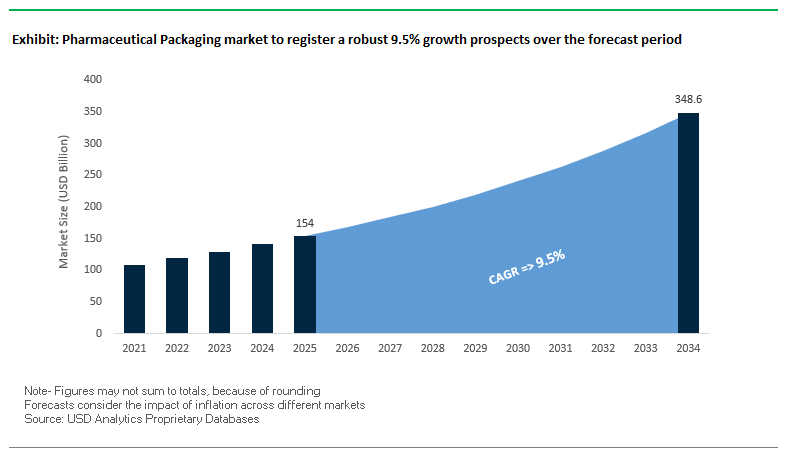
The global Pharmaceutical Packaging Market is projected to increase from USD 154.0 billion in 2025 to USD 348.5 billion by 2034, expanding at a CAGR of 9.5%. Pharmaceutical packaging encompasses primary systems that directly contact drug products, secondary formats used for protection, identification and regulatory information, and tertiary packaging used for distribution. Bottles, blister packs, vials, ampoules, prefillable syringes, cartridges, closures, labels, cartons, pouches and transport packaging serve oral solid doses, injectable therapies, topical products and inhalation, nasal and ophthalmic medicines.
Market value is increasingly concentrated in technically demanding applications. Biologics, biosimilars, vaccines, oncology drugs and other sterile injectables require packaging systems with controlled material interaction, dimensional consistency, container-closure integrity and compatibility with aseptic filling. Expansion of self-administered injectable therapies is also increasing the role of prefillable syringes, cartridges and integrated delivery systems. AptarGroup reported in 2026 that demand across its pharmaceutical activities was being supported by biologics, GLP-1 therapies, vaccines and injectable applications, illustrating the changing mix of drug-delivery requirements.
Ready-to-use and ready-to-fill formats are becoming more prominent across sterile fill-finish operations. Pre-washed, pre-sterilized vials, cartridges and syringes reduce the number of container-preparation operations undertaken immediately before filling and are increasingly paired with automated filling and inspection equipment. Conventional oral-dose packaging remains substantial by volume, particularly HDPE bottles, blister systems and closures, while injectable packaging generates greater technical differentiation through glass composition, polymer selection, elastomer performance, siliconization, extractables and leachables control, and container-closure integrity.
Recent Pharmaceutical Packaging Developments and Manufacturer Strategies
SCHOTT Pharma Develops High-Performance Sterile Cartridge for Sensitive Biologics
In April 2026, SCHOTT Pharma announced cartriQ BioPure, a sterile glass cartridge designed for complex biologic medicines. The platform incorporates enhanced chemical resistance and an improved extractables and leachables profile and complements the company's BioPure syringe and vial portfolio. Samples became available ahead of a planned commercial launch toward the end of 2026. The development reflects increasing specialization of primary packaging around drug stability, component interaction and delivery-device compatibility rather than container geometry alone.
West Commercializes Integrated Prefillable Syringe Platform
In January 2026, West Pharmaceutical Services announced global commercial availability of its Synchrony S1 prefillable syringe system. Configurations include 1 mL long and 2.25 mL staked-needle systems for biologics, along with 1 mL standard staked-needle and Luer-lock options for vaccine applications. The system combines components that historically could be sourced and evaluated separately, reflecting broader movement toward integrated container-closure and drug-delivery platforms. West Synchrony S1 announcement
Amcor Expands Healthcare Packaging Capacity in India
In June 2026, Amcor announced an additional multi-million-dollar investment at its Sira facility in Karnataka, expanding capabilities for high-performance healthcare packaging and patient-centric drug-delivery solutions serving India and South Asia. The investment follows Amcor's April 2025 completion of its combination with Berry Global and illustrates the increased scale and geographic breadth of the combined healthcare packaging platform. Amcor healthcare packaging expansion in India
Aptar Pharma Expands System-Level Testing for Injectable Packaging
In July 2026, Aptar Pharma launched an integrated system-level framework for injectable drug-delivery systems. The program combines partner components, system-level testing and data packages covering container-closure integrity, sealing performance, functional performance and component interactions. Aptar linked the initiative to evolving USP <382> expectations and the increasing need to assess assembled injectable systems rather than isolated elastomeric or container components.
Stevanato Group Advances RTU Vial, Syringe and Cartridge Capacity
Stevanato Group continued expanding high-value drug-containment capacity during 2026. At its Fishers, Indiana facility, the company reported completion of performance qualification on its first EZ-fill vial line and progress toward customer validation, while drug-delivery contract manufacturing remained scheduled to enter commercial production around late 2026 or early 2027. In Latina, Italy, capacity expansion includes high-value prefillable syringes and next-generation RTU 400 EZ-fill cartridge lines, with commercial cartridge production planned for early 2027.
SGD Pharma Expands Tubular Glass and RTU Capabilities Through Alphial
In August 2025, SGD Pharma announced an agreement to acquire Alphial S.r.l., an Italian producer of tubular vials, ampoules and ready-to-use products. Alphial employed more than 220 people across four production sites at the time of the announcement. The transaction expands SGD Pharma beyond its established molded-glass position and strengthens its participation in tubular pharmaceutical containers and RTU formats in Europe.
Pharmaceutical Packaging Regulatory, Quality and Technical Framework
FDA Container-Closure Requirements Remain Central to Primary Packaging Qualification
Under 21 CFR 211.94, drug-product containers and closures cannot be reactive, additive or absorptive to an extent that alters the safety, identity, strength, quality or purity of a drug. Container-closure systems are also required to provide adequate protection from foreseeable external factors that could cause contamination or deterioration, while containers and closures must be cleaned and, where appropriate, sterilized and depyrogenated. These requirements make material compatibility, component cleanliness and package integrity fundamental attributes of pharmaceutical primary packaging.
In August 2026, FDA issued a new draft guidance, “Container Closure Systems for Human Drugs and Biological Products.” The draft provides principles for evaluating the quality of container-closure systems used for drugs and biologics, including systems that also function as device constituent parts of combination products. The document remains draft guidance and contains non-binding recommendations rather than new binding statutory requirements. FDA Container Closure Systems draft guidance, August 2026
Biosimilars Increase Attention to Container and Device Comparability
FDA issued separate draft guidance in July 2026 addressing container-closure systems and device constituent parts for biosimilar and interchangeable biosimilar products. The document addresses development considerations where a proposed biosimilar uses delivery-device or container configurations that interact with the drug product and its administration. This regulatory focus is relevant to prefillable syringes, cartridges and other drug-device combinations as biosimilar portfolios broaden beyond vial-based presentations. FDA biosimilar container-closure and device draft guidance
Serialization and Anti-Tampering Requirements Sustain Secondary Packaging Complexity
U.S. Drug Supply Chain Security Act provisions have established interoperable electronic tracing requirements at the package level for covered prescription drugs, with FDA maintaining specific exemptions for defined trading partners. Serialized product identifiers consequently remain closely linked to pharmaceutical healthcare labels and cartons even though serialization infrastructure extends beyond the physical packaging itself..
In the European Union, the Falsified Medicines Directive and Commission Delegated Regulation (EU) 2016/161 require applicable medicinal-product packs to carry safety features including a unique identifier and an anti-tampering device on outer packaging. The European Commission issued version 22 of its related safety-features Q&A in July 2026, indicating continued regulatory maintenance of the medicine-verification framework.
PPWR Introduces Circularity Requirements but Preserves Pharmaceutical Exemptions
Regulation (EU) 2025/40 on Packaging and Packaging Waste (PPWR) began applying from 12 August 2026. Although the regulation establishes progressively stronger recyclability, recycled-content and packaging-waste provisions, pharmaceutical packaging receives important exemptions where health, safety and medicinal-product quality requirements apply.
Immediate medicinal-product packaging is excluded from specified recycled-content requirements, while qualifying outer pharmaceutical packaging required to preserve medicinal-product quality is also exempt. The regulation similarly provides exemptions from specified recyclability requirements for immediate medicinal-product packaging and qualifying outer packaging. Consequently, pharmaceutical sustainability is developing under a different technical constraint set from many consumer-packaging applications because material circularity cannot override drug compatibility, sterility, stability or product-quality requirements. Regulation (EU) 2025/40 — Packaging and Packaging Waste
Pharmaceutical Packaging Market Share Insights
Primary Packaging Holds 52% Market Share
Primary packaging accounts for 52% of the pharmaceutical packaging market in 2025, making it the largest product-type segment. Primary packaging includes rigid pharmaceutical packaging formats such as bottles, blister cavities, vials, ampoules, cartridges, syringes and other formats that directly contain the drug product. Its leading position reflects the regulatory and technical requirements associated with drug-contact materials, barrier protection, sterility, container-closure integrity and compatibility throughout shelf life.
Secondary packaging holds 33%, covering cartons, labels, package inserts and associated protective formats. Serialization, anti-tampering systems, regulatory labeling and multilingual information requirements increase the functional value of secondary packaging beyond branding and physical protection. Tertiary packaging accounts for the remaining 15%, supporting warehousing, distribution and transport through cases, pallets and other logistics configurations.
Oral Drug Delivery Leads with 45% Share While Injectable Packaging Gains Value
Oral drug delivery accounts for 45% of pharmaceutical packaging demand in 2025, supported by the global scale of tablets and capsules and their extensive use of bottles, pharmaceutical blister packaging, closures and cartons. These formats combine established high-volume manufacturing with moisture, oxygen, light and tamper-protection requirements that vary by formulation and distribution environment.
Parenteral and injectable drug delivery holds 28% and represents the fastest-growing drug-delivery segment.. Biologics, biosimilars, oncology products, vaccines and self-administered injectable therapies support demand for sterile vials, prefillable syringes, cartridges and elastomeric closure systems. Topical, inhalation, nasal, ocular and other delivery routes represent smaller but technically specialized packaging categories in which dispensing accuracy and container-device performance are major product attributes.
Pharmaceutical Packaging Market Trends, Technologies and Industry Developments
Drug Stability and Container Compatibility Define Primary Packaging Selection
Primary pharmaceutical packaging selection is increasingly driven by the interaction between the drug formulation and the container-closure system rather than by container format alone. Moisture and oxygen sensitivity, light exposure, pH stability, adsorption, permeation, extractables and leachables, and interaction with glass, polymers or elastomers can influence product stability throughout shelf life. These considerations differentiate packaging requirements across tablets, capsules, biologics, vaccines and sterile injectables. Glass vials and cartridges remain important for chemically sensitive products, while cyclic olefin polymers and other engineered materials provide alternatives where break resistance, dimensional consistency or low interaction profiles are required. FDA's August 2026 draft guidance on container-closure systems reinforces the importance of evaluating the quality and suitability of the complete packaging system for human drugs and biological products.
Biologics and Complex Injectables Increase Demand for High-Performance Primary Containers
Growth in biologics, biosimilars, monoclonal antibodies, peptides and other complex injectable therapies is increasing demand for pharmaceutical containers with tighter material and functional performance characteristics. These products can be sensitive to surface interactions, pH changes, silicone, particles and leachable substances, increasing differentiation among pharmaceutical glass, polymer and elastomer systems. SCHOTT Pharma, for example, announced cartriQ BioPure in April 2026, a sterile glass cartridge for sensitive biologics incorporating enhanced chemical resistance, controlled silicone levels and an improved extractables and leachables profile. Stevanato Group also reported continued 2026 demand for high-value solutions across prefillable syringes, vials and cartridges, supported particularly by biologics and GLP-1/incretin therapies. The trend is shifting value toward specialized containment systems rather than conventional commodity packaging.
Ready-to-Use Vials, Syringes and Cartridges Reshape Aseptic Fill-Finish
Ready-to-use and ready-to-fill pharmaceutical containers are expanding across vials, prefillable syringes and cartridges as injectable-drug manufacturing becomes more automated and increasingly oriented toward flexible aseptic filling. RTU containers can be supplied pre-washed, depyrogenated, sterilized and arranged in standardized nest-and-tub configurations, reducing container-preparation operations at the pharmaceutical filling site. The format is particularly relevant to biologics, clinical-scale production and facilities handling multiple container types. Stevanato Group describes its EZ-fill platform as covering syringes, vials and cartridges that are washed, depyrogenated and sterilized before supply, while the company continues expanding next-generation RTU cartridge and vial capacity in Italy and the United States. RTU growth is consequently linking primary-container design more closely with filling equipment, inspection systems, dimensional tolerances and automated material handling.
Prefilled Syringes and Cartridges Expand Packaging into Drug-Delivery Systems
Pharmaceutical packaging is increasingly converging with drug delivery as injectable medicines move from conventional vial-and-syringe administration toward prefilled syringe packaging systems, cartridges and integrated injection devices. These formats combine drug containment with administration functions, creating additional requirements around plunger movement, needle systems, break-loose and glide forces, dose delivery, container dimensions and device compatibility. In January 2026, West Pharmaceutical Services announced global commercial availability of its Synchrony S1 prefillable syringe system, including 1 mL long and 2.25 mL configurations for biologics and additional configurations for vaccines. FDA's July 2026 draft guidance on biosimilar container-closure systems and device constituent parts also reflects the increasing regulatory intersection between primary packaging and delivery devices. This convergence is expanding competition from individual containers and closures toward integrated containment-and-delivery platforms.
Container-Closure Integrity and Extractables/Leachables Become System-Level Performance Requirements
Container-closure integrity and extractables/leachables control are becoming increasingly important as pharmaceutical packaging supports sterile, sensitive and long-shelf-life drug products. Performance depends on the interaction between the container, stopper, plunger, seal, coating, lubricant and other system components rather than the characteristics of one material in isolation. Sterile packaging must maintain an adequate barrier against microbial and environmental contamination while the drug-contact system must avoid interactions that alter product quality. FDA's 2026 draft container-closure guidance explicitly addresses the quality evaluation of complete systems used for drugs and biologics, including systems functioning as constituent parts of combination products. Manufacturer developments are similarly emphasizing system-level performance: SCHOTT Pharma's BioPure cartridge platform combines high-performance glass, controlled siliconization and coated elastomer options to reduce container interaction for sensitive biologics.
PPWR Creates Different Sustainability Pathways for Primary and Secondary Pharmaceutical Packaging
Sustainability is influencing pharmaceutical packaging, but regulatory and product-quality constraints mean primary and secondary formats are evolving differently. Regulation (EU) 2025/40 on Packaging and Packaging Waste introduces stronger recyclability, packaging-minimization and recycled-content requirements across the European packaging market, while providing important exemptions for pharmaceutical applications. Immediate medicinal-product packaging is exempt from specified recyclability and minimum recycled-content requirements, and qualifying outer packaging is also exempt where it is necessary to preserve medicinal-product quality.
As a result, redesign is likely to be more visible in cartons, inserts, labels, transport packaging and other secondary formats where fiber optimization, material reduction and recyclability can be implemented with fewer drug-contact constraints. Primary containers remain governed more strongly by stability, sterility, compatibility and validated performance, making pharmaceutical sustainability a technically differentiated transition rather than a straightforward substitution toward recycled materials.
Regional and Country Analysis of the Pharmaceutical Packaging Market
United States: Injectable Packaging, CCS Quality and Package-Level Traceability Shape Demand
The United States combines high consumption of oral solid-dose packaging with a technologically intensive market for biologics, injectable medicines and combination products. FDA's CGMP requirements for drug containers and closures, the August 2026 CCS draft guidance and the July 2026 biosimilar draft guidance reinforce the importance of container suitability, protection and device integration. DSCSA traceability requirements continue to support serialization and product-identifier functions in secondary packaging. U.S. manufacturing capacity is also expanding for high-value injectable formats, including Stevanato Group's Fishers, Indiana site.
Germany and France: Pharmaceutical Glass, Drug Delivery and EU Packaging Regulation Support Advanced Packaging
Germany and France form important European pharmaceutical-packaging manufacturing centers. Germany is home to major primary-packaging and containment suppliers including Gerresheimer and SCHOTT Pharma, while France-based SGD Pharma maintains substantial pharmaceutical glass activities. Across both countries, the EU Falsified Medicines framework governs applicable safety features on medicine packaging, while PPWR requirements now interact with pharmaceutical-specific exemptions for immediate and necessary outer packaging. Supplier investment remains concentrated in high-quality glass, RTU systems, drug-delivery components and material-efficiency programs.
China: Scale in Pharmaceuticals Supports Diverse Primary and Secondary Packaging Demand
China's pharmaceutical manufacturing base creates demand across high-volume oral solid-dose packaging, bottles and blisters as well as increasingly sophisticated sterile injectable containers. Packaging competition spans domestic and multinational suppliers and is influenced by manufacturing scale, drug-product quality requirements, automation and localization of component supply. Pharmaceutical glass, polymers, elastomeric components, labels and cartons serve a market extending from generic medicines to biologics and specialty therapies.
India: Pharmaceutical Production and Local Capacity Expansion Strengthen Packaging Supply
India combines large-volume requirements for bottles, blisters and secondary packaging with increasing demand for high-performance packaging used in export pharmaceuticals, biologics and drug-delivery systems. Manufacturing localization is becoming more visible among multinational packaging suppliers. In June 2026, Amcor expanded its Sira, Karnataka facility through an additional multi-million-dollar healthcare investment aimed at high-performance packaging and patient-centric drug-delivery solutions for India and South Asia.
Japan: High-Quality Drug Containment and Patient-Focused Formats Sustain Specialized Demand
Japan's pharmaceutical packaging market is characterized by stringent product-quality expectations, established use of high-performance glass and polymer systems, and significant demand from prescription medicines serving an aging population. Oral-dose packaging remains important, while sterile vials, syringes, cartridges, ophthalmic dispensers and other specialized systems support injectable and patient-administered therapies. Packaging differentiation is concentrated in material consistency, dosage protection, usability and high-precision manufacturing rather than purely decorative design.
Brazil: Pharmaceutical Distribution Supports Bottles, Blisters and Drug-Delivery Packaging
Brazil represents a major pharmaceutical-packaging market in South America, with demand spanning generic and branded prescription medicines, OTC products and hospital pharmaceuticals. Bottles, blister packs, closures, labels and cartons serve broad oral-dose demand, while vials and delivery systems address hospital and specialty-drug applications. Regional pharmaceutical supply chains are also becoming more localized: Aptar Pharma, for example, commissioned Advanced Preservative Free pump production in Argentina in September 2026 as part of a wider Latin American manufacturing program.
Competitive Landscape: Primary Containment, Drug Delivery and High-Barrier Packaging Define Competition
The pharmaceutical packaging competitive landscape includes global primary-container manufacturers, elastomer and drug-delivery specialists, flexible-packaging converters, rigid-packaging producers and secondary-carton suppliers. Amcor plc now incorporates the former Berry Global operations following completion of their combination on April 30, 2025, eliminating Berry Global as a separate current competitor. Gerresheimer AG combines glass and polymer drug-containment, closure and delivery-system capabilities and has owned Bormioli Pharma since completing the acquisition of its holding company in December 2024; Bormioli Pharma therefore remains relevant as a portfolio/business identity rather than an independent competitor. Injectable packaging competition also includes West Pharmaceutical Services, Inc., SCHOTT Pharma AG & Co. KGaA, SGD Pharma, DWK Life Sciences LLC, Comar, LLC, and Stevanato Group S.p.A. These companies compete across vials, ampoules, syringes, cartridges, bottles, closures and elastomeric components on dimensional quality, material performance, RTU processing, container-closure integrity, extractables/leachables characteristics, analytical services, sterile processing and regional production capacity. SCHOTT Pharma replaces the older generic “SCHOTT AG” identification for the group's dedicated pharmaceutical containment and delivery business.
Flexible, blister, tube and secondary-packaging competition includes Tekni-Plex, Inc., Constantia Flexibles Group GmbH, Huhtamaki Oyj, EPL Limited, Graphic Packaging International/Graphic Packaging Holding Company and Amcor's expanded healthcare operations, while AptarGroup, Inc. adds nasal, ophthalmic, injectable and other dispensing and drug-delivery technologies. Competition across this group centers on pharmaceutical-grade barrier properties, pharmaceutical barrier films and foils, tubes, cartons, dispensing accuracy, tamper evidence, serialization compatibility, sustainability, regulatory documentation and manufacturing footprint. The market is consequently becoming more integrated, with suppliers extending from individual packaging components toward tested container systems, RTU formats, analytical services and drug-delivery interfaces.
Pharmaceutical Packaging Market Report Scope
Pharmaceutical Packaging market
Parameter
Details
Market Size (2025)
$154 Billion
Market Size (2034)
$348.5 Billion
Market Growth Rate
9.5%
Segments
By Product Type (Primary Packaging, Secondary Packaging, Tertiary Packaging), By Material (Plastics & Polymers, Glass, Paper & Paperboard, Metals, Others), By Drug Delivery Mode (Oral Drug Delivery, Parenteral/Injectable Drug Delivery, Topical Drug Delivery, Inhalation Drug Delivery, Nasal Drug Delivery, Ocular Drug Delivery, Other Drugs Delivery)
Study Period
2020- 2025 and 2026-2034
Units
Revenue (USD)
Qualitative Analysis
Porter’s Five Forces, SWOT Profile, Market Share, Scenario Forecasts, Market Ecosystem, Company Ranking, Market Dynamics, Industry Benchmarking
Companies
Amcor plc, Gerresheimer AG, West Pharmaceutical Services, Inc., Berry Global Inc., AptarGroup, Inc., Tekni-Plex, Inc., Schott AG, Huhtamaki Oyj, DWK Life Sciences LLC, Comar, LLC, Bormioli Pharma S.p.A., SGD Pharma, AR Packaging, Constantia Flexibles Group GmbH, EPL Limited
Countries
US, Canada, Mexico, Germany, France, Spain, Italy, UK, Russia, China, India, Japan, South Korea, Australia, South East Asia, Brazil, Argentina, Middle East, Africa
Pharmaceutical Packaging Market Segmentation
By Product Type
Primary Packaging
Secondary Packaging
Tertiary Packaging
By Material
Plastics & Polymers
Glass
Paper & Paperboard
Metals
Others
By Drug Delivery Mode
Oral Drug Delivery
Parenteral/Injectable Drug Delivery
Topical Drug Delivery
Inhalation Drug Delivery
Nasal Drug Delivery
Ocular Drug Delivery
Other Drugs Delivery
Countries Analyzed
North America (US, Canada, Mexico)
Europe (Germany, UK, France, Spain, Italy, Russia, Rest of Europe)
Asia Pacific (China, India, Japan, South Korea, Australia, South East Asia, Rest of Asia)
South America (Brazil, Argentina, Rest of South America)
Middle East and Africa (Saudi Arabia, UAE, Rest of Middle East, South Africa, Egypt, Rest of Africa)
Top Companies in Pharmaceutical Packaging Market
Amcor plc
Gerresheimer AG
West Pharmaceutical Services, Inc.
Berry Global Inc.
AptarGroup, Inc.
Tekni-Plex, Inc.
Schott AG
Huhtamaki Oyj
DWK Life Sciences LLC
Comar, LLC
Bormioli Pharma S.p.A.
SGD Pharma
AR Packaging
Constantia Flexibles Group GmbH
EPL Limited
* List Not Exhaustive
Research Coverage
This report investigates the pharmaceutical packaging market with a concentrated emphasis on biologics containment, RTU/RTF platforms, connected packs, and sustainability breakthroughs; it synthesizes industry milestones, commercial pilots, and technology validation so stakeholders can assess speed-to-market, regulatory risk, and patient-centric performance. The analysis reviews cross-sector case studies, serialization and cold-chain integrations, and materials science advances—highlighting practical trade-offs between extractables/leachables control, circularity, and usability—and this report is an essential resource for packaging engineers, regulatory leads, C-suite strategists, and investors seeking evidence-based advice. USDAnalytics applies scenario mapping and investment lenses to identify priority product classes, regional vulnerability points, and vendor strategies that materially affect supply resilience and filing timelines, offering targeted recommendations to align packaging choices with clinical, commercial, and ESG objectives.
Scope Highlights
Segmentation: By Product Type (Primary Packaging, Secondary Packaging, Tertiary Packaging); By Material (Plastics & Polymers, Glass, Paper & Paperboard, Metals, Others); By Drug Delivery Mode (Oral Drug Delivery, Parenteral/Injectable Drug Delivery, Topical Drug Delivery, Inhalation Drug Delivery, Nasal Drug Delivery, Ocular Drug Delivery, Other Delivery Modes).
Geographic Scope: “Analysis spans 25+ countries across North America, Europe, Asia Pacific, Latin America, the Middle East & Africa.”
Timeframe: Historical series covering 2021–2024 with forward forecasts from 2025–2034.
Companies: Includes analysis and executive-level profiles of 15+ strategic players across glass, device, and flexible/rigid converter categories.
Methodology
The study uses a hybrid research design combining primary interviews with packaging R&D and quality leads, procurement managers, contract manufacturers, cold-chain logisticians, and regulatory experts, plus exhaustive secondary research of annual reports, regulatory guidances, patent filings, trade literature, and validated shipment/production data; market sizing was generated through both bottom-up (plant capacity, SKU-level consumption) and top-down (end-market demand) techniques, with cross-validation via company CAPEX announcements and observed plant startups. Technology adoption curves were modelled from pilot deployments and licensing activity; scenario and sensitivity analyses quantify impacts from raw-material price swings, serialization mandates, and accelerated biologics/GLP-1 demand. All findings were stress-tested against supply-disruption scenarios and regulatory permutations to produce investment-grade, actionable forecasts and prioritized strategic recommendations.
Deliverables:
• Comprehensive Market Research Report (PDF and Excel) with detailed tables, charts, and interactive visualizations.
• Country-Specific Forecasts & Analysis.
• Segment-Wise Revenue Forecasts (2026–2034).
• Competitive Analysis, Benchmarking, and SWOT Profiles.
• Recent Developments & Innovation Tracker.
• Executive Summary & Analyst Commentary.
• Post-Purchase Analyst Support for Client-Specific Questions and Custom Data Requirements.
Table of Contents: Pharmaceutical Packaging Market
2. Pharmaceutical Packaging Market Landscape & Outlook (2025–2034)
2.1. Introduction to Pharmaceutical Packaging Market
2.2. Market Valuation and Growth Projections (2025–2034)
2.3. Drivers: Biologics, GLP-1, and Specialty Therapies
2.4. Challenges: Regulatory Compliance, Cold-Chain, and Sustainability
2.5. Market Dynamics: Primary, Secondary, Tertiary Packaging & Material Innovations
3. Innovations Reshaping the Pharmaceutical Packaging Market
3.1. Trend: Connected and Smart Packaging for Traceability
3.2. Trend: Advanced Sustainable and Recyclable Materials
3.3. Opportunity: Packaging Solutions for Biologics and GLP-1 Therapies
3.4. Opportunity: Patient-Centric and Accessible Packaging Designs
4. Strategic Investments and Capacity Expansion
4.1. Mergers, Acquisitions, and Alliances
4.2. Expansion of Production and RTU/RTF Platforms
4.3. Regional Manufacturing Strategies
4.4. Investment in Digital and Eco-Friendly Packaging Solutions
5. Market Share and Segmentation Insights: Pharmaceutical Packaging Market
5.1. By Product Type
5.1.1. Primary Packaging
5.1.2. Secondary Packaging
5.1.3. Tertiary Packaging
5.2. By Material
5.2.1. Plastics & Polymers
5.2.2. Glass
5.2.3. Paper & Paperboard
5.2.4. Metals
5.2.5. Others
5.3. By Drug Delivery Mode
5.3.1. Oral Drug Delivery
5.3.2. Parenteral/Injectable Drug Delivery
5.3.3. Topical Drug Delivery
5.3.4. Inhalation Drug Delivery
5.3.5. Nasal Drug Delivery
5.3.6. Ocular Drug Delivery
5.3.7. Other Drug Delivery Modes
6. Country Analysis and Outlook of Pharmaceutical Packaging Market
6.1. United States
6.2. Canada
6.3. Mexico
6.4. Germany
6.5. France
6.6. Spain
6.7. Italy
6.8. UK
6.9. Russia
6.10. China
6.11. India
6.12. Japan
6.13. South Korea
6.14. Australia
6.15. South East Asia
6.16. Brazil
6.17. Argentina
6.18. Middle East
6.19. Africa
7. Pharmaceutical Packaging Market Size Outlook by Region (2025–2034)
7.1. North America Pharmaceutical Packaging Market Size Outlook to 2034
7.1.1. By Product Type
7.1.2. By Material
7.1.3. By Drug Delivery Mode
7.1.4. Other Segments
7.2. Europe Pharmaceutical Packaging Market Size Outlook to 2034
7.2.1. By Product Type
7.2.2. By Material
7.2.3. By Drug Delivery Mode
7.2.4. Other Segments
7.3. Asia Pacific Pharmaceutical Packaging Market Size Outlook to 2034
7.3.1. By Product Type
7.3.2. By Material
7.3.3. By Drug Delivery Mode
7.3.4. Other Segments
7.4. South America Pharmaceutical Packaging Market Size Outlook to 2034
7.4.1. By Product Type
7.4.2. By Material
7.4.3. By Drug Delivery Mode
7.5. Middle East and Africa Pharmaceutical Packaging Market Size Outlook to 2034
7.5.1. By Product Type
7.5.2. By Material
7.5.3. By Drug Delivery Mode
8. Company Profiles: Leading Players in the Pharmaceutical Packaging Market
8.1. Amcor plc
8.2. Gerresheimer AG
8.3. West Pharmaceutical Services, Inc.
8.4. Berry Global Inc.
8.5. AptarGroup, Inc.
8.6. Tekni-Plex, Inc.
8.7. Schott AG
8.8. Huhtamaki Oyj
8.9. DWK Life Sciences LLC
8.10. Comar, LLC
8.11. Bormioli Pharma S.p.A.
8.12. SGD Pharma
8.13. AR Packaging
8.14. Constantia Flexibles Group GmbH
8.15. EPL Limited
9. Methodology
9.1. Research Scope
9.2. Market Research Approach
9.3. Market Sizing and Forecasting Model
9.4. Research Coverage
9.5. Data Horizon
9.6. Deliverables
10. Appendix
10.1. Acronyms and Abbreviations
10.2. List of Tables
10.3. List of Figures
Pharmaceutical Packaging Market Segmentation
By Product Type
Primary Packaging
Secondary Packaging
Tertiary Packaging
By Material
Plastics & Polymers
Glass
Paper & Paperboard
Metals
Others
By Drug Delivery Mode
Oral Drug Delivery
Parenteral/Injectable Drug Delivery
Topical Drug Delivery
Inhalation Drug Delivery
Nasal Drug Delivery
Ocular Drug Delivery
Other Drugs Delivery
Countries Analyzed
North America (US, Canada, Mexico)
Europe (Germany, UK, France, Spain, Italy, Russia, Rest of Europe)
Asia Pacific (China, India, Japan, South Korea, Australia, South East Asia, Rest of Asia)
South America (Brazil, Argentina, Rest of South America)
Middle East and Africa (Saudi Arabia, UAE, Rest of Middle East, South Africa, Egypt, Rest of Africa)
Biologics and GLP-1 drugs demand higher barrier, low-extractables primary packaging (specialty glass, polymer syringes, cartridges) and validated cold-chain solutions to protect potency. Packaging must also meet enhanced CCI testing, compatibility studies, and regulatory scrutiny for leachables/extractables, driving demand for RTU/RTF formats that shorten fill-finish timelines and reduce contamination risk.
RTU/RTF containers cut line changeovers, lower contamination events, and accelerate regulatory filings by supplying pre-qualified, sterile components. They reduce on-site sterilization burden, improve batch reproducibility, and allow faster scale-up—critical for time-sensitive biologics and surge manufacturing during launches or public-health emergencies.
Adopt a phased strategy: implement GS1-compliant serialization at scale while piloting NFC/QR and IoT sensors for authentication and cold-chain monitoring. Integrate packaging data into cloud platforms for real-time verification, recall targeting, and adherence support—prioritizing APIs and validation plans that align with DSCSA, EU FMD, and regional traceability mandates.
Recyclable mono-material secondary cartons, validated recyclable blister alternatives, and higher-PCR content in tertiary packaging present early wins. For primary packs, industry focus is on validated polymer systems and closed-loop take-back pilots; any material shift must be backed by regulatory comparability data on extractables, leachables, and stability to ensure patient safety.
Key risks include glass tubing shortages, elastomer supply volatility, and disruptions from tariffs or regional capacity constraints. Mitigations: diversify qualified suppliers across regions, maintain strategic safety stocks of critical components, invest in RTU platforms to reduce upstream dependencies, and secure long-term offtake or partnership agreements with key material producers.
More Healthcare and Pharmaceutical Packaging Reports