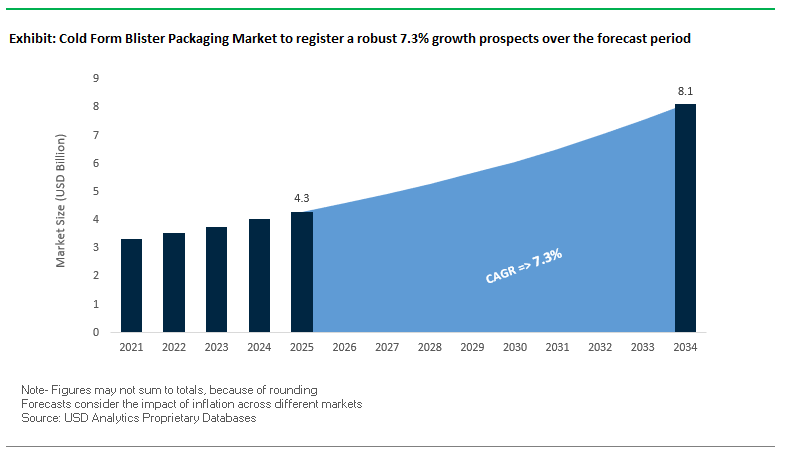
Cold Form Blister Packaging Market Overview: Growth to $8.1 Billion by 2034
The global cold form blister packaging market is expected to reach $4.3 billion in 2025 and expand to $8.1 billion by 2034, reflecting a steady CAGR of 7.3%. This growth trajectory underscores the sector’s pivotal role in ensuring high-barrier protection for sensitive pharmaceutical and healthcare products. For buyers and industry professionals, the key questions center on how the market will respond to growing regulatory pressures, sustainability requirements, and technological shifts toward automation and material innovation.
Key Insights include:
Pharmaceutical Reliability: More than 45% of sensitive drug formulations now rely on cold form blister packs, highlighting their unmatched protection against oxygen, light, and moisture.
Tamper-Evident Security: Demand for aluminum–aluminum blister packs is rising due to strict patient safety standards, preventing counterfeiting and ensuring compliance.
Material Innovation: Over 40% of manufacturers are introducing multi-layered laminates combining aluminum, nylon, and PVC to improve barrier properties and reduce recalls.
Automation in Production: Robotics and automated feeding systems are increasingly adopted in production lines, boosting efficiency and lowering manual costs.
With rising pharmaceutical demand, stringent global regulatory frameworks, and rapid adoption of sustainable and automated production practices, cold form blister packaging is emerging as a critical enabler of pharmaceutical reliability and patient safety.
Market Analysis: Strategic Investments, Sustainability, and Technology Reshaping 2025
The cold form blister packaging industry is undergoing structural transformation, with sustainability commitments, regional expansions, and digitalization shaping the competitive landscape.
In September 2025, Constantia Flexibles showcased its expanded “Ecolutions” portfolio at FACHPACK 2025, highlighting new low-carbon aluminum-based lidding materials. Just a month earlier, in August 2025, Amcor expanded its healthcare packaging network in Costa Rica to serve the rapidly growing medical device sector in Latin America. That same month, Constantia announced a €100 million global production network upgrade, including a €50 million rolling mill investment in Austria to increase aluminum foil output by 30% and a €6 million MDO line investment in Germany.
In July 2025, several notable developments occurred. A logistics summit emphasized the rising demand for single-use cold chain packaging for biologics and vaccines, which frequently use cold form blister foil. At the same time, reports revealed growing use of AI-powered forecasting and supply chain optimization to manage just-in-time delivery of packaging materials. Also in July, Winpak became an authorized converter of DuPont™ Tyvek® healthcare packaging, strengthening its sterile barrier offerings for medical devices.
Earlier, in May 2025, Winpak celebrated its 50th anniversary, reaffirming its leadership in high-performance packaging with an emphasis on sustainability. In the same month, Sonoco divested its thermoformed and flexibles packaging business to TOPPAN Holdings, reflecting a strategic shift toward core competencies and higher-margin packaging segments.
Emerging Trends and Opportunities Transforming the Cold Form Blister Packaging Market
Accelerated Adoption of Recyclable and Sustainable High-Barrier Material Structures
The cold form blister packaging market is undergoing a fundamental material transition, driven by stringent sustainability regulations and corporate ESG commitments. Traditional multi-material laminates of aluminum, PVC, and polyamide, which are nearly impossible to recycle, are being replaced by mono-material and recycle-ready structures. This shift is not only environmentally necessary but also financially advantageous as Extended Producer Responsibility (EPR) frameworks impose higher costs on non-recyclable packaging.
Leading pharmaceutical companies are making packaging a critical part of their Scope 3 emissions reduction strategies. For instance, Novartis has pledged to cut absolute Scope 3 greenhouse gas emissions by 42% by 2030 and 90% by 2040, directly incentivizing suppliers to design packaging with reduced carbon footprints. Packaging innovators are responding Amcor’s AmSky™ recycle-ready blister system, though currently thermoform-based, demonstrates the direction of industry innovation with polyethylene-based materials compatible with existing recycling streams. The company’s EcoGuard™ line claims up to 80% carbon footprint reduction, underscoring the growing alignment of sustainability with performance. With the EU PPWR mandating recyclability by 2030, the financial and reputational risks of failing to adopt recyclable cold form blister solutions will accelerate industry-wide transformation.
Integration of Advanced Serialization and Patient Adherence Technologies
Cold form blisters are evolving into smart, connected platforms that enhance security, compliance, and patient outcomes. Under the European Union’s Falsified Medicines Directive (FMD), serialization and tamper-evident features are now mandatory, embedding cold form blisters into the global digital track-and-trace infrastructure for pharmaceuticals. Unique 2D barcodes and secure seals protect supply chains against falsification, which is particularly critical in high-value therapeutic categories.
Development of High-Speed, AI-Powered Visual Inspection Systems
The opaque structure of cold form blisters poses unique challenges for defect detection and quality control. Traditional machine vision systems often fail to identify subtle defects such as micro-pinholes, delamination, or incomplete seals. This presents a significant opportunity for AI-powered machine vision systems, which use deep learning algorithms to analyze complex textures and irregular surfaces with a higher degree of accuracy.
By dramatically reducing false rejects and improving detection rates, these systems enable 100% blister integrity assurance, which is critical for ensuring drug stability and patient safety. Moreover, the data analytics capabilities of AI-based inspection allow manufacturers to move toward predictive quality control. Trends in defect occurrence can inform predictive maintenance schedules, minimizing downtime and reducing material waste. This integration of AI not only enhances compliance with strict pharmaceutical quality standards but also delivers measurable improvements in line efficiency and OEE (Overall Equipment Effectiveness).
Innovation in Child-Resistant yet Senior-Friendly (CR/SF) Opening Features
Another significant opportunity lies in the redesign of blister packaging to meet the dual requirements of child resistance and senior usability. The U.S. Consumer Product Safety Commission (CPSC) mandates child-resistant protocols, but packaging must also remain accessible for elderly patients, a demographic that is expanding rapidly due to global aging trends. Suppliers are responding with CR/SF packaging innovations such as peel-push foils that incorporate two-step opening mechanisms difficult for children to manipulate but simple for adults to use. In addition, the development of engineered lidding foils requiring minimal push-through force directly addresses the needs of patients with reduced dexterity, including those with arthritis. These innovations ensure safety compliance without compromising patient convenience, enhancing both brand trust and product accessibility. As regulators intensify focus on patient-centric packaging, investment in CR/SF cold form blister solutions will emerge as a major competitive differentiator.
Competitive Landscape: Leading Players in Cold Form Blister Packaging
The cold form blister packaging market features a blend of multinational giants and innovation-driven specialists. Each company is pursuing sustainability, barrier performance, and customer-specific solutions to strengthen global market share.
Amcor Plc focuses on recyclable and high-barrier blister solutions
Amcor has positioned itself as a leader in pharmaceutical blister packaging with its EcoGuard™ HealthCare™ FormPack. Known for high-barrier protection, the company has invested heavily in facility upgrades in the UK to enhance recyclability and meet global sustainability targets. Its innovation pipeline includes recyclable, metal-free blister packs designed to fit existing recycling streams. Amcor’s focus on healthcare packaging ensures compliance with pharmaceutical safety while driving circular economy goals.
Constantia Flexibles Group GmbH drives circular economy in blister packaging
Constantia Flexibles continues to expand aggressively in Europe with the acquisition of Aluflexpack, reinforcing its regional presence. In 2025, it committed over €100 million to expand global aluminum foil production capacity. Its REGULA CIRC solution, which replaces PVC with polyethylene sealing layers, has won industry awards for recyclability. Constantia also launched a state-of-the-art digital printing line, enabling faster customization and premium branding for pharmaceutical clients.
Huhtamaki Oyj integrates sustainability into blister pack innovation
Huhtamaki leverages its strong global manufacturing network to deliver flexible packaging across pharmaceutical, food, and consumer sectors. Recognized for award-winning packaging designs, Huhtamaki’s innovations align with its Science Based Targets initiative (SBTi)-validated climate commitments. Its product line includes Push Tab® Blister Lids, known for user convenience and barrier integrity. Huhtamaki’s strategy is firmly anchored in achieving carbon neutrality and advancing circular packaging.
Sonoco Products Company streamlines portfolio for focused growth
Sonoco is optimizing its business portfolio, evidenced by the sale of its thermoformed and flexibles unit to TOPPAN Holdings in May 2025. In the cold form blister packaging space, Sonoco capitalizes on material science expertise, producing high-barrier blister foils designed for regulatory compliance. The company continues to invest in automation, robotics, and digital printing technologies to strengthen customization and reduce production costs, supporting both pharma and consumer healthcare sectors.
Winpak Ltd. enhances sterile barrier systems with Tyvek partnership
Winpak, a North American leader, celebrated its 50th anniversary in May 2025, emphasizing its long-standing commitment to innovation and sustainability. Its strategic agreement to convert DuPont™ Tyvek® packaging expands sterile barrier offerings for the pharmaceutical and medical device industries. Winpak combines packaging materials and equipment manufacturing, providing integrated solutions through its Winpak Lane unit. Its innovations increasingly target recyclability and sustainable packaging formats without compromising performance.
Cold Form Blister Packaging Market Share Insights
Aluminum Dominates Market Share by Material in Cold Form Blister Packaging
Aluminum holds an overwhelming 75% share of the global cold form blister packaging market in 2025, cementing its role as the backbone of this ultra-high-barrier packaging format. Its unmatched ability to block moisture, oxygen, and light makes it the only material capable of meeting the stringent stability requirements for highly sensitive pharmaceuticals. The cold-forming process depends entirely on aluminum’s malleability, allowing deep cavities to be created without heat while maintaining complete protection an attribute critical for biologics, APIs, and high-value drugs with long shelf-life requirements. Oriented polyamide (oPA), with a 15% share, is indispensable as the puncture-resistant outer layer in aluminum laminates, providing durability, structural strength, and a printable surface to enhance branding and compliance labeling. While oPA’s presence is significant, it exists almost exclusively in tandem with aluminum as part of multilayer structures. PVC, PP, and other polymers such as PE or PET occupy only niche roles, used sparingly in specialized cases for lidding films or less sensitive products. Their limited adoption highlights the specificity of cold form blister technology, which is fundamentally defined by aluminum-based laminates as the industry standard.
Healthcare Applications Drive Nearly All Market Share in Cold Form Blister Packaging
Healthcare and pharmaceuticals dominate the cold form blister packaging market with a commanding 95% share in 2025, underscoring this sector’s absolute reliance on high-barrier packaging to ensure drug efficacy, patient safety, and regulatory compliance. Cold form blister packs are indispensable for hygroscopic and oxygen-sensitive medications, including antibiotics, biologics, oncology treatments, and potent APIs, where product degradation could compromise therapeutic performance. Stringent global regulatory frameworks (FDA, EMA, and WHO guidelines) reinforce the dominance of this segment, as manufacturers are compelled to adopt proven technologies for long-term stability. Food and confectionery applications hold a very limited but ultra-premium niche, primarily in dehydrated gourmet products, specialty ingredients, or luxury confectionery where maximum moisture protection is critical to preserving product integrity. The high costs of cold form blister packs restrict their adoption to only the most premium goods. Other applications, such as electronics and industrial components, represent a minimal share, used only for highly sensitive devices like microchips or military-grade parts where corrosion prevention is essential. However, alternative barrier technologies are typically more cost-effective, reaffirming that cold form blister packaging remains purpose-built for the pharmaceutical industry’s uncompromising standards.
United States: Regulatory Compliance and Advanced Smart Cold Form Blister Packaging
The United States cold form blister packaging market is heavily influenced by stringent FDA regulations that demand tamper-evident, child-resistant, and robust protective solutions for both over-the-counter (OTC) and prescription medications. This regulatory rigor ensures patient safety while maintaining the efficacy and shelf life of sensitive products. In response, U.S. manufacturers are at the forefront of technological innovation, integrating smart packaging features like QR codes and RFID tags for enhanced supply chain tracking, authentication, and consumer engagement. Companies such as AptarGroup are pioneering advanced blister packaging solutions for solid-dose medicines, emphasizing security and traceability.
Beyond pharmaceuticals, the booming nutraceutical and dietary supplement sector is driving demand for cold form blister packaging that protects vitamins, probiotics, and herbal supplements from oxygen and moisture. Sustainability is also gaining traction, with a growing shift toward mono-material cold form films that are easier to recycle. These trends position the U.S. as a leading market for high-barrier, sustainable, and technologically advanced blister packaging solutions, supporting both domestic consumption and export-oriented pharmaceutical distribution.
Germany: Circular Economy and Automation Enhancing Cold Form Blister Packaging
Germany’s cold form blister packaging market benefits from its strong pharmaceutical manufacturing base and its central role in the European healthcare industry. Companies are highly focused on quality, patient safety, and environmental compliance, driven by both market demand and EU regulations such as the European Green Deal. This has spurred innovation in recyclable and sustainable cold form blister materials that align with circular economy principles, incorporating recycled content and promoting end-of-life recyclability.
Automation and efficiency are hallmarks of the German market. Leading machinery manufacturers like Uhlmann and Romaco are advancing highly automated blister packaging lines, reducing waste while ensuring consistent quality and throughput. With a strong emphasis on environmental protection, patient safety, and high-performance packaging, Germany continues to be a benchmark market for cold form blister technology in Europe, catering to both domestic pharmaceutical producers and global exporters.
China: Expanding Pharma Sector and Smart Packaging Driving Market Growth
China’s cold form blister packaging market is experiencing rapid growth due to the expansion of its pharmaceutical and healthcare sectors. With a large, aging population, the demand for both generic and branded medicines is rising, creating a robust need for high-barrier protective packaging. Companies are increasingly investing in research and development to innovate new materials and adopt smart packaging solutions that prevent counterfeiting and improve traceability across the supply chain.
Governmental regulations have also tightened, focusing on pharmaceutical safety and integrity, which is fueling the adoption of cold form blister films with superior oxygen and moisture barriers. Additionally, the rise of online pharmacies and e-commerce is increasing the need for tamper-evident and protective packaging solutions that ensure product safety during transit. This combination of regulatory enforcement, technological adoption, and growing pharmaceutical demand positions China as a leading market in the Asia-Pacific cold form blister packaging landscape.
India: Generic Drug Production and Cost-Effective Blister Packaging Solutions
India is a major global producer and exporter of generic drugs, making it a critical market for cold form blister packaging. The country’s pharmaceutical sector requires high-quality, long-shelf-life packaging to serve both domestic consumption and international exports. Government initiatives aimed at improving healthcare infrastructure, increasing accessibility to essential medicines, and promoting domestic pharmaceutical manufacturing have significantly boosted market demand.
Indian companies, such as ACG and Bilcare, are investing in advanced manufacturing technologies to produce high-barrier cold form blister films. These solutions meet stringent local and international quality standards while ensuring cost-effective production, a key factor in India’s competitive pharmaceutical market. The integration of modern facilities and efficient supply chain practices allows India to deliver reliable and affordable cold form blister packaging solutions for a rapidly growing pharmaceutical and nutraceutical sector.
France: Pharmaceutical Safety and Eco-Friendly Innovations Driving Market Expansion
France’s cold form blister packaging market is largely driven by the pharmaceutical industry, where product safety, integrity, and compliance are paramount. Cold form blister solutions are preferred due to their superior protection against oxygen, moisture, and environmental factors, ensuring consistent drug quality. Sustainability is also a growing focus, with companies developing eco-friendly, recyclable blister foils that comply with strict European standards for environmental performance.
Integration of smart technologies, such as QR codes, is becoming increasingly common, providing enhanced product information and enabling full traceability. French packaging manufacturers are combining safety, sustainability, and innovation to meet both regulatory requirements and consumer expectations. These advancements make France a leading market for premium, sustainable, and technologically advanced cold form blister packaging solutions in Europe.
Cold Form Blister Packaging Market Report Scope
Cold Form Blister Packaging Market
Parameter
Details
Market Size (2025)
$4.3 Billion
Market Size (2034)
$8.1 Billion
Market Growth Rate
7.3%
Segments
By Material (Oriented-Polyamide, Aluminum, Polyvinyl Chloride, Polypropylene, Polyethylene, Polyethylene Terephthalate), By Application (Healthcare, Consumer Products, Electronics & Semiconductors, Food & Confectionery, Industrial Goods)
Study Period
2019- 2024 and 2025-2034
Units
Revenue (USD)
Qualitative Analysis
Porter’s Five Forces, SWOT Profile, Market Share, Scenario Forecasts, Market Ecosystem, Company Ranking, Market Dynamics, Industry Benchmarking
US, Canada, Mexico, Germany, France, Spain, Italy, UK, Russia, China, India, Japan, South Korea, Australia, South East Asia, Brazil, Argentina, Middle East, Africa
Cold Form Blister Packaging Market Segmentation
By Material
Oriented-Polyamide
Aluminum
Polyvinyl Chloride
Polypropylene
Polyethylene
Polyethylene Terephthalate
By Application
Healthcare
Consumer Products
Electronics & Semiconductors
Food & Confectionery
Industrial Goods
Countries Analyzed
North America (US, Canada, Mexico)
Europe (Germany, UK, France, Spain, Italy, Russia, Rest of Europe)
Asia Pacific (China, India, Japan, South Korea, Australia, South East Asia, Rest of Asia)
South America (Brazil, Argentina, Rest of South America)
Middle East and Africa (Saudi Arabia, UAE, Rest of Middle East, South Africa, Egypt, Rest of Africa)
Top Companies in Cold Form Blister Packaging Market
Amcor plc
Constantia Flexibles
Klöckner Pentaplast
Tekni-Plex, Inc.
ACG
Bilcare Limited
SteriPack Group
Sonoco Products Company
Sealed Air Corporation
Huhtamaki Oyj
Wasdell Group
Uflex Limited
R-Pharm Germany GmbH
WINPAK LTD.
* List Not Exhaustive
Research Coverage
This USDAnalytics report investigates the dynamic landscape of the global cold form blister packaging market, highlighting pivotal breakthroughs in material innovation, automation, and sustainability practices that are reshaping pharmaceutical and healthcare packaging. The analysis reviews key drivers, including the increasing adoption of aluminum-based high-barrier laminates, integration of serialization and tamper-evident features, and the rising demand for eco-friendly, recyclable solutions. This report highlights strategic developments by leading players, regional expansions, and technological advancements that enhance patient safety, regulatory compliance, and operational efficiency. In addition, the study underscores the evolving role of AI-powered visual inspection systems, child-resistant yet senior-friendly packaging designs, and smart digital traceability features as essential enablers of quality and compliance. USDAnalytics emphasizes emerging market opportunities in Asia-Pacific and Latin America, while providing a comprehensive understanding of the competitive landscape. This report is an essential resource for pharmaceutical manufacturers, packaging innovators, investors, and supply chain professionals seeking data-driven insights to navigate the market from 2021 to 2034, optimize material and production strategies, and capitalize on sustainable and technologically advanced cold form blister packaging solutions.
Scope Highlights:
Segmentation: By Material (Oriented-Polyamide, Aluminum, Polyvinyl Chloride, Polypropylene, Polyethylene, Polyethylene Terephthalate); By Application (Healthcare, Consumer Products, Electronics & Semiconductors, Food & Confectionery, Industrial Goods)
Geographic Scope: Analysis spans 25+ countries across North America, Europe, Asia Pacific, Latin America, the Middle East & Africa
The research methodology for this report combines both primary and secondary research approaches to ensure accurate, high-quality insights into the cold form blister packaging market. Primary data collection involved interviews with senior executives, R&D specialists, and supply chain managers from leading packaging and pharmaceutical companies to capture expert perspectives on market trends, technology adoption, and sustainability initiatives. Secondary research entailed exhaustive analysis of company reports, regulatory filings, trade publications, and industry white papers to track historical performance from 2021 to 2024 and project future growth to 2034. Quantitative modeling techniques, including CAGR calculations, market share analysis, and scenario forecasting, were employed to evaluate market dynamics across materials, applications, and geographies. Competitive benchmarking was performed using SWOT, product portfolio analysis, and strategic investment mapping to highlight leadership positioning and innovation pathways. USDAnalytics ensured that findings are actionable for strategic decision-making, providing insights that bridge regulatory compliance, technological adoption, and sustainable packaging development.
Deliverables:
• Comprehensive Market Research Report (PDF and Excel) with detailed tables, charts, and interactive visualizations.
• Country-Specific Forecasts & Analysis.
• Segment-Wise Revenue Forecasts (2025–2034).
• Competitive Analysis, Benchmarking, and SWOT Profiles.
• Recent Developments & Innovation Tracker.
• Executive Summary & Analyst Commentary.
• Post-Purchase Analyst Support for Client-Specific Questions and Custom Data Requirements.
Table of Contents: Cold Form Blister Packaging Market
2. Cold Form Blister Packaging Market Landscape & Outlook (2025–2034)
2.1. Introduction to Cold Form Blister Packaging Market
2.2. Market Valuation and Growth Projections (2025–2034)
2.3. Regulatory and Compliance Landscape
2.4. Sustainability and Circular Economy Initiatives
2.5. Technological Advancements in Production and Automation
3. Innovations Reshaping the Cold Form Blister Packaging Market
3.1. Trend: Accelerated Adoption of Recyclable and Sustainable High-Barrier Material Structures
3.2. Trend: Integration of Advanced Serialization and Patient Adherence Technologies
3.3. Opportunity: Development of High-Speed, AI-Powered Visual Inspection Systems
3.4. Opportunity: Innovation in Child-Resistant yet Senior-Friendly (CR/SF) Opening Features
4. Competitive Landscape and Strategic Developments
4.1. Company Expansion and Investment Initiatives
4.2. Product Portfolio Enhancements
4.3. Mergers, Acquisitions, and Divestitures
4.4. Sustainability-Driven Differentiation Strategies
6. Country Analysis and Outlook of Cold Form Blister Packaging Market
6.1. United States
6.2. Canada
6.3. Mexico
6.4. Germany
6.5. France
6.6. Spain
6.7. Italy
6.8. UK
6.9. Russia
6.10. China
6.11. India
6.12. Japan
6.13. South Korea
6.14. Australia
6.15. South East Asia
6.16. Brazil
6.17. Argentina
6.18. Middle East
6.19. Africa
7. Cold Form Blister Packaging Market Size Outlook by Region (2025–2034)
7.1. North America Market Size Outlook to 2034
7.1.1. By Material
7.1.2. By Application
7.2. Europe Market Size Outlook to 2034
7.2.1. By Material
7.2.2. By Application
7.3. Asia Pacific Market Size Outlook to 2034
7.3.1. By Material
7.3.2. By Application
7.4. South America Market Size Outlook to 2034
7.4.1. By Material
7.4.2. By Application
7.5. Middle East and Africa Market Size Outlook to 2034
7.5.1. By Material
7.5.2. By Application
8. Company Profiles: Leading Players in the Cold Form Blister Packaging Market
8.1. Amcor Plc
8.2. Constantia Flexibles
8.3. Klöckner Pentaplast
8.4. Tekni-Plex, Inc.
8.5. ACG
8.6. Bilcare Limited
8.7. SteriPack Group
8.8. Sonoco Products Company
8.9. Sealed Air Corporation
8.10. Huhtamaki Oyj
8.11. Wasdell Group
8.12. Uflex Limited
8.13. R-Pharm Germany GmbH
8.14. WINPAK LTD.
9. Methodology
9.1. Research Scope
9.2. Market Research Approach
9.3. Market Sizing and Forecasting Model
9.4. Research Coverage
9.5. Data Horizon
9.6. Deliverables
10. Appendix
10.1. Acronyms and Abbreviations
10.2. List of Tables
10.3. List of Figures
Cold Form Blister Packaging Market Segmentation
By Material
Oriented-Polyamide
Aluminum
Polyvinyl Chloride
Polypropylene
Polyethylene
Polyethylene Terephthalate
By Application
Healthcare
Consumer Products
Electronics & Semiconductors
Food & Confectionery
Industrial Goods
Countries Analyzed
North America (US, Canada, Mexico)
Europe (Germany, UK, France, Spain, Italy, Russia, Rest of Europe)
Asia Pacific (China, India, Japan, South Korea, Australia, South East Asia, Rest of Asia)
South America (Brazil, Argentina, Rest of South America)
Middle East and Africa (Saudi Arabia, UAE, Rest of Middle East, South Africa, Egypt, Rest of Africa)
Aluminum dominates the market due to its unmatched barrier properties against moisture, light, and oxygen, essential for pharmaceuticals. Oriented polyamide (oPA) complements aluminum in multilayer laminates, while niche polymers like PVC, PP, and PET are used in specialized lidding or consumer products. Recent trends focus on mono-material and recyclable structures to meet sustainability regulations.
Automation is increasing efficiency through robotics, AI-powered visual inspection, and automated feeding systems, reducing manual labor and ensuring consistent blister quality. AI-based inspection systems now detect micro-defects and delamination, improving compliance with pharmaceutical quality standards and predictive maintenance for production lines.
Sustainability is central to cold form blister packaging innovation, with recyclable, mono-material foils and low-carbon aluminum initiatives gaining traction. Pharmaceutical companies are aligning packaging strategies with Scope 3 emissions reduction, and regulatory mandates such as the EU PPWR drive adoption of circular economy solutions, enhancing both compliance and brand reputation.
Cold form blisters are increasingly incorporating serialization, QR codes, and RFID tags to enable tamper-evident protection and real-time track-and-trace. These technologies prevent counterfeiting, enhance patient adherence, and improve supply chain transparency, particularly in high-value biologics, oncology drugs, and over-the-counter medications.
Asia-Pacific, including China and India, is experiencing rapid expansion due to growing pharmaceutical manufacturing, e-commerce, and aging populations. Europe, led by Germany and France, emphasizes circular economy and automation, while the U.S. focuses on regulatory compliance, smart packaging, and sustainable solutions, collectively shaping global growth trajectories.