Frankincense Oil Market Size 2025–2034: $273 Million to $514.7 Million at 7.3% CAGR Driven by Ethical Sourcing, Clinical Validation and Premium Wellness Demand
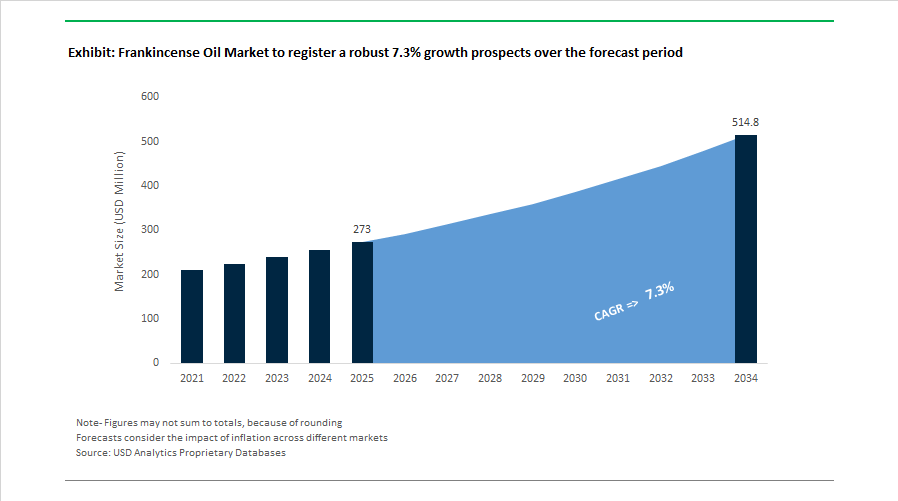
The Frankincense Oil Market is projected to grow from $273 Million in 2025 to $514.7 Million by 2034, registering a CAGR of 7.3%. Market expansion is fueled by rising global demand for essential oils in aromatherapy, natural skincare, nutraceuticals, and pharmaceutical formulations. Boswellia serrata extracts, Boswellia carterii resin oil, and Styrax benzoin derivatives are increasingly incorporated into anti-inflammatory supplements, luxury cosmetics, and premium fragrance fixatives. Supply chain traceability, biodiversity protection, FairWild certification, and geographical indication recognition are becoming critical differentiators in procurement contracts across Europe, North America, and Asia-Pacific.
In February 2026, doTERRA announced the return of founding executive David Stirling as CEO, signaling renewed emphasis on product purity and sustainable sourcing amid heightened scrutiny of high-demand oils such as frankincense. In January 2026, doTERRA appointed Steve Powell as Executive Vice President of Innovation and Advanced Development to integrate advanced scientific validation into its essential oil portfolio, particularly focusing on the therapeutic efficacy of frankincense. In February 2026, Givaudan committed $110 million to a new compounding facility in Pedro Escobedo, Mexico, strengthening Latin American fragrance manufacturing capabilities that incorporate sustainably sourced frankincense oil into premium personal care formulations.
Sustainability and biodiversity initiatives intensified throughout 2025. In December 2025, a BBC investigative report warned that global frankincense supply faces severe ecological stress, projecting potential production declines over the next two decades due to over-tapping and climate pressures. This report accelerated corporate investments in tree health monitoring technologies and FairWild certification programs. In October 2025, doTERRA joined the Union for Ethical BioTrade, reinforcing responsible sourcing practices in Somaliland, a critical Boswellia harvesting region. During the same month, doTERRA launched RevitaZen, a wellness blend featuring frankincense positioned within detoxification and holistic health routines. In March 2025, Verify Markets recognized doTERRA with a Market Leadership Award, citing its Co-Impact Sourcing model. Throughout 2025, the Darwin Initiative and FairWild Foundation began comprehensive supply chain mapping of frankincense resins originating from Sudan, Ethiopia, and Somalia to formalize sustainability standards and address geopolitical harvesting risks.
Earlier developments strengthened conservation and clinical positioning. In 2024, India-based research on Boswellin® Super demonstrated rapid symptom relief for knee osteoarthritis, supporting expanded pharmaceutical and nutraceutical adoption of standardized Boswellia serrata extracts across Europe and North America. In 2024, the HALO Trust and the Royal Botanic Garden Edinburgh launched the Frankincense Revival initiative in Somaliland to establish licensed harvesting cooperatives and prevent woodland degradation. In September 2024, Neal’s Yard Remedies highlighted its traceable, ethically sourced frankincense supply chain as part of its conservation-focused sourcing program. In 2025, Indonesia secured Geographical Indication certification for North Tapanuli frankincense, strengthening legal protection and international competitiveness for Styrax benzoin producers in the global fragrance and fixative markets.
Trends and Opportunities in the Global Frankincense Oil Market
Supply Chain Diversification and Species-Specific Sourcing Strategies
Geopolitical instability across the Horn of Africa combined with decades of over-tapping has structurally altered frankincense supply economics. As of January 2025, raw frankincense resin prices have shown year-over-year volatility of up to 25%, driven by climate stress, export bottlenecks, and declining yields from legacy species such as Boswellia sacra and Boswellia papyrifera. In response, large buyers are actively reallocating procurement toward Boswellia serrata from India, which offers comparatively stable industrial-scale availability and predictable cost structures.
Ecological risk has become a material business variable. Peer-reviewed studies published in March 2025 indicate that unmanaged harvesting could reduce Boswellia papyrifera populations by nearly 50% within a decade. This warning has accelerated species diversification, with Tier-1 suppliers qualifying oils from Somaliland and Eritrea, particularly Boswellia frereana, to reduce single-origin exposure and safeguard long-term supply continuity.
Trade policy has further intensified this shift. Under U.S. Harmonized Tariff Schedule updates effective May 2025, certain specialty oleoresin extracts now attract Section 301 tariffs of up to 37.5%. This has prompted distributors to redesign blending strategies, favoring duty-exempt origins or high-purity, single-origin oils that can sustain premium pricing in aromatherapy, wellness, and perfumery applications despite higher input costs.
Standardization of Bioactive Chemotypes for Nutraceutical Applications
Frankincense oil is increasingly positioned as a clinically relevant anti-inflammatory ingredient rather than a traditional aromatic extract. Demand is rapidly shifting toward standardized extracts with guaranteed levels of AKBA (3-O-acetyl-11-keto-beta-boswellic acid), a key bioactive compound linked to inflammation modulation.
In March 2025, Nestlé Health Science and PLT Health Solutions disclosed clinical trial data demonstrating that a standardized Boswellia serrata extract significantly reduced joint inflammation and improved mobility within 30 days. Imaging data confirmed measurable improvements in cartilage integrity, elevating the credibility threshold for frankincense-based joint health products and setting new benchmarks for substantiated claims.
Regulatory oversight is tightening in parallel. As of August 2025, enhanced FDA post-market scrutiny of botanical extracts has pushed manufacturers to adopt pharmaceutical-grade analytical validation using GC-MS and HPLC methods. This is driving capital investment into quality systems, traceability, and adulteration detection, favoring suppliers with vertically integrated or tightly audited sourcing models.
Formulation innovation is also accelerating. Research published in July 2025 confirmed that synergistic blends of Boswellia serrata and Curcuma longa significantly outperform single-ingredient formulations in managing osteoarthritis pain. This has opened a high-growth pathway for complex, multi-actives in the global supplement market, where clinically differentiated ingredients command sustained pricing power.
Clinically Backed Dermo-Pharma and Therapeutic Skincare Applications
Frankincense oil’s anti-inflammatory, antimicrobial, and barrier-repair properties present a strong opportunity in the fast-expanding dermo-pharma segment. By mid-2025, an estimated 38% of cosmetic and wellness brands had incorporated frankincense oil into topical formulations, yet most offerings remain positioned as cosmetic rather than therapeutic products.
The opportunity lies in FDA-compliant, clinically substantiated topical solutions targeting chronic inflammatory skin conditions such as eczema and psoriasis. Advanced delivery systems, including nanoemulsions and lipid carriers, are being developed to improve dermal penetration of boswellic acids, overcoming historical bioavailability constraints. Brands capable of substantiating antimicrobial efficacy and wound-healing performance with peer-reviewed data are capturing premium positioning within the cosmeceutical market, where consumers routinely pay 40–50% price premiums for verified therapeutic-grade formulations.
Sustainable Agroforestry and ESG-Driven Production Models
Long-term market viability is now directly linked to conservation-led supply strategies. Research conducted in 2025 confirms that managed regeneration through fenced wildlings under mature trees significantly outperforms nursery propagation for Boswellia papyrifera. This insight is driving investment into community-managed tree sanctuaries across Ethiopia and Somalia, creating traceable, ESG-aligned supply chains while stabilizing resin yields.
India has emerged as a structurally attractive growth geography. In 2025, national agroforestry programs and NABARD-linked subsidies classified Boswellia serrata as a priority medicinal crop. Farmers integrating these trees into dryland systems can access subsidies covering 40–60% of establishment costs, enabling scalable, low-risk expansion for bulk oil producers and extract manufacturers.
ESG credentials are now a decisive differentiator in the premium segment. Market leaders such as doTERRA and Young Living, which collectively account for roughly 35% of premium frankincense oil demand, are expanding co-impact sourcing programs. These initiatives enforce controlled tapping limits, fair-trade pricing, and community reinvestment, directly addressing the growing share of global buyers who prioritize ethical sourcing, traceability, and long-term ecological stewardship.
Frankincense Oil Market Share and Segmentation Insights
Boswellia sacra Leads Premium Frankincense Oil Production Through Superior Aroma and Heritage Value
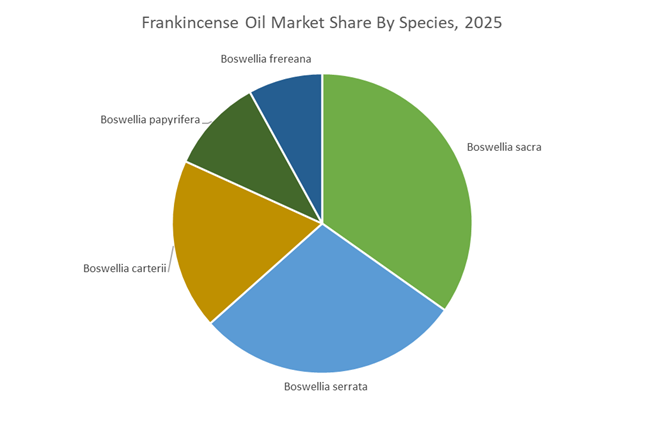
Boswellia sacra accounted for 34.80% of the Frankincense Oil Market share in 2025, making it the most commercially valuable species used in the global frankincense oil industry. Often referred to as Omani or Sacred Frankincense, Boswellia sacra is widely regarded for its complex aromatic profile, higher resin purity, and superior essential oil quality, making it highly sought after in luxury perfumery, high-end aromatherapy formulations, and spiritual applications. The resin harvested from Boswellia sacra trees produces essential oil with distinctive warm, balsamic, and citrus-like notes, which perfumers value for its ability to act as a base or fixative note in sophisticated fragrance compositions. In 2025, the supply chain for Boswellia sacra is increasingly shaped by sustainability management and regulated harvesting practices. Wild populations of Boswellia sacra trees in Oman have faced pressure from overharvesting and climate stress, prompting the Omani government to introduce strict export quotas, controlled harvesting cycles, and sustainability certification systems to protect natural tree populations. As a result, major buyers now require traceable chain-of-custody certification for sustainably harvested frankincense resin, creating a clear distinction between certified sustainable oil and uncertified products from unmanaged sources. This certification-driven supply structure has reinforced Boswellia sacra’s premium market positioning in the global frankincense oil market.
Aromatherapy Drives the Largest Global Demand for Frankincense Essential Oil
Aromatherapy represented 34.20% of the Frankincense Oil Market share in 2025, making it the leading application segment for this high-value essential oil. Frankincense oil has long been recognized for its calming, grounding, and meditative properties, making it one of the most widely used essential oils in aromatherapy practices worldwide. It is frequently incorporated into diffuser blends, massage oils, meditation products, and relaxation therapies, where its distinctive aroma is believed to promote emotional balance and stress reduction. Consumer interest in holistic wellness, mindfulness practices, and natural health remedies continues to support strong demand for frankincense-based aromatherapy products across both retail and professional wellness markets. In 2025, the aromatherapy sector is experiencing a notable shift toward clinical aromatherapy integration within healthcare environments. Hospitals, hospices, rehabilitation centers, and wellness clinics are increasingly incorporating aromatherapy as part of complementary patient care programs designed to improve relaxation, emotional comfort, and overall patient well-being. This trend has created growing demand for pharmaceutical-grade essential oils with standardized composition, contaminant-free processing, and verified botanical origin. As healthcare institutions adopt aromatherapy protocols more widely, frankincense oil is emerging as a key ingredient within professional therapeutic-grade essential oil formulations, strengthening its position within the global aromatherapy and essential oils market.
Competitive Landscape in Frankincense Oil Market
doTERRA Scales Traceable Multi-Species Sourcing and Ingestible Boswellia Applications
doTERRA International leads the therapeutic-grade frankincense oil segment by volume, supported by its Co-Impact Sourcing framework designed to stabilize resin harvesting in fragile regions. Its flagship frankincense oil blends four species including Boswellia carterii, sacra, papyrifera, and frereana, maximizing chemical diversity in alpha-pinene and limonene content. In late 2025, doTERRA expanded its standardized 60% AKBA capsule line, moving beyond aromatherapy into ingestible wellness and joint health categories. In 2026, the company scaled its Oman distillation facility to enable source-level processing, reducing oxidation and degradation during transport while strengthening local labor participation. Blockchain-verified traceability is central to its strategy, addressing regulatory scrutiny surrounding illegal resin trade and overharvesting concerns.
Young Living Strengthens Vertical Integration and Regenerative Resin Supply
Young Living Essential Oils maintains a strong position through its Seed to Seal quality program and direct ownership of distillation assets in Oman and Somalia. Its Sacred Frankincense derived from Boswellia sacra is distilled in Salalah, Oman, at one of the first Western-owned facilities in the region. In 2026, the company announced the Boswellia Regeneration Project, planting 12,000 saplings to offset over-tapping trends observed across East Africa during the previous decade. Aromatherapy and spiritual applications account for approximately 45% of total frankincense oil usage in 2026, reinforcing Young Living’s core consumer base. Vertical integration allows the company to bypass intermediary resin brokers, maintaining purity standards and reducing adulteration risk in premium essential oil markets.
Robertet Integrates Seed-to-Scent Processing for Luxury Resinous Perfumes
Robertet Group remains a leading B2B supplier of natural raw materials to the fine fragrance industry, celebrating 175 years of operations during 2025 to 2026. The company exceeded €700 million in net sales in the 2025 to 2026 cycle, sustaining an EBITDA margin of 18.3% despite elevated resin procurement costs in Africa. Its Seed to Scent model integrates raw resin sourcing with advanced molecular distillation in Grasse to produce colorless frankincense extracts tailored for luxury perfumery. In February 2026, Robertet confirmed a 34% reduction in scope 1 and 2 emissions since 2020 under SBTi-validated climate targets. Planned production expansion in the Dominican Republic aims to diversify botanical sourcing and mitigate Middle Eastern supply risks, reinforcing resilience in high-end fragrance ingredient supply chains.
Givaudan Expands Clinical-Grade Boswellia and Encapsulated Fragrance Formats
Givaudan incorporates frankincense across its fragrance, biotech, and health-focused portfolios. In early 2026, the company expanded PlanetCaps biodegradable encapsulation capacity in Singapore, supporting long-wear frankincense-based personal care applications. Under its Health Essentials platform, Givaudan utilizes clinical-grade Boswellia serrata extracts standardized for anti-inflammatory properties. The Guardians of Memories initiative launched in late 2025 leverages digital storytelling to connect younger consumers with frankincense’s historical heritage. Reported 2025 sales of CHF 7.5 billion included strong fine fragrance growth of 18.3%, supported by renewed demand for balsamic and resinous scent profiles. Givaudan’s integration of clinical extracts with premium fragrance design strengthens its multi-segment positioning.
Biolandes Focuses on Pharmaceutical-Grade Extracts and Clean Beauty Traceability
Biolandes specializes in high-purity resinoids and essential oils for pharmaceutical and niche perfume clients, offering more than 700 natural extracts across 35 partner countries. Its portfolio includes conventional and organic certified frankincense from Boswellia carterii and serrata. At Cosme Tech 2026 in Tokyo, Biolandes showcased cosmetic actives derived from frankincense resin targeting anti-aging and skin repair applications. The company enhanced Zero Liquid Discharge systems at its French distillation facilities to comply with evolving EU environmental standards. Full field-to-extract traceability documentation supports European clean beauty brands requiring verified alpha-boswellic acid concentrations. This high-purity positioning enables Biolandes to serve pharmaceutical and prestige skincare segments.
NOW Foods Dominates Retail Health Channel Through Analytical Purity
NOW Foods leads the value-purity segment within retail health food and e-commerce channels, which account for more than 80% of essential oil distribution volume. The company concentrates on Boswellia serrata oil to meet growing demand for affordable therapeutic-grade products used in home diffusers and DIY skincare. Strategic investment in gas chromatography and mass spectrometry testing ensures protection against synthetic adulterants prevalent in the mass market. By combining competitive pricing with analytical transparency, NOW Foods captures high-volume retail consumers seeking verified purity without premium pricing. This balance of affordability and quality control sustains its strong position in the retail-driven frankincense oil market.
Sultanate of Oman: Institutional Quality Control and Origin Protection Elevating Global Positioning
Oman is consolidating its position as the global benchmark for premium frankincense oil through coordinated regulatory, conservation, and trade initiatives. In December 2025, the Ministry of Commerce, Industry and Investment Promotion finalized five national quality standards dedicated to frankincense products. These standards define purity thresholds, chemical composition parameters, and traceability requirements, enabling Omani frankincense oil to meet the stringent specifications demanded by high-end perfumery, nutraceutical, and pharmaceutical buyers. This framework is strengthening buyer confidence while reducing variability across export consignments.
Parallel to quality standardization, Oman launched a comprehensive Geographical Indication program for Omani Frankincense in collaboration with the World Intellectual Property Organization. The GI protects oils derived from Boswellia sacra in the Dhofar region, ensuring verified origin and materially enhancing export premiums in luxury fragrance and wellness markets. On the supply side, conservation efforts are reinforcing long-term availability. The designation of the Dawkah Valley as a core conservation zone and the replanting of over 600 frankincense trees by late 2025 are safeguarding the world’s largest wild Boswellia reserve. Additionally, Oman’s late-2025 memorandum of understanding with India and Bahrain on mutual recognition of conformity assessment systems is streamlining regulatory clearance, accelerating access to Asian and Gulf markets.
Somalia and Somaliland: Certification, Community Governance, and Supply Chain Reset
Somalia and Somaliland are undergoing a structural reset in the frankincense oil value chain, centered on sustainability certification and community-led governance. In October 2025, the Darwin Initiative and FairWild completed a pilot certifying sustainable harvesting of Boswellia frereana. This certification enables Somali exporters to directly engage Global North buyers by demonstrating ethical labor practices, controlled tapping intensity, and active tree health monitoring, reducing reliance on opaque intermediary networks.
Social organization is also evolving. Following the 2024 Asli Maydi supply chain controversy, the Beeyo Maal women’s collective was established in Erigavo to formalize sorting and grading activities. By 2025, the cooperative had begun direct negotiations with international aromatherapy brands, securing fair-trade pricing and greater revenue retention at the community level. Looking ahead, the Species Saviour Initiative is rolling out Somalia’s first scientifically validated Sustainable Harvesting Practice Guide in early 2026, with plans to train 350 master custodians across 300 frankincense fields. Complementing this, the HALO Trust, in partnership with the Royal Botanic Garden Edinburgh, completed rapid population health surveys in Bari and Bakool during 2025, enabling licensed community cooperatives to manage wild resin yields under monitored conditions.
United States: Compliance-Driven Testing and Medical-Grade Demand Expansion
The United States frankincense oil market is being reshaped by regulatory compliance requirements, ethical sourcing scrutiny, and growing pharmaceutical interest. In response to heightened oversight of East African sourcing, leading wellness brands such as doTERRA implemented satellite-based forest monitoring and direct-contracting models in 2025. These systems enhance supply chain transparency, verify harvesting zones, and support claims related to sustainability and origin integrity.
Regulatory compliance is intensifying under the Modernization of Cosmetics Regulation Act. The U.S. Food and Drug Administration has prioritized 2026 as the deadline for updated safety dossiers, prompting frankincense oil producers to invest heavily in gas chromatography-mass spectrometry testing to document purity and absence of restricted contaminants. Trade dynamics are also influencing sourcing strategies. The 37.5% Section 301 tariff imposed on Chinese oleoresin extracts in May 2025 has redirected U.S. distillation and blending operations toward India and Europe. Concurrently, publicly funded clinical research in 2025 exploring the anti-inflammatory potential of acetyl-11-keto-β-boswellic acid is stimulating demand for pharmaceutical-grade frankincense oil with standardized boswellic acid profiles.
France: Regulatory Substitution and Advanced Extraction Driving Clean Perfumery
France is reinforcing its leadership in clean perfumery by integrating regulatory compliance with advanced extraction technologies. Regulation (EU) 2025/877, effective September 2025, prohibits 21 newly classified cosmetic substances, prompting French fragrance houses to replace synthetic fixatives with certified natural frankincense oils that offer compliant stabilization and olfactive depth. This shift is elevating frankincense oil from a traditional ingredient to a strategic formulation component within luxury fragrance architectures.
Investment in green processing is accelerating this transition. In 2025, Biolandes and Robertet expanded supercritical CO₂ extraction capacity. This method preserves heat-sensitive therapeutic compounds while reducing solvent residues, aligning with clean-label requirements. In parallel, Givaudan scaled its House of Naturals program throughout 2025, combining ethical sourcing partnerships in Ethiopia with advanced extraction to develop new frankincense-based accords for the premium clean perfumery segment.
Ethiopia: Liberalization and Infrastructure Investment Supporting Scaled Supply
Ethiopia is emerging as a structurally important supplier of frankincense oil following sector liberalization and foreign investment inflows. Reforms implemented during 2025–2026 have opened the export-import trade to foreign participation, allowing international essential oil companies to invest directly in primary processing infrastructure within industrial parks. This reduces dependence on fragmented local intermediaries and improves consistency in resin grading and oil distillation.
Foreign direct investment is reinforcing sustainability objectives. Ethiopia reported USD 4 billion in FDI during 2025, with a notable allocation toward climate-smart agriculture and sustainable forest management. Investments targeting protection of Boswellia papyrifera stands are strengthening long-term resin availability while supporting traceable, export-ready frankincense oil supply for European and North American buyers seeking ethically sourced natural ingredients.
Summary of Country-Level Strategic Drivers in the Frankincense Oil Market
Frankincense Oil Market County Level Snapshot
Country
Primary Strategic Driver
Implications for Frankincense Oil
Oman
National standards and GI protection
Premium positioning and verified origin exports
Somalia and Somaliland
Certification and community governance
Ethical sourcing and stabilized wild harvests
United States
MoCRA compliance and medical research
Growth in pharmaceutical-grade oil demand
France
EU regulation and green extraction
Substitution toward natural compliant fixatives
Ethiopia
Liberalization and FDI
Scaled, traceable supply with sustainability focus
Frankincense Oil Market Report Scope
Frankincense Oil Market
Parameter
Details
Market Size (2025)
$273 Million
Market Size (2034)
$514.7 Million
Market Growth Rate
7.3%
Segments
By Species (Boswellia sacra, Boswellia carterii, Boswellia frereana, Boswellia papyrifera, Boswellia serrata), By Method of Extraction (Steam Distillation, Supercritical CO₂ Extraction, Solvent Extraction), By Grade (Therapeutic Grade, Cosmetic Grade, Industrial Grade), By Application (Personal Care and Cosmetics, Fragrances and Perfumery, Aromatherapy, Pharmaceuticals and Nutraceuticals, Spiritual and Religious), By Distribution Channel (Direct Sourcing, Specialized Retail, E-commerce)
Study Period
2019- 2025 and 2026-2034
Units
Revenue (USD)
Qualitative Analysis
Porter’s Five Forces, SWOT Profile, Market Share, Scenario Forecasts, Market Ecosystem, Company Ranking, Market Dynamics, Industry Benchmarking
Companies
doTERRA International, Young Living Essential Oils, DSM-Firmenich AG, Givaudan SA, Robertet Group, Biolandes, Albert Vieille, Privi Speciality Chemicals Limited, SVP Chemicals, Mountain Rose Herbs LLC, Plant Therapy Essential Oils, Edens Garden, Falcon Oils, H. Reynaud & Fils
Countries
US, Canada, Mexico, Germany, France, Spain, Italy, UK, Russia, China, India, Japan, South Korea, Australia, South East Asia, Brazil, Argentina, Middle East, Africa
Frankincense Oil Market Segmentation
By Species
Boswellia sacra
Boswellia carterii
Boswellia frereana
Boswellia papyrifera
Boswellia serrata
By Method of Extraction
Steam Distillation
Supercritical CO₂ Extraction
Solvent Extraction
By Grade
Therapeutic Grade
Cosmetic Grade
Industrial Grade
By Application
Personal Care and Cosmetics
Fragrances and Perfumery
Aromatherapy
Pharmaceuticals and Nutraceuticals
Spiritual and Religious
By Distribution Channel
Direct Sourcing
Specialized Retail
E-commerce
By Region
North America (United States, Canada, Mexico)
Europe (Germany, France, United Kingdom, Spain, Italy, Rest of Europe)
Asia Pacific (China, India, Japan, South Korea, Australia, Rest of APAC)
South and Central America (Brazil, Argentina, Rest of SCA)
Middle East and Africa (Saudi Arabia, UAE, South Africa, Rest of Middle East, Rest of Africa)
2. Frankincense Oil Market Landscape & Outlook (2026–2034)
2.1. Introduction to Frankincense Oil Market
2.2. Market Valuation and Growth Projections (2026–2034)
2.3. Ethical Sourcing, Biodiversity Protection, and Traceability in Frankincense Supply Chains
2.4. Expanding Demand from Aromatherapy, Natural Skincare, and Nutraceutical Applications
2.5. Clinical Validation of Boswellia Extracts and Pharmaceutical-Grade Essential Oils
3. Innovations Reshaping the Frankincense Oil Market
3.1. Trend: Supply Chain Diversification and Species-Specific Sourcing Strategies
3.2. Trend: Standardization of Bioactive Chemotypes for Nutraceutical Applications
3.3. Opportunity: Clinically Backed Dermo-Pharma and Therapeutic Skincare Applications
3.4. Opportunity: Sustainable Agroforestry and ESG-Driven Production Models
4. Competitive Landscape and Strategic Initiatives
4.1. Mergers and Acquisitions
4.2. R&D and Material Innovation
4.3. Sustainability and ESG Strategies
4.4. Market Expansion and Regional Focus
5. Market Share and Segmentation Insights: Frankincense Oil Market
5.1. By Species
5.1.1. Boswellia sacra
5.1.2. Boswellia carterii
5.1.3. Boswellia frereana
5.1.4. Boswellia papyrifera
5.1.5. Boswellia serrata
5.2. By Method of Extraction
5.2.1. Steam Distillation
5.2.2. Supercritical CO₂ Extraction
5.2.3. Solvent Extraction
5.3. By Grade
5.3.1. Therapeutic Grade
5.3.2. Cosmetic Grade
5.3.3. Industrial Grade
5.4. By Application
5.4.1. Personal Care and Cosmetics
5.4.2. Fragrances and Perfumery
5.4.3. Aromatherapy
5.4.4. Pharmaceuticals and Nutraceuticals
5.4.5. Spiritual and Religious
5.5. By Distribution Channel
5.5.1. Direct Sourcing
5.5.2. Specialized Retail
5.5.3. E-commerce
6. Country Analysis and Outlook of Frankincense Oil Market
6.1. United States
6.2. Canada
6.3. Mexico
6.4. Germany
6.5. France
6.6. Spain
6.7. Italy
6.8. UK
6.9. Russia
6.10. China
6.11. India
6.12. Japan
6.13. South Korea
6.14. Australia
6.15. South East Asia
6.16. Brazil
6.17. Argentina
6.18. Middle East
6.19. Africa
7. Frankincense Oil Market Size Outlook by Region (2026–2034)
7.1. North America Frankincense Oil Market Size Outlook to 2034
7.1.1. By Species
7.1.2. By Method of Extraction
7.1.3. By Grade
7.1.4. By Application
7.1.5. By Distribution Channel
7.2. Europe Frankincense Oil Market Size Outlook to 2034
7.2.1. By Species
7.2.2. By Method of Extraction
7.2.3. By Grade
7.2.4. By Application
7.2.5. By Distribution Channel
7.3. Asia Pacific Frankincense Oil Market Size Outlook to 2034
7.3.1. By Species
7.3.2. By Method of Extraction
7.3.3. By Grade
7.3.4. By Application
7.3.5. By Distribution Channel
7.4. South America Frankincense Oil Market Size Outlook to 2034
7.4.1. By Species
7.4.2. By Method of Extraction
7.4.3. By Grade
7.4.4. By Application
7.4.5. By Distribution Channel
7.5. Middle East and Africa Frankincense Oil Market Size Outlook to 2034
7.5.1. By Species
7.5.2. By Method of Extraction
7.5.3. By Grade
7.5.4. By Application
7.5.5. By Distribution Channel
8. Company Profiles: Leading Players in the Frankincense Oil Market
8.1. doTERRA International
8.2. Young Living Essential Oils
8.3. DSM-Firmenich AG
8.4. Givaudan SA
8.5. Robertet Group
8.6. Biolandes
8.7. Albert Vieille
8.8. Privi Speciality Chemicals Limited
8.9. SVP Chemicals
8.10. Mountain Rose Herbs LLC
8.11. Plant Therapy Essential Oils
8.12. Edens Garden
8.13. Falcon Oils
8.14. H. Reynaud & Fils
9. Methodology
9.1. Research Scope
9.2. Market Research Approach
9.3. Market Sizing and Forecasting Model
9.4. Research Coverage
9.5. Data Horizon
9.6. Deliverables
10. Appendix
10.1. Acronyms and Abbreviations
10.2. List of Tables
10.3. List of Figures
Frankincense Oil Market Segmentation
By Species
Boswellia sacra
Boswellia carterii
Boswellia frereana
Boswellia papyrifera
Boswellia serrata
By Method of Extraction
Steam Distillation
Supercritical CO₂ Extraction
Solvent Extraction
By Grade
Therapeutic Grade
Cosmetic Grade
Industrial Grade
By Application
Personal Care and Cosmetics
Fragrances and Perfumery
Aromatherapy
Pharmaceuticals and Nutraceuticals
Spiritual and Religious
By Distribution Channel
Direct Sourcing
Specialized Retail
E-commerce
By Region
North America (United States, Canada, Mexico)
Europe (Germany, France, United Kingdom, Spain, Italy, Rest of Europe)
Asia Pacific (China, India, Japan, South Korea, Australia, Rest of APAC)
South and Central America (Brazil, Argentina, Rest of SCA)
Middle East and Africa (Saudi Arabia, UAE, South Africa, Rest of Middle East, Rest of Africa)
The Frankincense Oil Market is expected to grow from $273 million in 2025 to $514.7 million by 2034, registering a CAGR of 7.3%. Market growth is driven by expanding applications in aromatherapy, nutraceutical supplements, natural skincare, and luxury fragrance formulations. Rising demand for clinically validated Boswellia extracts and ethically sourced essential oils is further strengthening global market expansion.
Boswellia sacra accounted for 34.8% of the market share in 2025, making it the most commercially valuable frankincense species. Its resin produces essential oil with a complex balsamic and citrus-like aroma, making it highly desirable in luxury perfumery and premium aromatherapy products. Strict harvesting regulations and geographical indication protection in Oman are also reinforcing its premium market positioning.
Sustainability concerns have become a key procurement criterion for global buyers. Overharvesting and climate stress affecting Boswellia populations in Africa have accelerated adoption of FairWild certification, blockchain traceability, and community-managed harvesting programs. Major brands are investing in co-impact sourcing models and forest regeneration initiatives to ensure long-term supply stability and biodiversity protection.
Frankincense oil is increasingly used in clinical nutraceutical formulations, dermo-cosmetic skincare, and pharmaceutical-grade anti-inflammatory products. Standardized Boswellia serrata extracts containing bioactive compounds such as AKBA (acetyl-11-keto-β-boswellic acid) are gaining traction in joint health supplements and therapeutic skincare. Advanced delivery technologies such as nanoemulsions are also improving bioavailability in topical formulations.
Leading companies in the Frankincense Oil Market include doTERRA International, Young Living Essential Oils, DSM-Firmenich, Givaudan, Robertet Group, Biolandes, Privi Speciality Chemicals, SVP Chemicals, Mountain Rose Herbs, and Plant Therapy Essential Oils. These companies are investing in ethical sourcing programs, advanced extraction technologies, and pharmaceutical-grade Boswellia extracts to strengthen their positions in premium wellness and fragrance markets.