Hospitality Cleaning Services Market: Transforming Guest Experience Through Technology and Sustainability
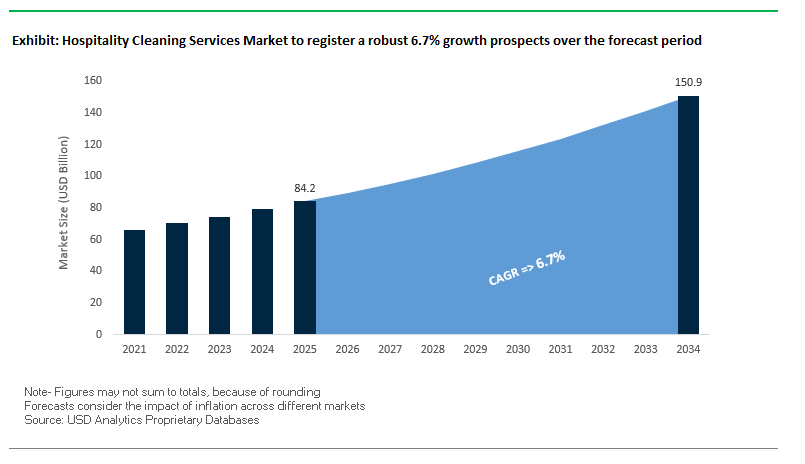
The global hospitality cleaning services market is anticipated to increase from $84.2 billion in 2025 to $150.9 billion in 2034 at a CAGR of 6.7%. The industry has come a long way from the conventional janitorial roles to technology-based, sustainability-oriented backbone of the hospitality sector. Hotels, resorts, and restaurants now view cleaning services not merely as operational expenses but as brand-defining elements that result in guest satisfaction, loyalty, and overall reputation.
This is driven by increased guest expectations, tightening of cleanliness expectations, and the adoption of cutting-edge technologies like AI, robotics, and IoT in cleaning solutions. Sustainability is the norm now; hospitality companies are actively looking for cleaning partners who can collaborate to advance ESG goals through green chemistry, water-saving cleaning solutions, and waste-reduction initiatives. Large-scale players are also moving towards integrated service providers who can offer cleaning services in addition to maintenance, energy management, and concierge services to facilitate optimized operations.
Key Insights for Industry Professionals:
- Over 90% of guests in a 2025 survey ranked cleanliness as a top factor in return visits.
- Rapid adoption of AI-driven and IoT-enabled cleaning is enabling real-time cleanliness monitoring.
- Eco-friendly cleaning solutions are a critical selection criterion for hospitality brands with ESG mandates.
- Integrated service models are driving operational efficiency and cost savings across luxury hotel chains.
Recent Developments in Hospitality Cleaning Services Industry
The past year has witnessed major strategic shifts, acquisitions, and new product launches in the hospitality cleaning services industry, which attest to the sector's evolution toward high-tech, high-value service paradigms.
In July 2025, ABM introduced a new brand platform defining the company as an integrated solutions company, technologically driven. The rebranding comes in response to growing client need for single-source providers who can deliver end-to-end facility management as well as cleaning services. In June 2025, Sodexo expanded its presence in Europe through the acquisition of Grupo Mediterránea, further strengthening its integrated food, cleaning, and facilities management solutions in Spain a central hospitality market.
Ecolab's 2024 Growth & Impact Report (issued May 2025) established new records for water savings, infection prevention, and greenhouse gas emissions reduction, illustrating the intersection of sustainability and hygiene leadership and business performance. ABM's UK & Ireland business also updated its ESG strategy in March 2025, prioritizing measurable environmental and social returns in line with hospitality client interests.
On the innovation front, Microsoft's November 2024 partnerships with AI represent the enhanced role of digital solutions in employee training, cleaning optimization, and workflow automation. Sustainability leaders in the environmental services sector like Clean Harbors continued to advance sustainability, as evidenced by their August 2024 report that highlighted more efficient recycling and waste solutions for hotels. Additionally, DuPont's September 2024 promotion of high-performance FilmTec™ RO membrane shows the integration of cleaning services and on-site water treatment efficiency in hotel operations.
Trends and Opportunities in the Hospitality Cleaning Services Market
Autonomous Robots with UV-C Technology for High-Touch Surface Disinfection
The hospitality cleaning services sector is experiencing a revolution in technology with the launch of AI-powered autonomous cleaning robots integrated with UV-C disinfecting technology. The robots address one of the largest pain points of modern hospitality to deliver a high level of cleanliness consistently in guest rooms, lobbies, conference spaces, and dining areas. Scientifically proven, UV-C light inactivates up to 99.99% of pathogens by destroying their DNA and RNA, making it a hospital-grade disinfecting technology. AI-powered navigation algorithms allow the robots to move and sweep high-touch areas such as door handles, elevator buttons, and remote controls on their own without pre-mapping by hand. Improved safety features such as motion detectors that switch off UV-C lamps when there is human presence ensure safe operation. Hotels employing these solutions can utilize them as a differentiator, promoting "technology-driven disinfection" as a luxury. Not only does this build increased guest confidence, but it also offers a chance to charge premium room rates for those disinfected with advanced robotic technology while improving labor efficiency.
Transition to Eco-Certified, Chemical-Free Cleaning Solutions
Sustainability is emerging as a differentiator for hospitality cleaning services, and leading hotels are dropping VOC-laden chemical cleaners in favor of eco-certified, plant-based, non-toxic cleaners. Stabilized aqueous ozone (SAO), enzyme cleaners, and bio-degradable cleaners are employed to build high levels of sanitation while safeguarding indoor air quality. The products address guest health sensitivities for allergy and respiratory patients and reduce employee exposure risks. Eco-certified products also meet corporate sustainability goals through reduced environmental footprint by a property through biodegradable content and reduced packaging waste. Several high-performance eco-friendly cleaning products are certified to kill up to 99.999% of bacteria and viruses, equivalent to or exceeding traditional chemical cleaners. The double benefit of guest wellness and environmental stewardship is making chemical-free cleaning solutions the norm for luxury and eco-friendly hospitality brands.
Predictive AI for Smart Cleaning Schedules
The combination of predictive AI with hospitality cleaning operations provides a solution to dramatic cost savings, more efficient operations, and enhanced guest satisfaction. By utilizing real-time data from property management systems (PMS), AI technology can dynamically allocate cleaning staff according to occupancy levels, check-in/check-out timetables, and special requests from guests. Prioritized deployment guarantees high-priority room cleaning in real-time and avoids unnecessary servicing of empty rooms. Predictive analytics are also employed to analyze equipment maintenance sensors integrated into cleaning equipment can warn maintenance crews of coming failures before they occur, evading costly delays. By optimizing housekeeping routes and resource allocation, predictive AI minimizes labor costs and guarantees faster room turnover, which contributes directly to enhanced guest satisfaction and better online reviews.
On-Demand Deep Cleaning Services for Luxury Properties
The luxury hospitality post-pandemic market is experiencing high demand for hospital-grade deep cleaning services as a high-end, bookable amenity. High-end resort guests, particularly those on extended-stay stays, are paying a premium for customized, verifiable disinfection protocols. These protocols may vary from electrostatic spraying with hospital-grade disinfectants, UV-C robot-guided cleaning, and antimicrobial surface treatments. Partnership with certified cleaning experts approved by organizations like the Global Biorisk Advisory Council (GBAC) or the CDC lends credibility and guest confidence. Hotels can provide this as an upsell package, where guests can book deep cleaning prior to check-in, after parties, or on a regular interval during their stay. This model not only meets high guest expectations of cleanliness but also provides a high-margin, recurring revenue stream.
Market Share Insights in the Hospitality Cleaning Services Market
Market Share by Service Type: General Cleaning Leading, Specialized Services Rising
General cleaning services account for 45% market share and includes daily housekeeping activities such as guest room cleaning, lobby upkeep, and restaurant cleanliness. Post-pandemic, these have become more specific and systematic, with strict guidelines to ensure visible cleanliness and guest safety. Specialist cleaning services account for 25% market share, fueled by requirements for intense carpet cleaning, post-renovation disinfection, and high-touch surface disinfection. Laundry services outsourced more and more to help hotels cut costs without lowering quality standards, particularly for high-thread-count linens utilized in high-end properties. Waste management and pest control services are increasing due to tighter hygiene standards, with properties looking for providers that provide green waste disposal and integrated pest management.
Market Share by Technology: Manual Cleaning Dominates, Automation and Smart Systems Expanding Rapidly
Manual cleaning remains at the helm with a 50% market share, valued for its precision and versatility in handling varied cleaning environments. Automated cleaning technologies with a 30% market share are expanding fast robotic vacuum cleaners, automatic floor scrubbers, and window-cleaning drones have become the norm in large-scale hospitality chains. IoT sensors and real-time monitoring features are being added to smart cleaning systems to gain acceptance in luxury hotel chains, enabling precise monitoring of cleaning activity and performance metrics. High-tech disinfection systems like electrostatic sprayers and UV-C sterilization robots are increasingly being applied to high-touch points, delivering efficacy as well as a preferable marketing story for cleanliness-seekers. Overall, these technology advancements are revolutionizing operational workflows, boosting staff productivity, and improving the overall guest experience in the global hospitality cleaning services market.
.png)
Competitive Landscape – Key Players Defining the Hospitality Cleaning Services Sector
The Competitive Landscape is dominated by global facility management leaders and specialized cleaning providers who are expanding capabilities through technology integration, sustainability initiatives, and strategic acquisitions. Key players included are Aramark, ISS A/S, Sodexo, ABM Industries, CleanNet USA, Jani-King International, Inc., Coverall North America, Inc., GDI Integrated Facility Services, Kärcher (Alfred Kärcher SE & Co. KG), Tennant Company, Diversey Holdings, Ltd., Ecolab Inc., Hotel Cleaning Services, EFS Facilities Services Group, ahs hospitality, Others.
ABM Industries – Integrated Facility Solutions at Scale
ABM taps decades of expertise to offer a complete range of janitorial, engineering, energy management, and parking solutions. Its technology-driven solution strategic emphasis evident in its 2025 brand platform positions it as a go-to partner for hotels seeking efficiency and consistency. The business's Greater Orlando Aviation Authority contract win is a testament to its operational prowess in high-volume, guest-facing environments.
Ecolab Inc. – Science-Driven Hygiene and Sustainability
Ecolab's reputation is based on infection prevention, water treatment, and hygiene scientific excellence. From automated dispensing systems, hospital-grade disinfectants, and data-driven monitoring solutions, to hospitality-specific solutions, its portfolio is extensive. Its 2030 Positive Impact targets are on measurable sustainability, while its 2025 AI-based operational optimization solutions solidify its position in cleaning and hygiene leadership through technology.
Sodexo S.A. – Global Service Integration Leader
Sodexo operates a colossal global network and supplies cleaning, catering, and technical services to hospitality clients. Its 2025 acquisition of Grupo Mediterránea is one of its strategies to establish its dominance in the European market. Sodexo's ability to package cleaning services together with bigger facilities management contracts offers hotels operational convenience and brand consistency.
Clean Harbors, Inc. – Sustainable Industrial and Environmental Services
Clean Harbors is a hazardous materials handling, environmental waste management, and emergency environmental response expert and therefore a perfect strategic match as a hospitality property partner with complicated operational footprints. Its 2024 Sustainability Report outlined initiatives in reducing client environmental footprint, directly aligning with hotels' ESG agendas.
ISS A/S – Human-Centered Integrated Service Models
ISS differentiates itself by offering technical, catering, and cleaning services through a human-focused strategy with an emphasis on guest comfort and security. The company's "Pure Space" solution, offering high sanitation levels and real-time cleanliness monitoring information, shows how services are merging with analytics to address evolving hospitality needs.
United States: Technology-Driven Cleaning Solutions and Sustainable Operations
The United States hospitality cleaning services market is experiencing rapid transformation through the integration of advanced cleaning technologies and sustainable practices. Major hotel chains are deploying autonomous robotic cleaning equipment, such as Tennant Company’s robotic vacuum cleaners and UV-C disinfection units, to maintain high hygiene standards in a post-pandemic landscape. The adoption of IoT-enabled housekeeping management systems allows real-time monitoring of room occupancy, automated task allocation, and guest-request tracking, ensuring operational efficiency and personalized service. These innovations are complemented by enhanced guest communication strategies, with hotels promoting their upgraded cleaning protocols through digital platforms to strengthen trust and attract hygiene-conscious travelers.
Sustainability has become a competitive differentiator in the U.S. hospitality cleaning services sector. Many properties are replacing chemical-heavy cleaning products with biodegradable and eco-friendly alternatives, implementing linen and towel reuse programs, and adopting energy-efficient cleaning equipment to reduce operational costs and environmental impact. Technology providers are also integrating smart analytics into cleaning management software, enabling hotels to optimize labor allocation, track cleaning performance, and measure environmental metrics. With the rise of both luxury and mid-range hotel developments, the U.S. market is expected to see continued growth in customized cleaning service solutions that balance guest satisfaction, brand reputation, and long-term cost efficiency.
India: Government-Led Hygiene Programs and Green Hospitality Practices
India’s hospitality cleaning services market is being shaped by government-backed sanitation initiatives and the hospitality sector’s growing emphasis on eco-conscious operations. Programs such as the Swachhata Green Leaf Rating, jointly run by the Ministry of Tourism and the Department of Drinking Water and Sanitation, are incentivizing hotels to adopt advanced cleaning technologies and sustainable waste management systems. This aligns with the Swachh Bharat Mission, which encourages hotels to implement waste segregation, reduce single-use plastics, and improve liquid waste treatment facilities. Additionally, technology adoption in Indian hotels is accelerating, with AI-powered check-ins, mobile key access, and smart housekeeping scheduling contributing to both operational efficiency and guest satisfaction.
Skill development is another significant driver, supported by initiatives like the National Action for Mechanized Sanitation Ecosystem (NAMASTE), which trains sanitation workers in the use of mechanized cleaning tools for greater efficiency and safety. Hotels are increasingly adopting water- and energy-saving cleaning equipment, as well as eco-friendly detergents, to meet rising consumer expectations for green hospitality. This dual push government regulation and private sector sustainability commitments is positioning India as a fast-growing hub for innovative and socially responsible hospitality cleaning services across both urban and tourist-centric regions.
Germany: High-Quality Equipment Manufacturing and Eco-Conscious Cleaning Practices
Germany’s hospitality cleaning services market stands out for its precision engineering and adherence to strict hygiene regulations. Renowned manufacturers like Kärcher are producing battery-powered, professional-grade vacuum cleaners, automated scrubbers, and disinfectant application systems tailored for hotels. These innovations address Germany’s demand for high-efficiency, durable cleaning equipment capable of meeting rigorous hygiene standards in both luxury and budget accommodation facilities. Additionally, structured service contracts and the requirement for professionally certified cleaning staff contribute to consistent service quality.
The market’s sustainability focus is equally strong, with hotels increasingly adopting eco-certified cleaning products and water-efficient cleaning systems to reduce environmental impact. Automated cleaning robots are gaining traction in large hospitality spaces, enabling efficient floor maintenance without disrupting guest activities. This integration of engineering excellence, environmental responsibility, and automation is positioning Germany as a leader in high-end, sustainable hospitality cleaning solutions across Europe.
United Arab Emirates: Luxury Hospitality Standards and Digital Integration
The UAE’s hospitality cleaning services market is heavily influenced by its luxury tourism industry and high-profile properties such as Burj Al Arab and Atlantis The Palm. Maintaining immaculate conditions in these globally recognized hotels requires advanced cleaning protocols, cutting-edge equipment, and highly trained staff. The nation’s smart tourism strategy incorporates digital hospitality tools like AI chatbots, keyless entry, and mobile housekeeping requests, which improve service responsiveness and guest satisfaction.
Sustainability initiatives are also gaining momentum, with eco-friendly cleaning products and zero-waste hospitality practices becoming more common. Hotels in Dubai and Abu Dhabi are adopting water- and energy-efficient cleaning technologies, aligning with the UAE’s broader sustainability vision. This blend of luxury-level service standards, tech integration, and eco-conscious operations ensures that cleaning services play a central role in the UAE’s reputation as a global hospitality leader.
Japan: Precision Cleaning and Robotics-Enhanced Housekeeping
Japan’s hospitality cleaning services market benefits from a cultural emphasis on cleanliness and a strong focus on meticulous detail in guest room maintenance. Hotels employ rigorous cleaning protocols supported by well-trained staff and increasingly by robotic cleaning systems. Robotics companies are producing compact, efficient units that assist with repetitive tasks like vacuuming and corridor cleaning, allowing human staff to focus on personalized guest interactions and high-touch area sanitation.
Eco-friendly cleaning practices are gaining traction, with hotels incorporating waste reduction strategies and environmentally safe cleaning agents that align with Japan’s national sustainability goals. Digital housekeeping management tools are also being adopted to coordinate staff in real-time, optimize turnaround times, and maintain consistently high service standards. This combination of precision, automation, and eco-consciousness ensures Japan remains a benchmark for hospitality cleaning excellence in Asia.
United Kingdom: Health-Centric Protocols and Operational Efficiency
The UK hospitality cleaning services market has evolved significantly post-pandemic, with a heightened focus on health and safety protocols in hotels. Properties are implementing enhanced cleaning schedules for high-touch areas, utilizing HEPA-grade air filtration, and investing in disinfection technology to minimize airborne pathogens. Housekeeping departments are increasingly integrated with digital check-in/check-out systems, allowing for real-time room turnover alerts and faster guest accommodation readiness.
Labor flexibility is a critical factor, with companies like ahs hospitality offering scalable staffing solutions that address seasonal demand spikes without compromising service quality. Sustainability is also a priority, with hotels introducing biodegradable cleaning products, water-saving laundry processes, and eco-friendly waste disposal systems. By combining health-driven cleaning innovations, workforce adaptability, and digital coordination, the UK continues to enhance its position as a leader in efficient and guest-focused hospitality cleaning services.
Hospitality Cleaning Services Market Report Scope
Hospitality Cleaning Services Market
|
Parameter
|
Details
|
|
Market Size (2025)
|
$84.2 Billion
|
|
Market Size (2034)
|
$150.9 Billion
|
|
Market Growth Rate
|
6.7%
|
|
Segments
|
By Service Type (General Cleaning, Specialized Cleaning (Deep Cleaning, Disinfection), Laundry Services, Waste Management, Pest Control), By End-User (Hotels & Resorts, Motels, Bed & Breakfasts, Vacation Rentals), By Service Provider (In-House Services, Outsourced Services), By Technology (Manual Cleaning, Automated Cleaning (Robotics), Smart Cleaning Systems (IoT-enabled), Disinfection Technology (UV-C)), By Cleaning Type (Eco-Friendly/Green Cleaning, Traditional Cleaning)
|
|
Study Period
|
2019- 2024 and 2025-2034
|
|
Units
|
Revenue (USD)
|
|
Qualitative Analysis
|
Porter’s Five Forces, SWOT Profile, Market Share, Scenario Forecasts, Market Ecosystem, Company Ranking, Market Dynamics, Industry Benchmarking
|
|
Companies
|
Aramark, ISS A/S, Sodexo, ABM Industries, CleanNet USA, Jani-King International, Inc., Coverall North America, Inc., GDI Integrated Facility Services, Kärcher (Alfred Kärcher SE & Co. KG), Tennant Company, Diversey Holdings, Ltd., Ecolab Inc., Hotel Cleaning Services, EFS Facilities Services Group, ahs hospitality, Others.
|
|
Countries
|
US, Canada, Mexico, Germany, France, Spain, Italy, UK, Russia, China, India, Japan, South Korea, Australia, South East Asia, Brazil, Argentina, Middle East, Africa
|
Hospitality Cleaning Services Market Segmentation
By Service Type
- General Cleaning
- Specialized Cleaning (Deep Cleaning, Disinfection)
- Laundry Services
- Waste Management
- Pest Control
By End-User
- Hotels & Resorts
- Motels
- Bed & Breakfasts
- Vacation Rentals
By Service Provider
- In-House Services
- Outsourced Services
By Technology
- Manual Cleaning
- Automated Cleaning
- Smart Cleaning Systems (IoT-enabled)
- Disinfection Technology (UV-C)
By Cleaning Type
- Eco-Friendly/Green Cleaning
- Traditional Cleaning
Countries Analyzed
- North America (US, Canada, Mexico)
- Europe (Germany, UK, France, Spain, Italy, Russia, Rest of Europe)
- Asia Pacific (China, India, Japan, South Korea, Australia, South East Asia, Rest of Asia)
- South America (Brazil, Argentina, Rest of South America)
- Middle East and Africa (Saudi Arabia, UAE, Rest of Middle East, South Africa, Egypt, Rest of Africa)
Top Companies in Hospitality Cleaning Services Market
- Aramark
- ISS A/S
- Sodexo
- ABM Industries
- CleanNet USA
- Jani-King International Inc.
- Coverall North America Inc.
- GDI Integrated Facility Services
- Kärcher (Alfred Kärcher SE & Co. KG)
- Tennant Company
- Diversey Holdings Ltd.
- Ecolab Inc.
- Hotel Cleaning Services
- EFS Facilities Services Group
- ahs hospitality
* List Not Exhaustive
Research Coverage
This report investigates the global Hospitality Cleaning Services Market, delivering comprehensive analysis, reviews, and strategic insights tailored for industry professionals. Compiled by USDAnalytics, it highlights key breakthroughs, evaluates growth trajectories, and examines market-defining innovations across service types, technologies, and regions. The research explores how sustainability, AI integration, and automation are transforming operational efficiency, guest satisfaction, and brand positioning in the hospitality sector. From high-touch disinfection robots to eco-certified cleaning solutions, the study reveals critical shifts shaping competitive advantage. Covering 25+ countries, profiling 15+ top companies, and spanning historic data from 2021 to 2024 with forecasts to 2034, this report is an essential resource for executives, investors, and stakeholders seeking a 360-degree market view. Scope includes-
- Segmentation: By Service Type (General Cleaning, Specialized Cleaning, Laundry, Waste Management, Pest Control), By End-User (Hotels & Resorts, Motels, Bed & Breakfasts, Vacation Rentals), By Service Provider (In-House, Outsourced), By Technology (Manual, Automated, Smart Cleaning Systems, UV-C), By Cleaning Type (Eco-Friendly/Green, Traditional)
- Geographic Scope: Analysis spans 25+ countries across North America, Europe, Asia Pacific, Latin America, Middle East & Africa
- Historic and Forecast Data: Historic data from 2021–2024; forecast data from 2025–2034
- Company Profiles: Detailed insights on 15+ key market players
Methodology
The study is based on a blend of primary and secondary research methodologies, including in-depth interviews with hospitality industry experts, facility managers, and sustainability officers. Secondary data sources include company reports, ESG disclosures, patent filings, government databases, and reputable industry journals. USDAnalytics employs advanced market modeling techniques, integrating quantitative forecasting with qualitative analysis to capture technology adoption trends, competitive benchmarking, and regional dynamics. Forecasts leverage scenario-based modeling to account for economic, regulatory, and innovation-driven market shifts, ensuring accuracy and relevance for decision-making.
Deliverables:
- Comprehensive Market Research Report (PDF and Excel) with detailed tables, charts, and interactive visualizations.
- Country-Specific Forecasts & Analysis.
- Segment-Wise Revenue Forecasts (2025–2034).
- Competitive Analysis, Benchmarking, and SWOT Profiles.
- Recent Developments & Innovation Tracker.
- Executive Summary & Analyst Commentary.
- Post-Purchase Analyst Support for Client-Specific Questions and Custom Data Requirements.
