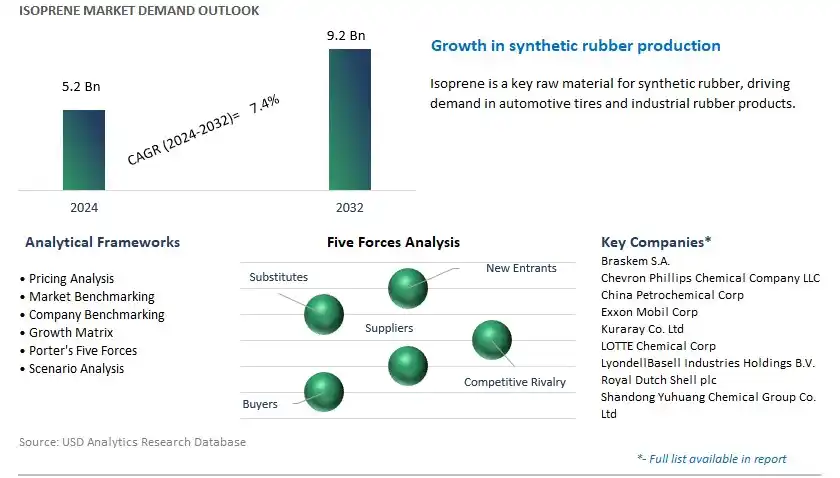
Global Isoprene Market Size is valued at $5.2 Billion in 2024 and is forecast to register a growth rate (CAGR) of 7.4% to reach $9.2 Billion by 2032.
The global Isoprene Market Study analyzes and forecasts the market size across 6 regions and 24 countries for diverse segments -By Grade (Polymer Grade, Chemical Grade), By Application (Tires, Adhesives, Industrial rubber, Others).
An Introduction to Isoprene Market in 2024
Isoprene, a volatile liquid hydrocarbon, plays a crucial role in the production of synthetic rubber and various chemical intermediates. In 2024, the demand for isoprene remains strong, driven by its applications in the rubber industry, plastics manufacturing, and specialty chemicals production. Isoprene is primarily utilized as a monomer in the production of synthetic polyisoprene rubber, which is used in tires, conveyor belts, footwear, and other rubber products requiring high resilience, tensile strength, and abrasion resistance. Additionally, isoprene serves as a feedstock for the production of specialty elastomers such as styrene-butadiene rubber (SBR) and polybutadiene rubber (PBR), which find applications in automotive components, construction materials, and industrial goods. Isoprene is also used as a starting material for the synthesis of various chemical intermediates such as isoprene glycol, isoprene dimer, and isoprenoid compounds, which are utilized in the production of pharmaceuticals, fragrances, and flavoring agents. With the growing demand for synthetic rubber and specialty chemicals worldwide, the market for isoprene is expected to expanding, driven by its essential role in diverse industrial applications.
Isoprene Market Competitive Landscape
The market report analyses the leading companies in the industry including Braskem S.A., Chevron Phillips Chemical Company LLC, China Petrochemical Corp, Exxon Mobil Corp, Kuraray Co. Ltd, LOTTE Chemical Corp, LyondellBasell Industries Holdings B.V., Royal Dutch Shell plc, Shandong Yuhuang Chemical Group Co. Ltd, and others.
Isoprene Market Dynamics
Market Trend: Increasing Demand for Synthetic Rubber
The market for Isoprene is experiencing a prominent trend towards the increasing demand for synthetic rubber, primarily driven by the automotive industry's growth and the rise in construction and infrastructure projects globally. Isoprene is a key raw material in the production of synthetic rubber, particularly polyisoprene rubber, which is used in tire manufacturing, automotive components, industrial goods, and construction materials. As economies continue to develop and urbanize, there is a growing need for vehicles, transportation infrastructure, and durable rubber products, thus fueling the demand for Isoprene as a crucial component in synthetic rubber production.
Market Driver: Growth in Tire Manufacturing Industry
A key driver fueling the growth of the Isoprene market is the expansion of the tire manufacturing industry, which is the largest consumer of synthetic rubber. Isoprene-derived polyisoprene rubber is extensively used in tire production due to its superior properties such as high elasticity, abrasion resistance, and heat resistance. With the increasing demand for automobiles worldwide, driven by population growth, urbanization, and rising disposable incomes, there is a corresponding surge in tire manufacturing activities. Moreover, advancements in tire technology, such as the shift towards high-performance and eco-friendly tires, further boost the demand for Isoprene as tire manufacturers seek to enhance tire performance, fuel efficiency, and sustainability.
Market Opportunity: Development of Bio-based Isoprene
An emerging opportunity in the Isoprene market lies in the development of bio-based Isoprene as a sustainable alternative to petroleum-derived Isoprene. With growing environmental concerns and a focus on reducing carbon footprint, there is a rising interest in bio-based feedstocks for chemical production. Isoprene can be derived from renewable resources such as biomass, lignocellulosic materials, and bio-based chemicals through fermentation or biochemical processes. By investing in research and development, bio-refining technologies, and bioprocess optimization, manufacturers can produce bio-based Isoprene with reduced greenhouse gas emissions and environmental impact compared to traditional Isoprene. This presents an opportunity to meet the growing demand for sustainable materials in the rubber industry while addressing sustainability goals and regulatory requirements. Additionally, bio-based Isoprene offers potential applications in eco-friendly tires, green packaging, and renewable polymers, further expanding its market potential and creating value-added opportunities for stakeholders in the Isoprene market.
Isoprene Market Share Analysis: Polymer Grade segment generated the highest revenue in 2024
Within the Isoprene Market, the Polymer Grade segment is the largest. Polymer grade isoprene is primarily utilized as a monomer in the production of synthetic rubbers, particularly styrene-butadiene rubber (SBR) and polyisoprene rubber (IR). These synthetic rubbers find extensive applications in tire manufacturing, automotive components, footwear, adhesives, and industrial products. The robust demand for synthetic rubbers in various industries, particularly the automotive sector, where tires constitute a significant application, drives the consumption of polymer grade isoprene. Additionally, the growth of the construction and infrastructure sectors, coupled with the increasing demand for consumer goods and electronics, further contributes to the demand for polymer grade isoprene in rubber-based products. Moreover, advancements in polymerization technologies and the development of high-performance rubber formulations enhance the utility and market potential of polymer grade isoprene. As industries continue to rely on synthetic rubbers for their performance, durability, and versatility, the Polymer Grade segment is expected to maintain its dominance within the Isoprene Market.
Isoprene Market Share Analysis: Adhesives is poised to register the fastest CAGR over the forecast period
Among the application segments in the Isoprene Market, the Adhesives segment is the fastest-growing. Isoprene-based adhesives offer high bonding strength, flexibility, and resistance to heat and chemicals, making them ideal for a wide range of applications across industries such as construction, automotive, packaging, and electronics. The increasing demand for adhesives in various manufacturing and assembly processes, coupled with the growing trend towards lightweight and multi-material constructions, fuels the demand for isoprene-based adhesives. Additionally, the versatility of isoprene allows for the formulation of adhesives tailored to specific requirements, such as pressure-sensitive adhesives for tapes and labels, structural adhesives for bonding substrates in construction and automotive applications, and sealants for joints and seams. Moreover, the development of eco-friendly and low-VOC (volatile organic compound) formulations in response to environmental regulations and consumer preferences further drives the adoption of isoprene-based adhesives. As industries continue to innovate and seek advanced adhesive solutions for diverse applications, the Adhesives segment is expected to experience accelerated growth within the Isoprene Market.
Isoprene Market
By Grade
Polymer Grade
Chemical Grade
By Application
Tires
Adhesives
Industrial rubber
Others
Countries Analyzed
North America (US, Canada, Mexico)
Europe (Germany, UK, France, Spain, Italy, Russia, Rest of Europe)
Asia Pacific (China, India, Japan, South Korea, Australia, South East Asia, Rest of Asia)
South America (Brazil, Argentina, Rest of South America)
Middle East and Africa (Saudi Arabia, UAE, Rest of Middle East, South Africa, Egypt, Rest of Africa)
Isoprene Companies Profiled in the Study
Braskem S.A.
Chevron Phillips Chemical Company LLC
China Petrochemical Corp
Exxon Mobil Corp
Kuraray Co. Ltd
LOTTE Chemical Corp
LyondellBasell Industries Holdings B.V.
Royal Dutch Shell plc
Shandong Yuhuang Chemical Group Co. Ltd
*- List Not Exhaustive
TABLE OF CONTENTS
1 Introduction to 2024 Isoprene Market
1.1 Market Overview
1.2 Quick Facts
1.3 Scope/Objective of the Study
1.4 Market Definition
1.5 Countries and Regions Covered
1.6 Units, Currency, and Conversions
1.7 Industry Value Chain
2 Research Methodology
2.1 Market Size Estimation
2.2 Sources and Research Methodology
2.3 Data Triangulation
2.4 Assumptions and Limitations
3 Executive Summary
3.1 Global Isoprene Market Size Outlook, $ Million, 2021 to 2032
3.2 Isoprene Market Outlook by Type, $ Million, 2021 to 2032
3.3 Isoprene Market Outlook by Product, $ Million, 2021 to 2032
3.4 Isoprene Market Outlook by Application, $ Million, 2021 to 2032
3.5 Isoprene Market Outlook by Key Countries, $ Million, 2021 to 2032
4 Market Dynamics
4.1 Key Driving Forces of Isoprene Industry
4.2 Key Market Trends in Isoprene Industry
4.3 Potential Opportunities in Isoprene Industry
4.4 Key Challenges in Isoprene Industry
5 Market Factor Analysis
5.1 Value Chain Analysis
5.2 Competitive Landscape
5.2.1 Global Isoprene Market Share by Company (%), 2023
5.2.2 Product Offerings by Company
5.3 Porter’s Five Forces Analysis
5.4 Pricing Analysis and Outlook
6 Growth Outlook Across Scenarios
6.1 Growth Analysis-Case Scenario Definitions
6.2 Low Growth Scenario Forecasts
6.3 Reference Growth Scenario Forecasts
6.4 High Growth Scenario Forecasts
7 Global Isoprene Market Outlook by Segments
7.1 Isoprene Market Outlook by Segments, $ Million, 2021- 2032
By Grade
Polymer Grade
Chemical Grade
By Application
Tires
Adhesives
Industrial rubber
Others
8 North America Isoprene Market Analysis and Outlook To 2032
8.1 Introduction to North America Isoprene Markets in 2024
8.2 North America Isoprene Market Size Outlook by Country, 2021-2032
8.2.1 United States
8.2.2 Canada
8.2.3 Mexico
8.3 North America Isoprene Market size Outlook by Segments, 2021-2032
By Grade
Polymer Grade
Chemical Grade
By Application
Tires
Adhesives
Industrial rubber
Others
9 Europe Isoprene Market Analysis and Outlook To 2032
9.1 Introduction to Europe Isoprene Markets in 2024
9.2 Europe Isoprene Market Size Outlook by Country, 2021-2032
9.2.1 Germany
9.2.2 France
9.2.3 Spain
9.2.4 United Kingdom
9.2.4 Italy
9.2.5 Russia
9.2.6 Norway
9.2.7 Rest of Europe
9.3 Europe Isoprene Market Size Outlook by Segments, 2021-2032
By Grade
Polymer Grade
Chemical Grade
By Application
Tires
Adhesives
Industrial rubber
Others
10 Asia Pacific Isoprene Market Analysis and Outlook To 2032
10.1 Introduction to Asia Pacific Isoprene Markets in 2024
10.2 Asia Pacific Isoprene Market Size Outlook by Country, 2021-2032
10.2.1 China
10.2.2 India
10.2.3 Japan
10.2.4 South Korea
10.2.5 Indonesia
10.2.6 Malaysia
10.2.7 Australia
10.2.8 Rest of Asia Pacific
10.3 Asia Pacific Isoprene Market size Outlook by Segments, 2021-2032
By Grade
Polymer Grade
Chemical Grade
By Application
Tires
Adhesives
Industrial rubber
Others
11 South America Isoprene Market Analysis and Outlook To 2032
11.1 Introduction to South America Isoprene Markets in 2024
11.2 South America Isoprene Market Size Outlook by Country, 2021-2032
11.2.1 Brazil
11.2.2 Argentina
11.2.3 Rest of South America
11.3 South America Isoprene Market size Outlook by Segments, 2021-2032
By Grade
Polymer Grade
Chemical Grade
By Application
Tires
Adhesives
Industrial rubber
Others
12 Middle East and Africa Isoprene Market Analysis and Outlook To 2032
12.1 Introduction to Middle East and Africa Isoprene Markets in 2024
12.2 Middle East and Africa Isoprene Market Size Outlook by Country, 2021-2032
12.2.1 Saudi Arabia
12.2.2 UAE
12.2.3 Oman
12.2.4 Rest of Middle East
12.2.5 Egypt
12.2.6 Nigeria
12.2.7 South Africa
12.2.8 Rest of Africa
12.3 Middle East and Africa Isoprene Market size Outlook by Segments, 2021-2032
By Grade
Polymer Grade
Chemical Grade
By Application
Tires
Adhesives
Industrial rubber
Others
13 Company Profiles
13.1 Company Snapshot
13.2 SWOT Profiles
13.3 Products and Services
13.4 Recent Developments
13.5 Financial Profile
Braskem S.A.
Chevron Phillips Chemical Company LLC
China Petrochemical Corp
Exxon Mobil Corp
Kuraray Co. Ltd
LOTTE Chemical Corp
LyondellBasell Industries Holdings B.V.
Royal Dutch Shell plc
Shandong Yuhuang Chemical Group Co. Ltd
14 Appendix
14.1 Customization Offerings
14.2 Subscription Services
14.3 Related Reports
14.4 Publisher Expertise
By Grade
Polymer Grade
Chemical Grade
By Application
Tires
Adhesives
Industrial rubber
Others
Countries Analyzed
North America (US, Canada, Mexico)
Europe (Germany, UK, France, Spain, Italy, Russia, Rest of Europe)
Asia Pacific (China, India, Japan, South Korea, Australia, South East Asia, Rest of Asia)
South America (Brazil, Argentina, Rest of South America)
Middle East and Africa (Saudi Arabia, UAE, Rest of Middle East, South Africa, Egypt, Rest of Africa)
