Menthol Tonka Beans Market 2025–2034: Cooling Gourmand Fragrance Trends, Coumarin Regulation, and Sustainable Amazon Sourcing Driving $338.5 Million Outlook at 5% CAGR
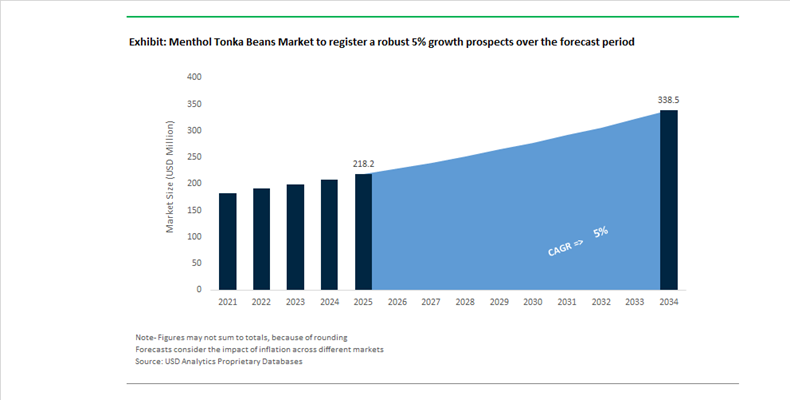
The Menthol Tonka Beans Market is projected to grow from $218.2 Million in 2025 to $338.5 Million by 2034, registering a CAGR of 5%. Market expansion is driven by rising demand for gourmand fragrance compositions, specialty menthol compounds, and coumarin-rich tonka extracts across luxury perfumery, niche beverages, and artisanal food applications. Tonka beans, derived from Dipteryx odorata, are prized for their almond-vanilla-caramel profile due to high natural coumarin content, while menthol derivatives contribute cooling accords increasingly favored in modern fragrance layering. The convergence of warm gourmand bases with fresh, mentholated top notes has become a defining trend in premium perfumery, influencing formulation strategies and raw material sourcing.
In January 2024, Brew York launched the seventh edition of its Empress Tonkoko stout, demonstrating tonka’s continued penetration into craft beverage innovation. In June 2024, Oraculum debuted Arabesque, utilizing tonka bean as a creamy fixative base for fresher top notes. During 2024, leading fragrance houses including Givaudan and Symrise expanded ethical sourcing initiatives for Dipteryx odorata in Venezuela and Brazil, strengthening fair-trade supply chains and mitigating price volatility linked to overharvesting. In 2025, regulatory scrutiny intensified as the FDA maintained restrictions on tonka beans in food products due to coumarin content, while the European Union updated cosmetic dosage guidelines. This regulatory environment stimulated investment in biotechnology-based production of nature-identical coumarin alternatives to ensure compliance in food-safe and cosmetic formulations.
Innovation and legal developments shaped the competitive landscape in 2025 and early 2026. In September 2025, Maison Tahité launched The Tonka Collection, including Tonka Sel_Noir with cooling accords reflecting the mentholated gourmand trend. In 2025, Givaudan expanded capabilities of its CARTO AI platform to optimize menthol-tonka pairings for balanced cooling sensations. In October 2025, International Flavors & Fragrances settled a $26 million antitrust lawsuit related to fragrance ingredient pricing, impacting specialty menthol and coumarin-based supply chains. Authorities in late 2025 and February 2026 formally dropped Symrise from a global fragrance cartel investigation, stabilizing procurement outlook for natural tonka extracts and synthetic menthol compounds. In early 2026, Tom Ford introduced Oud Voyager with a tonka heart, while Jo Malone London’s Myrrh & Tonka Cologne Intense emerged as a top-selling unisex luxury scent, reinforcing tonka’s transition from niche sweetness to mainstream resinous and woody fragrance positioning.
Menthol Tonka Beans Market Trends and Opportunities
Trend: IFRA 51st Amendment Compliance Reshapes Tonka-Based Fine Fragrance Formulation
The Menthol Tonka Beans market is undergoing a structurally significant reformulation cycle as fragrance houses adapt to tightening global safety and compliance frameworks, most notably the IFRA 51st Amendment and EU Regulation (EC) No 1223/2009. Coumarin, the primary aromatic compound in tonka beans and typically present at 1 to 3% by weight, is now subject to stringent concentration caps in dermal applications. Under IFRA Category 4 standards for fine fragrance, the maximum allowable coumarin level in finished products is limited to 1.5%, forcing manufacturers to re-engineer classic amber, fougère, and gourmand accords. Leading fragrance houses such as Givaudan and Firmenich are increasingly deploying fractional distillation and selective extraction technologies to remove sensitizing fractions while preserving the signature warm, balsamic tonka profile.
This regulatory pressure has also intensified analytical scrutiny across the supply chain. A 2025 European Commission Joint Research Centre review triggered a sharp increase in high-resolution HPLC and UV-Vis testing investments, with manufacturers prioritizing batch-level coumarin certification before tonka derivatives enter the European market. As a result, tonka bean sourcing has shifted from artisanal procurement toward standardized, specification-driven supply agreements. Reformulation strategies are also evolving creatively rather than defensively. Industry data from late 2024 indicates that more than 45% of new fragrance launches now blend tonka with citrus, floral, or green notes, achieving olfactory complexity while naturally diluting coumarin concentration. This trend positions compliant menthol tonka fractions as premium building blocks rather than restricted materials, reinforcing their relevance in regulated global fragrance portfolios.
Trend: Single-Origin Tonka and Biodiversity-Linked Sourcing Gain Strategic Value
Beyond regulatory compliance, the Menthol Tonka Beans market is being reshaped by a strong pivot toward sourcing sovereignty, traceability, and biodiversity-linked value creation. Prestige and niche perfumers are increasingly rejecting commodity-grade tonka in favor of single-origin beans with a verifiable geographic and ecological identity. This trend is tightly coupled with agroforestry conservation initiatives in the Amazon and Orinoco basins, where Dipteryx odorata trees play a critical role in rainforest preservation and indigenous livelihoods.
A flagship example is the Venezuela-based conservation partnership maintained by Givaudan in collaboration with Conservation International. As of late 2025, this program protects more than 149,400 hectares in the Caura Basin and supports 92 harvesting families through a zero-deforestation model that delivers traceable, wild-collected tonka beans for luxury fragrance brands. Parallel developments are underway in Brazil’s Pará region, where agroforestry projects reported in May 2025 are restoring over 5,246 hectares of degraded land by integrating tonka trees with fruit crops. These systems not only stabilize yields but also command price premiums of 20 to 25% in clean beauty and ethical fragrance segments. Traceability is becoming a core commercial differentiator, with niche brands deploying blockchain-backed sourcing narratives tied to indigenous communities. In this environment, menthol tonka beans are no longer evaluated solely on aromatic strength but on their verified origin, biodiversity impact, and storytelling potential within high-end fragrance positioning.
Despite the long-standing U.S. FDA ban on coumarin in food, reaffirmed in December 2025 import alerts, menthol tonka beans are emerging as a high-value opportunity in regulated culinary applications across Europe and selected international markets. The European Food Safety Authority’s Tolerable Daily Intake model, which permits coumarin exposure of up to 0.1 mg per kilogram of body weight, has enabled a specialized market for standardized tonka pastes, sugars, and infusions designed to remain within legal thresholds. A January 2025 European food research review highlighted successful compliance strategies in premium bakery and spirits applications, including tonka-infused gins and desserts aligned with the 50 mg per kilogram limit applied to cinnamon-labeled products.
This regulatory pathway aligns with the broader neo-gourmand and clean label movements reshaping premium gastronomy. Chefs and mixologists are increasingly substituting synthetic vanillin with tonka-derived profiles to achieve deeper almond, cherry, and tobacco nuances perceived as more authentic by consumers. The most significant upside lies in low-coumarin extraction innovation. CO₂-based extraction technologies now allow processors to isolate desirable gourmand aromatics while materially reducing hepatotoxic components. These advances create a pathway for legally compliant, high-margin culinary tonka ingredients, particularly in EU markets and emerging regions adopting EFSA-style risk frameworks rather than absolute bans.
Opportunity: Functional Wellness and Quiet Luxury Aromatherapy Expansion
The fastest-growing non-fragrance opportunity for menthol tonka beans is emerging at the intersection of functional wellness and quiet luxury personal care. As consumers gravitate toward mood-driven purchasing and sensory wellness, tonka’s warm, balsamic, and grounding profile is being repositioned from a traditional fixative to an active emotional ingredient. Industry assessments from 2025 indicate that spa and relaxation applications now dominate tonka bean oil demand, particularly in solid perfumes, botanical diffusers, and high-concentration perfume oils marketed for stress reduction and emotional balance.
This shift is reinforced by a broader move away from synthetic tobacco and leather accords. Over the past five years, more than 38% of fragrance sector growth has been attributed to the replacement of synthetic aroma chemicals with botanical extracts, with tonka bean oil playing a central role due to its natural ability to deliver these complex base notes. In mid-2025, fragrance analysts identified a strong rise in sleep-enhancement and focus-improvement blends, where tonka is paired with lavender, sandalwood, or resins to support wellness-oriented positioning. For suppliers, this represents a structurally attractive opportunity to develop menthol tonka fractions optimized for aromatherapy safety profiles, enabling higher dosage formats while maintaining compliance with dermal exposure standards.
Menthol Tonka Beans Market Share and Segmentation Insights
Natural Menthol Tonka Extract Leads Market with Premium Aroma Profile for Perfumery and Flavor Applications
Natural menthol tonka extract accounted for 58.60% of the Menthol Tonka Beans Market share in 2025, making it the leading product form used in fragrance and flavor formulation. Extracted from tonka beans harvested primarily in Amazonian regions of South America, this ingredient delivers a distinctive aromatic profile characterized by vanilla, almond, cherry, and coumarin notes combined with subtle menthol freshness. Natural extracts are widely preferred because they capture the complex, multi-layered sensory profile of tonka beans, which synthetic substitutes struggle to replicate accurately. These characteristics make natural menthol tonka extract a highly valued ingredient in fine fragrance creation, luxury cosmetic formulations, natural flavor systems, and specialty fragrance bases. In 2025, rising demand for naturally derived fragrance ingredients and ethically sourced botanicals has strengthened the position of natural tonka extracts. Major fragrance houses and ingredient suppliers increasingly emphasize certified sustainable sourcing programs, ensuring traceability, biodiversity protection, and fair labor practices within Amazonian harvesting communities while supporting premium positioning in high-end fragrance and cosmetic markets.
Fragrance Industry Drives the Largest Demand for Menthol Tonka Bean Ingredients
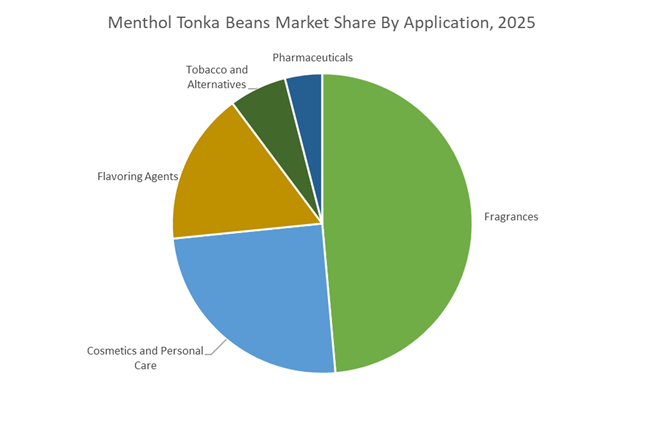
Fragrance applications accounted for 48.60% of the Menthol Tonka Beans Market share in 2025, establishing perfumery as the dominant end-use sector for tonka-derived aromatic ingredients. Tonka bean extracts are widely used as base notes in fine perfumes and fragrance compositions, particularly within amber, oriental, gourmand, and woody fragrance families. Their warm and sweet aroma profile provides depth, richness, and long-lasting scent stability, while natural coumarin content contributes a smooth vanilla-like sweetness that enhances fragrance complexity. In addition to their aromatic value, tonka extracts also function as natural fragrance fixatives, helping stabilize volatile top notes and extending the longevity of perfume compositions. In 2025, regulatory frameworks affecting coumarin usage in food and cosmetic formulations have shifted a significant portion of tonka bean demand toward fragrance manufacturing. Perfumers carefully formulate products within International Fragrance Association (IFRA) guidelines, balancing coumarin concentration while preserving the characteristic sensory profile that makes tonka-derived ingredients essential components in premium fragrance design.
Menthol Tonka Beans Market Competitive Landscape
The menthol tonka beans market in 2026 is driven by supercritical CO2 extraction, traceable Amazonian sourcing, and biotech-derived cooling agents. Competitive differentiation centers on “gourmand-cool” fragrance engineering, biodiversity-positive supply chains, and high-purity coumarin derivatives for luxury perfumery, personal care, and functional flavor applications.
Givaudan integrates biodiversity traceability with advanced tonka olfactive molecule discovery
Givaudan S.A. leads through its Sourcing4Good framework, combining regenerative sourcing in the Caura River Basin with advanced olfactive R&D. Its conservation programs, including reforestation and biodiversity tracking across 1,600+ species, enable premium sustainability claims for luxury fragrance brands. Leveraging metagenomic discovery, Givaudan isolates rare aromatic compounds from tonka beans, enabling natural sweetness profiles while avoiding synthetic coumarin constraints, reinforcing its leadership in high-value, traceable menthol-tonka formulations.
IFF scales low-carbon tonka extraction with supercritical CO2 and clean-label innovation
IFF (LMR Naturals) is advancing clean-label menthol tonka ingredients through Tonka Bean CO2 Absolute, delivering authentic gourmand profiles with a 34% lower carbon footprint. Its €10 million Grasse expansion enhances R&D capacity for sustainable naturals, while the Conscious Collection integrates renewable CO2 extraction to eliminate petrochemical residues. With strong demand for traceable, high-hedonic ingredients, IFF is positioning itself as a leader in low-impact, premium tonka-menthol blends for fragrance and flavor markets.
Symrise bridges menthol cooling and tonka warmth through sensory wellness platforms
Symrise AG is leveraging its expertise in cooling agents and aroma molecules to create multi-sensory “gourmand-cool” profiles. Its Physcool® technology delivers long-lasting, odorless cooling, enhancing tonka’s warm, sweet notes in oral care and active fragrances. Through its ONE CARE platform and FSC-aligned sourcing initiatives, Symrise integrates sustainable raw materials with functional sensory design, supporting the growing demand for wellness-oriented fragrance solutions in personal care and fine perfumery.
Mane advances biotech-derived cooling molecules for high-end culinary and fragrance applications
Mane SA is differentiating through proprietary biotechnology and olfactometry-driven innovation, developing exclusive cooling molecules and enzymatically derived tonka compounds. Its focus on solvent-free extraction ensures contaminant-free tonka oils, while Physcool®-based applications in HoReCa and artisanal beverages highlight cross-industry versatility. By precisely calibrating menthol-tonka ratios, Mane is targeting “indulgent recovery” and sensory contrast trends across premium fragrance and culinary markets.
Takasago integrates emotional science and sustainable sourcing for functional menthol-tonka fragrances
Takasago International Corporation is positioning menthol-tonka blends within functional fragrance systems, combining biotech malodor control with sensory-driven design. Its membership in Together for Sustainability (TfS) strengthens traceability and ethical sourcing in South America. Through its “Sustainable Creations” and “House of Science” initiatives, Takasago utilizes physiological measurement tools and skin-mapping technologies to optimize sensorial performance, targeting stress reduction, mental clarity, and well-being in active beauty and home care applications.
Venezuela: Biodiversity-Led Supply Security and Traceable Wild Harvesting
Venezuela remains the structural anchor of the global menthol tonka beans market due to its dominance in wild-harvested Dipteryx odorata sourced from the Caura Basin. In late 2025, Givaudan, in partnership with Conservation International, expanded its forest conservation program to cover 149,400 hectares. This initiative directly secures long-term tonka bean availability by stabilizing incomes for 92 harvesting families, reducing deforestation risk while preserving access to high-coumarin, naturally mentholated tonka varieties demanded by U.S. and European fragrance houses.
Traceability and post-harvest quality upgrades are reinforcing Venezuela’s premium positioning. The Sourcing4Good program implemented in mid-2025 digitally maps harvesting routes and batch origins, enabling compliance with forthcoming 2026 EU deforestation-free supply chain mandates. Concurrent investments in centralized drying and fermentation units have materially improved surface coumarin crystallization on tonka beans, increasing export-grade value and consistency. These infrastructure upgrades have strengthened Venezuela’s role as a compliant, traceable, and quality-focused origin market for menthol tonka beans used in perfumery, tobacco aroma systems, and specialty cosmetics.
India: Menthol Processing Leadership and Domestic Fragrance Integration
India’s role in the menthol tonka beans market is defined by technological leadership in menthol extraction and rapid downstream integration into fragrance, wellness, and food applications. India produced 12.34 thousand metric tonnes of menthol in 2024, and by 2025–2026 the industry transitioned toward supercritical fluid extraction and molecular distillation. These advanced processes deliver natural menthol at 99.5% purity, creating an optimal base for high-end menthol-tonka cosmetic and aromatherapy blends that demand precision cooling effects with minimal impurities.
Policy-led export restructuring is accelerating domestic value addition. In December 2025, the Ministry of Commerce launched a ₹25,060 crore export ecosystem mission that includes niche crop zones for aromatic plants. This framework enables Indian processors to bundle domestically produced menthol with imported tonka beans for local fragrance and flavor manufacturing. Investment momentum was reinforced at World Food India 2025, where companies including Patanjali signed large-scale agreements that include aromatic ingredient processing for gourmet bakery and confectionery applications. Parallel R&D efforts in Indian laboratories have stabilized menthol-tonka extracts for topical Ayurvedic analgesics, combining menthol’s cooling action with tonka bean coumarin’s antispasmodic properties, expanding the market into regulated wellness products.
United States: Regulatory-Constrained Demand and Niche Perfumery Expansion
The United States represents a paradoxical but strategically important market for menthol tonka beans. Despite the long-standing FDA prohibition on coumarin in food applications dating to 1954, the U.S. remains the world’s largest importer of tonka beans. In 2025, imports rose sharply to supply the premium tobacco and e-cigarette sectors, where tonka-derived coumarin extracts are legally used for cherry-vanilla and mentholated aroma profiles. This demand anchors tonka bean utilization in regulated non-food applications with stable procurement volumes.
Cosmetics and fine fragrance are emerging as high-growth niches under tighter regulatory oversight. Enforcement of the Modernization of Cosmetics Regulation Act during 2025–2026 has pushed U.S. manufacturers toward high-precision analytical testing to ensure menthol-tonka blends used in cooling lotions and personal care products remain within dermal sensitivity thresholds. Simultaneously, craft fragrance houses in New York and California reported a 25% increase in new launches featuring mentholated tonka accords in late 2025, aligning with Gen Z preferences for wellness-oriented, multi-sensory scent profiles that combine freshness with warmth.
France: Luxury Fragrance Chemistry and Controlled Culinary Use
France continues to define the innovation frontier for menthol tonka beans through luxury fragrance chemistry and tightly regulated culinary experimentation. In June 2025, leading fragrance houses including Robertet and Mane introduced green tonka molecules produced via enzymatic hydrolysis. These molecules reduce coumarin toxicity while enhancing fresh, mentholated top notes, aligning with summer perfume trends and clean-label fragrance narratives.
Regulatory discipline underpins culinary applications. In 2025, French authorities aligned with European Food Safety Authority guidance by reaffirming a tolerable daily intake of 0.1 mg per kg body weight for coumarin. A national testing campaign of 151 gourmet samples provided pastry chefs with clear boundaries for safe tonka bean usage. Supply security is also being institutionalized, with Grasse-based fragrance companies finalizing 10-year sourcing contracts with Venezuelan and Brazilian cooperatives in late 2025, locking in fermented tonka bean supply for the 2026–2030 production cycle.
Brazil: Yield Innovation and Agroforestry-Based Supply Expansion
Brazil is strengthening its position in the menthol tonka beans market through agricultural innovation and sustainability-aligned cultivation models. In 2025, Brazilian research institutes successfully piloted grafted Dipteryx odorata trees that reduce time-to-first-harvest from 10 years to approximately 6 years. This breakthrough materially lowers investment risk for industrial buyers planning long-term tonka bean sourcing strategies beyond 2026.
Policy support is reinforcing this trajectory. Under the 2025 Plano Safra program, the Brazilian government introduced dedicated credit lines for agroforestry systems that integrate tonka bean trees with coffee and cocoa cultivation. These systems enhance biodiversity, improve farmer income resilience, and enable participation in carbon sequestration and net-zero credit programs. As a result, Brazil is emerging as a scalable and sustainability-certified alternative supply base for menthol tonka beans destined for fragrance, tobacco, and specialty wellness markets.
Country-Level Strategic Positioning in the Menthol Tonka Beans Market
Menthol Tonka Beans Market County Level Snapshot
Country
Strategic Role
Key Differentiators
Policy or Institutional Driver
Primary End-Use Orientation
Venezuela
Wild-harvest origin hub
Traceable forest sourcing, high coumarin
Conservation partnerships, EU mandates
Fine fragrance, tobacco
India
Menthol processing and formulation
99.5% purity menthol, Ayurvedic blends
Export ecosystem reform
Cosmetics, wellness
United States
High-volume importer
Tobacco aroma use, niche perfumery
MoCRA enforcement
Tobacco, personal care
France
Luxury fragrance innovation
Green tonka chemistry, EFSA compliance
Food safety and sourcing contracts
Perfumery, gourmet
Brazil
Emerging cultivation base
Faster harvest cycles, agroforestry
Plano Safra sustainability finance
Long-term industrial supply
Menthol Tonka Beans Market Report Scope
Menthol Tonka Beans Market
Parameter
Details
Market Size (2025)
$218.2 Million
Market Size (2034)
$338.5 Million
Market Growth Rate
5%
Segments
By Product Type (Natural Menthol Tonka Extract, Synthetic Menthol Compounds, Whole Mentholated Tonka Beans), By Extraction Technology (Supercritical Fluid Extraction, Molecular Distillation, Solvent Extraction, Steam Distillation), By Application (Fragrances, Cosmetics and Personal Care, Flavoring Agents, Pharmaceuticals, Tobacco and Alternatives), By Distribution Channel (Direct Business-to-Business, Specialty Distributors, Online Retail)
Study Period
2019- 2025 and 2026-2034
Units
Revenue (USD)
Qualitative Analysis
Porter’s Five Forces, SWOT Profile, Market Share, Scenario Forecasts, Market Ecosystem, Company Ranking, Market Dynamics, Industry Benchmarking
Companies
Givaudan, Symrise, Firmenich, International Flavors and Fragrances, Robertet, Mane, Takasago International, Biolandes, Frutarom, T. Hasegawa, Bhagat Aromatics, Sharman’s Essential Oils, Vigon International, Berjé, Aromatic F&F
Countries
US, Canada, Mexico, Germany, France, Spain, Italy, UK, Russia, China, India, Japan, South Korea, Australia, South East Asia, Brazil, Argentina, Middle East, Africa
Menthol Tonka Beans Market Segmentation
By Product Type
Natural Menthol Tonka Extract
Synthetic Menthol Compounds
Whole Mentholated Tonka Beans
By Extraction Technology
Supercritical Fluid Extraction
Molecular Distillation
Solvent Extraction
Steam Distillation
By Application
Fragrances
Cosmetics and Personal Care
Flavoring Agents
Pharmaceuticals
Tobacco and Alternatives
By Distribution Channel
Direct Business-to-Business
Specialty Distributors
Online Retail
By Region
North America (United States, Canada, Mexico)
Europe (Germany, France, United Kingdom, Spain, Italy, Rest of Europe)
Asia Pacific (China, India, Japan, South Korea, Australia, Rest of APAC)
South and Central America (Brazil, Argentina, Rest of SCA)
Middle East and Africa (Saudi Arabia, UAE, South Africa, Rest of Middle East, Rest of Africa)
2. Menthol Tonka Beans Market Landscape & Outlook (2025–2034)
2.1. Introduction to Menthol Tonka Beans Market
2.2. Market Valuation and Growth Projections (2025–2034)
2.3. Rising Demand for Gourmand-Cooling Fragrance Compositions
2.4. Coumarin Regulation and Compliance-Driven Reformulation
2.5. Sustainable Amazon Sourcing and Traceability Expansion
3. Innovations Reshaping the Menthol Tonka Beans Market
3.1. Trend: IFRA Compliance and Low-Coumarin Formulation Engineering
3.2. Trend: Single-Origin Tonka and Biodiversity-Linked Sourcing Models
3.3. Opportunity: Low-Coumarin Extracts for Premium Culinary Applications
3.4. Opportunity: Functional Wellness and Aromatherapy-Based Tonka Blends
4. Competitive Landscape and Strategic Initiatives
4.1. Mergers and Acquisitions
4.2. R&D and Extraction Technology Innovation
4.3. Sustainability and Ethical Sourcing Strategies
4.4. Market Expansion and Global Fragrance Supply Networks
5. Market Share and Segmentation Insights: Menthol Tonka Beans Market
5.1. By Product Type
5.1.1. Natural Menthol Tonka Extract
5.1.2. Synthetic Menthol Compounds
5.1.3. Whole Mentholated Tonka Beans
5.2. By Extraction Technology
5.2.1. Supercritical Fluid Extraction
5.2.2. Molecular Distillation
5.2.3. Solvent Extraction
5.2.4. Steam Distillation
5.3. By Application
5.3.1. Fragrances
5.3.2. Cosmetics and Personal Care
5.3.3. Flavoring Agents
5.3.4. Pharmaceuticals
5.3.5. Tobacco and Alternatives
5.4. By Distribution Channel
5.4.1. Direct Business-to-Business
5.4.2. Specialty Distributors
5.4.3. Online Retail
5.5. By Region
5.5.1. North America
5.5.2. Europe
5.5.3. Asia Pacific
5.5.4. South and Central America
5.5.5. Middle East and Africa
6. Country Analysis and Outlook of Menthol Tonka Beans Market
6.1. United States
6.2. Canada
6.3. Mexico
6.4. Germany
6.5. France
6.6. Spain
6.7. Italy
6.8. UK
6.9. Russia
6.10. China
6.11. India
6.12. Japan
6.13. South Korea
6.14. Australia
6.15. South East Asia
6.16. Brazil
6.17. Argentina
6.18. Middle East
6.19. Africa
7. Menthol Tonka Beans Market Size Outlook by Region (2025–2034)
7.1. North America Menthol Tonka Beans Market Size Outlook to 2034
7.1.1. By Product Type
7.1.2. By Extraction Technology
7.1.3. By Application
7.1.4. By Distribution Channel
7.1.5. By Region
7.2. Europe Menthol Tonka Beans Market Size Outlook to 2034
7.2.1. By Product Type
7.2.2. By Extraction Technology
7.2.3. By Application
7.2.4. By Distribution Channel
7.2.5. By Region
7.3. Asia Pacific Menthol Tonka Beans Market Size Outlook to 2034
7.3.1. By Product Type
7.3.2. By Extraction Technology
7.3.3. By Application
7.3.4. By Distribution Channel
7.3.5. By Region
7.4. South America Menthol Tonka Beans Market Size Outlook to 2034
7.4.1. By Product Type
7.4.2. By Extraction Technology
7.4.3. By Application
7.4.4. By Distribution Channel
7.4.5. By Region
7.5. Middle East and Africa Menthol Tonka Beans Market Size Outlook to 2034
7.5.1. By Product Type
7.5.2. By Extraction Technology
7.5.3. By Application
7.5.4. By Distribution Channel
7.5.5. By Region
8. Company Profiles: Leading Players in the Menthol Tonka Beans Market
8.1. Givaudan
8.2. Symrise
8.3. Firmenich
8.4. International Flavors and Fragrances
8.5. Robertet
8.6. Mane
8.7. Takasago International
8.8. Biolandes
8.9. Frutarom
8.10. T. Hasegawa
8.11. Bhagat Aromatics
8.12. Sharman’s Essential Oils
8.13. Vigon International
8.14. Berjé
8.15. Aromatic F&F
9. Methodology
9.1. Research Scope
9.2. Market Research Approach
9.3. Market Sizing and Forecasting Model
9.4. Research Coverage
9.5. Data Horizon
9.6. Deliverables
10. Appendix
10.1. Acronyms and Abbreviations
10.2. List of Tables
10.3. List of Figures
Menthol Tonka Beans Market Segmentation
By Product Type
Natural Menthol Tonka Extract
Synthetic Menthol Compounds
Whole Mentholated Tonka Beans
By Extraction Technology
Supercritical Fluid Extraction
Molecular Distillation
Solvent Extraction
Steam Distillation
By Application
Fragrances
Cosmetics and Personal Care
Flavoring Agents
Pharmaceuticals
Tobacco and Alternatives
By Distribution Channel
Direct Business-to-Business
Specialty Distributors
Online Retail
By Region
North America (United States, Canada, Mexico)
Europe (Germany, France, United Kingdom, Spain, Italy, Rest of Europe)
Asia Pacific (China, India, Japan, South Korea, Australia, Rest of APAC)
South and Central America (Brazil, Argentina, Rest of SCA)
Middle East and Africa (Saudi Arabia, UAE, South Africa, Rest of Middle East, Rest of Africa)
The Menthol Tonka Beans Market was valued at $218.2 million in 2025 and is projected to reach $338.5 million by 2034, growing at a CAGR of 5%. Growth is driven by rising demand in fine fragrances, niche beverages, and specialty cosmetics. The fusion of gourmand and cooling accords is expanding applications. Regulatory-driven reformulation is also reshaping market dynamics.
Global regulations such as IFRA standards and EU cosmetic rules are limiting allowable coumarin concentrations in end products. This is forcing fragrance houses to adopt selective extraction and fractionation technologies. Advanced analytical testing and batch-level certification are becoming mandatory. As a result, compliant tonka derivatives are gaining premium positioning in regulated markets.
Premium fragrance brands are increasingly prioritizing traceable, single-origin tonka beans sourced from Amazonian regions. Biodiversity-linked sourcing programs ensure environmental compliance and ethical harvesting practices. These initiatives command price premiums of 20–25% in luxury segments. Traceability is now a core value proposition alongside aromatic quality.
Opportunities are emerging in low-coumarin culinary extracts and functional wellness applications. CO₂ extraction technologies enable safer tonka usage in regulated food markets, particularly in Europe. Additionally, aromatherapy and wellness products are leveraging tonka’s calming sensory profile. This expands demand into high-margin personal care and therapeutic segments.
Key players include Givaudan, Symrise, Firmenich, IFF, Mane, and Takasago. These companies are focusing on sustainable sourcing, biotech-derived coumarin alternatives, and advanced extraction technologies. Investments in AI-driven fragrance formulation and traceability platforms are increasing. Strategic positioning revolves around premium, compliant, and high-purity menthol-tonka blends.
More Fragrance, Flavor and Functional Ingredients Reports