Nutritionally Enhanced Eggs Market Outlook – Health-Driven Demand and Premium Positioning
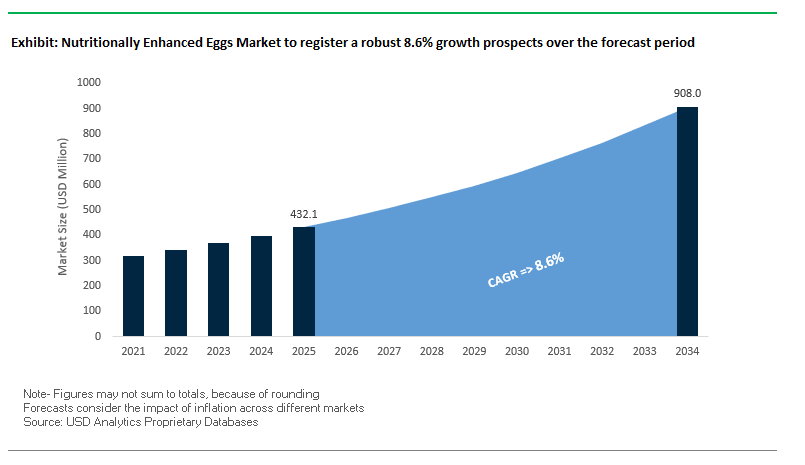
The global nutritionally enhanced eggs market is set to expand from USD 432.1 million in 2025 to USD 907.9 million by 2034, achieving a CAGR of 8.6%. Positioned at the nexus of functional nutrition and ethical sourcing, this market is motivated by increasing health awareness, consumer desire for preventative wellness, and an increasing trend towards sustainable agriculture. By fortifying eggs with vitamins and minerals like Omega-3 fatty acids, Vitamin D, and Vitamin E through specific hen diets, manufacturers are providing value-added food solutions that respond to both health and lifestyle movements. The segment also gains from the U.S. FDA's redefined definition of a "healthy" food, which now encompasses eggs, adding further momentum to market acceptance and expansion.
Key Insights for Industry Professionals
- Functional Food Growth – Omega-3 enriched, Vitamin D fortified, and specialty nutrient eggs address the demand for food with health benefits.
- Ethical Farming Practices – Cage-free, free-range, and pasture-raised production methods are critical for brand positioning.
- Premium Pricing Power – Enhanced nutritional profiles enable higher price points and strong brand differentiation.
- Consumer Education – Transparent labeling, influencer partnerships, and digital content are central to raising awareness.
- Geographic Expansion – Rapid adoption in North America, Europe, and emerging Asia-Pacific health-conscious consumer bases.
Nutritionally Enhanced Eggs Market Analysis – Strategic Expansions, M&A, and Marketing Innovation
The market for nutritionally improved eggs is stepping into a scale-up mode, with players utilizing both organic and inorganic means to increase supply, diversify product portfolios, and enhance consumer interaction. Cal-Maine Foods in June 2025 made a takeover of Echo Lake Foods, representing an expansion beyond shell eggs into prepared foods to tap into wider retail and foodservice opportunities. Burnbrae Farms made an announcement in August 2025 of a new 150,000 sq. ft. egg grading plant in Ontario, conceived with integration of solar power and cutting-edge automation to address the need for specialty eggs while reducing operational emissions.
Network expansion is a central growth driver. Vital Farms moved past 500 family farms during July 2025, solidifying its supply capability and dedication to pasture-raised production. The company's robust Q2 2025 performance reported 25.4% YoY revenue growth, driven by volume increases and positive pricing. In the meantime, Happy Egg's October 2024 merger with Egg Innovations positioned it to scale regenerative farming and increase organic egg supply, secured by vertical integration through its in-house feed mill.
Consumer engagement and branding are also paramount. Eggland's Best used the FDA's May 2025 "healthy" recognition of eggs to highlight its nutritional benefit, and ASMR-based marketing (May 2024) to appeal to younger demographics. Cal-Maine Foods emphasized organic growth initiatives with more than 2 million cage-free and free-range layer hens in its July 2025 release, highlighting the level of capacity growth. Together, these actions demonstrate an industry's movement toward premium positioning, diversified revenue bases, and consumer-driven innovation.
Emerging Trends and Strategic Opportunities in the Nutritionally Enhanced Eggs Market
Precision-Fed Poultry with CRISPR-Edited Feed Driving Nutritional Customization
The market for nutritionally superior eggs is being revolutionized through the adoption of precision feeding systems and CRISPR gene-editing technologies. This facilitates the customization of hen diets to deliver eggs enriched with high-value, specific nutrients propelling a new generation of functional food development. Metabolomics studies of poultry nutrition illustrate how biochemical profiling can fine-tune feed formulations to enhance hen health and metabolic efficiency, leading to eggs with better nutrient quality. CRISPR/Cas9, already used to enhance poultry disease resistance and feed efficiency, holds the promise to engineer genetic traits that determine the nutrient quality of eggs. Precision feeding using AI is also lowering nitrogen excretion by as much as 30%, improving sustainability while optimizing feed-to-egg conversion ratios. The outcome is an economically scalable route to pharmaceutical-grade nutrient delivery via daily food items, merging health outcomes with production efficiency.
Carbon-Negative Egg Production Shaping the Future of Sustainable Agriculture
The revolution in egg production toward carbon negativity is creating new standards for sustainable agriculture. Regenerative agricultural methods like rotational grazing, cover crops, and reduced tillage are facilitating soil carbon sequestration and reducing greenhouse gas emissions. Research indicates that feed production is responsible for more than 85% of the industry's carbon footprint, and regenerative systems that feed locally can significantly reduce these emissions. By incorporating hens into multi-species ecosystems, farms can increase biodiversity, decrease the use of synthetic fertilizers, and enhance animal well-being at the same time. The ecological advantages are matched by high consumer demand, as environmentally aware consumers increasingly select eggs with clear carbon footprint information. Companies leading in carbon-negative production are presenting themselves as high-end, sustainable brands that address both nutritional and environmental market needs.
Medical-Application Eggs for Targeted Health Benefits
Medical-application eggs offer a high-value development opportunity, capitalizing on the intersection between diet and clinical health outcomes. Clinical trials demonstrate that omega-3 enriched eggs will enhance cardiovascular biomarkers without increasing TMAO levels, promoting heart health and cognitive status. Vitamin D fortified eggs combat widespread deficiencies, promoting bone density and immune status. Their inclusion in muscle protein synthesis was also noted in research, with whole-egg protein after resistance exercise promoting recovery as well as satiety. Bioactives such as lutein and zeaxanthin contribute eye health benefits, lowering age-related macular degeneration risk. By tapping into preventive healthcare trends, eggs in medical application can reach targeted health-aware niches, establishing a premium differentiated category in the functional foods sector.
Urban Vertical Layer Systems for Localized, Year-Round Supply
Urban vertical layer systems present a paradigm-shifting production methodology for providing nutritionally improved eggs locally within city centers. By incorporating vertical farming concepts, such systems optimize yield per square foot while reducing water and land consumption. They respond to food insecurity in under-resourced neighborhoods by providing reliable, local supply of high-protein content. Controlled environment housing provides for consistent egg size, nutrient content, and freshness critical consumer purchasing drivers. Scalable from community-scale co-ops to large industrial production, urban vertical farms can include blockchain traceability for transparency and trust. This model not only satisfies increasing demand for sustainable and local food but also offers a solution with potential for scalability for nations that experience land shortages and dependence on imports.
Nutritionally Enhanced Eggs Market Share and Segmentation Insights
Omega-3 Rich Eggs Dominant Leadership in Functional Egg Innovation
Omega-3 fortified eggs dominate the nutritionally enhanced eggs category with a 32% share in 2025 as consumers increasingly focus on their cardiovascular and cognitive health benefits. These items ride the wave of increasing demand for functional foods supported by clinical evidence. Organic eggs, having 25% share, continue to have firm appeal among environmentally conscious and health-driven purchasers even at premium price levels. Vitamin D enriched eggs are witnessing growth at a faster pace, driven by post-pandemic health consciousness and government nutrition initiatives. Multi-nutrient fortified eggs with the blend of omega-3, lutein, and vitamin D are turning out to be an upscale subsector for wholesome wellness. Regional adoption trends are still diverse where some markets emphasize organic certification while others highlight fortification. In all forms, the focus is on providing quantifiable health benefits, making improved eggs a functional source of protein beyond fundamental nutrition.
Cage-Free Systems at the Forefront of Ethical and Responsible Production
Cage-free eggs lead production method share at 45%, driven by retailer and foodservice pledges to phase out traditional cages by 2025. Free-range eggs, holding a 30% share, are growing via premiumization, delivering perceived quality advantages such as increased vitamin D levels from sun exposure. Pastured systems hold the highest price premiums; however, scalability of supply is still a limiting factor. Traditional production, although still prevalent in price-sensitive markets, is gradually losing ground based on animal welfare concerns and changing consumer expectations. Evolving differentiators are regenerative farming integration and blockchain-based production validation, which increase environmental credibility and consumer confidence. Producers allocating resources to cage-free and regenerative systems are well placed to achieve long-term market share as sustainability and ethics increasingly drive purchasing decisions.
.png)
Competitive Landscape – Leaders Driving Growth in the Nutritionally Enhanced Eggs Sector
The market is dominated by a combination of large-scale producers and impact-driven ethical brands, blending operational effectiveness with compelling consumer-facing stories. The major players listed are Cal-Maine Foods, Inc., Rose Acre Farms, Vital Farms, The Happy Egg Co., Eggland's Best, LLC, Gourmet Egg Farms, Organic Valley, OvoPro Foods Inc., Eggoz, Yojna Poultry, Sneha Select, Barnana Organics, Burnbrae Farms, Suguna Foods, Srinivasa Farms, Others.
Cal-Maine Foods, Inc. – Scaling Specialty Egg Leadership
Cal-Maine's fiscal 2025 figures indicated specialty eggs accounted for 36.7% of overall egg sales, an increase from last year. The acquisition by the company of Echo Lake Foods enhances diversification in prepared foods, and projects underway will add more than 2-million-layer hens in cage-free and free-range systems. Its operational resiliency provides consistent fulfillment amid market uncertainty.
Vital Farms – Scaling the Pasture-Raised Model
Vital Farms uses a Certified B Corporation status and a large network of family farms to satisfy skyrocketing demand. Spanning more than 26,000 retail outlets, its offerings comprise shell eggs, butter, and liquid egg form. Supply chain investments, such as a second egg washing and packing plant, drive its $1 billion revenue aspiration.
Eggland's Best, LLC – Nutritional Differentiation Through Proprietary Feed
Eggland's Best's vegetarian hen feed has greater Omega-3, Vitamin D, and Vitamin E content compared to regular eggs. Creative initiatives such as its ASMR series and collaborations with national organizations build brand loyalty, while its varied range from cage-free to pasture-raised resonates with a wide consumer base.
Happy Egg Co. – Regenerative Farming Advocate
Happy Egg's brand is built on free-range and regenerative systems, with hens granted extensive outdoor access. The October 2024 acquisition of Egg Innovations added strength in vertical integration and increased organic supply capacity. Special products such as Heritage eggs in deep brown and light blue shells add to shelf appeal.
United States: Flexible Fortification Policies, Specialty Egg Growth, and Consumer Health Focus
The U.S. market for nutritionally enhanced eggs operates within a voluntary fortification framework under FDA guidance, giving producers significant flexibility to innovate while ensuring labeling compliance. This has encouraged the development of specialty egg products, particularly cage-free and certified organic offerings, which dominate retail advertising and reflect consumer demand for both nutritional benefits and animal welfare. The USDA reports a steady increase in non-organic commercial cage-free flocks, underscoring a structural production shift toward higher-welfare systems.
Innovation in nutritional enrichment especially omega-3 fatty acids and vitamin D is largely driven by targeted dietary modifications for hens, such as flaxseed and rapeseed supplementation. Technological advancements in membrane separation are enabling higher-purity egg components for use in fortified foods, while improved packaging technologies extend the shelf life of nutrient-enhanced eggs. With U.S. consumers increasingly prioritizing preventive health and functional nutrition, fortified eggs are positioned as a convenient, everyday source of essential nutrients.
China: Scale-Driven Market Potential and Designer Egg Development
As the world’s largest egg producer and consumer, China’s market for nutritionally enhanced eggs benefits from scale and cultural integration of eggs into daily diets. Ongoing research in “designer eggs” focuses on boosting omega-3s, lutein, and selenium content via specialized feed formulas tailored to population-specific nutritional needs. This opens the door to premium positioning in an otherwise mass-market category.
Consumer awareness remains relatively low, but interest in premium and high-quality eggs is growing alongside rising living standards. Regional differences in preferences for shell color and egg weight create opportunities for localized product strategies. Additionally, the introduction of animal-free egg proteins through precision fermentation such as initiatives by The Every Company signals the emergence of a new protein category appealing to sustainability-minded and ethically conscious consumers.
European Union: Regulatory Rigor, Animal Welfare Leadership, and Feed Innovation
The EU’s nutritionally enhanced eggs market is shaped by strict regulatory and labeling standards, ensuring consistent quality and consumer protection. Animal welfare remains a core driver, with stringent oversight of cage-free and free-range production systems. Price monitoring by production method (barn, cage, free-range) is integral to the EU’s transparency approach.
Sustainability considerations are deeply embedded in market operations, illustrated by the rejection of eggshell powder for agricultural use due to contamination concerns, prompting the search for safer, eco-friendly alternatives. Feed innovation is central to EU research, with flaxseed and rapeseed supplementation shown to improve yolk fatty acid profiles particularly the omega-6:omega-3 ratio aligning with public health goals. This commitment to nutrient optimization within welfare-compliant systems strengthens the EU’s global reputation for ethical, high-quality egg production.
India: Health-Driven Demand, D2C Expansion, and Tech-Enabled Poultry Growth
India’s market for nutritionally enhanced eggs is accelerating on the back of rising health awareness and growing interest in high-protein, functional foods. The country’s increasing prevalence of lifestyle-related conditions is shifting consumer focus toward nutrient-dense, fortified eggs as a daily wellness choice. D2C brands are capitalizing on e-commerce and quick commerce channels to directly reach urban consumers, bypassing traditional retail and offering traceable, premium-quality products.
A notable trend is the fusion of traditional dietary practices with modern nutritional science, where fortified eggs are marketed as combining the benefits of natural protein with added omega-3s, selenium, and other essential micronutrients. Anticipated advancements in automation and processing technology within the poultry sector will support efficiency gains, scale-up production, and meet growing demand for both conventional and fortified eggs.
Nutritionally Enhanced Eggs Market Report Scope
Nutritionally Enhanced Eggs Market
|
Parameter
|
Details
|
|
Market Size (2025)
|
$432.1 Million
|
|
Market Size (2034)
|
$907.9 Million
|
|
Market Growth Rate
|
8.6%
|
|
Segments
|
By Product (Omega-3 Enriched Eggs, Vitamin D Fortified Eggs, Lutein Enriched Eggs, Organic Eggs, Selenium Enriched Eggs, Choline-Rich Eggs), By End-Use (Retail, Food Service), By Distribution Channel (Supermarkets & Hypermarkets, Convenience Stores, Online Retail, Specialty Stores), By Production Method (Cage-Free, Free-Range, Pastured), By Form (Shell Eggs, Processed Eggs (Liquid, Powder))
|
|
Study Period
|
2019- 2024 and 2025-2034
|
|
Units
|
Revenue (USD)
|
|
Qualitative Analysis
|
Porter’s Five Forces, SWOT Profile, Market Share, Scenario Forecasts, Market Ecosystem, Company Ranking, Market Dynamics, Industry Benchmarking
|
|
Companies
|
Cal-Maine Foods, Inc., Rose Acre Farms, Vital Farms, The Happy Egg Co., Eggland's Best, LLC, Gourmet Egg Farms, Organic Valley, OvoPro Foods Inc., Eggoz, Yojna Poultry, Sneha Select, Barnana Organics, Burnbrae Farms, Suguna Foods, Srinivasa Farms, Others.
|
|
Countries
|
US, Canada, Mexico, Germany, France, Spain, Italy, UK, Russia, China, India, Japan, South Korea, Australia, South East Asia, Brazil, Argentina, Middle East, Africa
|
Nutritionally Enhanced Eggs Market Segmentation
By Product
- Omega-3 Enriched Eggs
- Vitamin D Fortified Eggs
- Lutein Enriched Eggs
- Organic Eggs
- Selenium Enriched Eggs
- Choline-Rich Eggs
By End-Use
By Distribution Channel
- Supermarkets & Hypermarkets
- Convenience Stores
- Online Retail
- Specialty Stores
By Production Method
- Cage-Free
- Free-Range
- Pastured
By Form
- Shell Eggs
- Processed Eggs
- Liquid
- Powder
Countries Analyzed
- North America (US, Canada, Mexico)
- Europe (Germany, UK, France, Spain, Italy, Russia, Rest of Europe)
- Asia Pacific (China, India, Japan, South Korea, Australia, South East Asia, Rest of Asia)
- South America (Brazil, Argentina, Rest of South America)
- Middle East and Africa (Saudi Arabia, UAE, Rest of Middle East, South Africa, Egypt, Rest of Africa)
Top Companies in Nutritionally Enhanced Eggs Market
- Cal-Maine Foods Inc.
- Rose Acre Farms
- Vital Farms
- The Happy Egg Co.
- Eggland's Best LLC
- Gourmet Egg Farms
- Organic Valley
- OvoPro Foods Inc.
- Eggoz
- Yojna Poultry
- Sneha Select
- Barnana Organics
- Burnbrae Farms
- Suguna Foods
- Srinivasa Farms
* List Not Exhaustive
Research Coverage
This report investigates the global Nutritionally Enhanced Eggs Market, delivering comprehensive analysis reviews, strategic insights, and industry breakthroughs shaping its growth trajectory. It highlights the role of functional nutrition, ethical farming practices, and premium brand positioning in driving adoption, while also reviewing technological innovations such as CRISPR-edited feed, AI-powered precision feeding, and carbon-negative production models. By examining expansion strategies, M&A activities, and market-specific consumer trends, this report by USDAnalytics is an essential resource for industry professionals seeking actionable intelligence. It provides deep coverage of competitive positioning, emerging opportunities such as medical-application eggs and urban vertical layer systems, and consumer education strategies that enhance market acceptance. With a global scope, it spans over 25 countries, offering a data-backed forecast from 2025 to 2034 to support strategic planning and investment decisions. Scope includes- :
- Segmentation:
- By Product: Omega-3 Enriched Eggs, Vitamin D Fortified Eggs, Lutein Enriched Eggs, Organic Eggs, Selenium Enriched Eggs, Choline-Rich Eggs
- By End-Use: Retail, Food Service
- By Distribution Channel: Supermarkets & Hypermarkets, Convenience Stores, Online Retail, Specialty Stores
- By Production Method: Cage-Free, Free-Range, Pastured
- By Form: Shell Eggs, Processed Eggs (Liquid, Powder)
- Geographic Scope: Analysis spans 25+ countries across North America, Europe, Asia Pacific, Latin America, Middle East & Africa.
- Historic Data: 2021–2024, with forecast data from 2025–2034.
- Companies: Profiles and competitive insights for 15+ leading market players.
Methodology
This study applies a hybrid research methodology combining primary and secondary data collection to ensure high accuracy and industry relevance. Primary research included structured interviews and surveys with producers, distributors, nutrition scientists, and retailers across key regions. Secondary research leveraged reputable trade publications, regulatory documents, academic studies, and company disclosures. Data validation was conducted through triangulation, ensuring consistency between market statistics, expert opinions, and observed trends. Forecast modeling for 2025–2034 was performed using time-series analysis, adoption curve modeling for fortified foods, and scenario planning for regulatory, technological, and consumer adoption shifts. This robust methodology ensures the report delivers reliable, actionable, and forward-looking insights for stakeholders.
