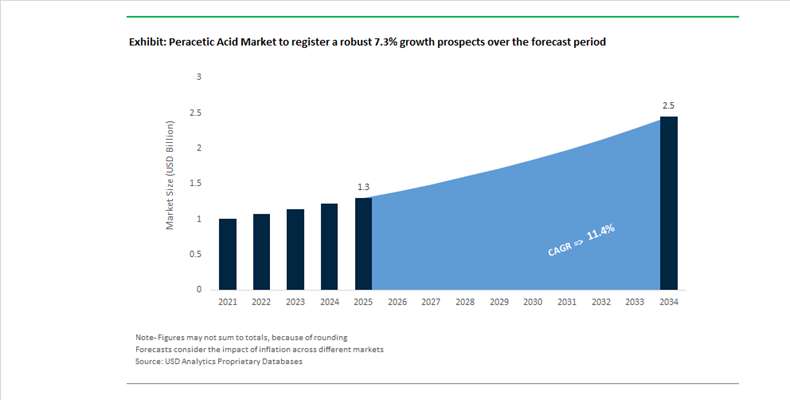
Peracetic Acid Market Size 2025–2034: $1.3 Billion to $2.5 Billion at 7.3% CAGR Driven by Biosecurity, Water Treatment Digitization, and Specialty Peroxide Integration
The global peracetic acid (PAA) market is projected to grow from $1.3 billion in 2025 to $2.5 billion by 2034, registering a CAGR of 7.3%. Growth is anchored in rising demand for high-efficacy disinfectants, advanced oxidation chemistry in municipal water treatment, and regulatory shifts toward residue-free antimicrobial solutions across food processing, healthcare, and agriculture. As a powerful oxidizing biocide that decomposes into acetic acid, oxygen, and water, peracetic acid is increasingly positioned as a sustainable alternative to chlorine-based sanitizers and quaternary ammonium compounds.
Capacity expansion and supply chain consolidation accelerated in 2024. In March 2024, Evonik expanded peracetic acid capacity at its Rheinfelden, Germany site to address rising European demand for green disinfectants in healthcare and water treatment applications. Earlier, in late 2023 and early 2024, Evonik finalized the acquisition of Thai Peroxide Co., Ltd., strengthening its specialty peroxide and PAA production footprint in Asia-Pacific. This acquisition directly supports growth in microchip fabrication, solar cell cleaning, and high-purity food safety applications, sectors that require ultra-clean oxidizing chemistries with minimal residual contamination.
Product innovation in 2024 reinforced PAA’s position in high-level disinfection markets. In December 2024, GAMA Healthcare introduced a specialized Clinell Peracetic Acid range featuring oxidative-release wipes and drain disinfectants for hospitals, targeting reduction of healthcare-associated infections. In August 2024, RX Marine International expanded its antimicrobial portfolio with stabilized 12% and 15% PAA formulations designed for industrial wastewater treatment and marine sanitation, addressing long-term storage stability challenges that previously limited bulk adoption in remote operations. Public sector endorsement also strengthened adoption momentum in 2024 when the New York State Department of Transportation updated vegetation management guidance recommending peracetic acid in sensitive infrastructure zones, reinforcing its zero-residual and environmentally compliant profile.
Regulatory approvals and digital optimization initiatives in 2025 expanded application depth. In March 2025, Enviro Tech Chemical Services secured a US EPA label amendment approving its dry peracetic acid formulation, PeraGuard® AH, for surface disinfection against Avian Influenza and other high-consequence animal viruses. This approval materially increased PAA usage in poultry biosecurity and livestock sanitation programs, sectors facing recurring viral outbreaks. In May 2025, Ecolab’s Growth & Impact Report highlighted the role of PAA-based sanitizers in protecting 1.7 billion people from foodborne illness, emphasizing expansion of ready-to-use formulations that improve handling safety and dosing accuracy in institutional cleaning environments.
Industrial process integration is shifting toward digital and AI-enabled control systems. In early 2025, Solvay intensified deployment of IoT-enabled dosing systems for its PROXITANE® brand, enabling real-time optimization of PAA concentrations in food and beverage bottling lines to reduce chemical waste and ensure sterilization consistency. By January 2026, municipal utilities in North America and Europe increasingly adopted AI-driven PAA dosing strategies integrated with aeration systems to improve oxygen transfer efficiency in wastewater treatment while eliminating chlorine residuals and disinfection byproducts. This convergence of advanced oxidation processes and digital control platforms is redefining operational standards in water infrastructure.
Upstream restructuring is also influencing peroxide derivative supply. In 2024, Bondalti Ibérica initiated a takeover bid for Ercros, which received regulatory approval in late 2025. Given Ercros’ significant presence in chlorine and peroxide derivatives, this ownership shift is expected to impact precursor availability for Mediterranean PAA production. Meanwhile, Kemira’s 2025 strategic update reaffirmed focus on distilled peracetic acid for pulp bleaching, where dPAA is increasingly used as a post-bleaching agent to enhance brightness stability in elemental chlorine-free and totally chlorine-free pulp systems.
Strategic Trends and High-Growth Opportunities Reshaping the Peracetic Acid Market
Accelerated Shift Toward Peracetic Acid as a Chlorine Alternative in Water Treatment
The global peracetic acid market is benefiting from a decisive shift away from chlorine-based disinfectants as municipalities and industrial operators seek to eliminate carcinogenic disinfection by-products such as trihalomethanes and haloacetic acids. This transition is particularly visible in wastewater treatment plants discharging into environmentally sensitive water bodies and in facilities supplying treated water for agricultural reuse. As regulatory scrutiny on effluent quality intensifies, PAA is increasingly viewed as a permit-friendly and future-proof disinfection chemistry.
According to the 2025 Water Index published by Kemira, roughly 42% of domestic wastewater globally still receives no treatment, highlighting a vast untapped opportunity for advanced oxidizing biocides. In both the United States and Europe, environmental agencies are actively encouraging utilities to move away from sodium hypochlorite and chlorine gas to reduce DBP-related compliance risks. Peracetic acid’s rapid decomposition into acetic acid, oxygen, and water aligns well with these regulatory priorities.
Operational considerations are reinforcing this trend. Data released in 2025 by Brainerd Chemical shows that PAA systems eliminate the need for de-chlorination steps and specialized gas handling infrastructure. While peracetic acid carries a higher unit cost than chlorine, the absence of scrubbers, neutralization tanks, and hazardous gas storage often results in lower total lifecycle costs for utilities. Adoption is also expanding in the energy sector. In late 2024, field trials demonstrated that PAA can control sulfate-reducing bacteria and hydrogen sulfide in produced-water recycling for hydraulic fracturing without leaving halogenated residues that disrupt downhole chemistries. This versatility is broadening PAA’s relevance beyond municipal water into industrial reuse and energy applications.
Vertical Integration and M&A Strengthen Regional Supply Security
As demand for peracetic acid accelerates, producers are moving aggressively to secure localized supply chains and reduce the risks associated with transporting high-concentration oxidizers. The market is therefore witnessing a wave of mergers, acquisitions, and capacity expansions designed to place production closer to end users in high-growth regions.
A landmark transaction occurred in January 2024 when Evonik completed the full acquisition of Thai Peroxide Company Limited in Saraburi, Thailand. This acquisition significantly strengthens Evonik’s position in Southeast Asia by enabling direct, regional production of hydrogen peroxide and peracetic acid for food processing, beverage bottling, and municipal water treatment customers. The move reflects a broader industry strategy to reduce dependency on long-distance transport of unstable PAA solutions.
The near-customer model is becoming a competitive differentiator. Solvay now operates a global network of 18 industrial sites and three research and innovation centers to provide localized technical service and rapid formulation support. This structure minimizes logistics risk while enabling faster customization for customer-specific disinfection challenges. Supply resilience is also driving inorganic growth. In its October 2025 interim disclosure, Kemira highlighted consistent growth in water treatment chemicals across all regions, prompting the acquisition of Water Engineering, Inc. to deepen its portfolio of industrial water service solutions. Collectively, these moves are consolidating market power among integrated players with regional production footprints.
Rising Use of Peracetic Acid in Animal Health and Biosecurity Applications
One of the most structurally attractive opportunities for the peracetic acid market lies in animal health, where the global shift toward antibiotic-free livestock production is redefining biosecurity spending. PAA’s broad-spectrum antimicrobial efficacy, combined with its zero-residue profile, makes it a critical input for poultry and swine producers under pressure to control pathogens without contributing to antimicrobial resistance.
Commercial-scale validation is accelerating adoption. In January 2025, large trials conducted by Aga2Tech across 250,000 broilers in the United Kingdom demonstrated that its in-water PAA treatment could eradicate Salmonella within one week. Similar results have been reported in avian influenza mitigation. UKAS-certified laboratory trials in 2025 confirmed that low-dose PAA effectively inactivates the avian influenza virus while remaining safe for animal consumption, offering a less corrosive and less hazardous alternative to bleach-based disinfectants.
This efficacy is translating into export-driven demand. Products such as OXYKIL and PROXITANE AHC from Solvay are being positioned across Asia’s animal health sector. Their rapid breakdown into benign components ensures compliance with increasingly strict maximum residue limits for meat destined for European and North American markets. As biosecurity becomes a non-discretionary cost for large-scale producers, PAA is evolving into a core operational input rather than an optional disinfectant.
Stabilized, Low-Odor Formulations Unlock Institutional and Healthcare Demand
A second high-impact opportunity is emerging from advances in formulation and packaging that address one of PAA’s historical limitations: its strong vinegar-like odor. Research and development efforts are now focused on stabilized, low-odor, and ready-to-use peracetic acid products that can compete directly with quaternary ammonium compounds and alcohol-based disinfectants in enclosed environments.
Healthcare is already a major demand pillar. By 2025, an estimated 35% of hospitals worldwide relied on PAA-based systems for high-level disinfection of heat-sensitive medical instruments such as endoscopes. The appeal lies in PAA’s ability to destroy resistant bacterial spores within 15 minutes, significantly faster than many conventional liquid sterilants. This performance advantage is driving deeper penetration into centralized sterilization departments and outpatient facilities.
Broader institutional use is the next frontier. Industry disclosures in August 2025 highlighted progress in stabilization chemistry and packaging innovations that extend shelf life while reducing odor intensity. These next-generation PAA solutions are being positioned for professional cleaning in schools, hotels, and retail spaces, where safety, efficacy, and sustainability credentials influence procurement decisions. Sustainability strategies further reinforce this opportunity. Under its Next Generation Solutions program, Evonik aims to generate more than 50% of sales from sustainable products by 2030, positioning peracetic acid as a flagship bio-based disinfectant for ESG-driven institutional buyers. Together, these trends support sustained expansion of the peracetic acid market well beyond its traditional industrial base.
Peracetic Acid Market Share and Segmentation Insights
Standard Grade Peracetic Acid Leads Market Consumption in Industrial and Food Safety Disinfection
Standard grade peracetic acid accounted for 52.80% of the Peracetic Acid Market by grade in 2025, reflecting its widespread use in sanitation and disinfection processes across food processing, healthcare, and water treatment systems. Typically supplied at concentrations ranging from 5% to 15%, standard grade peracetic acid offers a balance of antimicrobial efficacy, stability, and handling safety suitable for routine sanitation operations. Its effectiveness against bacteria, viruses, fungi, and spores makes it a preferred disinfectant in regulated hygiene environments. In 2025, the market trend toward ready-to-use stabilized peracetic acid formulations is gaining momentum, allowing industrial and institutional users to simplify sanitation processes while maintaining consistent disinfectant performance and extended product shelf life.
Disinfectant Applications Drive Peracetic Acid Demand in Food Processing and Healthcare Hygiene
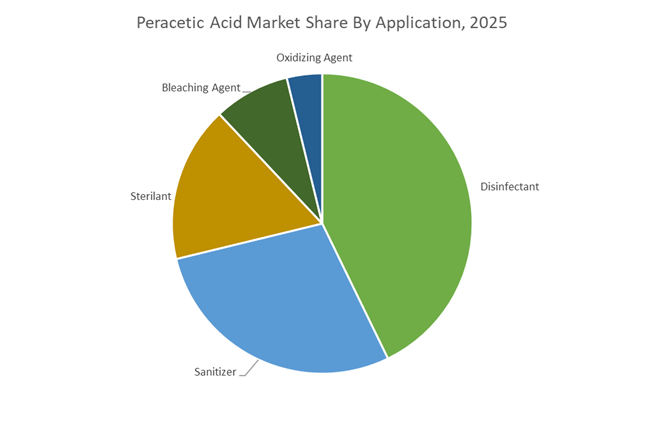
Disinfectant applications represented 42.80% of the Peracetic Acid Market by application in 2025, making microbial control the primary use of this powerful oxidizing biocide. Peracetic acid is widely applied in food processing plants, healthcare facilities, and water treatment systems where rapid antimicrobial action is required to ensure hygienic conditions. Its ability to inactivate pathogens at relatively low concentrations makes it effective for equipment sanitation and surface disinfection. In 2025, the cold sterilization advantage of peracetic acid is supporting broader adoption, as the compound maintains antimicrobial performance at low temperatures, enabling effective disinfection of heat-sensitive equipment and materials while decomposing into environmentally benign byproducts without leaving harmful residues.
Peracetic Acid Market Competitive Landscape
The Peracetic Acid (PAA) Market is shifting toward integrated digital dosing systems, on-site generation, and sustainable active oxygen chemistry. Competitive dynamics are driven by green disinfection demand in wastewater treatment and aseptic packaging, with leading players leveraging IoT monitoring, vertical integration, and residue-free sterilization technologies.
Evonik strengthens global leadership through integrated active oxygen supply and on-site PAA generation
Evonik Industries AG leads the global peracetic acid market through its fully integrated Active Oxygens platform, strengthened by the PeroxyChem acquisition. The company reported a stable 15.8% EBITDA margin in 2025, supported by growth in specialty-grade hydrogen peroxide and PAA. Its sustainability roadmap prioritizes high-efficiency PAA formulations for wastewater disinfection, eliminating dechlorination requirements. Evonik is expanding aggressively across Asia-Pacific, targeting electronics and food safety applications requiring high-purity sterilization. Its on-site PAA generation systems reduce transportation risks and improve operational safety for large-scale users. This integration of supply chain control and sustainable chemistry reinforces its global market dominance.
Ecolab drives digital disinfection leadership with CIP IQ and high-growth ultrapure water integration
Ecolab Inc. dominates the services-led segment by integrating PAA chemistry with advanced digital platforms and real-time monitoring systems. Its Ecolab® CIP IQ™ solution enables food and beverage processors to optimize Clean-in-Place operations, reducing chemical waste while ensuring microbial control. The acquisition of Ovivo’s ultrapure water business strengthens its position in semiconductor-grade sterilization systems. Ecolab achieved 15% EPS growth in 2025 and projects 12–15% growth in 2026, driven by its One Ecolab initiative. Its strategy emphasizes the water-energy nexus, using PAA for low-toxicity wastewater treatment. This digital-service integration differentiates Ecolab as a premium solution provider.
Solvay targets high-stability PAA formulations for clean-label food and medical sterilization markets
Solvay S.A. focuses on high-performance peracetic acid under its PROXITANE® portfolio, targeting healthcare and food safety applications. Its Oxypure™ formulations deliver enhanced stability and residue-free sterilization, aligning with clean-label food processing requirements. The company is advancing digital dosing tools that optimize chemical usage and reduce total cost of ownership for mid-sized users. Solvay is expanding its presence in low-temperature sterilization for heat-sensitive medical devices, positioning PAA as an alternative to ethylene oxide. Its circular production strategy incorporates bio-based acetic acid feedstocks to meet EU Green Deal targets. This focus on precision chemistry and sustainability strengthens its niche leadership.
Kemira advances chlorine-free water treatment with AI-enabled PAA platforms and regulatory approvals
Kemira Oyj is positioning PAA as a core component of its green water treatment portfolio, particularly in municipal and industrial wastewater applications. Its KemConnect™ DEX platform, approved by the U.S. EPA, enables chlorine-free disinfection and was deployed in large-scale events like the Paris Olympics. The company is collaborating with CuspAI to develop next-generation PAA stabilizers using advanced AI-driven material discovery. Kemira reported a strong 19.1% EBITDA margin in 2025, with 64% of its products improving resource efficiency. Its investments in activated carbon reactivation complement its PAA offerings for advanced tertiary treatment. This integrated approach enhances its competitive positioning in sustainable water treatment.
Enviro Tech expands global reach with dry PAA innovation and modular on-site generation systems
Enviro Tech Chemical Services, under Arxada, is emerging as a key innovator in dry peracetic acid formulations and agricultural biosecurity. Its PeraGuard® AH received EPA approval for use against Avian Influenza, strengthening its role in livestock and poultry sanitation. The company is expanding modular on-site PAA generation systems across Latin America and Southeast Asia to address logistics challenges. Its Perafoam™ and liquid PAA solutions are widely used in meat processing to meet USDA-FSIS pathogen reduction standards. Increased R&D investment under Arxada is accelerating global expansion beyond its traditional U.S. base. This focus on compliance-driven innovation and decentralized delivery systems enhances its market competitiveness.
United States – Cleanroom-Grade Innovation and No-Residual Disinfection
The United States peracetic acid industry is increasingly defined by pharmaceutical-grade innovation and regulatory-driven substitution away from chlorine-based chemistries. In November 2025, Ecolab Life Sciences launched Klercide Rapid Sporicide, a peracetic acid–hydrogen peroxide blend engineered specifically for pharmaceutical cleanrooms. This formulation addresses a long-standing industry constraint by delivering rapid sporicidal efficacy while minimizing corrosion risks to sensitive stainless steel equipment, isolators, and robotics. Adoption has been strongest in sterile injectables and biologics manufacturing, where chlorine-free, residue-free disinfection aligns directly with FDA and EMA expectations for contamination control.
Beyond pharma, structural growth is being reinforced across water treatment and food safety. Kemira finalized its $150 million acquisition of Water Engineering in December 2025, embedding peracetic acid-based disinfection services deeper into the U.S. industrial water treatment value chain. Municipal uptake accelerated in 2025 as utilities such as the Metro Wastewater Reclamation District in Denver scaled Peragreen 15% PAA for tertiary effluent disinfection, eliminating dechlorination steps and lowering compliance complexity under tightening NPDES permit reporting rules effective January 2026. Parallel innovation is emerging in solid-format chemistries, with Enviro Tech Chemical Services expanding distribution of PeraGuard, the world’s first dry peracetic acid, targeting food processing plants seeking improved handling safety. In agriculture, USDA data from mid-2025 indicate a 12% increase in PAA use for pre-harvest irrigation and soil oxygenation, reflecting demand for residue-free pathogen control in organic and specialty crop systems.
China – Feedstock Scale-Up and Food Safety Normalization
China’s peracetic acid market is scaling rapidly on the back of hydrogen peroxide capacity expansion and regulatory endorsement in food and industrial applications. In March 2025, Evonik signed a licensing agreement with China Pingmei Shenma Group to construct a 200-kiloton hydrogen peroxide megaplant, creating a dedicated upstream backbone for large-scale PAA production. This was reinforced in January 2025 through a joint venture between Evonik and Fuhua Tongda Chemicals in Leshan, Sichuan, focused on high-purity hydrogen peroxide for food safety and electronics-grade peracetic acid.
Downstream adoption is being normalized by policy. Under the 2025 National Food Safety Standards, poultry processors have broadly adopted PAA as an approved antimicrobial for carcass washing, reducing reliance on chlorine and aligning domestic practices with international export requirements. Simultaneously, MIIT’s 2025–2026 Action Plan has pushed pulp and paper mills in the Yangtze River Delta toward PAA-enhanced bleaching processes to cut AOX levels in wastewater. These shifts position peracetic acid as a default “green oxidant” in China’s food, paper, and industrial sanitation ecosystems.
Germany – Carbon-Optimized Supply Chains and Energy Efficiency
Germany’s peracetic acid industry is shaped by decarbonization mandates and energy efficiency targets rather than volume expansion. In June 2025, Solvay and BASF launched a partnership to reduce Scope 3 emissions across the peroxide value chain. By sourcing low-Product Carbon Footprint aluminum chloride from BASF’s German sites, Solvay reduced the carbon intensity of its PAA precursors by more than 50%, setting a new benchmark for climate-aligned oxidants.
Feedstock decarbonization has also advanced through Evonik’s “Way to GO2” certified carbon-neutral hydrogen peroxide, introduced in April 2024 and now widely used by German PAA formulators targeting climate neutrality by 2045. Operationally, German industrial laundries transitioned in 2025 to PAA-based low-temperature disinfection systems, achieving approximately 20% energy savings while maintaining hospital-grade hygiene. This positions peracetic acid as both a compliance tool and a cost-reduction lever under Europe’s high energy price environment.
Finland – Water-Centric Strategy and Capital Reallocation
Finland’s peracetic acid landscape is dominated by strategic repositioning toward municipal and industrial water treatment. Kemira’s 2025 Interim Report highlighted that Water Solutions now account for roughly 45% of group sales, with PAA as a core growth driver in wastewater disinfection and sludge treatment. This focus aligns directly with tightening EU effluent standards affecting Nordic municipalities.
Kemira’s €500 million renewable revenue target by 2030 has elevated PAA R&D priority, particularly for low-temperature, low-residual disinfection systems suitable for cold climates. The 2024 divestment of its Oil & Gas business freed capital for reinvestment into PAA production capacity and advanced water treatment technologies through 2026, reinforcing Finland’s role as a technology-led rather than volume-led market.
Thailand – Export-Oriented Hub for Aquaculture and Packaging
Thailand has emerged as a strategic peracetic acid production and export base for Southeast Asia. Following Evonik’s full acquisition of Thai Peroxide Co., Ltd. in late 2023 and early 2024, the site had, by 2025, become a critical supply hub for PAA serving regional aquaculture and aseptic packaging markets. The location offers logistical advantages for ASEAN customers seeking consistent oxidant supply with international quality standards.
Demand growth is particularly visible in aquaculture. Thailand’s shrimp farming sector recorded a 15% increase in PAA-based water conditioner usage in 2025, driven by the need to control biofouling and pathogens without the ecological toxicity associated with traditional biocides. This positions peracetic acid as a sustainability-aligned input for export-oriented seafood production.
Comparative Snapshot – Peracetic Acid Industry by Country
Peracetic Acid Market County Level Snapshot
Country
Strategic Focus
Primary Demand Driver
Market Character
United States
Pharma-grade and no-residual disinfection
Cleanrooms, wastewater, organic agriculture
Innovation-led, compliance-driven
China
Feedstock scale and food safety adoption
Poultry processing, pulp bleaching
Volume expansion with policy backing
Germany
Carbon and energy optimization
Scope 3 reduction, industrial hygiene
Low-PCF, efficiency-focused
Finland
Municipal water solutions
EU wastewater regulations
Technology-led, water-centric
Thailand
Regional export platform
Aquaculture and aseptic packaging
Export-oriented growth hub
Peracetic Acid Market Report Scope
Peracetic Acid Market
Parameter
Details
Market Size (2025)
$1.3 Billion
Market Size (2034)
$2.5 Billion
Market Growth Rate
7.3%
Segments
By Grade (Standard Grade, Concentrated Grade, Distilled Grade), By Application (Disinfectant, Sterilant, Sanitizer, Bleaching Agent, Oxidizing Agent), By End-Use Industry (Food and Beverage, Healthcare and Life Sciences, Water Treatment, Pulp and Paper, Agriculture and Aquaculture)
Study Period
2019- 2025 and 2026-2034
Units
Revenue (USD)
Qualitative Analysis
Porter’s Five Forces, SWOT Profile, Market Share, Scenario Forecasts, Market Ecosystem, Company Ranking, Market Dynamics, Industry Benchmarking
Companies
Evonik Industries, Solvay, Ecolab, Kemira, Mitsubishi Gas Chemical, Enviro Tech Chemical Services, PeroxyChem, Airedale Chemical, Aditya Birla Chemicals, Jubilant Pharmova, Seeler Industries, National Peroxide, Christeyns, Seitz, Diversey
Countries
US, Canada, Mexico, Germany, France, Spain, Italy, UK, Russia, China, India, Japan, South Korea, Australia, South East Asia, Brazil, Argentina, Middle East, Africa
Peracetic Acid Market Segmentation
By Grade
Standard Grade
Concentrated Grade
Distilled Grade
By Application
Disinfectant
Sterilant
Sanitizer
Bleaching Agent
Oxidizing Agent
By End-Use Industry
Food and Beverage
Healthcare and Life Sciences
Water Treatment
Pulp and Paper
Agriculture and Aquaculture
By Region
North America (United States, Canada, Mexico)
Europe (Germany, France, United Kingdom, Spain, Italy, Rest of Europe)
Asia Pacific (China, India, Japan, South Korea, Australia, Rest of APAC)
South and Central America (Brazil, Argentina, Rest of SCA)
Middle East and Africa (Saudi Arabia, UAE, South Africa, Rest of Middle East, Rest of Africa)
2. Peracetic Acid Market Landscape & Outlook (2025–2034)
2.1. Introduction to Peracetic Acid Market
2.2. Market Valuation and Growth Projections (2025–2034)
2.3. Role of Peracetic Acid in Disinfection, Oxidation Chemistry, and Water Treatment
2.4. Impact of Biosecurity, Regulatory Shifts, and Residue-Free Antimicrobial Demand
2.5. Supply Chain Expansion, Digital Dosing Systems, and Specialty Peroxide Integration
3. Innovations Reshaping the Peracetic Acid Market
3.1. Trend: Shift Toward Peracetic Acid as a Chlorine Alternative in Water Treatment
3.2. Trend: Vertical Integration and M&A for Regional Supply Security
3.3. Opportunity: Expansion in Animal Health and Biosecurity Applications
3.4. Opportunity: Development of Stabilized, Low-Odor Formulations for Healthcare and Institutional Use
4. Competitive Landscape and Strategic Initiatives
4.1. Mergers and Acquisitions
4.2. R&D and Material Innovation
4.3. Sustainability and ESG Strategies
4.4. Market Expansion and Regional Focus
5. Market Share and Segmentation Insights: Peracetic Acid Market
5.1. By Grade
5.1.1. Standard Grade
5.1.2. Concentrated Grade
5.1.3. Distilled Grade
5.2. By Application
5.2.1. Disinfectant
5.2.2. Sterilant
5.2.3. Sanitizer
5.2.4. Bleaching Agent
5.2.5. Oxidizing Agent
5.3. By End-Use Industry
5.3.1. Food and Beverage
5.3.2. Healthcare and Life Sciences
5.3.3. Water Treatment
5.3.4. Pulp and Paper
5.3.5. Agriculture and Aquaculture
5.4. By Region
5.4.1. North America
5.4.2. Europe
5.4.3. Asia Pacific
5.4.4. South and Central America
5.4.5. Middle East and Africa
6. Country Analysis and Outlook of Peracetic Acid Market
6.1. United States
6.2. Canada
6.3. Mexico
6.4. Germany
6.5. France
6.6. Spain
6.7. Italy
6.8. UK
6.9. Russia
6.10. China
6.11. India
6.12. Japan
6.13. South Korea
6.14. Australia
6.15. South East Asia
6.16. Brazil
6.17. Argentina
6.18. Middle East
6.19. Africa
7. Peracetic Acid Market Size Outlook by Region (2025–2034)
7.1. North America Peracetic Acid Market Size Outlook to 2034
7.1.1. By Grade
7.1.2. By Application
7.1.3. By End-Use Industry
7.1.4. By Region
7.2. Europe Peracetic Acid Market Size Outlook to 2034
7.2.1. By Grade
7.2.2. By Application
7.2.3. By End-Use Industry
7.2.4. By Region
7.3. Asia Pacific Peracetic Acid Market Size Outlook to 2034
7.3.1. By Grade
7.3.2. By Application
7.3.3. By End-Use Industry
7.3.4. By Region
7.4. South America Peracetic Acid Market Size Outlook to 2034
7.4.1. By Grade
7.4.2. By Application
7.4.3. By End-Use Industry
7.4.4. By Region
7.5. Middle East and Africa Peracetic Acid Market Size Outlook to 2034
7.5.1. By Grade
7.5.2. By Application
7.5.3. By End-Use Industry
7.5.4. By Region
8. Company Profiles: Leading Players in the Peracetic Acid Market
8.1. Evonik Industries
8.2. Solvay
8.3. Ecolab
8.4. Kemira
8.5. Mitsubishi Gas Chemical
8.6. Enviro Tech Chemical Services
8.7. PeroxyChem
8.8. Airedale Chemical
8.9. Aditya Birla Chemicals
8.10. Jubilant Pharmova
8.11. Seeler Industries
8.12. National Peroxide
8.13. Christeyns
8.14. Seitz
8.15. Diversey
9. Methodology
9.1. Research Scope
9.2. Market Research Approach
9.3. Market Sizing and Forecasting Model
9.4. Research Coverage
9.5. Data Horizon
9.6. Deliverables
10. Appendix
10.1. Acronyms and Abbreviations
10.2. List of Tables
10.3. List of Figures
Peracetic Acid Market Segmentation
By Grade
Standard Grade
Concentrated Grade
Distilled Grade
By Application
Disinfectant
Sterilant
Sanitizer
Bleaching Agent
Oxidizing Agent
By End-Use Industry
Food and Beverage
Healthcare and Life Sciences
Water Treatment
Pulp and Paper
Agriculture and Aquaculture
By Region
North America (United States, Canada, Mexico)
Europe (Germany, France, United Kingdom, Spain, Italy, Rest of Europe)
Asia Pacific (China, India, Japan, South Korea, Australia, Rest of APAC)
South and Central America (Brazil, Argentina, Rest of SCA)
Middle East and Africa (Saudi Arabia, UAE, South Africa, Rest of Middle East, Rest of Africa)
The Peracetic Acid Market is valued at $1.3 billion in 2025 and is projected to reach $2.5 billion by 2034, growing at a CAGR of 7.3%. Growth is driven by increasing demand for high-efficacy disinfectants and advanced oxidation processes. Expansion across water treatment, food safety, and healthcare sectors is sustaining long-term demand.
Peracetic acid eliminates harmful disinfection byproducts such as trihalomethanes and haloacetic acids associated with chlorine. It decomposes into environmentally benign components, reducing regulatory compliance risks. Additionally, it removes the need for dechlorination infrastructure, improving lifecycle cost efficiency for utilities.
IoT-enabled and AI-driven dosing systems are optimizing peracetic acid usage in real time across water treatment and food processing operations. These systems reduce chemical consumption while maintaining consistent disinfection performance. Integration with aeration and monitoring systems is improving operational efficiency and process control.
Key players include Evonik Industries, Solvay, Ecolab, Kemira, and Enviro Tech Chemical Services. These companies are focusing on capacity expansion, on-site generation systems, and digital dosing technologies. Strategic acquisitions and development of stabilized, low-odor formulations are strengthening their competitive positioning.
Major opportunities are emerging in animal biosecurity, aquaculture, and healthcare sterilization. PAA is increasingly used for pathogen control in poultry and livestock systems due to its zero-residue profile. Additionally, stabilized formulations and institutional cleaning applications are expanding demand beyond traditional industrial uses.
More Organic and Inorganic Chemical Intermediates Reports