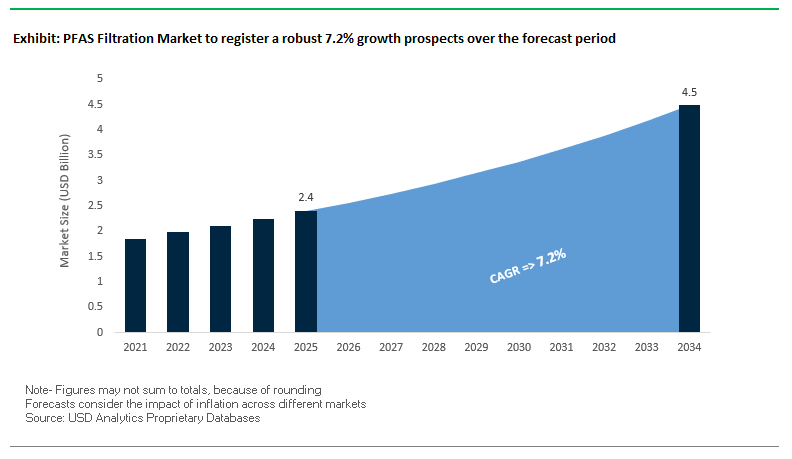
The global PFAS filtration market is valued at $2.4 billion in 2025 and is projected to reach $4.5 billion by 2034, expanding at a CAGR of 7.2%. PFAS filtration encompasses treatment systems, adsorption media, selective ion-exchange technologies, pressure-driven membranes and associated services used to separate or capture per- and polyfluoroalkyl substances from drinking water, groundwater, industrial wastewater, landfill leachate and remediation streams. Granular activated carbon (GAC), anion-exchange resins, reverse osmosis (RO), nanofiltration (NF) and emerging PFAS-selective adsorbents form the principal separation technologies evaluated across municipal and industrial applications.
PFAS treatment requirements differ according to compound structure, carbon-chain length, source-water composition, organic matter, co-contaminants, influent concentration and treatment configuration. GAC remains extensively deployed in municipal water systems, while PFAS-selective ion-exchange materials address high-loading and increasingly difficult contaminant profiles. RO and NF provide broad rejection across PFAS compounds but generate concentrated reject streams requiring subsequent handling. Industrial and remediation applications introduce additional variability through wastewater chemistry, landfill leachate, firefighting-foam contamination and fluorochemical manufacturing streams.
The commercial market includes filtration equipment, treatment media, mobile and permanent treatment systems, media replacement, carbon reactivation, installation, monitoring and engineering services. Drinking-water treatment accounts for the largest application share, while groundwater remediation and industrial wastewater create additional demand for modular treatment, multi-media vessels and treatment trains combining separation technologies.
Market Analysis: Recent Developments in PFAS Filtration
Full-scale municipal PFAS filtration is expanding beyond pilot installations as permanent adsorption and ion-exchange infrastructure enters service. In June 2025, Veolia opened the Stanton Water Treatment Plant in Delaware with capacity to remove regulated PFAS from up to 30 million gallons of water per day for more than 100,000 residents. The project forms part of Veolia's broader BeyondPFAS program and illustrates the scale at which dedicated PFAS filtration is being integrated into municipal drinking-water infrastructure.
Activated-carbon deployment is also increasing the commercial importance of media supply, replacement and reactivation. In January 2025, Calgon Carbon, a Kuraray subsidiary, and American Water finalized a nine-year agreement covering GAC, equipment and reactivation services at more than 50 sites across 10 U.S. states through 2033. Calgon Carbon subsequently announced nearly $100 million of investment in February 2026 to add approximately 27 million pounds per year of potable-water carbon reactivation capacity at its Columbus, Ohio facility, with operations scheduled for 2028.
Development in ion exchange is increasingly associated with PFAS that display weaker adsorption on conventional carbon media. In May 2026, LANXESS reported results from an industrial field trial of Lewatit MDS TP 108 at the Chemours Dordrecht facility in the Netherlands. The system uses a three-stage ion-exchange vessel cascade to treat short- and ultrashort-chain PFAS downstream of other treatment processes, with LANXESS reporting adsorption of more than 99% of fluorinated organic compounds under the field-trial conditions.
Engineered adsorbents are broadening the range of PFAS-specific filtration media. In April 2026, Kurita Water Industries invested in Cyclopure and obtained exclusive U.S. sales rights for the DEXSORB adsorbent across specified industrial and municipal applications. DEXSORB is positioned as a PFAS-selective adsorbent, adding a specialty-media route alongside activated carbon and ion-exchange technologies.
Existing drinking-water plants are also being retrofitted rather than replaced. SUEZ began modernization of the Ternay drinking-water plant in France in 2025, converting six activated-carbon filters to Carbazur Simplex continuous-renewal reactors. SUEZ reported in January 2026 that operational reactors were achieving water below the European 0.10 µg/L parameter for the sum of 20 regulated PFAS, with the plant serving approximately 170,000 users..
PFAS Filtration Regulatory Landscape and Compliance Drivers
The U.S. regulatory framework remains central to municipal PFAS treatment activity. The 2024 National Primary Drinking Water Regulation established enforceable maximum contaminant levels for PFAS, including 4.0 ppt for PFOA and PFOS. On May 18, 2026, EPA published its proposed PFOA and PFOS compliance extension rule, retaining those two MCLs while proposing a mechanism through which qualifying drinking-water systems could receive up to two additional years, through 2031, to comply. The public-comment period closed on July 20, 2026, and the action remained a proposed rule as of October 2026. EPA simultaneously proposed rescinding the regulations and regulatory determinations for PFHxS, PFNA, HFPO-DA and the Hazard Index mixture.
Treatment infrastructure is also supported by federal funding. EPA announced nearly $1 billion in additional 2026 funding to states through programs addressing PFAS and other emerging contaminants in drinking water. The funding covers activities including testing, planning and infrastructure associated with contamination control, while municipal treatment projects continue to move through design, construction and operating phases.
European drinking-water regulation entered a new implementation stage on January 12, 2026. Under the recast Drinking Water Directive, Member States began harmonized PFAS monitoring and reporting against the European drinking-water parameters. The European Commission's EU-wide PFAS drinking-water monitoring requirements require reporting of monitoring results, exceedances, incidents and derogations, creating a standardized framework for identifying drinking-water systems requiring additional PFAS control.
Short- and Ultrashort-Chain PFAS Reshape Adsorbent and Ion-Exchange Chemistry
PFAS adsorption behavior varies materially by molecular structure, functional group and carbon-chain length. Longer-chain compounds generally exhibit stronger hydrophobic interactions with activated carbon, while shorter-chain PFAS can display earlier breakthrough because of lower affinity for conventional carbon surfaces. Source-water chemistry adds further complexity because natural organic matter, inorganic ions and co-contaminants compete for adsorption sites and influence effective media capacity.
Selective ion-exchange resins address this treatment gap through charged functional groups and polymer structures designed to retain anionic PFAS. Resin performance depends on exchange capacity, pore structure, hydrophobic interaction, water chemistry and the PFAS mixture entering the treatment vessel. Shorter-chain compounds can therefore create different loading and breakthrough profiles from PFOA and PFOS, particularly in industrial wastewater containing multiple fluorinated constituents.
Engineered PFAS adsorbents extend the material landscape beyond conventional GAC and general-purpose ion exchange. These materials are being developed around stronger contaminant selectivity, higher loading efficiency and treatment of PFAS profiles that are comparatively difficult to capture with traditional carbon. The commercial market consequently includes activated carbon, specialty resin and PFAS-specific adsorbent platforms with different replacement frequencies, vessel requirements and residual streams.
Carbon Reactivation and Media Replacement Create a Recurring PFAS Service Market
Activated-carbon filtration generates recurring media requirements because adsorption capacity declines as PFAS and competing organic constituents occupy available carbon surfaces. Treatment therefore involves a continuing operating cycle of media loading, performance monitoring, carbon removal and replacement rather than a one-time purchase of filtration equipment. The replacement interval varies with influent PFAS concentration, carbon properties, water chemistry, flow conditions and required treatment performance.
Spent-carbon management creates a separate commercial layer encompassing carbon removal, transportation, reactivation and replacement media. Reactivation restores adsorption capacity by thermally processing spent carbon under controlled conditions, while virgin activated carbon remains part of the supply mix for new installations and applications requiring specific material characteristics. Large municipal systems can consequently generate long-duration demand for both treatment media and associated handling services.
PFAS filtration equipment and activated-carbon services are closely connected commercially. Vessel servicing, carbon change-outs, logistics, reactivation capacity and supply continuity influence the operating cost structure of GAC treatment systems. This creates recurring revenue streams for carbon producers, treatment-system suppliers, service contractors and reactivation operators throughout the operating life of a PFAS filtration installation.
RO and Nanofiltration Shift PFAS Treatment Toward Concentrate Management
Reverse osmosis and nanofiltration separate PFAS through pressure-driven membrane processes rather than adsorption onto consumable media. Their tighter separation characteristics enable rejection across a broad range of PFAS compounds, including several shorter-chain species that can exhibit weaker adsorption on conventional activated carbon. The retained PFAS remains in the membrane reject stream, creating a concentrated liquid residual rather than a spent solid medium.
Membrane-system performance is closely linked to water recovery, feed-water composition, membrane fouling, scaling, pretreatment and operating pressure. Higher recovery reduces the volume of reject water but increases the concentration of dissolved salts and retained contaminants in the concentrate. PFAS treatment by RO or NF therefore incorporates both permeate-quality performance and the volume and composition of the resulting residual stream.
The commercial role of membrane filtration differs accordingly from GAC and ion exchange. RO and NF are particularly relevant where PFAS removal is integrated with broader dissolved-solids reduction, water reuse or high-purity treatment requirements. Pretreatment, membrane cleaning, concentrate handling and downstream treatment form additional equipment and service components within membrane-based PFAS treatment systems.
Industrial Wastewater and Remediation Expand Mobile and Modular PFAS Treatment
Industrial and remediation applications create operating conditions that differ significantly from conventional municipal drinking-water treatment. PFAS concentrations can vary widely between chemical manufacturing wastewater, landfill leachate, firefighting-foam-impacted groundwater, metal-plating streams and contaminated-site dewatering. Flow rates may also change during the project period, particularly where water treatment accompanies construction, groundwater extraction or environmental remediation.
These characteristics support mobile, rental and containerized filtration configurations alongside permanently installed treatment systems. Modular vessels can incorporate activated carbon, ion-exchange resin or other adsorbent media and can be added or removed as treatment volumes change. Temporary systems are also used where treatment is linked to a defined remediation project rather than continuous operation of a municipal water facility.
The commercial model extends beyond equipment supply. Remediation-related PFAS treatment can include installation, temporary system operation, sampling, monitoring, media replacement, spent-media handling and removal of treatment assets after project completion. Environmental engineering firms, rental-equipment providers, filtration companies and remediation contractors therefore participate alongside media manufacturers in this portion of the market.
Utility Retrofits and Media-Flexible Systems Extend Existing Treatment Infrastructure
PFAS treatment can be incorporated into existing drinking-water facilities through additional adsorption vessels, modification of existing filter assets or integration of new media stages into established treatment trains. Retrofit feasibility depends on available footprint, hydraulic capacity, contact time, vessel configuration, pressure loss and compatibility with upstream and downstream processes.
Existing infrastructure can support different adsorption media where vessel geometry and operating conditions permit media substitution. GAC, ion-exchange resins and specialty adsorbents have different density, hydraulic, contact-time and breakthrough characteristics, creating distinct operating requirements even when similar vessel infrastructure is used. Media-flexible treatment configurations therefore separate the long-life equipment asset from the consumable treatment medium.
Retrofit activity also expands the role of engineering and application support within PFAS filtration. Changes to filter configuration can involve piping, controls, backwash arrangements, media-retention systems, monitoring equipment and modifications to operating procedures. The market consequently includes equipment modification and system-integration activity in addition to new treatment-plant construction.
PFAS Residual Management Extends the Market Beyond Point-of-Capture
PFAS filtration transfers contaminants from treated water into a concentrated solid or liquid residual. Activated carbon produces PFAS-loaded spent media, ion exchange produces spent resin and potentially PFAS-containing regenerant, while RO and NF produce concentrated reject streams. The contaminant mass therefore remains within the treatment chain after the primary separation stage.
Residual characteristics differ according to filtration technology. Spent carbon and resin require handling as solid treatment media, while regenerant and membrane concentrate create liquid streams with elevated PFAS concentrations. Residual volumes, PFAS loading, co-contaminants and treatment configuration influence transportation, storage, reactivation, disposal or downstream destruction requirements.
This creates a commercial interface between filtration companies and waste-management, reactivation and destruction-service providers. Carbon reactivation, spent-media logistics, concentrate treatment and disposal services extend the economic scope of PFAS filtration beyond the treatment vessel itself. Technologies focused on destroying concentrated PFAS operate downstream of filtration and therefore represent a different function from the initial capture or membrane-separation stage.
Market Share Insights of PFAS Filtration Market
Market Share by Technology: GAC Leads, Destructive Solutions Gain Momentum
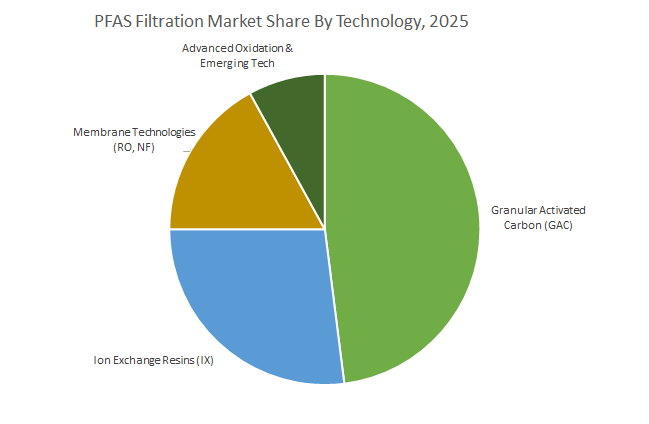
Granular Activated Carbon (GAC, 48.5%) dominates the market due to its cost-effectiveness, wide adoption, and proven performance for municipal water treatment. Ion Exchange resins (IX, 26.9%) are the fastest-growing technology, particularly effective for short-chain PFAS compounds like GenX, offering higher loading capacity and extended bed life. Membrane technologies (RO/NF, 16.9%) are highly effective at achieving non-detect PFAS levels but produce concentrated waste streams. Advanced Oxidation & emerging technologies, including AOPs and electrochemical destruction, represent a high-value, future-focused segment aimed at permanently destroying PFAS and addressing the challenge of contaminated media disposal.
Market Share by Media Type: Carbon-Based Media Retains Dominance, Resins Gain Traction
Carbon-based media (54.2%), primarily GAC, remains the incumbent due to its established supply chain, high adsorption capacity, and familiarity among water treatment engineers. Resin-based media (44.1%) is increasingly favored for its longer lifespan, higher removal efficiency, and ability to handle diverse PFAS compounds, making it particularly attractive for industrial and municipal remediation. Emerging media, such as Molecularly Imprinted Polymers (MIPs) and modified clays, are still niche but represent high-potential innovation opportunities for specialty applications.
Market Share by Application: Drinking Water Leads, Remediation Expands Rapidly
Drinking water treatment (44.1%) dominates, driven by legally enforceable MCLs and the urgent need for municipal compliance. Wastewater and groundwater remediation (32.8%) are high-value segments fueled by corporate liability, Superfund actions, and legacy contamination sites, creating long-term demand for advanced PFAS solutions. Industrial process wastewater (16.9%) represents a growing segment as regulators focus on source control, requiring industries to treat PFAS at the point of discharge. Soil remediation often involves washing contaminated soil and subsequently treating the wash water, creating integrated opportunities for filtration and treatment providers.
Competitive Landscape of the PFAS Filtration Market
The competitive structure of PFAS filtration includes integrated water-treatment companies, adsorption-media producers, ion-exchange resin manufacturers, membrane suppliers, environmental engineering groups and providers of downstream residual-treatment technologies. Competitive positioning differs materially according to whether a company supplies a complete treatment system, a consumable filtration medium, process engineering or a technology for PFAS-rich residual streams.
Integrated PFAS Treatment Systems and Services
Veolia, Xylem, SUEZ, Kurita Water Industries and Hawkins/WaterSurplus participate across system design, treatment equipment, media integration, mobile or fixed assets and operating services. Veolia's portfolio includes full-scale municipal filtration and residual management, while SUEZ has implemented continuously renewed activated-carbon treatment within an existing drinking-water plant. Xylem incorporates capabilities originating from its 2023 acquisition of Evoqua, consolidating mobile water treatment, adsorption and ion-exchange capabilities within the Xylem organization.
System-level competition encompasses treatment capacity, retrofit compatibility, media-management services, modular deployment and the ability to integrate multiple separation stages. Municipal applications often emphasize permanent GAC or IX vessels, while remediation and industrial applications also use rental, mobile and containerized filtration configurations.
PFAS Filtration Media and Separation Materials
Calgon Carbon/Kuraray, LANXESS, Ecolab/Purolite, DuPont and Cyclopure participate through carbon, selective ion-exchange resins, membrane technologies or engineered adsorbents. Calgon Carbon combines GAC production with equipment and reactivation infrastructure, while LANXESS and Purolite supply selective resin chemistries for PFAS removal. Cyclopure's DEXSORB adds a specialty adsorbent platform to this media segment.
DuPont participates through RO, NF and ion-exchange technologies applicable to PFAS separation and multi-stage water-treatment systems. Membrane suppliers occupy a different technical position from GAC and resin producers because rejected PFAS remains concentrated in the membrane-retentate stream.
Downstream PFAS Concentrate and Residual Treatment
Aclarity, AECOM/Aquatech and Veolia also participate in technologies associated with destruction or management of PFAS-rich residual streams. Electrochemical oxidation and thermal treatment address concentrated PFAS after separation rather than replacing GAC, IX or membrane filtration as the initial water-treatment step.
This distinction separates the competitive roles of filtration-media suppliers from companies working on end-of-life treatment of spent media, regenerant, RO concentrate and other PFAS-bearing wastes. EPA's 2026 interim guidance continues to identify significant data gaps across destruction and disposal technologies. US EPA
United States: Federal Regulations and Infrastructure Investments Accelerating PFAS Filtration Market Growth
The United States PFAS filtration market is witnessing rapid growth, driven primarily by regulatory enforcement and infrastructure investment. In April 2024, the EPA finalized the first-ever national drinking water standards for six PFAS compounds, setting a strict Maximum Contaminant Level (MCL) of 4.0 ppt for PFOA and PFOS. These rules are reshaping municipal and industrial adoption of advanced PFAS removal technologies.
The Biden-Harris Administration’s $2 billion allocation under the Bipartisan Infrastructure Law (BIL) supports small, rural, and disadvantaged communities in addressing PFAS contamination through source water treatment and infrastructure upgrades. Corporate innovation is also reshaping the market: in April 2025, Hawkins acquired WaterSurplus, enhancing its PFAS filtration equipment portfolio, while Georgia Tech researchers unveiled an AI-driven model that can identify new membrane materials capable of blocking over 95% of PFAS in days.
As utilities, industries, and municipalities race to meet federal standards, the U.S. PFAS filtration market outlook is being defined by regulatory compliance, infrastructure funding, and next-generation technologies targeting "forever chemicals."
China: National Action Plan and Emerging PFAS Removal Technologies Driving Market Expansion
The China PFAS filtration market is driven by both policy intervention and technological development. Following widespread contamination, the government launched the “Action Plan on Controlling New Pollutants” in 2022, setting reference limits for PFOA and PFOS in drinking water and restricting PFAS production. These measures have accelerated investments in PFAS removal technologies across industrial regions, particularly in the highly developed eastern provinces.
Technological advancements are strengthening China’s position in the Asia Pacific PFAS filtration market. In early 2025, Asian researchers, including teams in China, collaborated on carbon-based filtration materials designed for PFAS remediation. China is also prioritizing circular economy solutions, such as water reuse and resource recovery, integrating them into its PFAS treatment strategy.
The country’s market expansion is supported by stringent standards for drinking water safety, industrial wastewater treatment, and remediation projects, positioning China as a key driver of Asia Pacific PFAS market growth.
Canada: New National Standards and Toxic Substance Classification Driving PFAS Filtration Adoption
The Canada PFAS filtration market is accelerating under strong regulatory and governmental initiatives. In August 2024, Health Canada introduced a combined concentration limit of 30 ng/L for 25 PFAS compounds, one of the strictest standards globally, even exceeding EU benchmarks. This regulatory framework has fueled demand for advanced filtration systems across municipalities and industries.
In 2025, Canada further escalated its stance by classifying all non-polymeric PFAS as toxic substances under national law. This designation grants federal authorities broad control over PFAS management across the lifecycle, including discharge limits and mandatory wastewater monitoring.
Key applications include remediation at military bases and airports, where PFAS-containing firefighting foams were historically used, and ensuring compliance at federal sites. With strong policies and growing investment, Canada is emerging as a leader in North American PFAS remediation and drinking water protection.
Germany: EU Directives and Innovation in Advanced Water Treatment Technologies Boosting PFAS Filtration Market
The Germany PFAS filtration market is shaped by strict EU-wide regulatory frameworks and strong domestic innovation. In January 2025, the revised EU Urban Wastewater Treatment Directive came into force, mandating enhanced monitoring and treatment of pollutants, including PFAS. This regulation is pushing utilities and industries to adopt advanced PFAS filtration systems.
Germany’s leadership in water treatment technology development further supports its market strength. Research institutions and private companies are pioneering advanced filtration solutions for micropollutant and PFAS removal, ensuring compliance while addressing strong public demand for safe drinking water.
The combination of stringent EU directives and Germany’s role as a hub for PFAS removal technology innovations positions the country as a critical player in the European PFAS filtration market.
Australia: Government Research Funding and On-Site Remediation Innovations Driving PFAS Filtration Market
The Australia PFAS filtration market is expanding due to federal funding initiatives and novel remediation technologies. In December 2024, the Australian government allocated $8.2 million to nine research projects targeting PFAS remediation, including new water treatment and soil cleanup methods.
A notable technological advancement came from South Australia, where the SourceZone system demonstrated up to 99% PFAS mass removal from soil during a large-scale trial. This approach highlights Australia’s focus on sustainable, site-specific PFAS remediation technologies that minimize environmental risks.
The market’s growth is primarily driven by the need to remediate military bases, fire training facilities, and historically contaminated sites, combined with the country’s push for sustainable water management in a water-scarce environment.
Japan: Strict PFAS Ban and Cutting-Edge Membrane Technologies Reshaping Market Outlook
The Japan PFAS filtration market is undergoing rapid transformation following strong regulatory actions and technology breakthroughs. In January 2025, Japan enforced a ministerial ordinance under the Chemical Substances Control Law (CSCL), banning the manufacture, import, and use of 138 PFAS compounds, including restrictions on finished goods and components. This sweeping ban is pushing industries toward PFAS-free alternatives and advanced filtration solutions.
At the same time, Japanese researchers are pioneering PFAS removal innovations. The Institute of Science Tokyo developed a novel membrane distillation system and carbon-based adsorbents capable of removing PFAS from water without relying on conventional heaters. These electricity-free systems mark a major step toward sustainable and scalable PFAS treatment technologies.
Japan’s dual focus on regulatory compliance and technological innovation ensures its pivotal role in the Asia Pacific PFAS filtration market, particularly in driving next-generation remediation systems.
Saudi Arabia and UAE: SWRO Capacity Expands the Installed Base for Desalination Chemicals
The Gulf region represents a significant application base for desalination membrane chemicals, particularly antiscalants, membrane cleaners, biocides and dechlorination agents used in large seawater RO plants. High salinity, sulfate chemistry, biological activity and continuous high-throughput operation create recurring chemical-treatment requirements.
In the UAE, DEWA commissioned the first 60 MIGD block of the Hassyan seawater RO project during 2026 and expects the full facility to reach 180 MIGD, with completion scheduled for the first quarter of 2027. The project adds a large new operating base for seawater RO pretreatment, scale control and membrane-maintenance chemistry.
PFAS Filtration Market Report Scope
PFAS Filtration Market
Parameter
Details
Market Size (2025)
$2.4 Billion
Market Size (2034)
$4.5 Billion
Market Growth Rate
7.2%
Segments
By Technology (Granular Activated Carbon (GAC), Anion‐Exchange Resins, Membrane Technologies, Advanced Oxidation Processes (AOPs) and Electrochemical Processes), By Media Type (Carbon-based Media, Resin-based Media), By Application (Drinking Water Treatment, Wastewater & Groundwater Remediation, Industrial Process & Wastewater, Soil Remediation), By Service Type (Installation Services, Maintenance & Monitoring Services, Consulting Services), By End-User (Municipalities & Government Agencies, Industrial Facilities, Commercial & Residential, Environmental Remediation Contractors)
Study Period
2020- 2025 and 2026-2034
Units
Revenue (USD)
Qualitative Analysis
Porter’s Five Forces, SWOT Profile, Market Share, Scenario Forecasts, Market Ecosystem, Company Ranking, Market Dynamics, Industry Benchmarking
Companies
Veolia, Xylem Inc., Evoqua Water Technologies, DuPont de Nemours, Inc., SUEZ, Siemens, Kurita Water Industries Ltd., Aquatech International, Badger Meter, Calgon Carbon Corporation (A Subsidiary of Kuraray Co., Ltd.), Solvay S.A., LANXESS, Cummins Inc., Trojan Technologies (A Danaher Company), Aclarity LLC
Countries
US, Canada, Mexico, Germany, France, Spain, Italy, UK, Russia, China, India, Japan, South Korea, Australia, South East Asia, Brazil, Argentina, Middle East, Africa
PFAS Filtration Market Segmentation
By Technology
Granular Activated Carbon (GAC)
Anion‐Exchange Resins
Membrane Technologies
Advanced Oxidation Processes (AOPs) and Electrochemical Processes
By Media Type
Carbon-based Media
Resin-based Media
By Application
Drinking Water Treatment
Wastewater & Groundwater Remediation
Industrial Process & Wastewater
Landfill Leachate
Firefighting Training Grounds
Chemical Manufacturing
Metal Plating
Soil Remediation
By Service Type
Installation Services
Maintenance & Monitoring Services
Consulting Services
By End-User
Municipalities & Government Agencies
Industrial Facilities
Commercial & Residential
Environmental Remediation Contractors
Countries Analyzed
North America (US, Canada, Mexico)
Europe (Germany, UK, France, Spain, Italy, Russia, Rest of Europe)
Asia Pacific (China, India, Japan, South Korea, Australia, South East Asia, Rest of Asia)
South America (Brazil, Argentina, Rest of South America)
Middle East and Africa (Saudi Arabia, UAE, Rest of Middle East, South Africa, Egypt, Rest of Africa)
Top Companies in the PFAS Filtration Industry include-
Veolia
Xylem Inc.
SUEZ
Kurita Water Industries Ltd.
Calgon Carbon Corporation / Kuraray
LANXESS
Ecolab / Purolite
DuPont
Cyclopure Inc.
Hawkins / WaterSurplus
DESOTEC
Jacobs
AECOM
Aquatech International
Aclarity
*- List not Exhaustive
Research Coverage
USDAnalytics evaluates the PFAS filtration market across municipal drinking water, groundwater remediation, industrial wastewater, landfill leachate, firefighting-foam-impacted water and other PFAS-containing liquid streams. Technology coverage includes activated-carbon filtration, selective ion exchange, RO/NF membranes, engineered adsorbents and treatment of residual materials generated after PFAS separation.
The research distinguishes water-phase capture and separation from downstream PFAS destruction, reflecting differences in technology function, equipment configuration and commercial participation. Technical analysis incorporates PFAS chain length, adsorption behavior, breakthrough characteristics, competing water constituents, media replacement, carbon reactivation, resin handling, membrane rejection and concentrate generation.
Regulatory assessment incorporates current drinking-water requirements, contaminant-monitoring frameworks, remediation policy and treatment-residual guidance from national and regional authorities. Company analysis uses documented treatment installations, product portfolios, field trials, manufacturing and reactivation capacity, acquisitions and technology partnerships. Manufacturer-reported treatment-performance data are identified as company-reported results where independent regulatory validation is not available.
Scope Includes-
Segmentation: By technology (GAC; anion-exchange resins; membranes; AOPs/electrochemical), media type (carbon-based; resin-based), application (drinking water; wastewater & groundwater remediation; industrial process & wastewater landfill leachate, fire-training grounds, chemical manufacturing, metal plating; soil remediation), service type (installation; maintenance & monitoring; consulting), and end-user (municipalities & government; industrial; commercial & residential; remediation contractors).
Geographic Scope: “Analysis spans 25+ countries across North America, Europe, Asia Pacific, Latin America, the Middle East & Africa.”
Historic data from 2021 to 2024 and forecast data from 2025 to 2034.
Companies (Profiles of 15+ companies): Veolia; Xylem Inc.; Evoqua Water Technologies; DuPont de Nemours, Inc.; SUEZ; Siemens; Kurita Water Industries Ltd.; Aquatech International; Badger Meter; Calgon Carbon Corporation (Kuraray); Solvay S.A.; LANXESS; Cummins Inc.; Trojan Technologies (Danaher); Aclarity LLC.
Methodology
USDAnalytics combines primary research with secondary validation across water utilities, plant managers, filtration OEMs, treatment-media suppliers, environmental remediation organizations and engineering contractors. Secondary research incorporates regulatory rulemaking, government technical documentation, project information, manufacturer technical literature, procurement information, company filings and peer-reviewed scientific evidence.
Bottom-up market modeling incorporates installed and awarded treatment projects, filtration capacity, media consumption and change-out cycles, treatment volumes and technology deployment. Top-down validation examines water-treatment expenditure, municipal and industrial demand, regulatory implementation, contamination-remediation activity and regional treatment infrastructure.
Technology analysis considers removal performance across PFAS chemistries, GAC and resin characteristics, empty-bed contact time, breakthrough behavior, membrane rejection, residual generation, media handling and treatment configuration. Forecast modeling incorporates regulatory timelines, treatment infrastructure spending, filtration-media capacity, industrial remediation requirements and adoption of PFAS-specific separation technologies.
Deliverables:
Comprehensive Market Research Report (PDF and Excel) with detailed tables, charts, and interactive visualizations.
Country-Specific Forecasts & Analysis.
Segment-Wise Revenue Forecasts (2025–2034).
Competitive Analysis, Benchmarking, and SWOT Profiles.
Recent Developments & Innovation Tracker.
Executive Summary & Analyst Commentary.
Post-Purchase Analyst Support for Client-Specific Questions and Custom Data Requirements.
Table of Contents: PFAS Filtration Market
1. Executive Summary
1.1. Market Highlights & Key Projections
1.2. Global Market Snapshot
1.3. Key Findings
2. PFAS Filtration Market Overview (2025–2034)
2.1. Introduction
2.2. Market Valuation and Growth Projections (2025–2034)
The global PFAS filtration market is valued at $2.4 billion in 2025 and is forecast to reach $4.5 billion by 2034, representing a CAGR of 7.2% over the forecast period.
Commercial PFAS separation technologies include granular activated carbon, anion-exchange resins, reverse osmosis and nanofiltration. EPA's PFAS treatment evaluation identifies GAC, PFAS-selective IX and RO/NF as best available technologies for regulated PFAS in drinking water.
GAC captures PFAS through adsorption on porous carbon surfaces, while anion-exchange resins use charged functional groups and hydrophobic interactions to retain PFAS. GAC has extensive full-scale drinking-water use, while selective IX products provide high PFAS loading capacity and are increasingly used for compounds that exhibit earlier breakthrough on conventional carbon media.
Drinking-water treatment accounts for 44.1% of the market, followed by wastewater and groundwater remediation at 32.8% and industrial process and wastewater applications at 16.9%.
Programs increasingly specify traceable waste chains, reactivation with certified facilities, and on-site/off-site destructive technologies for regenerants and concentrates to reduce Superfund exposure. Contracts align KPIs to breakthrough, waste volumes, and compliance uptime, while continuous online analyzers provide defensible data for audits and reporting.