Water Purification Adsorbents Market: Growth Analysis and Value Forecast
Adsorbents for Water Purification Market Overview
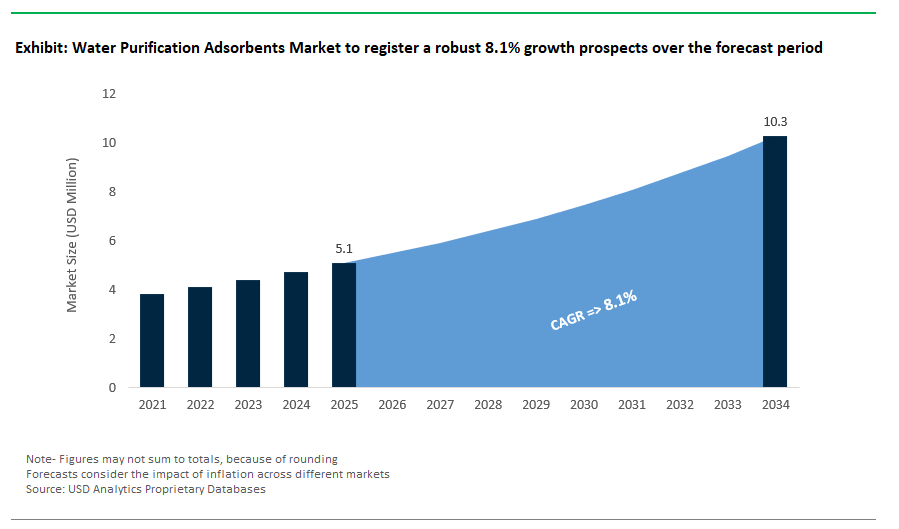
The global Adsorbents for Water Purification Market, encompassing specialized water treatment adsorbents and adsorption media, is valued at $5.1 billion in 2025 and is projected to reach $10.3 billion by 2034, expanding at a CAGR of 8.1%. Water purification adsorbents are solid treatment materials used to remove dissolved organic compounds, inorganic contaminants, taste- and odor-causing substances, micropollutants and selected emerging contaminants from drinking water, municipal wastewater, industrial process water, groundwater and point-of-use systems. Major material classes include activated carbon, zeolites, activated alumina, iron and other metal oxides, clay and mineral media, polymeric adsorbents, silica-based materials and bio-derived sorbents.
Commercial water treatment media address different contaminant classes according to their surface chemistry and pore structure. Activated carbon is extensively used for organic contaminants, pesticides, pharmaceuticals, natural organic matter, disinfection-by-product precursors and taste and odor compounds. Activated alumina and iron-based media are associated with arsenic, fluoride, phosphate and other oxyanions, while zeolites provide ion-exchange and molecular-sieving characteristics relevant to ammonium and selected metal ions. Polymeric, engineered mineral and bio-based adsorbents extend the material portfolio for applications requiring contaminant selectivity or specialized water-treatment configurations.
Adsorbent performance depends on pore architecture, surface functionality, particle size, contaminant speciation, pH, natural organic matter, competing ions, influent concentration, hydraulic loading and contact time. Fixed-bed water purification adsorbents operate until contaminant breakthrough reaches a defined treatment endpoint, while powdered materials are dosed into water and removed during subsequent solids separation. Selected adsorbents can be regenerated or thermally reactivated, creating recurring demand for media replacement, reactivation and spent-media handling across municipal and industrial water treatment applications.
Adsorbents for Water Purification Market Developments and Commercial Adoption
Reactivated carbon is becoming a more formalized category of municipal drinking-water treatment media. In 2026, Kuraray announced an approximately $100 million expansion at Calgon Carbon's Columbus, Ohio facility to add 12,300 tons per year of reactivated-carbon capacity for drinking-water applications, with operations scheduled for 2028. In June 2026, Calgon Carbon also introduced Filtrasorb Rx, a reactivated granular activated carbon grade developed for municipal drinking-water systems.
Engineered mineral adsorbents are expanding contaminant-specific water and remediation applications. In September 2026, CETCO, a Minerals Technologies company, reported that FLUORO-SORB received the Water Environment Federation Innovative Technology Award. The proprietary bentonite-based adsorbent is applied across drinking water, landfill leachate, wastewater, contaminated groundwater and soil, extending specialty adsorption media beyond conventional activated carbon and resin chemistries.
Inorganic adsorption media are developing around nutrient and oxyanion removal as well as drinking-water purification. At IFAT 2026, LANXESS presented Bayoxide E IN 20, an iron-oxide-hydroxide adsorbent evaluated for phosphorus removal from municipal wastewater. The company reported pilot effluent concentrations of no more than 0.1 mg/L phosphorus under the cited test conditions and identified a larger demonstration installation as the next stage of commercial validation.
Activated-carbon functionality is expanding beyond conventional contaminant adsorption. CarboTech and Heraeus Precious Metals presented antimicrobial-functionalized activated carbon at FILTECH 2026 for filtration and water-treatment applications. The material combines activated-carbon adsorption with antimicrobial surface functionality intended to limit microbial growth and biofilm formation on filtration media.
Spent-media treatment is becoming increasingly integrated with the commercial activated-carbon lifecycle. In September 2025, NORIT Activated Carbon reported validation of 99.98% PFAS destruction through the thermal reactivation process at its NSF-certified Pryor, Oklahoma facility. The performance figure represents company-reported results for the specified reactivation process and operating conditions.
Activated Carbon for Water Treatment Remains Central to Organic-Contaminant Removal
Activated carbon functions through adsorption on internal pore surfaces created during carbonization and activation. Micropores contribute strongly to adsorption of smaller molecules, while mesopores support transport and adsorption of larger organic compounds. The distribution of pore sizes therefore affects performance against taste- and odor-causing compounds, natural organic matter, pesticides, pharmaceuticals, industrial organics and other micropollutants.
Commercial activated carbon is produced from carbonaceous feedstocks including bituminous coal, coconut shell and wood. Feedstock and activation conditions produce different pore structures, densities, hardness characteristics and adsorption profiles. Coal-based granular products are extensively used in municipal fixed beds, coconut-shell carbons are associated with highly microporous structures, and wood-based carbons are widely available in powdered forms with pore structures suited to larger organic molecules.
Granular activated carbon is used as a fixed-bed material through which water continuously passes, allowing a measurable mass-transfer zone to develop through the bed. Powdered activated carbon is dosed into the treatment stream and subsequently removed with solids rather than retained as a permanent packed bed. Activated-carbon fibers provide another configuration in which high external surface accessibility and short diffusion paths can support rapid adsorption in compact formats.
The contaminant range is broader than PFAS. Commercial drinking-water carbon portfolios cover geosmin and MIB, pesticides, volatile organic compounds, natural organic matter, disinfection-by-product precursors, endocrine-disrupting compounds, pharmaceuticals and other micropollutants. Jacobi Carbons, for example, documents these applications across its AquaSorb water-treatment portfolio, while Ingevity's AquaNuchar products are designed around taste, odor and total-organic-carbon reduction.
Activated Alumina and Iron-Oxide Water Treatment Media Target Arsenic, Fluoride and Oxyanions
Activated alumina provides a high-surface-area aluminum-oxide medium capable of adsorbing ionic contaminants under suitable water-chemistry conditions. Its established drinking-water applications include arsenic and fluoride, while adsorption capacity varies with pH, contaminant speciation, competing ions and the condition of the adsorbent surface. Regeneration can be technically feasible for selected alumina systems, producing a concentrated regenerant stream requiring subsequent management.
Iron-based media provide strong affinity for arsenic and several other oxyanions. Granular ferric oxide and ferric hydroxide materials can operate in fixed beds, where target species bind to hydroxylated iron surfaces as water passes through the adsorber. The media are also used for phosphate, antimony, selenium and selected heavy-metal applications depending on the formulation and water matrix.
Arsenic chemistry makes speciation important to adsorbent performance. Arsenate and arsenite differ in surface interaction and treatment behavior, while oxidation upstream of adsorption can alter the dominant arsenic form. The Jal Jeevan Mission treatment handbook notes that sorption efficiency depends on both adsorbent choice and competing constituents within the water matrix.
Commercial iron-oxide products illustrate the specialization of this segment. LANXESS Bayoxide E 33 is designed for arsenic and other ionic contaminants in potable water, while other Bayoxide grades target process water, wastewater and phosphate removal. NSF/ANSI 61-approved variants are available for drinking-water applications.
Water Treatment Adsorbent Performance Depends on Breakthrough, Contact Time and Water Chemistry
Adsorbent capacity measured under laboratory equilibrium conditions does not directly equal usable capacity in a continuously operated water-treatment bed. Full-scale performance is governed by mass-transfer kinetics, hydraulic residence time and the progressive formation of a contaminant-loading front through the media. Breakthrough occurs when the target contaminant begins appearing in treated water at a concentration that defines the operating endpoint.
Empty-bed contact time represents the nominal contact duration calculated from the volume of the media bed and water-flow rate. Shorter contact times increase throughput but provide less time for contaminant transfer into internal pores or reactive sites. Bed depth affects available adsorbent inventory and the distance through which the mass-transfer zone can progress before breakthrough reaches the outlet.
Water composition modifies these relationships. Natural organic matter competes for activated-carbon surface area and can block pores, while competing anions influence inorganic adsorbents and ion-selective media. pH alters contaminant speciation and surface charge. Suspended solids can create pressure loss and interfere with access to adsorbent surfaces, particularly in packed beds containing relatively fine media.
Particle characteristics influence both adsorption kinetics and hydraulics. Smaller particles shorten internal diffusion distances but create higher pressure drops, while larger granules allow easier hydraulic operation but can require longer mass-transfer times. Attrition resistance becomes significant where media undergo repeated backwashing, hydraulic transport or thermal reactivation.
Service life is therefore expressed through treatment-specific metrics such as bed volumes processed, breakthrough concentration and replacement interval rather than by surface area alone. EPA's adsorptive-media treatment framework explicitly incorporates assumptions including bed volumes before breakthrough and bed depth into treatment-cost modeling.
Major Water Purification Adsorbents and Treatment Applications
Major Water Purification Adsorbents and Treatment Applications
Arsenic, phosphate, selenium and selected metal ions
Zeolites
Ammonium, selected metal ions and ionic contaminants
Polymeric Adsorbents
Targeted organic compounds and contaminant-selective purification
Clay & Mineral Adsorbents
Groundwater, wastewater and contaminant-specific remediation
Bio-Based Adsorbents
Metals, dyes, organic compounds and specialty water-treatment applications
Reactivation, Regeneration and Spent-Media Handling Shape the Adsorbent Lifecycle
Adsorbents eventually accumulate sufficient contaminant loading that continued operation no longer provides the required treated-water quality. The material then enters a replacement, regeneration, reactivation or disposal stage. The available pathway depends on media chemistry, adsorbed contaminants, operating history and the applicable waste-management framework.
Granular activated carbon has an established thermal reactivation route. Spent carbon is removed from treatment vessels, processed at elevated temperature to desorb or destroy accumulated organic contaminants, and returned to service where the reactivated material meets the required product specifications. Physical losses and changes in carbon properties occur during handling and reactivation, creating a continuing requirement for make-up carbon.
Other adsorptive materials use different regeneration chemistries. Selected activated alumina systems can be regenerated using acid and caustic washes, while polymeric ion-selective materials may use chemical regenerants selected for the functional groups and retained contaminants. Regeneration transfers contaminant mass into a smaller liquid waste stream, separating media reuse from final contaminant management.
Spent-media logistics constitute a commercial activity distinct from adsorbent manufacturing. Vessel change-outs, transport, media characterization, reactivation, fresh-media replacement and disposal services support recurring revenue over the operating life of municipal and industrial treatment systems. Carbon producers with captive reactivation networks participate across a larger portion of this lifecycle than suppliers focused solely on virgin media.
Tertiary Micropollutant Removal Expands Adsorbent Use in Municipal Wastewater
Conventional primary and biological wastewater treatment removes suspended solids, biodegradable organic matter and nutrients but can leave trace concentrations of pharmaceuticals, endocrine-active compounds, pesticides and other persistent organics in final effluent. Adsorption provides an additional separation mechanism for compounds that are poorly biodegradable or occur at concentrations below those addressed efficiently by conventional biological processes.
Powdered activated carbon can be dosed into tertiary or advanced treatment stages and subsequently separated from the water with sludge or filtration processes. Granular activated carbon provides fixed-bed polishing in which treated wastewater passes through a carbon bed before discharge or reuse. The two configurations create different carbon-consumption, solids-management and plant-integration requirements.
Quaternary treatment policy in Europe places additional regulatory attention on broad-spectrum micropollutant removal. Directive (EU) 2024/3019 requires staged implementation for large wastewater-treatment plants and risk-designated smaller agglomerations through 2045, while producers of pharmaceuticals and cosmetics are required to finance at least 80% of specified quaternary-treatment costs under the extended producer responsibility framework.
Adsorbents also operate as final polishing materials in industrial water reuse, pharmaceutical wastewater, food-processing water and other applications where residual organic compounds can restrict discharge or recycling. Polishing configurations typically treat water after substantial contaminant reduction in earlier biological, chemical or membrane stages, concentrating adsorbent capacity on the remaining dissolved compounds.
Bio-Based, Mineral and Framework Adsorbents Progress at Different Commercial Maturity Levels
Bio-based adsorbents encompass a heterogeneous material group derived from agricultural residues, lignin, cellulose, chitosan and thermochemically produced biochar. Surface chemistry can be modified through activation, oxidation, impregnation or functionalization to alter affinity for metals, dyes, organics and ionic contaminants. Feedstock variability, ash content, pore structure and functional-group density produce substantial differences between bio-based materials marketed under the same broad classification.
Engineered mineral adsorbents occupy a more established commercial position in selected applications. Bentonite, modified clays and metal-bearing minerals can provide adsorption or immobilization functions in groundwater, wastewater, landfill leachate and contaminated-soil applications. Material chemistry determines whether contaminant removal occurs primarily through surface adsorption, ion exchange, complexation or immobilization within the mineral matrix.
Polymeric adsorbents provide tunable pore structure and chemical functionality. Cross-linked polymer beads can be manufactured with controlled porosity and functional groups to target organic molecules or ions, while chelating and ion-exchange materials provide higher selectivity for defined dissolved species. Mitsubishi Chemical's separation portfolio includes porous synthetic adsorbents and chelating resins used across liquid purification and wastewater applications.
Metal-organic frameworks and related high-surface-area crystalline materials remain at an earlier stage for bulk aqueous treatment. Their tunable pore chemistry supports high laboratory adsorption performance for selected contaminants, but water stability, synthesis cost, competing solutes, regeneration and scale-up remain important distinctions between laboratory sorption data and continuous commercial water-treatment use.
Adsorbents for Water Purification Regulatory Landscape and Treatment Standards
Drinking-water regulation creates contaminant-specific demand for adsorptive media where adsorption is an established treatment route. The U.S. EPA identifies activated carbon as one form of adsorptive media and separately recognizes aluminum-, iron-, titanium- and zirconium-based materials. EPA's technical framework associates adsorptive media with contaminants including arsenic, fluoride, selenium, thallium and uranium and identifies activated alumina, iron-modified activated alumina, granular ferric oxide and granular ferric hydroxide within drinking-water treatment cost models. EPA's drinking-water adsorptive-media guidance also states that adsorptive capacity depends on media characteristics, water chemistry and contaminant properties.
U.S. drinking-water standards establish a 0.010 mg/L MCL for arsenic, 4.0 mg/L for fluoride, 10 mg/L for nitrate as nitrogen, and 1 mg/L for nitrite as nitrogen. These standards interact with adsorbent demand according to contaminant and treatment route; activated alumina and iron-based media have established roles in arsenic and fluoride treatment, while selective resin and other media are applied to specific ionic contaminants.
European wastewater regulation adds a different demand mechanism. Directive (EU) 2024/3019 introduces progressive quaternary treatment requirements for organic micropollutants, reaching all covered urban wastewater plants of at least 150,000 population equivalent by 2045 and applying risk-based requirements to certain smaller agglomerations. The directive does not prescribe activated carbon as the only treatment process, but adsorption using powdered or granular activated carbon is an established route for removing organic micropollutants during advanced wastewater treatment. The EU Urban Wastewater Treatment Directive establishes the implementation timetable.
Indian drinking-water treatment guidance provides a regulator-backed basis for inorganic adsorbent use. The Jal Jeevan Mission handbook describes activated alumina, activated carbon, iron- and manganese-coated sand, kaolinite clay and hydrated ferric oxide among sorptive materials used for arsenic removal and notes that competing constituents in water influence adsorption capacity. The government's Handbook on Drinking Water Treatment Technologies places sorption within the country's drinking-water treatment technology framework.
Emerging contaminants add another regulatory layer. PFAS treatment requirements in the United States, Europe, Japan, Canada and the UK have increased evaluation and deployment of granular activated carbon, selective polymeric media and specialty adsorbents. PFAS represents one contaminant family within the wider water-purification adsorbent market rather than the sole basis for material demand.
Adsorbents Market for Water Purification – Segmentation Insights (2025–2034)
Activated carbon commands the largest market share among adsorbent types, accounting for 42.3% of the adsorbents market for water purification in 2025. Its prominent position is driven by stringent regulations mandating the effective removal of contaminants such as PFAS and pharmaceuticals from drinking water. Activated carbon’s high adsorption efficiency, scalability, and proven effectiveness across various purification applications significantly bolster its market presence. Meanwhile, bio-based adsorbents, encompassing innovative materials like biochar and chitosan, are experiencing the fastest growth at a notable 9.3% CAGR. This rapid expansion results from an increased global emphasis on sustainability and environmentally responsible water treatment solutions. Other significant adsorbents include zeolites, growing at a healthy pace primarily due to their efficacy in ammonium and radionuclide removal (10% CAGR), activated alumina for fluoride and arsenic removal, polymer-based adsorbents witnessing rising adoption for specialized contaminant targeting, silica gel favored for moisture-sensitive purification, and traditional clay & mineral adsorbents maintaining steady use in cost-sensitive applications.
In the adsorbents market segmented by function, polishing or tertiary treatment occupies the leading position with a market share of 34.2% in 2025. This dominance reflects heightened global initiatives aimed at micropollutant elimination particularly pharmaceuticals, pesticides, and industrial contaminants resulting in widespread adoption across municipal and industrial water treatment sectors. In contrast, the wastewater resource recovery segment exhibits the fastest growth, achieving a robust CAGR of 9.7% during 2025–2034. Its growth trajectory is closely linked to increasing implementation of circular economy strategies, targeting the recovery of valuable nutrients such as phosphorus and nitrogen for reuse. Additionally, Point-of-Use (POU) systems show significant momentum driven by rising consumer awareness around PFAS contamination and preference for personalized filtration solutions at household levels. Meanwhile, primary treatment remains integral for initial contaminant reduction, while Point-of-Entry (POE) systems continue steady expansion, particularly in residential and commercial infrastructures demanding comprehensive water purification solutions at entry points.
Competitive Landscape of the Adsorbents for Water Purification Market
The competitive landscape includes global water treatment adsorbent manufacturers, activated carbon suppliers, inorganic treatment-media producers, ion-exchange specialists and engineered adsorbent material companies. Supplier positioning differs according to contaminant selectivity, adsorption capacity under real-water conditions, media form, hydraulic performance, drinking-water certification, regeneration or reactivation capability and access to commercial-scale manufacturing.
Activated-carbon suppliers compete across feedstock, pore-size distribution, powdered and granular product forms, drinking-water grades and reactivation infrastructure. Inorganic water treatment media suppliers focus more heavily on contaminant-specific chemistry such as arsenic, fluoride, phosphate and other oxyanions. Polymeric and engineered mineral adsorbent manufacturers differentiate through functional groups, contaminant affinity, regeneration behavior and suitability for drinking water, industrial wastewater, groundwater or environmental remediation.
The market also includes companies combining adsorbent production with media change-out, carbon reactivation, technical support and treatment-system integration. This creates commercial differentiation between suppliers selling primarily virgin adsorbent materials and companies participating across a larger portion of the water-treatment media lifecycle.
Activated Carbon and Reactivation Suppliers
Calgon Carbon/Kuraray, Jacobi Carbons, NORIT Activated Carbon, Haycarb, Ingevity and CarboTech supply activated-carbon products across municipal drinking water, wastewater, groundwater and industrial water treatment. Their portfolios include powdered, granular and extruded carbon grades developed for organic contaminants, taste and odor, natural organic matter, micropollutants and contaminant-specific treatment requirements.
Inorganic and Selective Water Treatment Media Suppliers
LANXESS, Axens and Evonik Industries participate through iron-oxide, activated-alumina and other adsorptive materials used for arsenic, fluoride, phosphate, oxyanions and selected metal removal. Commercial differentiation reflects surface chemistry, particle characteristics, contaminant capacity, hydraulic behavior and suitability for certified drinking-water applications.
Polymeric and Engineered Adsorbent Manufacturers
Ecolab/Purolite, ResinTech, Mitsubishi Chemical Group, Minerals Technologies/CETCO and Cyclopure participate through polymeric, ion-selective, mineral and specialty adsorbent platforms. These materials address contaminant-specific purification across potable water, industrial treatment, groundwater and environmental remediation.
United States Leads Adsorbents Market with Federal Funding and PFAS Innovation
The United States stands as a central driver of the global adsorbents market for water purification, propelled by unprecedented federal investments and a relentless focus on emerging contaminants such as PFAS. The Infrastructure Investment and Jobs Act, the largest federal commitment to water infrastructure in U.S. history, has earmarked over $50 billion to the EPA for upgrading the nation’s drinking water, wastewater, and stormwater networks. A landmark $15 billion allocation specifically targets the Drinking Water State Revolving Fund to replace aging lead service lines, catalyzing demand for advanced adsorbent solutions that effectively capture heavy metals and toxicants. Additionally, $4 billion is channeled towards addressing “emerging contaminants” notably PFAS or “forever chemicals” which is fueling a surge in the development and deployment of next-generation adsorbents engineered for selectivity, durability, and environmental compliance.
The EPA’s strategic promotion of innovative and alternative wastewater treatment technologies, showcased in its Wastewater Treatment Clearinghouse, is accelerating the adoption of adsorbent-based water purification systems across municipalities. As utilities modernize aging infrastructure, the integration of smart, high-capacity, and regenerable adsorbent materials is becoming an essential component of long-term water quality assurance in the United States. The ongoing transformation, underpinned by government funding and regulatory mandates, positions the U.S. as a frontrunner in the commercialization and innovation of water purification adsorbents, setting standards for the global industry.
China Accelerates Advanced Materials and Bio-Based Adsorbents for Sustainable Water Purification
China’s rapid industrial growth and urbanization are fundamentally reshaping the country’s water purification adsorbents market. The competitive landscape is moving decisively beyond conventional activated carbon, with leading Chinese enterprises and research institutions investing in advanced adsorbent technologies such as zeolites, graphene, and metal-organic frameworks (MOFs) for highly selective contaminant removal. In response to escalating environmental regulations, there is a pronounced shift toward sustainable and cost-efficient adsorbent feedstocks including rice husks, bamboo, and sugarcane bagasse positioning China as a key innovator in the development of bio-based adsorbents.
Sustainability is driving not only materials selection but also process innovation. The growing focus on regenerable media, although requiring upfront capital for infrastructure, promises long-term operational cost savings and improved lifecycle sustainability. China’s municipal water sector is an especially vibrant market for ion-exchange zeolites, prized for their efficiency and cost-effectiveness in ammonia and heavy metal removal. These trends underscore China’s dual emphasis on environmental stewardship and advanced materials science, cementing its role as a major player in the global adsorbents market.
India Champions Affordable, Sustainable Adsorbents with Breakthrough Nanomaterial Technologies
India is fast emerging as an epicenter for innovation in the adsorbents market, with a focus on affordable, scalable, and sustainable solutions for both urban and rural water purification needs. Pioneering research at the Indian Institute of Technology (IIT) Madras has led to the development of AMRIT (Anion and Metal Removal by Indian Technology), a breakthrough nanomaterial-based adsorbent platform for arsenic, fluoride, and multi-contaminant removal. The AMRIT technology, rolled out across diverse applications from household purifiers to large-scale community systems demonstrates India’s ability to deliver high-impact, low-maintenance water treatment solutions at scale.
A standout feature is the maintenance-free iron removal unit, eliminating the need for backwashing and sludge handling a persistent challenge in traditional water treatment. Cross-border collaborations, such as the Indo-US Science and Technology Endowment Fund’s project in West Bengal, further underscore India’s leadership in deploying innovative in-situ adsorbent generation for localized water challenges. By integrating advanced materials with community-centric delivery models, India is driving a new paradigm of affordable and sustainable water purification.
Germany Advances Green Adsorbents and Surface-Modified Materials for Superior Water Quality
Germany continues to set global benchmarks in adsorbents research and development, emphasizing the transition toward green, sustainable, and high-efficiency water purification materials. Leading academic and industrial R&D initiatives are advancing the use of renewable and biodegradable materials such as starch, chitosan, and nanoscale structures including zeolites and MOFs as the foundation for next-generation inorganic adsorbents. A core research focus lies in surface modification techniques, which are significantly enhancing the adsorption capacity and regenerative performance of various adsorbents.
Germany’s “green adsorbents” strategy is anchored in the valorization of agricultural and forestry waste streams, with biochar derived from forestry waste showing removal efficiencies above 69% for heavy metals in wastewater. This sustainability-first approach, combined with world-class engineering and regulatory rigor, is positioning Germany as a leader in the development of eco-friendly, high-performance adsorbents. The country’s commitment to R&D in sustainable water treatment technologies is shaping both European and global standards in water purification.
Canada Tightens PFAS Regulations and Drives Advanced Adsorbent Adoption
Canada’s regulatory landscape is rapidly evolving, making it one of the most dynamic markets for advanced water purification adsorbents. The federal government’s dramatic reduction in PFAS limits to just 30 nanograms per liter across 25 compounds represents one of the strictest regulatory stances worldwide, compelling water utilities and municipalities to invest in next-generation adsorbent materials and processes. This move is supported by a broader “source-to-tap” water quality approach, with enhanced guidelines for a wide array of microbiological and chemical parameters, including aluminum and antimony.
As municipal water providers assess contaminant levels and plan for extensive treatment upgrades, demand is surging for specialized adsorbents capable of meeting these stringent standards. Canada’s proactive regulatory measures are creating both legal and economic incentives for the rapid adoption of advanced adsorbent technologies. The country’s rigorous policies are not only transforming domestic water treatment but also setting influential precedents for global best practices in adsorbents deployment and water quality management.
Japan Drives Global Impact with Deployable Adsorbent Innovations and International Outreach
Japan distinguishes itself in the global adsorbents market through its emphasis on deployable, user-friendly technologies and international development partnerships. Nippon Poly-Glu Co., Ltd. exemplifies this with the invention of PGα21Ca a polyglutamic acid-based water purification “magic powder” derived from fermented soybeans, engineered to aggregate and remove impurities swiftly and efficiently. This technology, designed for easy use and local management, has been deployed in nearly 80 countries, improving water access for 18 million people and creating over 1,500 jobs globally.
Japan’s government, through robust Official Development Assistance (ODA), has historically invested billions into international water and sanitation projects, reinforcing its reputation as a leader in humanitarian and infrastructure-focused water solutions. By combining technological ingenuity with capacity-building and sustainability, Japan is catalyzing the global adoption of simple, scalable, and community-empowering adsorbent technologies.
France Pioneers Energy-Positive Wastewater Plants and Digital Water Solutions
France is carving a unique position in the adsorbents market through its leadership in sustainable infrastructure and the digital transformation of water management. Industry leaders such as SUEZ are developing innovative approaches to water resource protection, from large-scale wastewater reuse and desalination to the deployment of decentralized, off-grid purification systems. A notable example is the energy-positive wastewater treatment plant in Nice, designed to generate four times the energy it consumes, setting a new standard for sustainability in municipal infrastructure.
The French market is also at the forefront of integrating digital technologies for leak detection, predictive maintenance, and infrastructure optimization. EU-funded pilots, like the solar-powered, self-sufficient purification project in Côte d'Azur, showcase France’s commitment to combining renewable energy with cutting-edge adsorbent systems. These initiatives are driving both industrial and community-level innovation, positioning France as a hub for future-ready, digitally integrated water purification solutions.
United Kingdom Ramps Up Water Sustainability with Smart Infrastructure and Stewardship Programs
The United Kingdom is intensifying its efforts in water sustainability through a combination of ambitious government targets, infrastructure modernization, and private-sector collaboration. With a national goal to halve water leakage by 2050, the UK is investing heavily in the adoption of smart sensors, predictive analytics, and advanced adsorbent technologies for leak detection and water savings. Regulatory initiatives also aim to cut per capita water consumption from 143 to 110 liters per day by 2050, supported by standards review and extensive public engagement.
Private-sector partnerships, such as the Strategic Panel’s Market Improvement Fund with Yorkshire Water, are fostering the implementation of water stewardship programs that equip businesses with practical tools for sustainable water use. The “Plan for Water” integrates policies to restore water bodies, curb pollution, and boost supply resilience all of which drive demand for innovative adsorbents and next-generation treatment technologies. The UK’s holistic, data-driven approach is positioning it as a leader in advanced water sustainability and resource management.
Adsorbents Market for Water Purification Report Scope
Adsorbents Market for Water Purification
Parameter
Details
Market Size (2025)
$5.1 Billion
Market Size (2034)
$10.3 Billion
Market Growth Rate
8.1%
Segments
By Adsorbent Type (Activated Carbon, Zeolites, Silica Gel, Activated Alumina, Clay and Minerals, Metal Oxides, Polymer-based Adsorbents, Bio-based Adsorbents), By Application (Organic Contaminant Removal, Inorganic Contaminant Removal, Emerging Contaminant Removal, Color and Odor Removal, Desalination Support), By Function (Primary Treatment, Polishing/Tertiary Treatment, Point-of-Use (POU) Systems, Point-of-Entry (POE) Systems, Wastewater Resource Recovery), By End-User Industry (Municipal Water Treatment, Industrial Water Treatment, Food and Beverage, Pharmaceuticals, Textiles and Leather, Pulp and Paper, Mining and Metals, Residential/Household, Commercial), By Form (Granules/Extrudates, Powders, Pellets, Beads/Spheres, Fabrics/Non-wovens
Study Period
2020- 2025 and 2026-2034
Units
Revenue (USD)
Qualitative Analysis
Porter’s Five Forces, SWOT Profile, Market Share, Scenario Forecasts, Market Ecosystem, Company Ranking, Market Dynamics, Industry Benchmarking
US, Canada, Mexico, Germany, France, Spain, Italy, UK, Russia, China, India, Japan, South Korea, Australia, South East Asia, Brazil, Argentina, Middle East, Africa
Adsorbents Market for Water Purification Market Segmentation
By Adsorbent Type
Activated Carbon
Granular Activated Carbon (GAC)
Powdered Activated Carbon (PAC)
Activated Carbon Fibers (ACF)
Zeolites
Natural
Synthetic
Silica Gel
Activated Alumina
Clay and Minerals
Metal Oxides
Polymer-based Adsorbents
Bio-based Adsorbents
Chitosan
Lignin
Cellulose
Agricultural Waste
By Application
Organic Contaminant Removal
Pesticides/Herbicides
Pharmaceuticals and Personal Care Products (PPCPs)
Organic Solvents
Natural Organic Matter (NOM)
Inorganic Contaminant Removal
Heavy Metals (Arsenic, Lead, Mercury, Cadmium)
Fluoride
Nitrates/Nitrites
Ammonia
Emerging Contaminant Removal
Per- and Polyfluoroalkyl Substances (PFAS)
Microplastics
Endocrine Disruptors
Color and Odor Removal
Desalination Support
By Function
Primary Treatment
Polishing/Tertiary Treatment
Point-of-Use (POU) Systems
Point-of-Entry (POE) Systems
Wastewater Resource Recovery
By End-User Industry
Municipal Water Treatment
Drinking Water Plants
Wastewater Treatment Plants (WWTPs)
Industrial Water Treatment
Food and Beverage
Pharmaceuticals
Textiles and Leather
Pulp and Paper
Mining and Metals
Residential/Household
Commercial
By Form
Granules/Extrudates
Powders
Pellets
Beads/Spheres
Fabrics/Non-wovens
Countries Analyzed
North America (US, Canada, Mexico)
Europe (Germany, UK, France, Spain, Italy, Russia, Rest of Europe)
Asia Pacific (China, India, Japan, South Korea, Australia, South East Asia, Rest of Asia)
South America (Brazil, Argentina, Rest of South America)
Middle East and Africa (Saudi Arabia, UAE, Rest of Middle East, South Africa, Egypt, Rest of Africa)
Top Companies in Adsorbents Market for Water Purification
Calgon Carbon Corporation / Kuraray
Jacobi Carbons
NORIT Activated Carbon
Haycarb PLC
Ingevity Corporation
CarboTech Group
LANXESS
Axens
Evonik Industries
Ecolab / Purolite
ResinTech
Mitsubishi Chemical Group
Minerals Technologies / CETCO
Cyclopure
* List Not Exhaustive
Research Coverage
This report offers a focused analysis of the global adsorbents market for water purification, highlighting key breakthroughs, market drivers, and in-depth segmentation by adsorbent type, application, function, end-user industry, and form. It reviews the transition to advanced materials—including metal-organic frameworks, engineered biochar, and sustainable bio-based adsorbents—while examining adoption trends across major geographies and end-use sectors. With strategic insights and data-backed reviews, this report is an essential resource for industry professionals navigating regulatory changes, sustainability mandates, and new opportunities in water purification. USDAnalytics delivers the clarity and actionable intelligence needed for forward-thinking decision-makers.
Scope Highlights:
Segmentation:
By Adsorbent Type: Activated Carbon, Zeolites, Silica Gel, Activated Alumina, Clay and Minerals, Metal Oxides, Polymer-based Adsorbents, Bio-based Adsorbents
By Application: Organic Contaminant Removal, Inorganic Contaminant Removal, Emerging Contaminant Removal, Color and Odor Removal, Desalination Support
By End-User Industry: Municipal Water Treatment (Drinking Water, Wastewater Plants), Industrial Water Treatment, Food and Beverage, Pharmaceuticals, Textiles and Leather, Pulp and Paper, Mining and Metals, Residential/Household, Commercial
By Form: Granules/Extrudates, Powders, Pellets, Beads/Spheres, Fabrics/Non-wovens
Geographic Scope: Analysis spans 25+ countries across North America, Europe, Asia Pacific, Latin America, and the Middle East & Africa.
Data Coverage: Historic data from 2021 to 2024 and forecast data from 2025 to 2034.
Key Players: BASF SE, Calgon Carbon Corporation (Kuraray Co., Ltd.), W. R. Grace and Co.-Conn., Clariant, Evonik Industries AG, Cabot Corporation, Mitsubishi Chemical Corporation, Arkema SA, Honeywell International Inc., JALON (China) (list not exhaustive)
Methodology
USDAnalytics combines primary research with secondary validation across adsorbent manufacturers, municipal utilities, industrial water users, treatment-system integrators, environmental engineering organizations, reactivation service providers and contaminant-specific treatment specialists.
Secondary research incorporates national and regional drinking-water regulations, wastewater legislation, government technology assessments, manufacturer technical literature, product certification information, company disclosures, commercial installations and peer-reviewed adsorption research. Regulatory requirements and manufacturer performance claims are treated as separate evidence categories.
Bottom-up modeling incorporates adsorbent consumption, fixed-bed media inventory, powdered-media use, replacement and reactivation cycles, municipal and industrial treatment volumes, point-of-use applications, wastewater polishing and contaminant-specific treatment installations. Top-down validation incorporates water-treatment expenditure, municipal infrastructure activity, industrial water demand, regulatory implementation and regional contaminant-management requirements.
Material-level analysis evaluates adsorption chemistry, contaminant affinity, media form, service life, treatment function and end-user exposure. Forecast modeling incorporates changes in contaminant regulation, advanced wastewater treatment, reactivated-carbon capacity, specialty-media commercialization and expansion of tertiary polishing applications..
Deliverables
Complete Market Research Report (PDF, Excel): data tables, market charts, and visual insights.
Country-Level Forecasts & Analysis
Segment-wise Revenue Projections (2025–2034)
Competitive Benchmarking & SWOT Analysis
Recent Developments & News Tracker
Executive summary and key takeaway slides for boardroom presentations
Post-Purchase Analyst Support for Client-Specific Questions and Custom Data Requirements
Adsorbents Market for Water Purification
Table of Contents: Adsorbents Market for Water Purification
1. Executive Summary
1.1. Market Highlights
1.2. Key Findings
1.3. Global Market Snapshot
2. Adsorbents Market Landscape & Outlook (2025–2034)
2.1. Introduction to Adsorbents Market for Water Purification
2.2. Market Valuation and Growth Projections (2025–2034)
2.2.1. Current Market Size (2025): $5.1 Billion
2.2.2. Forecasted Market Size and CAGR (2034): $10.3 Billion at 8.1% CAGR
2.3. Activated Carbon: Cornerstone of Legacy Purification Systems
2.3.1. High Surface Area and Micropore Volume Performance
2.3.2. Challenges with Thermal Regeneration and Structural Degradation
2.3.3. Removal Efficiency for Persistent PFAS Compounds
2.4. Competitive Dynamics and Next-Gen Materials
2.4.1. Metal-Organic Frameworks (MOFs) in Pilot Stages
2.4.2. Need for Scalability, Selectivity, and Lower Regeneration Energy
2.5. Market Drivers: Water Security and Regulatory Pressures
3. Major Shifts and Emerging Opportunities in the Adsorbents Market
3.1. Market Trend: Rise of Next-Generation Adsorbents
3.1.1. Metal-Organic Frameworks (MOFs) and Engineered Biochar
3.1.2. Convergence of Tightening Regulations and Limitations of Legacy Technologies
3.1.3. Commercial Viability of MOF-based Systems (e.g., BASF)
3.1.4. Cost and Performance Benefits of Functionalized Biochar
3.1.5. Alignment with Circular Economy Mandates
3.2. Market Opportunity: Mining Sector as a High-Value Application
3.2.1. Recovery of Critical Minerals (Lithium, Boron, REEs) from Effluents
3.2.2. Dual-Value Proposition: Water Reuse and Mineral Monetization
3.2.3. Case Studies: EnergyX's MOF-Functionalized Membranes and SQM's Biochar Trials
3.2.4. Strategic Pivot Point for Adsorbent Suppliers in a High-Margin Vertical
4. Competitive Landscape: Adsorbents Market for Water Purification
4.1. Overview of Market Dynamics and Drivers
4.2. Key Players and Product Portfolios
4.2.1. Calgon Carbon (Kuraray): Leader in Activated Carbon (Filtrasorb®, Centaur®)
4.2.2. Mitsubishi Chemical: Diahope™ and Shirasagi™ Activated Carbon Lines
4.2.3. Clariant: Key Supplier of Activated Alumina
4.2.4. W. R. Grace and Honeywell UOP: Synthetic Zeolites and Silica Gel-Based Systems
4.2.5. BASF, Evonik, and Cabot: Specialized and Functionalized Adsorbents
4.2.6. JALON and Arkema: Cost-Effective Zeolites and Related Technologies
4.3. Key Competitive Factors: Efficiencies, Cost-Performance, and Reusability
5. Adsorbents Market for Water Purification – Segmentation Insights (2025–2034)
5.1. By Adsorbent Type
5.1.1. Activated Carbon: Largest Market Share (42.3% in 2025)
The global adsorbents market for water purification is estimated to reach $5.1 billion in 2025 and is projected to double to $10.3 billion by 2034, growing at a CAGR of 8.1%. This growth is driven by stricter environmental regulations, the need for PFAS removal, and the adoption of next-generation adsorbents like metal-organic frameworks (MOFs) and engineered biochar.
Next-generation adsorbents such as MOFs and engineered biochar are gaining traction due to their higher selectivity, scalability, and lower regeneration energy requirements compared to traditional activated carbon. Regulatory changes, such as the EPA’s PFAS limits (4 ppt), are making activated carbon systems less viable, while MOFs offer up to 99% PFAS removal and biochar aligns with circular economy goals by reducing waste and costs.
The mining industry is emerging as a high-value application for advanced adsorbents like MOFs and biochar. These materials enable both wastewater purification and resource recovery, such as lithium, boron, and rare earth elements. Technologies like MOF-functionalized membranes are helping mining companies recover 98% lithium while reducing freshwater procurement costs by up to 60%, creating a dual sustainability and profitability advantage.
The United States leads the global adsorbents market, supported by federal investments exceeding $50 billion for water infrastructure under the Infrastructure Investment and Jobs Act. A dedicated $15 billion fund targets lead service line replacement, while $4 billion is allocated for emerging contaminants such as PFAS. These initiatives are accelerating the adoption of high-capacity, regenerable adsorbents and next-gen technologies.
Key trends include the rise of MOFs and biochar as sustainable alternatives to activated carbon, increasing focus on PFAS and heavy metal removal, and rapid digitalization of water treatment systems. Countries like China and India are advancing bio-based and nanomaterial adsorbents, while Europe and North America lead in green adsorbents and infrastructure modernization, driving innovation and global market expansion.

.png)