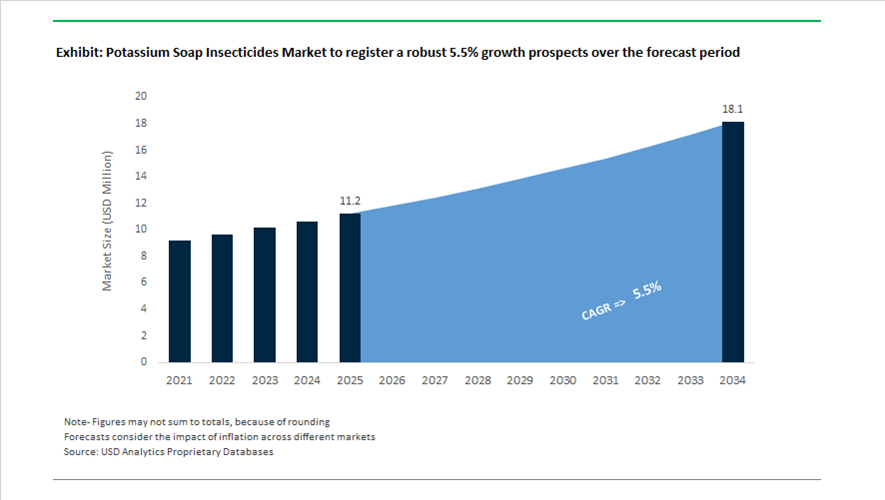
Potassium Soap Insecticides Market Valued at $11.2 Million in 2025, Projected to Reach $18.1 Million by 2034 at 5.5% CAGR
The global potassium soap insecticides market is valued at $11.2 million in 2025 and is projected to reach $18.1 million by 2034, expanding at a CAGR of 5.5%. Growth is driven by increasing adoption of potassium salts of fatty acids, insecticidal soaps for aphid control, contact-kill bioinsecticides, organic-certified pest management inputs, and residue-free greenhouse crop protection solutions. Demand is particularly strong across organic vegetables, cannabis cultivation, high-value horticulture, and integrated pest management (IPM) systems where rapid degradation, zero-day pre-harvest intervals, and compatibility with beneficial insects are critical performance requirements.
Regulatory stability and institutional support strengthened the market in 2024. In March 2024, Certis Biologicals expanded its biological crop protection portfolio through the acquisition of AgBiome assets, including Howler® and Theia® fungicides. This move enables integrated “tank-mix” strategies combining biofungicides with DES-X™ insecticidal soap to simultaneously manage fungal and insect pressure. In May 2024, BASF introduced Efficon® (Axalion® active) in India, emphasizing compatibility with non-target organisms and establishing potassium soap insecticides as foundational rotation partners to mitigate resistance risks in Group 36 insecticides. In September 2024, Certis appointed Eda Reinot as President and CEO, initiating a strategy centered on systematized biological solutions where contact insecticidal soaps function as entry-level interventions in sustainable cropping programs. In December 2024, Health Canada’s PMRA issued its proposed re-evaluation decision PRVD2025-05 for the Fatty Acid Cluster, confirming continued registration of potassium salts of fatty acids for indoor and outdoor applications, including cannabis production, with updated label guidance effective 2025.
Commercial momentum continued into 2025. Throughout 2024 and 2025, major agrochemical companies such as Bayer reinforced strategic collaborations with biocontrol leaders like Koppert to integrate potassium soap-based cleaners as mandatory pre-treatments to remove honeydew before releasing predatory mites and parasitoid wasps. In early 2025, SKL Fertilizers launched Okynol SM, positioned as a plant strengthener delivering dual-action cleansing and induced plant defense activation. In 2025, OMRI reported a record number of newly listed potassium soap formulations, reflecting the impact of Horizon Europe’s Organic Action Plan funding for sustainable pest control research. Farmonaut’s 2025 sustainable farming survey indicated that over 80% of eco-certified growers adopted insecticidal soaps as their primary solution for aphid management, triggered by satellite-based crop stress monitoring tools.
Regulatory tightening and sustainability initiatives are reshaping competitive dynamics into 2026. Effective January 2026, the “One Product One Certificate” policy in key Asian markets removed several generic, non-verified soap brands, consolidating the market around registered, high-purity potassium fatty acid formulations. In early 2026, suppliers including Safer® Brand and Monterey transitioned insecticidal soap concentrates into 100% post-consumer recycled plastic packaging, aligning with circular economy mandates and retailer sustainability criteria.
The potassium soap insecticides market is increasingly characterized by OMRI-listed organic formulations, IPM-compatible contact insecticides, honeydew-cleansing pre-treatment protocols, resistance management rotation strategies, zero-day PHI greenhouse solutions, regulatory re-evaluations confirming safety profiles, and PCR-based sustainable packaging transitions. Integration into precision agriculture platforms and organic certification frameworks continues to reinforce long-term adoption across specialty crops and controlled-environment agriculture.
Trends and Opportunities in the Potassium Soap Insecticides Market
Mainstreaming in Professional Horticulture and Controlled Environment Agriculture (CEA)
Potassium soap insecticides are transitioning from niche organic inputs to core pest management tools in professional horticulture, driven by tightening Maximum Residue Level (MRL) requirements and the rapid expansion of controlled environment agriculture. Commercial greenhouses, vertical farms, and indoor cultivation facilities increasingly prioritize potassium salts of fatty acids because they enable effective pest control without leaving detectable residues. The absence of a Pre-Harvest Interval (PHI) is a decisive operational advantage, allowing growers to apply treatments up to the day of harvest while maintaining compliance with retailer and export standards.
Field trials conducted across 2024 and 2025 have reinforced the commercial viability of these products. Applications at concentrations between 1.0% and 1.5% have demonstrated population reductions of up to 54% in soft-bodied pests such as whiteflies and thrips. More importantly for growers, these trials have linked potassium soap use to substantial improvements in crop outcomes, with marketable yields in certain vegetable systems increasing by as much as 112%. In resistance-prone greenhouse environments, potassium soap-based programs have outperformed several synthetic pyrethroids, particularly where repeated chemical use has eroded efficacy.
Regulatory momentum further supports this trend. In November 2025, Health Canada’s Pest Management Regulatory Agency reaffirmed the registration of potassium salts of fatty acids for commercial greenhouse and indoor cannabis use, emphasizing their low-risk toxicological profile and compatibility with worker safety standards. This decision reinforces the role of potassium soap insecticides as a long-term, regulator-approved solution for high-intensity horticultural production in North America.
Strategic Shift Toward Multi-Mode-of-Action (MMOA) and Ready-to-Use Formulations
As pest resistance management becomes a central concern, manufacturers are repositioning potassium soap insecticides within multi-mode-of-action strategies. Rather than relying solely on membrane disruption, new formulations combine potassium soap with botanical oils, plant extracts, or functional adjuvants to enhance knockdown speed, broaden pest coverage, and improve residual performance without compromising biodegradability.
Product innovation in 2024 and 2025 illustrates this shift clearly. New-generation contact insecticides built on potassium soap bases have been launched to control aphids, mites, and leafhoppers while remaining safe for use in urban and peri-urban settings. These hybrid formulations appeal to municipalities, schools, and commercial landscapers seeking effective pest control solutions that align with public safety and environmental expectations.
At the same time, the market is seeing strong momentum toward ready-to-use (RTU) formats, particularly in the home and garden and small-scale professional segments. Consumer data from early 2025 indicates that RTU sprays now account for a growing share of retail insecticide sales, driven by the expansion of urban gardening and hobby farming. Leading brands have responded by scaling RTU portfolios that incorporate potassium soap combined with silica or desiccating agents, delivering both immediate pest suppression and protective surface effects while eliminating the need for user dilution or specialized application equipment.
Specialized Pest Management in the Legal Cannabis Sector
The legal cannabis industry represents one of the most attractive growth segments for potassium soap insecticides due to its uniquely restrictive pesticide residue standards. Cannabis products are subject to near-zero tolerance thresholds, and failure to meet these standards can result in the destruction of entire harvests. Potassium soap insecticides, frequently classified as minimum-risk or tolerance-exempt products, have therefore become foundational tools in integrated pest management programs across licensed cultivation facilities.
By 2025, standardized cultivation protocols across the United States and Canada commonly recommend potassium soap dilutions in the range of 1 to 2% for controlling mites and aphids. Growers favor these products because they leave no detectable residues on flowers or trichomes, ensuring compliance with third-party laboratory testing required for market access. Beyond direct insect control, potassium soap offers secondary agronomic benefits that further strengthen its value proposition. Mid-2025 field observations indicate that routine applications help remove honeydew and molasses residues left by aphids, reducing the risk of secondary fungal issues such as sooty mold and powdery mildew. This dual-action clean-and-protect effect is particularly valuable in high-density indoor cultivation environments.
Compliance-Driven Adoption in Export-Oriented Specialty Crops
Export-oriented producers of herbs, spices, and exotic fruits are increasingly turning to potassium soap insecticides as international residue limits tighten. Buyers in the European Union and Japan are progressively lowering acceptable MRLs, creating significant rejection risks for shipments treated with conventional synthetic pesticides late in the growing cycle. Potassium soap provides growers with a residue-safe solution for managing late-season pest pressure without jeopardizing export eligibility.
The regulatory push under the EU Green Deal and the Sustainable Use of Pesticides Regulation has further accelerated this shift. These frameworks actively encourage reductions in synthetic pesticide use, creating strong demand for bio-based alternatives in Mediterranean, African, and Southeast Asian production regions that supply European markets. Potassium soap-based insecticides are increasingly integrated into export compliance programs to maintain cosmetic quality and pest-free certification while aligning with sustainability benchmarks.
From an economic perspective, 2025 cost-benefit analyses highlight that potassium soap insecticides often deliver superior overall value for small and mid-sized horticultural enterprises. While they may exhibit lower standalone potency than systemic chemicals, their advantages include reduced personal protective equipment requirements, zero environmental remediation costs, and preservation of beneficial insects such as pollinators and predatory mites. Over time, this supports more resilient agroecosystems and lowers total pest management costs, reinforcing potassium soap insecticides as a structurally attractive solution in compliance-driven agricultural markets.
Potassium Soap Insecticides Market Share and Segmentation Insights
High-concentration concentrates accounted for 48.60% of the Potassium Soap Insecticides Market by product type in 2025, reflecting their cost efficiency and flexibility for agricultural pest management programs. Concentrated potassium soap insecticides allow growers to dilute formulations to target specific pest infestations across different crop types while reducing packaging volume, storage requirements, and transportation costs. These formulations are widely used in professional horticulture, greenhouse production, and commercial farming operations. In 2025, formulation development has focused on compatibility with integrated pest management systems, enabling concentrated potassium soap products to be tank mixed with neem oil, pyrethrins, and biological pest control agents while maintaining stability and field performance.
Commercial agriculture represented 38.60% of the Potassium Soap Insecticides Market by end-use industry in 2025, supported by increasing adoption of environmentally friendly pest control solutions across large-scale farming operations. Potassium soap insecticides are effective against soft bodied pests such as aphids, whiteflies, mites, and thrips that affect fruit crops, vegetables, and ornamental plants. Their low environmental impact, short re entry intervals, and compatibility with biological control programs make them valuable tools for both organic and conventional farming systems. In 2025, expansion of organic farmland and integrated pest management adoption has strengthened demand, as growers increasingly rely on potassium soap formulations to manage pest resistance while maintaining sustainable agricultural production practices.
The global potassium soap insecticides market in 2026 is driven by Integrated Pest Management (IPM), organic farming compliance, and zero-residue crop protection. Demand is accelerating for OMRI-listed formulations with zero-day PHI, especially in greenhouse crops, vertical farming, and high-value horticulture applications.
Neudorff Expands Dual-Action Organic Insecticide Portfolio for Greenhouse Crop Safety
Neudorff continues to lead the potassium soap insecticides market with its eco-friendly, residue-free formulations tailored for organic agriculture. The expanded 2026 registration of KOPA™ Insecticidal Soap in North America strengthens its presence in greenhouse berry production, targeting pests like leafhoppers and lygus bugs. Its dual-action capability as both a contact insecticide and powdery mildew suppressant enhances operational efficiency for growers. The company maintains OMRI certification, ensuring compliance with organic farming standards and increasing adoption in premium horticulture. Strategic distribution partnerships with TerraLink and Plant Products enhance technical support and market penetration. Neudorff’s R&D focus on crop safety, particularly during sensitive flowering stages, reinforces its leadership in precision biocontrol solutions.
Certis Biologicals Integrates Potassium Soap into Multi-Modal Biopesticide Programs
Certis Biologicals is leveraging its global footprint to position potassium soap insecticides as a core component of integrated pest control systems. Its DES-X® formulation delivers high-concentration potassium salts of fatty acids that rapidly disrupt insect cell membranes, ensuring fast-acting pest control. The company expanded product utility in 2025 with 2(ee) label approvals for deer repellency, increasing versatility across field and specialty crops. DES-X is engineered for compatibility with beneficial insects, making it ideal for pre-release "hot spot" treatments in greenhouse IPM programs. Operating in over 50 countries, Certis is expanding its presence in the U.S. specialty crop market and Latin America. Its focus on biological integration and dual-function applications strengthens its competitive advantage in sustainable agriculture.
Koppert Leads Global Biocontrol Systems with Soap-Based Crop Preparation and Precision Application
Koppert Biological Systems dominates the biological crop protection segment by integrating potassium soap insecticides into holistic IPM strategies. Its Savona product is widely recognized for effective control of soft-bodied pests while maintaining safety for beneficial organisms after drying. Koppert’s global presence spans over 100 countries, supported by a workforce of more than 3,000 employees. The company is investing in precision agriculture technologies, including automated spraying and smart scouting, to improve application efficiency on leaf undersides. Strategic collaborations, such as its partnership with Amoéba, expand its portfolio of integrated biological solutions. Koppert’s approach of combining soaps with beneficial insect deployment positions it as a leader in sustainable crop protection ecosystems.
OHP Strengthens Ornamental Market Position with Flexible and Fast-Reentry Potassium Soap Solutions
OHP focuses on high-performance potassium soap insecticides tailored for the ornamental and nursery sectors. Its Kopa™ product, developed in partnership with Neudorff, is valued for its short 12-hour Restricted Entry Interval (REI), enabling rapid workforce re-entry. The formulation is labeled for a wide range of crops, including fruits, vegetables, herbs, and ornamentals, across both field and controlled environments. OHP positions potassium soap as a critical rotational tool in resistance management, reducing reliance on synthetic pesticides. Its flexible packaging solutions cater to both large-scale nurseries and specialized growers. By addressing operational efficiency and resistance mitigation, OHP strengthens its niche in professional horticulture markets.
Kao Advances Surfactant Science to Enhance Efficacy of Bio-Based Insecticidal Soaps
Kao Corporation is leveraging its expertise in surfactant chemistry to enhance the performance of potassium soap insecticides. The company reported ¥1.53 trillion in revenue, with its Chemical segment growing 4.5% due to rising demand for eco-friendly agricultural inputs. Kao’s R&D focuses on optimizing fatty acid structures to improve wetting, spreading, and penetration on plant surfaces and insect cuticles. Under its K25 strategy, the company is prioritizing bio-based and biodegradable surfactants to replace synthetic chemical alternatives. Its potassium soap formulations are increasingly used as adjuvants to enhance the efficacy of other biological pesticides. This integration capability positions Kao as a technology-driven innovator in sustainable crop protection.
Vicchem Expands Soft Chemistry Solutions for Sustainable Horticulture and Broad-Acre Crops
Victorian Chemical Company (Vicchem) is a key Southern Hemisphere player specializing in potassium soap-based insecticides and spray adjuvants. Its Biopest® solutions support IPM-compliant pest control in citrus, grapes, and other high-value crops requiring low phytotoxicity. The company collaborates with Australian research institutions to expand applications in cotton and pulse crops, reducing reliance on conventional pesticides. Vicchem’s expertise in high-purity fatty acid salts ensures minimal crop damage and consistent performance. It is expanding into Southeast Asia, targeting sustainable palm oil and rubber plantation markets where biodegradable pest control is critical. Its focus on soft chemistry and regional adaptability strengthens its position in environmentally sensitive agricultural sectors.
United States: Residue Sensitivity and Precision Agriculture Accelerate Adoption
The United States potassium soap insecticides market is expanding rapidly due to residue sensitivity in food labeling, domestic supply chain recalibration, and the integration of precision agriculture technologies. Following the 2025 FDA redefinition of “Healthy” food claims, growers supplying premium retail and foodservice channels have intensified the use of potassium salts of fatty acids, with application volumes rising by an estimated 18% to meet stricter low-residual expectations. This regulatory-driven shift has been reinforced by trade policy. New U.S. tariffs imposed in January 2025 on imported chemical intermediates prompted manufacturers to localize fatty acid sourcing, increasing reliance on U.S.-derived soybean oil as a stable, traceable feedstock for potassium soap formulations.
Technology adoption is amplifying efficiency gains. In mid-2025, Certis Biologicals and partners integrated potassium soap insecticides into AI-enabled precision spraying platforms that use IoT sensors for localized spot applications, cutting overall product use by approximately 25%. Regulatory and market access incentives remain strong. By early 2026, a record number of high-concentration potassium soap products achieved Organic Materials Review Institute listing, aligned with sustained growth in U.S. organic acreage. Urban agriculture policies further support demand, as cities including New York and Chicago updated pest management codes in 2025 to mandate minimum-risk pesticides for community gardens and rooftop farms. Additionally, the U.S. Department of Agriculture increased procurement of potassium soap products for Spotted Lanternfly control in the Northeast, citing high efficacy on soft-bodied nymphs with no environmental persistence.
European Union: Green Deal Mandates and Pollinator-Safe Chemistry
The European Union is positioning potassium soap insecticides as a cornerstone chemistry within its Green Deal-aligned crop protection framework. Under the Sustainable Use of Pesticides Regulation effective July 2026, growers are required to prioritize bio-based alternatives, elevating potassium soaps to primary contact insecticides for protected vegetable cultivation in countries such as Spain and Italy. Regulatory clarity is reinforced by the European Commission’s decision to maintain Maximum Residue Level exempt status for potassium salts of fatty acids in 2025, simplifying cross-border trade for fruit and vegetable exporters across the Mediterranean region.
Digital compliance and formulation innovation are advancing in parallel. New Classification, Labelling, and Packaging rules taking effect in July 2026 mandate digital smart labels with QR-based access to real-time safety and application data, increasing transparency for biopesticide users. On the manufacturing side, German and French formulators adopted 3D-printed catalyst architectures in 2025 to improve saponification efficiency, delivering clearer soap solutions with 15% higher solubility in hard water conditions. Environmental protection remains a decisive driver. Updated 2025 guidance from the European Food Safety Authority identified potassium soap as a pollinator-safe option, permitting application during bloom periods where conventional synthetic insecticides are restricted.
Canada: Regulatory Certainty and Controlled-Environment Agriculture Demand
Canada’s potassium soap insecticides market is benefiting from regulatory certainty and expanding controlled-environment agriculture. In November 2025, the Pest Management Regulatory Agency finalized Re-evaluation Decision RVD2025-07, confirming continued registration of all potassium soap uses while updating safety labeling requirements. This decision provided manufacturers and distributors with long-term visibility, accompanied by a 24-month transition window extending to late 2027 to implement revised environmental and runoff mitigation standards.
Demand growth is particularly pronounced in indoor cultivation. During the 2025–2026 production cycle, Canadian licensed cannabis producers increased potassium soap adoption by 22% for spider mite control, driven by the compound’s zero-residue profile and compatibility with pharmaceutical-grade testing protocols. As regulatory scrutiny in cannabis and greenhouse vegetables intensifies, potassium soap insecticides are increasingly positioned as compliance-friendly, repeat-use solutions within Canada’s high-value horticulture segments.
India: Export Compliance and Domestic Biological Manufacturing
India’s potassium soap insecticides market is being reshaped by export compliance pressures and localized biological manufacturing under national self-reliance initiatives. In 2025, stricter export audits enforced by the Food Safety and Standards Authority of India compelled grape and pomegranate growers to replace organophosphate insecticides with liquid potassium soap concentrates to achieve zero-rejection rates in European markets. This shift is accelerating adoption among export-oriented horticulture clusters.
Domestic capacity is scaling to meet demand. In May 2025, Bharat Certis AgriScience commissioned a dedicated biologicals facility focused on potassium soap variants optimized for tropical pests such as thrips and whiteflies. Feedstock security is improving under Atmanirbhar Bharat policies. The 2025 Production Linked Incentive scheme for agriculture provided targeted subsidies for domestic production of plant-derived fatty acids, reducing reliance on imported palm oil derivatives and enhancing cost stability for Indian formulators.
Brazil: Accelerated Registration and Large-Scale IPM Integration
Brazil’s potassium soap insecticides industry is advancing through regulatory acceleration and integration into large-scale integrated pest management programs. The 2025 update to the National Bio-Inputs Program under RenovaBio significantly shortened approval timelines for fatty acid-based insecticides, cutting registration periods from 24 months to approximately 8 months. This reform has lowered entry barriers for biological solutions and expanded product availability across major cropping systems.
Adoption is increasingly strategic rather than substitutive. In 2025, large soybean operations in Mato Grosso reported increased use of potassium soap as a tank-mix adjuvant to improve rainfastness and enhance the efficacy of other biological inputs. This positioning reflects Brazil’s emphasis on compatibility and performance optimization within high-acreage IPM frameworks rather than standalone insecticidal action.
China: Green Manufacturing Policy and Supply Chain Transparency
China’s potassium soap insecticides market is aligning with national green manufacturing priorities and export transparency requirements. The Ministry of Industry and Information Technology’s 2026 chemical industry roadmap explicitly prioritizes biodegradable saponified insecticides as replacements for legacy toxic chemistries in tea and citrus cultivation. This policy direction is driving formulation shifts among domestic producers supplying residue-sensitive crops.
Supply chain verification is emerging as a differentiator. In 2025, leading manufacturers in Shandong implemented blockchain-enabled traceability systems, allowing overseas buyers to verify the non-GMO origin of vegetable oils used in potassium soap production. This capability is strengthening access to European and premium Asian markets where feedstock transparency and sustainability credentials are increasingly scrutinized.
Comparative Overview of Country-Level Dynamics in the Potassium Soap Insecticides Industry
Potassium Soap Insecticides Market County Level Snapshot
Country / Region
Primary Policy or Market Driver
Implications for Potassium Soap Insecticides
United States
Healthy labeling, tariffs, precision agriculture
Strong growth in OMRI-listed, precision-applied products
European Union
SUR 2026, pollinator protection, MRL exemption
Core chemistry for protected crops and organic systems
Canada
PMRA re-evaluation, indoor cultivation
Stable regulatory outlook with greenhouse-led demand
India
Export audits, PLI incentives
Rapid adoption in horticulture with localized manufacturing
Brazil
Bio-input fast-track approvals
Integration into large-scale IPM programs
China
Green manufacturing roadmap, traceability
Expansion in tea and citrus with export-focused transparency
Potassium Soap Insecticides Market Report Scope
Potassium Soap Insecticides Market
Parameter
Details
Market Size (2025)
$11.2 Million
Market Size (2034)
$18.1 Million
Market Growth Rate
5.5%
Segments
By Product Type (Low-Concentration Solutions, High-Concentration Concentrates, Bio-Enhanced Formulations), By Target Pest (Aphids & Whiteflies, Mites & Thrips, Mealybugs & Scale Insects, Soft-Bodied Larvae), By Application Method (Foliar Spray, Drip Irrigation & Chemigation, Tank Mixing), By End-Use Industry (Commercial Agriculture, Protected Cropping, Horticulture & Landscaping, Home & Garden, Medicinal Crops)
Study Period
2019- 2025 and 2026-2034
Units
Revenue (USD)
Qualitative Analysis
Porter’s Five Forces, SWOT Profile, Market Share, Scenario Forecasts, Market Ecosystem, Company Ranking, Market Dynamics, Industry Benchmarking
US, Canada, Mexico, Germany, France, Spain, Italy, UK, Russia, China, India, Japan, South Korea, Australia, South East Asia, Brazil, Argentina, Middle East, Africa
Potassium Soap Insecticides Market Segmentation
By Product Type
Low-Concentration Solutions
High-Concentration Concentrates
Bio-Enhanced Formulations
By Target Pest
Aphids & Whiteflies
Mites & Thrips
Mealybugs & Scale Insects
Soft-Bodied Larvae
By Application Method
Foliar Spray
Drip Irrigation & Chemigation
Tank Mixing
By End-Use Industry
Commercial Agriculture
Protected Cropping
Horticulture & Landscaping
Home & Garden
Medicinal Crops
By Region
North America (United States, Canada, Mexico)
Europe (Germany, France, United Kingdom, Spain, Italy, Rest of Europe)
Asia Pacific (China, India, Japan, South Korea, Australia, Rest of APAC)
South and Central America (Brazil, Argentina, Rest of SCA)
Middle East and Africa (Saudi Arabia, UAE, South Africa, Rest of Middle East, Rest of Africa)
Top Companies in Potassium Soap Insecticides Industry
Neudorff GmbH
Koppert Biological Systems
Certis Biologicals
Woodstream Corporation
Bayer CropScience
Andermatt Biocontrol AG
SBM Life Science
BioBest Group NV
Summit Chemical
Bharat Certis AgriScience Ltd.
Vegalab SA
Natural Industries Inc.
Vossen Laboratories
Gowan Company
Layn Natural Ingredients
*- List not Exhaustive
Table of Contents: Potassium Soap Insecticides Market
2. Potassium Soap Insecticides Market Landscape & Outlook (2025–2034)
2.1. Introduction to Potassium Soap Insecticides Market
2.2. Market Valuation and Growth Projections (2025–2034)
2.3. Key Growth Drivers: Organic Farming Adoption, IPM Integration, and Residue-Free Crop Protection
2.4. Technology Evolution: Bio-Based Formulations, Multi-Mode-of-Action Products, and Precision Application Systems
2.5. End-Use Expansion: Greenhouse Crops, Cannabis Cultivation, Horticulture, and Controlled Environment Agriculture
3. Innovations Reshaping the Potassium Soap Insecticides Market
3.1. Trend: Mainstreaming in Professional Horticulture and Controlled Environment Agriculture (CEA)
3.2. Trend: Strategic Shift Toward Multi-Mode-of-Action (MMOA) and Ready-to-Use Formulations
3.3. Opportunity: Specialized Pest Management in the Legal Cannabis Sector
3.4. Opportunity: Compliance-Driven Adoption in Export-Oriented Specialty Crops
4. Competitive Landscape and Strategic Initiatives
4.1. Mergers and Acquisitions
4.2. R&D and Material Innovation
4.3. Sustainability and ESG Strategies
4.4. Market Expansion and Regional Focus
5. Market Share and Segmentation Insights: Potassium Soap Insecticides Market
5.1. By Product Type
5.1.1. Low-Concentration Solutions
5.1.2. High-Concentration Concentrates
5.1.3. Bio-Enhanced Formulations
5.2. By Target Pest
5.2.1. Aphids & Whiteflies
5.2.2. Mites & Thrips
5.2.3. Mealybugs & Scale Insects
5.2.4. Soft-Bodied Larvae
5.3. By Application Method
5.3.1. Foliar Spray
5.3.2. Drip Irrigation & Chemigation
5.3.3. Tank Mixing
5.4. By End-Use Industry
5.4.1. Commercial Agriculture
5.4.2. Protected Cropping
5.4.3. Horticulture & Landscaping
5.4.4. Home & Garden
5.4.5. Medicinal Crops
5.5. By Region
5.5.1. North America
5.5.2. Europe
5.5.3. Asia Pacific
5.5.4. South and Central America
5.5.5. Middle East and Africa
6. Country Analysis and Outlook of Potassium Soap Insecticides Market
6.1. United States
6.2. Canada
6.3. Mexico
6.4. Germany
6.5. France
6.6. Spain
6.7. Italy
6.8. UK
6.9. Russia
6.10. China
6.11. India
6.12. Japan
6.13. South Korea
6.14. Australia
6.15. South East Asia
6.16. Brazil
6.17. Argentina
6.18. Middle East
6.19. Africa
7. Potassium Soap Insecticides Market Size Outlook by Region (2025–2034)
7.1. North America Potassium Soap Insecticides Market Size Outlook to 2034
7.1.1. By Product Type
7.1.2. By Target Pest
7.1.3. By Application Method
7.1.4. By End-Use Industry
7.1.5. By Region
7.2. Europe Potassium Soap Insecticides Market Size Outlook to 2034
7.2.1. By Product Type
7.2.2. By Target Pest
7.2.3. By Application Method
7.2.4. By End-Use Industry
7.2.5. By Region
7.3. Asia Pacific Potassium Soap Insecticides Market Size Outlook to 2034
7.3.1. By Product Type
7.3.2. By Target Pest
7.3.3. By Application Method
7.3.4. By End-Use Industry
7.3.5. By Region
7.4. South America Potassium Soap Insecticides Market Size Outlook to 2034
7.4.1. By Product Type
7.4.2. By Target Pest
7.4.3. By Application Method
7.4.4. By End-Use Industry
7.4.5. By Region
7.5. Middle East and Africa Potassium Soap Insecticides Market Size Outlook to 2034
7.5.1. By Product Type
7.5.2. By Target Pest
7.5.3. By Application Method
7.5.4. By End-Use Industry
7.5.5. By Region
8. Company Profiles: Leading Players in the Potassium Soap Insecticides Market
8.1. Neudorff GmbH
8.2. Koppert Biological Systems
8.3. Certis Biologicals
8.4. Woodstream Corporation
8.5. Bayer CropScience
8.6. Andermatt Biocontrol AG
8.7. SBM Life Science
8.8. BioBest Group NV
8.9. Summit Chemical
8.10. Bharat Certis AgriScience Ltd.
8.11. Vegalab SA
8.12. Natural Industries Inc.
8.13. Vossen Laboratories
8.14. Gowan Company
8.15. Layn Natural Ingredients
9. Methodology
9.1. Research Scope
9.2. Market Research Approach
9.3. Market Sizing and Forecasting Model
9.4. Research Coverage
9.5. Data Horizon
9.6. Deliverables
10. Appendix
10.1. Acronyms and Abbreviations
10.2. List of Tables
10.3. List of Figures
Potassium Soap Insecticides Market Segmentation
By Product Type
Low-Concentration Solutions
High-Concentration Concentrates
Bio-Enhanced Formulations
By Target Pest
Aphids & Whiteflies
Mites & Thrips
Mealybugs & Scale Insects
Soft-Bodied Larvae
By Application Method
Foliar Spray
Drip Irrigation & Chemigation
Tank Mixing
By End-Use Industry
Commercial Agriculture
Protected Cropping
Horticulture & Landscaping
Home & Garden
Medicinal Crops
By Region
North America (United States, Canada, Mexico)
Europe (Germany, France, United Kingdom, Spain, Italy, Rest of Europe)
Asia Pacific (China, India, Japan, South Korea, Australia, Rest of APAC)
South and Central America (Brazil, Argentina, Rest of SCA)
Middle East and Africa (Saudi Arabia, UAE, South Africa, Rest of Middle East, Rest of Africa)
The potassium soap insecticides market is valued at $11.2 million in 2025 and is projected to reach $18.1 million by 2034, growing at a CAGR of 5.5%. Growth is driven by increasing adoption in organic farming, greenhouse crop protection, and integrated pest management systems. Demand is particularly strong in high-value crops requiring residue-free solutions.
Potassium soap insecticides offer zero-day pre-harvest intervals and leave no detectable residues, making them ideal for controlled environment agriculture (CEA). Their compatibility with beneficial insects supports IPM programs. Growers benefit from flexibility in application timing and compliance with strict export and retail residue standards.
Regulatory support such as OMRI certification growth, Health Canada PMRA approvals, and EU Green Deal policies are accelerating adoption. The shift toward minimum-risk pesticides and MRL exemptions positions potassium soaps as compliant alternatives to synthetic insecticides. New certification policies in Asia are also consolidating the market around high-quality formulations.
Demand is expanding across organic vegetables, cannabis cultivation, and export-oriented horticulture. Potassium soap insecticides are increasingly used as pre-treatment agents to remove honeydew before biological control release. Additionally, their role in resistance management rotations and tank-mix compatibility is strengthening adoption in commercial agriculture.
Key players include Neudorff, Koppert Biological Systems, Certis Biologicals, Bayer CropScience, and Andermatt Biocontrol. These companies focus on OMRI-listed formulations, IPM integration, and bio-based innovation. Strategic priorities include precision agriculture compatibility, sustainable packaging, and expansion in greenhouse and specialty crop markets.