Prefilled Syringe Packaging Market Overview: Primary Container Integrity, Biologic Compatibility and Ready-to-Fill Systems Define Demand
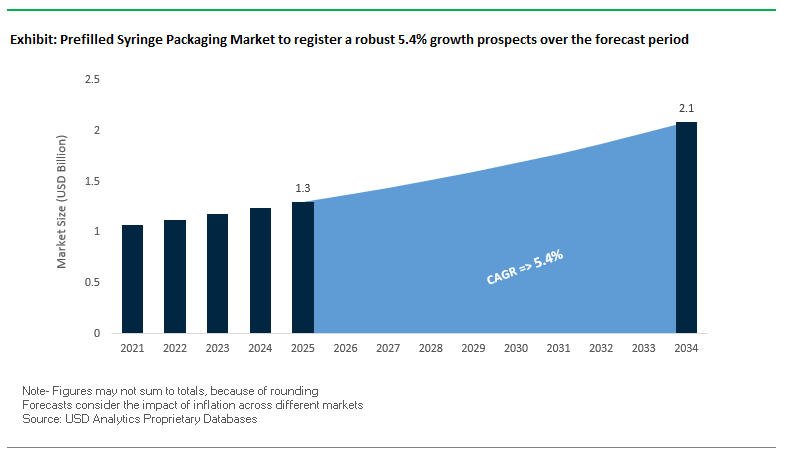
The global Prefilled Syringe Packaging Market is valued at USD 1.3 billion in 2025 and is projected to reach USD 2.1 billion by 2034, expanding at a CAGR of 5.4%. Single-chamber systems account for approximately 82% of the market by design, while autoimmune diseases represent approximately 25% of application demand. The formal market segmentation covers glass and polymer materials; single-chamber, dual-chamber and customized designs; therapeutic applications; end-use settings; and staked-needle, needle-free and Luer-lock closing systems.
Prefilled syringe packaging encompasses the primary container-closure and associated packaging architecture used to contain, protect, fill, store and deliver an injectable pharmaceutical or biologic product. The system can include a glass or polymer barrel, plunger stopper, plunger rod, tip cap or needle shield, staked needle or Luer closure and ready-to-fill nest-and-tub configuration. This creates a narrower packaging-focused scope than the broader Prefilled Syringes Market, which centers more directly on finished drug-delivery products, therapeutic adoption and administration.
Packaging performance becomes particularly important for monoclonal antibodies, vaccines, anticoagulants, autoimmune therapies, GLP-1 products and other injectable drugs in which the primary container remains in prolonged direct contact with the formulation. Dimensional tolerances, container-closure integrity, extractables and leachables, silicone-oil distribution, tungsten residues, particles and plunger-glide characteristics can therefore influence both product stability and delivery-device functionality. Prefilled syringes also form part of the broader parenteral products packaging ecosystem spanning vials, ampoules, cartridges and other injectable primary-container systems.
Glass continues to provide an established platform for high-volume prefillable syringe production, while cyclic olefin polymer and cyclic olefin copolymer systems serve applications requiring break resistance, low ion release, specialized low-temperature performance or alternative drug-contact surfaces. The market is consequently developing through multiple material and container architectures rather than a universal transition from glass to polymer. Current product launches and capacity investments also show closer integration between the syringe primary container, aseptic fill-finish operations and downstream autoinjector platforms.
Recent Developments and Company Strategies in Prefilled Syringe Packaging
West Pharmaceutical Services Commercializes Synchrony S1 Prefillable Syringe Platform
In January 2026, West Pharmaceutical Services announced the global commercial availability of its Synchrony S1 prefillable syringe system. The portfolio includes 1 mL long and 2.25 mL staked-needle configurations for biologics, alongside 1 mL standard staked-needle and Luer-lock options for vaccines. Staked-needle formats are offered with rigid or soft needle shields, while the Luer-lock system incorporates an integrated tip cap.
The launch expands West's participation beyond elastomeric components into a more integrated syringe-container platform. It also reflects increasing differentiation of prefillable syringe systems by drug class, fill volume and front-end closure configuration rather than by barrel material alone.
SCHOTT Pharma Commercializes 5.5 mL Glass Syringe for Large-Volume Biologics
In October 2025, SCHOTT Pharma introduced a 5.5 mL staked-needle prefillable glass syringe within its syriQ BioPure platform. The syringe is commercially available and designed for compatibility with Ypsomed's YpsoMate 5.5 large-volume autoinjector. SCHOTT Pharma identified immunology, oncology and central nervous system therapies among the applications associated with the larger-volume format.
The development illustrates the increasing connection between primary-container volume and downstream injection-device architecture. Larger fill volumes allow some biologic formulations to move beyond traditional 1 mL and 2.25 mL syringe formats, while container geometry, plunger performance, needle characteristics and autoinjector compatibility become increasingly interdependent.
BD Expands High-Viscosity Syringe Technology and Manufacturing Capacity
BD commercially released its Neopak XtraFlow glass prefillable syringe in September 2024. The system combines an 8 mm needle with a thinner-wall cannula for subcutaneous delivery of higher-viscosity formulations. At its Le Pont-de-Claix site in France, BD also installed a high-volume Neopak manufacturing line that the company states increased the production capacity of a single line sevenfold.
BD is simultaneously developing RFID-enabled unit-level identification through its iDFill platform. The concept assigns each syringe a unique identifier and associates individual containers with tubs, filling batches and downstream manufacturing steps. The technology remains under development and is not a released product, making it an example of emerging fill-finish traceability rather than an established commercial smart-syringe platform.
Gerresheimer Adds Several Hundred Million Syringes of Planned North American Capacity
Gerresheimer has started new syringe-forming lines at its expanded Querétaro facility in Mexico. At full build-out, the company expects the site to add several hundred million ready-to-fill syringes annually for the North American market. Gerresheimer disclosed approximately EUR 100 million of investment in the plant expansion and equipment and has also installed an EZ-fill Smart line incorporating vaporized hydrogen peroxide sterilization capability.
The expansion is particularly relevant to biologics and GLP-1-based injectable products and demonstrates continued localization of ready-to-fill syringe capacity within the North American pharmaceutical supply chain.
Stevanato Group Expands Nexa and Dual-Chamber Syringe Capacity
Stevanato Group continued syringe-capacity installation and customer validation activities at Latina, Italy and Fishers, Indiana through 2025 and 2026. The company's disclosures identify ongoing Nexa syringe expansion at both sites and planned dual-chamber syringe capacity in Latina. Stevanato also reported that biologics represented 41% of its Biopharmaceutical and Diagnostic Solutions revenue in fiscal 2025, compared with 34% in 2024.
The capacity program reflects increasing commercial exposure to high-value injectable containment systems and ready-to-fill formats associated with biologics and integrated drug-delivery devices.
SCHOTT Expands Syringe-Grade Glass Tubing Production in India
In August 2025, SCHOTT began local production of high-precision syringe and cartridge glass tubing at its Jambusar, Gujarat facility. The company identified the expansion as the first local production of this type in India and stated that the site made it Asia's largest producer of syringe and cartridge glass tubing. The manufacturing platform uses FIOLAX Type I borosilicate glass and incorporates tight inner-diameter controls relevant to plunger sealing and glide behavior.
The investment strengthens the upstream material base for prefillable syringe production in Asia and connects India's pharmaceutical manufacturing scale with locally produced high-precision primary-packaging glass.
Regulatory and Quality Standards for Prefilled Syringe Packaging
Prefilled syringe packaging is governed by a combination of pharmaceutical container-closure requirements, international syringe standards, pharmacopeial requirements and drug-device combination rules. The regulatory framework covers dimensional performance, container-closure integrity, elastomeric components, ready-to-fill packaging systems and the functional performance of the finished drug-filled syringe. Requirements differ according to whether the syringe is evaluated as a pharmaceutical container, a device constituent of a combination product or a finished prefilled syringe system.
ISO 11040-4:2024 Defines Requirements for Glass Barrels and Ready-to-Fill Syringe Assemblies
ISO 11040-4:2024 establishes requirements for tubing-glass barrels and sterilized subassembled syringes ready for filling. The standard covers materials, dimensions, quality and performance characteristics together with relevant test methods. Its scope applies to single-chamber glass barrels for injectable preparations and sterilized syringe subassemblies supplied for pharmaceutical filling. Components used to complete the system, including the plunger stopper and plunger rod, are outside the scope of Part 4.
The standard provides an important technical basis for dimensional consistency and functional performance before filling. Barrel geometry is particularly relevant to closure fit, plunger movement and downstream compatibility with filling equipment and injection devices.
ISO 11040-7:2024 Covers Nest-and-Tub Packaging for Ready-to-Fill Syringes
ISO 11040-7:2024 specifically addresses packaging systems used to deliver sterilized subassembled syringes ready for filling in tubs and nests. This makes the standard particularly relevant to the Prefilled Syringe Packaging Market because the nest-and-tub system forms the interface between syringe manufacturing, sterilization and pharmaceutical aseptic filling.
The standard focuses on the packaging system used before filling. Requirements arising after filling, including subsequent transport or reprocessing of the filled syringe, fall outside its stated scope. This distinction separates ready-to-fill transport packaging from the performance requirements of the finished prefilled syringe.
ISO 11040-8:2026 Establishes Current Requirements for Finished Prefilled Syringes
Published in June 2026, ISO 11040-8:2026 establishes quality, functional-performance and safety requirements and associated test methods for finished prefilled syringes. The standard applies to aseptically processed or terminally sterilized single-use prefilled syringes based on applicable syringe-barrel, plunger-stopper and front-end closure components.
The 2026 edition replaces ISO 11040-8:2016 and extends the current technical framework for evaluating finished systems. ISO also notes that the standard can serve as guidance for additional designs, including dual-chamber prefilled syringes. Its publication provides a particularly current reference for packaging-system performance, functional testing and safety evaluation.
For prefilled syringe systems, elastomer functionality is linked to dimensional compatibility, sealing, break-loose behavior, glide performance and interaction with the complete packaging/delivery system. This makes the stopper and closure system part of both pharmaceutical containment and device functionality rather than a standalone packaging component.
FDA's 2026 Draft Guidance Updates the U.S. Container-Closure Framework
In August 2026, the U.S. FDA issued draft guidance on Container Closure Systems for Human Drugs and Biological Products. The draft provides principles for evaluating the quality of container-closure systems used for human drugs and biologics and explicitly includes systems that are device constituent parts of combination products.
This is directly relevant to prefilled syringes because the syringe can simultaneously function as the drug's primary container and as a device constituent within a combination product. The FDA document remains draft guidance, is not for implementation and contains non-binding recommendations as of September 2026.
EU MDR Article 117 Applies to Integral Prefilled Syringe Drug-Device Combinations
The European Medicines Agency identifies prefilled syringes and prefilled pens as examples of integral medicinal product–medical device combinations. Under the EMA framework for medicinal products used in combination with a medical device, the medicinal product remains regulated under EU pharmaceutical legislation when its medicinal action is principal, while the device constituent is also subject to relevant conformity requirements.
For applicable integral combinations, Article 117 of Regulation (EU) 2017/745 requires the marketing-authorisation dossier to include evidence concerning conformity of the device constituent, such as a CE certificate or, where applicable, a notified-body opinion. EMA's associated quality guideline also covers device-related information that can affect the quality, safety and efficacy of the medicinal product.
Glass and Polymer Syringe Systems Evolve Around Drug Compatibility, Break Resistance and Device Integration
Type I borosilicate glass remains extensively used for prefillable syringes because of its established pharmaceutical history, chemical resistance, gas and moisture barrier and compatibility with high-throughput forming and fill-finish systems. Tight dimensional control is particularly important because barrel geometry influences stopper sealing, break-loose force, glide force and compatibility with downstream safety devices and autoinjectors.
Polymer syringes based primarily on COC or COP provide a different performance profile. Their characteristics can include high break resistance, tight dimensional reproducibility and very low ion release, while specific platforms are engineered for unusual environments such as deep-frozen pharmaceutical storage. SCHOTT Pharma's TOPPAC freeze COC syringe, for example, has been tested for container-closure integrity at temperatures down to −180°C and is supplied in a presterilized nest-and-tub configuration.
Container-Closure Integrity and Elastomeric Components Remain Central to Prefilled Syringe Performance
The prefilled syringe forms a dynamic container-closure system consisting of the barrel, plunger stopper and front-end closure. Container-closure integrity depends on dimensional fit and sealing performance at these interfaces during filling, storage, transportation and use.
Plunger stoppers simultaneously provide drug containment and permit controlled movement through the barrel during administration. Material formulation, surface treatment and dimensional consistency influence sealing, break-loose force, glide force and the potential for extractables and leachables. Front-end closure systems—including rigid needle shields, soft needle shields and tip caps—perform an equivalent containment role at the opposite end of the syringe.
USP <382> places elastomeric-component functionality within the complete intended packaging/delivery system rather than treating the closure as an isolated material. This system-level approach is particularly relevant to prefilled syringes because the same component can influence both long-term product containment and injection performance.
Siliconization, Tungsten Control and Particle Reduction Gain Importance for Sensitive Biologics
Silicone oil is commonly used to provide suitable plunger movement in glass syringe barrels. The distribution, quantity and form of silicone can affect break-loose and glide forces, while free silicone droplets can contribute to subvisible-particle populations. Alternative technologies include controlled spraying, baked-on or cross-linked silicone systems and component coatings intended to reduce free silicone while preserving functional performance.
Tungsten is another glass-syringe consideration associated with conventional needle-forming processes used in some manufacturing routes. Residual tungsten exposure has attracted particular attention for sensitive protein therapeutics, making low-tungsten manufacturing a differentiating characteristic in some high-value syringe platforms.
SCHOTT Pharma's syriQ BioPure systems and Stevanato Group's high-value syringe platforms illustrate manufacturer focus on controlling drug-contact surfaces, silicone levels and other potential interaction pathways for biologic formulations. SCHOTT's large-volume 5.5 mL syringe specifically incorporates manufacturing technology intended to maintain ultra-low tungsten levels.
High-Viscosity and Large-Volume Biologics Expand 2.25 mL and Larger Prefilled Syringe Platforms
The expansion of monoclonal antibodies and other concentrated biologics is changing prefilled syringe geometry and delivery-system requirements. Higher drug concentration can increase formulation viscosity, while therapeutic dosing requirements can increase the volume delivered in a single administration.
Current commercial activity reflects expansion beyond the historically dominant 1 mL long syringe. West's Synchrony portfolio includes a 2.25 mL biologics format, while SCHOTT Pharma commercialized a 5.5 mL glass syringe in 2025 for integration with a large-volume autoinjector.
Needle characteristics also form part of the packaging-delivery relationship. BD's Neopak XtraFlow uses an 8 mm thin-wall needle intended to improve flow characteristics for high-viscosity formulations. As syringe volumes increase, container dimensional consistency, glide forces, needle configuration and device compatibility become increasingly interconnected.
Ready-to-Fill Nest-and-Tub Systems Expand with Automated Aseptic Fill-Finish
Ready-to-fill syringe systems are supplied washed, sterilized and organized in nests placed within tubs, allowing pharmaceutical fill-finish operations to receive standardized primary containers without performing all upstream container-preparation steps internally. ISO 11040-7:2024 specifically defines the packaging systems used to deliver sterilized subassembled syringes in this format.
Dimensional consistency of the syringe and nest becomes relevant to automated denesting, robotic transfer, filling, stoppering, inspection and downstream assembly. Capacity additions from Gerresheimer and Stevanato Group therefore combine syringe manufacturing investment with ready-to-fill platform expansion and pharmaceutical customer validation.
Digital traceability is emerging as an additional fill-finish development. BD's iDFill concept links a unique RFID identifier on each syringe to the parent tub/nest and subsequent filling batch, potentially connecting individual primary containers with manufacturing records across filling, inspection and assembly. The platform remains under development rather than a released commercial product.
Dual-Chamber Syringes Support Drugs Requiring Separation and Reconstitution Before Administration
Dual-chamber prefilled syringes maintain two components in separate compartments until preparation for administration. The architecture is relevant where a drug substance and diluent require physical separation during storage, including selected lyophilized or otherwise unstable injectable formulations.
Compared with a conventional single-chamber syringe, the system introduces additional interfaces and functional elements. These can include intermediate stoppers, bypass geometry and sequential plunger movement, increasing the importance of dimensional control, closure functionality and reliable reconstitution behavior.
Stevanato Group has disclosed additional dual-chamber syringe capacity as part of its Latina expansion program, providing current manufacturer evidence that specialized multi-chamber configurations remain an active area of capacity development.
Dual-chamber systems do not inherently eliminate cold-chain requirements. Storage conditions remain specific to the formulated medicinal product and its stability profile. Their principal packaging function is controlled separation and reconstitution within an integrated container-delivery system.
Prefilled Syringe Packaging Market Share Insights
Single-Chamber Designs Account for Approximately 82% of the Market
Single-chamber prefilled syringes hold approximately 82% market share by design in 2025. Their position reflects the applicability of a relatively standardized barrel-and-plunger architecture across vaccine packaging applications, antithrombotics, biologics, diabetes therapies and other injectable products that remain stable as filled liquid formulations.
Single-chamber systems also interface readily with established ready-to-fill nests, filling equipment, needle-safety systems and autoinjectors. Current product development is extending this architecture into larger volumes and higher-viscosity formulations rather than displacing it with more complex multi-chamber systems.
Dual-chamber and customized designs represent smaller segments but provide specialized containment where formulation separation, reconstitution or non-standard delivery characteristics are required.
Autoimmune Diseases Represent Approximately 25% of Application Demand
Autoimmune diseases account for approximately 25% of market demand by application. The segment's packaging requirements are closely associated with chronic biologic therapies, repeated subcutaneous administration and increasing integration of prefilled syringes into self-injection devices.
Diabetes and metabolic therapies also represent important packaging demand as injectable treatment portfolios expand, while vaccines, antithrombotics, anaphylaxis and oncology create distinct requirements around dose volume, administration setting, needle configuration, product stability and frequency of use.
Prefilled Syringe Packaging Market Analysis by Country and Region
United States: Combination-Product and Container-Closure Requirements Shape Packaging Qualification
The U.S. market combines substantial biologics activity with established pharmaceutical container-closure requirements and expanding fill-finish and primary-container capacity. FDA's August 2026 draft Container Closure Systems guidance explicitly covers container-closure systems that also function as device constituent parts of combination products, making it directly relevant to prefilled syringes. The guidance remains draft and is not currently for implementation.
Domestic and North American supply is also expanding through Stevanato Group's Fishers operations and Gerresheimer's Querétaro ready-to-fill syringe capacity serving North America. The regional market is therefore characterized by biologic-container performance, combination-product integration and high-volume ready-to-fill manufacturing rather than a generalized shift toward polymer alone.
European Union: Article 117 and High-Value Syringe Manufacturing Define the Regulatory and Industrial Base
In the European Union, integral prefilled syringes fall within the medicinal-product/device combination framework. EMA identifies prefilled syringes as integral drug-device combinations, with MDR Article 117 requirements applicable where the device constituent requires notified-body involvement.
Europe also remains a major manufacturing base for high-value prefillable syringes. BD's French operations include its expanded Neopak capacity, while SCHOTT Pharma and Stevanato Group maintain substantial syringe manufacturing and development activities across Europe.
China: Pharmaceutical Packaging GMP Annex Adds Direct Quality-System Requirements
China's pharmaceutical-packaging regulatory environment changed materially with the NMPA's Pharmaceutical Packaging Materials Annex to the Good Manufacturing Practice for Drugs, effective January 1, 2026. The framework requires pharmaceutical-packaging-material manufacturers to maintain quality systems, conduct supplier assessment, inspect and release batches, manage changes and communicate material changes with drug marketing-authorization holders.
China's 2025 Pharmacopoeia separately became effective on October 1, 2025 and forms part of the country's legally applicable national drug standards. China's 2025 Pharmacopoeia became effective on October 1, 2025 and forms part of the country's legally applicable national drug standards. Together with the Pharmaceutical Packaging Materials Annex, these requirements strengthen quality-system expectations for pharmaceutical primary packaging and supplier-change control.
India: Local Syringe-Glass Production Strengthens the Primary-Packaging Supply Base
India's prefilled syringe packaging market is gaining a stronger upstream material base through SCHOTT's 2025 introduction of high-precision syringe and cartridge glass-tubing production at Jambusar, Gujarat. The company describes the operation as India's first local production of this type and as part of a direct technology transfer from German manufacturing expertise.
The development is particularly relevant to biologics, diabetes and other injectable products because barrel dimensional tolerances influence sealing and glide performance. India also continues to approve injectable products supplied in prefilled formats through CDSCO, including biologic prefilled syringe presentations.
Japan: Pharmaceutical Container Compatibility Remains the More Relevant Packaging Theme
Japan's pharmaceutical framework recognizes prefilled syringes as container-closure systems for injectable products. Japanese Pharmacopoeia guidance describes containers as including closures and requires them not to exhibit physical or chemical reactivity that affects the quality of their contents; glass prefilled syringes are specifically recognized among containers used for injections.
The Prefilled Syringe Packaging Market includes primary-container manufacturers, elastomeric-component specialists, drug-delivery companies, packaging groups and sterile fill-finish service providers. Companies include Becton, Dickinson and Company (BD), Gerresheimer AG, SCHOTT AG, Stevanato Group, West Pharmaceutical Services, Inc., AptarGroup, Inc., Nipro Corporation, Catalent, Inc., Terumo Corporation, Fresenius SE & Co. KGaA, Nemera, Amcor plc, ARaymond, Datwyler Holding Inc., and Vetter Pharma. Their participation spans glass and polymer syringes, stoppers and closures, safety systems, device integration, ready-to-fill packaging, contract fill-finish and secondary pharmaceutical packaging..
Prefilled Syringe Packaging Market Report Scope
Prefilled Syringe Packaging Market
Parameter
Details
Market Size (2025)
$1.3 Billion
Market Size (2034)
$2.1 Billion
Market Growth Rate
5.4%
Segments
By Material (Glass, Polymer), By Design (Single-Chamber, Dual-Chamber, Customized), By Application (Vaccines, Antithrombotics, Autoimmune Diseases, Diabetes, Anaphylaxis, Oncology, Others), By End-Use (Hospitals & Clinics, Ambulatory Surgical Centers, Home-Care Settings), By Closing System (Staked Needle Systems, Needle-Free Systems, Luer Lock Systems)
Study Period
2020- 2025 and 2026-2034
Units
Revenue (USD)
Qualitative Analysis
Porter’s Five Forces, SWOT Profile, Market Share, Scenario Forecasts, Market Ecosystem, Company Ranking, Market Dynamics, Industry Benchmarking
Companies
Becton, Dickinson and Company (BD), Gerresheimer AG, SCHOTT AG, Stevanato Group, West Pharmaceutical Services, Inc., AptarGroup, Inc., Nipro Corporation, Catalent, Inc., Terumo Corporation, Fresenius SE & Co. KGaA, Nemera, Amcor plc, ARaymond, Datwyler Holding Inc., Vetter Pharma
Countries
US, Canada, Mexico, Germany, France, Spain, Italy, UK, Russia, China, India, Japan, South Korea, Australia, South East Asia, Brazil, Argentina, Middle East, Africa
Prefilled Syringe Packaging Market Segmentation
By Material
Glass
Polymer
By Design
Single-Chamber
Dual-Chamber
Customized
By Application
Vaccines
Antithrombotics
Autoimmune Diseases
Diabetes
Anaphylaxis
Oncology
Others
By End-Use
Hospitals & Clinics
Ambulatory Surgical Centers
Home-Care Settings
By Closing System
Staked Needle Systems
Needle-Free Systems
Luer Lock Systems
Countries Analyzed
North America (US, Canada, Mexico)
Europe (Germany, UK, France, Spain, Italy, Russia, Rest of Europe)
Asia Pacific (China, India, Japan, South Korea, Australia, South East Asia, Rest of Asia)
South America (Brazil, Argentina, Rest of South America)
Middle East and Africa (Saudi Arabia, UAE, Rest of Middle East, South Africa, Egypt, Rest of Africa)
Top Companies in Prefilled Syringe Packaging Market
Becton, Dickinson and Company (BD)
Gerresheimer AG
SCHOTT AG
Stevanato Group
West Pharmaceutical Services, Inc.
AptarGroup, Inc.
Nipro Corporation
Catalent, Inc.
Terumo Corporation
Fresenius SE & Co. KGaA
Nemera
Amcor plc
ARaymond
Datwyler Holding Inc.
Vetter Pharma
* List Not Exhaustive
Methodology
The research methodology combines primary and secondary approaches to ensure data reliability and market accuracy for the Prefilled Syringe Packaging Market. Primary research included interviews with pharmaceutical executives, packaging engineers, medtech innovators, regulatory specialists, and supply chain stakeholders across key regions such as North America, Europe, China, India, Japan, and the UK. Secondary research encompassed analysis of company annual reports, regulatory databases, patents, sustainability reports, and verified industry publications, with special attention to developments in biologics-compatible materials, polymer syringes, dual-chamber systems, and smart/connected devices. Advanced data triangulation validated market sizing, growth projections, and segmentation, integrating macroeconomic indicators, biologics adoption trends, polymer and glass material pricing, and technological innovation rates. Forecasts were generated using both top-down and bottom-up approaches, while regional insights were contextualized against local regulations, safety standards, sustainability mandates, and evolving healthcare delivery models. This rigorous, multi-layered methodology by USDAnalytics ensures that the report delivers accurate, fact-based, and actionable intelligence aligned with the real-world dynamics of the global prefilled syringe packaging industry.
Deliverables:
Comprehensive Market Research Report (PDF and Excel) with detailed tables, charts, and interactive visualizations.
Country-Specific Forecasts & Analysis.
Segment-Wise Revenue Forecasts (2026–2034).
Competitive Analysis, Benchmarking, and SWOT Profiles.
Recent Developments & Innovation Tracker.
Executive Summary & Analyst Commentary.
Post-Purchase Analyst Support for Client-Specific Questions and Custom Data Requirements.
Table of Contents: Prefilled Syringe Packaging Market
1. Executive Summary
1.1. Market Highlights
1.2. Key Findings
1.3. Global Market Snapshot
2. Prefilled Syringe Packaging Market Landscape & Outlook (2025–2034)
2.1. Introduction to Prefilled Syringe Packaging Market
2.2. Market Valuation and Growth Projections (2025–2034)
2.3. Market Drivers and Challenges
2.4. Regulatory Influences on Market Dynamics
2.5. Emerging Material Trends and Technological Innovations
3. Innovations Reshaping the Prefilled Syringe Packaging Market
3.1. Trend: Adoption of High-Barrier Polymer Syringes for Sensitive Biologics
3.2. Trend: Integration of Safety-Engineered Devices to Mitigate Needlestick Injuries
3.3. Opportunity: Development of Connected and Smart Syringes for Adherence Monitoring
3.4. Opportunity: Advanced Lyophilized Drug Product Platforms for Cold Chain Independence
4. Competitive Landscape and Strategic Initiatives
4.1. Mergers, Acquisitions and Strategic Alliances
4.2. R&D and Material Innovation
4.3. Sustainability and Strategies
4.4. Market Expansion and Regional Focus
5. Market Share and Segmentation Insights: Prefilled Syringe Packaging Market
5.1. By Material
5.1.1. Glass
5.1.2. Polymer
5.2. By Design
5.2.1. Single-Chamber
5.2.2. Dual-Chamber
5.2.3. Customized
5.3. By Application
5.3.1. Vaccines
5.3.2. Antithrombotics
5.3.3. Autoimmune Diseases
5.3.4. Diabetes
5.3.5. Anaphylaxis
5.3.6. Oncology
5.3.7. Others
5.4. By End-Use
5.4.1. Hospitals & Clinics
5.4.2. Ambulatory Surgical Centers
5.4.3. Home-Care Settings
5.5. By Closing System
5.5.1. Staked Needle Systems
5.5.2. Needle-Free Systems
5.5.3. Luer Lock Systems
6. Country Analysis and Outlook of Prefilled Syringe Packaging Market
6.1. United States
6.2. Canada
6.3. Mexico
6.4. Germany
6.5. France
6.6. Spain
6.7. Italy
6.8. UK
6.9. Russia
6.10. China
6.11. India
6.12. Japan
6.13. South Korea
6.14. Australia
6.15. South East Asia
6.16. Brazil
6.17. Argentina
6.18. Middle East
6.19. Africa
7. Prefilled Syringe Packaging Market Size Outlook by Region (2025-2034)
7.1. North America Prefilled Syringe Packaging Market Size Outlook to 2034
7.1.1. By Material
7.1.2. By Design
7.1.3. By Application
7.1.4. By End-Use
7.2. Europe Prefilled Syringe Packaging Market Size Outlook to 2034
7.2.1. By Material
7.2.2. By Design
7.2.3. By Application
7.2.4. By End-Use
7.3. Asia Pacific Prefilled Syringe Packaging Market Size Outlook to 2034
7.3.1. By Material
7.3.2. By Design
7.3.3. By Application
7.3.4. By End-Use
7.4. South America Prefilled Syringe Packaging Market Size Outlook to 2034
7.4.1. By Material
7.4.2. By Design
7.4.3. By Application
7.4.4. By End-Use
7.5. Middle East and Africa Prefilled Syringe Packaging Market Size Outlook to 2034
7.5.1. By Material
7.5.2. By Design
7.5.3. By Application
7.5.4. By End-Use
8. Company Profiles: Leading Players in the Prefilled Syringe Packaging Market
8.1. Becton, Dickinson and Company (BD)
8.2. Gerresheimer AG
8.3. SCHOTT AG
8.4. Stevanato Group
8.5. West Pharmaceutical Services, Inc.
8.6. AptarGroup, Inc.
8.7. Nipro Corporation
8.8. Catalent, Inc.
8.9. Terumo Corporation
8.10. Fresenius SE & Co. KGaA
8.11. Nemera
8.12. Amcor plc
8.13. ARaymond
8.14. Datwyler Holding Inc.
8.15. Vetter Pharma
9. Methodology
9.1. Research Scope
9.2. Market Research Approach
9.3. Market Sizing and Forecasting Model
9.4. Research Coverage
9.5. Data Horizon
9.6. Deliverables
10. Appendix
10.1. Acronyms and Abbreviations
10.2. List of Tables
10.3. List of Figures
Prefilled Syringe Packaging Market Segmentation
By Material
Glass
Polymer
By Design
Single-Chamber
Dual-Chamber
Customized
By Application
Vaccines
Antithrombotics
Autoimmune Diseases
Diabetes
Anaphylaxis
Oncology
Others
By End-Use
Hospitals & Clinics
Ambulatory Surgical Centers
Home-Care Settings
•By Closing System
Staked Needle Systems
Needle-Free Systems
Luer Lock Systems
Countries Analyzed
North America (US, Canada, Mexico)
Europe (Germany, UK, France, Spain, Italy, Russia, Rest of Europe)
Asia Pacific (China, India, Japan, South Korea, Australia, South East Asia, Rest of Asia)
South America (Brazil, Argentina, Rest of South America)
Middle East and Africa (Saudi Arabia, UAE, Rest of Middle East, South Africa, Egypt, Rest of Africa)
The global prefilled syringe packaging market is projected to grow from $1.3 billion in 2025 to $2.1 billion by 2034, at a CAGR of 5.4%. Growth is supported by biologics and biosimilars, self-administration, ready-to-fill systems, larger-volume syringe formats and continued development of both high-performance glass and polymer syringe platforms.
Glass and polymers dominate the market, with polymeric materials such as cyclic olefin copolymer (COC) gaining traction due to superior break resistance, reduced protein aggregation, and design flexibility. These materials also support integrated safety features and regulatory compliance for sensitive biologics.
Safety-engineered syringes, including passive needle shields and auto-retracting mechanisms, are increasingly mandated by regulatory authorities to reduce needlestick injuries. Their adoption is accelerating in hospitals, home-care, and chronic disease management, enhancing patient safety while improving operational efficiency.
Emerging innovations include dual-chamber systems for lyophilized biologics, smart syringes with connectivity features for adherence monitoring, and nanocoatings to improve barrier performance. These advances ensure drug stability, facilitate remote patient monitoring, and simplify handling in both hospital and home settings.
Regulatory frameworks such as the U.S. FDA guidance, EU MDR, PPWR, NMPA revisions in China, CDSCO in India, PMDA in Japan, and MHRA in the UK are shaping material choice, safety features, and sustainability practices. Compliance drives innovation, encourages adoption of recyclable or polymer materials, and ensures alignment with patient safety and drug integrity standards.
More Healthcare and Pharmaceutical Packaging Reports